ABS YAMAHA YZ450F 2016 User Guide
[x] Cancel search | Manufacturer: YAMAHA, Model Year: 2016, Model line: YZ450F, Model: YAMAHA YZ450F 2016Pages: 362, PDF Size: 10.49 MB
Page 115 of 362
CHASSIS
3-31
Compression dampingECA@
NOTICE
Do not turn the adjuster forcibly beyond its
adjusting range.
1. Adjust:
• Compression damping
▼▼▼▼▼▼▼▼▼▼▼▼▼▼▼▼▼▼▼▼▼▼▼▼▼▼▼▼▼▼▼▼
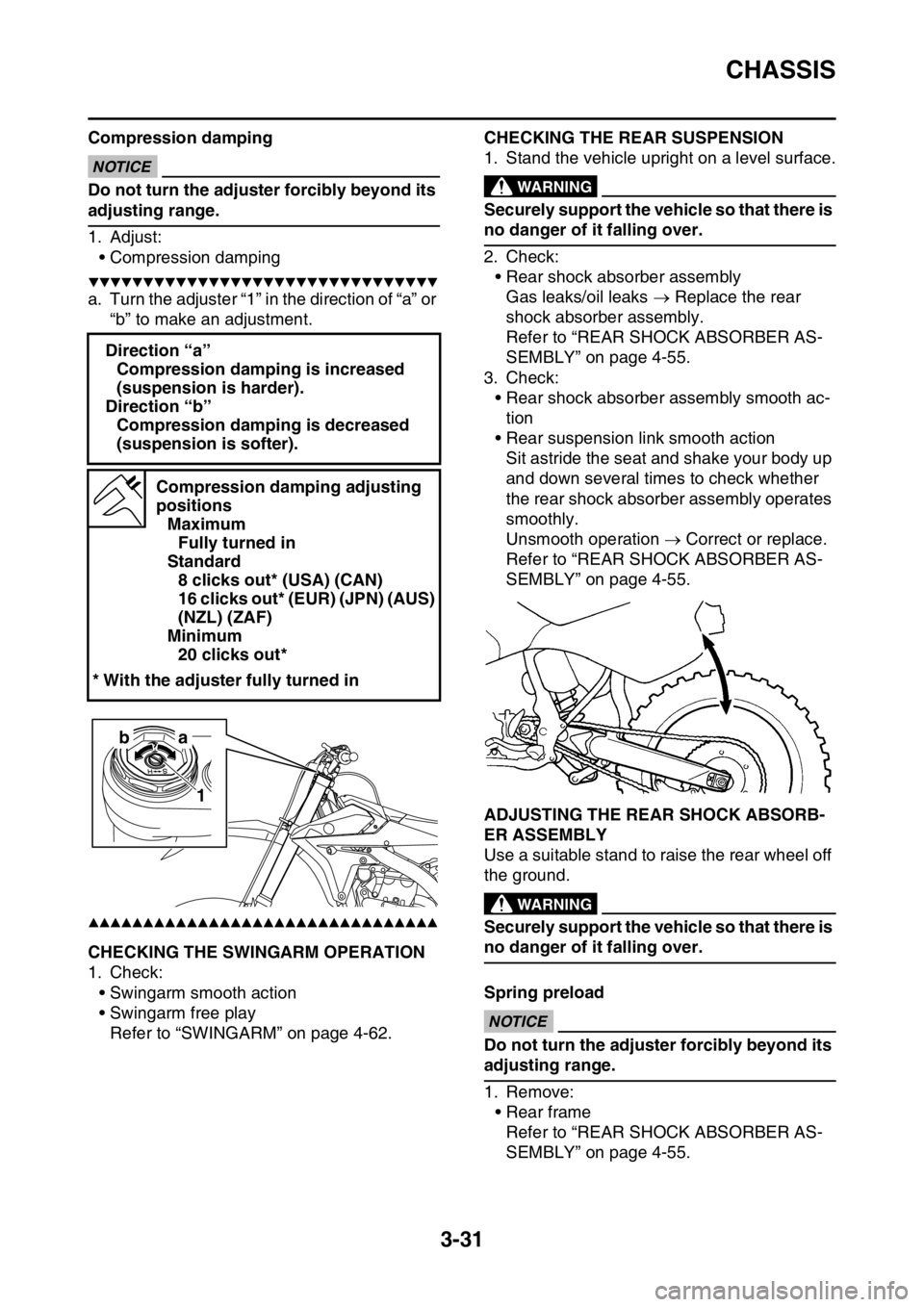
a. Turn the adjuster “1” in the direction of “a” or
“b” to make an adjustment.
▲▲▲▲▲▲▲▲▲▲▲▲▲▲▲▲▲▲▲▲▲▲▲▲▲▲▲▲▲▲▲▲
EASB111103CHECKING THE SWINGARM OPERATION
1. Check:
• Swingarm smooth action
• Swingarm free play
Refer to “SWINGARM” on page 4-62.
EASB111104
CHECKING THE REAR SUSPENSION
1. Stand the vehicle upright on a level surface.
EWA
WARNING
Securely support the vehicle so that there is
no danger of it falling over.
2. Check:
• Rear shock absorber assembly
Gas leaks/oil leaks Replace the rear
shock absorber assembly.
Refer to “REAR SHOCK ABSORBER AS-
SEMBLY” on page 4-55.
3. Check:
• Rear shock absorber assembly smooth ac-
tion
• Rear suspension link smooth action
Sit astride the seat and shake your body up
and down several times to check whether
the rear shock absorber assembly operates
smoothly.
Unsmooth operation Correct or replace.
Refer to “REAR SHOCK ABSORBER AS-
SEMBLY” on page 4-55.
EASB111105ADJUSTING THE REAR SHOCK ABSORB-
ER ASSEMBLY
Use a suitable stand to raise the rear wheel off
the ground.
EWA13120
WARNING
Securely support the vehicle so that there is
no danger of it falling over.
Spring preload
ECA@
NOTICE
Do not turn the adjuster forcibly beyond its
adjusting range.
1. Remove:
• Rear frame
Refer to “REAR SHOCK ABSORBER AS-
SEMBLY” on page 4-55. Direction “a”
Compression damping is increased
(suspension is harder).
Direction “b”
Compression damping is decreased
(suspension is softer).
Compression damping adjusting
positions
Maximum
Fully turned in
Standard
8 clicks out* (USA) (CAN)
16 clicks out* (EUR) (JPN) (AUS)
(NZL) (ZAF)
Minimum
20 clicks out*
* With the adjuster fully turned in
a b
1
Page 116 of 362
CHASSIS
3-32
2. Adjust:
• Spring preload
▼▼▼▼▼▼▼▼▼▼▼▼▼▼▼▼▼▼▼▼▼▼▼▼▼▼▼▼▼▼▼▼
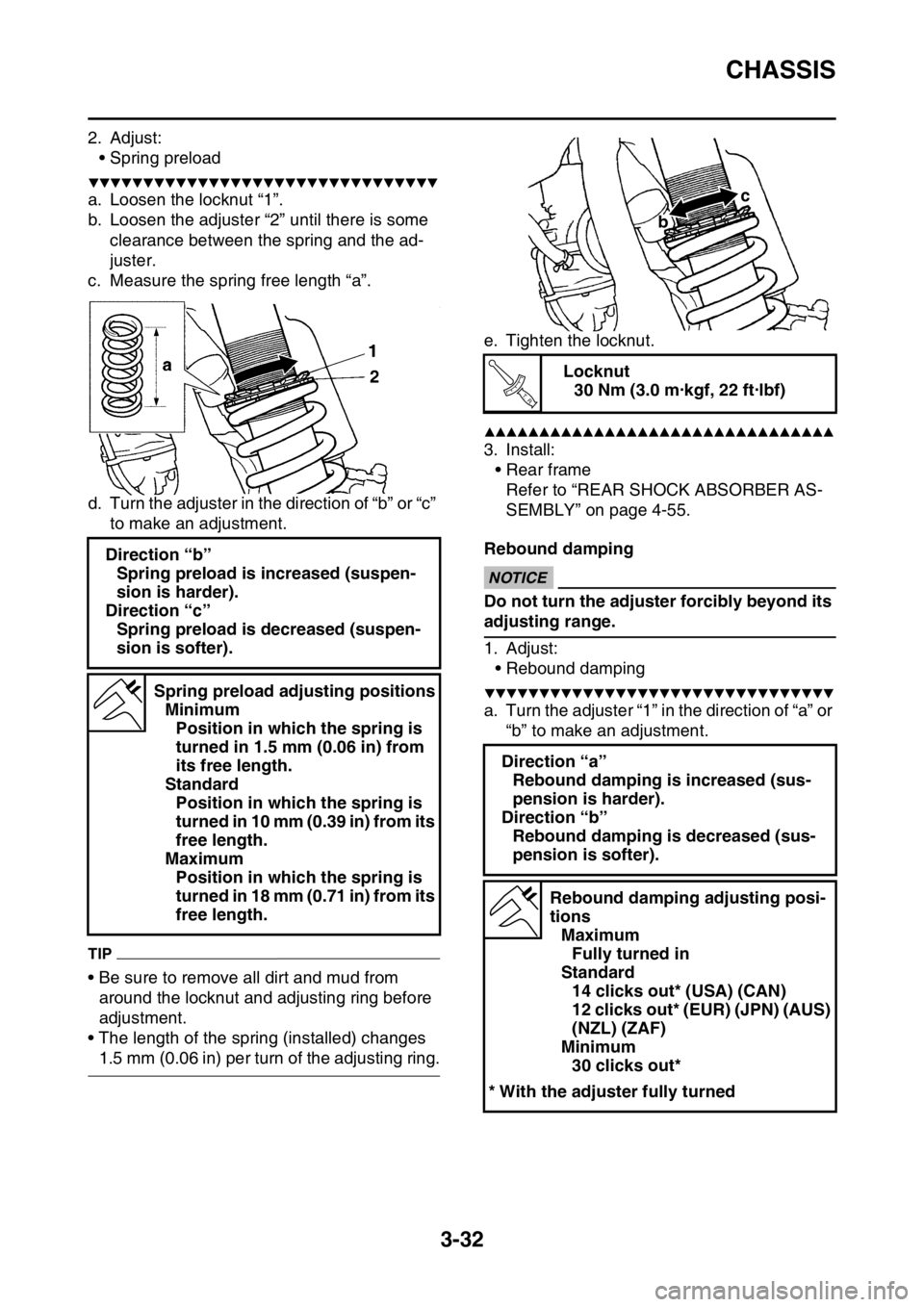
a. Loosen the locknut “1”.
b. Loosen the adjuster “2” until there is some
clearance between the spring and the ad-
juster.
c. Measure the spring free length “a”.
d. Turn the adjuster in the direction of “b” or “c”
to make an adjustment.
TIP
• Be sure to remove all dirt and mud from
around the locknut and adjusting ring before
adjustment.
• The length of the spring (installed) changes
1.5 mm (0.06 in) per turn of the adjusting ring.e. Tighten the locknut.
▲▲▲▲▲▲▲▲▲▲▲▲▲▲▲▲▲▲▲▲▲▲▲▲▲▲▲▲▲▲▲▲
3. Install:
• Rear frame
Refer to “REAR SHOCK ABSORBER AS-
SEMBLY” on page 4-55.
Rebound damping
ECA@
NOTICE
Do not turn the adjuster forcibly beyond its
adjusting range.
1. Adjust:
• Rebound damping
▼▼▼▼▼▼▼▼▼▼▼▼▼▼▼▼▼▼▼▼▼▼▼▼▼▼▼▼▼▼▼▼
a. Turn the adjuster “1” in the direction of “a” or
“b” to make an adjustment. Direction “b”
Spring preload is increased (suspen-
sion is harder).
Direction “c”
Spring preload is decreased (suspen-
sion is softer).
Spring preload adjusting positions
Minimum
Position in which the spring is
turned in 1.5 mm (0.06 in) from
its free length.
Standard
Position in which the spring is
turned in 10 mm (0.39 in) from its
free length.
Maximum
Position in which the spring is
turned in 18 mm (0.71 in) from its
free length.
Locknut
30 Nm (3.0 m·kgf, 22 ft·lbf)
Direction “a”
Rebound damping is increased (sus-
pension is harder).
Direction “b”
Rebound damping is decreased (sus-
pension is softer).
Rebound damping adjusting posi-
tions
Maximum
Fully turned in
Standard
14 clicks out* (USA) (CAN)
12 clicks out* (EUR) (JPN) (AUS)
(NZL) (ZAF)
Minimum
30 clicks out*
* With the adjuster fully turned
c
b
T R..
Page 124 of 362

HANDLEBAR................................................................................................. 4-32
REMOVING THE HANDLEBAR............................................................... 4-34
CHECKING THE HANDLEBAR ............................................................... 4-34
INSTALLING THE HANDLEBAR ............................................................. 4-34
FRONT FORK................................................................................................. 4-38
REMOVING THE FRONT FORK LEGS ................................................... 4-40
DISASSEMBLING THE FRONT FORK LEGS ......................................... 4-40
CHECKING THE FRONT FORK LEGS ................................................... 4-41
ASSEMBLING THE FRONT FORK LEGS ............................................... 4-42
INSTALLING THE FRONT FORK LEGS ................................................. 4-48
STEERING HEAD........................................................................................... 4-51
REMOVING THE LOWER BRACKET...................................................... 4-52
CHECKING THE STEERING HEAD ........................................................ 4-52
INSTALLING THE STEERING HEAD ...................................................... 4-52
REAR SHOCK ABSORBER ASSEMBLY..................................................... 4-55
HANDLING THE REAR SHOCK ABSORBER ......................................... 4-58
DISPOSING OF A REAR SHOCK ABSORBER ...................................... 4-58
REMOVING THE REAR SHOCK ABSORBER ASSEMBLY.................... 4-58
REMOVING THE BEARING..................................................................... 4-59
CHECKING THE REAR SHOCK ABSORBER ASSEMBLY .................... 4-59
CHECKING THE CONNECTING ARM AND RELAY ARM ...................... 4-59
INSTALLING THE RELAY ARM............................................................... 4-59
INSTALLING THE REAR SHOCK ABSORBER ASSEMBLY .................. 4-60
SWINGARM.................................................................................................... 4-62
REMOVING THE SWINGARM................................................................. 4-63
REMOVING THE BEARING..................................................................... 4-63
CHECKING THE SWINGARM ................................................................. 4-63
INSTALLING THE SWINGARM ............................................................... 4-64
CHAIN DRIVE................................................................................................. 4-65
REMOVING THE DRIVE CHAIN.............................................................. 4-66
CHECKING THE DRIVE CHAIN .............................................................. 4-66
CHECKING THE DRIVE SPROCKET...................................................... 4-67
CHECKING THE REAR WHEEL SPROCKET ......................................... 4-67
INSTALLING THE DRIVE CHAIN ............................................................ 4-67
Page 140 of 362
FRONT BRAKE
4-16
EASB111135INTRODUCTIONEWA
WARNING
If you need to disassemble the disc brake
components, observe the following precau-
tions.
• Never disassemble the brake components
unless absolutely necessary.
• If there is any problem with connections
on the hydraulic brake system, perform
the following jobs.
Disassemble the brake system, drain the
brake fluid, and clean it. After that, add a
suitable amount of brake fluid. Then, bleed
it after reassembly.
• Use only brake fluid for washing brake
components.
• Use new brake fluid for cleaning the brake
components.
• Immediately wipe off the spilled brake fluid
to avoid damage to painted surfaces or
plastic parts.
• Handle brake fluid with special care not to
let it enter your eyes so that you may not
lost your eyesight.
• FIRST AID FOR BRAKE FLUID ENTERING
THE EYES:
• Flush with water for 15 minutes and get
immediate medical attention.
EASB111136CHECKING THE FRONT BRAKE DISC
1. Remove:
• Front wheel
Refer to “FRONT WHEEL” on page 4-3.
2. Check:
• Front brake disc
Damage/galling Replace.
3. Measure:
• Brake disc thickness
Measure the brake disc thickness at a few
different locations.
Out of specification Replace.4. Install:
• Front wheel
Refer to “FRONT WHEEL” on page 4-3.
EASB111137REMOVING THE FRONT BRAKE CALIPER
TIP
Before disassembling the brake caliper, drain
the brake fluid from the entire brake system.
1. Remove:
• Union bolt
• Copper washers
• Brake hose
TIP
Put the end of the brake hose into a container
and pump out the brake fluid.
EASB111138DISASSEMBLING THE FRONT BRAKE CAL-
IPER
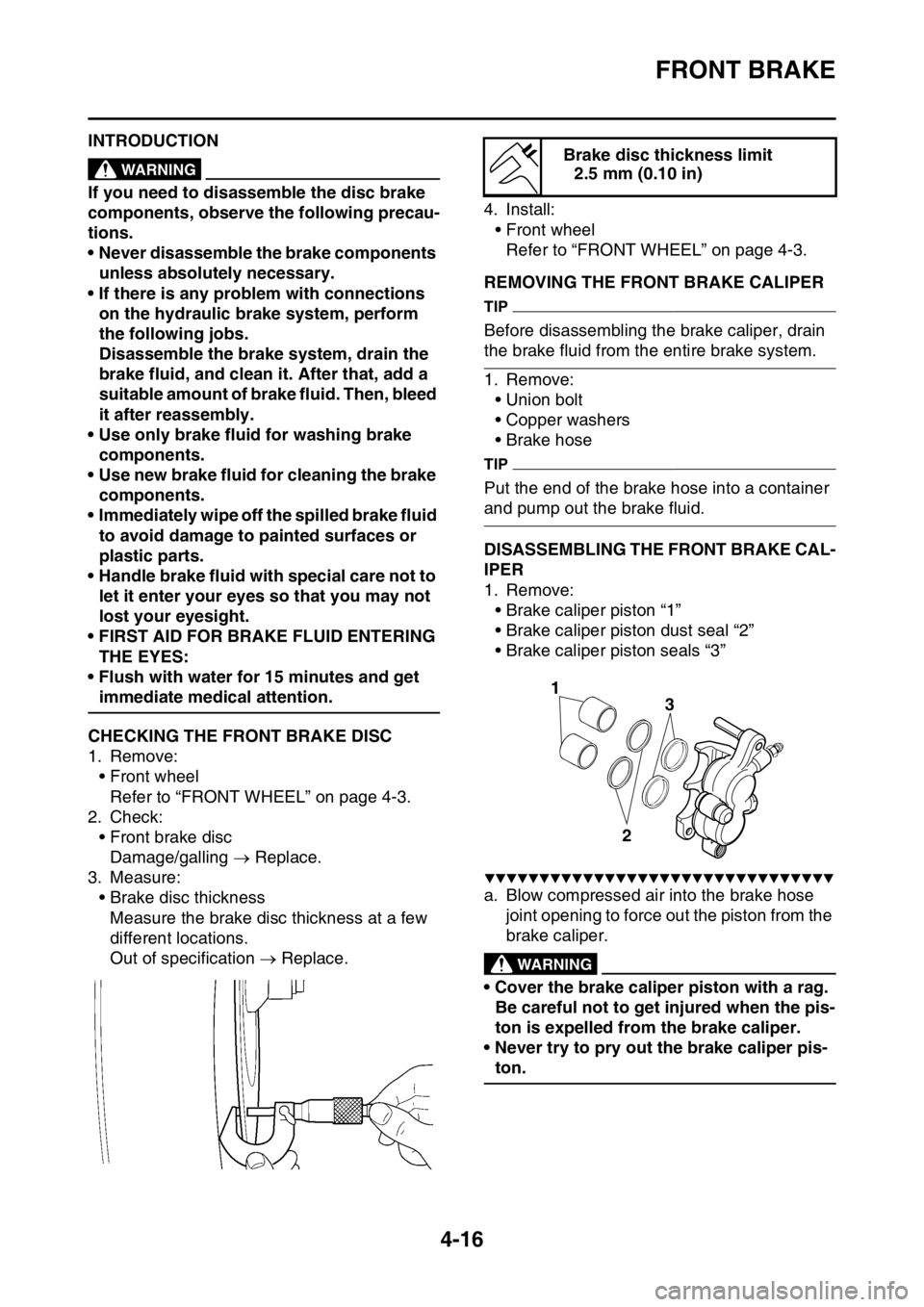
1. Remove:
• Brake caliper piston “1”
• Brake caliper piston dust seal “2”
• Brake caliper piston seals “3”
▼▼▼▼▼▼▼▼▼▼▼▼▼▼▼▼▼▼▼▼▼▼▼▼▼▼▼▼▼▼▼▼
a. Blow compressed air into the brake hose
joint opening to force out the piston from the
brake caliper.
EWA
WARNING
• Cover the brake caliper piston with a rag.
Be careful not to get injured when the pis-
ton is expelled from the brake caliper.
• Never try to pry out the brake caliper pis-
ton.
Brake disc thickness limit
2.5 mm (0.10 in)
3
2
1
Page 150 of 362
REAR BRAKE
4-26
EASB111148INTRODUCTIONEWA
WARNING
If you need to disassemble the disc brake
components, observe the following precau-
tions.
• Never disassemble the brake components
unless absolutely necessary.
• If there is any problem with connections
on the hydraulic brake system, perform
the following jobs.
Disassemble the brake system, drain the
brake fluid, and clean it. After that, add a
suitable amount of brake fluid. Then, bleed
it after reassembly.
• Use only brake fluid for washing internal
brake components.
• Use new brake fluid for cleaning the brake
components.
• Immediately wipe off the spilled brake fluid
to avoid damage to painted surfaces or
plastic parts.
• Handle brake fluid with special care not to
let it enter your eyes so that you may not
lost your eyesight.
• FIRST AID FOR BRAKE FLUID ENTERING
THE EYES:
• Flush with water for 15 minutes and get
immediate medical attention.
EASB111149CHECKING THE REAR BRAKE DISC
1. Remove:
• Rear wheel
Refer to “REAR WHEEL” on page 4-7.
2. Check:
• Brake disc
Damage/galling Replace.
3. Measure:
• Brake disc thickness
Measure the brake disc thickness at a few
different locations.
Out of specification Replace.
Refer to “CHECKING THE FRONT BRAKE
DISC” on page 4-16.
4. Measure:
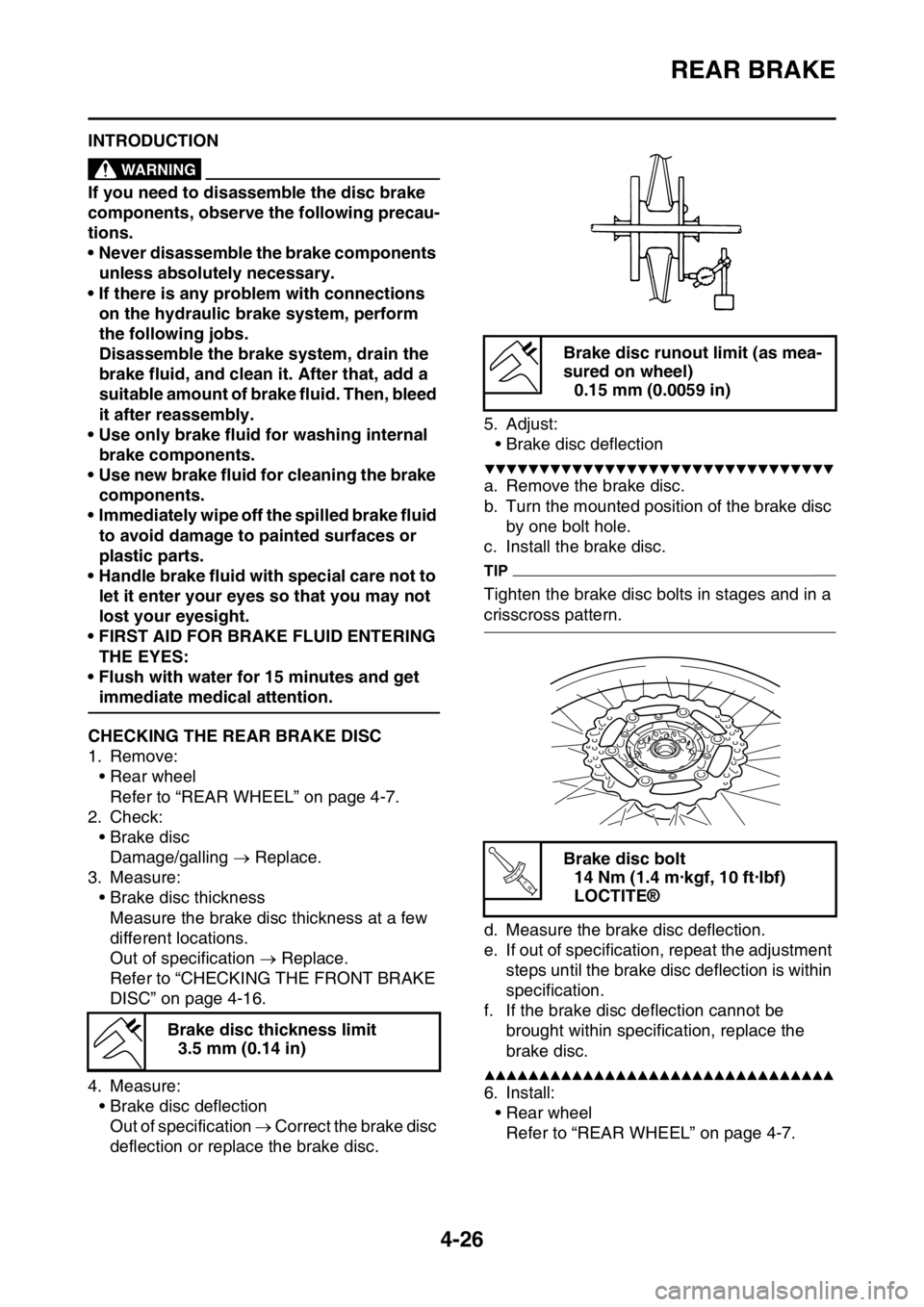
• Brake disc deflection
Out of specification Correct the brake disc
deflection or replace the brake disc.5. Adjust:
• Brake disc deflection
▼▼▼▼▼▼▼▼▼▼▼▼▼▼▼▼▼▼▼▼▼▼▼▼▼▼▼▼▼▼▼▼
a. Remove the brake disc.
b. Turn the mounted position of the brake disc
by one bolt hole.
c. Install the brake disc.
TIP
Tighten the brake disc bolts in stages and in a
crisscross pattern.
d. Measure the brake disc deflection.
e. If out of specification, repeat the adjustment
steps until the brake disc deflection is within
specification.
f. If the brake disc deflection cannot be
brought within specification, replace the
brake disc.
▲▲▲▲▲▲▲▲▲▲▲▲▲▲▲▲▲▲▲▲▲▲▲▲▲▲▲▲▲▲▲▲
6. Install:
• Rear wheel
Refer to “REAR WHEEL” on page 4-7. Brake disc thickness limit
3.5 mm (0.14 in)
Brake disc runout limit (as mea-
sured on wheel)
0.15 mm (0.0059 in)
Brake disc bolt
14 Nm (1.4 m·kgf, 10 ft·lbf)
LOCTITE®
T R..
Page 179 of 362
REAR SHOCK ABSORBER ASSEMBLY
4-55
EASB111174
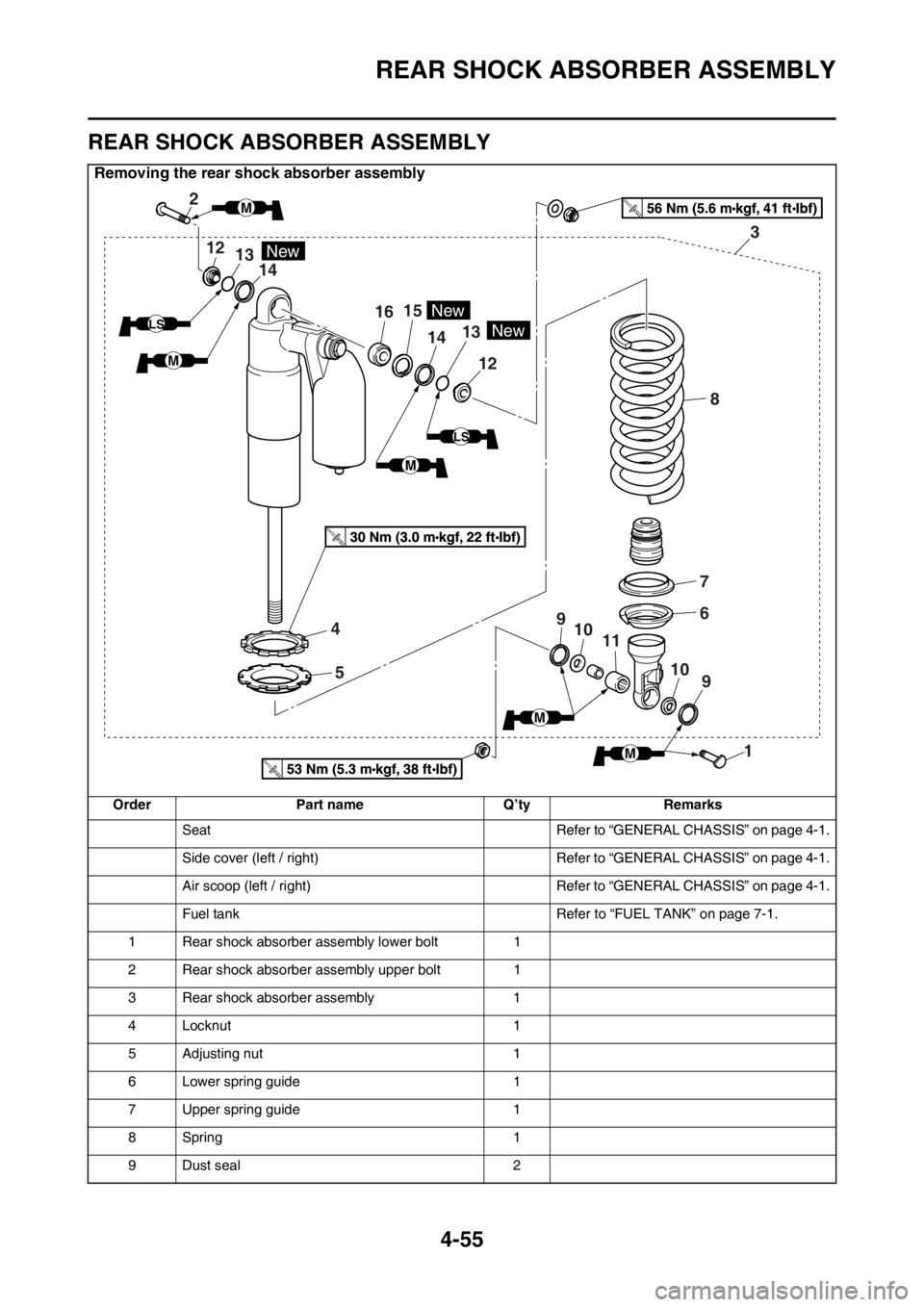
REAR SHOCK ABSORBER ASSEMBLY
Removing the rear shock absorber assembly
Order Part name Q’ty Remarks
Seat Refer to “GENERAL CHASSIS” on page 4-1.
Side cover (left / right) Refer to “GENERAL CHASSIS” on page 4-1.
Air scoop (left / right) Refer to “GENERAL CHASSIS” on page 4-1.
Fuel tank Refer to “FUEL TANK” on page 7-1.
1 Rear shock absorber assembly lower bolt 1
2 Rear shock absorber assembly upper bolt 1
3 Rear shock absorber assembly 1
4 Locknut 1
5 Adjusting nut 1
6 Lower spring guide 1
7 Upper spring guide 1
8Spring 1
9 Dust seal 2
2
12
1615
1413
12
14
4
5
7
6
83
9
9 10
10 11
1
New
New
13New
LS
LS
M
M
M
M
M
Page 180 of 362
REAR SHOCK ABSORBER ASSEMBLY
4-56
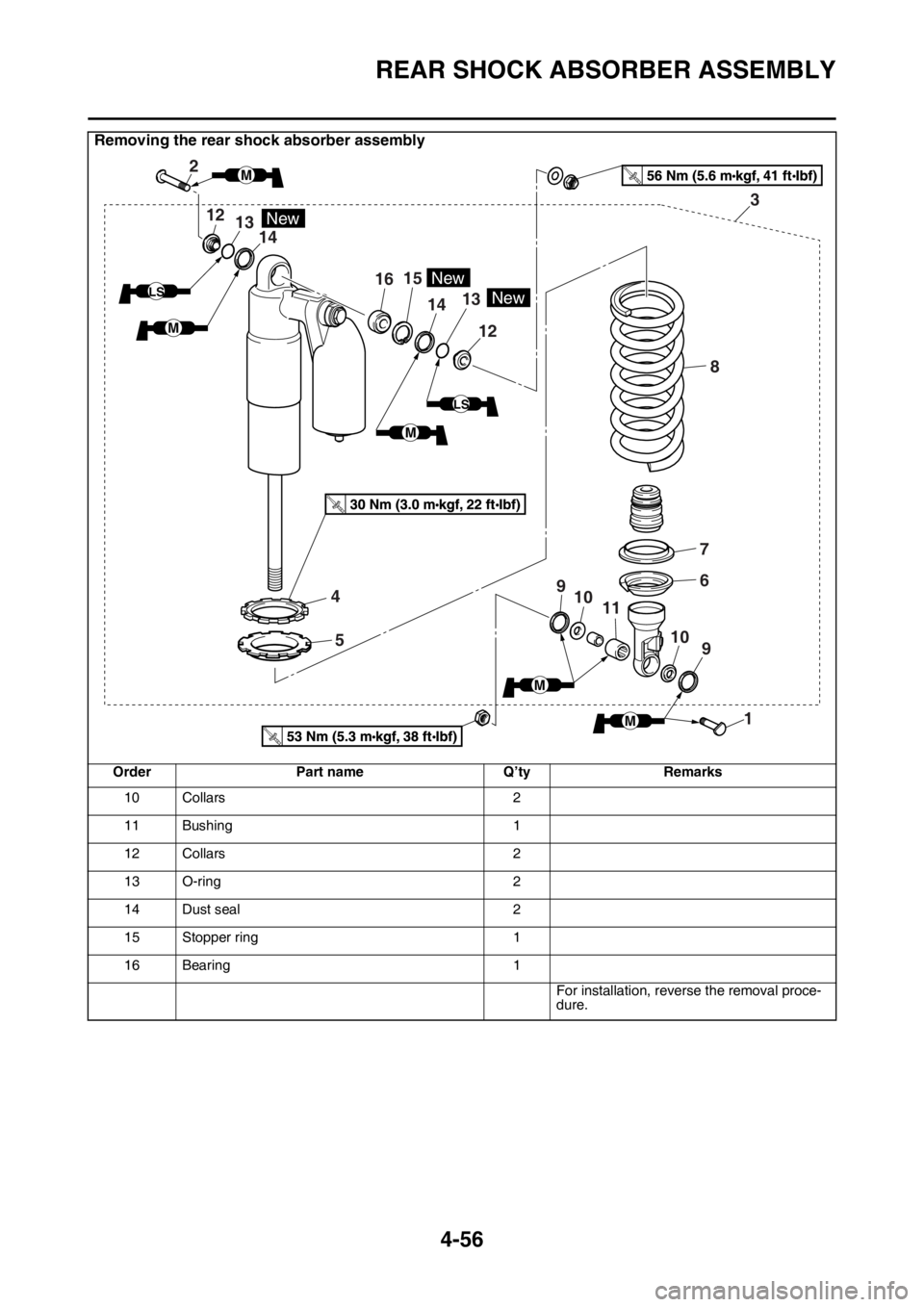
10 Collars 2
11 Bushing 1
12 Collars 2
13 O-ring 2
14 Dust seal 2
15 Stopper ring 1
16 Bearing 1
For installation, reverse the removal proce-
dure.
Removing the rear shock absorber assembly
Order Part name Q’ty Remarks
2
12
1615
1413
12
14
4
5
7
6
83
9
9 10
10 11
1
New
New
13New
LS
LS
M
M
M
M
M
Page 181 of 362
REAR SHOCK ABSORBER ASSEMBLY
4-57
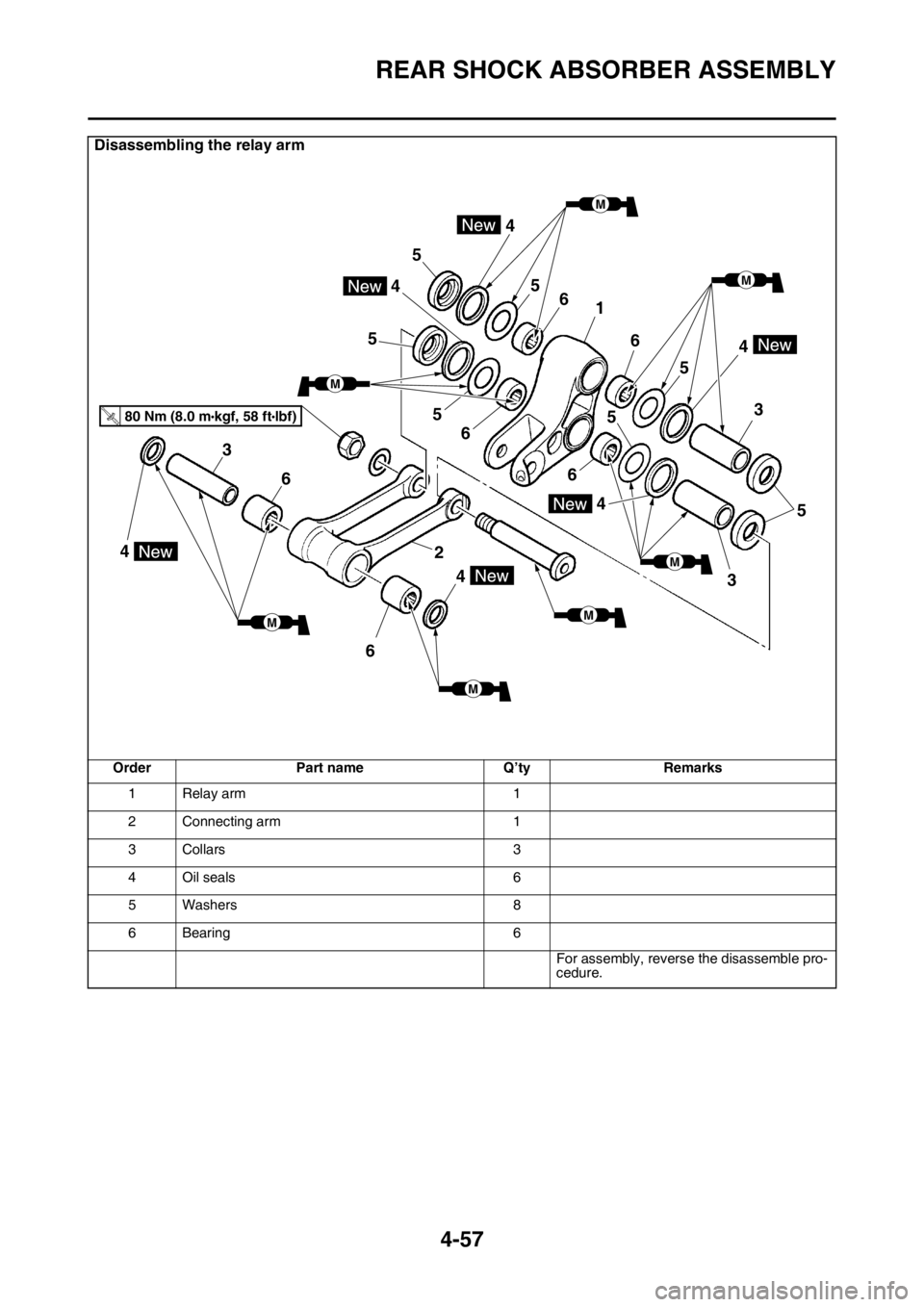
Disassembling the relay arm
Order Part name Q’ty Remarks
1 Relay arm 1
2 Connecting arm 1
3Collars 3
4Oil seals 6
5Washers 8
6 Bearing 6
For assembly, reverse the disassemble pro-
cedure.
5
3
5
6
165
4
5
5
4
5
6
6
5
4
3
2
4
6
6
3
4
4
T.R.80 Nm (8.0 mlbf) kgf, 58 ft
M
M
M
M
M MM
Page 182 of 362
REAR SHOCK ABSORBER ASSEMBLY
4-58
EASB111175HANDLING THE REAR SHOCK ABSORBEREWA
WARNING
This rear shock absorber contains highly
compressed nitrogen gas. Before handling
the rear shock absorber, read and make
sure that you understand the following in-
formation. The manufacturer cannot be held
responsible for property damage or person-
al injury that may result from improper han-
dling of the rear shock absorber.
• Do not tamper or attempt to open the rear
shock absorber.
• Do not subject the rear shock absorber to
an open flame or any other source of high
heat. High heat can cause an explosion
due to excessive gas pressure.
• Do not deform or damage the rear shock
absorber in any way. Rear shock absorber
damage will result in poor damping perfor-
mance.
TIP
A break-in is required up to about 50 km of run-
ning.
EASB111176DISPOSING OF A REAR SHOCK ABSORB-
ER
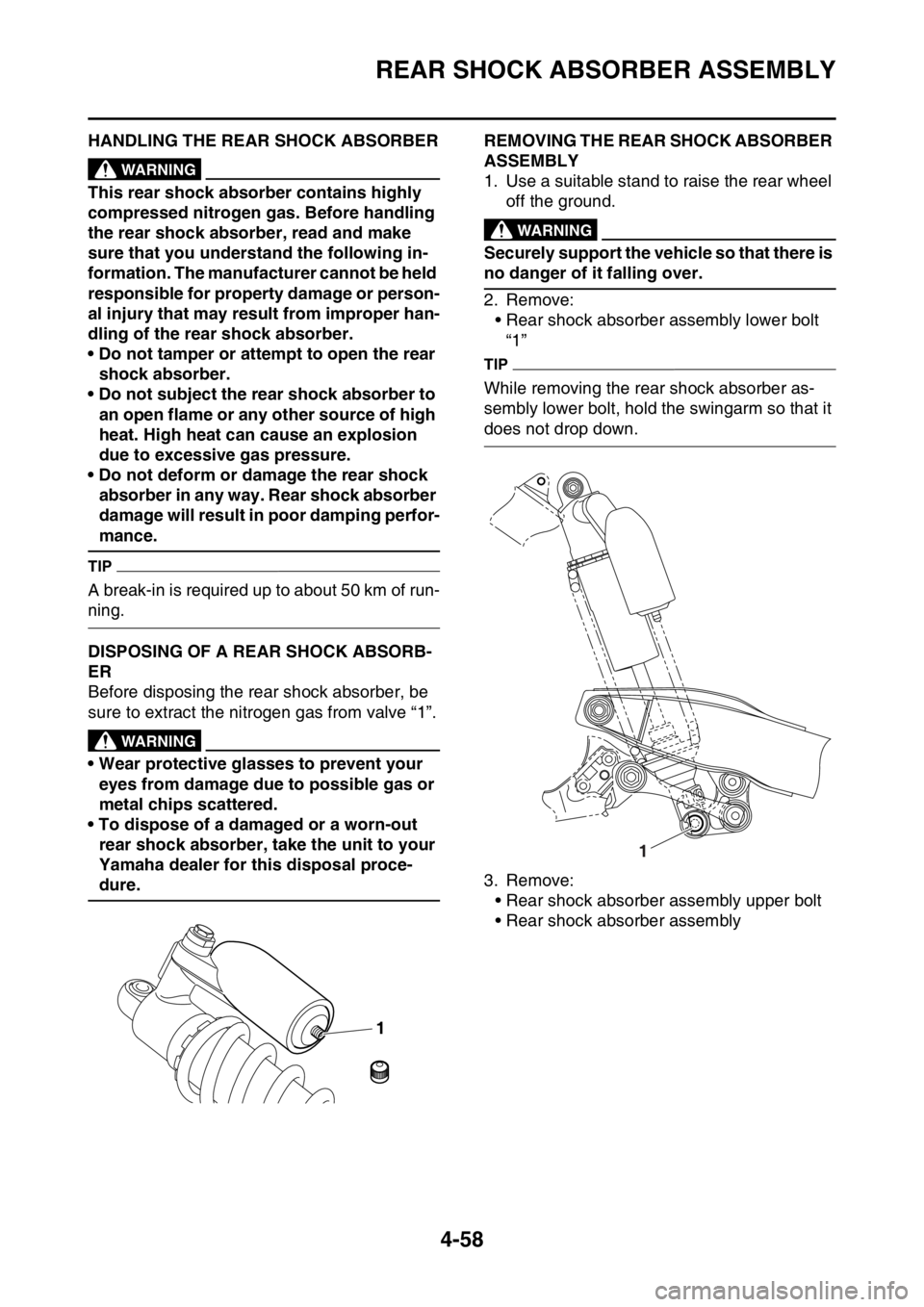
Before disposing the rear shock absorber, be
sure to extract the nitrogen gas from valve “1”.
EWA
WARNING
• Wear protective glasses to prevent your
eyes from damage due to possible gas or
metal chips scattered.
• To dispose of a damaged or a worn-out
rear shock absorber, take the unit to your
Yamaha dealer for this disposal proce-
dure.
EASB111177REMOVING THE REAR SHOCK ABSORBER
ASSEMBLY
1. Use a suitable stand to raise the rear wheel
off the ground.
EWA
WARNING
Securely support the vehicle so that there is
no danger of it falling over.
2. Remove:
• Rear shock absorber assembly lower bolt
“1”
TIP
While removing the rear shock absorber as-
sembly lower bolt, hold the swingarm so that it
does not drop down.
3. Remove:
• Rear shock absorber assembly upper bolt
• Rear shock absorber assembly
1
1
Page 183 of 362
REAR SHOCK ABSORBER ASSEMBLY
4-59
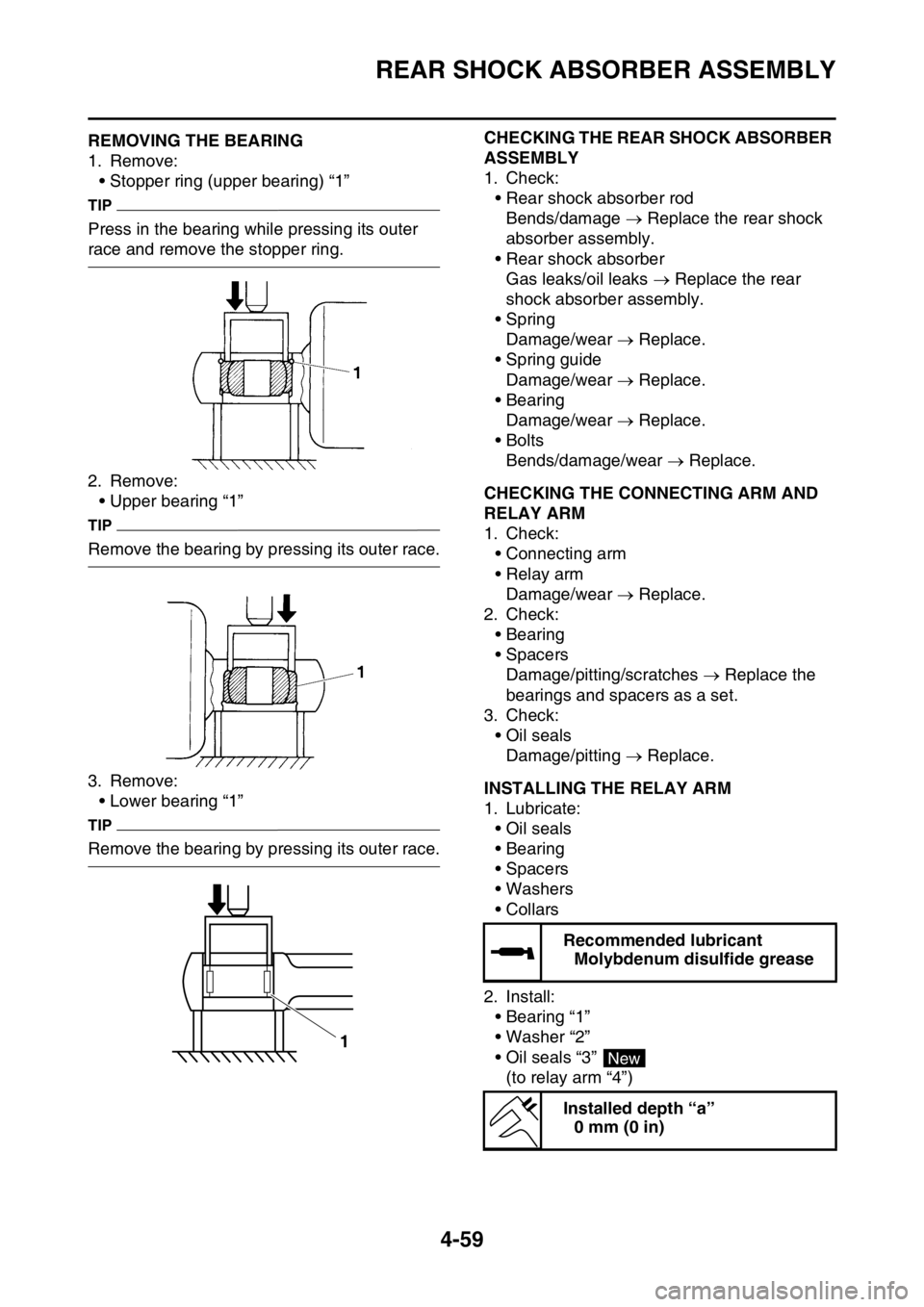
EASB111178REMOVING THE BEARING
1. Remove:
• Stopper ring (upper bearing) “1”
TIP
Press in the bearing while pressing its outer
race and remove the stopper ring.
2. Remove:
• Upper bearing “1”
TIP
Remove the bearing by pressing its outer race.
3. Remove:
• Lower bearing “1”
TIP
Remove the bearing by pressing its outer race.
EASB111179
CHECKING THE REAR SHOCK ABSORBER
ASSEMBLY
1. Check:
• Rear shock absorber rod
Bends/damage Replace the rear shock
absorber assembly.
• Rear shock absorber
Gas leaks/oil leaks Replace the rear
shock absorber assembly.
•Spring
Damage/wear Replace.
• Spring guide
Damage/wear Replace.
• Bearing
Damage/wear Replace.
•Bolts
Bends/damage/wear Replace.
EASB111180CHECKING THE CONNECTING ARM AND
RELAY ARM
1. Check:
• Connecting arm
• Relay arm
Damage/wear Replace.
2. Check:
• Bearing
• Spacers
Damage/pitting/scratches Replace the
bearings and spacers as a set.
3. Check:
• Oil seals
Damage/pitting Replace.
EASB111181INSTALLING THE RELAY ARM
1. Lubricate:
• Oil seals
• Bearing
• Spacers
• Washers
•Collars
2. Install:
• Bearing “1”
• Washer “2”
• Oil seals “3”
(to relay arm “4”)
1
Recommended lubricant
Molybdenum disulfide grease
Installed depth “a”
0 mm (0 in)
New