ECU YAMAHA YZ450F 2016 Owners Manual
[x] Cancel search | Manufacturer: YAMAHA, Model Year: 2016, Model line: YZ450F, Model: YAMAHA YZ450F 2016Pages: 362, PDF Size: 10.49 MB
Page 7 of 362

EASB111005
SAFETY INFORMATION
THIS MACHINE IS DESIGNED STRICTLY FOR COMPETITION USE, ONLY ON A CLOSED
COURSE. It is illegal for this machine to be operated on any public street, road, or highway. Off-road
use on public lands may also be illegal. Please check local regulations before riding.
• THIS MACHINE IS TO BE OPERATED BY AN EXPERIENCED RIDER ONLY.
Do not attempt to operate this machine at maximum power until you are totally familiar with its char-
acteristics.
• THIS MACHINE IS DESIGNED TO BE RIDDEN BY THE OPERATOR ONLY.
Do not carry passengers on this machine.
• ALWAYS WEAR PROTECTIVE APPAREL.
When operating this machine, always wear an approved helmet with goggles or a face shield. Also
wear heavy boots, gloves, and protective clothing. Always wear proper fitting clothing that will not
be caught in any of the moving parts or controls of the machine.
• ALWAYS MAINTAIN YOUR MACHINE IN PROPER WORKING ORDER.
For safety and reliability, the machine must be properly maintained. Always perform the pre-oper-
ation checks indicated in this manual.
Correcting a mechanical problem before you ride may prevent an accident.
• GASOLINE IS HIGHLY FLAMMABLE.
Always turn off the engine while refueling. Take care to not spill any gasoline on the engine or ex-
haust system. Never refuel in the vicinity of an open flame, or while smoking.
• GASOLINE CAN CAUSE INJURY.
If you should swallow some gasoline, inhale excess gasoline vapors, or allow any gasoline to get
into your eyes, contact a doctor immediately. If any gasoline spills onto your skin or clothing, imme-
diately wash skin areas with soap and water, and change your clothes.
• ONLY OPERATE THE MACHINE IN AN AREA WITH ADEQUATE VENTILATION.
Never start the engine or let it run for any length of time in an enclosed area. Exhaust fumes are
poisonous. These fumes contain carbon monoxide, which by itself is odorless and colorless. Car-
bon monoxide is a dangerous gas which can cause unconsciousness or can be lethal.
• PARK THE MACHINE CAREFULLY; TURN OFF THE ENGINE.
Always turn off the engine if you are going to leave the machine. Do not park the machine on a slope
or soft ground as it may fall over.
• THE ENGINE, EXHAUST PIPE AND MUFFLER WILL BE VERY HOT AFTER THE ENGINE HAS
BEEN RUN.
Be careful not to touch them or to allow any clothing item to contact them during inspection or repair.
• PROPERLY SECURE THE MACHINE BEFORE TRANSPORTING IT.
For safety, drain the gasoline from the fuel tank before transporting the vehicle.
Page 25 of 362
BASIC SERVICE INFORMATION
1-11
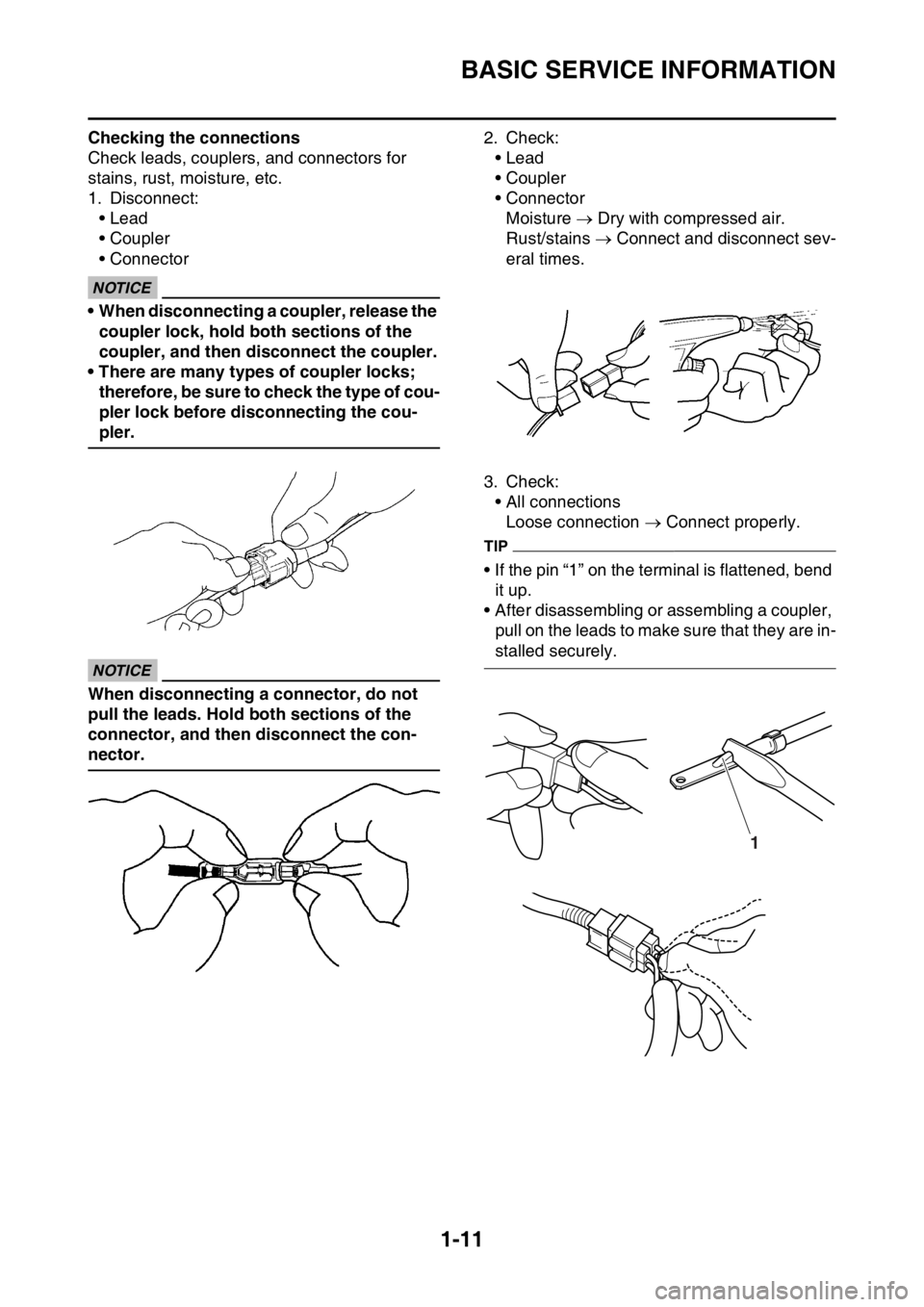
Checking the connections
Check leads, couplers, and connectors for
stains, rust, moisture, etc.
1. Disconnect:
• Lead
• Coupler
• Connector
ECA16780
NOTICE
• When disconnecting a coupler, release the
coupler lock, hold both sections of the
coupler, and then disconnect the coupler.
• There are many types of coupler locks;
therefore, be sure to check the type of cou-
pler lock before disconnecting the cou-
pler.
ECA16790
NOTICE
When disconnecting a connector, do not
pull the leads. Hold both sections of the
connector, and then disconnect the con-
nector.2. Check:
• Lead
• Coupler
• Connector
Moisture Dry with compressed air.
Rust/stains Connect and disconnect sev-
eral times.
3. Check:
• All connections
Loose connection Connect properly.
TIP
• If the pin “1” on the terminal is flattened, bend
it up.
• After disassembling or assembling a coupler,
pull on the leads to make sure that they are in-
stalled securely.
1
Page 26 of 362
BASIC SERVICE INFORMATION
1-12
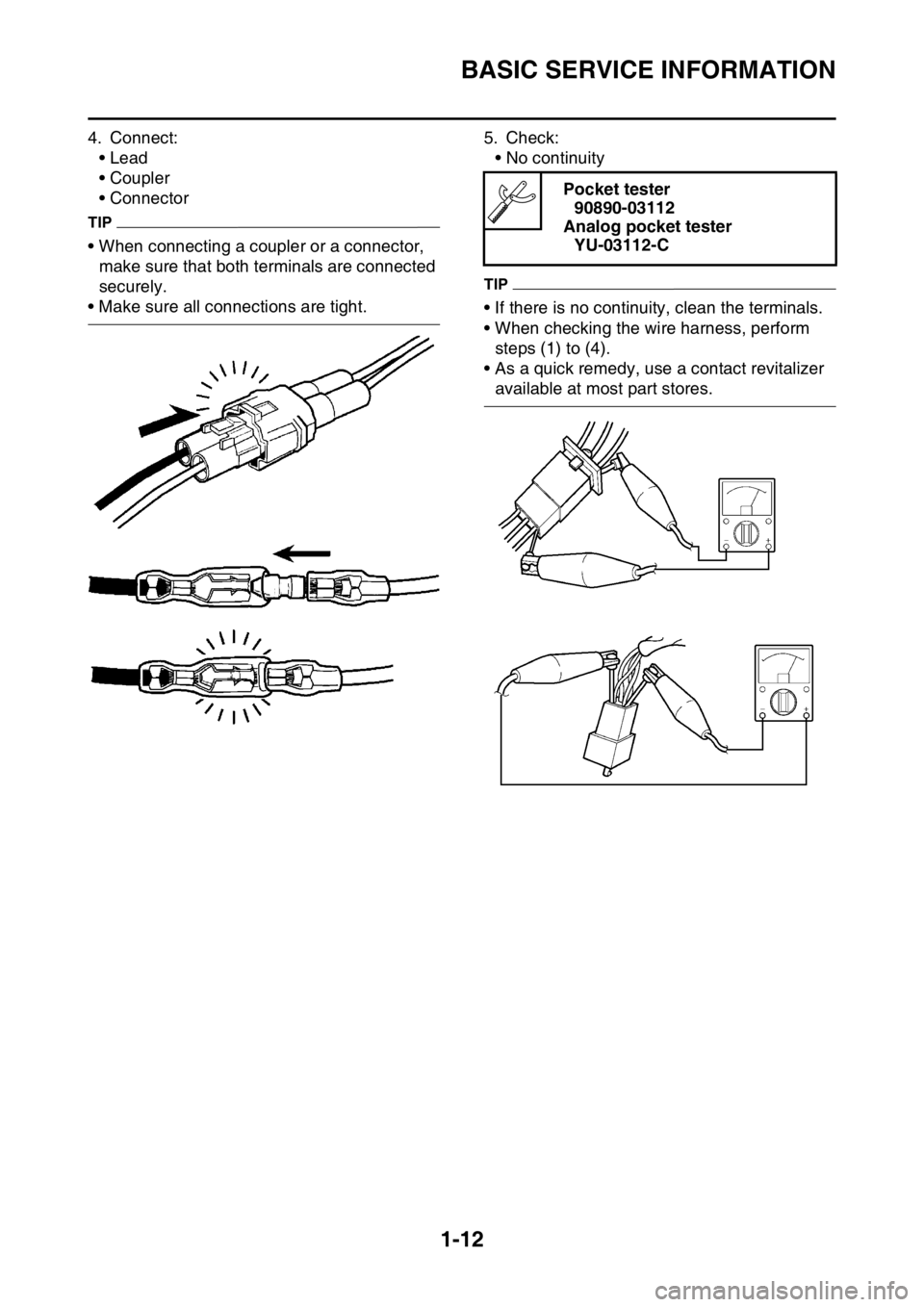
4. Connect:
• Lead
• Coupler
• Connector
TIP
• When connecting a coupler or a connector,
make sure that both terminals are connected
securely.
• Make sure all connections are tight.5. Check:
• No continuity
TIP
• If there is no continuity, clean the terminals.
• When checking the wire harness, perform
steps (1) to (4).
• As a quick remedy, use a contact revitalizer
available at most part stores.
Pocket tester
90890-03112
Analog pocket tester
YU-03112-C
Page 30 of 362
SPECIAL TOOLS
1-16
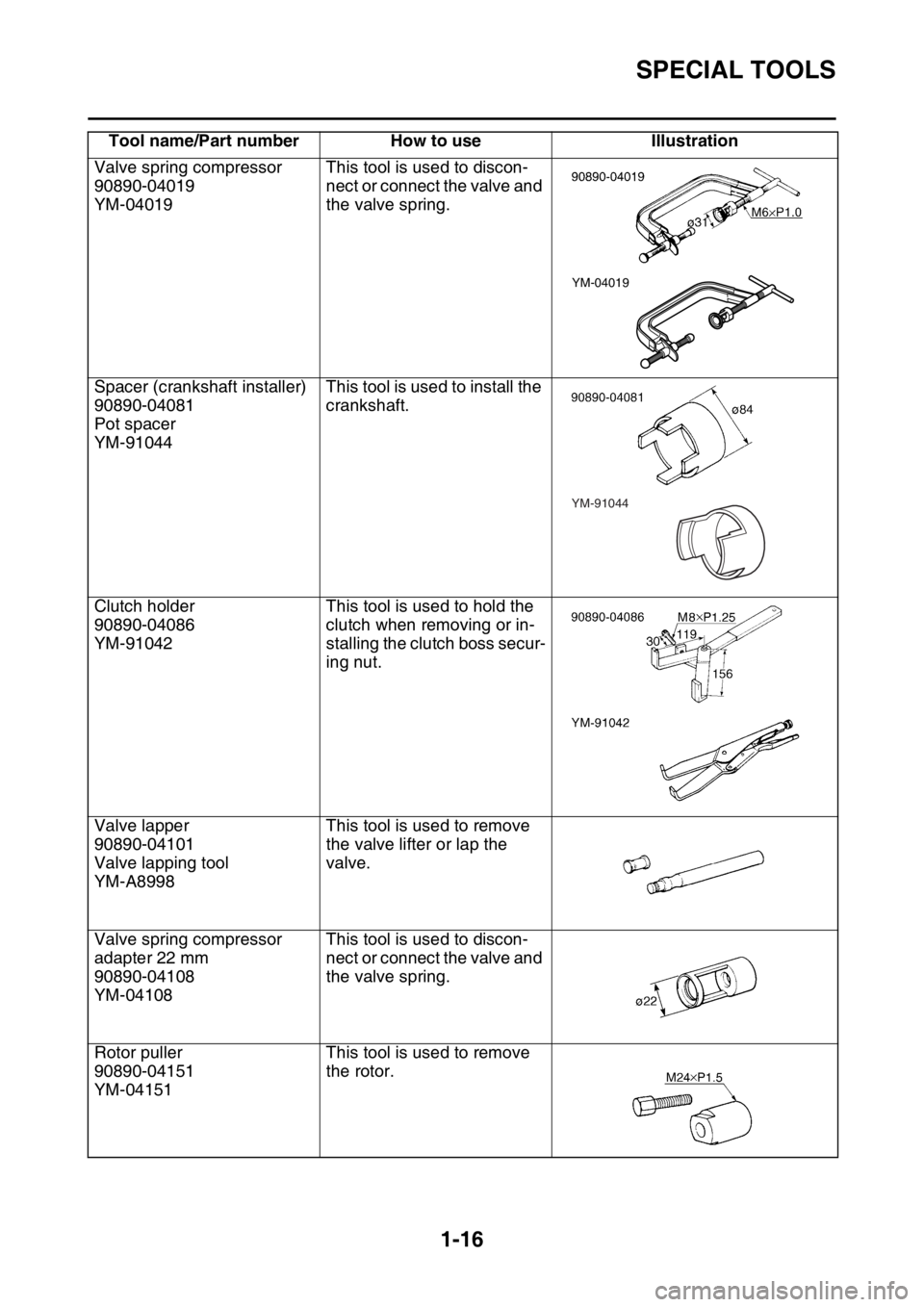
Valve spring compressor
90890-04019
YM-04019This tool is used to discon-
nect or connect the valve and
the valve spring.
Spacer (crankshaft installer)
90890-04081
Pot spacer
YM-91044This tool is used to install the
crankshaft.
Clutch holder
90890-04086
YM-91042This tool is used to hold the
clutch when removing or in-
stalling the clutch boss secur-
ing nut.
Valve lapper
90890-04101
Valve lapping tool
YM-A8998This tool is used to remove
the valve lifter or lap the
valve.
Valve spring compressor
adapter 22 mm
90890-04108
YM-04108This tool is used to discon-
nect or connect the valve and
the valve spring.
Rotor puller
90890-04151
YM-04151This tool is used to remove
the rotor. Tool name/Part number How to use Illustration
YM-04019
YM-91044
Page 40 of 362
CLEANING AND STORAGE
1-26
EASB111048
CLEANING AND STORAGE
EASB111049CLEANING
Frequent cleaning of your vehicle will enhance
its appearance, maintain performance, and ex-
tend the life of parts.
1. Before cleaning, block the silencer outlet to
prevent water from entering. A plastic bag
secured with a rubber band may be used for
this purpose.
2. If the engine is contaminated with oil, apply
some degreaser to it with a brush. Do not
apply degreaser to the drive chain, the
sprockets, or the wheel axles.
3. Hose off dirt. Use only enough water pres-
sure to do the job.
ECA
NOTICE
Do not use high-pressure washers or steam
cleaners. Otherwise, these may cause a fail-
ure because of the entry of water.
4. After hosing off the dirt, wash all surfaces
with a mild detergent and warm water. Use
a toothbrush to clean hard-to-reach places.
5. Rinse the detergent with clean water, and
dry the surfaces with a soft towel or a cloth.
6. Immediately after cleaning, remove any wa-
ter from the drive chain with a paper towel,
and lubricate it to prevent rust.
7. Clean the seat with a vinyl upholstery clean-
er to keep the cover pliable and glossy.
8. Automotive wax may be applied to all paint-
ed or chromed surfaces. Avoid using such
wax as contains abrasives, because it may
scratch surfaces.
9. After completing the above, start the engine
and allow it to warm up for several minutes.
EASB111050STORAGE
If your vehicle is to be stored for 60 days or
more, some preventive measures must be tak-
en to avoid deterioration. After cleaning the ve-
hicle thoroughly, prepare it for storage as
follows:
1. Fill the fuel tank with gasoline.
2. Remove the spark plug, pour a spoonful of
engine oil (SAE 10W-40) into the spark plug
hole, and reinstall the plug. With the engine
stop switch pushed in, by pushing down the
kickstarter lever, crank the engine to coat
the cylinder walls with oil.3. Remove the drive chain, clean it thoroughly
with solvent, and lubricate it Reinstall the
drive chain or store it in a plastic bag tied to
the frame.
4. Lubricate all cables.
5. Lift up the frame of the vehicle to keep the
wheels off the ground.
6. Tie a plastic bag over the muffler outlet to
prevent moisture from entering.
7. If the vehicle is to be stored in a place that is
humid or exposed to the sea breeze, apply a
light coat of oil to metal surfaces. Do not ap-
ply oil to the seat or rubber parts.
TIP
Make any necessary repairs before the vehicle
is stored.
Page 56 of 362

TIGHTENING TORQUES
2-15
Primary drive gear nut
M20 1 100 Nm (10 m·kgf, 72 ft·lbf)
Clutch spring bolt
M6 6 10 Nm (1.0 m·kgf, 7.2 ft·lbf)
Clutch boss nut
M20 1 75 Nm (7.5 m·kgf, 54 ft·lbf)
Drive sprocket nut M20 1 75 Nm (7.5 m·kgf, 54 ft·lbf)Use a
lock
washer.
Drive axle oil seal stopper bolt
M6 2 10 Nm (1.0 m·kgf, 7.2 ft·lbf)
Segment
M8 1 30 Nm (3.0 m·kgf, 22 ft·lbf)
Shift guide bolt
M6 2 10 Nm (1.0 m·kgf, 7.2 ft·lbf)
Stopper lever bolt
M6 1 10 Nm (1.0 m·kgf, 7.2 ft·lbf)
Shift pedal bolt M6 1 12 Nm (1.2 m·kgf, 8.7 ft·lbf)
Rotor nut
M12 1 65 Nm (6.5 m·kgf, 47 ft·lbf)
Stator screw
M5 3 8 Nm (0.8 m·kgf, 5.8 ft·lbf)
Crankshaft position sensor bolt
M6 2 10 Nm (1.0 m·kgf, 7.2 ft·lbf)
AC magneto lead holder bolt
M5 1 8 Nm (0.8 m·kgf, 5.8 ft·lbf)
Coolant temperature sensor
M10 1 16 Nm (1.6 m·kgf, 12 ft·lbf)
Neutral switch bolt
M5 2 3.5 Nm (0.35 m·kgf, 2.5 ft·lbf)
Intake air temperature sensor screw
M5 1 1.5 Nm (0.15 m·kgf, 1.1 ft·lbf)
Rectifier/regulator bolt
M6 2 7 Nm (0.7 m·kgf, 5.1 ft·lbf)
ECU bolt
M5 2 3.8 Nm (0.38 m·kgf, 2.8 ft·lbf)
Ignition coil bolt
M6 2 7 Nm (0.7 m·kgf, 5.1 ft·lbf)
Throttle position sensor screw
M5 2 3.4 Nm (0.34 m·kgf, 2.5 ft·lbf)
Intake air pressure sensor screw
M6 1 5 Nm (0.5 m·kgf, 3.6 ft·lbf) ITEMThread
sizeQ’ty TIGHTENING TORQUES RemarksE
LT
LT
LT
LT
LT
LT
LT
Page 79 of 362

CABLE ROUTING DIAGRAM
2-38
1. Main harness
2. Radiator
3. Throttle position sensor lead
4. Joint coupler
5. Intake air temperature sensor lead
6. Intake air pressure sensor lead
7. Frame
8. Fuel hose
9. High tension cord
10. Spark plug cap
11. Cylinder head cover
12. Sub-wire harness
13. Sub-wire harness coupler
14. Injector coupler
15. Injector lead
16. Launch control switch coupler
17. Launch control switch lead
18. Launch control switch lead (main harness side)
19. Rectifier/regulator lead (main harness side)
20. Grommet (high tension cord)
21. Air filter case
22. ECU
A. Fix the main harness by the plastic clamp, and in-
sert the projection of the plastic clamp into the
hole in the sheet metal of the radiator.
B. Insert the projection of the main harness into the
hole in the frame.
C. To the sub-wire harness
D. Pass the high tension cord above the fuel hose.
E. ±10°
F. Install the spark plug cap with this facing the right
of the vehicle.
G. Push the spark plug cap home, where there shall
be no gap between it and the cylinder head cover.
H. Pass the injector lead to the top of the vehicle be-
yond the fuel hose.
I. Apply adhesive to the slit and inside of the grom-
met, and then fix the grommet according to the
specified dimensions.
J. 50±3 mm (2.0±0.12 in)
K. Insert the coupler of the sub-wire harness into the
rib of the air filter case.
L. Pass the sub-wire harness between the ECU and
the air filter case.
Page 91 of 362

PRE-OPERATION INSPECTION AND MAINTENANCE
3-7
EASB111066
PRE-OPERATION INSPECTION AND MAINTENANCE
Before riding for break-in operation, practice or a race, make sure the machine is in good operating
condition.
Before using this machine, check the following points.
EASB111067GENERAL INSPECTION AND MAINTENANCE
TIP
Perform usual maintenance enough so that, in the race course, a confirmation of that and simple set-
ting adjustments may only be left, in order to get enough time to use effectively.ITEM inspect Page
CoolantCheck that coolant is filled up to the radiator cap.
Check the cooling system for leakage.3-8 – 10
FuelCheck that a fresh gasoline is filled in the fuel tank.
Check the fuel line for leakage.1-21
Engine oilCheck that the oil level is correct. Check the crank-
case and oil line for leakage.3-14 – 16
Gear shifter and clutchCheck that gears can be shifted correctly in order and
that the clutch operates smoothly.3-10 – 11
Throttle grip/HousingCheck that the throttle grip operation and free play
are correctly adjusted. Lubricate the throttle grip and
housing, if necessary.3-11 – 12
BrakesCheck the play of front brake and effect of front and
rear brake.3-22 – 28
Drive chainCheck drive chain slack and alignment. Check that
the drive chain is lubricated properly.3-28 – 29
4-66 – 67
WheelsCheck for excessive wear and tire pressure. Check
for loose spokes and have no excessive play.3-34
SteeringCheck that the handlebar can be turned smoothly and
have no excessive play.3-35 – 36
Front forks and rear
shock absorberCheck that they operate smoothly and there is no oil
leakage.3-29 – 33
Cables (wires)Check that the clutch and throttle cables move
smoothly. Check that they are not caught when the
handlebars are turned or when the front forks travel
up and down.—
Exhaust pipeCheck that the exhaust pipe is tightly mounted and
has no cracks.3-14
Rear wheel sprocketCheck that the rear wheel sprocket tightening bolt is
not loose.4-8 – 9
Lubrication Check for smooth operation. Lubricate if necessary. 3-12, 3-36
Bolts and nutsCheck the chassis and engine for loose bolts and
nuts.1-24 – 25
Lead connectorsCheck that the AC magneto, ECU and ignition coil are
connected tightly.1-10 – 12
SettingsIs the machine set suitably for the condition of the rac-
ing course and weather or by taking into account the
results of test runs before racing? Are inspection and
maintenance completely done?10-1 – 8
Page 101 of 362
ENGINE
3-17
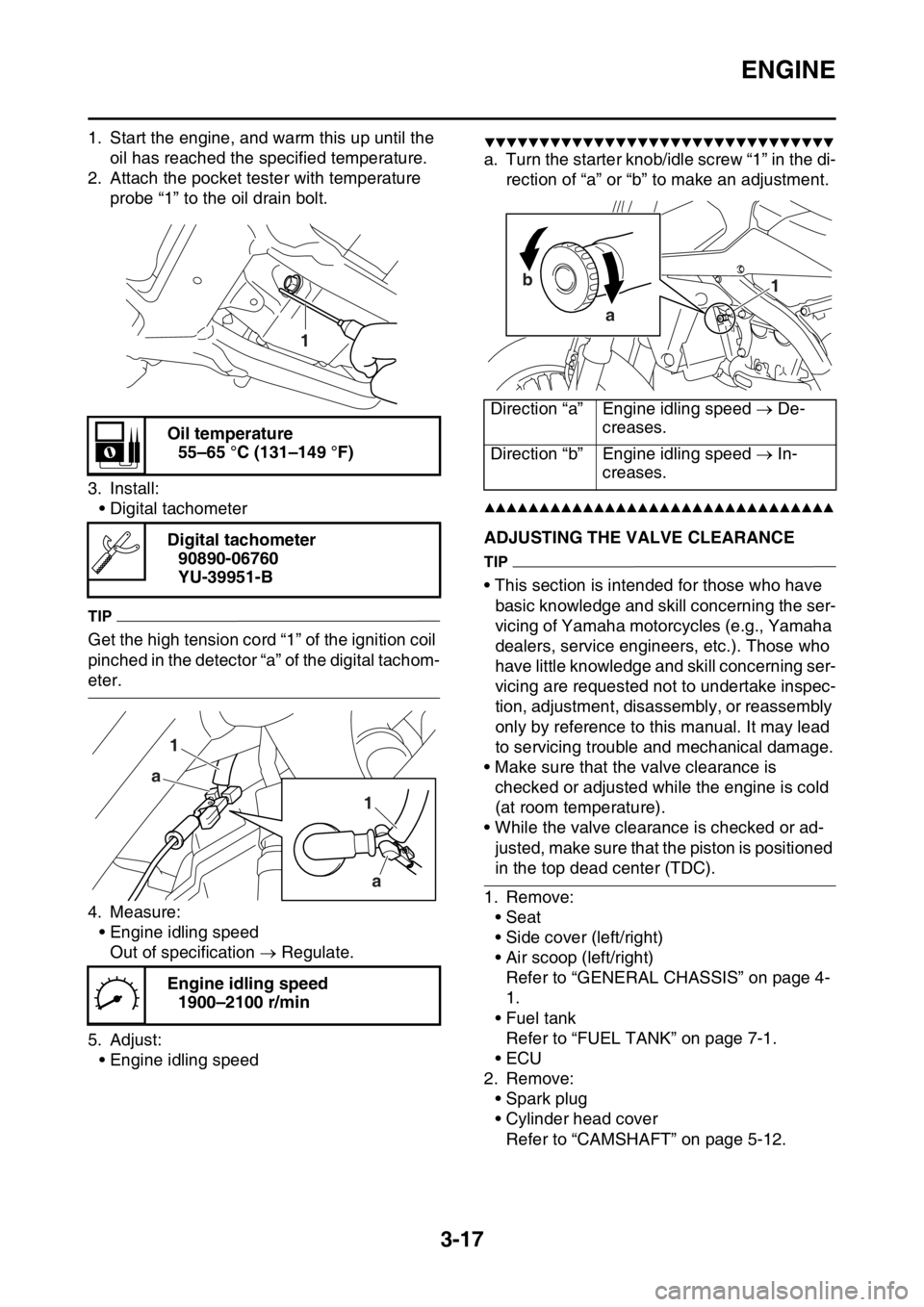
1. Start the engine, and warm this up until the
oil has reached the specified temperature.
2. Attach the pocket tester with temperature
probe “1” to the oil drain bolt.
3. Install:
• Digital tachometer
TIP
Get the high tension cord “1” of the ignition coil
pinched in the detector “a” of the digital tachom-
eter.
4. Measure:
• Engine idling speed
Out of specification Regulate.
5. Adjust:
• Engine idling speed
▼▼▼▼▼▼▼▼▼▼▼▼▼▼▼▼▼▼▼▼▼▼▼▼▼▼▼▼▼▼▼▼
a. Turn the starter knob/idle screw “1” in the di-
rection of “a” or “b” to make an adjustment.
▲▲▲▲▲▲▲▲▲▲▲▲▲▲▲▲▲▲▲▲▲▲▲▲▲▲▲▲▲▲▲▲
EASB111087ADJUSTING THE VALVE CLEARANCE
TIP
• This section is intended for those who have
basic knowledge and skill concerning the ser-
vicing of Yamaha motorcycles (e.g., Yamaha
dealers, service engineers, etc.). Those who
have little knowledge and skill concerning ser-
vicing are requested not to undertake inspec-
tion, adjustment, disassembly, or reassembly
only by reference to this manual. It may lead
to servicing trouble and mechanical damage.
• Make sure that the valve clearance is
checked or adjusted while the engine is cold
(at room temperature).
• While the valve clearance is checked or ad-
justed, make sure that the piston is positioned
in the top dead center (TDC).
1. Remove:
• Seat
• Side cover (left/right)
• Air scoop (left/right)
Refer to “GENERAL CHASSIS” on page 4-
1.
• Fuel tank
Refer to “FUEL TANK” on page 7-1.
•ECU
2. Remove:
• Spark plug
• Cylinder head cover
Refer to “CAMSHAFT” on page 5-12. Oil temperature
55–65 °C (131–149 °F)
Digital tachometer
90890-06760
YU-39951-B
Engine idling speed
1900–2100 r/min
1
1 1
a a
Direction “a” Engine idling speed De-
creases.
Direction “b” Engine idling speed In-
creases.
1 b
a
Page 106 of 362
CHASSIS
3-22
EASB111088
CHASSIS
EASB111089BLEEDING THE BRAKE SYSTEMEWA13100
WARNING
Bleed the brake system whenever:
• The system is disassembled.
• A brake hose is loosened, disconnected,
or replaced.
• The brake fluid level is very low.
• Brake operation is faulty.
1. Remove:
• Brake master cylinder cap
• Reservoir diaphragm
• Reservoir float (front brake)
• Protector (rear brake)
TIP
• Be careful not to spill any brake fluid or allow
the reservoir to overflow.
• Make sure that there is enough brake fluid be-
fore applying the brake. Ignoring this precau-
tion could allow air to enter the brake system,
considerably lengthening the bleeding proce-
dure.
• If bleeding is difficult, it may be necessary to
let the brake fluid settle for a few hours. Re-
peat the bleeding procedure when the tiny
bubbles in the hose have disappeared.
2. Bleed the brake system.
▼▼▼▼▼▼▼▼▼▼▼▼▼▼▼▼▼▼▼▼▼▼▼▼▼▼▼▼▼▼▼▼
a. Fill the reservoir to the proper level with the
recommended brake fluid.
b. Install the reservoir diaphragm.
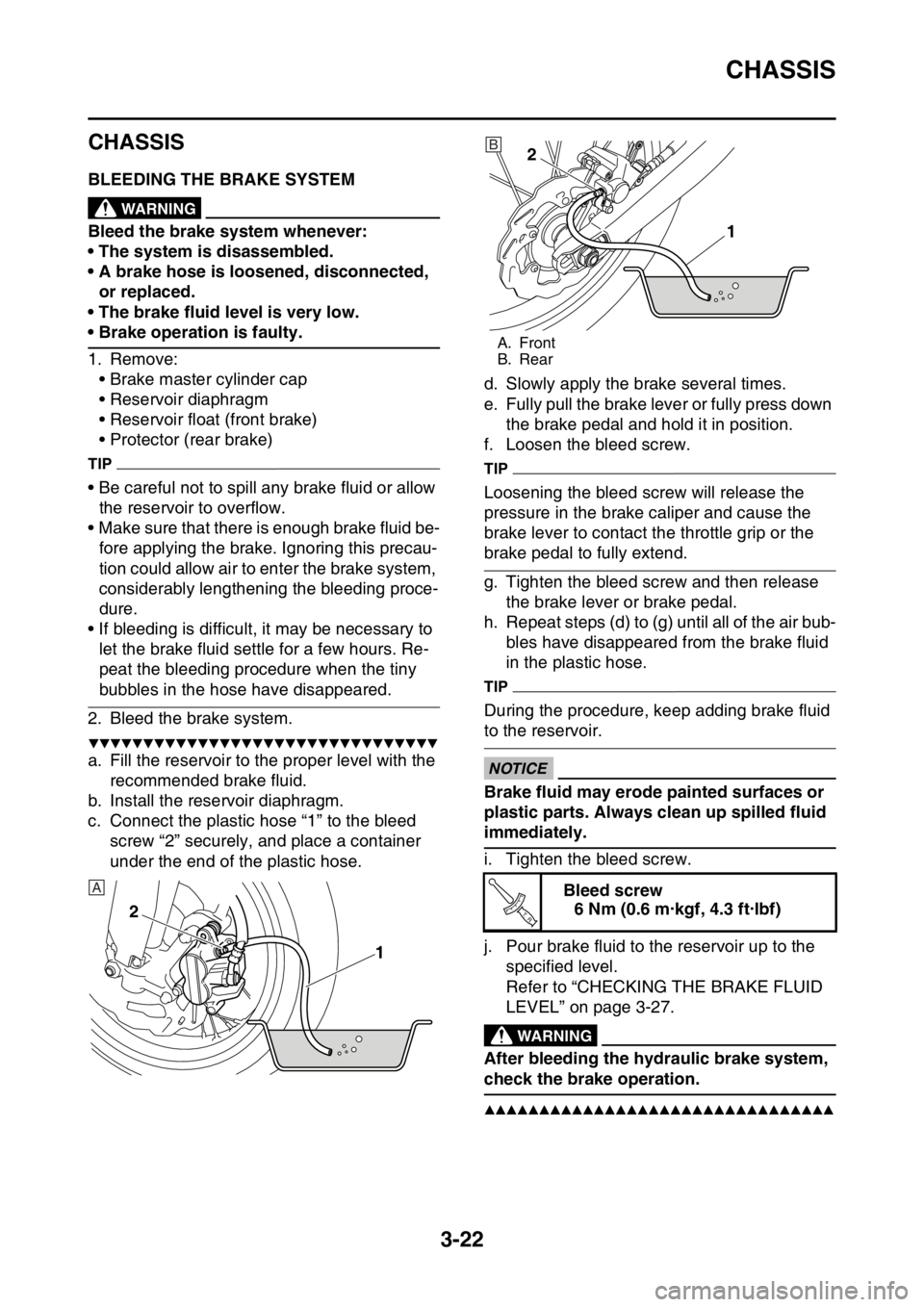
c. Connect the plastic hose “1” to the bleed
screw “2” securely, and place a container
under the end of the plastic hose.d. Slowly apply the brake several times.
e. Fully pull the brake lever or fully press down
the brake pedal and hold it in position.
f. Loosen the bleed screw.
TIP
Loosening the bleed screw will release the
pressure in the brake caliper and cause the
brake lever to contact the throttle grip or the
brake pedal to fully extend.
g. Tighten the bleed screw and then release
the brake lever or brake pedal.
h. Repeat steps (d) to (g) until all of the air bub-
bles have disappeared from the brake fluid
in the plastic hose.
TIP
During the procedure, keep adding brake fluid
to the reservoir.
ECA
NOTICE
Brake fluid may erode painted surfaces or
plastic parts. Always clean up spilled fluid
immediately.
i. Tighten the bleed screw.
j. Pour brake fluid to the reservoir up to the
specified level.
Refer to “CHECKING THE BRAKE FLUID
LEVEL” on page 3-27.
EWA13110
WARNING
After bleeding the hydraulic brake system,
check the brake operation.
▲▲▲▲▲▲▲▲▲▲▲▲▲▲▲▲▲▲▲▲▲▲▲▲▲▲▲▲▲▲▲▲
1 2
A
A. Front
B. Rear
Bleed screw
6 Nm (0.6 m·kgf, 4.3 ft·lbf)
2
1B
T R..