oil change YAMAHA YZ450F 2016 Owners Manual
[x] Cancel search | Manufacturer: YAMAHA, Model Year: 2016, Model line: YZ450F, Model: YAMAHA YZ450F 2016Pages: 362, PDF Size: 10.49 MB
Page 18 of 362
DESCRIPTION
1-4
EASB111009
DESCRIPTION
TIP
Designs and specifications of the vehicle are subject to change without notice. Therefore, please
note that the descriptions in this manual may be different from those for the vehicle you have pur-
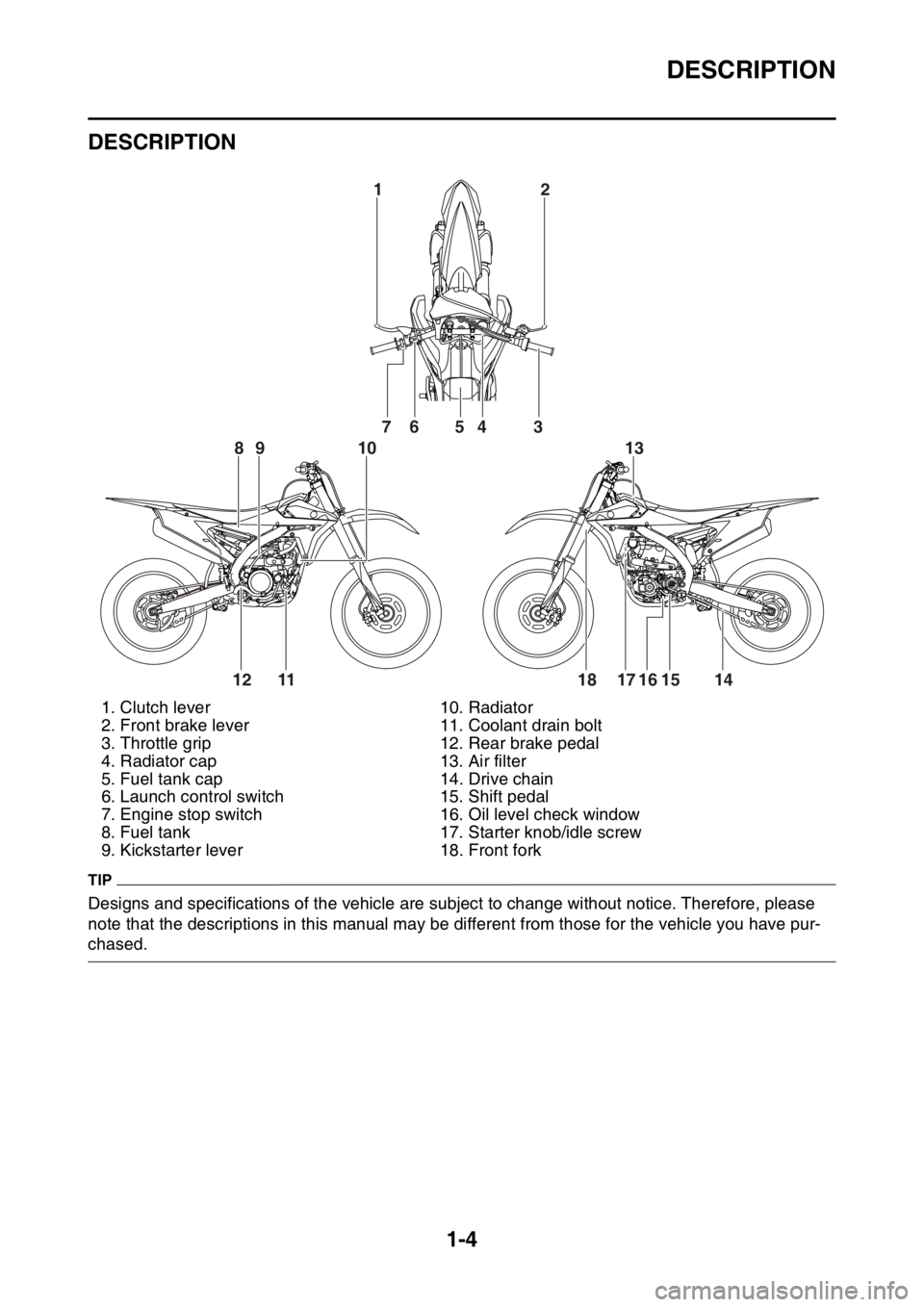
chased.1. Clutch lever 10. Radiator
2. Front brake lever 11. Coolant drain bolt
3. Throttle grip 12. Rear brake pedal
4. Radiator cap 13. Air filter
5. Fuel tank cap 14. Drive chain
6. Launch control switch 15. Shift pedal
7. Engine stop switch 16. Oil level check window
8. Fuel tank 17. Starter knob/idle screw
9. Kickstarter lever 18. Front fork
2 1
7
6
89 1054 3
12 11 18 17 16 15 1413
Page 22 of 362
IMPORTANT INFORMATION
1-8
EAS20180
IMPORTANT INFORMATION
EASB111020PREPARATION FOR REMOVAL AND DIS-
ASSEMBLY
1. Before the jobs, completely remove mud,
dust, and the like in order to prevent the en-
try of them into the inside during the jobs.
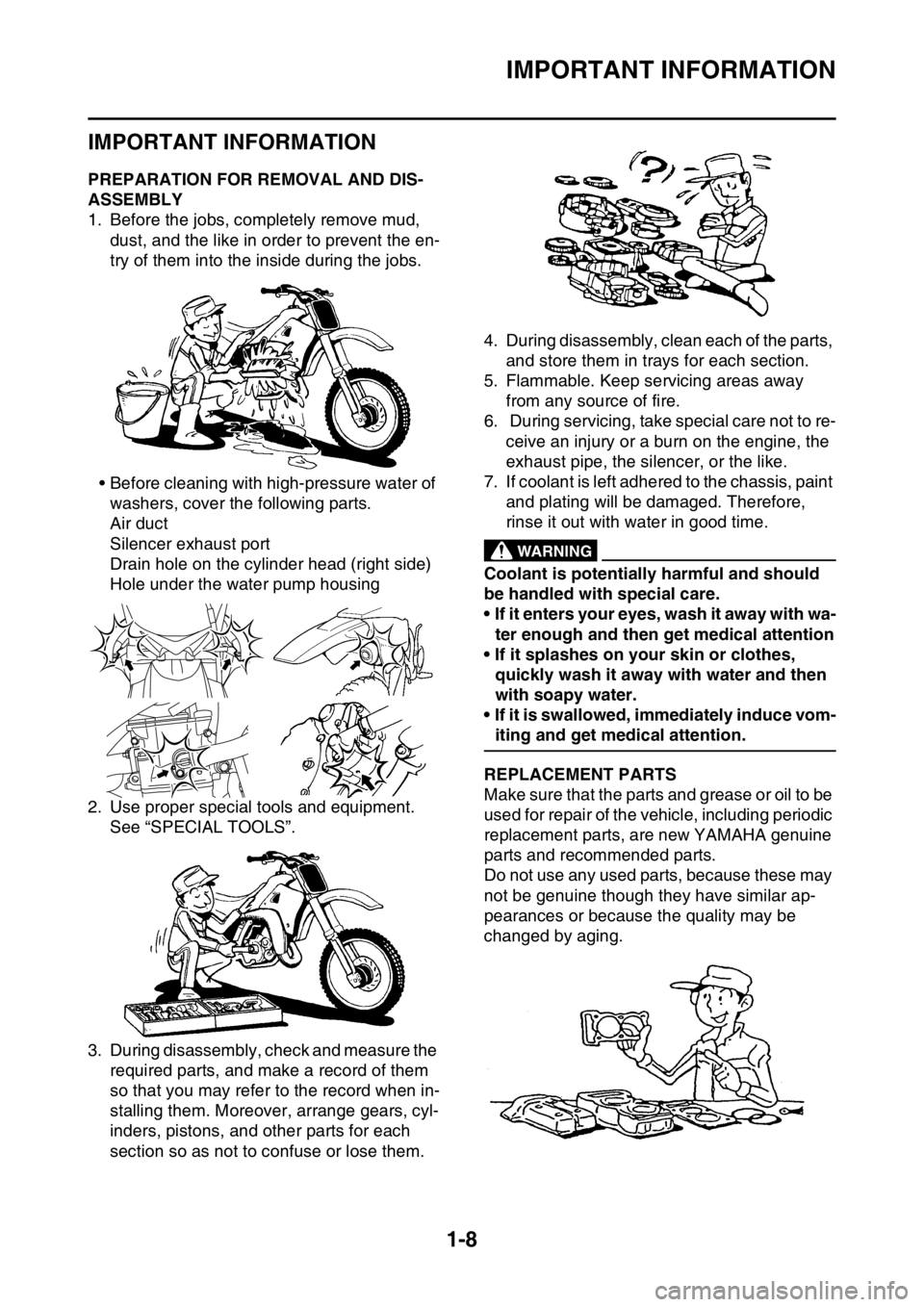
• Before cleaning with high-pressure water of
washers, cover the following parts.
Air duct
Silencer exhaust port
Drain hole on the cylinder head (right side)
Hole under the water pump housing
2. Use proper special tools and equipment.
See “SPECIAL TOOLS”.
3. During disassembly, check and measure the
required parts, and make a record of them
so that you may refer to the record when in-
stalling them. Moreover, arrange gears, cyl-
inders, pistons, and other parts for each
section so as not to confuse or lose them.4. During disassembly, clean each of the parts,
and store them in trays for each section.
5. Flammable. Keep servicing areas away
from any source of fire.
6. During servicing, take special care not to re-
ceive an injury or a burn on the engine, the
exhaust pipe, the silencer, or the like.
7. If coolant is left adhered to the chassis, paint
and plating will be damaged. Therefore,
rinse it out with water in good time.
EWA
WARNING
Coolant is potentially harmful and should
be handled with special care.
• If it enters your eyes, wash it away with wa-
ter enough and then get medical attention
• If it splashes on your skin or clothes,
quickly wash it away with water and then
with soapy water.
• If it is swallowed, immediately induce vom-
iting and get medical attention.
EASB111021REPLACEMENT PARTS
Make sure that the parts and grease or oil to be
used for repair of the vehicle, including periodic
replacement parts, are new YAMAHA genuine
parts and recommended parts.
Do not use any used parts, because these may
not be genuine though they have similar ap-
pearances or because the quality may be
changed by aging.
Page 37 of 362
MAINTENANCE AFTER BREAK-IN
1-23
EASB111045
MAINTENANCE AFTER BREAK-IN
After a break-in, perform careful maintenance
to get ready for the next practice or race.
Refer to “PRE-OPERATION INSPECTION
AND MAINTENANCE” on page 3-7.
EASB111046MAJOR MAINTENANCE
1. For the engine
• Leaks around the engine
Check for pressure leaks from the cylinder
head or the cylinder, oil leaks from the
crankcase or the case cover, leaks from the
coolant system, and other leaks.
• Check that the valve, the cylinder head, the
cylinder, the piston, and the piston ring fit
one another, and that contact between the
valve and the cylinder head, and that be-
tween the cylinder and the piston are cor-
rect.
• Engine oil change
Drain the oil, and check for dirt and foreign
materials such as metal chips. (If any foreign
material is mixed, disassemble and check
the crankcase.)
Pour the specified amount of the recom-
mended oil.
• AC magneto
Check for looseness in mounted areas of
the rotor and the stator.
Check that the connector is not being dis-
connected.
• Silencer
Check the main body and stay for cracks.
Check for leaks.
• Mounting bolts and nuts
Check for looseness in mounted areas of
parts, as well as engine mounting bolts and
engine brackets.
2. For the chassis
• Check welds and mounted areas of the
frame, the swingarm, the link, the bracket,
and so on, for looseness and cracks.
• Wheel (s)
Check the wheel for runout. Check the
spoke for looseness.
• Brake(s)
Check the brake disc mounting bolt for
looseness.
Check that the reservoir contains the speci-
fied amount of brake fluid. Check for leaks.• Cable
Grease and adjust cables.
•Drive chain
Lubricate the drive chain and adjust its ten-
sion.
• Fuel tank
Clean the inside of the fuel tank. Check for
leaks.
• Suspension
Check for oil leaks in the front fork or the rear
shock absorber. Check that the mounted
conditions are good.
• Sprocket
Check for looseness in the sprocket mount-
ed on the rear wheel.
• Mounting bolts and nuts
Check mounted areas for looseness.
ECA
NOTICE
After a break-in or before each race, always
check the points shown in “TORQUE-
CHECK POINTS” for tightening torques and
retighten them. (Refer to “TORQUE-CHECK
POINTS” on page 1-24.)
• Greasing and oiling
Always grease or oil the specified points.
Page 87 of 362
MAINTENANCE INTERVALS
3-3
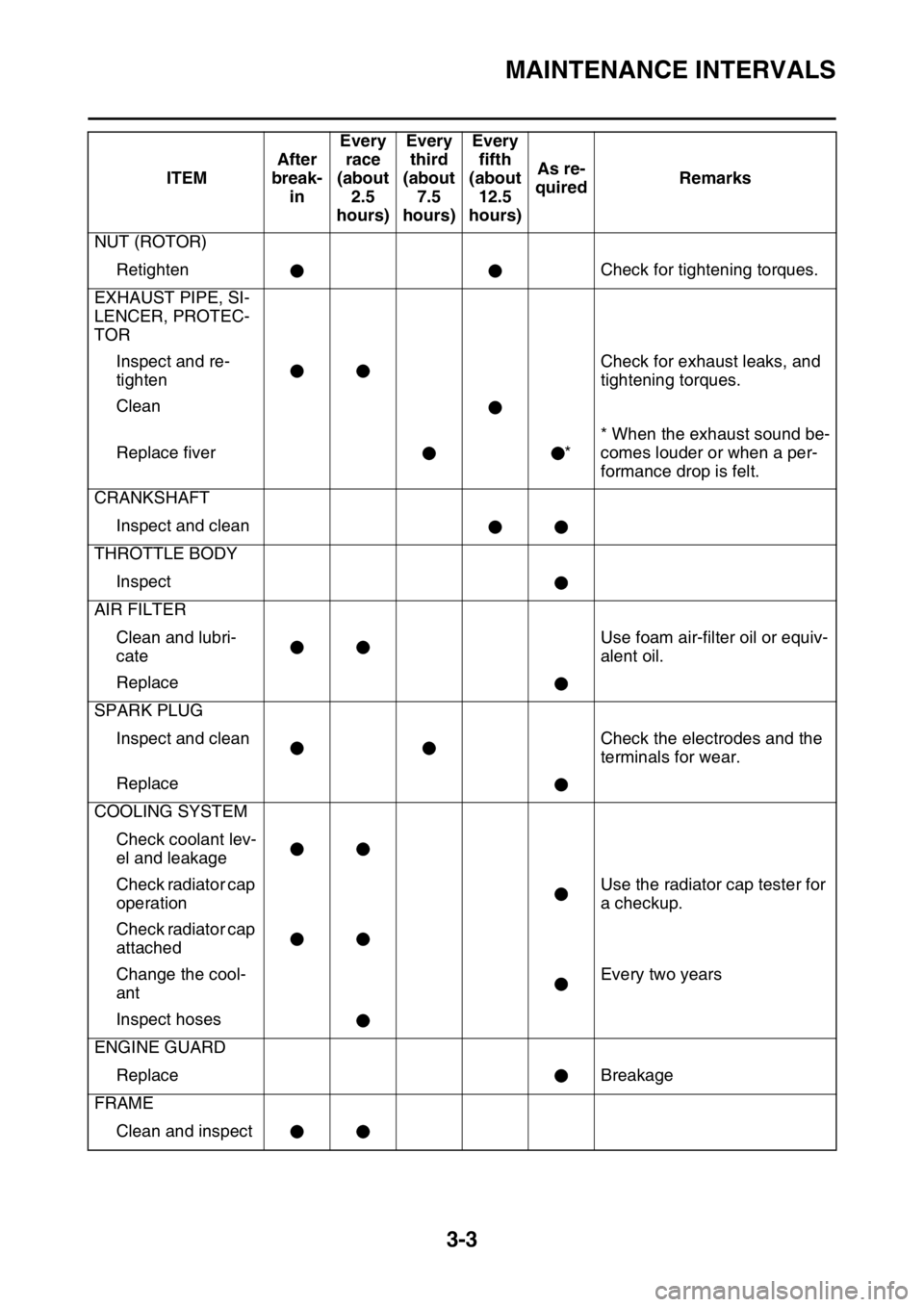
NUT (ROTOR)
Retighten Check for tightening torques.
EXHAUST PIPE, SI-
LENCER, PROTEC-
TOR
Inspect and re-
tightenCheck for exhaust leaks, and
tightening torques.
Clean
Replace fiver ** When the exhaust sound be-
comes louder or when a per-
formance drop is felt.
CRANKSHAFT
Inspect and clean
THROTTLE BODY
Inspect
AIR FILTER
Clean and lubri-
cateUse foam air-filter oil or equiv-
alent oil.
Replace
SPARK PLUG
Inspect and clean Check the electrodes and the
terminals for wear.
Replace
COOLING SYSTEM
Check coolant lev-
el and leakage
Check radiator cap
operationUse the radiator cap tester for
a checkup.
Check radiator cap
attached
Change the cool-
antEvery two years
Inspect hoses
ENGINE GUARD
Replace Breakage
FRAME
Clean and inspectITEMAfter
break-
inEvery
race
(about
2.5
hours)Every
third
(about
7.5
hours)Every
fifth
(about
12.5
hours)As re-
quiredRemarks
Page 278 of 362
WATER PUMP
6-5
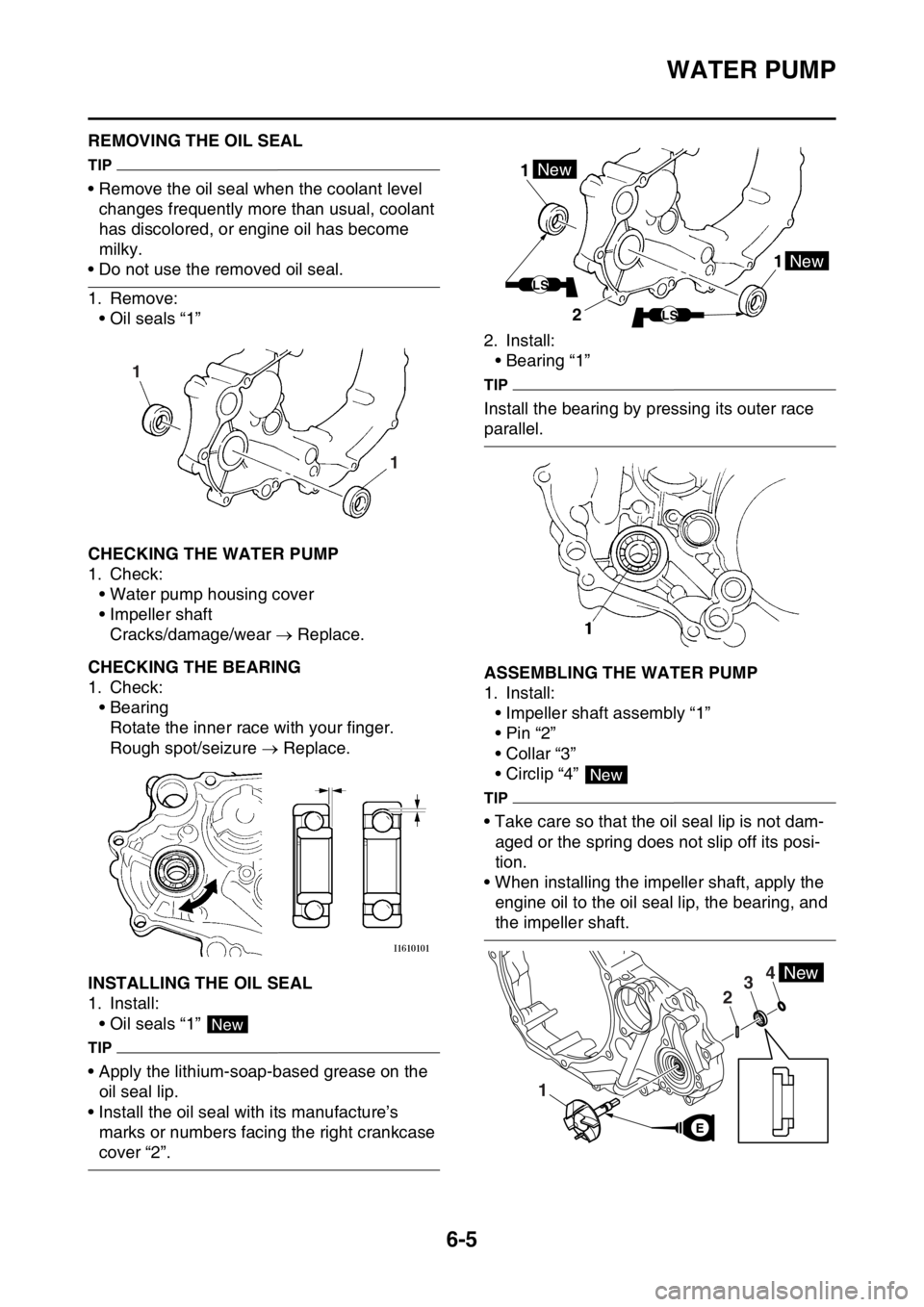
EASB111298REMOVING THE OIL SEAL
TIP
• Remove the oil seal when the coolant level
changes frequently more than usual, coolant
has discolored, or engine oil has become
milky.
• Do not use the removed oil seal.
1. Remove:
• Oil seals “1”
EASB111299CHECKING THE WATER PUMP
1. Check:
• Water pump housing cover
• Impeller shaft
Cracks/damage/wear Replace.
EASB111300CHECKING THE BEARING
1. Check:
• Bearing
Rotate the inner race with your finger.
Rough spot/seizure Replace.
EASB111301INSTALLING THE OIL SEAL
1. Install:
• Oil seals “1”
TIP
• Apply the lithium-soap-based grease on the
oil seal lip.
• Install the oil seal with its manufacture’s
marks or numbers facing the right crankcase
cover “2”.2. Install:
• Bearing “1”
TIP
Install the bearing by pressing its outer race
parallel.
EASB111302ASSEMBLING THE WATER PUMP
1. Install:
• Impeller shaft assembly “1”
•Pin “2”
• Collar “3”
• Circlip “4”
TIP
• Take care so that the oil seal lip is not dam-
aged or the spring does not slip off its posi-
tion.
• When installing the impeller shaft, apply the
engine oil to the oil seal lip, the bearing, and
the impeller shaft.
1 1
New
1 1New
New
LS
LS2
New
4
1
23New
E
Page 334 of 362
ELECTRICAL COMPONENTS
8-42
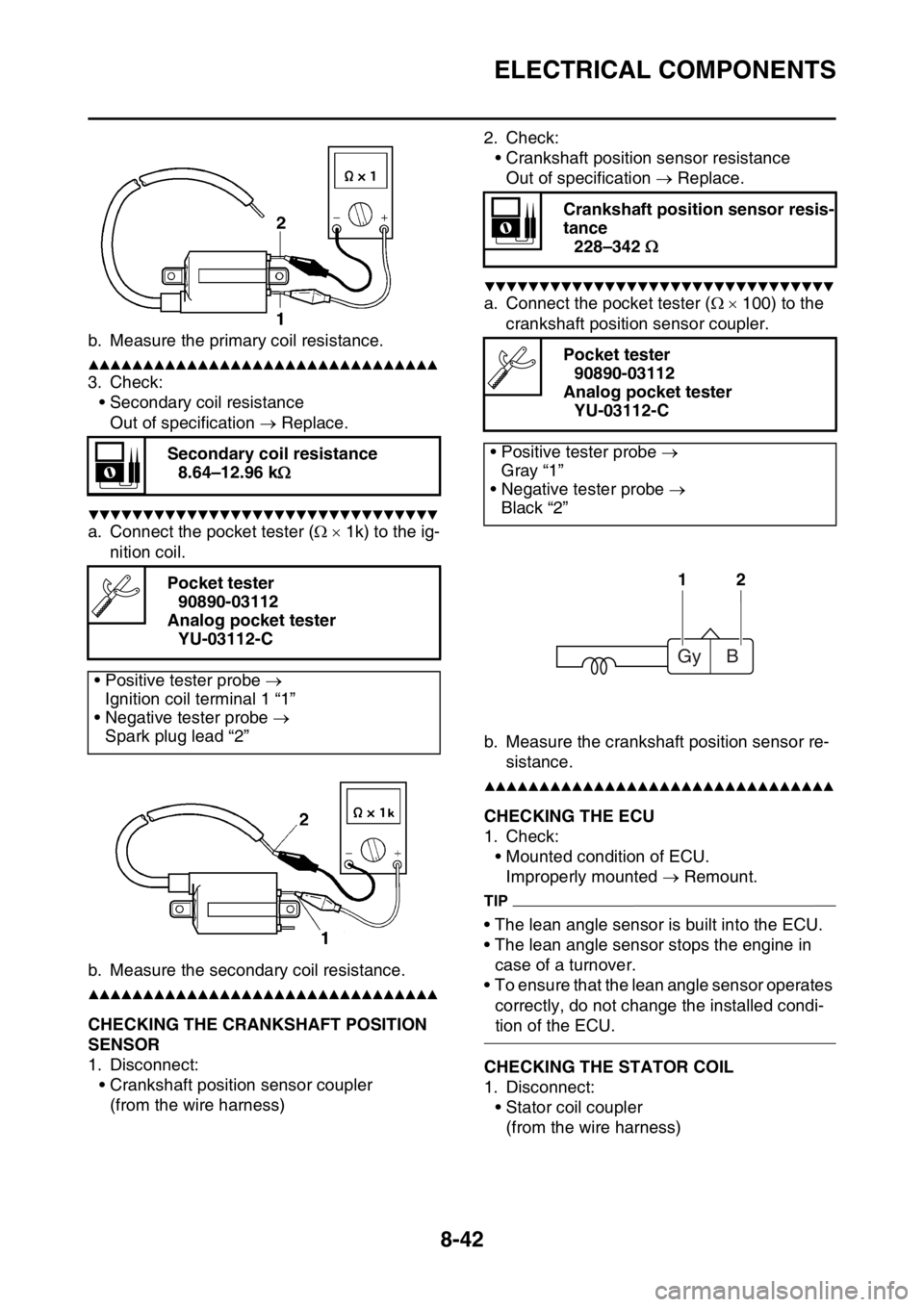
b. Measure the primary coil resistance.
▲▲▲▲▲▲▲▲▲▲▲▲▲▲▲▲▲▲▲▲▲▲▲▲▲▲▲▲▲▲▲▲
3. Check:
• Secondary coil resistance
Out of specification Replace.
▼▼▼▼▼▼▼▼▼▼▼▼▼▼▼▼▼▼▼▼▼▼▼▼▼▼▼▼▼▼▼▼
a. Connect the pocket tester ( 1k) to the ig-
nition coil.
b. Measure the secondary coil resistance.
▲▲▲▲▲▲▲▲▲▲▲▲▲▲▲▲▲▲▲▲▲▲▲▲▲▲▲▲▲▲▲▲
EASB111337CHECKING THE CRANKSHAFT POSITION
SENSOR
1. Disconnect:
• Crankshaft position sensor coupler
(from the wire harness)2. Check:
• Crankshaft position sensor resistance
Out of specification Replace.
▼▼▼▼▼▼▼▼▼▼▼▼▼▼▼▼▼▼▼▼▼▼▼▼▼▼▼▼▼▼▼▼
a. Connect the pocket tester ( 100) to the
crankshaft position sensor coupler.
b. Measure the crankshaft position sensor re-
sistance.
▲▲▲▲▲▲▲▲▲▲▲▲▲▲▲▲▲▲▲▲▲▲▲▲▲▲▲▲▲▲▲▲
EASB111338CHECKING THE ECU
1. Check:
• Mounted condition of ECU.
Improperly mounted Remount.
TIP
• The lean angle sensor is built into the ECU.
• The lean angle sensor stops the engine in
case of a turnover.
• To ensure that the lean angle sensor operates
correctly, do not change the installed condi-
tion of the ECU.
EASB111339CHECKING THE STATOR COIL
1. Disconnect:
• Stator coil coupler
(from the wire harness) Secondary coil resistance
8.64–12.96 k
Pocket tester
90890-03112
Analog pocket tester
YU-03112-C
• Positive tester probe
Ignition coil terminal 1 “1”
• Negative tester probe
Spark plug lead “2”
Crankshaft position sensor resis-
tance
228–342
Pocket tester
90890-03112
Analog pocket tester
YU-03112-C
• Positive tester probe
Gray “1”
• Negative tester probe
Black “2”
12
Gy B
Page 349 of 362

10
TUNING
CHASSIS........................................................................................................ 10-1
SELECTION OF THE SECONDARY REDUCTION RATIO
(SPROCKET) .......................................................................................... 10-1
DRIVE AND REAR WHEEL SPROCKETS SETTING PARTS ................ 10-1
TIRE PRESSURE..................................................................................... 10-2
FRONT FORK SETTING.......................................................................... 10-2
CHANGE IN AMOUNT AND CHARACTERISTICS OF FORK OIL.......... 10-2
SETTING OF SPRING AFTER REPLACEMENT .................................... 10-3
FRONT FORK SETTING PARTS............................................................. 10-3
REAR SUSPENSION SETTING .............................................................. 10-3
CHOOSING SET LENGTH ...................................................................... 10-3
SETTING OF SPRING AFTER REPLACEMENT .................................... 10-4
REAR SHOCK ABSORBER SETTING PARTS ....................................... 10-5
SUSPENSION SETTING (FRONT FORK)............................................... 10-6
SUSPENSION SETTING (REAR SHOCK ABSORBER) ......................... 10-7
Page 351 of 362
CHASSIS
10-2
EASB111369TIRE PRESSURE
Tire pressure should be adjusted to suit the
road surface condition of the circuit.
• Under a rainy, a muddy, a sandy, or a slippery
condition, the tire pressure should be lower
for a larger area of contact with the road sur-
face.
• Under a stony or a hard road condition, the
tire pressure should be higher to prevent a flat
tire.
EASB111370FRONT FORK SETTING
The front fork setting should be made depend-
ing on the rider’s feeling of an actual run and
the circuit conditions.
The front fork setting includes the following
three factors:
1. Setting of air spring characteristics
• Change the fork oil amount.
2. Setting of spring preload
• Change the spring.
3. Setting of damping force
• Change the compression damping force.
• Change the rebound damping force.
The spring acts on the load and the damping
force acts on the cushion travel speed.
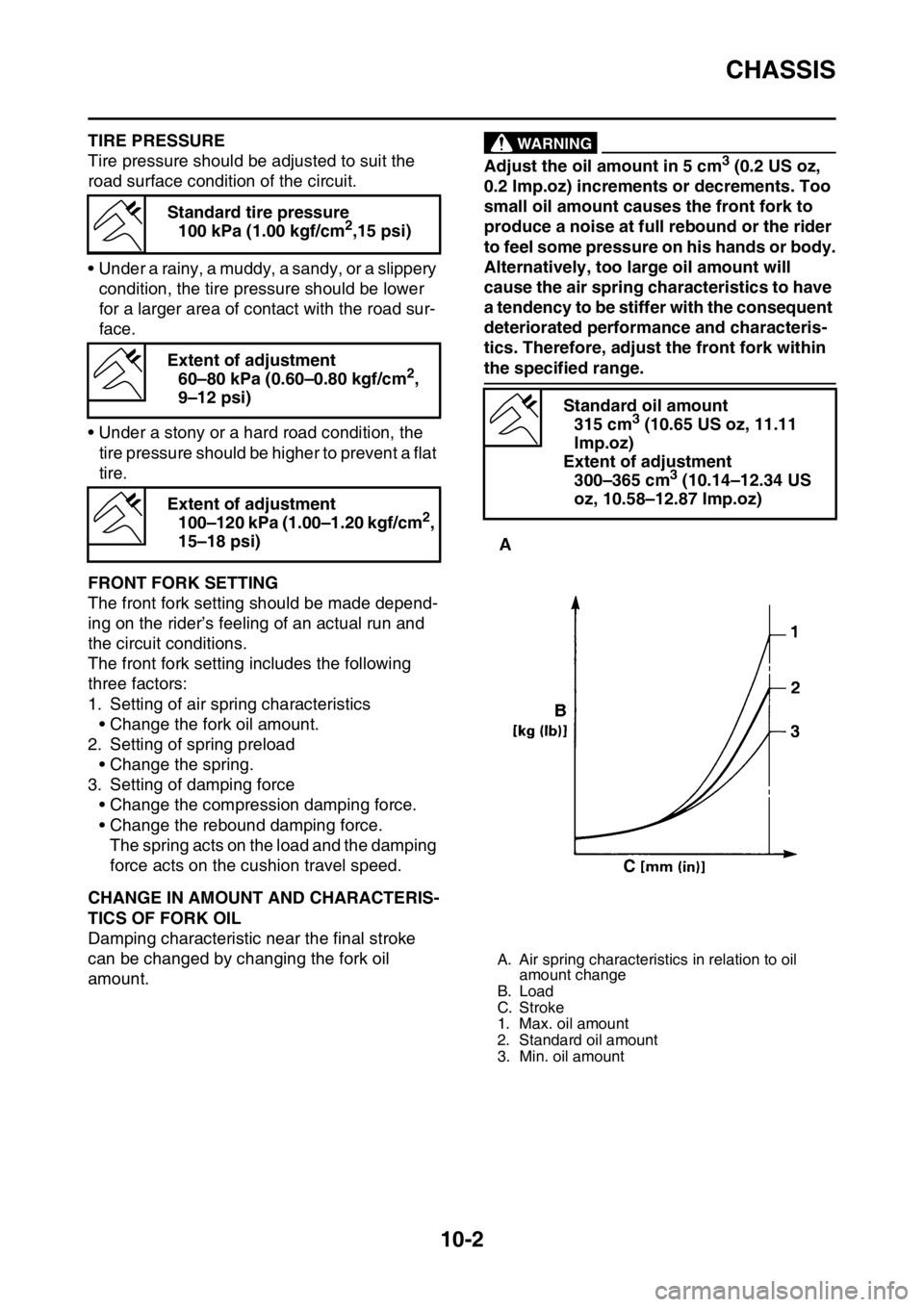
EASB111371CHANGE IN AMOUNT AND CHARACTERIS-
TICS OF FORK OIL
Damping characteristic near the final stroke
can be changed by changing the fork oil
amount.
EWA1DX4001
WARNING
Adjust the oil amount in 5 cm3 (0.2 US oz,
0.2 Imp.oz) increments or decrements. Too
small oil amount causes the front fork to
produce a noise at full rebound or the rider
to feel some pressure on his hands or body.
Alternatively, too large oil amount will
cause the air spring characteristics to have
a tendency to be stiffer with the consequent
deteriorated performance and characteris-
tics. Therefore, adjust the front fork within
the specified range. Standard tire pressure
100 kPa (1.00 kgf/cm
2,15 psi)
Extent of adjustment
60–80 kPa (0.60–0.80 kgf/cm
2,
9–12 psi)
Extent of adjustment
100–120 kPa (1.00–1.20 kgf/cm
2,
15–18 psi)
Standard oil amount
315 cm3 (10.65 US oz, 11.11
lmp.oz)
Extent of adjustment
300–365 cm
3 (10.14–12.34 US
oz, 10.58–12.87 Imp.oz)
A. Air spring characteristics in relation to oil
amount change
B. Load
C. Stroke
1. Max. oil amount
2. Standard oil amount
3. Min. oil amount
Page 355 of 362
CHASSIS
10-6
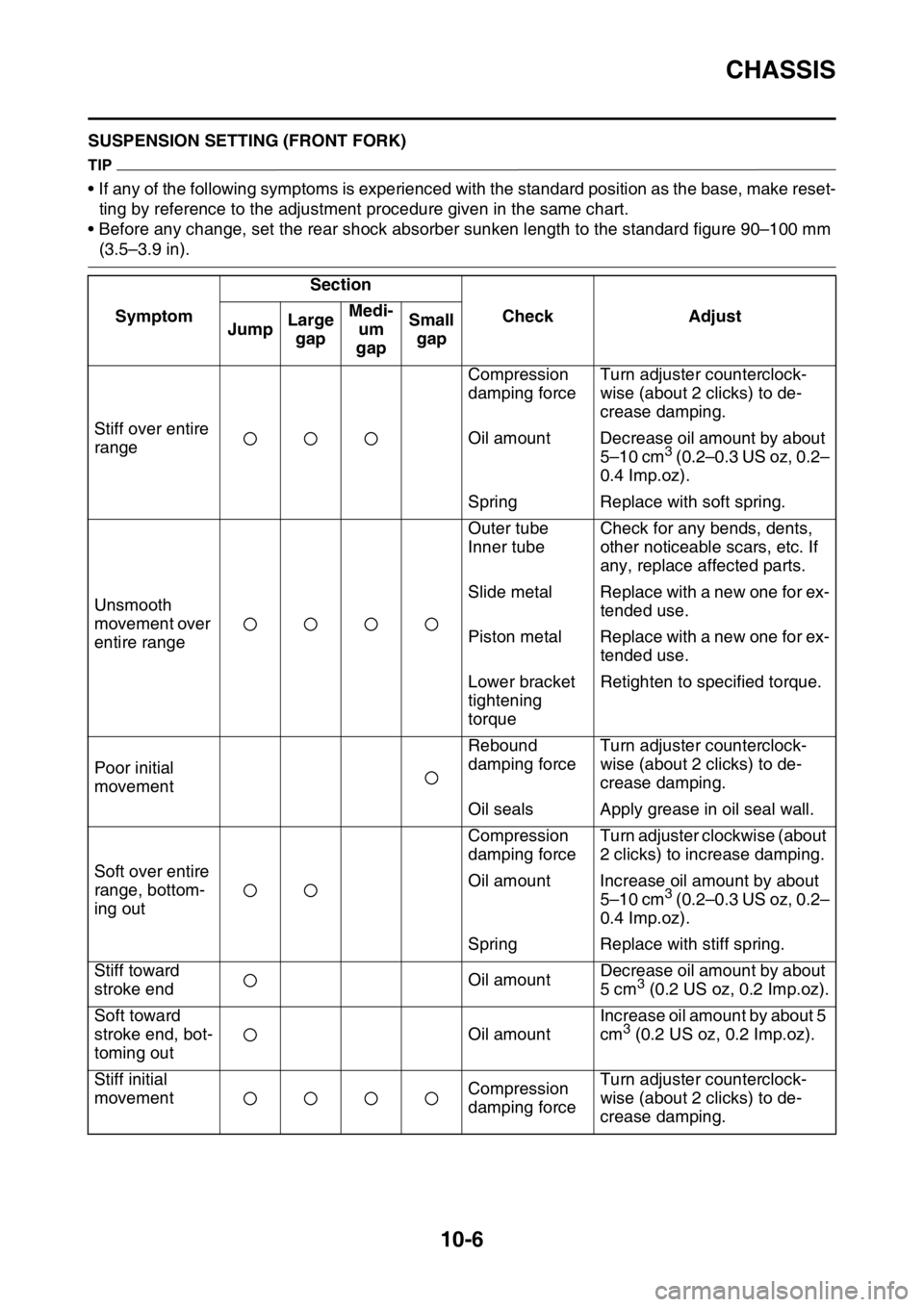
EASB111378SUSPENSION SETTING (FRONT FORK)
TIP
• If any of the following symptoms is experienced with the standard position as the base, make reset-
ting by reference to the adjustment procedure given in the same chart.
• Before any change, set the rear shock absorber sunken length to the standard figure 90–100 mm
(3.5–3.9 in).
SymptomSection
Check Adjust
JumpLarge
gapMedi-
um
gapSmall
gap
Stiff over entire
rangeCompression
damping forceTurn adjuster counterclock-
wise (about 2 clicks) to de-
crease damping.
Oil amount Decrease oil amount by about
5–10 cm
3 (0.2–0.3 US oz, 0.2–
0.4 Imp.oz).
Spring Replace with soft spring.
Unsmooth
movement over
entire rangeOuter tube
Inner tubeCheck for any bends, dents,
other noticeable scars, etc. If
any, replace affected parts.
Slide metal Replace with a new one for ex-
tended use.
Piston metal Replace with a new one for ex-
tended use.
Lower bracket
tightening
torqueRetighten to specified torque.
Poor initial
movementRebound
damping forceTurn adjuster counterclock-
wise (about 2 clicks) to de-
crease damping.
Oil seals Apply grease in oil seal wall.
Soft over entire
range, bottom-
ing outCompression
damping forceTurn adjuster clockwise (about
2 clicks) to increase damping.
Oil amount Increase oil amount by about
5–10 cm
3 (0.2–0.3 US oz, 0.2–
0.4 Imp.oz).
Spring Replace with stiff spring.
Stiff toward
stroke endOil amountDecrease oil amount by about
5 cm
3 (0.2 US oz, 0.2 Imp.oz).
Soft toward
stroke end, bot-
toming outOil amountIncrease oil amount by about 5
cm
3 (0.2 US oz, 0.2 Imp.oz).
Stiff initial
movementCompression
damping forceTurn adjuster counterclock-
wise (about 2 clicks) to de-
crease damping.