oil YAMAHA YZ85 2015 User Guide
[x] Cancel search | Manufacturer: YAMAHA, Model Year: 2015, Model line: YZ85, Model: YAMAHA YZ85 2015Pages: 88, PDF Size: 2.07 MB
Page 54 of 88
PERIODIC MAINTENANCE AND ADJUSTMENT
7-9
7To install the spark plu
g
1. Clean the surface of the spark plug gasket and its mating sur-
face, and then wipe off any grime
from the spark plug threads.
2. Install the spark plug with the spark plug wrench, and then tight-
en it to the specified torque.
TIPIf a torque wrench is not available
when installing a spark plug, a good
estimate of the correct torque is 1/4–
1/2 turn past finger tight. However, the
spark plug should be tightened to the
specified torque as soon as possible.3. Install the spark plug cap.
EAU41449
Transmission oilThe transmission must be checked for
oil leakage before each ride. If any
leakage is found, have a Yamaha deal-
er check and repair the motorcycle. In
addition, the transmission oil must be
changed at the intervals specified in
the periodic maintenance and lubrica-
tion chart.1. Start the engine, warm it up for several minutes, and then turn it
off.
2. Place the motorcycle on a level surface and hold it in an upright
position.
3. Place an oil pan under the trans- mission case to collect the used
oil.
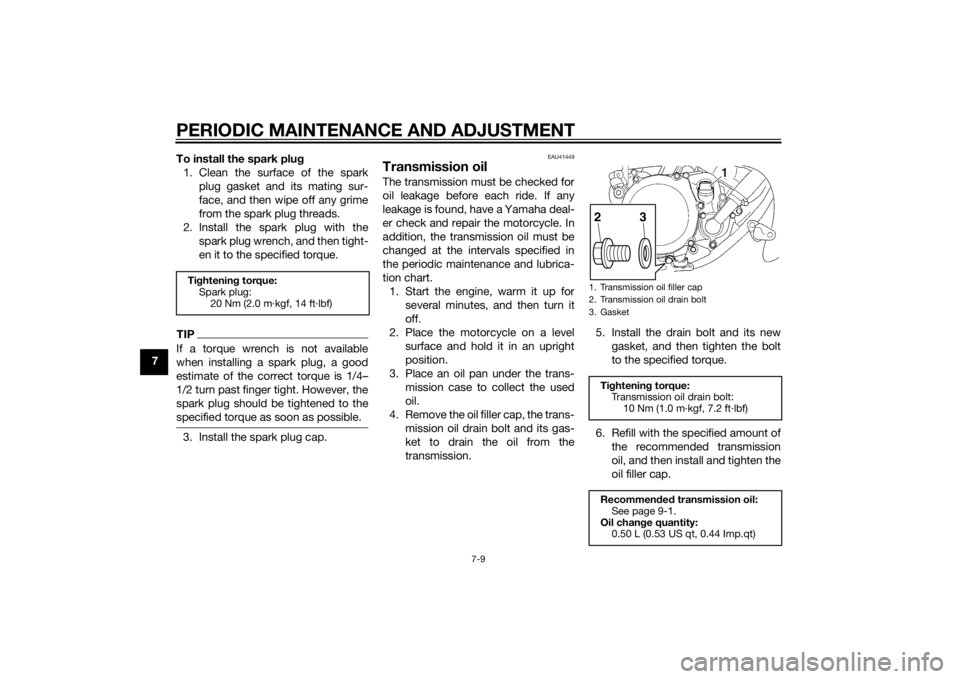
4. Remove the oil filler cap, the trans- mission oil drain bolt and its gas-
ket to drain the oil from the
transmission. 5. Install the drain bolt and its new
gasket, and then tighten the bolt
to the specified torque.
6. Refill with the specified amount of the recommended transmission
oil, and then install and tighten the
oil filler cap.
Tightenin g torque:
Spark plug: 20 Nm (2.0 m·kgf, 14 ft·lbf)
1. Transmission oil filler cap
2. Transmission oil drain bolt
3. GasketTightenin g torque:
Transmission oil drain bolt:
10 Nm (1.0 m·kgf, 7.2 ft·lbf)
Recommen ded transmission oil:
See page 9-1.
Oil chan ge quantity:
0.50 L (0.53 US qt, 0.44 Imp.qt)
1
2
3
U1SN83E0.book Page 9 Monday, September 8, 2014 2:36 PM
Page 55 of 88
PERIODIC MAINTENANCE AND ADJUSTMENT
7-10
7
NOTICE
ECA10453
In or der to prevent clutch slip-
pa ge (since the transmission oil
also lu bricates the clutch), do
not mix any chemical additives.
Do not use oils with a d iesel
specification of “CD” or oils of a
hi gher quality than specifie d. In
a ddition, do not use oils lab eled
“ENERGY CONSERVING II” or
hi gher.
Make sure that no forei gn mate-
rial enters the transmission.7. Start the engine, and then let it idle for several minutes while checking
it for oil leakage. If oil is leaking,
immediately turn the engine off
and check for the cause.
EAU20071
CoolantThe coolant level should be checked
before each ride. In addition, the cool-
ant must be changed at the intervals
specified in the periodic maintenance
and lubrication chart.
EAUM1296
To check the coolant level1. Place the vehicle on a level sur- face and hold it in an upright posi-
tion.TIPThe coolant level must be
checked on a cold engine since
the level varies with engine tem-
perature.
Make sure that the vehicle is posi-
tioned straight up when checking
the coolant level. A slight tilt to the
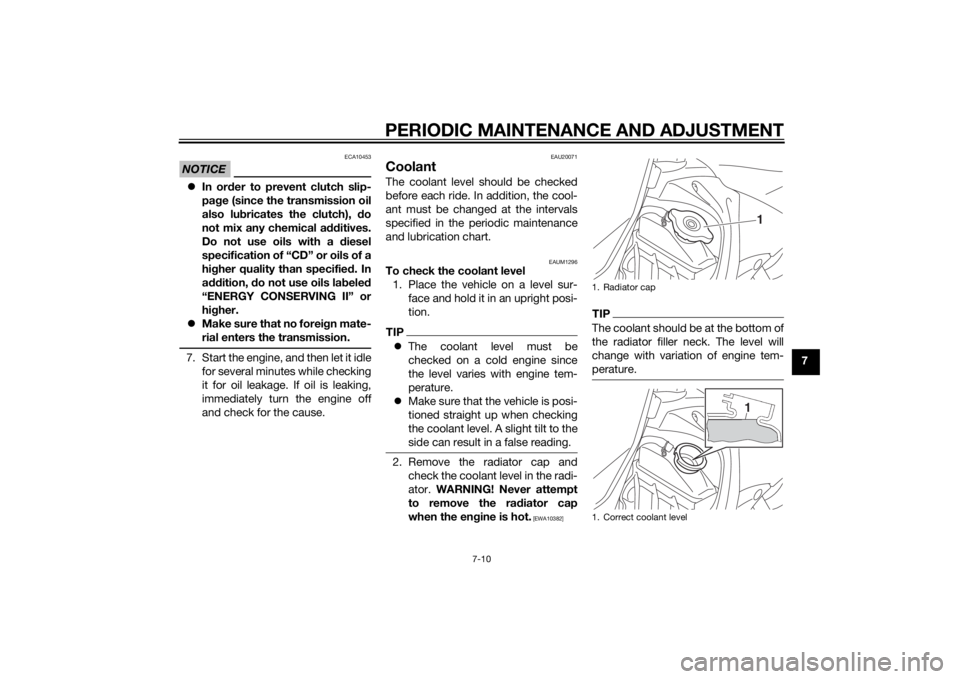
side can result in a false reading.2. Remove the radiator cap and
check the coolant level in the radi-
ator. WARNING! Never attempt
to remove the ra diator cap
when the en gine is hot.
[EWA10382]
TIPThe coolant should be at the bottom of
the radiator filler neck. The level will
change with variation of engine tem-
perature.1. Radiator cap
1. Correct coolant level
1
1
U1SN83E0.book Page 10 Monday, September 8, 2014 2:36 PM
Page 58 of 88
PERIODIC MAINTENANCE AND ADJUSTMENT
7-13
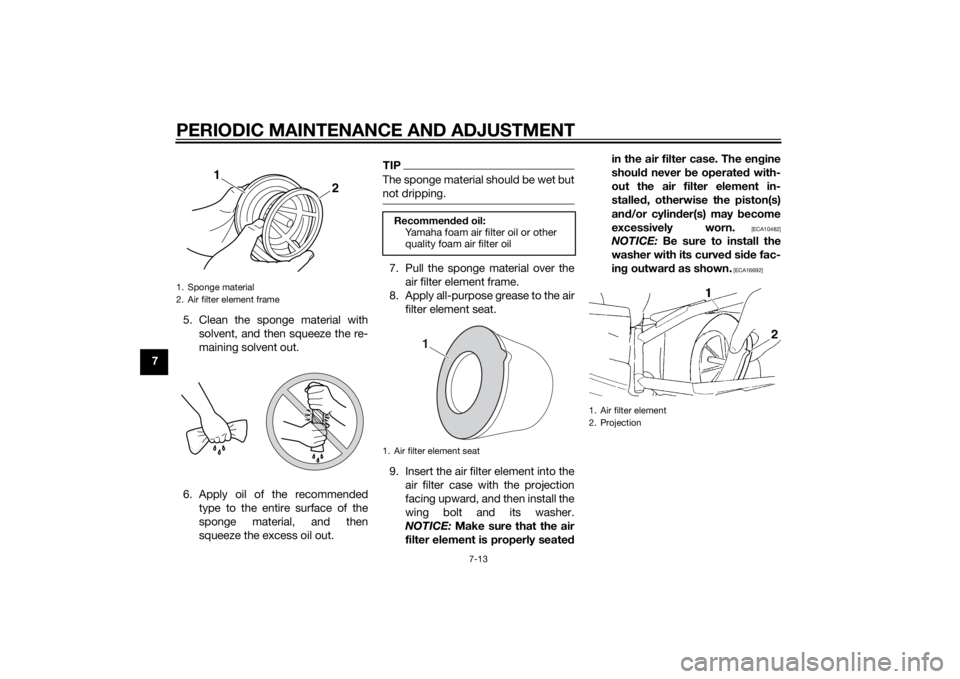
75. Clean the sponge material with
solvent, and then squeeze the re-
maining solvent out.
6. Apply oil of the recommended type to the entire surface of the
sponge material, and then
squeeze the excess oil out.
TIPThe sponge material should be wet but
not dripping.7. Pull the sponge material over theair filter element frame.
8. Apply all-purpose grease to the air filter element seat.
9. Insert the air filter element into the air filter case with the projection
facing upward, and then install the
wing bolt and its washer.
NOTICE: Make sure that the air
filter element is properly seate din the air filter case. The en
gine
shoul d never b e operated with-
out the air filter element in-
stalle d, otherwise the piston(s)
an d/or cylin der(s) may become
excessively worn.
[ECA10482]
NOTICE: Be sure to install the
washer with its curve d si de fac-
in g outwar d as shown.
[ECA16692]
1. Sponge material
2. Air filter element frame
1
2
Recommended oil:
Yamaha foam air filter oil or other
quality foam air filter oil1. Air filter element seat
1
1. Air filter element
2. Projection
U1SN83E0.book Page 13 Monday, September 8, 2014 2:36 PM
Page 66 of 88
PERIODIC MAINTENANCE AND ADJUSTMENT
7-21
7Rear
brake
WARNING
EWA15991
Improper maintenance can result in
loss of brakin g a bility. O bserve
these precautions: Insufficient brake flui d may al-
low air to enter the b rake sys-
tem, re ducin g brakin g
performance.
Clean the filler cap before re-
moving . Use only DOT 4 b rake
flui d from a seale d container.
Use only the specified b rake flu-
i d ; otherwise, the ru bber seals
may deteriorate, causin g leak-
a g e.
Refill with the same type of
brake flui d. A ddin g a brake flui d
other than DOT 4 may result in a
harmful chemical reaction.
Be careful that water does not
enter the brake flui d reservoir
when refillin g. Water will si gnifi-
cantly lower the boilin g point of
the flui d an d may result in vapor
lock.
NOTICE
ECA17641
Brake flui d may damag e painted
surfaces or plastic parts. Always
clean up spille d flui d imme diately.As the brake pads wear, it is normal for
the brake fluid level to gradually go
down. A low brake fluid level may indi-
cate worn brake pads and/or brake
system leakage; therefore, be sure to
check the brake pads for wear and the
brake system for leakage. If the brake fluid level goes down suddenly, have a
Yamaha dealer check the cause before further riding.
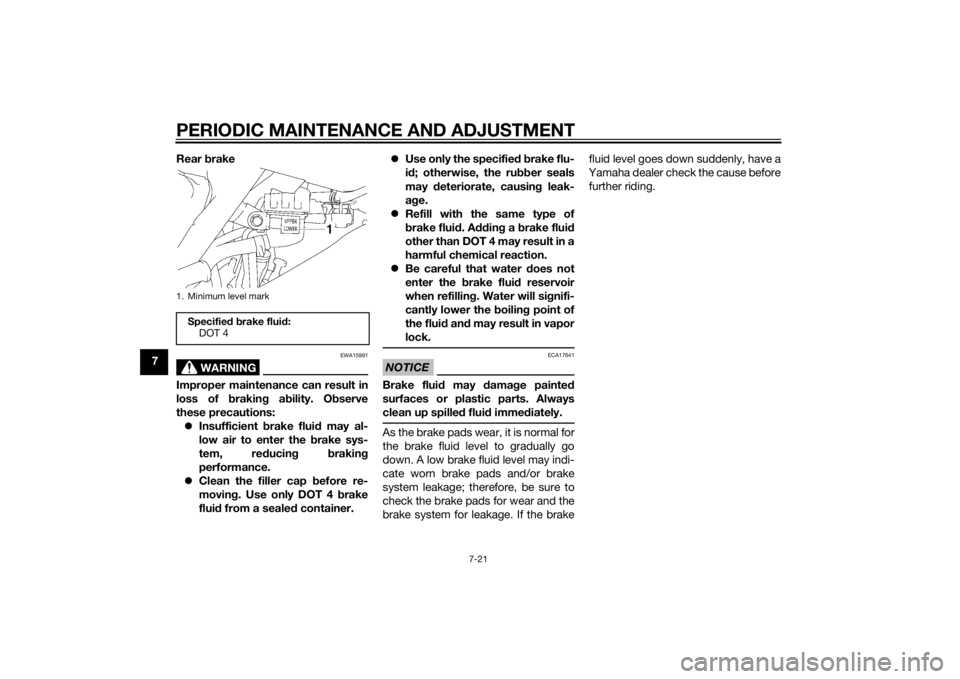
1. Minimum level markSpecifie d b rake flui d:
DOT 4
U1SN83E0.book Page 21 Monday, September 8, 2014 2:36 PM
Page 67 of 88
PERIODIC MAINTENANCE AND ADJUSTMENT
7-22
7
EAU51721
Changin g the brake flui dHave a Yamaha dealer change the
brake fluid at the intervals specified in
the periodic maintenance and lubrica-
tion chart. In addition, have the oil seals
of the master cylinders and calipers as
well as the brake hoses replaced at the
intervals listed below or whenever they
are damaged or leaking.
Oil seals: Replace every two
years.
Brake hoses: Replace every four
years.
EAU22762
Drive chain slackThe drive chain slack should be
checked before each ride and adjusted
if necessary.
EAU41413
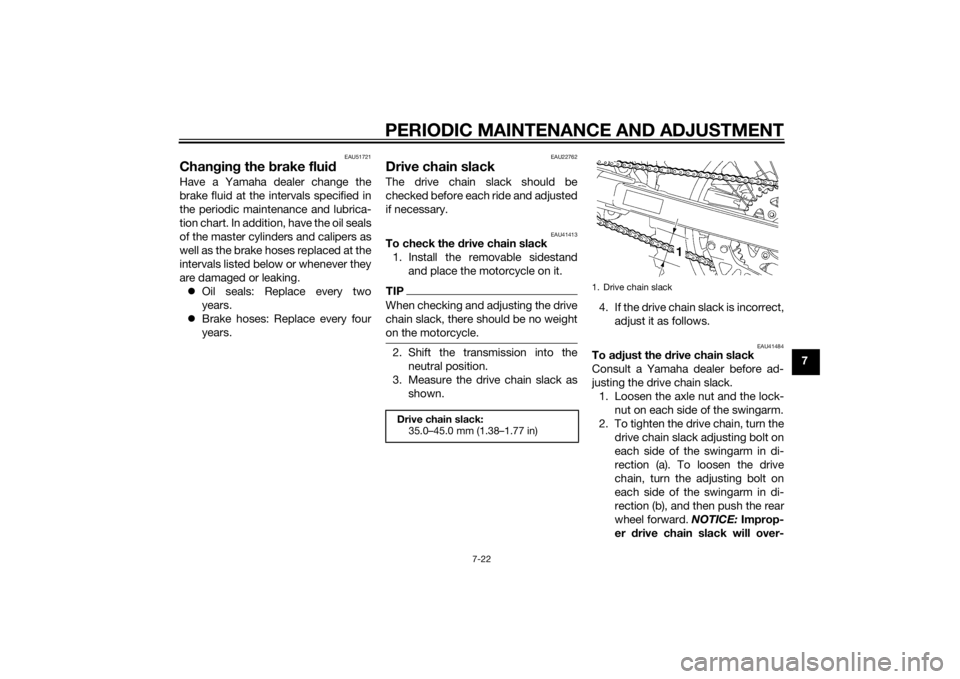
To check the drive chain slack
1. Install the removable sidestand and place the motorcycle on it.TIPWhen checking and adjusting the drive
chain slack, there should be no weight
on the motorcycle.2. Shift the transmission into theneutral position.
3. Measure the drive chain slack as shown. 4. If the drive chain slack is incorrect,
adjust it as follows.
EAU41484
To a djust the drive chain slack
Consult a Yamaha dealer before ad-
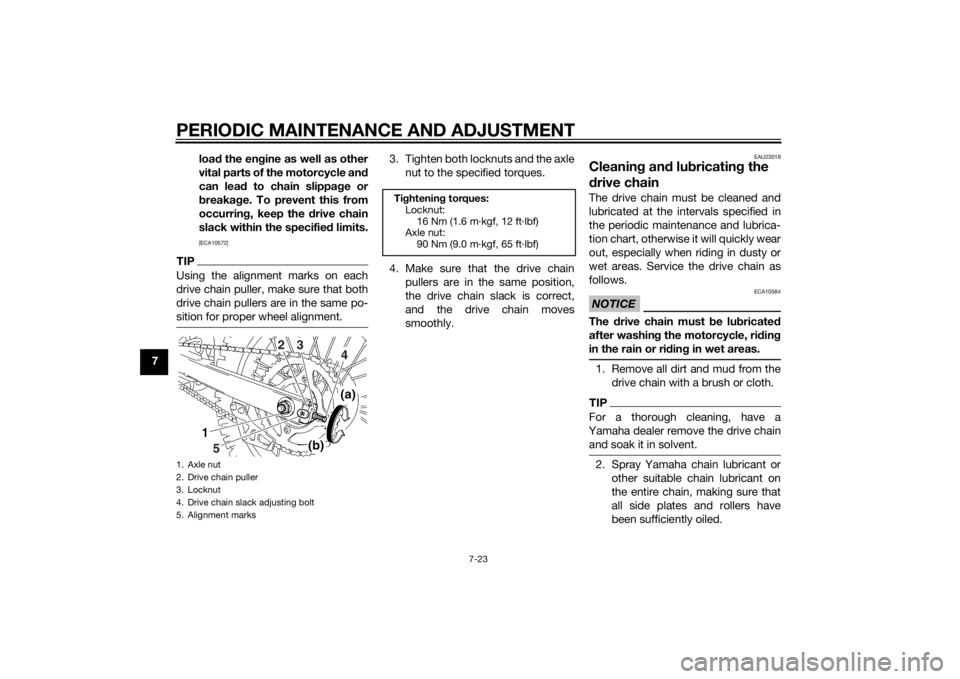
justing the drive chain slack. 1. Loosen the axle nut and the lock- nut on each side of the swingarm.
2. To tighten the drive chain, turn the drive chain slack adjusting bolt on
each side of the swingarm in di-
rection (a). To loosen the drive
chain, turn the adjusting bolt on
each side of the swingarm in di-
rection (b), and then push the rear
wheel forward. NOTICE: Improp-
er drive chain slack will over-
Drive chain slack:
35.0–45.0 mm (1.38–1.77 in)
1. Drive chain slack
U1SN83E0.book Page 22 Monday, September 8, 2014 2:36 PM
Page 68 of 88
PERIODIC MAINTENANCE AND ADJUSTMENT
7-23
7loa
d the en gine as well as other
vital parts of the motorcycle an d
can lead to chain slippa ge or
b reakag e. To prevent this from
occurrin g, keep the drive chain
slack within the specifie d limits.
[ECA10572]
TIPUsing the alignment marks on each
drive chain puller, make sure that both
drive chain pullers are in the same po-
sition for proper wheel alignment.
3. Tighten both locknuts and the axle
nut to the specified torques.
4. Make sure that the drive chain pullers are in the same position,
the drive chain slack is correct,
and the drive chain moves
smoothly.
EAU23018
Cleanin g an d lu bricatin g the
d rive chainThe drive chain must be cleaned and
lubricated at the intervals specified in
the periodic maintenance and lubrica-
tion chart, otherwise it will quickly wear
out, especially when riding in dusty or
wet areas. Service the drive chain as
follows.NOTICE
ECA10584
The drive chain must be lu bricated
after washin g the motorcycle, ri din g
in the rain or ri din g in wet areas.1. Remove all dirt and mud from the
drive chain with a brush or cloth.TIPFor a thorough cleaning, have a
Yamaha dealer remove the drive chain and soak it in solvent.2. Spray Yamaha chain lubricant or other suitable chain lubricant on
the entire chain, making sure that
all side plates and rollers have
been sufficiently oiled.
1. Axle nut
2. Drive chain puller
3. Locknut
4. Drive chain slack adjusting bolt
5. Alignment marks
5 4
32
Ti
ghtenin g torques:
Locknut: 16 Nm (1.6 m·kgf, 12 ft·lbf)
Axle nut:
90 Nm (9.0 m·kgf, 65 ft·lbf)
U1SN83E0.book Page 23 Monday, September 8, 2014 2:36 PM
Page 71 of 88
PERIODIC MAINTENANCE AND ADJUSTMENT
7-26
7
EAUM1653
Lubricatin g the swin garm piv-
otsThe swingarm pivots must be lubricat-
ed by a Yamaha dealer at the intervals
specified in the periodic maintenance
and lubrication chart.
EAU23273
Checkin g the front forkThe condition and operation of the
front fork must be checked as follows
at the intervals specified in the periodic
maintenance and lubrication chart.
To check the con dition
Check the inner tubes for scratches,
damage and excessive oil leakage.
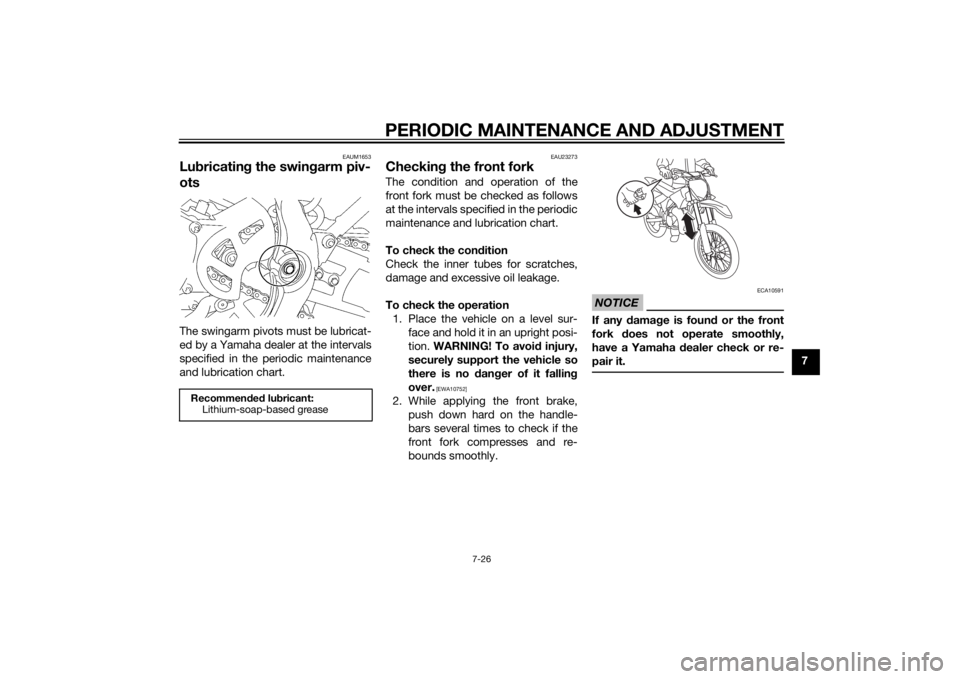
To check the operation 1. Place the vehicle on a level sur- face and hold it in an upright posi-
tion. WARNING! To avoi d injury,
securely support the vehicle so
there is no dan ger of it fallin g
over.
[EWA10752]
2. While applying the front brake, push down hard on the handle-
bars several times to check if the
front fork compresses and re-
bounds smoothly.
NOTICE
ECA10591
If any damag e is foun d or the front
fork does not operate smoothly,
have a Yamaha dealer check or re-
pair it.
Recommen ded lu bricant:
Lithium-soap-based grease
U1SN83E0.book Page 26 Monday, September 8, 2014 2:36 PM
Page 79 of 88
MOTORCYCLE CARE AND STORAGE8-1
8
EAU37834
Matte color cautionNOTICE
ECA15193
Some models are equipped with
matte colored finished parts. Be
sure to consult a Yamaha dealer for
a d vice on what prod ucts to use be-
fore cleanin g the vehicle. Usin g a
b rush, harsh chemical pro ducts or
cleanin g compoun ds when cleanin g
these parts will scratch or damag e
their surface. Wax also shoul d not
b e applie d to any matte colored fin-
ishe d parts.
EAU41359
CareWhile the open design of a motorcycle
reveals the attractiveness of the tech-
nology, it also makes it more vulnera-
ble. Rust and corrosion can develop
even if high-quality components are
used. A rusty exhaust pipe may go un-
noticed on a car, however, it detracts
from the overall appearance of a mo-
torcycle. Frequent and proper care
does not only comply with the terms of
the warranty, but it will also keep your
motorcycle looking good, extend its
life and optimize its performance.
Before cleanin g
1. Cover the muffler outlet with a plastic bag after the engine has
cooled down.
2. Make sure that all caps and cov- ers as well as all electrical cou-
plers and connectors, including
the spark plug cap, are tightly in-
stalled.
3. Remove extremely stubborn dirt, like oil burnt onto the crankcase,
with a degreasing agent and a
brush, but never apply such prod- ucts onto seals, gaskets, sprock-
ets, the drive chain and wheel
axles. Always rinse the dirt and
degreaser off with water.
Cleanin g
NOTICE
ECA17692
Avoi d usin g stron g aci dic wheel
cleaners, especially on spoked
wheels. If such pro ducts are
use d on har d-to-remove dirt, do
not leave the cleaner on the af-
fected area any lon ger than in-
structed . Also, thorou ghly rinse
the area off with water, immed i-
ately dry it, an d then apply a cor-
rosion protection spray.
Improper cleanin g can d amage
plastic parts (such as cowlin gs,
panels, etc.) an d the mufflers.
Use only a soft, clean cloth or
spon ge with water to clean
plastic. However, if the plastic
parts cannot be thorou ghly
cleaned with water, dilute d mil d
d eter gent with water may be
use d. Be sure to rinse off any
U1SN83E0.book Page 1 Monday, September 8, 2014 2:36 PM
Page 80 of 88
MOTORCYCLE CARE AND STORAGE
8-2
8d
eter gent resi due usin g plenty
of water, as it is harmful to plas-
tic parts.
Do not use any harsh chemical
prod ucts on plastic parts. Be
sure to avoi d using cloths or
spon ges which have been in
contact with stron g or a brasive
cleanin g prod ucts, solvent or
thinner, fuel ( gasoline), rust re-
movers or inhi bitors, brake flui d,
antifreeze or electrolyte.
Do not use hi gh-pressure wash-
ers or steam-jet cleaners since
they cause water seepa ge an d
d eterioration in the followin g ar-
eas: seals (of wheel an d swin g-
arm bearin gs, fork an d b rakes),
electric components (couplers,
connectors, an d switches),
b reather hoses an d vents.
After normal useRemove dirt with warm water, a mild
detergent, and a soft, clean sponge,
and then rinse thoroughly with clean
water. Use a toothbrush or bottlebrush
for hard-to-reach areas. Stubborn dirt and insects will come off more easily if
the area is covered with a wet cloth for
a few minutes before cleaning.
After riding in the rain or near the sea
Since sea salt is extremely corrosive,
carry out the following steps after each
ride in the rain or near the sea.
1. Clean the motorcycle with cold water and a mild detergent, after
the engine has cooled down.
NOTICE: Do not use warm wa-
ter since it increases the corro-
sive action of the salt.
[ECA10792]
2. Apply a corrosion protection spray on all metal, including chrome-
and nickel-plated, surfaces to pre-
vent corrosion.
After cleaning 1. Dry the motorcycle with a chamois or an absorbing cloth.
2. Immediately dry the drive chain and lubricate it to prevent it from
rusting.
3. Use a chrome polish to shine chrome, aluminum and stainless-
steel parts, including the exhaust
system. 4. To prevent corrosion, it is recom-
mended to apply a corrosion pro-
tection spray on all metal,
including chrome- and nickel-plat-
ed, surfaces.
5. Use spray oil as a universal clean- er to remove any remaining dirt.
6. Touch up minor paint damage caused by stones, etc.
7. Wax all painted surfaces.
8. Let the motorcycle dry completely before storing or covering it.
WARNING
EWA11132
Contaminants on the brakes or tires
can cause loss of control. Make sure that there is no oil or
wax on the brakes or tires.
If necessary, clean the brake
d iscs an d b rake linin gs with a
re gular brake disc cleaner or
acetone, an d wash the tires with
warm water an d a mil d d eter-
g ent. Before ri din g at hi gher
speed s, test the motorcycle’s
b rakin g performance an d cor-
nerin g b ehavior.
U1SN83E0.book Page 2 Monday, September 8, 2014 2:36 PM
Page 81 of 88
MOTORCYCLE CARE AND STORAGE8-3
8
NOTICE
ECA10801
Apply spray oil an d wax spar-
in gly an d make sure to wipe off
any excess.
Never apply oil or wax to any
rubber an d plastic parts, b ut
treat them with a suita ble care
prod uct.
Avoi d usin g a brasive polishin g
compoun ds as they will wear
away the paint.TIPConsult a Yamaha dealer for advice on
what products to use.
EAU41515
Stora geShort-term
Always store your motorcycle in a cool,
dry place and, if necessary, protect it
against dust with a porous cover. Be
sure the engine and the exhaust sys-
tem are cool before covering the mo-
torcycle.NOTICE
ECA10811
Storin g the motorcycle in a
poorly ventilated room or cover-
in g it with a tarp, while it is still
wet, will allow water an d humi d-
ity to seep in an d cause rust.
To prevent corrosion, avoi d
d amp cellars, sta bles ( because
of the presence of ammonia)
an d areas where stron g chemi-
cals are store d.Lon g-term
Before storing your motorcycle for sev-
eral months: 1. Follow all the instructions in the “Care” section of this chapter. 2. For motorcycles equipped with a
fuel cock that has an “OFF” posi-
tion: Turn the fuel cock lever to
“OFF”.
3. Drain the fuel tank and fuel lines, and the carburetor float chamber
by loosening the drain bolt; this
will prevent fuel deposits from
building up.
4. Perform the following steps to protect the cylinder, piston rings,
etc. from corrosion.a. Remove the spark plug cap and spark plug.
b. Pour a teaspoonful of engine oil into the spark plug bore.
c. Install the spark plug cap onto the spark plug, and then place
the spark plug on the cylinder
head so that the electrodes are
grounded. (This will limit spark-
ing during the next step.)
d. Turn the engine over several times with the starter. (This will
coat the cylinder wall with oil.)
e. Remove the spark plug cap from the spark plug, and then
install the spark plug and the
spark plug cap. WARNING! To
U1SN83E0.book Page 3 Monday, September 8, 2014 2:36 PM