Oul YAMAHA YZ85 2017 User Guide
[x] Cancel search | Manufacturer: YAMAHA, Model Year: 2017, Model line: YZ85, Model: YAMAHA YZ85 2017Pages: 88, PDF Size: 2.12 MB
Page 26 of 88
Instrument and control functions
4-1
4
EAU40661
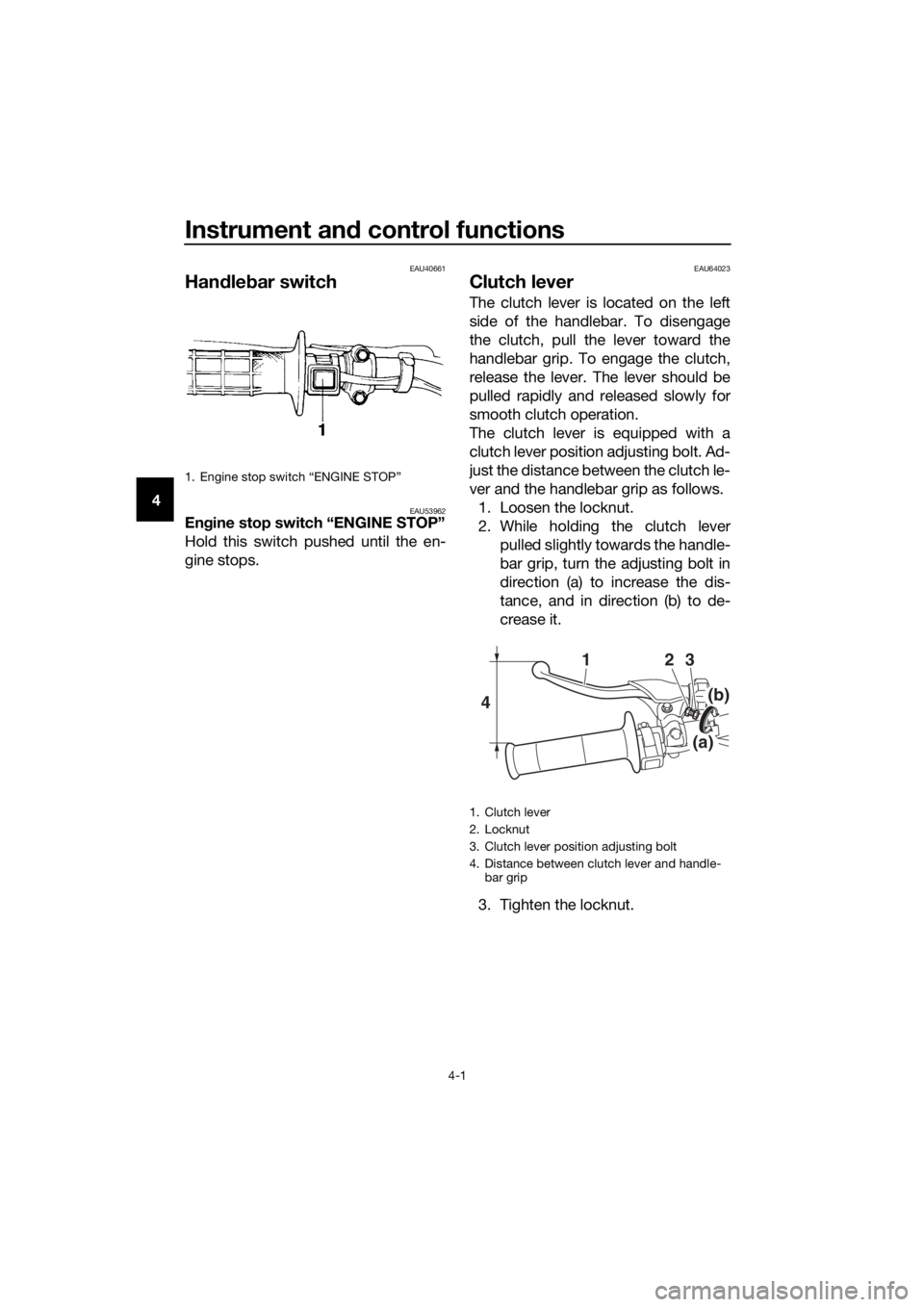
Han dle bar switch
EAU53962En gine stop switch “ENGINE STOP”
Hold this switch pushed until the en-
gine stops.
EAU64023
Clutch lever
The clutch lever is located on the left
side of the handlebar. To disengage
the clutch, pull the lever toward the
handlebar grip. To engage the clutch,
release the lever. The lever should be
pulled rapidly and released slowly for
smooth clutch operation.
The clutch lever is equipped with a
clutch lever position adjusting bolt. Ad-
just the distance between the clutch le-
ver and the handlebar grip as follows. 1. Loosen the locknut.
2. While holding the clutch lever pulled slightly towards the handle-
bar grip, turn the adjusting bolt in
direction (a) to increase the dis-
tance, and in direction (b) to de-
crease it.
3. Tighten the locknut.
1. Engine stop switch “ENGINE STOP”
1. Clutch lever
2. Locknut
3. Clutch lever position adjusting bolt
4. Distance between clutch lever and handle- bar grip
4
213
(b)
(a)
U1SN85E0.book Page 1 Friday, June 10, 2016 1:20 PM
Page 29 of 88
Instrument and control functions
4-4
4
EAU41836
Fuel
This motorcycle has been designed to
use a premixed fuel of gasoline and 2-
stroke engine oil. Always mix the gaso-
line and oil in a clean container before
filling the fuel tank.
NOTICE
ECA15602
Always use fresh g asoline, and fill
the fuel tank with a fresh mix just be-
fore ri din g. Do not use premixe d fuel
that is more than a few hours ol d.
Mixin g g asoline an d 2-stroke en gine
oil
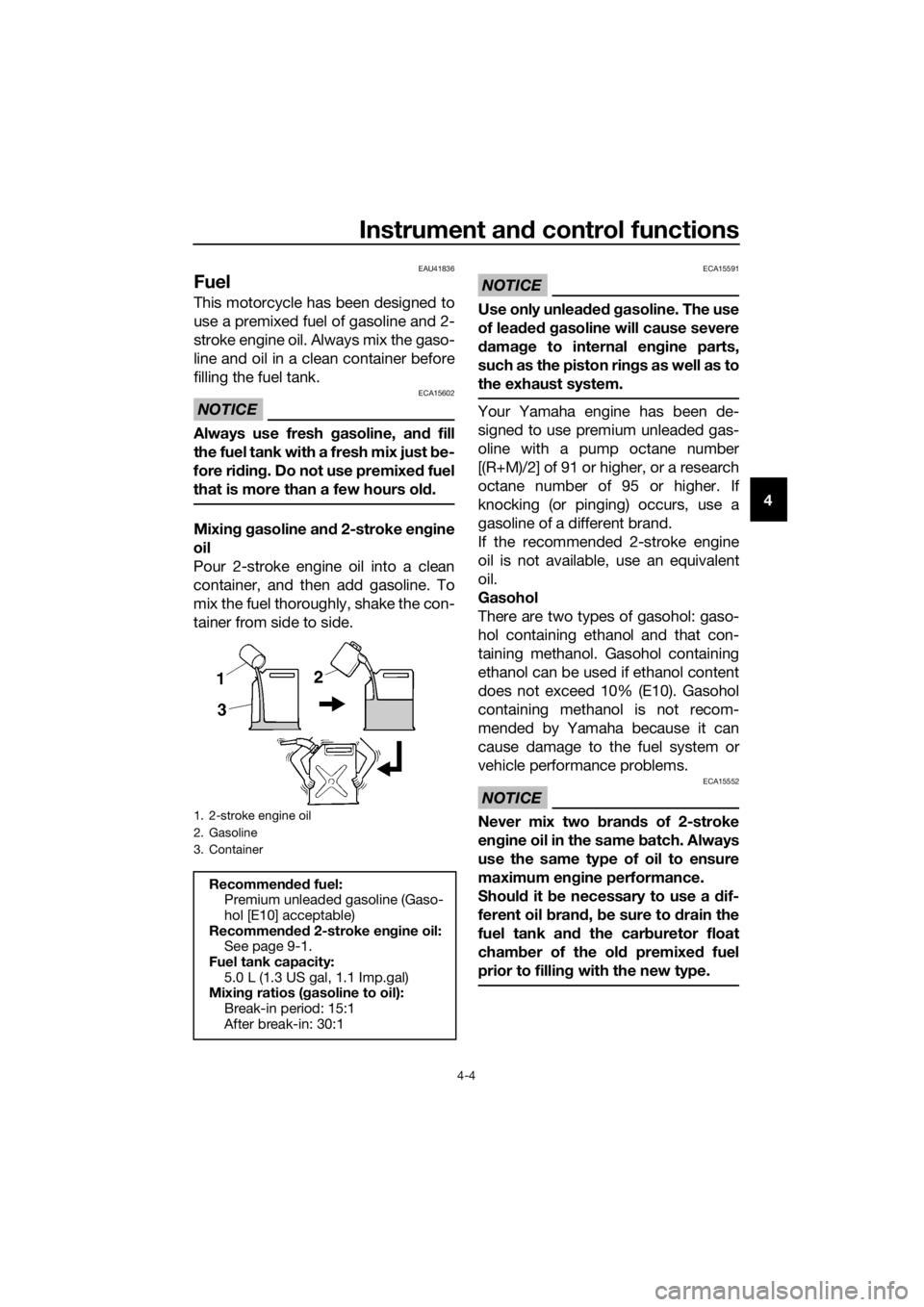
Pour 2-stroke engine oil into a clean
container, and then add gasoline. To
mix the fuel thoroughly, shake the con-
tainer from side to side.
NOTICE
ECA15591
Use only unlea ded g asoline. The use
of lead ed g asoline will cause severe
d amag e to internal en gine parts,
such as the piston rin gs as well as to
the exhaust system.
Your Yamaha engine has been de-
signed to use premium unleaded gas-
oline with a pump octane number
[(R+M)/2] of 91 or higher, or a research
octane number of 95 or higher. If
knocking (or pinging) occurs, use a
gasoline of a different brand.
If the recommended 2-stroke engine
oil is not available, use an equivalent
oil.
Gasohol
There are two types of gasohol: gaso-
hol containing ethanol and that con-
taining methanol. Gasohol containing
ethanol can be used if ethanol content
does not exceed 10% (E10). Gasohol
containing methanol is not recom-
mended by Yamaha because it can
cause damage to the fuel system or
vehicle performance problems.
NOTICE
ECA15552
Never mix two b rands of 2-stroke
en gine oil in the same b atch. Always
use the same type of oil to ensure
maximum en gine performance.
Shoul d it b e necessary to use a dif-
ferent oil bran d, b e sure to drain the
fuel tank an d the car buretor float
cham ber of the ol d premixe d fuel
prior to fillin g with the new type.1. 2-stroke engine oil
2. Gasoline
3. Container
Recommen ded fuel:
Premium unleaded gasoline (Gaso-
hol [E10] acceptable)
Recommen ded 2-stroke en gine oil:
See page 9-1.
Fuel tank capacity: 5.0 L (1.3 US gal, 1.1 Imp.gal)
Mixin g ratios ( gasoline to oil):
Break-in period: 15:1
After break-in: 30:1
U1SN85E0.book Page 4 Friday, June 10, 2016 1:20 PM
Page 30 of 88

Instrument and control functions
4-5
4 Fillin
g the fuel tank
WARNING
EWA10882
Gasoline an d g asoline vapors are
extremely flamma ble. To avoi d fires
an d explosions an d to re duce the
risk of injury when refuelin g, follow
these instructions.
1. Before refueling, turn off the en- gine and be sure that no one is sit-
ting on the vehicle. Never refuel
while smoking, or while in the vi-
cinity of sparks, open flames, or
other sources of ignition such as
the pilot lights of water heaters
and clothes dryers.
2. Do not overfill the fuel tank. Stop filling when the fuel reaches the
bottom of the filler tube. Because
fuel expands when it heats up,
heat from the engine or the sun
can cause fuel to spill out of the
fuel tank.
3. Wipe up any spilled fuel immedi- ately. NOTICE: Immediately
wipe off spille d fuel with a clean,
d ry, soft cloth, since fuel may
d eteriorate painted surfaces or
plastic parts.
[ECA10072]
4. Be sure to securely close the fuel tank cap.
WARNING
EWA15152
Gasoline is poisonous an d can cau-
se injury or death. Han dle gasoline
with care. Never siphon gasoline by
mouth. If you shoul d swallow some
g asoline or inhale a lot of gasoline
vapor, or get some g asoline in your
eyes, see your doctor imme diately. If
g asoline spills on your skin, wash
with soap an d water. If gasoline
spills on your clothin g, chan ge your
clothes.
1. Maximum fuel level
2. Fuel tank filler tube
U1SN85E0.book Page 5 Friday, June 10, 2016 1:20 PM
Page 34 of 88
Instrument and control functions
4-9
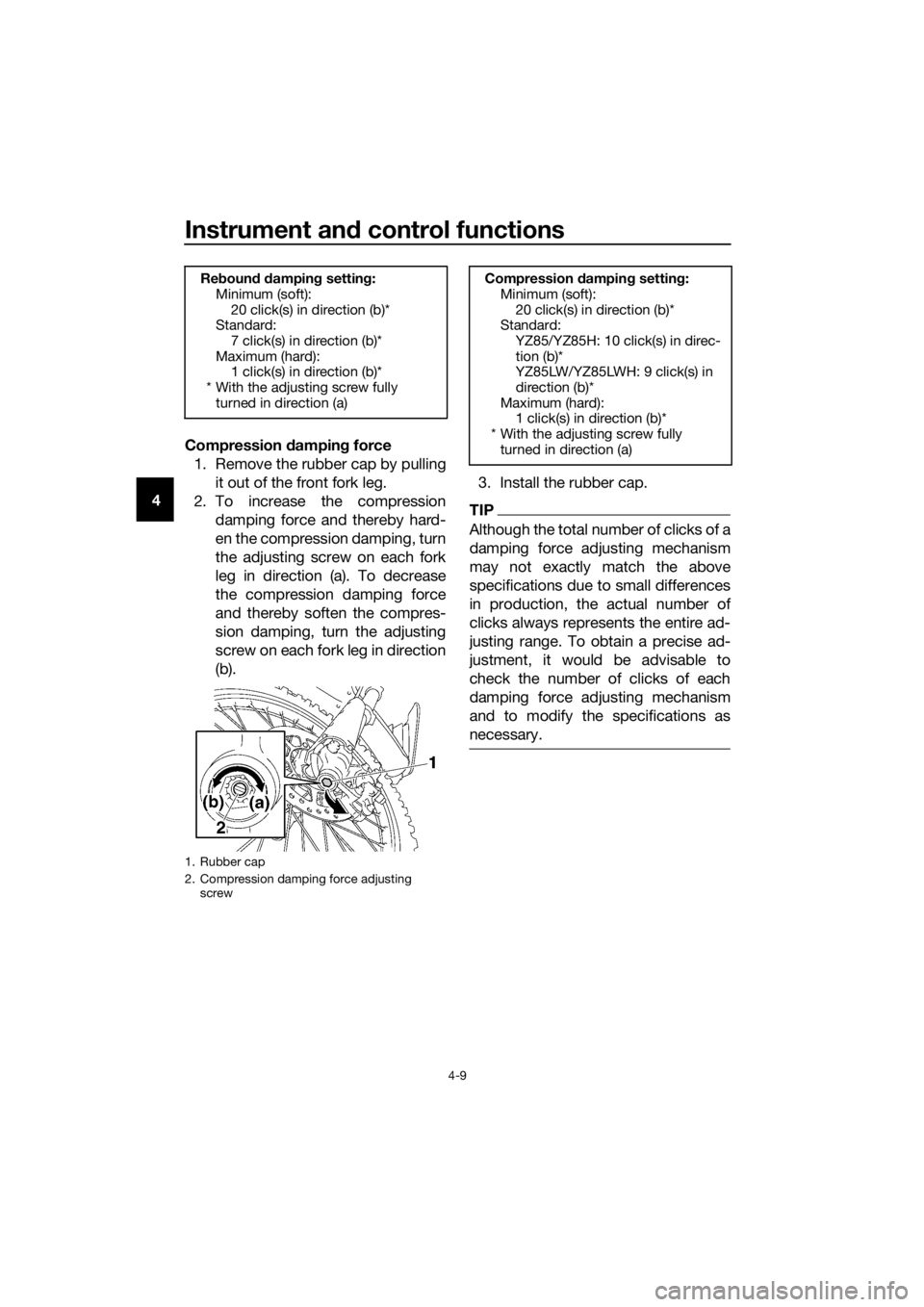
4 Compression
dampin g force
1. Remove the rubber cap by pulling it out of the front fork leg.
2. To increase the compression damping force and thereby hard-
en the compression damping, turn
the adjusting screw on each fork
leg in direction (a). To decrease
the compression damping force
and thereby soften the compres-
sion damping, turn the adjusting
screw on each fork leg in direction
(b). 3. Install the rubber cap.TIP
Although the total number of clicks of a
damping force adjusting mechanism
may not exactly match the above
specifications due to small differences
in production, the actual number of
clicks always represents the entire ad-
justing range. To obtain a precise ad-
justment, it would be advisable to
check the number of clicks of each
damping force adjusting mechanism
and to modify the specifications as
necessary.
Re
boun d d ampin g setting :
Minimum (soft): 20 click(s) in direction (b)*
Standard:
7 click(s) in direction (b)*
Maximum (hard): 1 click(s) in direction (b)*
* With the adjusting screw fully turned in direction (a)
1. Rubber cap
2. Compression damping force adjusting
screw
Compression dampin g settin g:
Minimum (soft): 20 click(s) in direction (b)*
Standard:
YZ85/YZ85H: 10 click(s) in direc-
tion (b)*
YZ85LW/YZ85LWH: 9 click(s) in
direction (b)*
Maximum (hard): 1 click(s) in direction (b)*
* With the adjusting screw fully turned in direction (a)
U1SN85E0.book Page 9 Friday, June 10, 2016 1:20 PM
Page 35 of 88
Instrument and control functions
4-10
4
EAU51651
Front fork blee din g
WARNING
EWA10201
Always blee d b oth fork le gs, other-
wise poor han dlin g an d loss of sta-
b ility may result.
When riding in extremely rough condi-
tions, the air temperature and pressure
in the front fork will rise. This will in-
crease the spring preload and harden
the front suspension. If this occurs,
bleed the front fork as follows.
1. Lift the front wheel off the ground according to the procedure on
page 7-28.
TIP
When bleeding the front fork, there
should be no weight on the front end of
the vehicle.
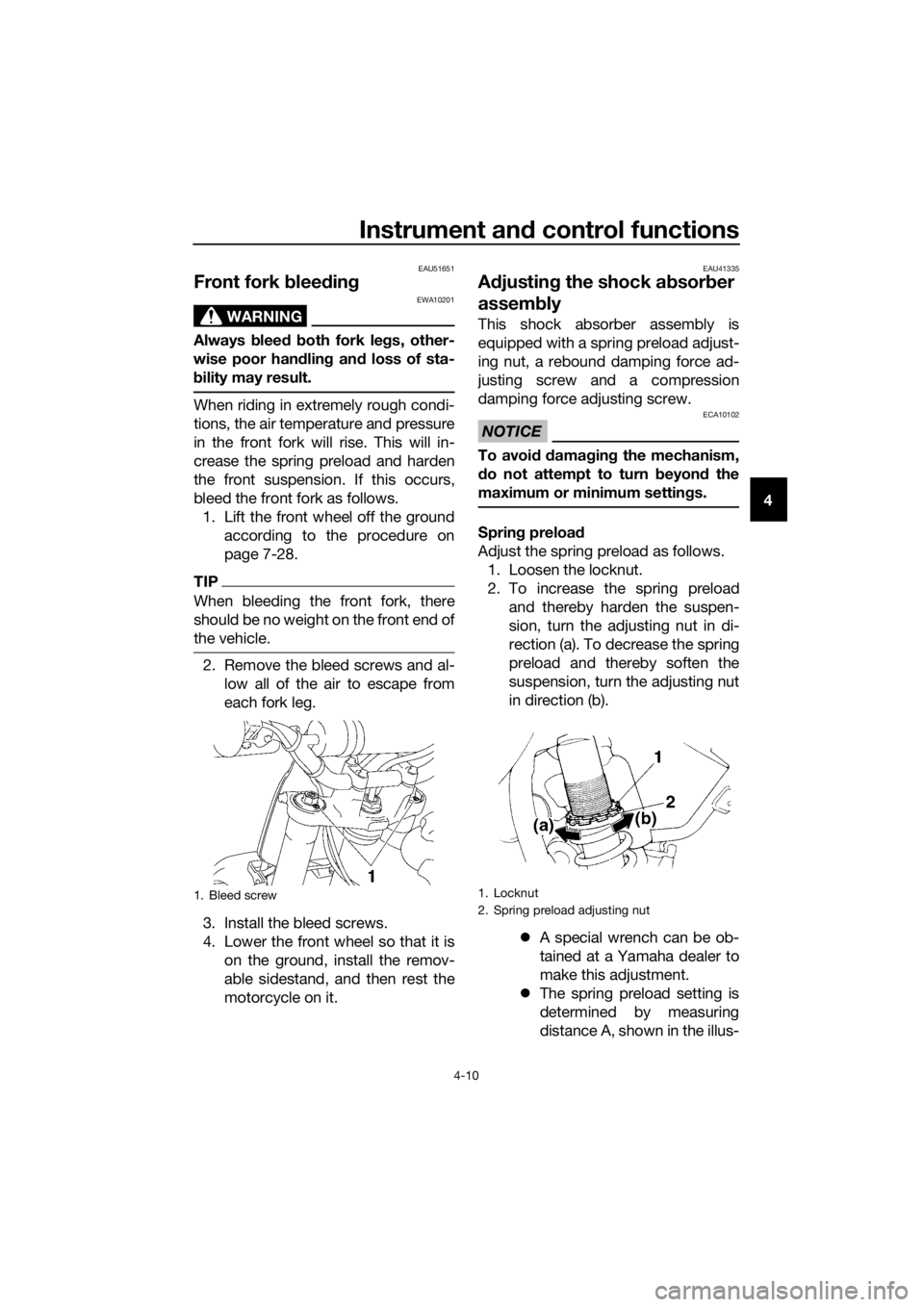
2. Remove the bleed screws and al-low all of the air to escape from
each fork leg.
3. Install the bleed screws.
4. Lower the front wheel so that it is on the ground, install the remov-
able sidestand, and then rest the
motorcycle on it.
EAU41335
Adjustin g the shock a bsor ber
assem bly
This shock absorber assembly is
equipped with a spring preload adjust-
ing nut, a rebound damping force ad-
justing screw and a compression
damping force adjusting screw.
NOTICE
ECA10102
To avoi d d amag ing the mechanism,
d o not attempt to turn b eyond the
maximum or minimum settin gs.
Sprin g preloa d
Adjust the spring preload as follows. 1. Loosen the locknut.
2. To increase the spring preload and thereby harden the suspen-
sion, turn the adjusting nut in di-
rection (a). To decrease the spring
preload and thereby soften the
suspension, turn the adjusting nut
in direction (b).
A special wrench can be ob-
tained at a Yamaha dealer to
make this adjustment.
The spring preload setting is
determined by measuring
distance A, shown in the illus-
1. Bleed screw1. Locknut
2. Spring preload adjusting nut
U1SN85E0.book Page 10 Friday, June 10, 2016 1:20 PM
Page 41 of 88
Operation and important ri din g points
6-1
6
EAU15952
Read the Owner’s Manual carefully to
become familiar with all controls. If
there is a control or function you do not
understand, ask your Yamaha dealer.
WARNING
EWA10272
Failure to familiarize yourself with
the controls can lead to loss of con-
trol, which coul d cause an acci dent
or injury.
EAU41308
Startin g an d warmin g up a
col d en gine
1. Turn the fuel cock lever to “ON”.
2. Shift the transmission into the
neutral position.
3. Turn the starter (choke) on and completely close the throttle. (See
page 4-7.)
4. Start the engine by pushing the kickstarter lever down.
5. When the engine is warm, turn the starter (choke) off.
TIP
The engine is warm when it responds
quickly to the throttle with the starter
(choke) turned off.
NOTICE
ECA11043
For maximum en gine life, never ac-
celerate har d when the en gine is
col d!
U1SN85E0.book Page 1 Friday, June 10, 2016 1:20 PM
Page 44 of 88

Operation and important rid ing points
6-4
6 be used, but sustained full-throttle
operation should be avoided.
Stop the engine and check the
spark plug again.
6. Allow the engine to cool, remove the cylinder head and cylinder,
and inspect the piston and cylin-
der. Remove any high spots on
the piston with #600-grit wet
sandpaper. Clean all components
and carefully reassemble the cyl-
inder head and cylinder.
7. Drain the break-in oil-fuel mixture from the fuel tank and refill with
the specified mix. (See page 4-4.)
8. Start the engine and check the op- eration of the motorcycle through-
out its entire operating range.
Stop the engine and check the
spark plug condition. Restart the
motorcycle and ride it for about 10
to 15 more minutes. The motorcy-
cle will now be ready to ride nor-
mally.
After the engine break-in period, thor-
oughly check the motorcycle for loose
parts, oil leakage and any other prob-
lems. Be sure to inspect and make ad-
justments thoroughly, especially cable
and drive chain slack and loose
spokes. In addition, check all fittings
and fasteners for looseness, and tight-
en if necessary.
NOTICE
ECA15561
When any of the following parts
have been replaced , they must
b e broken in.
Cylin der or crankshaft:
A bout one hour of b reak-in op-
eration is necessary. Piston, rin
gs or transmission
g ears:
These parts require a bout 30
minutes of b reak-in operation at
half-throttle or less. O bserve the
con dition of the en gine carefully
d urin g operation.
If any en gine trou ble shoul d oc-
cur durin g the en gine break-in
perio d, imme diately have a
Yamaha dealer check the vehi-
cle.
U1SN85E0.book Page 4 Friday, June 10, 2016 1:20 PM
Page 46 of 88
Periodic maintenance an d a djustment
7-1
7
EAU42074
Periodic inspection, adjustment, and
lubrication will keep your vehicle in the
safest and most efficient condition
possible. Safety is an obligation of the
vehicle owner/operator. The most im-
portant points of vehicle inspection,
adjustment, and lubrication are ex-
plained on the following pages.
The intervals given in the periodic
maintenance and lubrication chart
should be simply considered as a gen-
eral guide under normal riding condi-
tions. However, depending on the
weather, terrain, geographical location,
and individual use, the maintenance in-
tervals may need to be shortened.
WARNING
EWA10322
Failure to properly maintain the vehi-
cle or performin g maintenance ac-
tivities incorrectly may increase
your risk of injury or d eath durin g
service or while usin g the vehicle. If
you are not familiar with vehicle ser-
vice, have a Yamaha d ealer perform
service.
WARNING
EWA15123
Turn off the en gine when performin g
maintenance unless otherwise
specified .
A runnin g en gine has movin g
parts that can catch on body
parts or clothin g an d electrical
parts that can cause shocks or
fires.
Runnin g the en gine while ser-
vicin g can lead to eye injury,
b urns, fire, or car bon monoxi de
poisonin g – possi bly lea din g to d
eath. See pag e 2-2 for more in-
formation a bout car bon monox-
i d e.
WARNING
EWA15461
Brake discs, calipers, drums, an d
linin gs can b ecome very hot during
use. To avoi d possi ble burns, let
b rake components cool before
touchin g them.
U1SN85E0.book Page 1 Friday, June 10, 2016 1:20 PM
Page 47 of 88
Periodic maintenance an d a djustment
7-2
7
EAU66350
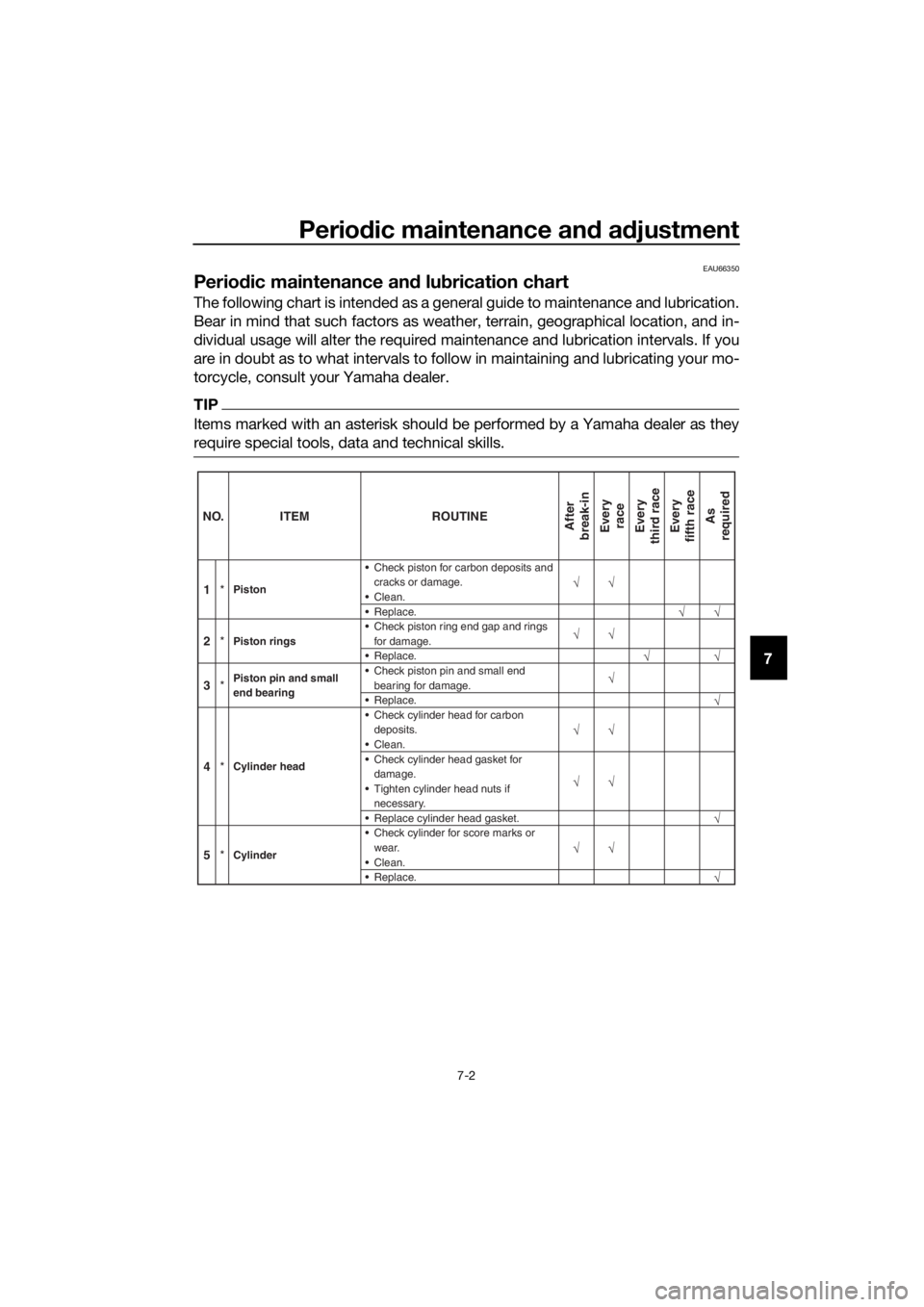
Perio dic maintenance an d lu brication chart
The following chart is intended as a general guide to maintenance and lubrication.
Bear in mind that such factors as weather, terrain, geographical location, and in-
dividual usage will alter the required maintenance and lubrication intervals. If you
are in doubt as to what intervals to follow in maintaining and lubricating your mo-
torcycle, consult your Yamaha dealer.
TIP
Items marked with an asterisk should be performed by a Yamaha dealer as they
require special tools, data and technical skills.
NO. ITEM ROUTINEAfter
break-in
Everyrace
Every
third race
Every
fifth race
As
required
1 *Piston Check piston for carbon deposits and
cracks or damage.√√ Clean.
Replace.
√√
2 *
Piston rings Check piston ring end gap and rings
for damage.√√
Replace.√√
3 *
Piston pin and small
end bearing Check piston pin and small end
bearing for damage.√
Replace.√
4 *
Cylinder head Check cylinder head for carbon
deposits.
√√ Clean.
Check cylinder head gasket for damage.
√√ Tighten cylinder head nuts if necessary.
Replace cylinder head gasket.
√
5 *
Cylinder Check cylinder for score marks or
wear.√√ Clean.
Replace.
√
U1SN85E0.book Page 2 Friday, June 10, 2016 1:20 PM
Page 51 of 88
Periodic maintenance an d a djustment
7-6
7
EAU19614
Checkin g the spark plu g
The spark plug is an important engine
component, which is easy to check.
Since heat and deposits will cause any
spark plug to slowly erode, the spark
plug should be removed and checked
in accordance with the periodic main-
tenance and lubrication chart. In addi-
tion, the condition of the spark plug
can reveal the condition of the engine.
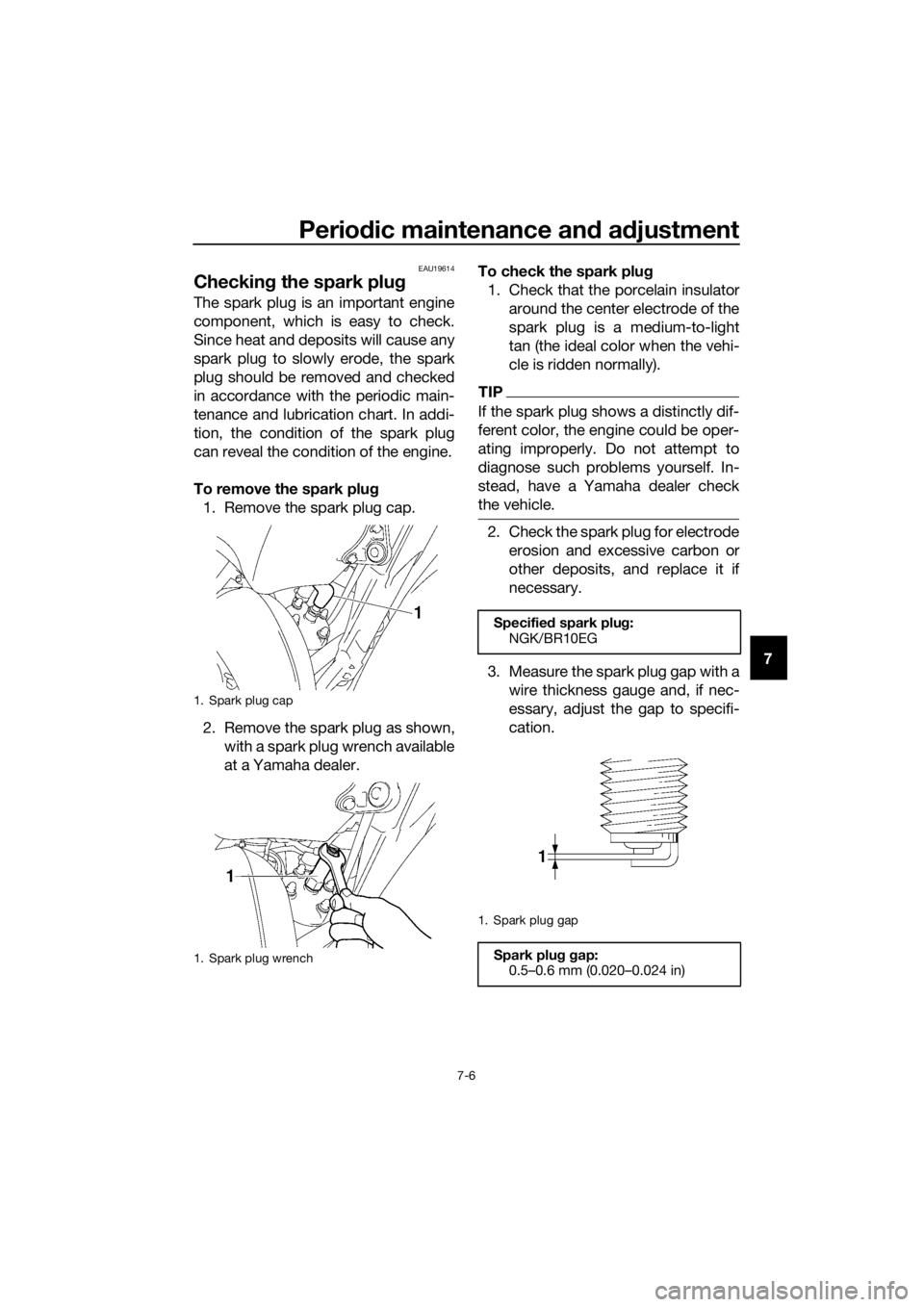
To remove the spark plu g
1. Remove the spark plug cap.
2. Remove the spark plug as shown, with a spark plug wrench available
at a Yamaha dealer. To check the spark plu
g
1. Check that the porcelain insulator around the center electrode of the
spark plug is a medium-to-light
tan (the ideal color when the vehi-
cle is ridden normally).
TIP
If the spark plug shows a distinctly dif-
ferent color, the engine could be oper-
ating improperly. Do not attempt to
diagnose such problems yourself. In-
stead, have a Yamaha dealer check
the vehicle.
2. Check the spark plug for electrodeerosion and excessive carbon or
other deposits, and replace it if
necessary.
3. Measure the spark plug gap with a wire thickness gauge and, if nec-
essary, adjust the gap to specifi-
cation.
1. Spark plug cap
1. Spark plug wrench
Specified spark plu g:
NGK/BR10EG
1. Spark plug gap
Spark plu g g ap:
0.5–0.6 mm (0.020–0.024 in)
U1SN85E0.book Page 6 Friday, June 10, 2016 1:20 PM