light YAMAHA YZ85 2022 Owners Manual
[x] Cancel search | Manufacturer: YAMAHA, Model Year: 2022, Model line: YZ85, Model: YAMAHA YZ85 2022Pages: 90, PDF Size: 2.63 MB
Page 24 of 90

Safety information
2-4
2products or having other modifications
performed to your vehicle that change
any of the vehicle’s design or operation
characteristics can put you and others
at greater risk of serious injury or
death. You are responsible for injuries
related to changes in the vehicle.
Keep the following guidelines in mind,
as well as those provided under “Load-
ing” when mounting accessories.
Never install accessories that
would impair the performance of
your motorcycle. Carefully inspect
the accessory before using it to
make sure that it does not in any
way reduce ground clearance or
cornering clearance, limit suspen-
sion travel, steering travel or con-
trol operation.
• Accessories fitted to the han- dlebar or the front fork area can
create instability due to improp-
er weight distribution. If acces-
sories are added to the
handlebar or front fork area,
they must be as lightweight as
possible and should be kept to
a minimum. • Bulky or large accessories may
seriously affect the stability of
the motorcycle. Wind may at-
tempt to lift the motorcycle, or
the motorcycle may become
unstable in cross winds.
• Certain accessories can dis- place the operator from his or
her normal riding position. This
improper position limits the
freedom of movement of the
operator and may limit control
ability, therefore, such accesso-
ries are not recommended.
Use caution when adding electri-
cal accessories. If electrical ac-
cessories exceed the capacity of
the motorcycle’s electrical sys-
tem, an electric failure could re-
sult, which could cause a
dangerous loss of lights or engine
power.
Aftermarket Tires an d Rims
The tires and rims that came with your
motorcycle were designed to match
the performance capabilities and to
provide the best combination of han-
dling, braking, and comfort. Other tires, rims, sizes, and combinations
may not be appropriate. Refer to page
7-14 for tire specifications and more in-
formation on replacing your tires.
Transportin
g the Motorcycle
Be sure to observe following instruc-
tions before transporting the motorcy-
cle in another vehicle. Remove all loose items from the
motorcycle.
Check that the fuel cock (if
equipped) is in the “OFF” position
and that there are no fuel leaks.
Point the front wheel straight
ahead on the trailer or in the truck
bed, and choke it in a rail to pre-
vent movement.
Shift the transmission in gear (for
models with a manual transmis-
sion).
Secure the motorcycle with tie-
downs or suitable straps that are
attached to solid parts of the mo-
torcycle, such as the frame or up-
per front fork triple clamp (and not,
for example, to rubber-mounted
handlebars or turn signals, or
parts that could break). Choose
UB4B83E0.book Page 4 Thursday, September 9, 2021 8:47 AM
Page 29 of 90
Instrument and control functions
4-1
4
EAU40661
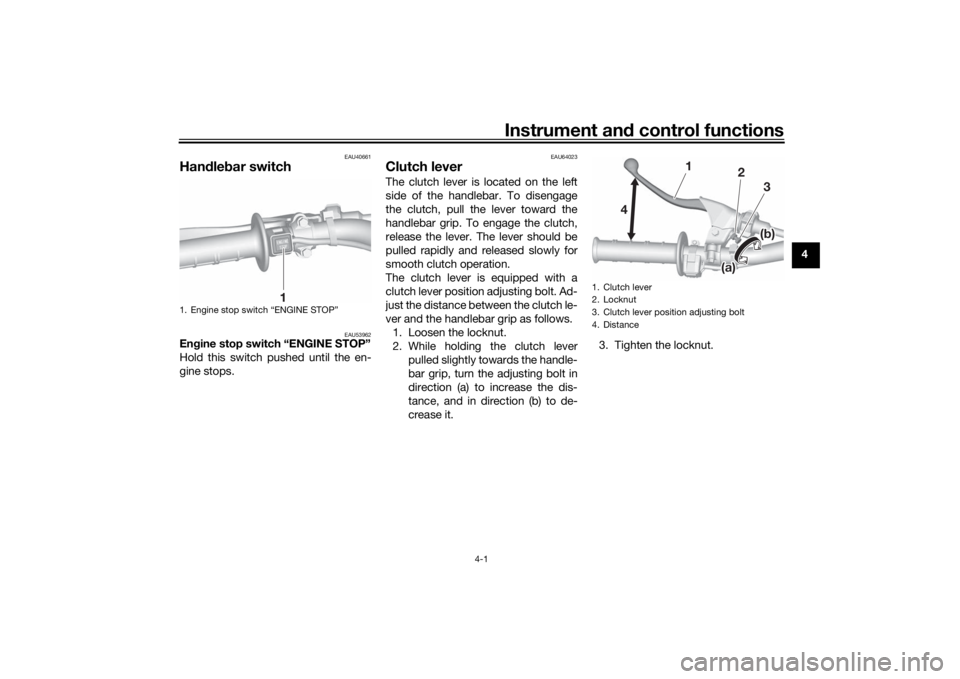
Han dle bar switch
EAU53962
En gine stop switch “ENGINE STOP”
Hold this switch pushed until the en-
gine stops.
EAU64023
Clutch leverThe clutch lever is located on the left
side of the handlebar. To disengage
the clutch, pull the lever toward the
handlebar grip. To engage the clutch,
release the lever. The lever should be
pulled rapidly and released slowly for
smooth clutch operation.
The clutch lever is equipped with a
clutch lever position adjusting bolt. Ad-
just the distance between the clutch le-
ver and the handlebar grip as follows. 1. Loosen the locknut.
2. While holding the clutch lever pulled slightly towards the handle-
bar grip, turn the adjusting bolt in
direction (a) to increase the dis-
tance, and in direction (b) to de-
crease it. 3. Tighten the locknut.
1. Engine stop switch “ENGINE STOP”
1
1. Clutch lever
2. Locknut
3. Clutch lever position adjusting bolt
4. Distance
1
2
4
3(b) (b)
(a) (a) (b)
(a)
UB4B83E0.book Page 1 Thursday, September 9, 2021 8:47 AM
Page 33 of 90
Instrument and control functions
4-5
4
Gasohol
There are two types of gasohol: gaso-
hol containing ethanol and that con-
taining methanol. Gasohol containing
ethanol can be used if the ethanol con-
tent does not exceed 10% (E10). Gas-
ohol containing methanol should not
be used as it can cause engine or fuel
system problems.
Fillin
g the fuel tank
WARNING
EWA10882
Gasoline an d gasoline vapors are
extremely flammab le. To avoid fires
an d explosions an d to re duce the
risk of injury when refueling , follow
these instructions.1. Before refueling, turn off the en- gine and be sure that no one is sit-
ting on the vehicle. Never refuel
while smoking, or while in the vi-
cinity of sparks, open flames, or
other sources of ignition such as
the pilot lights of water heaters
and clothes dryers.
2. Do not overfill the fuel tank. Stop filling when the fuel reaches the
bottom of the filler tube. Because
fuel expands when it heats up,
heat from the engine or the sun
can cause fuel to spill out of the
fuel tank.
3. Wipe up any spilled fuel immedi- ately. NOTICE: Immediately
wipe off spille d fuel with a clean,
d ry, soft cloth, since fuel may
d eteriorate painte d surfaces or
plastic parts.
[ECA10072]
4. Be sure to securely close the fuel tank cap.
WARNING
EWA15152
Gasoline is poisonous an d can
cause injury or death. Han dle gaso-
line with care. Never siphon gasoline
b y mouth. If you shoul d swallow
some gasoline or inhale a lot of g as-
oline vapor, or get some gasoline in
your eyes, see your doctor imme di-
ately. If g asoline spills on your skin,
wash with soap an d water. If gaso-
line spills on your clothin g, chan ge
your clothes.
1. Maximum fuel level
2. Fuel tank filler tube
1
2
UB4B83E0.book Page 5 Thursday, September 9, 2021 8:47 AM
Page 35 of 90
Instrument and control functions
4-7
4
EAU13641
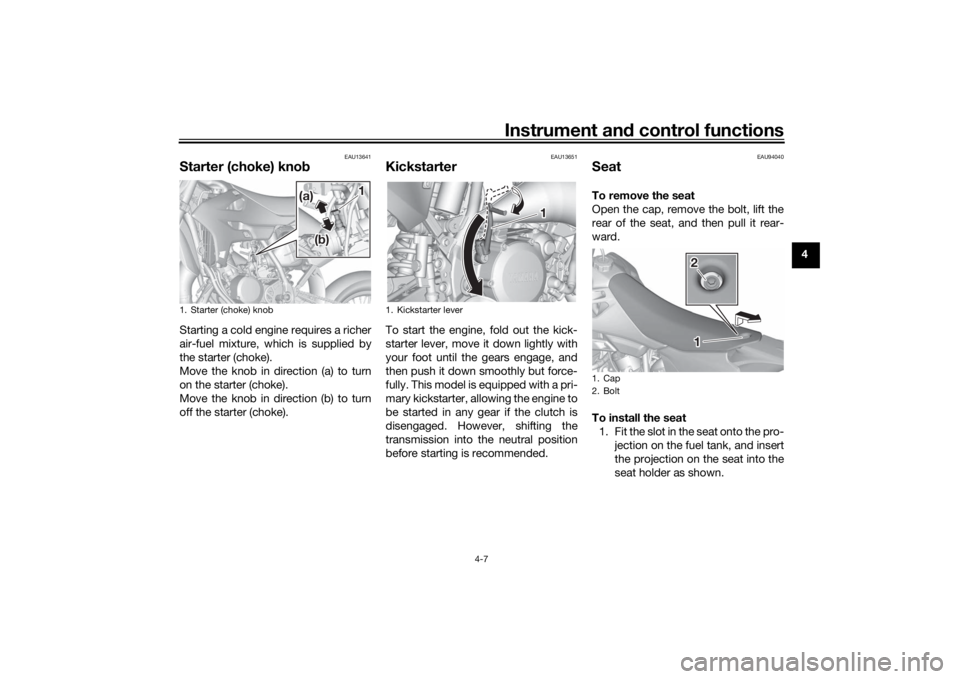
Starter (choke) kno bStarting a cold engine requires a richer
air-fuel mixture, which is supplied by
the starter (choke).
Move the knob in direction (a) to turn
on the starter (choke).
Move the knob in direction (b) to turn
off the starter (choke).
EAU13651
KickstarterTo start the engine, fold out the kick-
starter lever, move it down lightly with
your foot until the gears engage, and
then push it down smoothly but force-
fully. This model is equipped with a pri-
mary kickstarter, allowing the engine to
be started in any gear if the clutch is
disengaged. However, shifting the
transmission into the neutral position
before starting is recommended.
EAU94040
SeatTo remove the seat
Open the cap, remove the bolt, lift the
rear of the seat, and then pull it rear-
ward.
To install the seat
1. Fit the slot in the seat onto the pro- jection on the fuel tank, and insert
the projection on the seat into the
seat holder as shown.
1. Starter (choke) knob
(a) (a)
(b) (b)
(a)
1 1
(b)
1. Kickstarter lever
1 1
1. Cap
2. Bolt
2 21 1
UB4B83E0.book Page 7 Thursday, September 9, 2021 8:47 AM
Page 47 of 90
Operation and important ri din g points
6-2
6
der. Remove any high spots on
the piston with #600-grit wet
sandpaper. Clean all components
and carefully reassemble the cyl-
inder head and cylinder.
7. Drain the break-in oil-fuel mixture from the fuel tank and refill with
the normal oil-fuel mixture. (See
page 4-3.)
8. Start the engine and check its power delivery and throttle re-
sponse throughout all gear rang-
es. Stop the engine and check the
spark plug condition. It should be-
gin to lighten in color.
9. Restart the motorcycle and ride it for about 10 to 15 more minutes.
Stop the engine and check the
spark plug condition. (See page
7-7.)
10. Lastly, thoroughly check the mo- torcycle for loose parts, oil leak-
age and any other problems.
Check all fittings and fasteners
and tighten as necessary.
TIPBe sure to inspect and make adjust-
ments thoroughly. In particular, check
control cable slack, drive chain slack
and for loose spokes.Notes on en gine overhauls
If the following parts have been re-
placed, they must be broken in as fol-
lows. Piston, rings or transmission
gears: 30 minutes of break-in op-
eration at half-throttle or less.
Cylinder or crankshaft: 60 minutes
of break-in operation is necessary.TIPObserve the condition of the engine
carefully during break-in operation.NOTICE
ECA10271
If any en gine trou ble shoul d occur
d urin g the en gine break-in perio d,
imme diately have a Yamaha dealer
check the vehicle.
EAU41308
Startin g an d warmin g up a
col d en gine1. Turn the fuel cock lever to “ON”.
2. Shift the transmission into the
neutral position.
3. Turn the starter (choke) on and completely close the throttle. (See
page 4-7.)
4. Start the engine by pushing the kickstarter lever down.
5. When the engine is warm, turn the starter (choke) off.TIPThe engine is warm when it responds
quickly to the throttle with the starter
(choke) turned off.NOTICE
ECA11043
For maximum en gine life, never ac-
celerate har d when the en gine is
col d!
UB4B83E0.book Page 2 Thursday, September 9, 2021 8:47 AM
Page 48 of 90
Operation and important rid ing points
6-3
6
EAU16661
Startin g a warm en gineFollow the same procedure as for
starting a cold engine with the excep-
tion that the starter (choke) is not re-
quired when the engine is warm.
Instead, start the engine with the throt-
tle slightly open.TIPIf the engine does not start after sever-
al kicks, try again with the throttle 1/4
to 1/2 open.
EAU16675
Shiftin gShifting gears lets you control the
amount of engine power available for
starting off, accelerating, climbing hills,
etc.
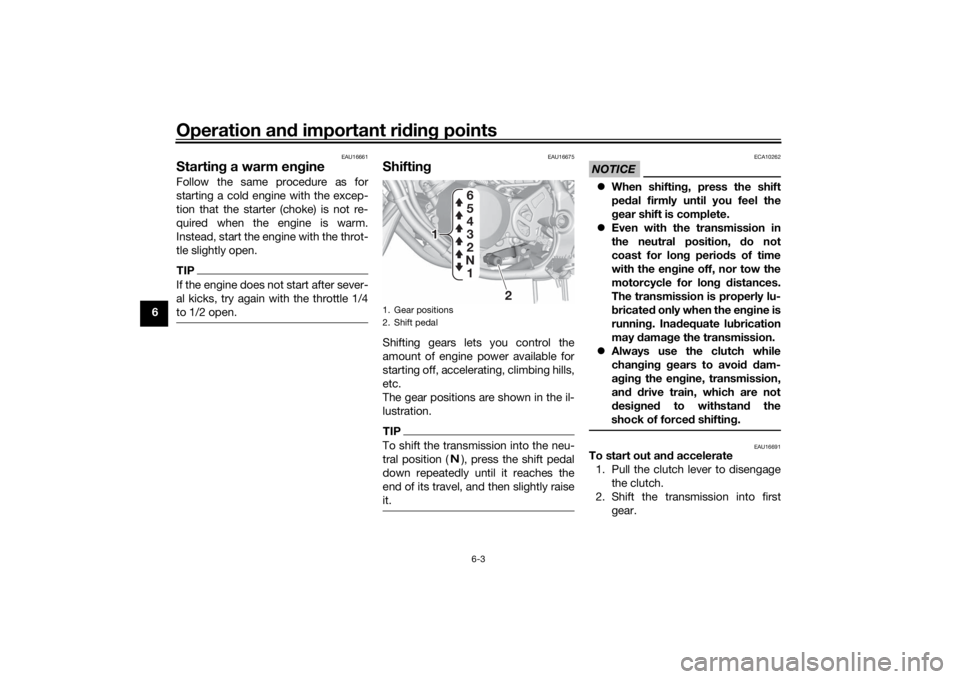
The gear positions are shown in the il-
lustration.TIPTo shift the transmission into the neu-
tral position ( ), press the shift pedal
down repeatedly until it reaches the
end of its travel, and then slightly raise
it.
NOTICE
ECA10262
When shiftin g, press the shift
pe dal firmly until you feel the
g ear shift is complete.
Even with the transmission in
the neutral position, do not
coast for lon g period s of time
with the en gine off, nor tow the
motorcycle for lon g d istances.
The transmission is properly lu-
b ricate d only when the en gine is
runnin g. Ina dequate lu brication
may damag e the transmission.
Always use the clutch while
chan gin g g ears to avoi d d am-
a g in g the en gine, transmission,
an d d rive train, which are not
d esi gne d to withstan d the
shock of force d shiftin g.
EAU16691
To start out an d accelerate
1. Pull the clutch lever to disengage the clutch.
2. Shift the transmission into first gear.
1. Gear positions
2. Shift pedal
2
11
1
N 2 3
4
5
6
UB4B83E0.book Page 3 Thursday, September 9, 2021 8:47 AM
Page 56 of 90
Periodic maintenance an d a djustment
7-7
7
EAU84450
Checkin g the spark plu gThe spark plug is an important engine
component, which is easy to check.
Since heat and deposits will cause any
spark plug to slowly erode, the spark
plug should be removed and checked
in accordance with the periodic main-
tenance and lubrication chart. In addi-
tion, the condition of the spark plug
can reveal the condition of the engine.
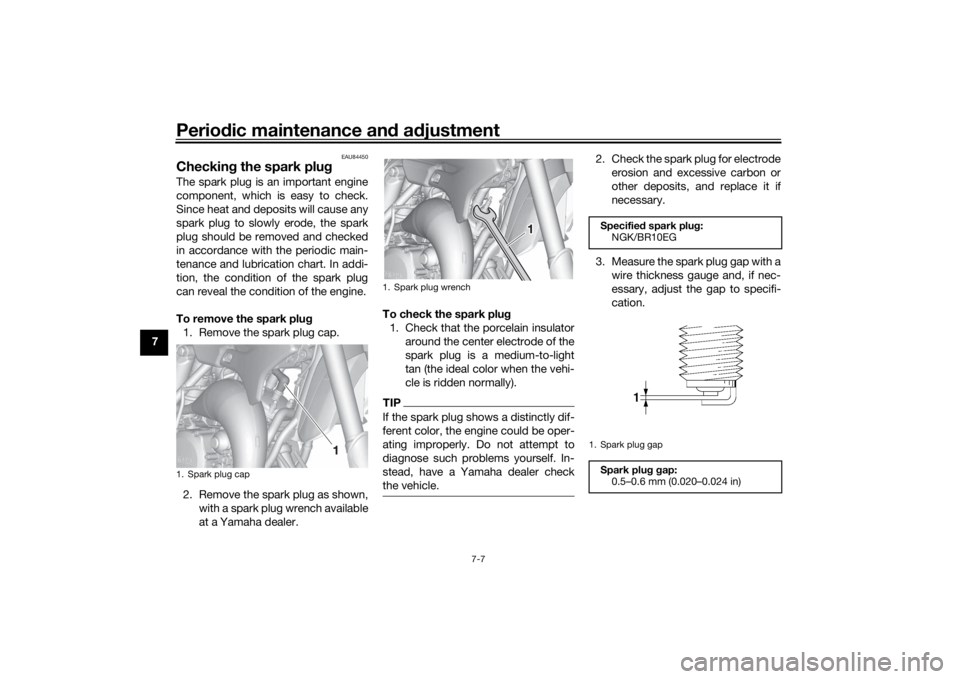
To remove the spark plu g
1. Remove the spark plug cap.
2. Remove the spark plug as shown, with a spark plug wrench available
at a Yamaha dealer. To check the spark plu
g
1. Check that the porcelain insulator around the center electrode of the
spark plug is a medium-to-light
tan (the ideal color when the vehi-
cle is ridden normally).
TIPIf the spark plug shows a distinctly dif-
ferent color, the engine could be oper-
ating improperly. Do not attempt to
diagnose such problems yourself. In-
stead, have a Yamaha dealer check
the vehicle.
2. Check the spark plug for electrodeerosion and excessive carbon or
other deposits, and replace it if
necessary.
3. Measure the spark plug gap with a wire thickness gauge and, if nec-
essary, adjust the gap to specifi-
cation.
1. Spark plug cap
1
1. Spark plug wrench
1 1
Specifie d spark plu g:
NGK/BR10EG1. Spark plug gapSpark plu g g ap:
0.5–0.6 mm (0.020–0.024 in)
UB4B83E0.book Page 7 Thursday, September 9, 2021 8:47 AM
Page 58 of 90
Periodic maintenance an d a djustment
7-9
7
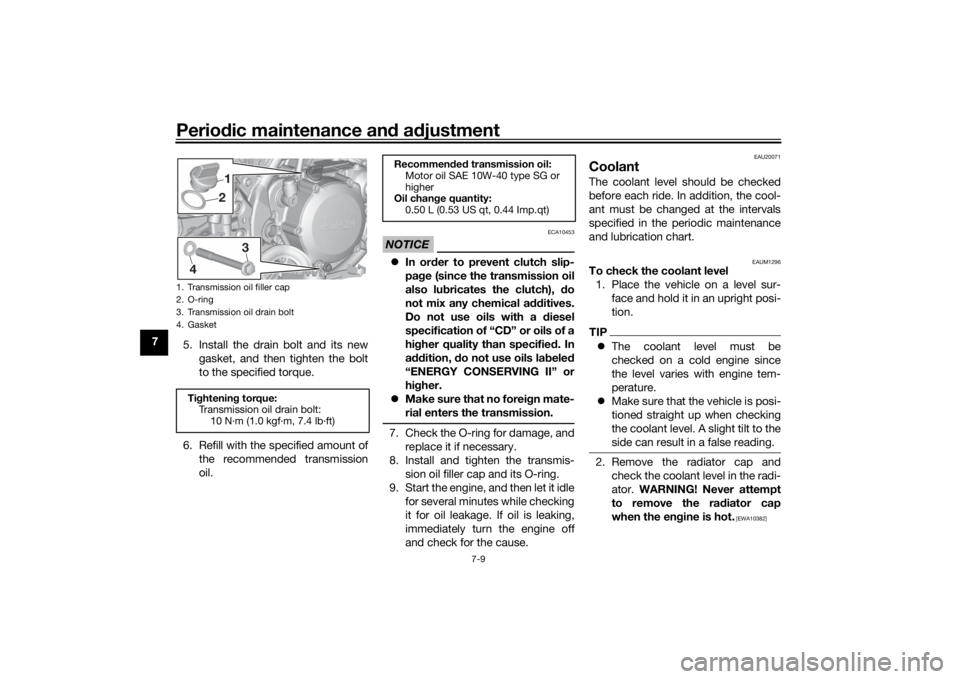
5. Install the drain bolt and its new
gasket, and then tighten the bolt
to the specified torque.
6. Refill with the specified amount of the recommended transmission
oil.
NOTICE
ECA10453
In or der to prevent clutch slip-
pa ge (since the transmission oil
also lu bricates the clutch), d o
not mix any chemical additives.
Do not use oils with a d iesel
specification of “CD” or oils of a
hi gher quality than specifie d. In
a ddition, do not use oils la beled
“ENERGY CONSERVING II” or
hi gher.
Make sure that no forei gn mate-
rial enters the transmission.7. Check the O-ring for damage, and replace it if necessary.
8. Install and tighten the transmis- sion oil filler cap and its O-ring.
9. Start the engine, and then let it idle for several minutes while checking
it for oil leakage. If oil is leaking,
immediately turn the engine off
and check for the cause.
EAU20071
CoolantThe coolant level should be checked
before each ride. In addition, the cool-
ant must be changed at the intervals
specified in the periodic maintenance
and lubrication chart.
EAUM1296
To check the coolant level1. Place the vehicle on a level sur- face and hold it in an upright posi-
tion.TIPThe coolant level must be
checked on a cold engine since
the level varies with engine tem-
perature.
Make sure that the vehicle is posi-
tioned straight up when checking
the coolant level. A slight tilt to the
side can result in a false reading.2. Remove the radiator cap and
check the coolant level in the radi-
ator. WARNING! Never attempt
to remove the ra diator cap
when the en gine is hot.
[EWA10382]
1. Transmission oil filler cap
2. O-ring
3. Transmission oil drain bolt
4. GasketTi ghtenin g torque:
Transmission oil drain bolt: 10 N·m (1.0 kgf·m, 7.4 lb·ft)
12
4
3
Recommen ded transmission oil:
Motor oil SAE 10W-40 type SG or
higher
Oil chan ge quantity:
0.50 L (0.53 US qt, 0.44 Imp.qt)
UB4B83E0.book Page 9 Thursday, September 9, 2021 8:47 AM
Page 82 of 90

Motorcycle care and stora ge
8-2
8 chemicals such as, solvents,
g
asoline, rust removers, b rake
flui d, or antifreeze, etc.
Before washin g
1. Park the vehicle out of direct sun- light and allow it to cool. This will
help avoid water spots.
2. Make sure all caps, covers, elec- trical couplers and connectors are
tightly installed.
3. Cover the muffler end with a plas- tic bag and a strong rubber band.
4. Pre-soak stubborn stains like in- sects or bird droppings with a wet
towel for a few minutes.
5. Remove road grime and oil stains with a quality degreasing agent
and a plastic-bristle brush or
sponge. NOTICE: Do not use
d eg reasin g a gent on areas re-
quirin g lu brication such as
seals, gaskets, an d wheel axles.
Follow prod uct instructions.
[ECA26290]
Washing
1. Rinse off any degreaser and spray down the vehicle with a garden
hose. Use only enough pressure
to do the job. Avoid spraying wa-
ter directly into the muffler, instru-
ment panel, air inlet, or other inner
areas such as underseat storage
compartments.
2. Wash the vehicle with a quality au- tomotive-type detergent mixed
with cool water and a soft, clean
towel or sponge. Use an old tooth-
brush or plastic-bristle brush for
hard-to-reach places. NOTICE:
Use col d water if the vehicle has
b een exposed to salt. Warm wa-
ter will increase salt’s corrosive
properties.
[ECA26301]
3. For windshield-equipped vehicles: Clean the windshield with a soft
towel or sponge dampened with
water and a pH neutral detergent.
If necessary, use a high-quality
windshield cleaner or polish for
motorcycles. NOTICE: Never use
any stron g chemicals to clean
the win dshiel d. A dditionally,
some cleanin g compoun ds for plastic may scratch the win
d-
shiel d, so b e sure to test all
cleanin g prod ucts before gen-
eral application.
[ECA26310]
4. Rinse off thoroughly with clean water. Be sure to remove all deter-
gent residues, as they can be
harmful to plastic parts.
After washin g
1. Dry the vehicle with a chamois or absorbent towel, preferably mi-
crofiber terrycloth.
2. For drive chain-equipped models: Dry and then lubricate the drive
chain to prevent rust.
3. Use a chrome polish to shine chrome, aluminum, and stainless
steel parts. Often the thermally in-
duced discoloring of stainless
steel exhaust systems can be re-
moved through polishing.
4. Apply a corrosion protection spray on all metal parts including
chrome or nickel-plated surfaces.
WARNING! Do not apply sili-
cone or oil spray to seats, han d
g rips, ru bber foot peg s or tire
trea ds. Otherwise these parts
UB4B83E0.book Page 2 Thursday, September 9, 2021 8:47 AM
Page 83 of 90
![YAMAHA YZ85 2022 Owners Manual Motorcycle care and stora ge
8-3
8
will
become slippery, which
coul d cause loss of control.
Thorou ghly clean the surfaces
of these parts before operatin g
the vehicle.
[EWA20650]
5. Treat rubber,](/img/51/54017/w960_54017-82.png "YAMAHA YZ85 2022 Owners Manual Motorcycle care and stora ge
8-3
8
will
become slippery, which
coul d cause loss of control.
Thorou ghly clean the surfaces
of these parts before operatin g
the vehicle.
[EWA20650]
5. Treat rubber,")
Motorcycle care and stora ge
8-3
8
will
become slippery, which
coul d cause loss of control.
Thorou ghly clean the surfaces
of these parts before operatin g
the vehicle.
[EWA20650]
5. Treat rubber, vinyl, and unpainted plastic parts with a suitable care
product.
6. Touch up minor paint damage caused by stones, etc.
7. Wax all painted surfaces using a non-abrasive wax or use a detail
spray for motorcycles.
8. When finished cleaning, start the engine and let it idle for several
minutes to help dry any remaining
moisture.
9. If the headlight lens has fogged up, start the engine and turn on
the headlight to help remove the
moisture.
10. Let the vehicle dry completely be- fore storing or covering it.NOTICE
ECA26320
Do not apply wax to ru bber or
unpainte d plastic parts.
Do not use a brasive polishin g
compoun ds as they will wear
away the paint.
Apply sprays an d wax sparin gly.
Wipe off excess afterwar ds.
WARNING
EWA20660
Contaminants left on the brakes or
tires can cause loss of control. Make sure there is no lu bricant
or wax on the brakes or tires.
If necessary, wash the tires with
warm water an d a mil d d eter-
g ent.
If necessary, clean the b rake
d iscs an d pad s with b rake
cleaner or acetone.
Before ri din g at hi gher spee ds,
test the vehicle’s brakin g per-
formance an d cornerin g b ehav-
ior.
EAU86460
Stora geAlways store the vehicle in a cool, dry
place. If necessary, protect it against
dust with a porous cover. Be sure the
engine and the exhaust system are
cool before covering the vehicle. If the
vehicle often sits for weeks at a time
between uses, the use of a quality fuel
stabilizer is recommended after each
fill-up.NOTICE
ECA21170
Storin g the vehicle in a poorly
ventilate d room or coverin g it
with a tarp, while it is still wet,
will allow water an d humi dity to
seep in an d cause rust.
To prevent corrosion, avoi d
d amp cellars, stab les (because
of the presence of ammonia)
an d areas where stron g chemi-
cals are stored .Long term stora ge
Before storing the vehicle long term (60
days or more):
UB4B83E0.book Page 3 Thursday, September 9, 2021 8:47 AM