lock YAMAHA YZF-R1 2001 User Guide
[x] Cancel search | Manufacturer: YAMAHA, Model Year: 2001, Model line: YZF-R1, Model: YAMAHA YZF-R1 2001Pages: 116, PDF Size: 12.72 MB
Page 29 of 116

INSTRUMENT AND CONTROL FUNCTIONS
3-14
3
EAU01890
SeatsRider seat
To remove the rider seatLift up the rear corners of the rider seat
as shown, remove the bolts, and then
pull the seat off.To install the rider seat
Insert the projection on the front of the
rider seat into the seat holder as
shown, place the seat in the original
position, and then install the bolts.Passenger seat
To remove the passenger seat
1. Insert the key into the seat lock,
and then turn it counterclockwise.
2. While holding the key in that posi-
tion, lift the front of the passenger
seat and pull it forward.
1. Bolt (´ 2)
1. Projection
2. Seat holder
1. Passenger seat lock
2. Unlock.
E_5jj.book Page 14 Friday, September 8, 2000 3:33 PM
Page 30 of 116

INSTRUMENT AND CONTROL FUNCTIONS
3-15
3
To install the passenger seat
1. Insert the projection on the rear of
the passenger seat into the seat
holder as shown, and then push
the front of the seat down to lock it
in place.
2. Remove the key.NOTE:@ Make sure that the seats are properly
secured before riding. @
EAU03159
Helmet holders The helmet holders are located on the
bottom of the passenger seat.
To secure a helmet to a helmet
holder
1. Remove the passenger seat. (See
page 3-14 for removal and instal-
lation procedures.)
2. Attach the helmet to a helmet
holder, and then securely install
the passenger seat.
EWA00015
WARNING
@ Never ride with a helmet attached to
a helmet holder, since the helmet
may hit objects, causing loss of
control and possibly an accident. @To release the helmet from a helmet
holder
Remove the passenger seat, remove
the helmet from the helmet holder, and
then install the seat.
1. Projection
2. Seat holder
1. Helmet holder (´ 2)
E_5jj.book Page 15 Friday, September 8, 2000 3:33 PM
Page 56 of 116
PERIODIC MAINTENANCE AND MINOR REPAIR
6-5
6
EAU01139
Removing and installing
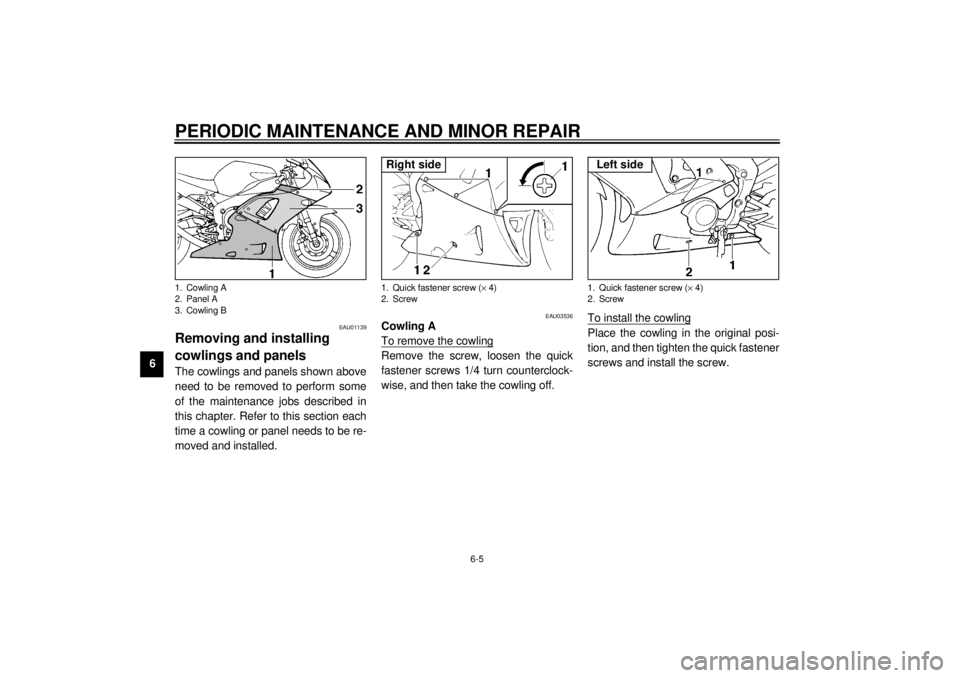
cowlings and panels The cowlings and panels shown above
need to be removed to perform some
of the maintenance jobs described in
this chapter. Refer to this section each
time a cowling or panel needs to be re-
moved and installed.
EAU03536
Cowling A
To remove the cowlingRemove the screw, loosen the quick
fastener screws 1/4 turn counterclock-
wise, and then take the cowling off.To install the cowling
Place the cowling in the original posi-
tion, and then tighten the quick fastener
screws and install the screw.
1. Cowling A
2. Panel A
3. Cowling B
1. Quick fastener screw (´ 4)
2. ScrewRight side
1. Quick fastener screw (´ 4)
2. ScrewLeft side
E_5jj.book Page 5 Friday, September 8, 2000 3:33 PM
Page 74 of 116
PERIODIC MAINTENANCE AND MINOR REPAIR
6-23
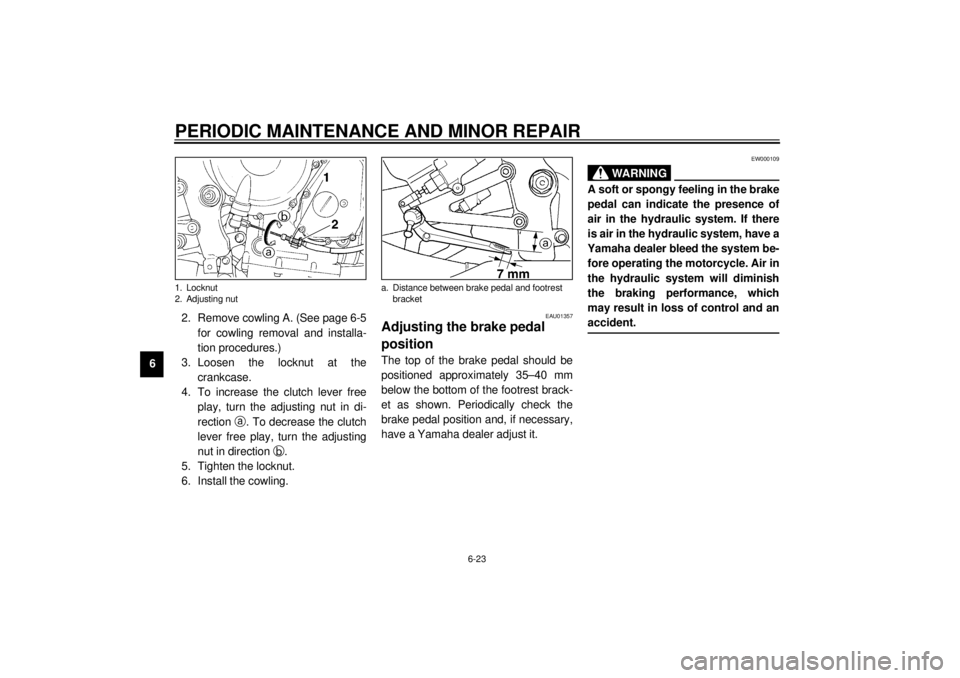
62. Remove cowling A. (See page 6-5
for cowling removal and installa-
tion procedures.)
3. Loosen the locknut at the
crankcase.
4. To increase the clutch lever free
play, turn the adjusting nut in di-
rection
a. To decrease the clutch
lever free play, turn the adjusting
nut in direction
b.
5. Tighten the locknut.
6. Install the cowling.
EAU01357
Adjusting the brake pedal
position The top of the brake pedal should be
positioned approximately 35–40 mm
below the bottom of the footrest brack-
et as shown. Periodically check the
brake pedal position and, if necessary,
have a Yamaha dealer adjust it.
EW000109
WARNING
@ A soft or spongy feeling in the brake
pedal can indicate the presence of
air in the hydraulic system. If there
is air in the hydraulic system, have a
Yamaha dealer bleed the system be-
fore operating the motorcycle. Air in
the hydraulic system will diminish
the braking performance, which
may result in loss of control and an
accident. @
1. Locknut
2. Adjusting nut
a. Distance between brake pedal and footrest
bracket
E_5jj.book Page 23 Friday, September 8, 2000 3:33 PM
Page 77 of 116
PERIODIC MAINTENANCE AND MINOR REPAIR
6-26
6 Observe these precautions:
l
When checking the fluid level,
make sure that the top of the mas-
ter cylinder or brake fluid reservoir
is level.
l
Use only the recommended quali-
ty brake fluid, otherwise the rubber
seals may deteriorate, causing
leakage and poor braking perfor-
mance.
l
Refill with the same type of brake
fluid. Mixing fluids may result in a
harmful chemical reaction and
lead to poor braking performance.
l
Be careful that water does not en-
ter the master cylinder or brake
fluid reservoir when refilling. Water
will significantly lower the boiling
point of the fluid and may result in
vapor lock.
l
Brake fluid may deteriorate paint-
ed surfaces or plastic parts. Al-
ways clean up spilled fluid
immediately.
l
As the brake pads wear, it is nor-
mal for the brake fluid level to
gradually go down. However, if the
brake fluid level goes down sud-
denly, have a Yamaha dealer
check the cause.
EAU03238
Changing the brake fluid Have a Yamaha dealer change the
brake fluid at the intervals specified in
the periodic maintenance and lubrica-
tion chart. In addition, have the oil seals
of the brake master cylinder and caliper
as well as the brake hose replaced at
the intervals listed below or whenever
they are damaged or leaking.l
Oil seals: Replace every two
years.
l
Brake hose: Replace every four
years.
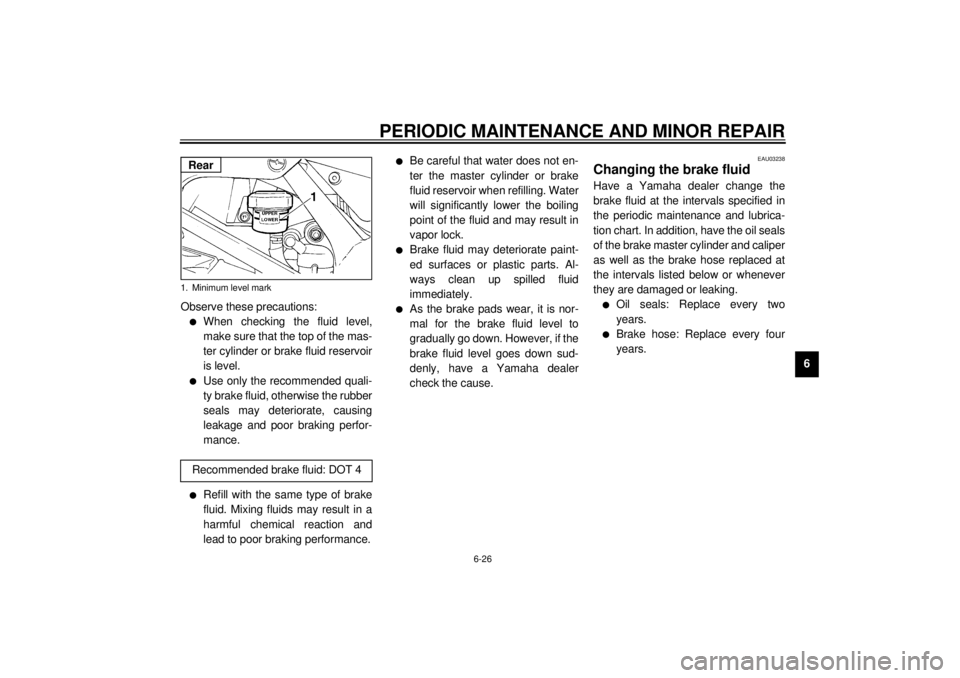
1. Minimum level mark
Recommended brake fluid: DOT 4RearRear
E_5jj.book Page 26 Friday, September 8, 2000 3:33 PM
Page 78 of 116
PERIODIC MAINTENANCE AND MINOR REPAIR
6-27
6
EAU00744
Drive chain slackThe drive chain slack should be
checked before each ride and adjusted
if necessary.
To check the drive chain slack
1. Place the motorcycle on a level
surface and hold it in an upright
position.NOTE:@ When checking and adjusting the drive
chain slack, the motorcycle should be
positioned straight up and there should
be no weight on it. @
2. Shift the transmission into the neu-
tral position.
3. Move the rear wheel by pushing
the motorcycle to locate the tight-
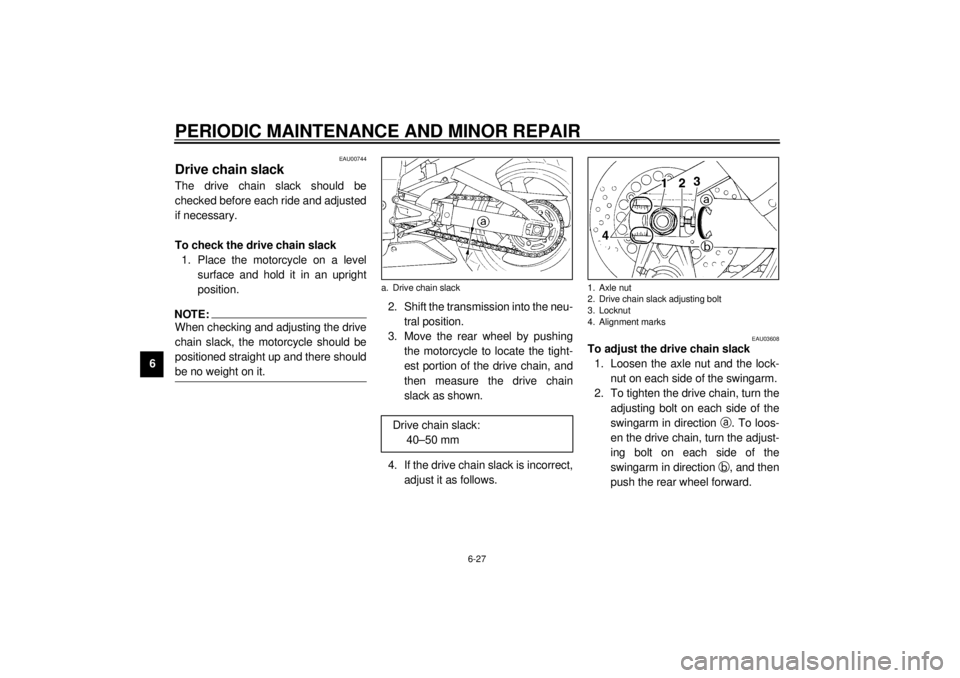
est portion of the drive chain, and
then measure the drive chain
slack as shown.
4. If the drive chain slack is incorrect,
adjust it as follows.
EAU03608
To adjust the drive chain slack
1. Loosen the axle nut and the lock-
nut on each side of the swingarm.
2. To tighten the drive chain, turn the
adjusting bolt on each side of the
swingarm in direction
a. To loos-
en the drive chain, turn the adjust-
ing bolt on each side of the
swingarm in direction
b, and then
push the rear wheel forward.
a. Drive chain slack
Drive chain slack:
40–50 mm
1. Axle nut
2. Drive chain slack adjusting bolt
3. Locknut
4. Alignment marks
E_5jj.book Page 27 Friday, September 8, 2000 3:33 PM
Page 79 of 116
PERIODIC MAINTENANCE AND MINOR REPAIR
6-28
6
NOTE:@ Using the alignment marks on each
side of the swingarm, make sure that
both chain pullers are in the same posi-
tion for proper wheel alignment. @
EC000096
CAUTION:@ Improper drive chain slack will over-
load the engine as well as other vital
parts of the motorcycle and can lead
to chain slippage or breakage. To
prevent this from occurring, keep
the drive chain slack within the
specified limits. @3. Tighten the locknuts, and then
tighten the axle nut to the specified
torque.
EAU03006
Lubricating the drive chain The drive chain must be cleaned and
lubricated at the intervals specified in
the periodic maintenance and lubrica-
tion chart, otherwise it will quickly wear
out, especially when riding in dusty or
wet areas. Service the drive chain as
follows.
EC000097
CAUTION:@ The drive chain must be lubricated
after washing the motorcycle or
riding in the rain. @1. Clean the drive chain with kero-
sene and a small soft brush.
ECA00053
CAUTION:@ To prevent damaging the O-rings,
do not clean the drive chain with
steam cleaners, high-pressure
washers or inappropriate solvents. @2. Wipe the drive chain dry.
3. Thoroughly lubricate the drive
chain with a special O-ring chain
lubricant.
ECA00052
CAUTION:@ Do not use engine oil or any other
lubricants for the drive chain, as
they may contain substances that
could damage the O-rings. @
Tightening torque:
Axle nut:
150 Nm (15.0 m·kg)
E_5jj.book Page 28 Friday, September 8, 2000 3:33 PM
Page 88 of 116
PERIODIC MAINTENANCE AND MINOR REPAIR
6-37
6
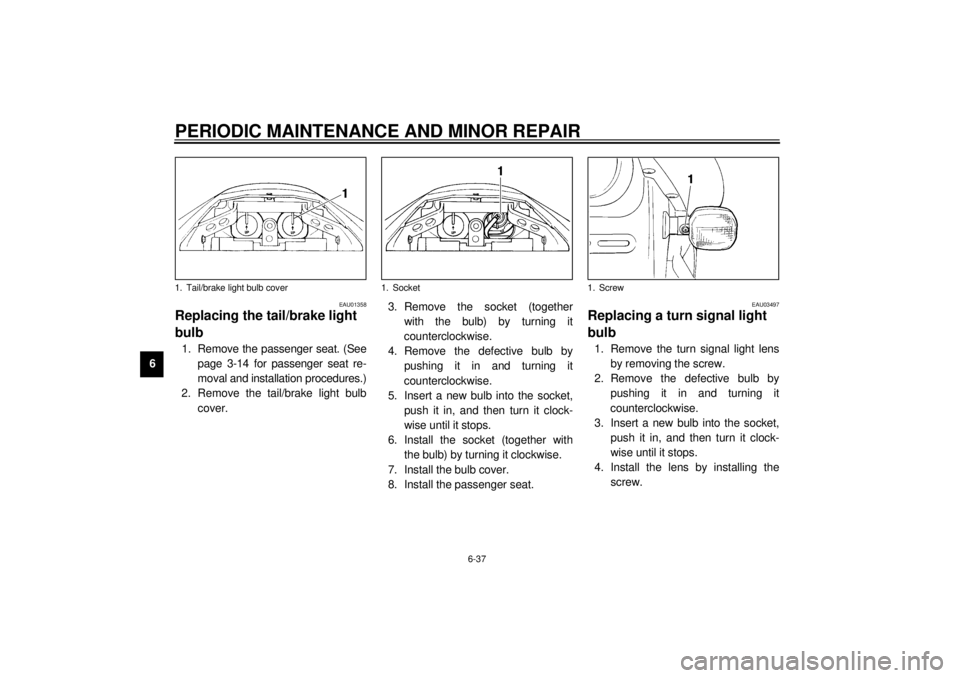
EAU01358
Replacing the tail/brake light
bulb 1. Remove the passenger seat. (See
page 3-14 for passenger seat re-
moval and installation procedures.)
2. Remove the tail/brake light bulb
cover.3. Remove the socket (together
with the bulb) by turning it
counterclockwise.
4. Remove the defective bulb by
pushing it in and turning it
counterclockwise.
5. Insert a new bulb into the socket,
push it in, and then turn it clock-
wise until it stops.
6. Install the socket (together with
the bulb) by turning it clockwise.
7. Install the bulb cover.
8. Install the passenger seat.
EAU03497
Replacing a turn signal light
bulb 1. Remove the turn signal light lens
by removing the screw.
2. Remove the defective bulb by
pushing it in and turning it
counterclockwise.
3. Insert a new bulb into the socket,
push it in, and then turn it clock-
wise until it stops.
4. Install the lens by installing the
screw.
1. Tail/brake light bulb cover
1. Socket
1. Screw
E_5jj.book Page 37 Friday, September 8, 2000 3:33 PM
Page 92 of 116
PERIODIC MAINTENANCE AND MINOR REPAIR
6-41
6
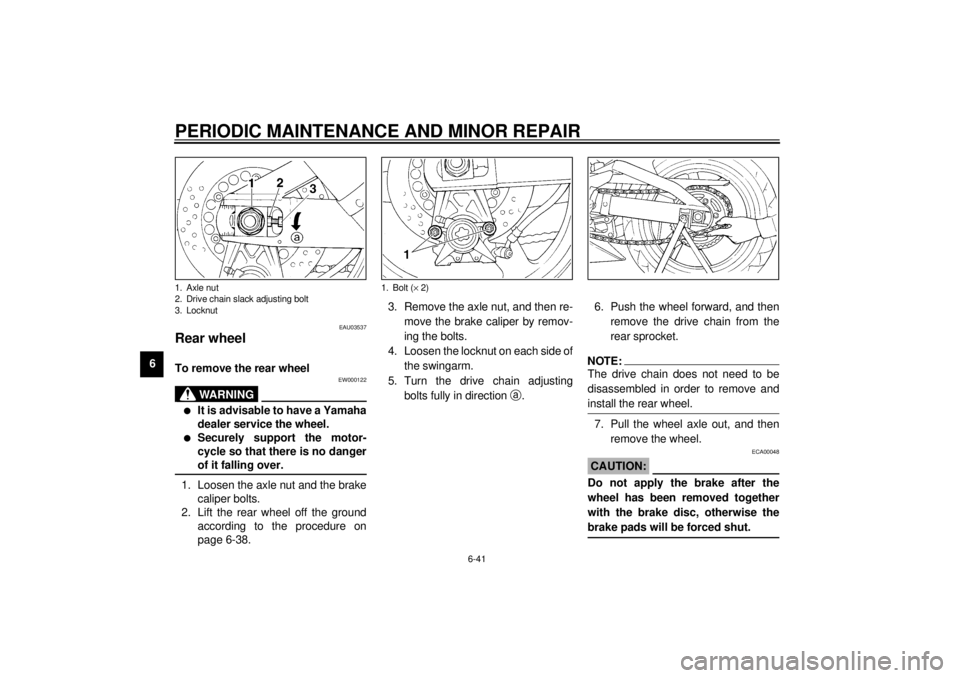
EAU03537
Rear wheel To remove the rear wheel
EW000122
WARNING
@ l
It is advisable to have a Yamaha
dealer service the wheel.
l
Securely support the motor-
cycle so that there is no danger
of it falling over.
@1. Loosen the axle nut and the brake
caliper bolts.
2. Lift the rear wheel off the ground
according to the procedure on
page 6-38.3. Remove the axle nut, and then re-
move the brake caliper by remov-
ing the bolts.
4. Loosen the locknut on each side of
the swingarm.
5. Turn the drive chain adjusting
bolts fully in direction
a.6. Push the wheel forward, and then
remove the drive chain from the
rear sprocket.
NOTE:@ The drive chain does not need to be
disassembled in order to remove and
install the rear wheel. @7. Pull the wheel axle out, and then
remove the wheel.
ECA00048
CAUTION:@ Do not apply the brake after the
wheel has been removed together
with the brake disc, otherwise the
brake pads will be forced shut. @
1. Axle nut
2. Drive chain slack adjusting bolt
3. Locknut
1. Bolt (´ 2)
E_5jj.book Page 41 Friday, September 8, 2000 3:33 PM
Page 95 of 116
PERIODIC MAINTENANCE AND MINOR REPAIR
6-44
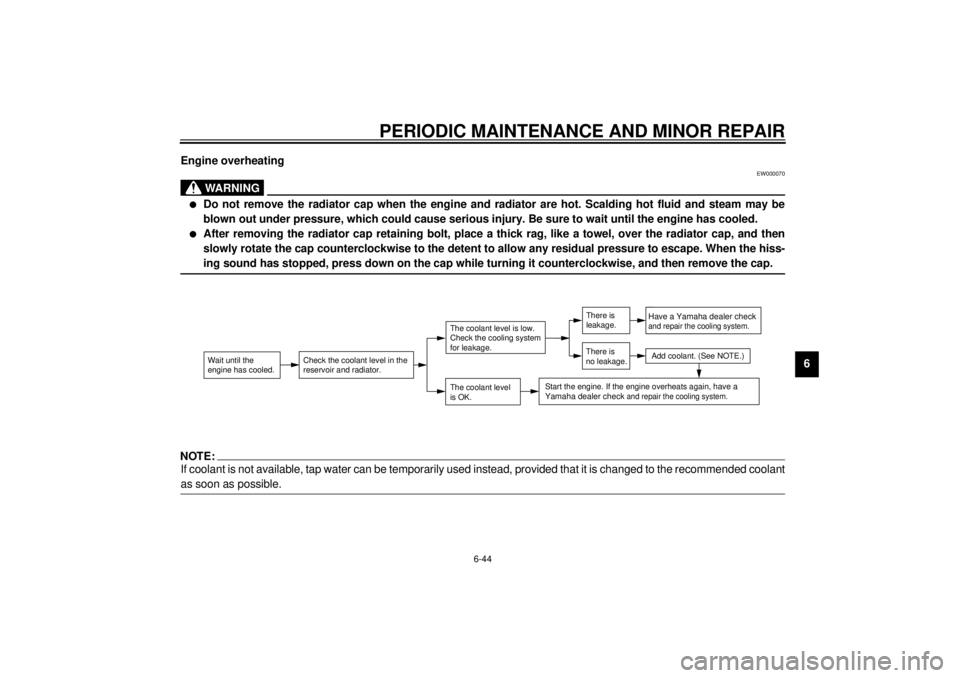
6 Engine overheating
EW000070
WARNING
@ l
Do not remove the radiator cap when the engine and radiator are hot. Scalding hot fluid and steam may be
blown out under pressure, which could cause serious injury. Be sure to wait until the engine has cooled.
l
After removing the radiator cap retaining bolt, place a thick rag, like a towel, over the radiator cap, and then
slowly rotate the cap counterclockwise to the detent to allow any residual pressure to escape. When the hiss-
ing sound has stopped, press down on the cap while turning it counterclockwise, and then remove the cap.
@NOTE:@ If coolant is not available, tap water can be temporarily used instead, provided that it is changed to the recommended coolant
as soon as possible. @
Wait until the
engine has cooled.
Check the coolant level in the
reservoir and radiator.
The coolant level
is OK.The coolant level is low.
Check the cooling system
for leakage.
Have a Yamaha dealer checkand repair the cooling system.Add coolant. (See NOTE.)
Start the engine. If the engine overheats again,
have a
Yamaha dealer check
and repair the cooling system.
There is
leakage.
There is
no leakage.
E_5jj.book Page 44 Friday, September 8, 2000 3:33 PM