warning YAMAHA YZF-R1 2012 Owner's Manual
[x] Cancel search | Manufacturer: YAMAHA, Model Year: 2012, Model line: YZF-R1, Model: YAMAHA YZF-R1 2012Pages: 112, PDF Size: 2.78 MB
Page 43 of 112
INSTRUMENT AND CONTROL FUNCTIONS
3-28
3
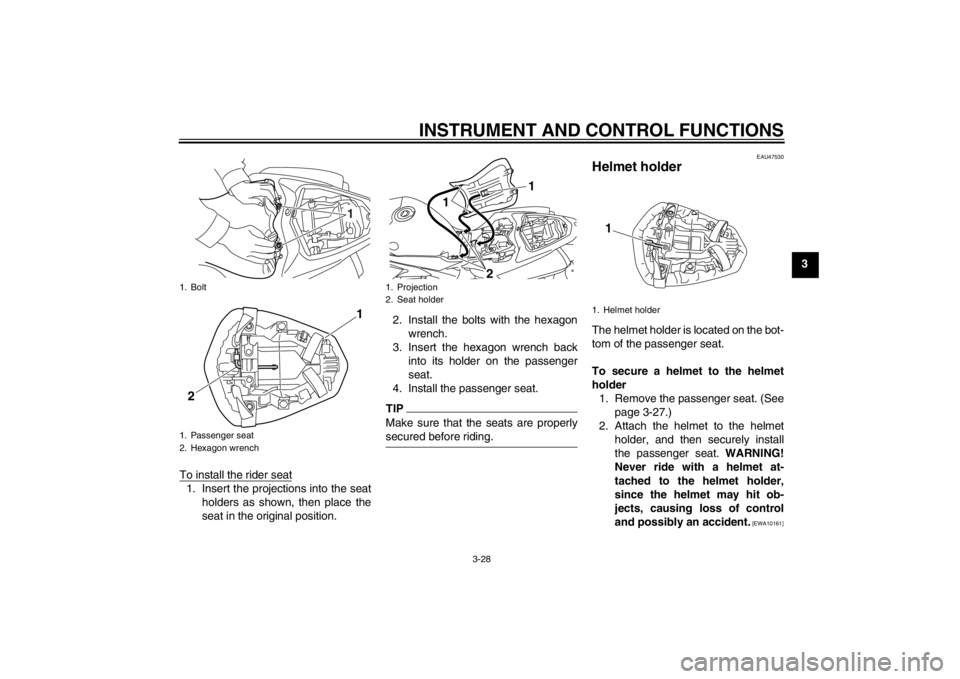
To install the rider seat
1. Insert the projections into the seat holders as shown, then place the
seat in the original position. 2. Install the bolts with the hexagon
wrench.
3. Insert the hexagon wrench back into its holder on the passenger
seat.
4. Install the passenger seat.
TIPMake sure that the seats are properly
secured before riding.
EAU47530
Helmet holder The helmet holder is located on the bot-
tom of the passenger seat.
To secure a helmet to the helmet
holder 1. Remove the passenger seat. (See page 3-27.)
2. Attach the helmet to the helmet holder, and then securely install
the passenger seat. WARNING!
Never ride with a helmet at-
tached to the helmet holder,
since the helmet may hit ob-
jects, causing loss of control
and possibly an accident.
[EWA10161]
1. Bolt
1. Passenger seat
2. Hexagon wrench
1
2 1
1. Projection
2. Seat holder
1
21
1. Helmet holder
1
U1KBE0E0.book Page 28 Monday, July 25, 2011 5:03 PM
Page 44 of 112
INSTRUMENT AND CONTROL FUNCTIONS
3-29
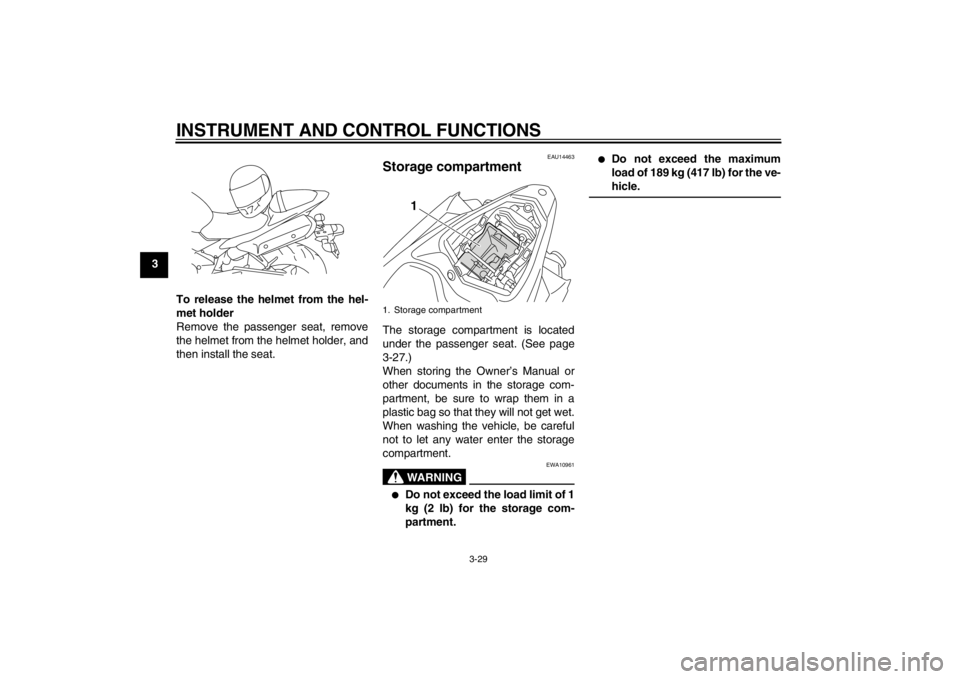
3To release the helmet from the hel-
met holder
Remove the passenger seat, remove
the helmet from the helmet holder, and
then install the seat.
EAU14463
Storage compartment The storage compartment is located
under the passenger seat. (See page
3-27.)
When storing the Owner’s Manual or
other documents in the storage com-
partment, be sure to wrap them in a
plastic bag so that they will not get wet.
When washing the vehicle, be careful
not to let any water enter the storage
compartment.
WARNING
EWA10961
●
Do not exceed the load limit of 1
kg (2 lb) for the storage com-
partment.
●
Do not exceed the maximum
load of 189 kg (417 lb) for the ve-
hicle.
1. Storage compartment
1
U1KBE0E0.book Page 29 Monday, July 25, 2011 5:03 PM
Page 45 of 112

INSTRUMENT AND CONTROL FUNCTIONS
3-30
3
EAU47442
Rider footrest position The rider footrests can be adjusted to
one of two positions to suit the rider’s
preference. Have a Yamaha dealer ad-
just the position of the rider footrests.
Left side
Right side
EAU47260
Rear view mirrors The rear view mirrors of this vehicle can
be folded forward for parking in narrow
spaces. Fold the mirrors back to their
original position before riding.
WARNING
EWA14371
Be sure to fold the rear view mirrors
back to their original position before
riding.
EAU47621
Adjusting the front fork
WARNING
EWA14670
Always adjust the spring preload on
both fork legs equally, otherwise
poor handling and loss of stability
may result.Each front fork leg is equipped with a
spring preload adjusting bolt, the right
front fork leg is equipped with a re-
bound damping force adjusting screw
and the left front fork leg with a com-
pression damping force adjusting
screw.NOTICE
ECA10101
To avoid damaging the mechanism,
do not attempt to turn beyond the
maximum or minimum settings.Spring preload
To increase the spring preload and
thereby harden the suspension, turn
the adjusting bolt on each fork leg in di-
rection (a). To decrease the spring pre-
1. Rider footrest
1. Rider footrest
1
1
1. Riding position
2. Parking position112
2
U1KBE0E0.book Page 30 Monday, July 25, 2011 5:03 PM
Page 49 of 112
INSTRUMENT AND CONTROL FUNCTIONS
3-34
3
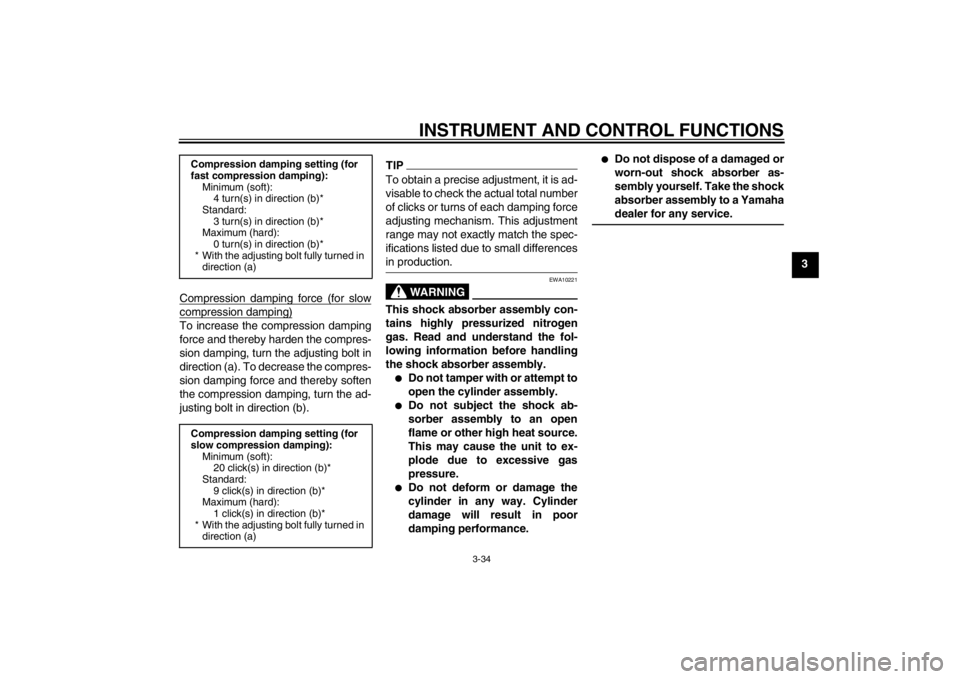
Compression damping force (for slow
compression damping)To increase the compression damping
force and thereby harden the compres-
sion damping, turn the adjusting bolt in
direction (a). To decrease the compres-
sion damping force and thereby soften
the compression damping, turn the ad-
justing bolt in direction (b).
TIPTo obtain a precise adjustment, it is ad-
visable to check the actual total number
of clicks or turns of each damping force
adjusting mechanism. This adjustment
range may not exactly match the spec-
ifications listed due to small differences
in production.
WARNING
EWA10221
This shock absorber assembly con-
tains highly pressurized nitrogen
gas. Read and understand the fol-
lowing information before handling
the shock absorber assembly.●
Do not tamper with or attempt to
open the cylinder assembly.
●
Do not subject the shock ab-
sorber assembly to an open
flame or other high heat source.
This may cause the unit to ex-
plode due to excessive gas
pressure.
●
Do not deform or damage the
cylinder in any way. Cylinder
damage will result in poor
damping performance.
●
Do not dispose of a damaged or
worn-out shock absorber as-
sembly yourself. Take the shock
absorber assembly to a Yamaha
dealer for any service.
Compression damping setting (for
fast compression damping): Minimum (soft):4 turn(s) in direction (b)*
Standard: 3 turn(s) in direction (b)*
Maximum (hard):
0 turn(s) in direction (b)*
* With the adjusting bolt fully turned in direction (a)
Compression damping setting (for
slow compression damping): Minimum (soft):20 click(s) in direction (b)*
Standard:
9 click(s) in direction (b)*
Maximum (hard): 1 click(s) in direction (b)*
* With the adjusting bolt fully turned in direction (a)
U1KBE0E0.book Page 34 Monday, July 25, 2011 5:03 PM
Page 50 of 112
INSTRUMENT AND CONTROL FUNCTIONS
3-35
3
EAU15181
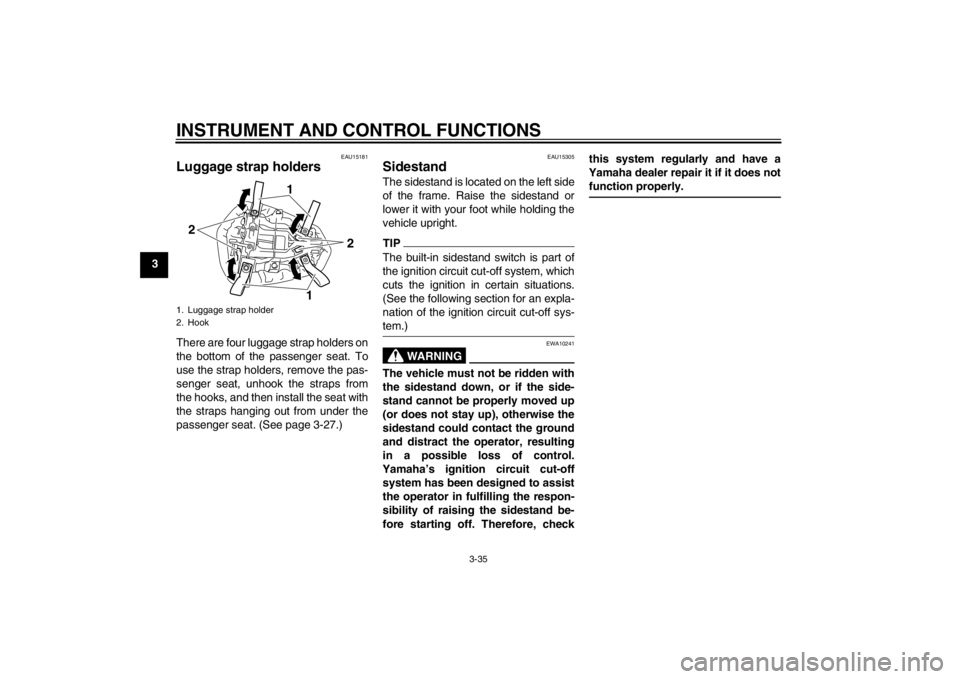
Luggage strap holders There are four luggage strap holders on
the bottom of the passenger seat. To
use the strap holders, remove the pas-
senger seat, unhook the straps from
the hooks, and then install the seat with
the straps hanging out from under the
passenger seat. (See page 3-27.)
EAU15305
Sidestand The sidestand is located on the left side
of the frame. Raise the sidestand or
lower it with your foot while holding the
vehicle upright.TIPThe built-in sidestand switch is part of
the ignition circuit cut-off system, which
cuts the ignition in certain situations.
(See the following section for an expla-
nation of the ignition circuit cut-off sys-
tem.)
WARNING
EWA10241
The vehicle must not be ridden with
the sidestand down, or if the side-
stand cannot be properly moved up (or does not stay up), otherwise the
sidestand could contact the ground
and distract the operator, resulting
in a possible loss of control.
Yamaha’s ignition circuit cut-off system has been designed to assist
the operator in fulfilling the respon-
sibility of raising the sidestand be-
fore starting off. Therefore, check this system regularly and have a
Yamaha dealer repair it if it does not function properly.
1. Luggage strap holder
2. Hook
2
1
2
1
U1KBE0E0.book Page 35 Monday, July 25, 2011 5:03 PM
Page 52 of 112
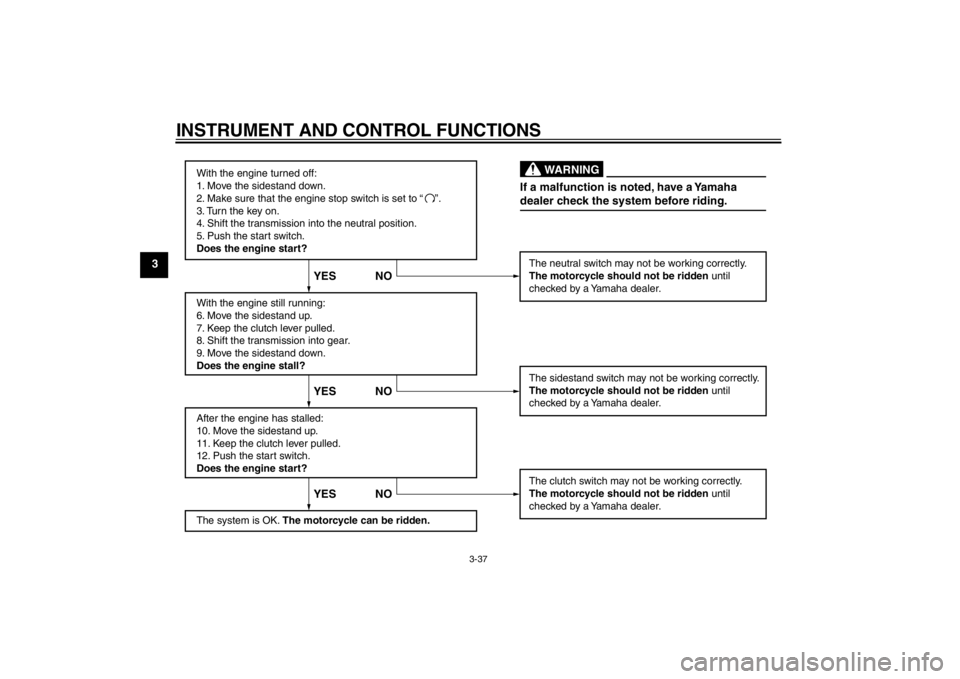
INSTRUMENT AND CONTROL FUNCTIONS
3-37
3
With the engine turned off:
1. Move the sidestand down.
2. Make sure that the engine stop switch is set to “
3. Turn the key on.
4. Shift the transmission into the neutral position.
5. Push the start switch.
Does the engine start?
With the engine still running:
6. Move the sidestand up.
7. Keep the clutch lever pulled.
8. Shift the transmission into gear.
9. Move the sidestand down.
Does the engine stall?
After the engine has stalled:
10. Move the sidestand up.
11. Keep the clutch lever pulled.
12. Push the start switch.
Does the engine start?
The system is OK. The motorcycle can be ridden. The neutral switch may not be working correctly.
The motorcycle should not be ridden
until
checked by a Yamaha dealer.
The sidestand switch may not be working correctly.
The motorcycle should not be ridden until
checked by a Yamaha dealer.
The clutch switch may not be working correctly.
The motorcycle should not be ridden until
checked by a Yamaha dealer.
YES NO YES NO YES NO
If a malfunction is noted, have a Yamaha
dealer check the system before riding.
WARNING
”.
U1KBE0E0.book Page 37 Monday, July 25, 2011 5:03 PM
Page 53 of 112

FOR YOUR SAFETY – PRE-OPERATION CHECKS
4-1
4
EAU15596
Inspect your vehicle each time you use it to make sure the vehicle is in safe operating condition. Always follow the inspection
and maintenance procedures and schedules described in the Owner’s Manual.
WARNING
EWA11151
Failure to inspect or maintain the vehicle properly increases the possibility of an accident or equipment damage.
Do not operate the vehicle if you find any problem. If a problem cannot be corrected by the procedures provided in
this manual, have the vehicle inspected by a Yamaha dealer.Before using this vehicle, check the following points:
ITEMCHECKS PAGE
Fuel Check fuel level in fuel tank.
Refuel if necessary.
Check fuel line for leakage.
Check fuel tank breather hose and overflow hose for obstructions, cracks or dam-
age, and check hose connections. 3-25, 3-26
Engine oil Check oil level in engine.
If necessary, add recommended oil to specified level.
Check vehicle for oil leakage. 6-11
Coolant Check coolant level in reservoir.
If necessary, add recommended coolant to specified level.
Check cooling system for leakage. 6-14
Front brake Check operation.
If soft or spongy, have Yamaha dealer bleed hydraulic system.
Check brake pads for wear.
Replace if necessary.
Check fluid level in reservoir.
If necessary, add specified brake fluid to specified level.
Check hydraulic system for leakage. 6-23, 6-23
U1KBE0E0.book Page 1 Monday, July 25, 2011 5:03 PM
Page 56 of 112

OPERATION AND IMPORTANT RIDING POINTS
5-1
5
EAU15951
Read the Owner’s Manual carefully to
become familiar with all controls. If
there is a control or function you do not
understand, ask your Yamaha dealer.
WARNING
EWA10271
Failure to familiarize yourself with
the controls can lead to loss of con-
trol, which could cause an accident
or injury.
EAU48710
TIPThis model is equipped with:●
a lean angle sensor to stop the en-
gine in case of a turnover. In this
case, the multi-function display in-
dicates error code 30, but this is
not a malfunction. Turn the key to
“OFF” and then to “ON” to clear the
error code. Failing to do so will pre-
vent the engine from starting even
though the engine will crank when
pushing the start switch.
●
an engine auto-stop system. The
engine stops automatically if left
idling for 20 minutes. If the engine
stops, simply push the start switch
to restart the engine.
EAU51880
Starting the engine In order for the ignition circuit cut-off
system to enable starting, one of the
following conditions must be met:●
The transmission is in the neutral
position.
●
The transmission is in gear with
the clutch lever pulled and the
sidestand up.
See page 3-36 for more informa-
tion.
1. Turn the key to “ON” and make sure that the engine stop switch is
set to “ ”.
The following warning lights and
indicator lights should come on for
a few seconds, then go off.●
Oil level warning light
●
Fuel level warning light
●
Coolant temperature warning
light
●
Shift timing indicator light
●
Engine trouble warning light
●
Traction control system indi-
cator/warning light
●
Immobilizer system indicator
light
U1KBE0E0.book Page 1 Monday, July 25, 2011 5:03 PM
Page 57 of 112
OPERATION AND IMPORTANT RIDING POINTS
5-2
5
NOTICE
ECA11833
If a warning or indicator light does
not come on initially when the key is
turned to “ON”, or if a warning or in-
dicator light remains on, see page
3-4 for the corresponding warning
and indicator light circuit check.2. Shift the transmission into the neu-tral position. The neutral indicator
light should come on. If not, ask a
Yamaha dealer to check the elec- trical circuit.
3. Start the engine by pushing the start switch.
If the engine fails to start, release
the start switch, wait a few sec-
onds, and then try again. Each
starting attempt should be as short
as possible to preserve the bat-
tery. Do not crank the engine more
than 10 seconds on any one at-
tempt.NOTICE
ECA11042
For maximum engine life, never ac-
celerate hard when the engine is
cold!
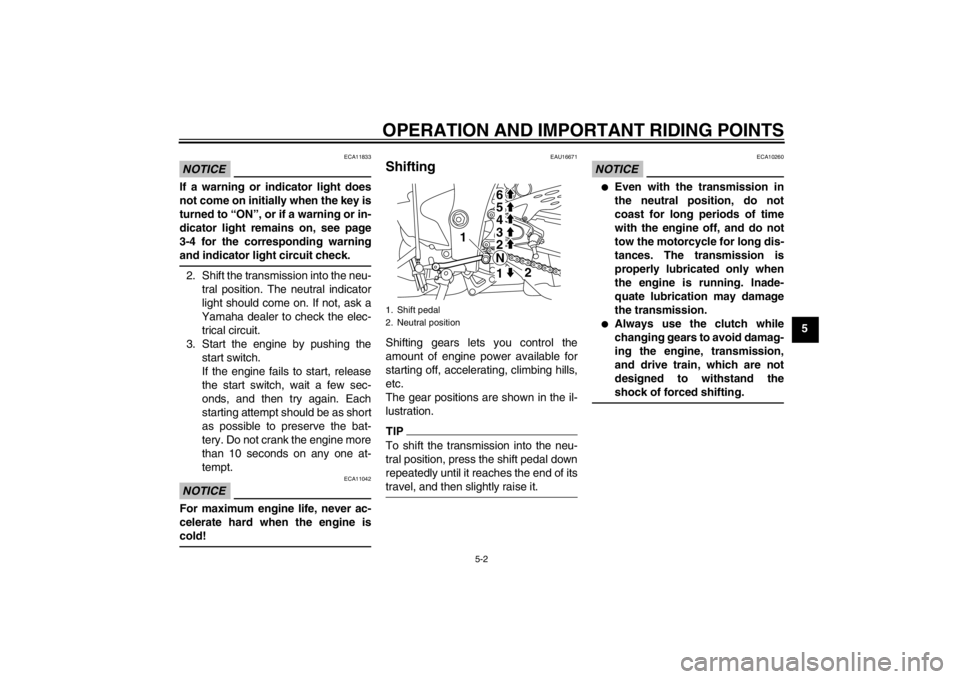
EAU16671
Shifting Shifting gears lets you control the
amount of engine power available for
starting off, accelerating, climbing hills,
etc.
The gear positions are shown in the il-
lustration.TIPTo shift the transmission into the neu-
tral position, press the shift pedal down
repeatedly until it reaches the end of its
travel, and then slightly raise it.
NOTICE
ECA10260
●
Even with the transmission in
the neutral position, do not
coast for long periods of time
with the engine off, and do not
tow the motorcycle for long dis-
tances. The transmission is
properly lubricated only when
the engine is running. Inade-
quate lubrication may damage
the transmission.
●
Always use the clutch while
changing gears to avoid damag-
ing the engine, transmission,
and drive train, which are not
designed to withstand the
shock of forced shifting.
1. Shift pedal
2. Neutral position
1
1
2
2
3 4
5 6
N
U1KBE0E0.book Page 2 Monday, July 25, 2011 5:03 PM
Page 59 of 112

OPERATION AND IMPORTANT RIDING POINTS
5-4
5
EAU17213
Parking When parking, stop the engine, and
then remove the key from the main
switch.
WARNING
EWA10311
●
Since the engine and exhaust
system can become very hot,
park in a place where pedestri-
ans or children are not likely to
touch them and be burned.
●
Do not park on a slope or on soft
ground, otherwise the vehicle
may overturn, increasing the
risk of a fuel leak and fire.
●
Do not park near grass or other
flammable materials which
might catch fire.
U1KBE0E0.book Page 4 Monday, July 25, 2011 5:03 PM