lock YAMAHA YZF-R1 2019 Owner's Manual
[x] Cancel search | Manufacturer: YAMAHA, Model Year: 2019, Model line: YZF-R1, Model: YAMAHA YZF-R1 2019Pages: 124, PDF Size: 9.58 MB
Page 93 of 124
Periodic maintenance and adjustment7-23
1
2
3
4
5
678
9
10
11
12
EAU37914
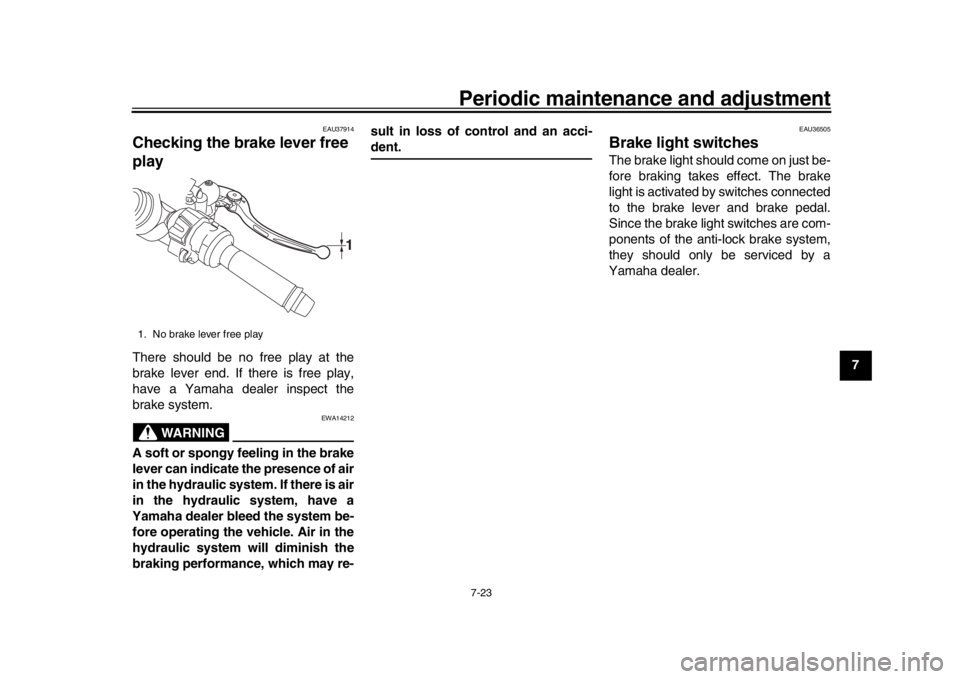
Checking the br ake lever free
playThere should be no free play at the
brake lever end. If there is free play,
have a Yamaha dealer inspect the
brake system.
WARNING
EWA14212
A soft or spongy feeling in the brake
lever can indicate the presence of air
in the hydraulic system. If there is air
in the hydraulic system, have a
Yamaha dealer bleed the system be-
fore operating the vehicle. Air in the
hydraulic system will diminish the
braking performance, which may re- sult in loss of control and an acci-
dent.
EAU36505
Brake light switchesThe brake light should come on just be-
fore braking takes effect. The brake
light is activated by switches connected
to the brake lever and brake pedal.
Since the brake light switches are com-
ponents of the anti-lock brake system,
they should only be serviced by a
Yamaha dealer.
1. No brake lever free play
1
BX4-9-E2.book 23 ページ 2018年9月6日 木曜日 午後4時39分
Page 95 of 124
Periodic maintenance and adjustment7-25
1
2
3
4
5
678
9
10
11
12
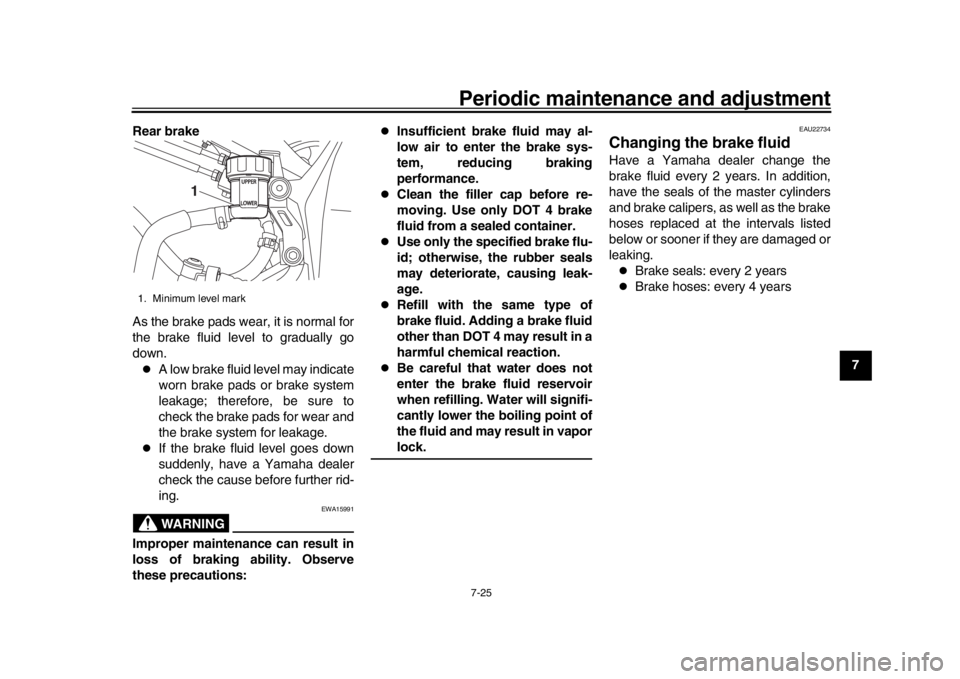
Rear brake
As the brake pads wear, it is normal for
the brake fluid level to gradually go
down.
A low brake fluid level may indicate
worn brake pads or brake system
leakage; therefore, be sure to
check the brake pads for wear and
the brake system for leakage.
If the brake fluid level goes down
suddenly, have a Yamaha dealer
check the cause before further rid-
ing.WARNING
EWA15991
Improper maintenance can result in
loss of braking ability. Observe
these precautions:
Insufficient brake fluid may al-
low air to enter the brake sys-
tem, reducing braking
performance.
Clean the filler cap before re-
moving. Use only DOT 4 brake
fluid from a sealed container.
Use only the specified brake flu-
id; otherwise, the rubber seals
may deteriorate, causing leak-
age.
Refill with the same type of
brake fluid. Adding a brake fluid
other than DOT 4 may result in a
harmful chemical reaction.
Be careful that water does not
enter the brake fluid reservoir
when refilling. Water will signifi-
cantly lower the boiling point of
the fluid and may result in vaporlock.
EAU22734
Changing the brake fluidHave a Yamaha dealer change the
brake fluid every 2 years. In addition,
have the seals of the master cylinders
and brake calipers, as well as the brake
hoses replaced at the intervals listed
below or sooner if they are damaged or
leaking.
Brake seals: every 2 years
Brake hoses: every 4 years
1. Minimum level mark
1
BX4-9-E2.book 25 ページ 2018年9月6日 木曜日 午後4時39分
Page 96 of 124

Periodic maintenance and adjustment
7-26
1
2
3
4
5
67
8
9
10
11
12
EAU22762
Drive chain slackThe drive chain slack should be
checked before each ride and adjusted
if necessary.
EAU74253
To check the drive chain slack 1. Place the motorcycle on the sides- tand.TIPWhen checking and adjusting the drive
chain slack, there should be no weighton the motorcycle.
2. Shift the transmission into the neu- tral position.
3. Measure the drive chain slack as shown. 4. If the drive chain slack is incorrect,
adjust it as follows. NOTICE: Im-
proper drive chain slack will
overload the engine as well as
other vital parts of the motorcy-
cle and can lead to chain slip-
page or breakage. To prevent
this from occurring, keep the
drive chain slack within the
specified limits.
[ECA10572]
EAU74260
To adjust the drive chain slack
Consult a Yamaha dealer before ad-
justing the drive chain slack. 1. Loosen the axle nut and the lock-
nut on each side of the swingarm.
2. To tighten the drive chain, turn the drive chain slack adjusting bolt on
each side of the swingarm in direc-
tion (a). To loosen the drive chain,
turn the adjusting bolt on each side
of the swingarm in direction (b),
and then push the rear wheel for-
ward.
TIPUsing the alignment marks on each
side of the swingarm, make sure that
both drive chain pullers are in the sameposition for proper wheel alignment.
1. Drive chain slackDrive chain slack:25.0–35.0 mm (0.98–1.38 in)
1
BX4-9-E2.book 26 ページ 2018年9月6日 木曜日 午後4時39分
Page 97 of 124

Periodic maintenance and adjustment7-27
1
2
3
4
5
678
9
10
11
12
3. Tighten the axle nut, then the lock-
nuts to their specified torques.
4. Make sure that the drive chain pull- ers are in the same position, the
drive chain slack is correct, and
the drive chain moves smoothly.
EAU23026
Cleaning and l ubricating the
drive chainThe drive chain must be cleaned and
lubricated at the intervals specified in
the periodic maintenance and lubrica-
tion chart, otherwise it will quickly wear
out, especially when riding in dusty or
wet areas. Service the drive chain as
follows.NOTICE
ECA10584
The drive chain must be lubricated
after washing the motorcycle, ridingin the rain or riding in wet areas.
1. Clean the drive chain with kero- sene and a small soft brush.
NOTICE: To prevent damaging
the O-rings, do not clean the
drive chain with steam cleaners,
high-pressure washers or inap-
propriate solvents.
[ECA11122]
2. Wipe the drive chain dry.
3. Thoroughly lubricate the drive chain with a special O-ring chain
lubricant. NOTICE: Do not use
engine oil or any other lubri-
cants for the drive chain, as they may contain substances that
could damage the O-rings.
[ECA11112]
1. Axle nut
2. Drive chain puller
3. Drive chain slack adjusting bolt
4. Locknut
5. Alignment marksTightening torques:
Axle nut: 190 N·m (19 kgf·m, 140 lb·ft)
Locknut: 16 N·m (1.6 kgf·m, 12 lb·ft)
1
2 3
45
(a)
(b)
BX4-9-E2.book 27 ページ 2018年9月6日 木曜日 午後4時39分
Page 109 of 124

Periodic maintenance and adjustment7-39
1
2
3
4
5
678
9
10
11
12
Engine overheating
WARNING
EWAT1041
Do not remove the radiator cap when the engine and radiator are hot. Scalding hot fluid and steam may be
blown out under pressure, which could cause serious injury. Be sure to wait until the engine has cooled.
Place a thick rag, like a towel, over the radiator cap, and then slowly rotate the cap counterclockwise to the de-
tent to allow any residual pressure to escape. When the hissing sound has stopped, press down on the capwhile turning it counterclockwise, and then remove the cap.
TIPIf coolant is not available, tap water can be temporarily
used instead, provided that it is changed to the recommended coolantas soon as possible.
Wait until the
engine has cooled.
Check the coolant level in the
reservoir and radiator.
The coolant level
is OK.The coolant level is low.
Check the cooling system
for leakage.
Have a Yamaha dealer checkand repair the cooling system.Add coolant. (See TIP.)
Start the engine. If the engine overheats again,
have a
Yamaha dealer check
and repair the cooling system.
There is
leakage.
There is
no leakage.
BX4-9-E2.book 39 ページ 2018年9月6日 木曜日 午後4時39分
Page 120 of 124

11-1
1
2
3
4
5
6
7
8
9
1011
12
IndexAABS warning light.................................... 4-6
Air filter element .................................... 7-17
Auxiliary DC connector ......................... 4-41
Auxiliary system warning light ................. 4-8BBattery................................................... 7-32
Brake and clutch levers, checking and lubricating ........................................... 7-29
Brake and shift pedals, checking and
lubricating ........................................... 7-28
Brake fluid, changing ............................ 7-25
Brake fluid level, checking .................... 7-24
Brake lever ............................................ 4-27
Brake lever free play, checking ............. 7-23
Brake light switches .............................. 7-23
Brake pedal ........................................... 4-28
Brake system ........................................ 4-28CCables, checking and lubricating .......... 7-28
Canister................................................. 7-12
Care ........................................................ 8-1
Catalytic converter ................................ 4-33
Clutch lever ........................................... 4-26
Clutch lever free play, adjusting ............ 7-22
Coolant.................................................. 7-16
Cowlings and panels, removing and installing................................................ 7-9DData recording, vehicle ......................... 10-2
Diagnostic connector ............................ 10-2
Dimmer switch ........................................ 4-4
Display, main screen............................... 4-8
Display, menu screen ........................... 4-13 Document storage ................................ 4-35
Drive chain, cleaning and lubricating .... 7-27
Drive chain slack .................................. 7-26
EEngine break-in ...................................... 6-3
Engine idling speed, checking .............. 7-18
Engine oil and oil fi
lter cartridge ........... 7-12
Engine serial number............................ 10-1
Engine trouble warning light ................... 4-6
EXUP system ....................................... 4-40FFront and rear brake pads, checking .... 7-24
Front fork, adjusting .............................. 4-36
Front fork, checking .............................. 7-30
Fuel....................................................... 4-31
Fuel consumption, tips for reducing........ 6-3
Fuel level warning light ........................... 4-6
Fuel tank cap ........................................ 4-30
Fuel tank overflow hose........................ 4-32
Fuses, replacing ................................... 7-33GGlossary ................................................. 3-4HHandlebar switches ................................ 4-3
Hazard switch ......................................... 4-4
High beam indicator light ........................ 4-6
Horn switch ............................................. 4-4IIdentification numbers .......................... 10-1
Ignition circuit cut-off system ................ 4-42
Immobilizer system ................................. 4-1
Immobilizer system indicator light........... 4-7
Indicator lights and warning lights .......... 4-5
MMain switch/steering lock ........................ 4-2
Maintenance and lubrication, periodic..... 7-5
Maintenance, emission control system ... 7-3
Matte color, caution ................................. 8-1
Model label ............................................ 10-2NNeutral indicator light .............................. 4-6OOil pressure and coolant temperature
warning light.......................................... 4-7PParking .................................................... 6-4
Part locations .......................................... 2-1
Pass/LAP switch ..................................... 4-4RRear view mirrors .................................. 4-36SSafety information ................................... 1-1
Seats ..................................................... 4-34
Shift indicator light ................................... 4-6
Shifting .................................................... 6-2
Shift pedal ............................................. 4-27
Shock absorber assembly, adjusting .... 4-38
Sidestand .............................................. 4-41
Sidestand, checking an d lubricating...... 7-30
Spark plugs, checking ........................... 7-11
Special features ...................................... 3-1
Specifications .......................................... 9-1
Stability control indicator light.................. 4-7
Starting the engine .................................. 6-1
Steering, checking................................. 7-31
Stop/Run/Start switch.............................. 4-4
Storage.................................................... 8-4
BX4-9-E2.book 1 ページ 2018年9月6日 木曜日 午後4時39分