ABS YAMAHA YZF-R1 2020 User Guide
[x] Cancel search | Manufacturer: YAMAHA, Model Year: 2020, Model line: YZF-R1, Model: YAMAHA YZF-R1 2020Pages: 136, PDF Size: 16.15 MB
Page 79 of 136

Operation and important ri din g points
6-2
6
EAU88420
Startin g the en gineThe ignition circuit cut-off system will
enable starting when:
the transmission is in the neutral
position or
the transmission is in gear, the
sidestand is up, and the clutch le-
ver is pulled.
To start the engine1. Turn the main switch on and set the engine stop switch to the run
position.
2. Confirm the indicator and warning light(s) come on for a few sec-
onds, and then go off. (See page
4-5.)TIPDo not start the engine if the mal-
function indicator light remains on.
The oil pressure and coolant tem-
perature warning light should
come on and stay on until the en-
gine is started.
The ABS warning light should
come on and stay on until the ve-
hicle reaches a speed of 10 km/h
(6 mi/h).
NOTICE
ECA24110
If a warnin g or in dicator li ght does
not work as d escribed a bove, have a
Yamaha dealer check the vehicle.3. Shift the transmission into the
neutral position.
4. Start the engine by pushing the start switch.
5. Release the start switch when the engine starts, or after 5 seconds.
Wait 10 seconds before pressing
the switch again to allow battery
voltage to restore.NOTICE
ECA11043
For maximum en gine life, never ac-
celerate har d when the en gine is
col d!
EAU68221
TIPThis model is equipped with:
an inertial measurement unit
(IMU). This unit stops the engine in
case of a turnover. Turn the main
switch off and then on before at-
tempting to restart the engine.
Failing to do so will prevent the en-
gine from starting even though the
engine will crank when pushing
the start switch.
an engine auto-stop system. The
engine stops automatically if left
idling for 20 minutes. If the engine
stops, simply push the start
switch to restart the engine.
UB3LE0E0.book Page 2 Tuesday, July 23, 2019 12:05 PM
Page 116 of 136
Periodic maintenance an d a djustment
7-35
7
EAU66593
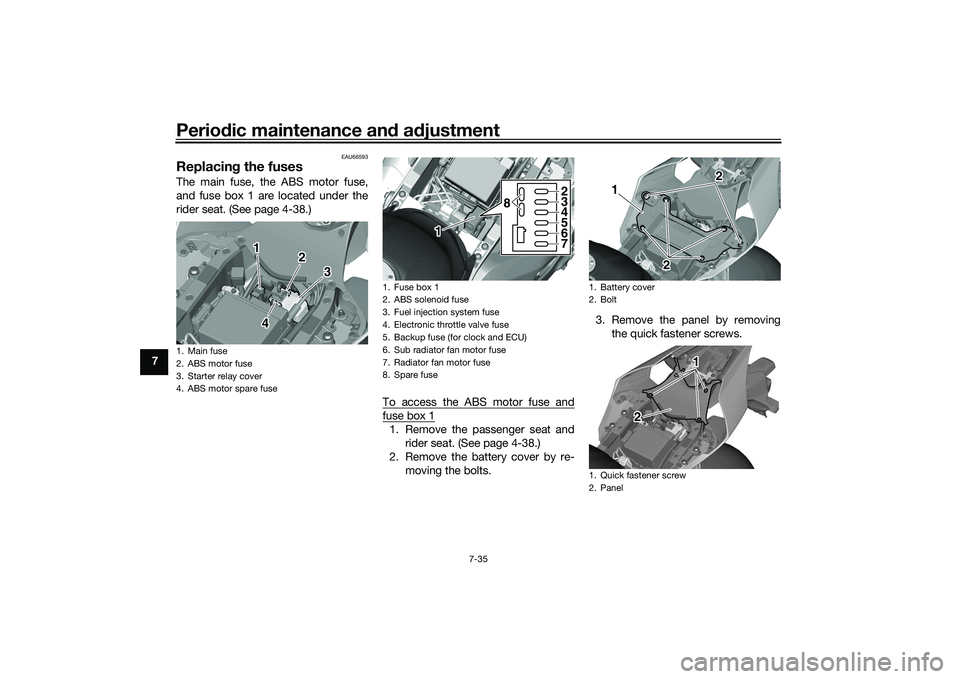
Replacin g the fusesThe main fuse, the ABS motor fuse,
and fuse box 1 are located under the
rider seat. (See page 4-38.)
To access the ABS motor fuse and
fuse box 11. Remove the passenger seat andrider seat. (See page 4-38.)
2. Remove the battery cover by re- moving the bolts. 3. Remove the panel by removing
the quick fastener screws.
1. Main fuse
2. ABS motor fuse
3. Starter relay cover
4. ABS motor spare fuse
14
3
2
1. Fuse box 1
2. ABS solenoid fuse
3. Fuel injection system fuse
4. Electronic throttle valve fuse
5. Backup fuse (for clock and ECU)
6. Sub radiator fan motor fuse
7. Radiator fan motor fuse
8. Spare fuse
8 2
3
4
5
6
7
1
1. Battery cover
2. Bolt
1. Quick fastener screw
2. Panel
2
2
1
1
2
UB3LE0E0.book Page 35 Tuesday, July 23, 2019 12:05 PM
Page 117 of 136
Periodic maintenance an d a djustment
7-36
7
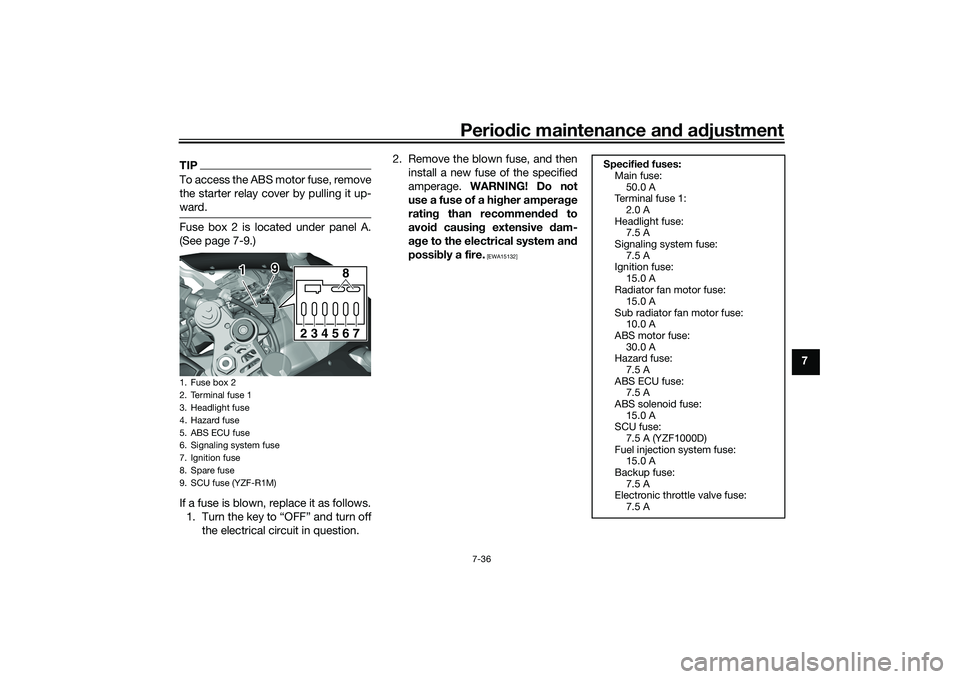
TIPTo access the ABS motor fuse, remove
the starter relay cover by pulling it up-
ward.Fuse box 2 is located under panel A.
(See page 7-9.)
If a fuse is blown, replace it as follows.
1. Turn the key to “OFF” and turn off the electrical circuit in question. 2. Remove the blown fuse, and then
install a new fuse of the specified
amperage. WARNING! Do not
use a fuse of a hi gher ampera ge
ratin g than recommen ded to
avoi d causin g extensive dam-
a g e to the electrical system an d
possi bly a fire.
[EWA15132]
1. Fuse box 2
2. Terminal fuse 1
3. Headlight fuse
4. Hazard fuse
5. ABS ECU fuse
6. Signaling system fuse
7. Ignition fuse
8. Spare fuse
9. SCU fuse (YZF-R1M)
234567
8
9
1
Specified fuses:
Main fuse:
50.0 A
Terminal fuse 1:
2.0 A
Headlight fuse: 7.5 A
Signaling system fuse: 7.5 A
Ignition fuse:
15.0 A
Radiator fan motor fuse: 15.0 A
Sub radiator fan motor fuse: 10.0 A
ABS motor fuse:
30.0 A
Hazard fuse: 7.5 A
ABS ECU fuse: 7.5 A
ABS solenoid fuse:
15.0 A
SCU fuse: 7.5 A (YZF1000D)
Fuel injection system fuse: 15.0 A
Backup fuse:
7.5 A
Electronic throttle valve fuse: 7.5 A
UB3LE0E0.book Page 36 Tuesday, July 23, 2019 12:05 PM
Page 123 of 136
Motorcycle care and stora ge
8-2
8
chemicals such as, solvents,
g
asoline, rust removers, b rake
flui d, or antifreeze, etc.
Before washin g
1. Park the vehicle out of direct sun- light and allow it to cool. This will
help avoid water spots.
2. Make sure all caps, covers, elec- trical couplers and connectors are
tightly installed.
3. Cover the muffler end with a plas- tic bag and a strong rubber band.
4. Pre-soak stubborn stains like in- sects or bird droppings with a wet
towel for a few minutes.
5. Remove road grime and oil stains with a quality degreasing agent
and a plastic-bristle brush or
sponge. NOTICE: Do not use
d eg reasin g a gent on areas re-
quirin g lu brication such as
seals, gaskets, an d wheel axles.
Follow pro duct instructions.
[ECA26290]
Washin g
1. Rinse off any degreaser and spray down the vehicle with a garden
hose. Use only enough pressure
to do the job. Avoid spraying wa-
ter directly into the muffler, instru-
ment panel, air inlet, or other inner
areas such as underseat storage
compartments.
2. Wash the vehicle with a quality au- tomotive-type detergent mixed
with cool water and a soft, clean
towel or sponge. Use an old tooth-
brush or plastic-bristle brush for
hard-to-reach places. NOTICE:
Use col d water if the vehicle has
b een exposed to salt. Warm wa-
ter will increase salt’s corrosive
properties.
[ECA26301]
3. For windshield-equipped vehicles: Clean the windshield with a soft
towel or sponge dampened with
water and a pH neutral detergent.
If necessary, use a high-quality
windshield cleaner or polish for
motorcycles. NOTICE: Never use
any stron g chemicals to clean
the wind shield. Additionally,
some cleanin g compoun ds for plastic may scratch the win
d-
shiel d, so b e sure to test all
cleanin g pro ducts before gen-
eral application.
[ECA26310]
4. Rinse off thoroughly with clean water. Be sure to remove all deter-
gent residues, as they can be
harmful to plastic parts.
After washin g
1. Dry the vehicle with a chamois or absorbent towel, preferably mi-
crofiber terrycloth.
2. For drive chain-equipped models: Dry and then lubricate the drive
chain to prevent rust.
3. Use a chrome polish to shine chrome, aluminum, and stainless
steel parts. Often the thermally in-
duced discoloring of stainless
steel exhaust systems can be re-
moved through polishing.
4. Apply a corrosion protection spray on all metal parts including
chrome or nickel-plated surfaces.
WARNING! Do not apply sili- cone or oil spray to seats, han d
g rips, ru bber foot pe gs or tire
trea ds. Otherwise these parts
UB3LE0E0.book Page 2 Tuesday, July 23, 2019 12:05 PM
Page 132 of 136
11-1
11
IndexAABS warning light ................................... 4-7
Air filter element .................................... 7-18
Auxiliary DC connector ......................... 4-49
Auxiliary system warning light ................ 4-8BBattery .................................................. 7-33
Brake and clutch levers, checking and
lubricating ........................................... 7-30
Brake and shift pedals, checking and lubricating ........................................... 7-30
Brake control system (BC) .................... 4-33
Brake fluid, changing ............................ 7-26
Brake fluid level, checking .................... 7-25
Brake lever ............................................ 4-33
Brake lever free play, checking............. 7-24
Brake light switches.............................. 7-24
Brake pedal........................................... 4-33CCables, checking and lubricating ......... 7-29
Canister................................................. 7-13
Care ........................................................ 8-1
Catalytic converter ................................ 4-38
CCU ...................................................... 4-39
Clutch lever ........................................... 4-32
Clutch lever free play, adjusting ........... 7-23
Coolant ................................................. 7-17
Cowlings and panels, removing and installing................................................ 7-9DData recording, vehicle ......................... 10-2
Diagnostic connector............................ 10-2
Dimmer switch ........................................ 4-4
Display, main screen............................... 4-9 Display, menu screen ........................... 4-15
Document storage ................................ 4-41
Drive chain, cleaning and lubricating ... 7-28
Drive chain slack .................................. 7-27
EEngine break-in ...................................... 6-1
Engine idling speed, checking ............. 7-19
Engine oil and oil filter
cartridge ........... 7-14
Engine overheating ............................... 7-40
Engine serial number ............................ 10-1
EXUP system........................................ 4-48FFront and rear brake pads, checking ... 7-25
Front fork, adjusting ............................. 4-42
Front fork, checking ............................. 7-32
Fuel ....................................................... 4-35
Fuel consumption, tips for reducing ...... 6-4
Fuel level warning light ........................... 4-6
Fuel tank cap ........................................ 4-35
Fuel tank overflow hose ....................... 4-37
Fuses, replacing ................................... 7-35GGlossary ................................................. 3-5HHandlebar switches ................................ 4-3
Hazard switch......................................... 4-4
High beam indicator light ....................... 4-6
Horn switch ............................................ 4-4IIdentification numbers .......................... 10-1
Ignition circuit cut-off system ............... 4-50
Immobilizer system ................................ 4-1
Immobilizer system indicator light .......... 4-7
Indicator lights and warning lights ......... 4-5
MMain switch/steering lock .......................4-2
Maintenance and lubrication, periodic....7-5
Maintenance, emission control
system ..................................................7-3
Malfunction indicator light (MIL)..............4-6
Matte color, caution ................................8-1
Model label ...........................................10-1NNeutral indicator light ..............................4-6OOil pressure and Coolant temperature warning light .........................................4-8PParking ....................................................6-4
Part locations ..........................................2-1
Pass/LAP switch .....................................4-4RRear view mirrors ..................................4-41SSafety information ...................................1-1
Seat cover .............................................4-40
Seats .....................................................4-38
Shift indicator light ..................................4-7
Shifting ....................................................6-3
Shift pedal .............................................4-32
Shock absorber assembly, adjusting ....4-45
Sidestand ..............................................4-49
Sidestand, checking and lubricating.....7-31
Spark plugs, checking ..........................7-12
Special features ......................................3-1
Specifications .........................................9-1
Stability control indicator light ................4-8
Starting the engine ..................................6-2
UB3LE0E0.book Page 1 Tuesday, July 23, 2019 12:05 PM