ABS YAMAHA YZF-R125 2016 User Guide
[x] Cancel search | Manufacturer: YAMAHA, Model Year: 2016, Model line: YZF-R125, Model: YAMAHA YZF-R125 2016Pages: 98, PDF Size: 6.87 MB
Page 67 of 98
Periodic maintenance and adjustment
6-25
6 Clean the filler cap before re-
moving. Use only DOT 4 brake
fluid from a sealed container.
Use only the specified brake flu-
id; otherwise, the rubber seals
may deteriorate, causing leak-
age.
Refill with the same type of
brake fluid. Adding a brake fluid
other than DOT 4 may result in a
harmful chemical reaction.
Be careful that water or dust
does not enter the brake fluid
reservoir when refilling. Water
will significantly lower the boil-
ing point of the fluid and may re-
sult in vapor lock, and dirt may
clog the ABS hydraulic unit
valves.
NOTICE
ECA17641
Brake fluid may damage painted
surfaces or plastic parts. Always
clean up spilled fluid immediately.
As the brake pads wear, it is normal for
the brake fluid level to gradually go
down. A low brake fluid level may indi-
cate worn brake pads and/or brake
system leakage; therefore, be sure to
check the brake pads for wear and the
brake system for leakage. If the brake
fluid level goes down suddenly, have a
Yamaha dealer check the cause before
further riding.
EAU22733
Changing the brake fluid
Have a Yamaha dealer change the
brake fluid at the intervals specified in
the periodic maintenance and lubrica-
tion chart. In addition, have the oil seals
of the master cylinders and calipers as
well as the brake hoses replaced at the
intervals listed below or whenever they
are damaged or leaking.
Oil seals: Replace every two
years.
Brake hoses: Replace every four
years.
U5D7E6E0.book Page 25 Wednesday, June 17, 2015 10:25 AM
Page 76 of 98
Periodic maintenance and adjustment
6-34
6
EAUM3461
Replacing the fuses
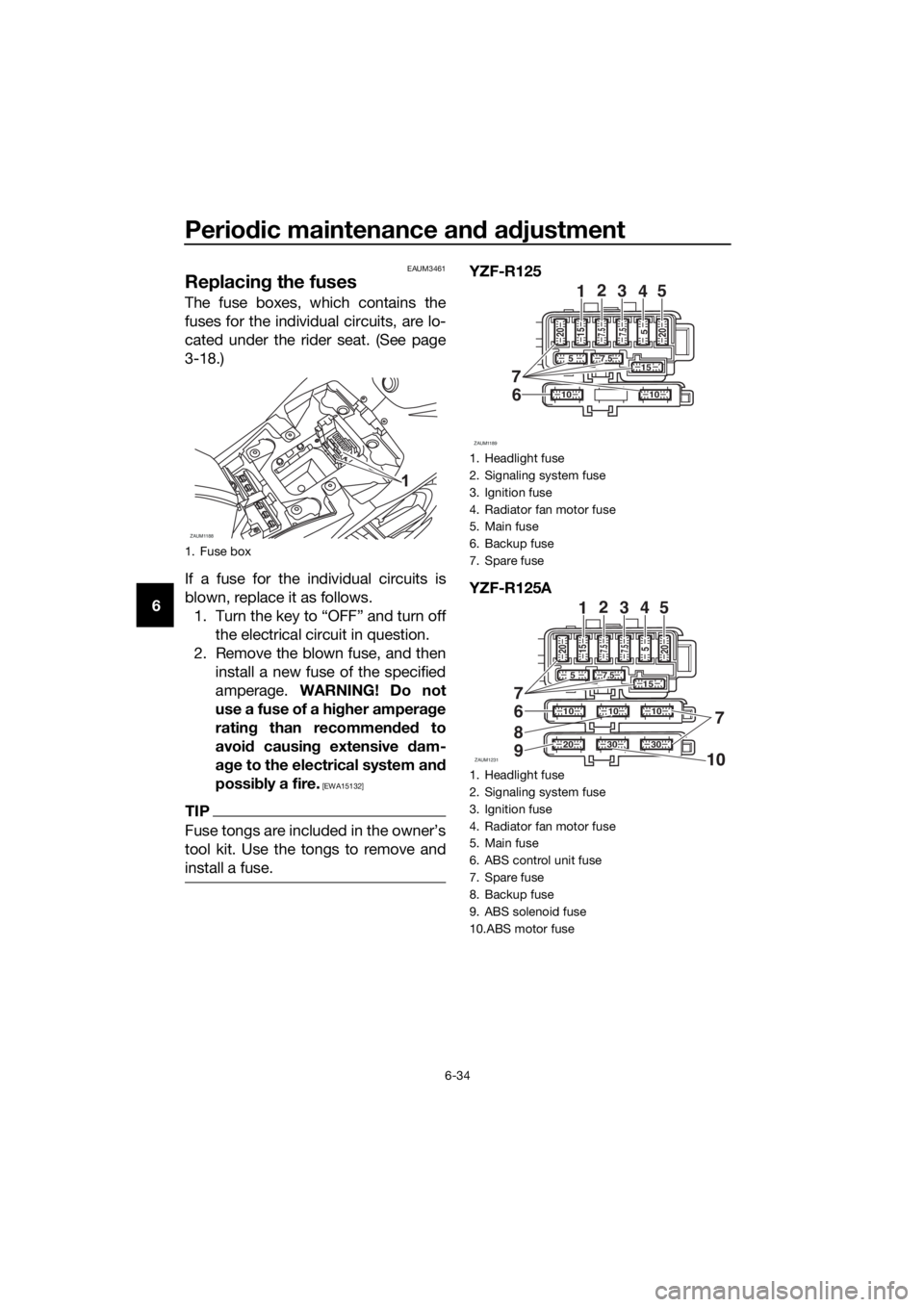
The fuse boxes, which contains the
fuses for the individual circuits, are lo-
cated under the rider seat. (See page
3-18.)
If a fuse for the individual circuits is
blown, replace it as follows.
1. Turn the key to “OFF” and turn off
the electrical circuit in question.
2. Remove the blown fuse, and then
install a new fuse of the specified
amperage. WARNING! Do not
use a fuse of a higher amperage
rating than recommended to
avoid causing extensive dam-
age to the electrical system and
possibly a fire.
[EWA15132]
TIP
tool kit. Use the tongs to remove and
install a fuse.
YZF-R125
YZF-R125A
1. Fuse box
ZAUM1188
1. Headlight fuse
2. Signaling system fuse
3. Ignition fuse
4. Radiator fan motor fuse
5. Main fuse
6. Backup fuse
7. Spare fuse
1. Headlight fuse
2. Signaling system fuse
3. Ignition fuse
4. Radiator fan motor fuse
5. Main fuse
6. ABS control unit fuse
7. Spare fuse
8. Backup fuse
9. ABS solenoid fuse
10.ABS motor fuse
ZAUM1189
1010
157.5
5207.5 7.515 20
5
7
12
3
45
6
ZAUM1231
10
303020
7
8
91010
157.5
207.5 7.515
5 20
5
7
12
3
45
6
U5D7E6E0.book Page 34 Wednesday, June 17, 2015 10:25 AM
Page 77 of 98

Periodic maintenance and adjustment
6-35
6 3. Turn the key to “ON” and turn on
the electrical circuit in question to
check if the device operates.
4. If the fuse immediately blows
again, have a Yamaha dealer
check the electrical system.
EAU34242
Replacing a headlight bulb
This model is equipped with halogen
bulb headlights. If a headlight bulb
burns out, have a Yamaha dealer re-
place it and, if necessary, adjust the
headlight beam.
Specified fuses:
Main fuse:
20.0 A
Ignition fuse:
7.5 A
Signaling system fuse:
7.5 A
Headlight fuse:
15.0 A
Radiator fan motor fuse:
5.0 A
ABS control unit fuse:
10.0 A (YZF-R125A)
ABS motor fuse:
30.0 A (YZF-R125A)
ABS solenoid fuse:
20.0 A (YZF-R125A)
Backup fuse:
10.0 A
U5D7E6E0.book Page 35 Wednesday, June 17, 2015 10:25 AM
Page 80 of 98
Periodic maintenance and adjustment
6-38
6
EAU24351
Supporting the motorcycle
Since this model is not equipped with a
centerstand, follow these precautions
when removing the front and rear
wheel or performing other mainte-
nance requiring the motorcycle to
stand upright. Check that the motorcy-
cle is in a stable and level position be-
fore starting any maintenance. A
strong wooden box can be placed un-
der the engine for added stability.
To service the front wheel
1. Stabilize the rear of the motorcy-
cle by using a motorcycle stand
or, if an additional motorcycle
stand is not available, by placing a
jack under the frame in front of the
rear wheel.
2. Raise the front wheel off the
ground by using a motorcycle
stand.
To service the rear wheel
Raise the rear wheel off the ground by
using a motorcycle stand or, if a motor-
cycle stand is not available, by placing
a jack either under each side of the
frame in front of the rear wheel or under
each side of the swingarm.
EAU44792
Front wheel (for non-ABS
models)
WARNING
EWA14841
For the ABS model, have a Yamaha
dealer remove and install the wheel.
EAU56531
To remove the front wheel
WARNING
EWA10822
To avoid injury, securely support the
vehicle so there is no danger of it
falling over.
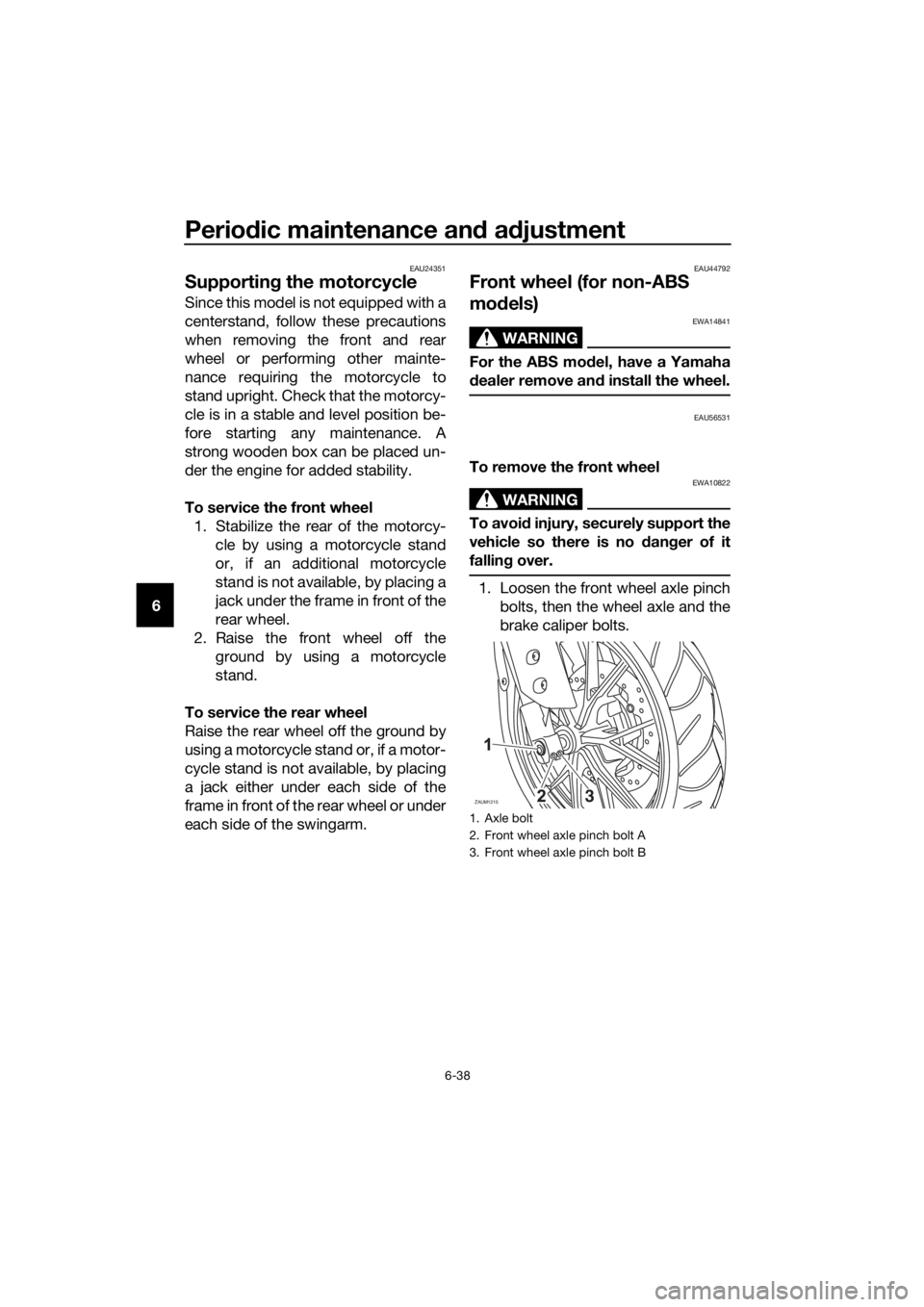
1. Loosen the front wheel axle pinch
bolts, then the wheel axle and the
brake caliper bolts.
1. Axle bolt
2. Front wheel axle pinch bolt A
3. Front wheel axle pinch bolt B
ZAUM12153
U5D7E6E0.book Page 38 Wednesday, June 17, 2015 10:25 AM
Page 82 of 98
Periodic maintenance and adjustment
6-40
6
EAU44802
Rear wheel (for non-ABS
models)
WARNING
EWA14841
For the ABS model, have a Yamaha
dealer remove and install the wheel.
EAU56701
To remove the rear wheel
WARNING
EWA10822
To avoid injury, securely support the
vehicle so there is no danger of it
falling over.
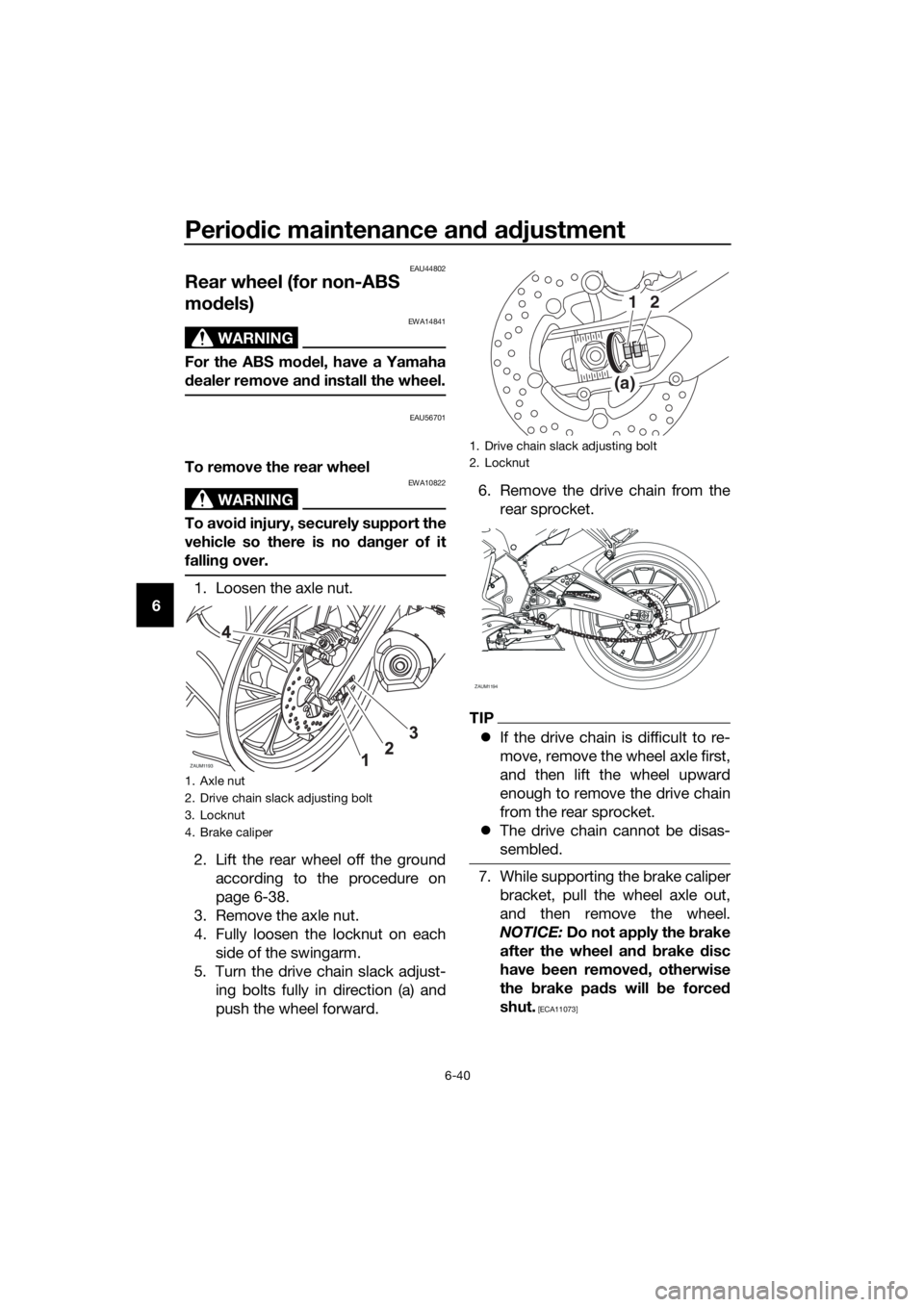
1. Loosen the axle nut.
2. Lift the rear wheel off the ground
according to the procedure on
page 6-38.
3. Remove the axle nut.
4. Fully loosen the locknut on each
side of the swingarm.
5. Turn the drive chain slack adjust-
ing bolts fully in direction (a) and
push the wheel forward.6. Remove the drive chain from the
rear sprocket.
TIP
If the drive chain is difficult to re-
move, remove the wheel axle first,
and then lift the wheel upward
enough to remove the drive chain
from the rear sprocket.
The drive chain cannot be disas-
sembled.
7. While supporting the brake caliper
bracket, pull the wheel axle out,
and then remove the wheel.
NOTICE: Do not apply the brake
after the wheel and brake disc
have been removed, otherwise
the brake pads will be forced
shut.
[ECA11073]
1. Axle nut
2. Drive chain slack adjusting bolt
3. Locknut
4. Brake caliper
ZAUM1193
1. Drive chain slack adjusting bolt
2. Locknut
(a)
12
ZAUM1194
U5D7E6E0.book Page 40 Wednesday, June 17, 2015 10:25 AM
Page 88 of 98
Motorcycle care and storage
7-3
72. After drying the motorcycle, apply
a corrosion protection spray on all
metal, including chrome- and
nickel-plated, surfaces to prevent
corrosion.
After cleaning
1. Dry the motorcycle with a chamois
or an absorbing cloth.
2. Immediately dry the drive chain
and lubricate it to prevent it from
rusting.
3. Use a chrome polish to shine
chrome, aluminum and stainless-
steel parts, including the exhaust
system. (Even the thermally in-
duced discoloring of stainless-
steel exhaust systems can be re-
moved through polishing.)
4. To prevent corrosion, it is recom-
mended to apply a corrosion pro-
tection spray on all metal,
including chrome- and nickel-plat-
ed, surfaces.
5. Use spray oil as a universal clean-
er to remove any remaining dirt.
6. Touch up minor paint damage
caused by stones, etc.
7. Wax all painted surfaces.
8. Let the motorcycle dry completely
before storing or covering it.
WARNING
EWA11132
Contaminants on the brakes or tires
can cause loss of control.
Make sure that there is no oil or
wax on the brakes or tires.
If necessary, clean the brake
discs and brake linings with a
regular brake disc cleaner or
acetone, and wash the tires with
warm water and a mild deter-gent. Before riding at higher
speeds, test the motorcycle’s
braking performance and cor-
nering behavior.
NOTICE
ECA10801
Apply spray oil and wax spar-
ingly and make sure to wipe off
any excess.
Never apply oil or wax to any
rubber and plastic parts, but
treat them with a suitable care
product.
Avoid using abrasive polishing
compounds as they will wear
away the paint.
TIP
Consult a Yamaha dealer for ad-
vice on what products to use.
Washing, rainy weather or humid
climates can cause the headlight
lens to fog. Turning the headlight
on for a short period of time will
help remove the moisture from the
lens.
U5D7E6E0.book Page 3 Wednesday, June 17, 2015 10:25 AM
Page 92 of 98

Specifications
8-2
8
Transmission:
Primary reduction ratio:
73/24 (3.042)
Final drive:
Chain
Secondary reduction ratio:
48/14 (3.429)
Transmission type:
Constant mesh 6-speed
Operation:
Left foot operation
Gear ratio:
1st:
34/12 (2.833)
2nd:
30/16 (1.875)
3rd:
30/22 (1.364)
4th:
24/21 (1.143)
5th:
22/23 (0.957)
6th:
21/25 (0.840)
Chassis:
Frame type:
Semi double cradle
Caster angle:
25.00 °
Trail:
89 mm (3.5 in)
Front tire:
Type:
Tubeless
Size:
100/80-17 M/C 52H(PIRELLI)-
52S(MICHELIN)
Manufacturer/model:
PIRELLI/SPORT DEMON
Manufacturer/model:
MICHELIN/PILOT STREET
Rear tire:
Type:
Tubeless
Size:
130/70-17 M/C 62H(PIRELLI)-
62S(MICHELIN)
Manufacturer/model:
PIRELLI/SPORT DEMONManufacturer/model:
MICHELIN/PILOT STREET
Loading:
Maximum load:
180 kg (397 lb)
(Total weight of rider, passenger, cargo
and accessories)
Tire air pressure (measured on cold
tires):
Loading condition:
0–90 kg (0–198 lb)
Front:
180 kPa (1.80 kgf/cm², 26 psi)
Rear:
200 kPa (2.00 kgf/cm², 29 psi)
Loading condition:
90–180 kg (198–397 lb)
Front:
180 kPa (1.80 kgf/cm², 26 psi)
Rear:
225 kPa (2.25 kgf/cm², 33 psi)
Front wheel:
Wheel type:
Cast wheel
Rim size:
17xMT2.75
Rear wheel:
Wheel type:
Cast wheel
Rim size:
17 x MT3.75
Front brake:
Type:
Single disc brake
Operation:
Right hand operation
Specified brake fluid:
DOT 4
Rear brake:
Type:
Single disc brake
Operation:
Right foot operation
Specified brake fluid:
DOT 4
Front suspension:
Type:
Telescopic fork
Spring/shock absorber type:
Coil spring/oil damper
U5D7E6E0.book Page 2 Wednesday, June 17, 2015 10:25 AM
Page 93 of 98

Specifications
8-3
8
Wheel travel:
130 mm (5.1 in)
Rear suspension:
Type:
Swingarm (link suspension)
Spring/shock absorber type:
Coil spring/oil damper
Wheel travel:
114 mm (4.5 in)
Electrical system:
System voltage:
12 V
Ignition system:
TCI
Charging system:
AC magneto
Battery:
Model:
12N5.5-4A / YUASA
Voltage, capacity:
12 V, 5.5 Ah
Headlight:
Bulb type:
Halogen bulb
Bulb voltage, wattage × quantity:
Headlight:
12 V, 55.0 W × 2
Brake/tail light:
LED
Front turn signal light:
12 V, 10.0 W × 2
Rear turn signal light:
12 V, 10.0 W × 2
Auxiliary light:
12 V, 5.0 W × 2
License plate light:
12 V, 5.0 W × 1
Meter lighting:
LED
Neutral indicator light:
LED
High beam indicator light:
LED
Turn signal indicator light:
LED
Fuel level warning light:
LED
Engine trouble warning light:
LEDABS warning light:
LED (YZF-R125A)
Fuse:
Main fuse:
20.0 A
Headlight fuse:
15.0 A
Signaling system fuse:
7.5 A
Ignition fuse:
7.5 A
Radiator fan motor fuse:
5.0 A
ABS control unit fuse:
10.0 A (YZF-R125A)
ABS motor fuse:
30.0 A (YZF-R125A)
ABS solenoid fuse:
20.0 A (YZF-R125A)
Backup fuse:
10.0 A
U5D7E6E0.book Page 3 Wednesday, June 17, 2015 10:25 AM
Page 95 of 98

10-1
10
Index
A
ABS (for ABS models) .......................... 3-15
ABS warning light (for ABS models)....... 3-2
Air filter element and check hose,
replacing and cleaning ....................... 6-15
Auxiliary light bulb, replacing ............... 6-36
B
Battery .................................................. 6-32
Brake and clutch levers, checking and
lubricating .......................................... 6-29
Brake fluid, changing ........................... 6-25
Brake fluid level, checking ................... 6-24
Brake lever ........................................... 3-14
Brake light switches ............................. 6-23
Brake pedal .......................................... 3-14
Brake pedal, checking and
lubricating .......................................... 6-29
Brake pedal free play, adjusting........... 6-22
C
Cables, checking and lubricating ......... 6-28
Care ........................................................ 7-1
Catalytic converter ............................... 3-18
Clutch lever .......................................... 3-13
Clutch lever free play, adjusting ........... 6-21
Coolant ................................................. 6-14
Cowlings and panel, removing and
installing ............................................... 6-7
D
Dimmer switch ..................................... 3-11
Drive chain, cleaning and lubricating ... 6-27
Drive chain slack .................................. 6-26
E
Engine break-in ...................................... 5-4
Engine idling speed, checking ............. 6-16
Engine oil and oil filter element ............ 6-11
Engine stop switch ............................... 3-12
Engine trouble warning light................... 3-2
F
Front and rear brake pads, checking ... 6-23
Front brake lever free play, checking ... 6-22
Front fork, checking ............................. 6-31
Fuel....................................................... 3-16
Fuel consumption, tips for reducing ...... 5-4
Fuel level warning light ........................... 3-2
Fuel tank cap........................................ 3-16
Fuses, replacing ................................... 6-34
H
Handlebar switches.............................. 3-11
Headlight bulb, replacing ..................... 6-35
High beam indicator light ....................... 3-2Horn switch........................................... 3-12
I
Identification numbers ............................ 9-1
Ignition circuit cut-off system ............... 3-20
Indicator lights and warning lights .......... 3-2
Info switch ............................................ 3-12
L
License plate light bulb, replacing ........ 6-37
M
Main switch/steering lock ....................... 3-1
Maintenance and lubrication, periodic ... 6-4
Maintenance, emission control
system .................................................. 6-3
Matte color, caution ................................ 7-1
Model label ............................................. 9-1
Multi-function meter unit ........................ 3-4
N
Neutral indicator light.............................. 3-2
P
Parking .................................................... 5-5
Part locations .......................................... 2-1
Pass switch........................................... 3-11
R
Rider seat.............................................. 3-18
S
Safety information................................... 1-1
Shifting .................................................... 5-3
Shift pedal............................................. 3-13
Sidestand .............................................. 3-19
Sidestand, checking and lubricating .... 6-30
Spark plug, checking .............................. 6-9
Specifications ......................................... 8-1
Starting the engine.................................. 5-2
Start switch ........................................... 3-12
Steering, checking ................................ 6-31
Storage ................................................... 7-4
Supporting the motorcycle ................... 6-38
Swingarm pivots, lubricating ................ 6-30
T
Tail/brake light ...................................... 6-36
Throttle grip and cable, checking and
lubricating ........................................... 6-28
Throttle grip free play, adjusting ........... 6-16
Tires ...................................................... 6-18
Tool kit .................................................... 6-2
Troubleshooting .................................... 6-41
Troubleshooting charts ......................... 6-42
Turn signal indicator light ....................... 3-2
Turn signal light bulb, replacing............ 6-37
Turn signal switch ................................. 3-12
U5D7E6E0.book Page 1 Wednesday, June 17, 2015 10:25 AM
Page 96 of 98

Index
10-2
10
V
Valve clearance..................................... 6-17
Vehicle identification number ................. 9-1
W
Wheel bearings, checking..................... 6-32
Wheel, front (for non-ABS models) ....... 6-38
Wheel, rear (for non-ABS models) ........ 6-40
Wheels .................................................. 6-20
U5D7E6E0.book Page 2 Wednesday, June 17, 2015 10:25 AM