wheel YAMAHA YZF-R125 2016 Owners Manual
[x] Cancel search | Manufacturer: YAMAHA, Model Year: 2016, Model line: YZF-R125, Model: YAMAHA YZF-R125 2016Pages: 98, PDF Size: 6.87 MB
Page 5 of 98

Table of contents
Safety information............................1-1
Description........................................2-1
Left view ..........................................2-1
Right view........................................2-2
Controls and instruments ................2-3
Instrument and control functions....3-1
Main switch/steering lock ...............3-1
Indicator lights and warning
lights ............................................3-2
Multi-function meter unit .................3-4
Handlebar switches.......................3-11
Clutch lever ...................................3-13
Shift pedal .....................................3-13
Brake lever ....................................3-14
Brake pedal ...................................3-14
ABS (for ABS models) ...................3-15
Fuel tank cap.................................3-16
Fuel................................................3-16
Catalytic converter ........................3-18
Rider seat ......................................3-18
Sidestand ......................................3-19
Ignition circuit cut-off system........3-20
For your safety – pre-operation
checks...............................................4-1
Operation and important riding
points.................................................5-1
Starting the engine ..........................5-2
Shifting ............................................5-3
Tips for reducing fuel
consumption ................................5-4
Engine break-in ...............................5-4
Parking ............................................5-5
Periodic maintenance and
adjustment........................................6-1
Owner’s tool kit ...............................6-2
Periodic maintenance chart for the
emission control system ..............6-3
General maintenance and
lubrication chart ...........................6-4
Removing and installing the
cowlings and panel ......................6-7Checking the spark plug ................. 6-9
Engine oil and oil filter element ..... 6-11
Coolant ......................................... 6-14
Replacing the air filter element
and cleaning the check hose..... 6-15
Checking the engine idling
speed......................................... 6-16
Adjusting the throttle grip free
play ............................................ 6-16
Valve clearance ............................. 6-17
Tires .............................................. 6-18
Cast wheels .................................. 6-20
Adjusting the clutch lever free
play ............................................ 6-21
Checking the front brake lever
free play ..................................... 6-22
Adjusting the brake pedal free
play ............................................ 6-22
Brake light switches ...................... 6-23
Checking the front and rear brake
pads........................................... 6-23
Checking the brake fluid level....... 6-24
Changing the brake fluid............... 6-25
Drive chain slack ........................... 6-26
Cleaning and lubricating the drive
chain .......................................... 6-27
Checking and lubricating the
cables ........................................ 6-28
Checking and lubricating the
throttle grip and cable ............... 6-28
Checking and lubricating the
brake and clutch levers ............. 6-29
Checking and lubricating the
brake pedal................................ 6-29
Checking and lubricating the
sidestand ................................... 6-30
Lubricating the swingarm pivots... 6-30
Checking the front fork ................. 6-31
Checking the steering ................... 6-31
Checking the wheel bearings ....... 6-32
Battery .......................................... 6-32
Replacing the fuses ...................... 6-34
Replacing a headlight bulb ........... 6-35
Replacing an auxiliary light bulb ... 6-36
Tail/brake light .............................. 6-36
U5D7E6E0.book Page 1 Wednesday, June 17, 2015 10:25 AM
Page 6 of 98

Table of contents
Replacing a turn signal light
bulb ........................................... 6-37
Replacing the license plate light
bulb ........................................... 6-37
Supporting the motorcycle ........... 6-38
Front wheel
(for non-ABS models)................ 6-38
Rear wheel
(for non-ABS models)................ 6-40
Troubleshooting............................ 6-41
Troubleshooting charts................. 6-42
Motorcycle care and storage.......... 7-1
Matte color caution ........................ 7-1
Care ................................................ 7-1
Storage ........................................... 7-4
Specifications................................... 8-1
Consumer information..................... 9-1
Identification numbers .................... 9-1
Index................................................ 10-1
U5D7E6E0.book Page 2 Wednesday, June 17, 2015 10:25 AM
Page 8 of 98

Safety information
1-2
1Many accidents involve inexperi-
enced operators. In fact, many op-
erators who have been involved in
accidents do not even have a cur-
rent motorcycle license.
• Make sure that you are qualified
and that you only lend your mo-
torcycle to other qualified oper-
ators.
• Know your skills and limits.
Staying within your limits may
help you to avoid an accident.
• We recommend that you prac-
tice riding your motorcycle
where there is no traffic until you
have become thoroughly famil-
iar with the motorcycle and all of
its controls.
Many accidents have been
caused by error of the motorcycle
operator. A typical error made by
the operator is veering wide on a
turn due to excessive speed or un-
dercornering (insufficient lean an-
gle for the speed).
• Always obey the speed limit and
never travel faster than warrant-
ed by road and traffic condi-
tions.
• Always signal before turning or
changing lanes. Make sure that
other motorists can see you.
The posture of the operator and
passenger is important for proper
control.
• The operator should keep both
hands on the handlebar and
both feet on the operator foot-
rests during operation to main-
tain control of the motorcycle.• The passenger should always
hold onto the operator, the seat
strap or grab bar, if equipped,
with both hands and keep both
feet on the passenger footrests.
Never carry a passenger unless
he or she can firmly place both
feet on the passenger footrests.
Never ride under the influence of
alcohol or other drugs.
This motorcycle is designed for
on-road use only. It is not suitable
for off-road use.
Protective Apparel
The majority of fatalities from motorcy-
cle accidents are the result of head in-
juries. The use of a safety helmet is the
single most critical factor in the pre-
vention or reduction of head injuries.
Always wear an approved helmet.
Wear a face shield or goggles.
Wind in your unprotected eyes
could contribute to an impairment
of vision that could delay seeing a
hazard.
The use of a jacket, heavy boots,
trousers, gloves, etc., is effective
in preventing or reducing abra-
sions or lacerations.
Never wear loose-fitting clothes,
otherwise they could catch on the
control levers, footrests, or wheels
and cause injury or an accident.
Always wear protective clothing
that covers your legs, ankles, and
feet. The engine or exhaust sys-
tem become very hot during or af-
ter operation and can cause
burns.
A passenger should also observe
the above precautions.
U5D7E6E0.book Page 2 Wednesday, June 17, 2015 10:25 AM
Page 11 of 98

Safety information
1-5
1 operator and may limit control
ability, therefore, such accesso-
ries are not recommended.
Use caution when adding electri-
cal accessories. If electrical ac-
cessories exceed the capacity of
the motorcycle’s electrical sys-
tem, an electric failure could re-
sult, which could cause a
dangerous loss of lights or engine
power.
Aftermarket Tires and Rims
The tires and rims that came with your
motorcycle were designed to match
the performance capabilities and to
provide the best combination of han-
dling, braking, and comfort. Other
tires, rims, sizes, and combinations
may not be appropriate. Refer to page
6-18 for tire specifications and more in-
formation on replacing your tires.
Transporting the Motorcycle
Be sure to observe following instruc-
tions before transporting the motorcy-
cle in another vehicle.
Remove all loose items from the
motorcycle.
Check that the fuel cock (if
equipped) is in the “OFF” position
and that there are no fuel leaks.
Point the front wheel straight
ahead on the trailer or in the truck
bed, and choke it in a rail to pre-
vent movement.
Shift the transmission in gear (for
models with a manual transmis-
sion).
Secure the motorcycle with tie-
downs or suitable straps that are
attached to solid parts of the mo-torcycle, such as the frame or up-
per front fork triple clamp (and not,
for example, to rubber-mounted
handlebars or turn signals, or
parts that could break). Choose
the location for the straps carefully
so the straps will not rub against
painted surfaces during transport.
The suspension should be com-
pressed somewhat by the tie-
downs, if possible, so that the mo-
torcycle will not bounce exces-
sively during transport.
U5D7E6E0.book Page 5 Wednesday, June 17, 2015 10:25 AM
Page 17 of 98
Instrument and control functions
3-3
3
The ABS may not work correctly. If any
of the above occurs, have a Yamaha
dealer check the system as soon as
possible. (See page 3-15 for an expla-
nation of the ABS.)
WARNING
EWA16041
If the ABS warning light does not go
off after traveling at a speed of 10
km/h (6 mi/h) or higher, or if the
warning light comes on or flashes
while riding, the brake system re-
verts to conventional braking. If ei-
ther of the above occurs, or if the
warning light does not come on at
all, use extra caution to avoid possi-
ble wheel lock during emergency
braking. Have a Yamaha dealer
check the brake system and electri-
cal circuits as soon as possible.
EAUM3440Tachometer high-rpm warning light
This light flashes at 9500 r/min to warn
you that the engine speed is about to
enter the high-rpm zone. Once the en-
gine speed reaches 10000 r/min, this
light will come on to warn you that it is
necessary to shift up to avoid engine
damage.
To activate or deactivate the tachome-
ter high-rpm warning light, hold the
“INFO” button pushed, turn the key to
“ON”, and when the tachometer high-
rpm warning light starts flashing, press
the “SELECT” button.
TIP
When activating or deactivating the
warning light the function, after press-
ing the “SELECT” button, the light will come on to indicate that the function is
activated or the light will go off to indi-
cate that the function is deactivated.
U5D7E6E0.book Page 3 Wednesday, June 17, 2015 10:39 AM
Page 29 of 98
Instrument and control functions
3-15
3
EAU60021
ABS (for ABS models)
The Yamaha ABS (Anti-lock Brake
System) features a dual electronic con-
trol system, which acts on the front and
rear brakes independently.
Operate the brakes with ABS as you
would conventional brakes. If the ABS
is activated, a pulsating sensation may
be felt at the brake lever or brake ped-
al. In this situation, continue to apply
the brakes and let the ABS work; do
not “pump” the brakes as this will re-
duce braking effectiveness.
WARNING
EWA16051
Always keep a sufficient distance
from the vehicle ahead to match the
riding speed even with ABS.
The ABS performs best with
long braking distances.
On certain surfaces, such as
rough or gravel roads, the brak-
ing distance may be longer with
the ABS than without.
The ABS is monitored by an ECU,
which will revert the system to conven-
tional braking if a malfunction occurs.
TIP
The ABS performs a self-diagno-
sis test each time the vehicle first
starts off after the key is turned to
“ON” and the vehicle has traveled
at a speed of 10 km/h (6 mi/h) or
higher. During this test, a “click-
ing” noise can be heard from the
hydraulic control unit, and if the
brake lever or brake pedal is even
slightly applied, a vibration can be
felt at the lever and pedal, but
these do not indicate a malfunc-
tion.This ABS has a test mode which
allows the owner to experience
the pulsation at the brake lever or
brake pedal when the ABS is op-
erating. However, special tools are
required, so please consult your
Yamaha dealer.
NOTICE
ECA20100
Be careful not to damage the wheel
sensor or wheel sensor rotor; other-
wise, improper performance of the
ABS will result.
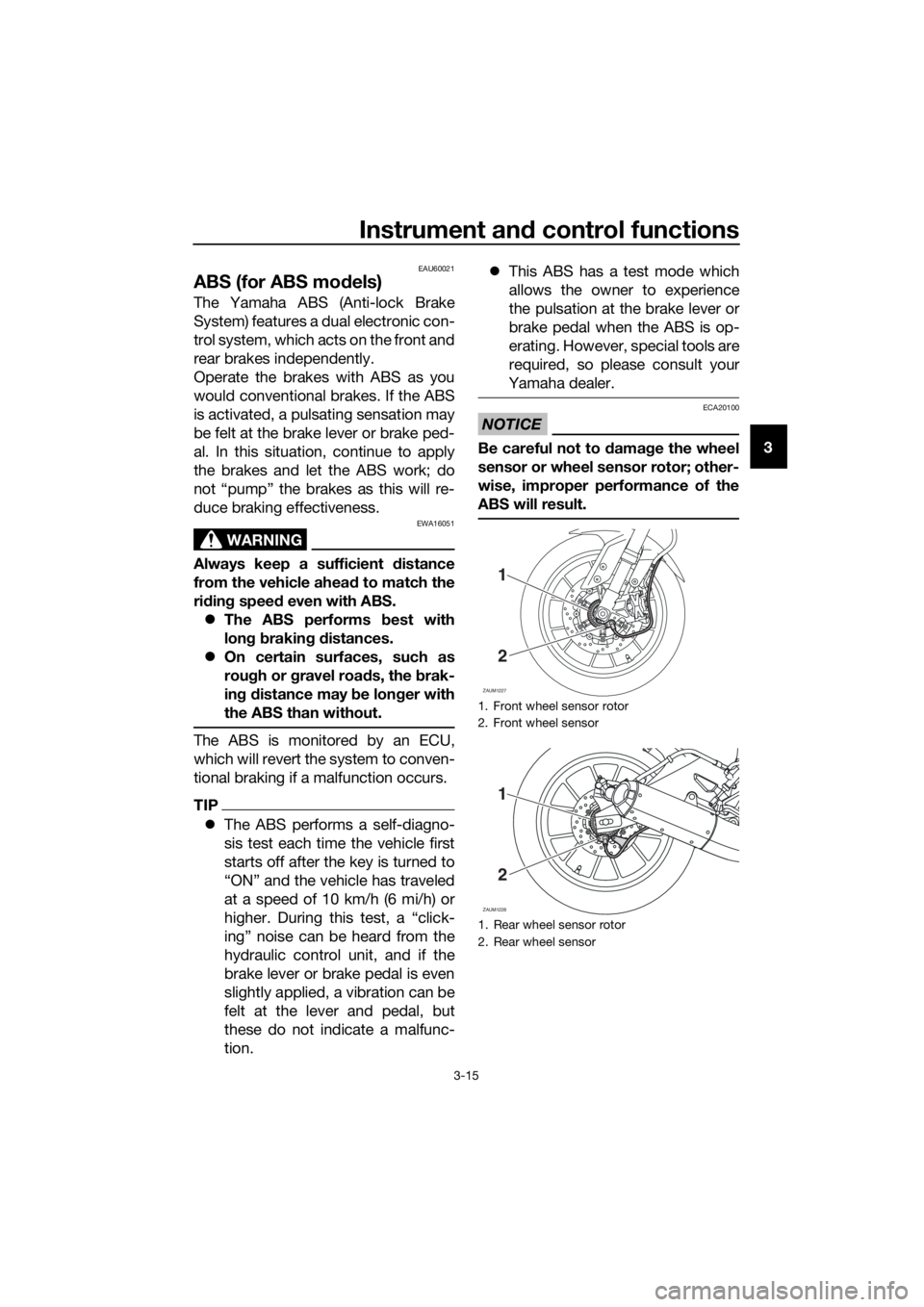
1. Front wheel sensor rotor
2. Front wheel sensor
1. Rear wheel sensor rotor
2. Rear wheel sensor
ZAUM1227
1
2
ZAUM1228
1
2
U5D7E6E0.book Page 15 Wednesday, June 17, 2015 10:25 AM
Page 37 of 98

For your safety – pre-operation checks
4-2
4
Control cables• Make sure that operation is smooth.
• Lubricate if necessary.6-28
Drive chain• Check chain slack.
• Adjust if necessary.
• Check chain condition.
• Lubricate if necessary.6-26,
6-27
Wheels and tires•Check for damage.
• Check tire condition and tread depth.
• Check air pressure.
• Correct if necessary.6-18,
6-20
Brake pedal• Make sure that operation is smooth.
• Lubricate pedal pivoting point if necessary.6-29
Brake and clutch le-
vers• Make sure that operation is smooth.
• Lubricate lever pivoting points if necessary.6-29
Sidestand• Make sure that operation is smooth.
• Lubricate pivot if necessary.6-30
Chassis fasteners• Make sure that all nuts, bolts and screws are properly
tightened.
• Tighten if necessary.—
Instruments, lights,
signals and switches• Check operation.
• Correct if necessary.—
Sidestand switch • Check operation of ignition circuit cut-off system.
• If system is not working correctly, have Yamaha dealer
check vehicle.3-19
Battery• Check fluid level.
• Fill with distilled water if necessary.6-32 ITEM CHECKS PAGE
U5D7E6E0.book Page 2 Wednesday, June 17, 2015 10:25 AM
Page 46 of 98

Periodic maintenance and adjustment
6-4
6
EAU69250
General maintenance and lubrication chart
NO. ITEM
1*Air filter element• Clean.√√
• Replace.√√
2Air filter check
hose• Clean.√√√√√
3*Battery• Check electrolyte level and spe-
cific gravity.
• Make sure that the breather
hose is properly routed.√√√√√
4Clutch• Check operation.
•Adjust.√√√√√
5*Front brake• Check operation, fluid level and
vehicle for fluid leakage.√√√√√√
• Replace brake pads. Whenever worn to the limit
6*Rear brake• Check operation, fluid level and
vehicle for fluid leakage.√√√√√√
• Replace brake pads. Whenever worn to the limit
7*Brake hoses• Check for cracks or damage.
• Check for correct routing and
clamping.√√√√√
• Replace. Every 4 years
8*Brake fluid• Change. Every 2 years
9*Wheels• Check runout and for damage.√√√√
10*Tires• Check tread depth and for dam-
age.
• Replace if necessary.
• Check air pressure.
• Correct if necessary.√√√√√
11*Wheel bearings• Check bearings for looseness or
damage.√√√√
12*Swingarm• Check operation and for exces-
sive play.√√√√
• Lubricate with lithium-soap-
based grease.Every 24000 km (14000 mi)X 1000 km CHECK OR
MAINTENANCE JOB
X 1000 miODOMETER
READINGANNUAL CHECK
1 6 12 18 24
0.6 3.5 7 10.5 14
U5D7E6E0.book Page 4 Wednesday, June 17, 2015 10:25 AM
Page 61 of 98
Periodic maintenance and adjustment
6-19
6
TIP
The tire tread depth limits may differ
from country to country. Always com-
ply with the local regulations.
WARNING
EWA10472
Have a Yamaha dealer replace
excessively worn tires. Besides
being illegal, operating the vehi-
cle with excessively worn tires
decreases riding stability and
can lead to loss of control.
The replacement of all wheel
and brake-related parts, includ-
ing the tires, should be left to a
Yamaha dealer, who has the
necessary professional knowl-
edge and experience to do so.
Ride at moderate speeds after
changing a tire since the tire
surface must first be “broken
in” for it to develop its optimal
characteristics.
Tire informationThis model is equipped with tubeless
tires and tire air valves.
Tires age, even if they have not been
used or have only been used occasion-
ally. Cracking of the tread and sidewall
rubber, sometimes accompanied by
carcass deformation, is an evidence of
ageing. Old and aged tires shall be
checked by tire specialists to ascertain
their suitability for further use.
WARNING
EWA10902
The front and rear tires should
be of the same make and de-
sign, otherwise the handling
characteristics of the motorcy-
cle may be different, which
could lead to an accident.
Always make sure that the valve
caps are securely installed to
prevent air pressure leakage.
Use only the tire valves and
valve cores listed below to
avoid tire deflation during a ride.
After extensive tests, only the tires list-
ed below have been approved for this
model by Yamaha.
Minimum tire tread depth (front and
rear):
1.6 mm (0.06 in)
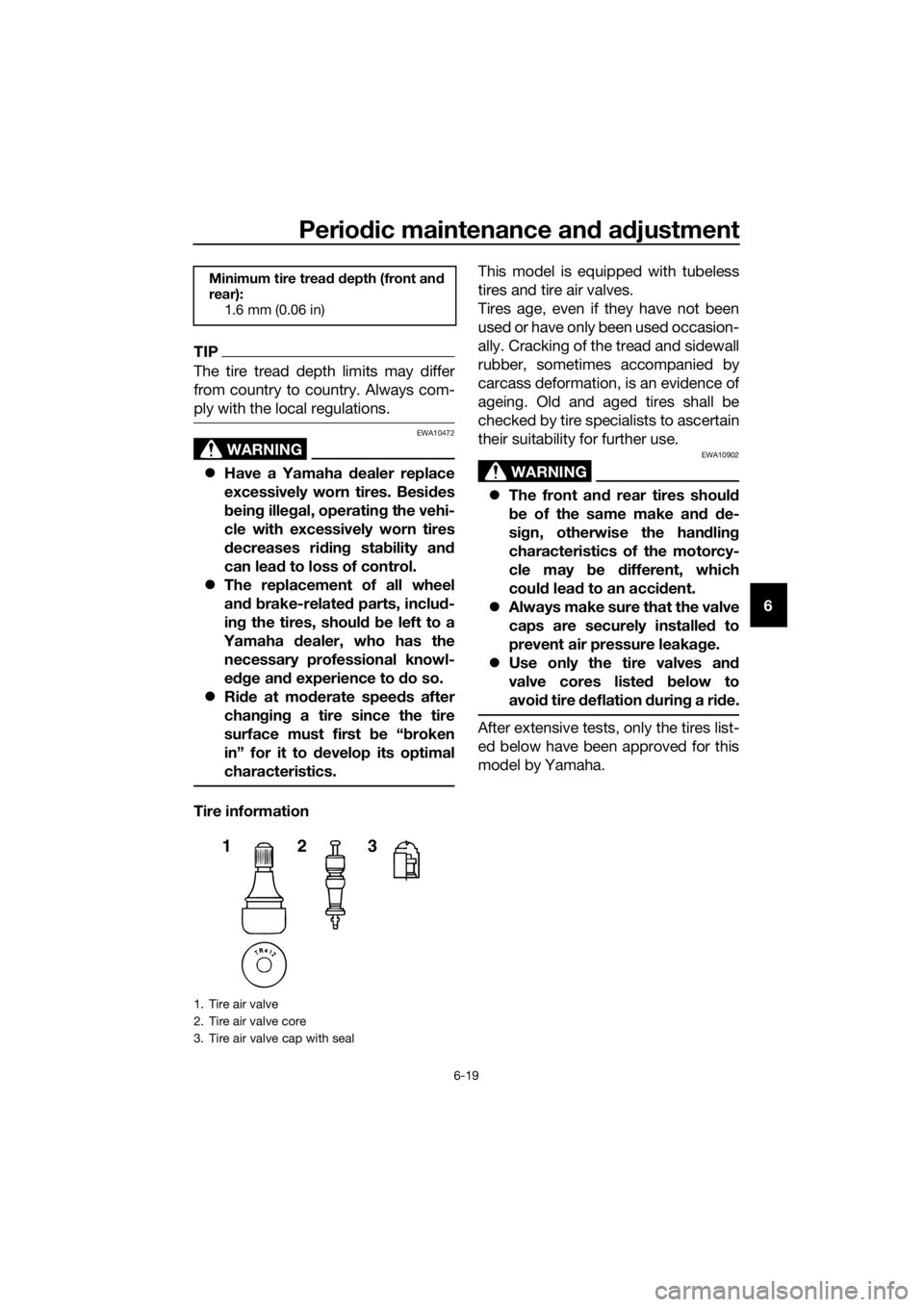
1. Tire air valve
2. Tire air valve core
3. Tire air valve cap with seal
123
U5D7E6E0.book Page 19 Wednesday, June 17, 2015 10:25 AM
Page 62 of 98
Periodic maintenance and adjustment
6-20
6WARNING
EWA10601
This motorcycle is fitted with super-
high-speed tires. Note the following
points in order to make the most ef-
ficient use of these tires.
Use only the specified replace-
ment tires. Other tires may run
the danger of bursting at super
high speeds.
Brand-new tires can have a rel-
atively poor grip on certain road
surfaces until they have been
“broken in”. Therefore, it is ad-
visable before doing any high-
speed riding to ride conserva-
tively for approximately 100 km
(60 mi) after installing a new tire.
The tires must be warmed up
before a high-speed run.
Always adjust the tire air pres-
sure according to the operating
conditions.
EAU21963
Cast wheels
To maximize the performance, durabil-
ity, and safe operation of your vehicle,
note the following points regarding the
specified wheels.
The wheel rims should be
checked for cracks, bends, warp-
age or other damage before each
ride. If any damage is found, have
a Yamaha dealer replace the
wheel. Do not attempt even the
smallest repair to the wheel. A de-
formed or cracked wheel must be
replaced.
The wheel should be balanced
whenever either the tire or wheel
has been changed or replaced. An
unbalanced wheel can result in
poor performance, adverse han-
dling characteristics, and a short-
ened tire life.
Front tire:
Size:
100/80-17 M/C 52H(PIRELLI)-
52S(MICHELIN)
Manufacturer/model:
PIRELLI/SPORT DEMON
MICHELIN/PILOT STREET
Rear tire:
Size:
130/70-17 M/C 62H(PIRELLI)-
62S(MICHELIN)
Manufacturer/model:
PIRELLI/SPORT DEMON
MICHELIN/PILOT STREET
FRONT and REAR:
Tire air valve:
TR412
Valve core:
V3002 (original)
U5D7E6E0.book Page 20 Wednesday, June 17, 2015 10:25 AM