maintenance YAMAHA YZF-R125 2017 Owner's Manual
[x] Cancel search | Manufacturer: YAMAHA, Model Year: 2017, Model line: YZF-R125, Model: YAMAHA YZF-R125 2017Pages: 96, PDF Size: 6.43 MB
Page 59 of 96
Periodic maintenance and adjustment
6-17
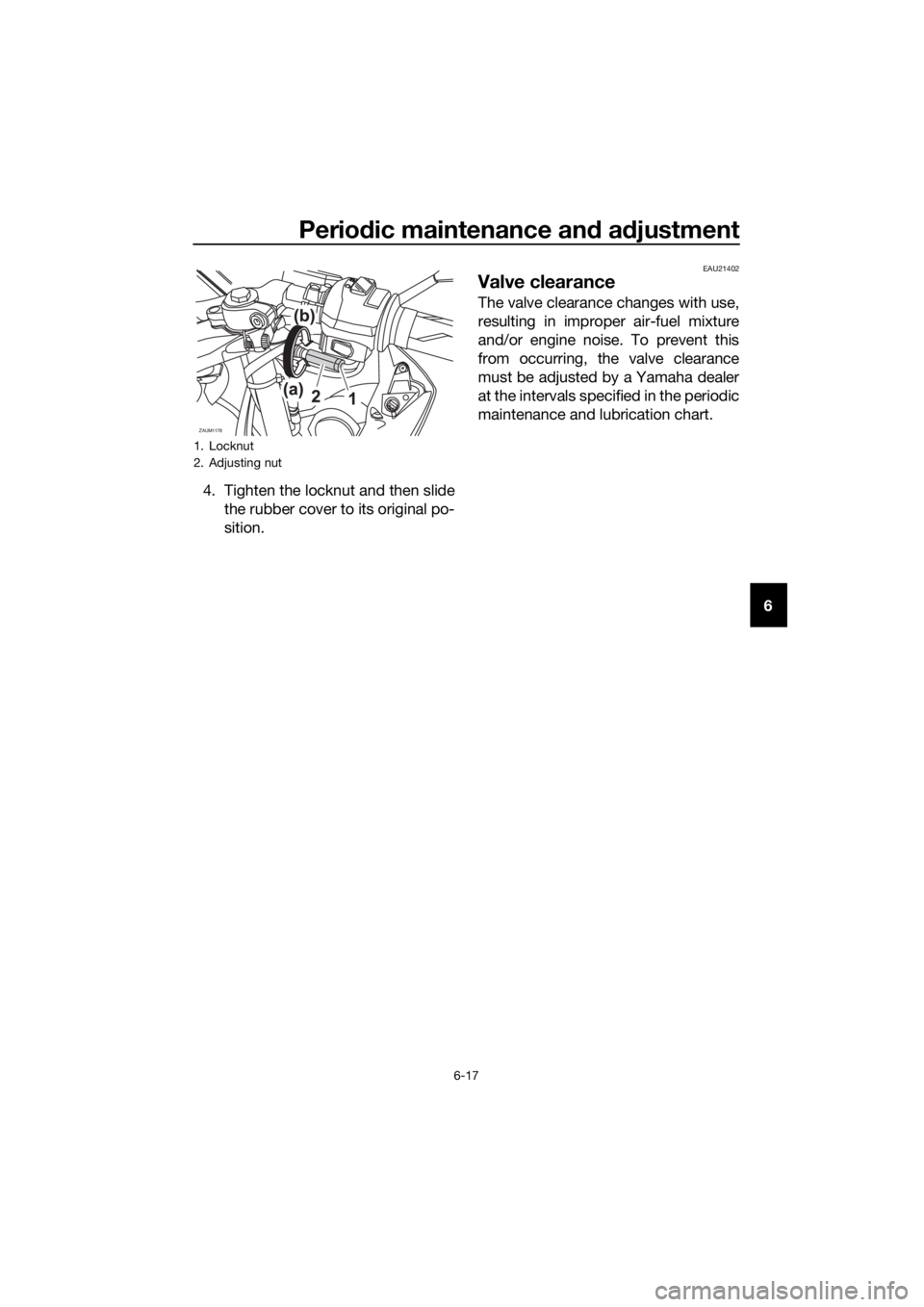
6 4. Tighten the locknut and then slide
the rubber cover to its original po-
sition.
EAU21402
Valve clearance
The valve clearance changes with use,
resulting in improper air-fuel mixture
and/or engine noise. To prevent this
from occurring, the valve clearance
must be adjusted by a Yamaha dealer
at the intervals specified in the periodic
maintenance and lubrication chart.
1. Locknut
2. Adjusting nut
ZAUM1178
UBR6E0E0.book Page 17 Wednesday, August 17, 2016 1:26 PM
Page 60 of 96
Periodic maintenance and adjustment
6-18
6
EAU59162
Tires
Tires are the only contact between the
vehicle and the road. Safety in all con-
ditions of riding depends on a relatively
small area of road contact. Therefore, it
is essential to maintain the tires in good
condition at all times and replace them
at the appropriate time with the speci-
fied tires.
Tire air pressure
The tire air pressure should be
checked and, if necessary, adjusted
before each ride.
WARNING
EWA10504
Operation of this vehicle with im-
proper tire pressure may cause se-
vere injury or death from loss of
control.
The tire air pressure must be
checked and adjusted on cold
tires (i.e., when the temperature
of the tires equals the ambient
temperature).
The tire air pressure must be
adjusted in accordance with the
riding speed and with the total
weight of rider, passenger, car-
go, and accessories approved
for this model.
WARNING
EWA10512
Never overload your vehicle. Opera-
tion of an overloaded vehicle could
cause an accident.
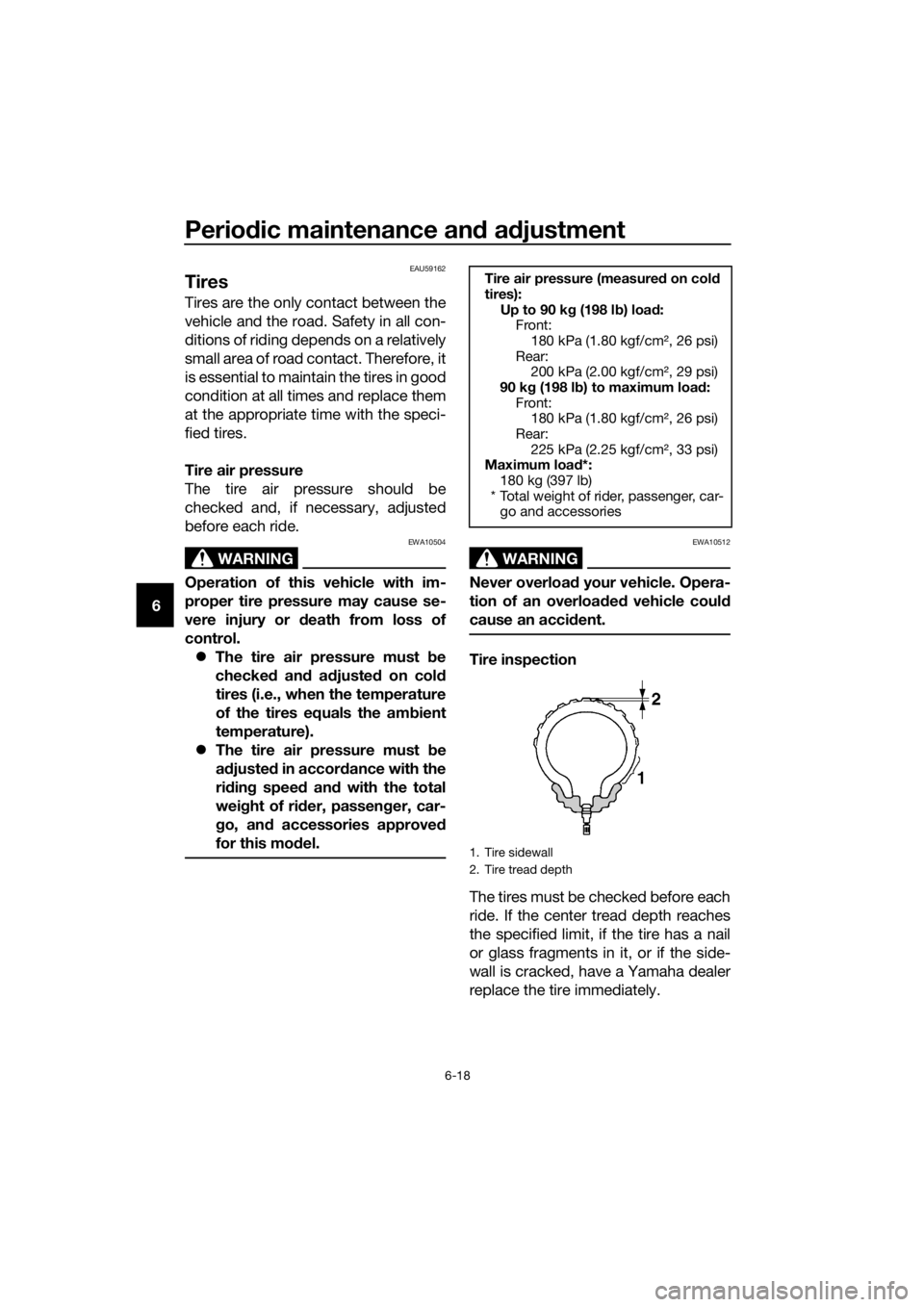
Tire inspection
The tires must be checked before each
ride. If the center tread depth reaches
the specified limit, if the tire has a nail
or glass fragments in it, or if the side-
wall is cracked, have a Yamaha dealer
replace the tire immediately.
Tire air pressure (measured on cold
tires):
Up to 90 kg (198 lb) load:
Front:
180 kPa (1.80 kgf/cm², 26 psi)
Rear:
200 kPa (2.00 kgf/cm², 29 psi)
90 kg (198 lb) to maximum load:
Front:
180 kPa (1.80 kgf/cm², 26 psi)
Rear:
225 kPa (2.25 kgf/cm², 33 psi)
Maximum load*:
180 kg (397 lb)
* Total weight of rider, passenger, car-
go and accessories
1. Tire sidewall
2. Tire tread depth
UBR6E0E0.book Page 18 Wednesday, August 17, 2016 1:26 PM
Page 61 of 96
Periodic maintenance and adjustment
6-19
6
TIP
The tire tread depth limits may differ
from country to country. Always com-
ply with the local regulations.
WARNING
EWA10472
Have a Yamaha dealer replace
excessively worn tires. Besides
being illegal, operating the vehi-
cle with excessively worn tires
decreases riding stability and
can lead to loss of control.
The replacement of all wheel
and brake-related parts, includ-
ing the tires, should be left to a
Yamaha dealer, who has the
necessary professional knowl-
edge and experience to do so.
Ride at moderate speeds after
changing a tire since the tire
surface must first be “broken
in” for it to develop its optimal
characteristics.
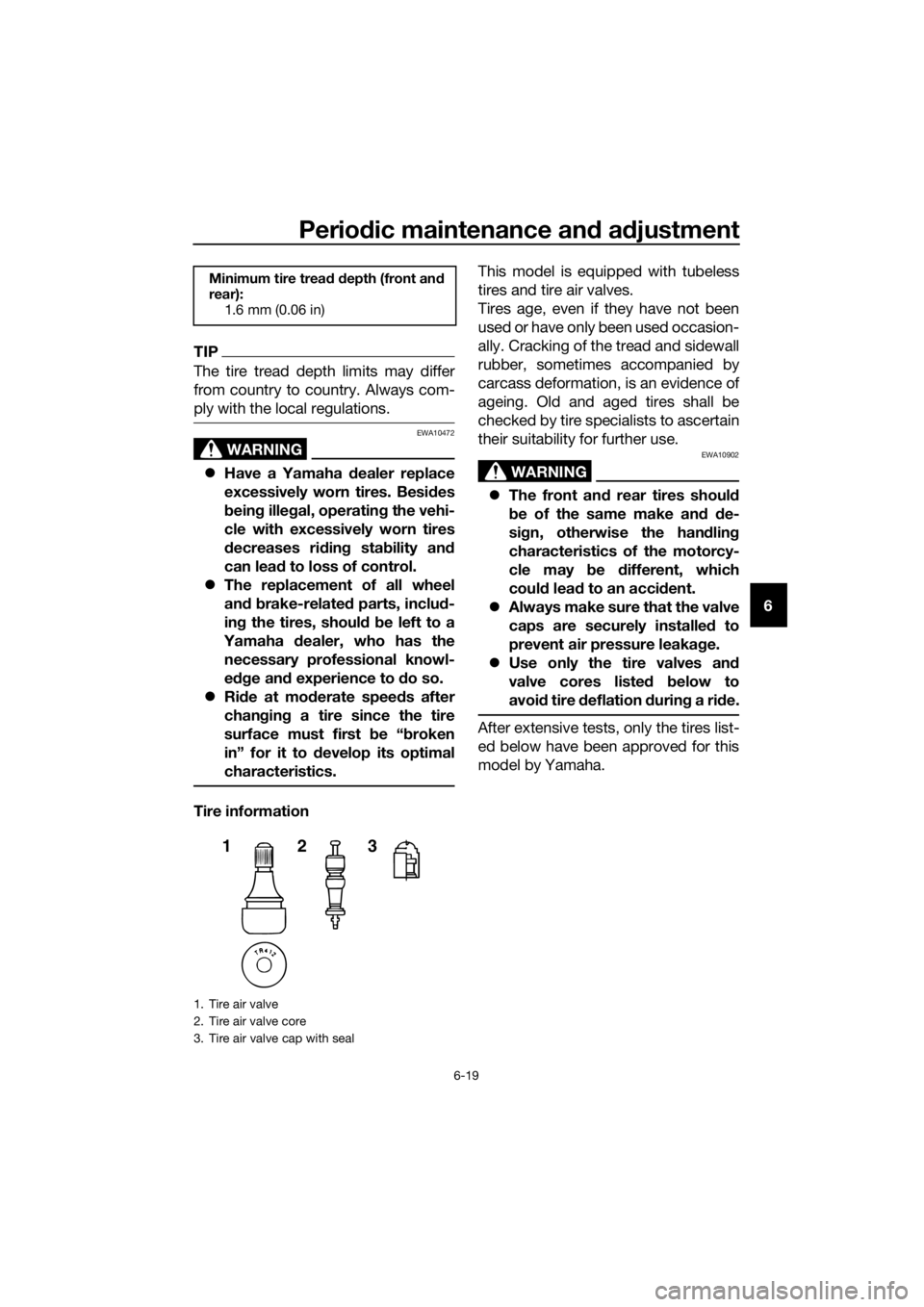
Tire informationThis model is equipped with tubeless
tires and tire air valves.
Tires age, even if they have not been
used or have only been used occasion-
ally. Cracking of the tread and sidewall
rubber, sometimes accompanied by
carcass deformation, is an evidence of
ageing. Old and aged tires shall be
checked by tire specialists to ascertain
their suitability for further use.
WARNING
EWA10902
The front and rear tires should
be of the same make and de-
sign, otherwise the handling
characteristics of the motorcy-
cle may be different, which
could lead to an accident.
Always make sure that the valve
caps are securely installed to
prevent air pressure leakage.
Use only the tire valves and
valve cores listed below to
avoid tire deflation during a ride.
After extensive tests, only the tires list-
ed below have been approved for this
model by Yamaha.
Minimum tire tread depth (front and
rear):
1.6 mm (0.06 in)
1. Tire air valve
2. Tire air valve core
3. Tire air valve cap with seal
123
UBR6E0E0.book Page 19 Wednesday, August 17, 2016 1:26 PM
Page 62 of 96
Periodic maintenance and adjustment
6-20
6WARNING
EWA10601
This motorcycle is fitted with super-
high-speed tires. Note the following
points in order to make the most ef-
ficient use of these tires.
Use only the specified replace-
ment tires. Other tires may run
the danger of bursting at super
high speeds.
Brand-new tires can have a rel-
atively poor grip on certain road
surfaces until they have been
“broken in”. Therefore, it is ad-
visable before doing any high-
speed riding to ride conserva-
tively for approximately 100 km
(60 mi) after installing a new tire.
The tires must be warmed up
before a high-speed run.
Always adjust the tire air pres-
sure according to the operating
conditions.
EAU21963
Cast wheels
To maximize the performance, durabil-
ity, and safe operation of your vehicle,
note the following points regarding the
specified wheels.
The wheel rims should be
checked for cracks, bends, warp-
age or other damage before each
ride. If any damage is found, have
a Yamaha dealer replace the
wheel. Do not attempt even the
smallest repair to the wheel. A de-
formed or cracked wheel must be
replaced.
The wheel should be balanced
whenever either the tire or wheel
has been changed or replaced. An
unbalanced wheel can result in
poor performance, adverse han-
dling characteristics, and a short-
ened tire life.
Front tire:
Size:
100/80-17 M/C 52H(PIRELLI)-
52S(MICHELIN)
Manufacturer/model:
PIRELLI/SPORT DEMON
MICHELIN/PILOT STREET
Rear tire:
Size:
130/70-17 M/C 62H(PIRELLI)-
62S(MICHELIN)
Manufacturer/model:
PIRELLI/SPORT DEMON
MICHELIN/PILOT STREET
FRONT and REAR:
Tire air valve:
TR412
Valve core:
V3002 (original)
UBR6E0E0.book Page 20 Wednesday, August 17, 2016 1:26 PM
Page 63 of 96
Periodic maintenance and adjustment
6-21
6
EAU22047
Adjusting the clutch lever free
play
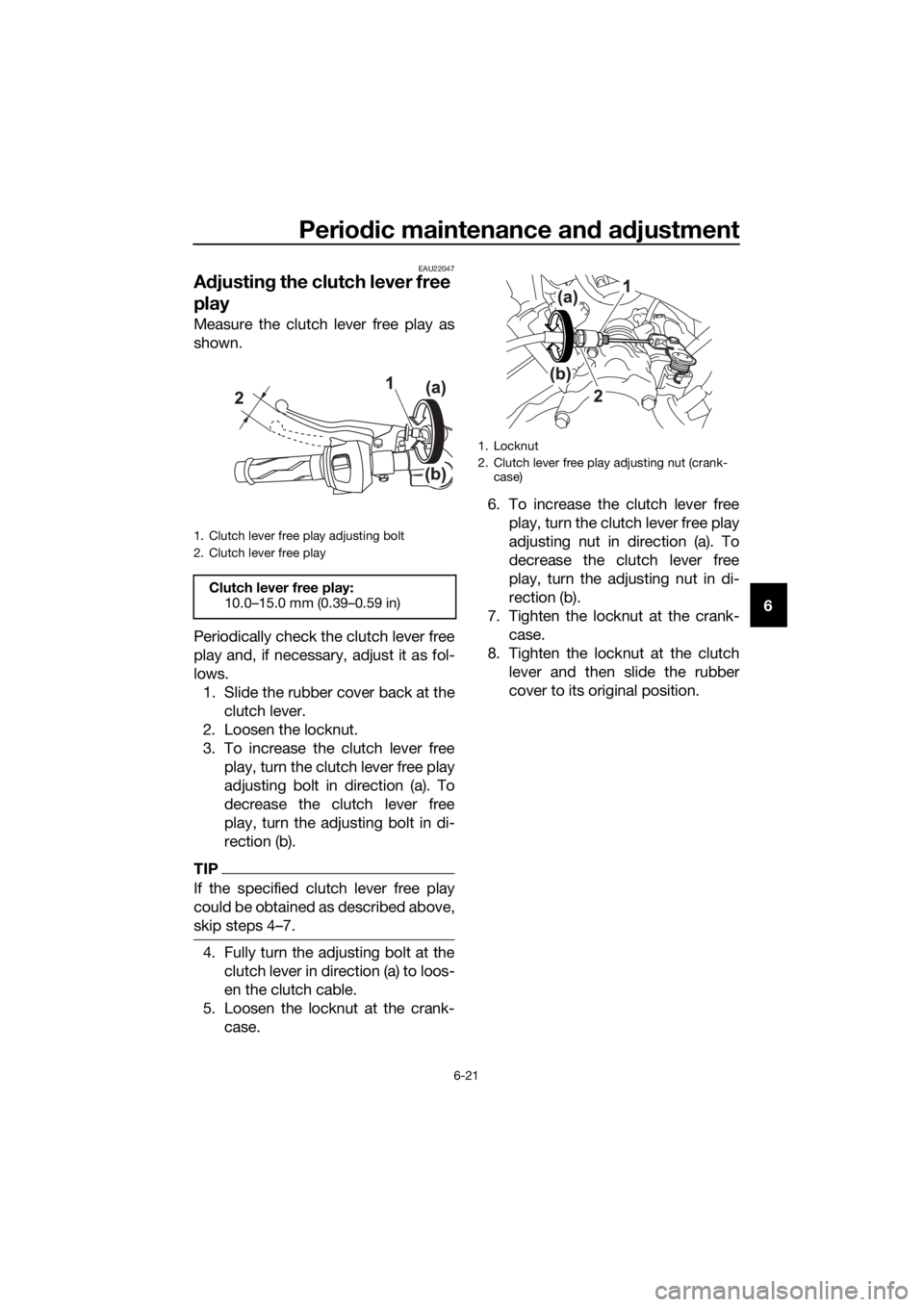
Measure the clutch lever free play as
shown.
Periodically check the clutch lever free
play and, if necessary, adjust it as fol-
lows.
1. Slide the rubber cover back at the
clutch lever.
2. Loosen the locknut.
3. To increase the clutch lever free
play, turn the clutch lever free play
adjusting bolt in direction (a). To
decrease the clutch lever free
play, turn the adjusting bolt in di-
rection (b).
TIP
If the specified clutch lever free play
could be obtained as described above,
skip steps 4…7.
4. Fully turn the adjusting bolt at the
clutch lever in direction (a) to loos-
en the clutch cable.
5. Loosen the locknut at the crank-
case.6. To increase the clutch lever free
play, turn the clutch lever free play
adjusting nut in direction (a). To
decrease the clutch lever free
play, turn the adjusting nut in di-
rection (b).
7. Tighten the locknut at the crank-
case.
8. Tighten the locknut at the clutch
lever and then slide the rubber
cover to its original position.
1. Clutch lever free play adjusting bolt
2. Clutch lever free play
Clutch lever free play:
10.0–15.0 mm (0.39–0.59 in)
1. Locknut
2. Clutch lever free play adjusting nut (crank-
case)
UBR6E0E0.book Page 21 Wednesday, August 17, 2016 1:26 PM
Page 64 of 96
Periodic maintenance and adjustment
6-22
6
EAUT1223
Checking the front brake lever
free play
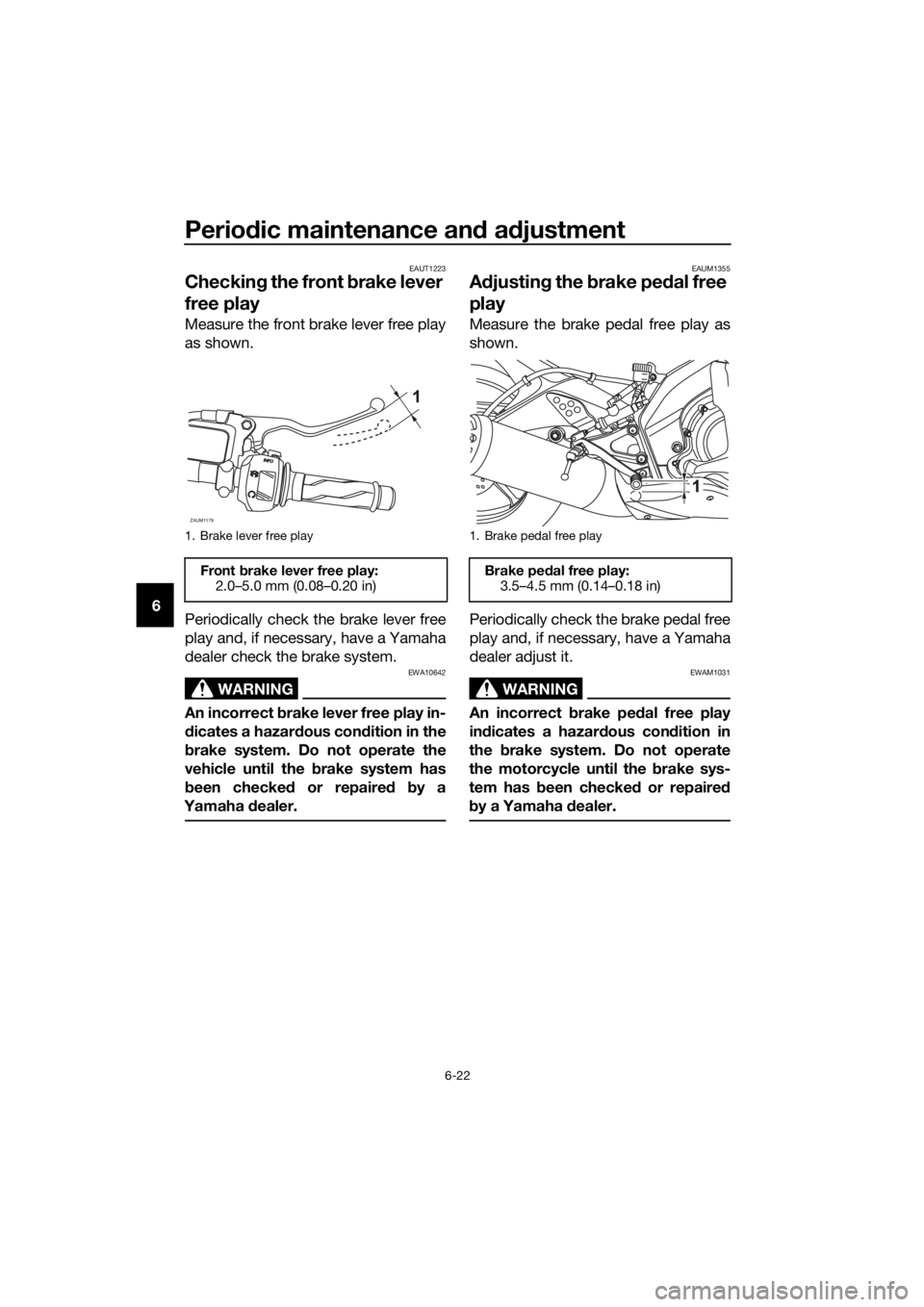
Measure the front brake lever free play
as shown.
Periodically check the brake lever free
play and, if necessary, have a Yamaha
dealer check the brake system.
WARNING
EWA10642
An incorrect brake lever free play in-
dicates a hazardous condition in the
brake system. Do not operate the
vehicle until the brake system has
been checked or repaired by a
Yamaha dealer.
EAUM1355
Adjusting the brake pedal free
play
Measure the brake pedal free play as
shown.
Periodically check the brake pedal free
play and, if necessary, have a Yamaha
dealer adjust it.
WARNING
EWAM1031
An incorrect brake pedal free play
indicates a hazardous condition in
the brake system. Do not operate
the motorcycle until the brake sys-
tem has been checked or repaired
by a Yamaha dealer.
1. Brake lever free play
Front brake lever free play:
2.0–5.0 mm (0.08–0.20 in)
ZAUM1179
INFOINFO
1. Brake pedal free play
Brake pedal free play:
3.5–4.5 mm (0.14–0.18 in)
UBR6E0E0.book Page 22 Wednesday, August 17, 2016 1:26 PM
Page 65 of 96
Periodic maintenance and adjustment
6-23
6
EAU36504
Brake light switches
The brake light, which is activated by
the brake pedal and brake lever,
should come on just before braking
takes effect. If necessary, have a
Yamaha dealer adjust the brake light
switches.
EAU22393
Checking the front and rear
brake pads
The front and rear brake pads must be
checked for wear at the intervals spec-
ified in the periodic maintenance and
lubrication chart.
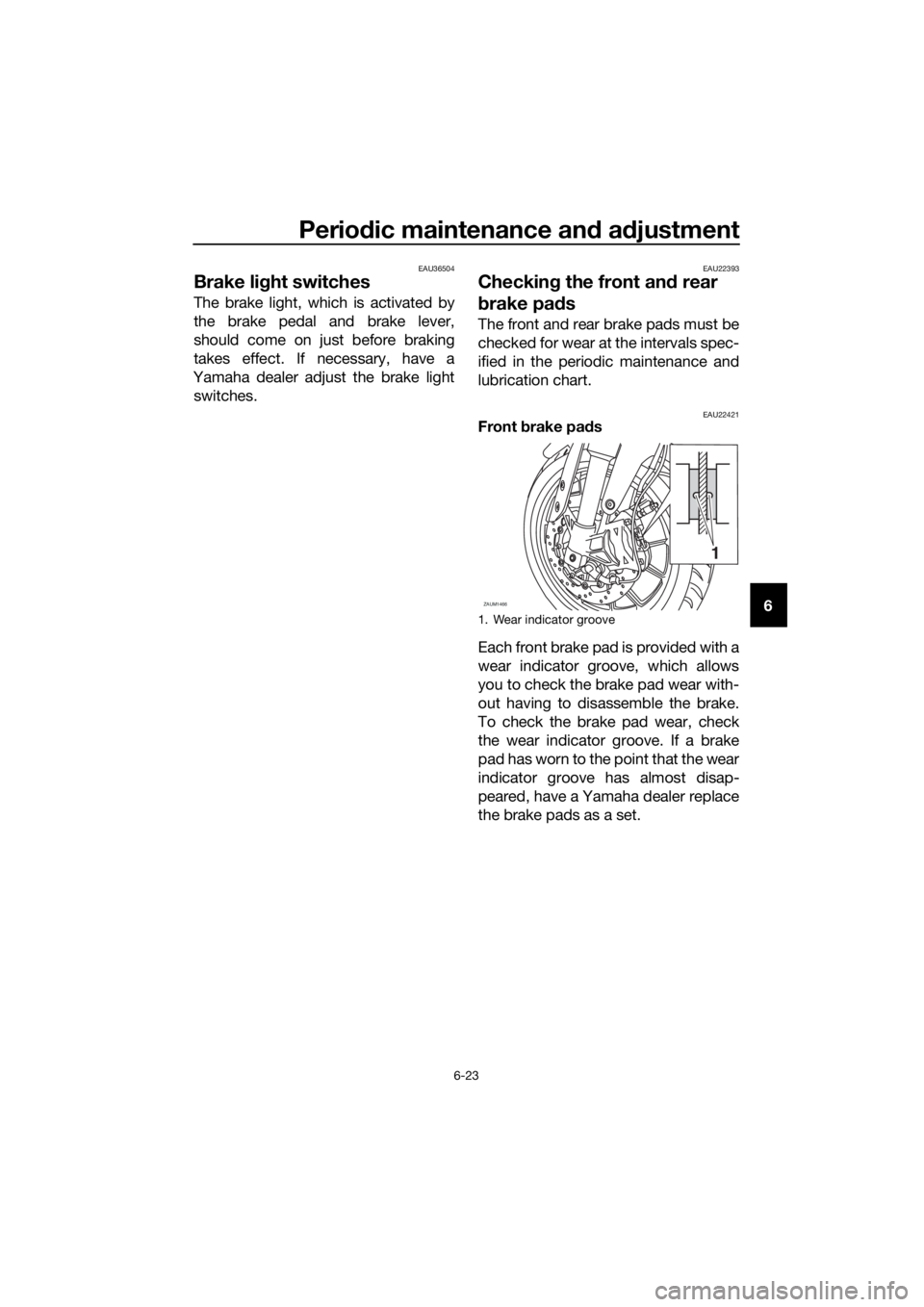
EAU22421Front brake pads
Each front brake pad is provided with a
wear indicator groove, which allows
you to check the brake pad wear with-
out having to disassemble the brake.
To check the brake pad wear, check
the wear indicator groove. If a brake
pad has worn to the point that the wear
indicator groove has almost disap-
peared, have a Yamaha dealer replace
the brake pads as a set.
1. Wear indicator groove
ZAUM1466
1
UBR6E0E0.book Page 23 Wednesday, August 17, 2016 1:26 PM
Page 66 of 96
Periodic maintenance and adjustment
6-24
6
EAU22501Rear brake pads
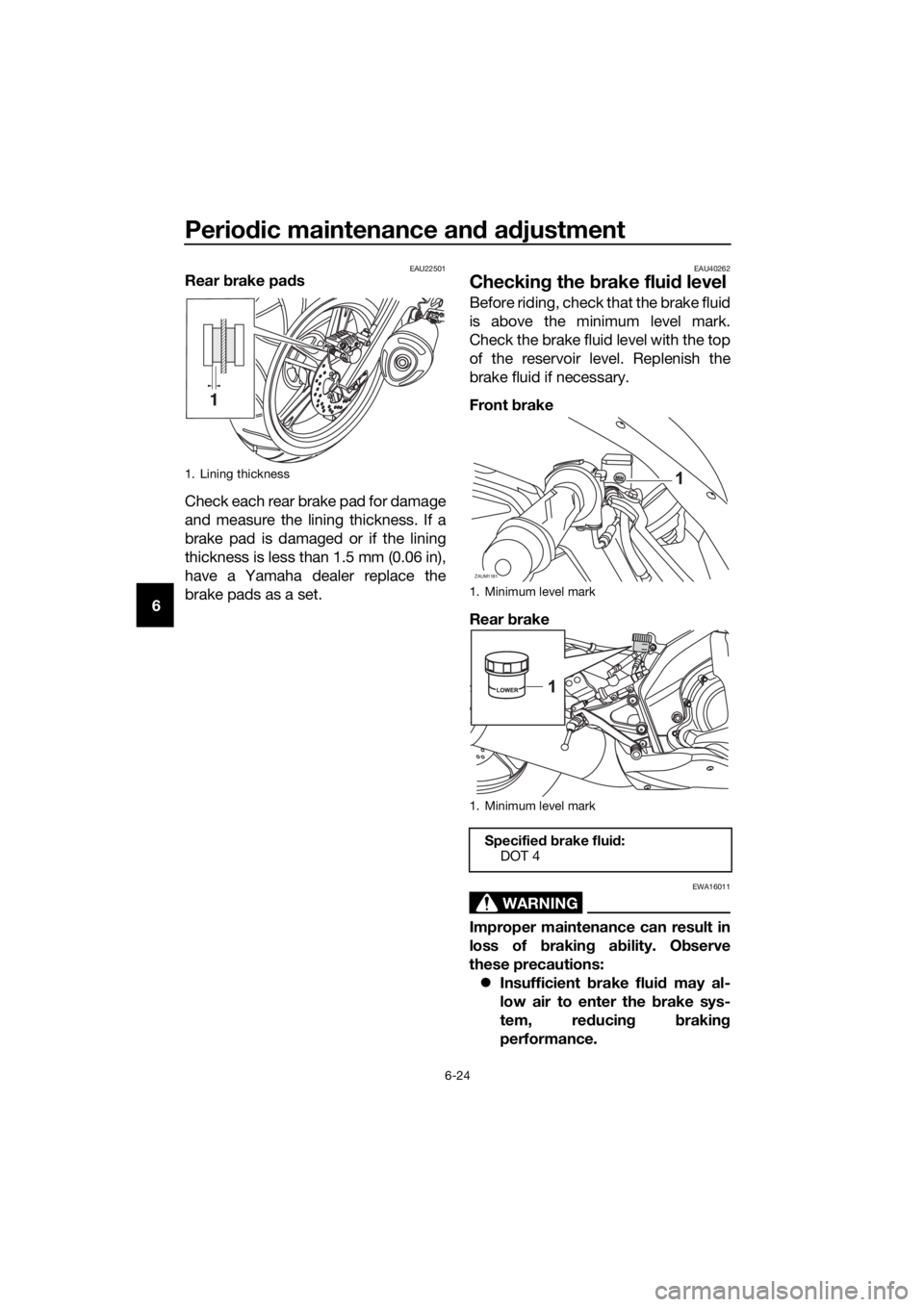
Check each rear brake pad for damage
and measure the lining thickness. If a
brake pad is damaged or if the lining
thickness is less than 1.5 mm (0.06 in),
have a Yamaha dealer replace the
brake pads as a set.EAU40262
Checking the brake fluid level
Before riding, check that the brake fluid
is above the minimum level mark.
Check the brake fluid level with the top
of the reservoir level. Replenish the
brake fluid if necessary.
Front brake
Rear brake
WARNING
EWA16011
Improper maintenance can result in
loss of braking ability. Observe
these precautions:
Insufficient brake fluid may al-
low air to enter the brake sys-
tem, reducing braking
performance.
1. Lining thickness
1. Minimum level mark
1. Minimum level mark
Specified brake fluid:
DOT 4
ZAUM1181
INFOINFO
UBR6E0E0.book Page 24 Wednesday, August 17, 2016 1:26 PM
Page 67 of 96
Periodic maintenance and adjustment
6-25
6 Clean the filler cap before re-
moving. Use only DOT 4 brake
fluid from a sealed container.
Use only the specified brake flu-
id; otherwise, the rubber seals
may deteriorate, causing leak-
age.
Refill with the same type of
brake fluid. Adding a brake fluid
other than DOT 4 may result in a
harmful chemical reaction.
Be careful that water or dust
does not enter the brake fluid
reservoir when refilling. Water
will significantly lower the boil-
ing point of the fluid and may re-
sult in vapor lock, and dirt may
clog the ABS hydraulic unit
valves.
NOTICE
ECA17641
Brake fluid may damage painted
surfaces or plastic parts. Always
clean up spilled fluid immediately.
As the brake pads wear, it is normal for
the brake fluid level to gradually go
down. A low brake fluid level may indi-
cate worn brake pads and/or brake
system leakage; therefore, be sure to
check the brake pads for wear and the
brake system for leakage. If the brake
fluid level goes down suddenly, have a
Yamaha dealer check the cause before
further riding.
EAU22733
Changing the brake fluid
Have a Yamaha dealer change the
brake fluid at the intervals specified in
the periodic maintenance and lubrica-
tion chart. In addition, have the oil seals
of the master cylinders and calipers as
well as the brake hoses replaced at the
intervals listed below or whenever they
are damaged or leaking.
Oil seals: Replace every two
years.
Brake hoses: Replace every four
years.
UBR6E0E0.book Page 25 Wednesday, August 17, 2016 1:26 PM
Page 68 of 96

Periodic maintenance and adjustment
6-26
6
EAU22762
Drive chain slack
The drive chain slack should be
checked before each ride and adjusted
if necessary.
EAUM3551To check the drive chain slack
1. Place the motorcycle on the side-
stand.
TIP
When checking and adjusting the drive
chain slack, there should be no weight
on the motorcycle.
2. Shift the transmission into the
neutral position.
3. Measure the drive chain slack at
the arrow mark on the swingarm
as shown in the illustration.
4. If the drive chain slack is incorrect,
adjust it as follows.
EAU3431ATo adjust the drive chain slack
Consult a Yamaha dealer before ad-
justing the drive chain slack.
1. Loosen the axle nut and the lock-
nut on each side of the swingarm.2. To tighten the drive chain, turn the
drive chain slack adjusting bolt on
each side of the swingarm in di-
rection (a). To loosen the drive
chain, turn the adjusting bolt on
each side of the swingarm in di-
rection (b), and then push the rear
wheel forward. NOTICE: Improp-
er drive chain slack will over-
load the engine as well as other
vital parts of the motorcycle and
can lead to chain slippage or
breakage. To prevent this from
occurring, keep the drive chain
slack within the specified limits.
[ECA10572]
TIP
Using the alignment marks on each
side of the swingarm, make sure that
both drive chain pullers are in the same
position for proper wheel alignment.
3. Tighten the axle nut, then the lock-
nuts to their specified torques.
Drive chain slack:
35.0–45.0 mm (1.38–1.77 in)
1. Drive chain slack
ZAUM1182
1. Axle nut
2. Drive chain slack adjusting bolt
3. Locknut
4. Alignment marks
ZAUM1468
UBR6E0E0.book Page 26 Wednesday, August 17, 2016 1:26 PM