pressure YAMAHA YZF-R6 2001 Owners Manual
[x] Cancel search | Manufacturer: YAMAHA, Model Year: 2001, Model line: YZF-R6, Model: YAMAHA YZF-R6 2001Pages: 118, PDF Size: 12.83 MB
Page 35 of 118

INSTRUMENT AND CONTROL FUNCTIONS
3-20
3
Compression damping force
To increase the compression damping
force and thereby harden the compres-
sion damping, turn the adjusting screw
in direction
a. To decrease the com-
pression damping force and thereby
soften the compression damping, turn
the adjusting screw in direction
b.
CI-02E
NOTE:@ Although the total number of clicks of a
damping force adjusting mechanism
may not exactly match the above spec-
ifications due to small differences in
production, the actual number of clicks
always represents the entire adjusting
range. To obtain a precise adjustment,
it would be advisable to check the num-
ber of clicks of each damping force ad-
justing mechanism and to modify the
specifications as necessary. @
EAU00315
WARNING
@ This shock absorber contains high-
ly pressurized nitrogen gas. For
proper handling, read and under-
stand the following information be-
fore handling the shock absorber.
The manufacturer cannot be held re-
sponsible for property damage or
personal injury that may result from
improper handling.l
Do not tamper with or attempt to
open the gas cylinder.
l
Do not subject the shock ab-
sorber to an open flame or other
high heat sources, otherwise it
may explode due to excessive
gas pressure.
l
Do not deform or damage the
gas cylinder in any way, as this
will result in poor damping per-
formance.
l
Always have a Yamaha dealer
service the shock absorber.
@
1. Compression damping force adjusting screwMinimum (soft) 12 clicks in direction
b*
Standard 7 clicks in direction
b*
Maximum (hard) 1 click in direction
b*
* With the adjusting screw fully turned in direction
a
E_5mt.book Page 20 Monday, September 18, 2000 9:08 AM
Page 42 of 118

4-1
4
EAU01114
4-PRE-OPERATION CHECKSThe condition of a vehicle is the owner’s responsibility. Vital components can start to deteriorate quickly and unexpectedly,
even if the vehicle remains unused (for example, as a result of exposure to the elements). Any damage, fluid leakage or loss
of tire air pressure could have serious consequences. Therefore, it is very important, in addition to a thorough visual inspec-
tion, to check the following points before each ride.
EAU03439
Pre-operation check list
CO-01E
ITEM CHECKS PAGE
Fuel• Check fuel level in fuel tank.
• Refuel if necessary.
• Check fuel line for leakage.3-11–3-12
Engine oil• Check oil level in engine.
• If necessary, add recommended oil to specified level.
• Check vehicle for oil leakage.6-10–6-13
Coolant• Check coolant level in reservoir.
• If necessary, add recommended coolant to specified level.
• Check cooling system for leakage.6-13–6-17
Front brake• Check operation.
• If soft or spongy, have Yamaha dealer bleed hydraulic system.
• Check fluid level in reservoir.
• If necessary, add recommended brake fluid to specified level.
• Check hydraulic system for leakage.6-28–6-30
Rear brake• Check operation.
• If soft or spongy, have Yamaha dealer bleed hydraulic system.
• Check fluid level in reservoir.
• If necessary, add recommended brake fluid to specified level.
• Check hydraulic system for leakage.6-27–6-30
Clutch• Check operation.
• Lubricate cable if necessary.
• Check lever free play.
• Adjust if necessary.6-25–6-26, 6-34
E_5mt.book Page 1 Monday, September 18, 2000 9:08 AM
Page 43 of 118

PRE-OPERATION CHECKS
4-2
4
Throttle grip• Make sure that operation is smooth.
• Lubricate throttle grip, housing and cables if necessary.
• Check free play.
• If necessary, have Yamaha dealer make adjustment.6-21, 6-33
Control cables• Make sure that operation is smooth.
• Lubricate if necessary.6-33
Drive chain• Check chain slack.
• Adjust if necessary.
• Check chain condition.
• Lubricate if necessary.6-31–6-32
Wheels and tires• Check for damage.
• Check tire condition and tread depth.
• Check air pressure.
• Correct if necessary.6-22–6-25
Brake and shift pedals• Make sure that operation is smooth.
• Lubricate pedal pivoting points if necessary.6-34
Brake and clutch levers• Make sure that operation is smooth.
• Lubricate lever pivoting points if necessary.6-34
Sidestand• Make sure that operation is smooth.
• Lubricate pivot if necessary.6-34
Chassis fasteners• Make sure that all nuts, bolts and screws are properly tightened.
• Tighten if necessary.—
Instruments, lights, signals
and switches• Check operation.
• Correct if necessary.—
Engine stop switch• Check operation.3-8
Sidestand switch• Check operation of ignition circuit cut-off system.
• If system is defective, have Yamaha dealer check vehicle.3-22 ITEM CHECKS PAGE
E_5mt.book Page 2 Monday, September 18, 2000 9:08 AM
Page 55 of 118

PERIODIC MAINTENANCE AND MINOR REPAIR
6-4
6
9
*Brake hoses• Check for cracks or damage.ÖÖÖÖ Ö
• Replace. (See NOTE on page 6-5.) Every 4 years
10*Wheels• Check runout and for damage.ÖÖÖÖ
11*Tires• Check tread depth and for damage.
• Replace if necessary.
• Check air pressure.
• Correct if necessary.ÖÖÖÖ
12*Wheel bearings• Check bearing for looseness or damage.ÖÖÖÖ
13*Swingarm• Operation and for excessive play.ÖÖÖÖ
• Lubricate with lithium-soap-based grease. Every 50,000 km
14 Drive chain• Check chain slack.
• Make sure that the rear wheel is properly aligned.
• Clean and lubricate.Every 1,000 km and after washing
the motorcycle or riding in the rain.
15*Steering bearings• Check bearing play and steering for roughness.ÖÖÖÖÖ
• Lubricate with lithium-soap-based grease. Every 20,000 km
16*Chassis fasteners• Make sure that all nuts, bolts and screws are properly tightened.ÖÖÖÖ Ö
17 Sidestand• Check operation.
• Lubricate.ÖÖÖÖ Ö
18*Sidestand switch• Check operation.ÖÖÖÖÖ Ö
19*Front fork• Check operation and for oil leakage.ÖÖÖÖ
20*Rear shock absorber
assembly• Check operation and shock absorber for oil leakage.ÖÖÖÖ
21*Rear suspension relay
arm and connecting arm
pivoting points• Check operation.ÖÖÖÖ
• Lubricate with lithium-soap-based grease.ÖÖ NO. ITEM CHECK OR MAINTENANCE JOBODOMETER READING (´1,000 km)
ANNUAL
CHECK
1 10203040
E_5mt_Periodic.fm Page 4 Tuesday, December 12, 2000 5:49 PM
Page 73 of 118
PERIODIC MAINTENANCE AND MINOR REPAIR
6-22
6
EAU00637
Adjusting the valve clearance The valve clearance changes with use,
resulting in improper air-fuel mixture
and/or engine noise. To prevent this
from occurring, the valve clearance
must be adjusted by a Yamaha dealer
at the intervals specified in the periodic
maintenance and lubrication chart.
EAU00658
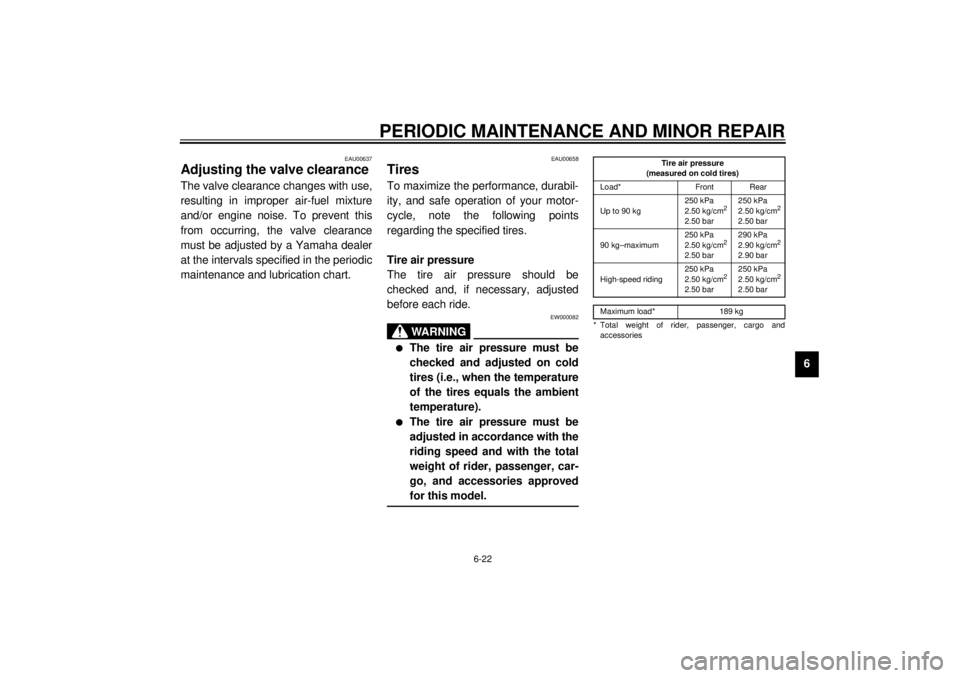
Tires To maximize the performance, durabil-
ity, and safe operation of your motor-
cycle, note the following points
regarding the specified tires.
Tire air pressure
The tire air pressure should be
checked and, if necessary, adjusted
before each ride.
EW000082
WARNING
@ l
The tire air pressure must be
checked and adjusted on cold
tires (i.e., when the temperature
of the tires equals the ambient
temperature).
l
The tire air pressure must be
adjusted in accordance with the
riding speed and with the total
weight of rider, passenger, car-
go, and accessories approved
for this model.
@
CE-01E
CE-07E
Tire air pressure
(measured on cold tires)
Load* Front Rear
Up to 90 kg250 kPa
2.50 kg/cm
2
2.50 bar250 kPa
2.50 kg/cm
2
2.50 bar
90 kg–maximum250 kPa
2.50 kg/cm
2
2.50 bar290 kPa
2.90 kg/cm
2
2.90 bar
High-speed riding250 kPa
2.50 kg/cm
2
2.50 bar250 kPa
2.50 kg/cm
2
2.50 bar
Maximum load* 189 kg
* Total weight of rider, passenger, cargo and
accessories
E_5mt.book Page 22 Monday, September 18, 2000 9:08 AM
Page 74 of 118
PERIODIC MAINTENANCE AND MINOR REPAIR
6-23
6
EWA00012
WARNING
@ Because loading has an enormous
impact on the handling, braking,
performance and safety characteris-
tics of your motorcycle, you should
keep the following precautions in
mind. l
NEVER OVERLOAD THE
MOTORCYCLE! Operation of an
overloaded motorcycle may re-
sult in tire damage, loss of con-
trol, or severe injury. Make sure
that the total weight of rider,
passenger, cargo, and accesso-
ries does not exceed the speci-
fied maximum load for the
vehicle.
l
Do not carry along loosely
packed items, which can shift
during a ride.
l
Securely pack the heaviest
items close to the center of the
motorcycle and distribute the
weight evenly on both sides.
l
Adjust the suspension and tire
air pressure with regard to the
load.
l
Check the tire condition and air
pressure before each ride.
@
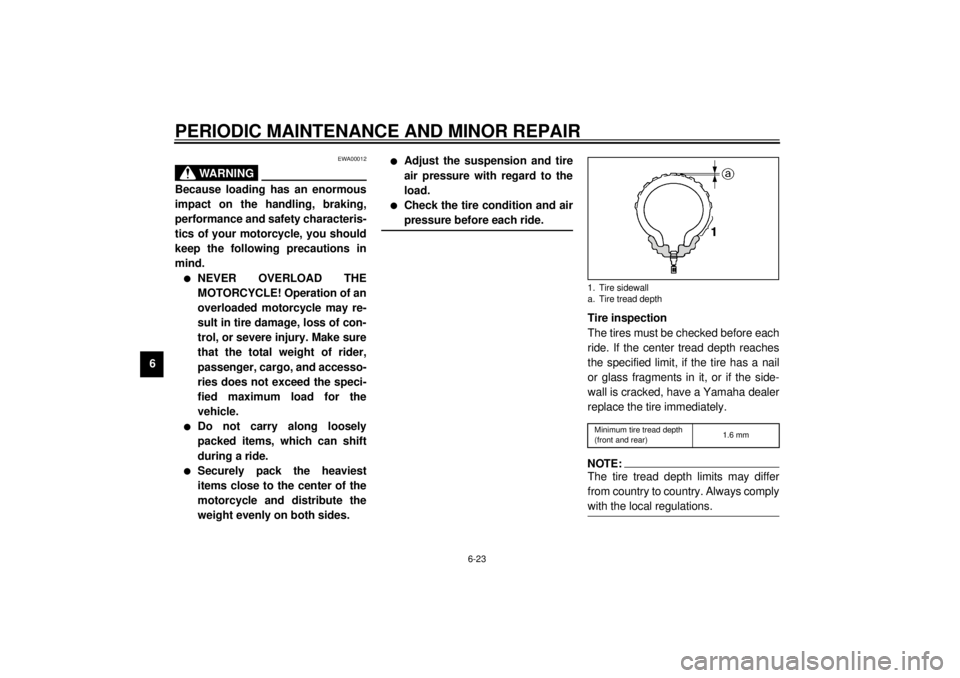
Tire inspection
The tires must be checked before each
ride. If the center tread depth reaches
the specified limit, if the tire has a nail
or glass fragments in it, or if the side-
wall is cracked, have a Yamaha dealer
replace the tire immediately.CE-08ENOTE:@ The tire tread depth limits may differ
from country to country. Always comply
with the local regulations. @1. Tire sidewall
a. Tire tread depthMinimum tire tread depth
(front and rear)1.6 mm
E_5mt.book Page 23 Monday, September 18, 2000 9:08 AM
Page 75 of 118
PERIODIC MAINTENANCE AND MINOR REPAIR
6-24
6
EW000079
WARNING
@ l
Have a Yamaha dealer replace
excessively worn tires. Besides
being illegal, operating the
motorcycle with excessively
worn tires decreases riding sta-
bility and can lead to loss of
control.
l
The replacement of all wheel-
and brake-related parts, includ-
ing the tires, should be left to a
Yamaha dealer, who has the
necessary professional knowl-
edge and experience.
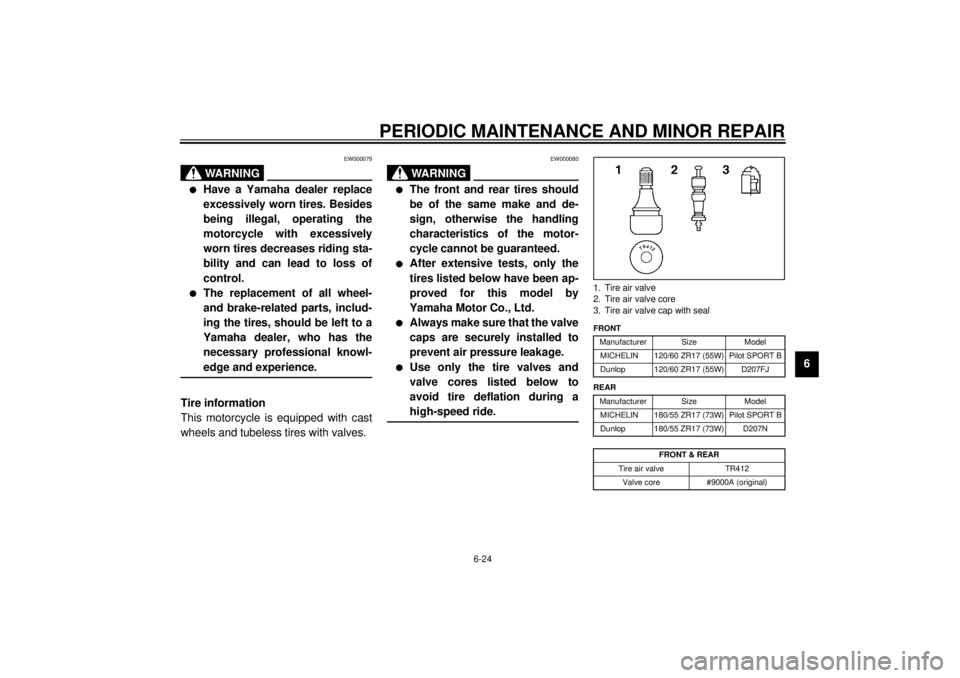
@Tire information
This motorcycle is equipped with cast
wheels and tubeless tires with valves.
EW000080
WARNING
@ l
The front and rear tires should
be of the same make and de-
sign, otherwise the handling
characteristics of the motor-
cycle cannot be guaranteed.
l
After extensive tests, only the
tires listed below have been ap-
proved for this model by
Yamaha Motor Co., Ltd.
l
Always make sure that the valve
caps are securely installed to
prevent air pressure leakage.
l
Use only the tire valves and
valve cores listed below to
avoid tire deflation during a
high-speed ride.
@
CE-10E
CE-14E1. Tire air valve
2. Tire air valve core
3. Tire air valve cap with sealFRONT
Manufacturer Size Model
MICHELIN 120/60 ZR17 (55W) Pilot SPORT B
Dunlop 120/60 ZR17 (55W) D207FJ
REAR
Manufacturer Size Model
MICHELIN 180/55 ZR17 (73W) Pilot SPORT B
Dunlop 180/55 ZR17 (73W) D207N
FRONT & REAR
Tire air valve TR412
Valve core #9000A (original)
E_5mt.book Page 24 Monday, September 18, 2000 9:08 AM
Page 83 of 118

PERIODIC MAINTENANCE AND MINOR REPAIR
6-32
6
NOTE:@ Using the alignment marks on each
side of the swingarm, make sure that
both chain pullers are in the same posi-
tion for proper wheel alignment. @
EC000096
CAUTION:@ Improper drive chain slack will over-
load the engine as well as other vital
parts of the motorcycle and can lead
to chain slippage or breakage. To
prevent this from occurring, keep
the drive chain slack within the
specified limits. @3. Tighten the locknuts, and then
tighten the axle nut to the specified
torque.
EAU03006
Lubricating the drive chain The drive chain must be cleaned and
lubricated at the intervals specified in
the periodic maintenance and lubrica-
tion chart, otherwise it will quickly wear
out, especially when riding in dusty or
wet areas. Service the drive chain as
follows.
EC000097
CAUTION:@ The drive chain must be lubricated
after washing the motorcycle or
riding in the rain. @1. Clean the drive chain with kero-
sene and a small soft brush.
ECA00053
CAUTION:@ To prevent damaging the O-rings,
do not clean the drive chain with
steam cleaners, high-pressure
washers or inappropriate solvents. @2. Wipe the drive chain dry.
3. Thoroughly lubricate the drive
chain with a special O-ring chain
lubricant.
ECA00052
CAUTION:@ Do not use engine oil or any other
lubricants for the drive chain, as
they may contain substances that
could damage the O-rings. @
Tightening torque:
Axle nut:
150 Nm (15.0 m·kg)
E_5mt.book Page 32 Monday, September 18, 2000 9:08 AM
Page 97 of 118

PERIODIC MAINTENANCE AND MINOR REPAIR
6-46
6 Engine overheating
EW000070
WARNING
@ l
Do not remove the radiator cap when the engine and radiator are hot. Scalding hot fluid and steam may be
blown out under pressure, which could cause serious injury. Be sure to wait until the engine has cooled.
l
After removing the radiator cap retaining bolt, place a thick rag, like a towel, over the radiator cap, and then
slowly rotate the cap counterclockwise to the detent to allow any residual pressure to escape. When the hiss-
ing sound has stopped, press down on the cap while turning it counterclockwise, and then remove the cap.
@aNOTE:@ If coolant is not available, tap water can be temporarily used instead, provided that it is changed to the recommended coolant
as soon as possible. @
Wait until the
engine has cooled.
Check the coolant level in the
reservoir and radiator.
The coolant level
is OK.The coolant level is low.
Check the cooling system
for leakage.
Have a Yamaha dealer checkand repair the cooling system.Add coolant. (See NOTE.)
Start the engine. If the engine overheats again,
have a
Yamaha dealer check
and repair the cooling system.
There is
leakage.
There is
no leakage.
E_5mt.book Page 46 Monday, September 18, 2000 9:08 AM
Page 101 of 118

MOTORCYCLE CARE AND STORAGE
7-2
7
l
Do not use any harsh chemical
products on plastic parts. Be
sure to avoid using cloths or
sponges which have been in
contact with strong or abrasive
cleaning products, solvent or
thinner, fuel (gasoline), rust re-
movers or inhibitors, brake flu-
id, antifreeze or electrolyte.
l
Do not use high-pressure wash-
ers or steam-jet cleaners since
they cause water seepage and
deterioration in the following ar-
eas: seals (of wheel and swing-
arm bearings, fork and brakes),
electric components (couplers,
connectors, instruments, switch-
es and lights), breather hoses
and vents.
l
For motorcycles equipped with
a windshield: Do not use strong
cleaners or hard sponges as
they will cause dulling or
scratching. Some cleaning
compounds for plastic may
leave scratches on the wind-shield. Test the product on a
small hidden part of the wind-
shield to make sure that it does
not leave any marks. If the wind-
shield is scratched, use a quali-
ty plastic polishing compound
after washing.
@After normal useRemove dirt with warm water, a mild
detergent, and a soft, clean sponge,
and then rinse thoroughly with clean
water. Use a toothbrush or bottlebrush
for hard-to-reach areas. Stubborn dirt
and insects will come off more easily if
the area is covered with a wet cloth for
a few minutes before cleaning. Use the
special sponge, which is included in the
plastic bag containing the owner’s
manual, to clean the muffler and to re-
move any discoloration from it.After riding in the rain, near the sea or
on salt-sprayed roadsSince sea salt or salt sprayed on roads
during winter are extremely corrosive in
combination with water, carry out the
following steps after each ride in the
rain, near the sea or on salt-sprayed
roads.NOTE:@ Salt sprayed on roads in the winter may
remain well into spring. @1. Clean the motorcycle with cold
water and a mild detergent, after
the engine has cooled down.
ECA00012
CAUTION:@ Do not use warm water since it in-
creases the corrosive action of the
salt. @2. Apply a corrosion protection spray
on all metal, including chrome-
and nickel-plated, surfaces to pre-
vent corrosion.
E_5mt.book Page 2 Monday, September 18, 2000 9:08 AM