maintenance YAMAHA YZF-R6 2013 Owner's Manual
[x] Cancel search | Manufacturer: YAMAHA, Model Year: 2013, Model line: YZF-R6, Model: YAMAHA YZF-R6 2013Pages: 110, PDF Size: 2.43 MB
Page 67 of 110
PERIODIC MAINTENANCE AND ADJUSTMENT
6-16
6
addition, do not use oils labeled
“ENERGY CONSERVING II” or
higher.
●
Make sure that no foreign mate-
rial enters the crankcase.
15. Start the engine, and then let it idle
for several minutes while checking
it for oil leakage. If oil is leaking, im-
mediately turn the engine off and
check for the cause.TIPAfter the engine is started, the engine
oil level warning light should go off if the
oil level is sufficient.NOTICE
ECA10401
If the oil level warning light flickers
or remains on even if the oil level is
correct, immediately turn the engine
off and have a Yamaha dealer check
the vehicle.16. Turn the engine off, and thencheck the oil level and correct it if
necessary.
17. Install the cowling.
EAU20070
Coolant The coolant level should be checked
before each ride. In addition, the cool-
ant must be changed at the intervals
specified in the periodic maintenance
and lubrication chart.
EAU39087
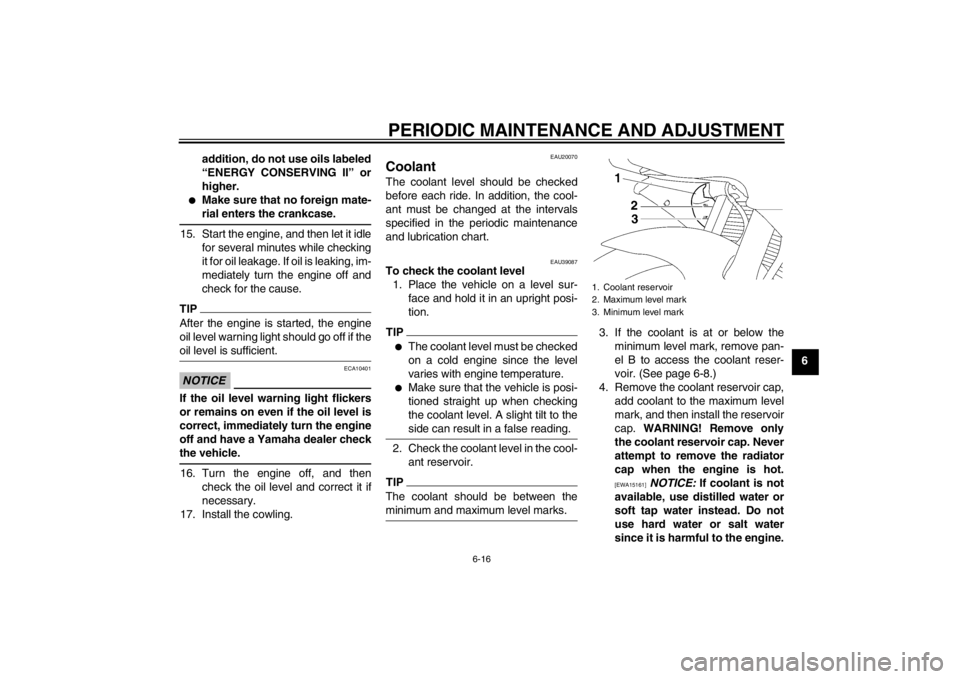
To check the coolant level 1. Place the vehicle on a level sur- face and hold it in an upright posi-
tion.TIP●
The coolant level must be checked
on a cold engine since the level
varies with engine temperature.
●
Make sure that the vehicle is posi-
tioned straight up when checking
the coolant level. A slight tilt to the
side can result in a false reading.
2. Check the coolant level in the cool-ant reservoir.TIPThe coolant should be between the
minimum and maximum level marks.
3. If the coolant is at or below theminimum level mark, remove pan-
el B to access the coolant reser-
voir. (See page 6-8.)
4. Remove the coolant reservoir cap, add coolant to the maximum level
mark, and then install the reservoir
cap. WARNING! Remove only
the coolant reservoir cap. Never
attempt to remove the radiator
cap when the engine is hot.
[EWA15161]
NOTICE: If coolant is not
available, use distilled water or
soft tap water instead. Do not
use hard water or salt water
since it is harmful to the engine.
1. Coolant reservoir
2. Maximum level mark
3. Minimum level mark
U1JSE1E0.book Page 16 Wednesday, June 6, 2012 10:05 AM
Page 68 of 110

PERIODIC MAINTENANCE AND ADJUSTMENT
6-17
6If water has been used instead
of coolant, replace it with cool-
ant as soon as possible, other-
wise the cooling system will not
be protected against frost and
corrosion. If water has been
added to the coolant, have a
Yamaha dealer check the anti-
freeze content of the coolant as
soon as possible, otherwise the
effectiveness of the coolant will
be reduced.
[ECA10472]
5. Install the panel.
EAU39004
To change the coolant
1. Place the vehicle on a level sur- face and let the engine cool if nec-
essary.
2. Remove cowlings B and C. (See page 6-8.)
3. Place a container under the engine to collect the used coolant.
4. Remove the radiator cap. WARNING! Never attempt to re-
move the radiator cap when the
engine is hot.
[EWA10381]
5. Remove the coolant drain bolt andits gasket to drain the cooling sys-
tem. 6. Move the hose clamp in the direc-
tion shown, and then disconnect
the radiator hose to drain the radi-
ator.
7. Remove the coolant reservoir by removing the bolts.
8. Remove the coolant reservoir cap, and then turn the coolant reservoir
upside down to empty it.
1. Coolant reservoir capCoolant reservoir capacity (up to
the maximum level mark):0.25 L (0.26 US qt, 0.22 Imp.qt)
1. Radiator cap
1. Coolant drain bolt
2. Gasket
3. Radiator hose
4. Hose clamp
1
2
4
3
U1JSE1E0.book Page 17 Wednesday, June 6, 2012 10:05 AM
Page 69 of 110

PERIODIC MAINTENANCE AND ADJUSTMENT
6-18
6
9. After the coolant is completely
drained, thoroughly flush the cool-
ing system with clean tap water.
10. Install the coolant reservoir by in- stalling the bolts.
11. Connect the radiator hose, and then move the hose clamp back to
its original position.
12. Install the coolant drain bolt and its new gasket, and then tighten the
bolt to the specified torque. 13. Pour the recommended coolant
into the reservoir to the maximum
level mark, and then install the
coolant reservoir cap.
14. Pour the recommended coolant into the radiator until it is full.
15. Install the radiator cap, start the engine, let it idle for several min-
utes, and then turn it off.
16. Remove the radiator cap to check the coolant level in the radiator. If
necessary, add sufficient coolant
until it reaches the top of the radia-
tor, and then install the radiator
cap. 17. Start the engine, and then check
the vehicle for coolant leakage. If
coolant is leaking, have a Yamaha
dealer check the cooling system.
18. Install the cowlings.
1. Coolant reservoir cap
2. Coolant reservoir
3. BoltTightening torque: Coolant drain bolt:
10 Nm (1.0 m·kgf, 7.2 ft·lbf)
2
1
3
Antifreeze/water mixture ratio: 1:1
Recommended antifreeze: High-quality ethylene glycol anti-
freeze containing corrosion inhibi-
tors for aluminum engines
Coolant quantity:
Radiator capacity (including all
routes):2.30 L (2.43 US qt, 2.02 Imp.qt)
Coolant reservoir capacity (up to the
maximum level mark): 0.25 L (0.26 US qt, 0.22 Imp.qt)
U1JSE1E0.book Page 18 Wednesday, June 6, 2012 10:05 AM
Page 70 of 110

PERIODIC MAINTENANCE AND ADJUSTMENT
6-19
6
EAU36764
Air filter element The air filter element must be replaced
at the intervals specified in the periodic
maintenance and lubrication chart.
Have a Yamaha dealer replace the air
filter element.
EAU44734
Checking the engine idling
speed Check the engine idling speed and, if
necessary, have it corrected by a
Yamaha dealer.
EAU21384
Checking the throttle grip free
play The throttle grip free play should mea-
sure 3.0–5.0 mm (0.12–0.20 in) at the
inner edge of the throttle grip. Periodi-
cally check the throttle grip free play
and, if necessary, have a Yamaha deal-
er adjust it.
Engine idling speed: 1250–1350 r/min
1. Throttle grip free play
U1JSE1E0.book Page 19 Wednesday, June 6, 2012 10:05 AM
Page 71 of 110
PERIODIC MAINTENANCE AND ADJUSTMENT
6-20
6
EAU21401
Valve clearance The valve clearance changes with use,
resulting in improper air-fuel mixture
and/or engine noise. To prevent this
from occurring, the valve clearance
must be adjusted by a Yamaha dealer
at the intervals specified in the periodic
maintenance and lubrication chart.
EAU21776
Tires Tires are the only contact between the
vehicle and the road. Safety in all con-
ditions of riding depends on a relatively
small area of road contact. Therefore, it
is essential to maintain the tires in good
condition at all times and replace them
at the appropriate time with the speci-
fied tires.
Tire air pressure
The tire air pressure should be checked
and, if necessary, adjusted before each
ride.
WARNING
EWA10503
Operation of this vehicle with im-
proper tire pressure may cause se-
vere injury or death from loss of
control.●
The tire air pressure must be
checked and adjusted on cold
tires (i.e., when the temperature
of the tires equals the ambient
temperature).
●
The tire air pressure must be ad-
justed in accordance with the
riding speed and with the totalweight of rider, passenger, car-
go, and accessories approved
for this model.
WARNING
EWA10511
Never overload your vehicle. Opera-
tion of an overloaded vehicle could
cause an accident.
Tire air pressure (measured on cold
tires):
0–90 kg (0–198 lb): Fr o nt :
250 kPa (2.50 kgf/cm², 36 psi)
Rear: 290 kPa (2.90 kgf/cm², 42 psi)
90–186 kg (198–410 lb): Fr o nt :250 kPa (2.50 kgf/cm², 36 psi)
Rear: 290 kPa (2.90 kgf/cm², 42 psi)
High-speed riding:
Fr o nt :250 kPa (2.50 kgf/cm², 36 psi)
Rear:
290 kPa (2.90 kgf/cm², 42 psi)
Maximum load*: 186 kg (410 lb)
* Total weight of rider, passenger, car- go and accessories
U1JSE1E0.book Page 20 Wednesday, June 6, 2012 10:05 AM
Page 72 of 110
PERIODIC MAINTENANCE AND ADJUSTMENT
6-21
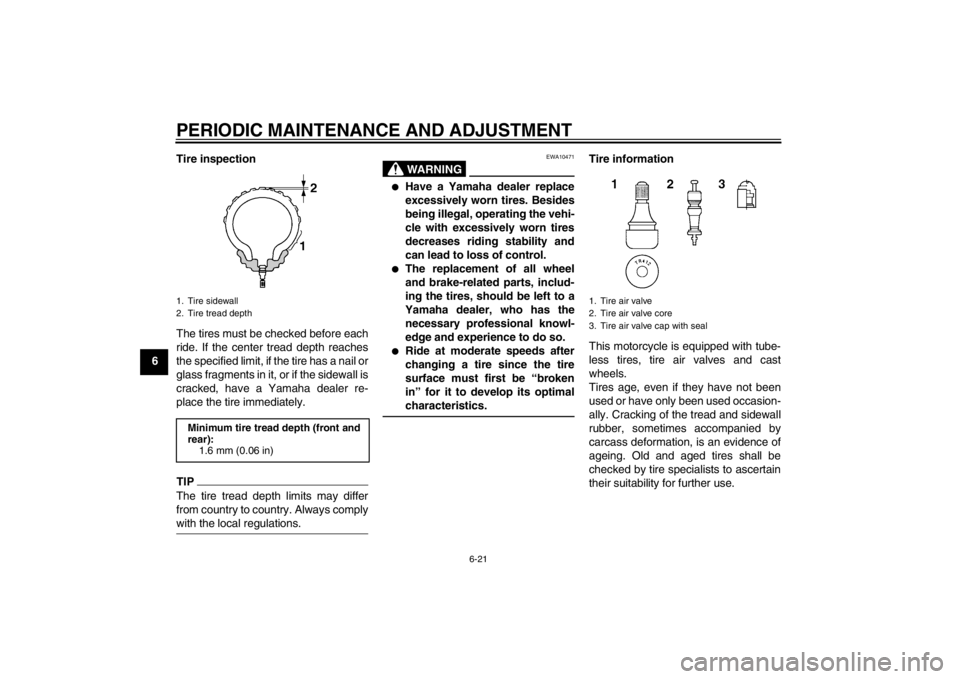
6Tire inspection
The tires must be checked before each
ride. If the center tread depth reaches
the specified limit, if the tire has a nail or
glass fragments in it, or if the sidewall is
cracked, have a Yamaha dealer re-
place the tire immediately.
TIPThe tire tread depth limits may differ
from country to country. Always comply
with the local regulations.
WARNING
EWA10471
●
Have a Yamaha dealer replace
excessively worn tires. Besides
being illegal, operating the vehi-
cle with excessively worn tires
decreases riding stability and
can lead to loss of control.
●
The replacement of all wheel
and brake-related parts, includ-
ing the tires, should be left to a
Yamaha dealer, who has the
necessary professional knowl-
edge and experience to do so.
●
Ride at moderate speeds after
changing a tire since the tire
surface must first be “broken
in” for it to develop its optimal
characteristics.
Tire information
This motorcycle is equipped with tube-
less tires, tire air valves and cast
wheels.
Tires age, even if they have not been
used or have only been used occasion-
ally. Cracking of the tread and sidewall
rubber, sometimes accompanied by
carcass deformation, is an evidence of
ageing. Old and aged tires shall be
checked by tire specialists to ascertain
their suitability for further use.
1. Tire sidewall
2. Tire tread depthMinimum tire tread depth (front and
rear):
1.6 mm (0.06 in)
1. Tire air valve
2. Tire air valve core
3. Tire air valve cap with seal
U1JSE1E0.book Page 21 Wednesday, June 6, 2012 10:05 AM
Page 73 of 110
PERIODIC MAINTENANCE AND ADJUSTMENT
6-22
6
WARNING
EWA10481
●
The front and rear tires should
be of the same make and de-
sign, otherwise the handling
characteristics of the motorcy-
cle may be different, which
could lead to an accident.
●
Always make sure that the valve
caps are securely installed to
prevent air pressure leakage.
●
Use only the tire valves and
valve cores listed below to
avoid tire deflation during a
high-speed ride.
After extensive tests, only the tires list-
ed below have been approved for this
model by Yamaha Motor Co., Ltd.
WARNING
EWA10600
This motorcycle is fitted with super-
high-speed tires. Note the following
points in order to make the most ef-
ficient use of these tires.●
Use only the specified replace-
ment tires. Other tires may run
the danger of bursting at super
high speeds.
●
Brand-new tires can have a rela-
tively poor grip on certain road
surfaces until they have been“broken in”. Therefore, it is ad-
visable before doing any high-
speed riding to ride conserva-
tively for approximately 100 km
(60 mi) after installing a new tire.
●
The tires must be warmed up
before a high-speed run.
●
Always adjust the tire air pres-
sure according to the operating
conditions.
Front tire:
Size:
120/70 ZR17M/C (58W)
Manufacturer/model:
BRIDGESTONE/BT016F F
DUNLOP/Qualifier PT M
Rear tire:
Size:180/55 ZR17M/C (73W)
Manufacturer/model:
BRIDGESTONE/BT016R F
DUNLOP/Qualifier PT M
FRONT and REAR:
Tire air valve:TR412
Va l ve c o r e :
#9100 (original)
U1JSE1E0.book Page 22 Wednesday, June 6, 2012 10:05 AM
Page 74 of 110
PERIODIC MAINTENANCE AND ADJUSTMENT
6-23
6
EAU21962
Cast wheels To maximize the performance, durabil-
ity, and safe operation of your vehicle,
note the following points regarding the
specified wheels.●
The wheel rims should be checked
for cracks, bends, warpage or oth-
er damage before each ride. If any
damage is found, have a Yamaha
dealer replace the wheel. Do not
attempt even the smallest repair to
the wheel. A deformed or cracked
wheel must be replaced.
●
The wheel should be balanced
whenever either the tire or wheel
has been changed or replaced. An
unbalanced wheel can result in
poor performance, adverse han-
dling characteristics, and a short-
ened tire life.
EAU33891
Adjusting the clutch lever free
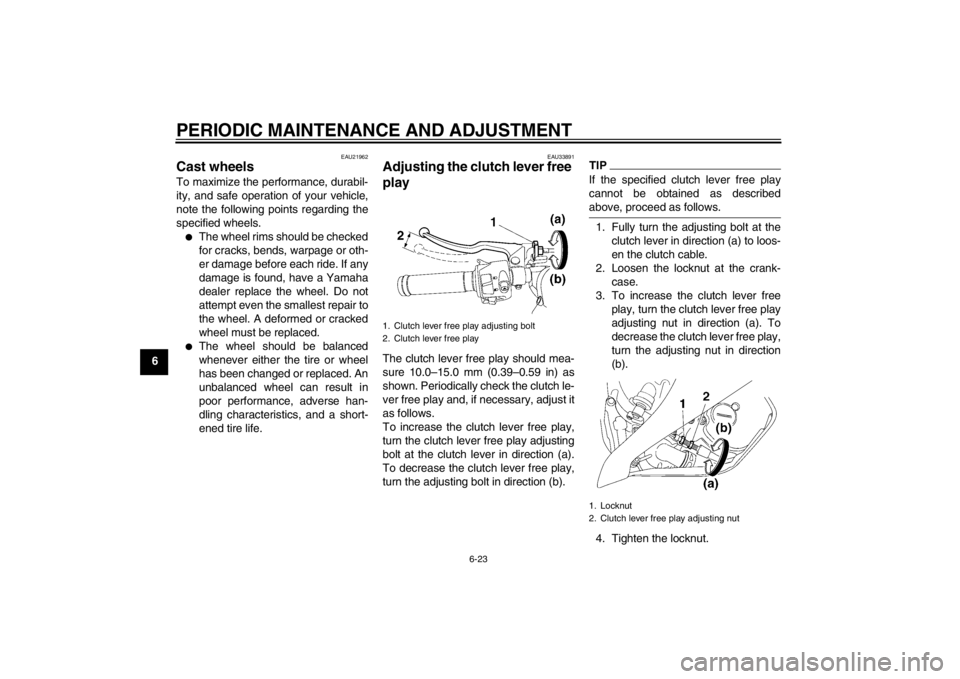
play The clutch lever free play should mea-
sure 10.0–15.0 mm (0.39–0.59 in) as
shown. Periodically check the clutch le-
ver free play and, if necessary, adjust it
as follows.
To increase the clutch lever free play,
turn the clutch lever free play adjusting
bolt at the clutch lever in direction (a).
To decrease the clutch lever free play,
turn the adjusting bolt in direction (b).
TIPIf the specified clutch lever free play
cannot be obtained as described
above, proceed as follows.1. Fully turn the adjusting bolt at theclutch lever in direction (a) to loos-
en the clutch cable.
2. Loosen the locknut at the crank- case.
3. To increase the clutch lever free play, turn the clutch lever free play
adjusting nut in direction (a). To
decrease the clutch lever free play,
turn the adjusting nut in direction
(b).
4. Tighten the locknut.
1. Clutch lever free play adjusting bolt
2. Clutch lever free play
1. Locknut
2. Clutch lever free play adjusting nut
U1JSE1E0.book Page 23 Wednesday, June 6, 2012 10:05 AM
Page 75 of 110
PERIODIC MAINTENANCE AND ADJUSTMENT
6-24
6
EAU37913
Checking the brake lever free
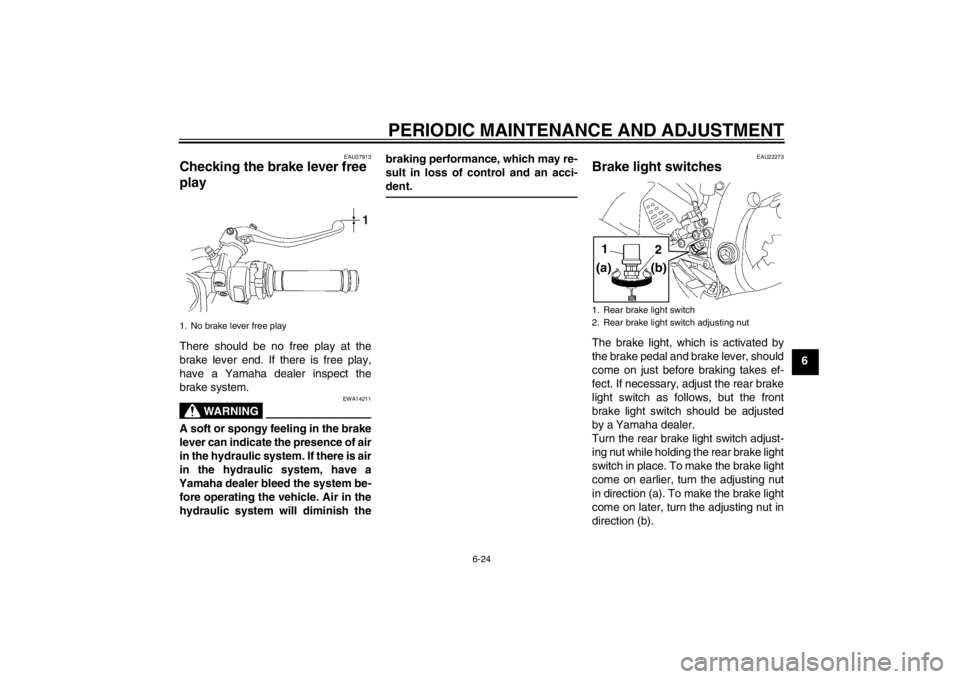
play There should be no free play at the
brake lever end. If there is free play,
have a Yamaha dealer inspect the
brake system.
WARNING
EWA14211
A soft or spongy feeling in the brake
lever can indicate the presence of air
in the hydraulic system. If there is air
in the hydraulic system, have a
Yamaha dealer bleed the system be- fore operating the vehicle. Air in the
hydraulic system will diminish the braking performance, which may re-
sult in loss of control and an acci-
dent.
EAU22273
Brake light switches The brake light, which is activated by
the brake pedal and brake lever, should
come on just before braking takes ef-
fect. If necessary, adjust the rear brake
light switch as follows, but the front
brake light switch should be adjusted
by a Yamaha dealer.
Turn the rear brake light switch adjust-
ing nut while holding the rear brake light
switch in place. To make the brake light
come on earlier, turn the adjusting nut
in direction (a). To make the brake light
come on later, turn the adjusting nut in
direction (b).
1. No brake lever free play
1
1. Rear brake light switch
2. Rear brake light switch adjusting nut
2
(b)
(a)
1
U1JSE1E0.book Page 24 Wednesday, June 6, 2012 10:05 AM
Page 76 of 110
PERIODIC MAINTENANCE AND ADJUSTMENT
6-25
6
EAU22392
Checking the front and rear
brake pads The front and rear brake pads must be
checked for wear at the intervals spec-
ified in the periodic maintenance and
lubrication chart.
EAU36890
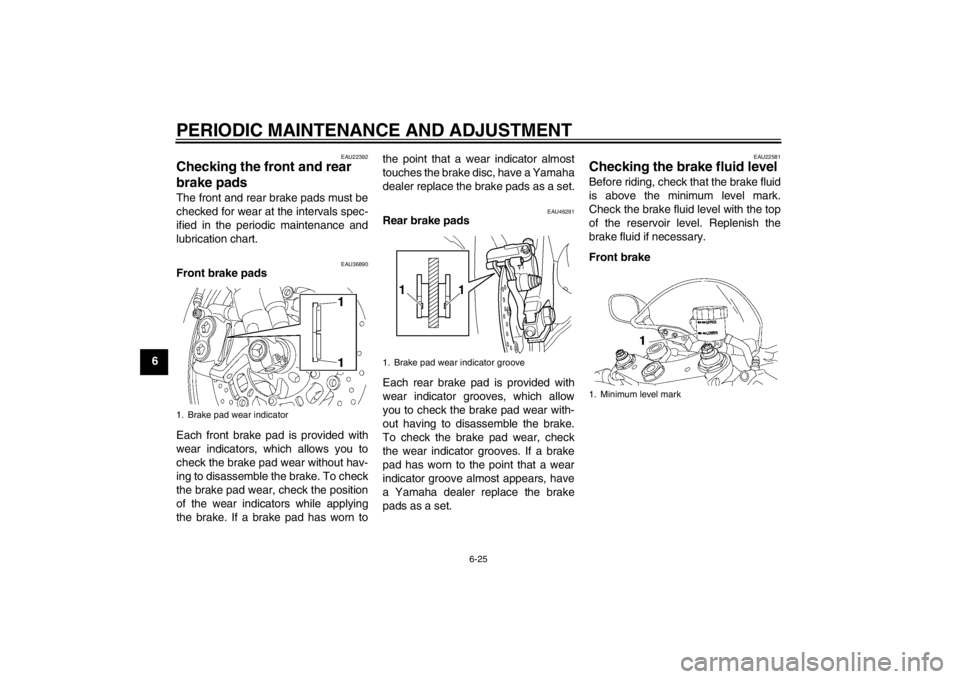
Front brake pads
Each front brake pad is provided with
wear indicators, which allows you to
check the brake pad wear without hav-
ing to disassemble the brake. To check
the brake pad wear, check the position
of the wear indicators while applying
the brake. If a brake pad has worn tothe point that a wear indicator almost
touches the brake disc, have a Yamaha
dealer replace the brake pads as a set.
EAU46291
Rear brake pads
Each rear brake pad is provided with
wear indicator grooves, which allow
you to check the brake pad wear with-
out having to disassemble the brake.
To check the brake pad wear, check
the wear indicator grooves. If a brake
pad has worn to the point that a wear
indicator groove almost appears, have
a Yamaha dealer replace the brake
pads as a set.
EAU22581
Checking the brake fluid level Before riding, check that the brake fluid
is above the minimum level mark.
Check the brake fluid level with the top
of the reservoir level. Replenish the
brake fluid if necessary.
Front brake
1. Brake pad wear indicator
1. Brake pad wear indicator groove
1
1
1. Minimum level mark
U1JSE1E0.book Page 25 Wednesday, June 6, 2012 10:05 AM