fuel YAMAHA YZF-R6 2017 User Guide
[x] Cancel search | Manufacturer: YAMAHA, Model Year: 2017, Model line: YZF-R6, Model: YAMAHA YZF-R6 2017Pages: 114, PDF Size: 4.2 MB
Page 40 of 114
Instrument and control functions
4-22
4
EAU80200
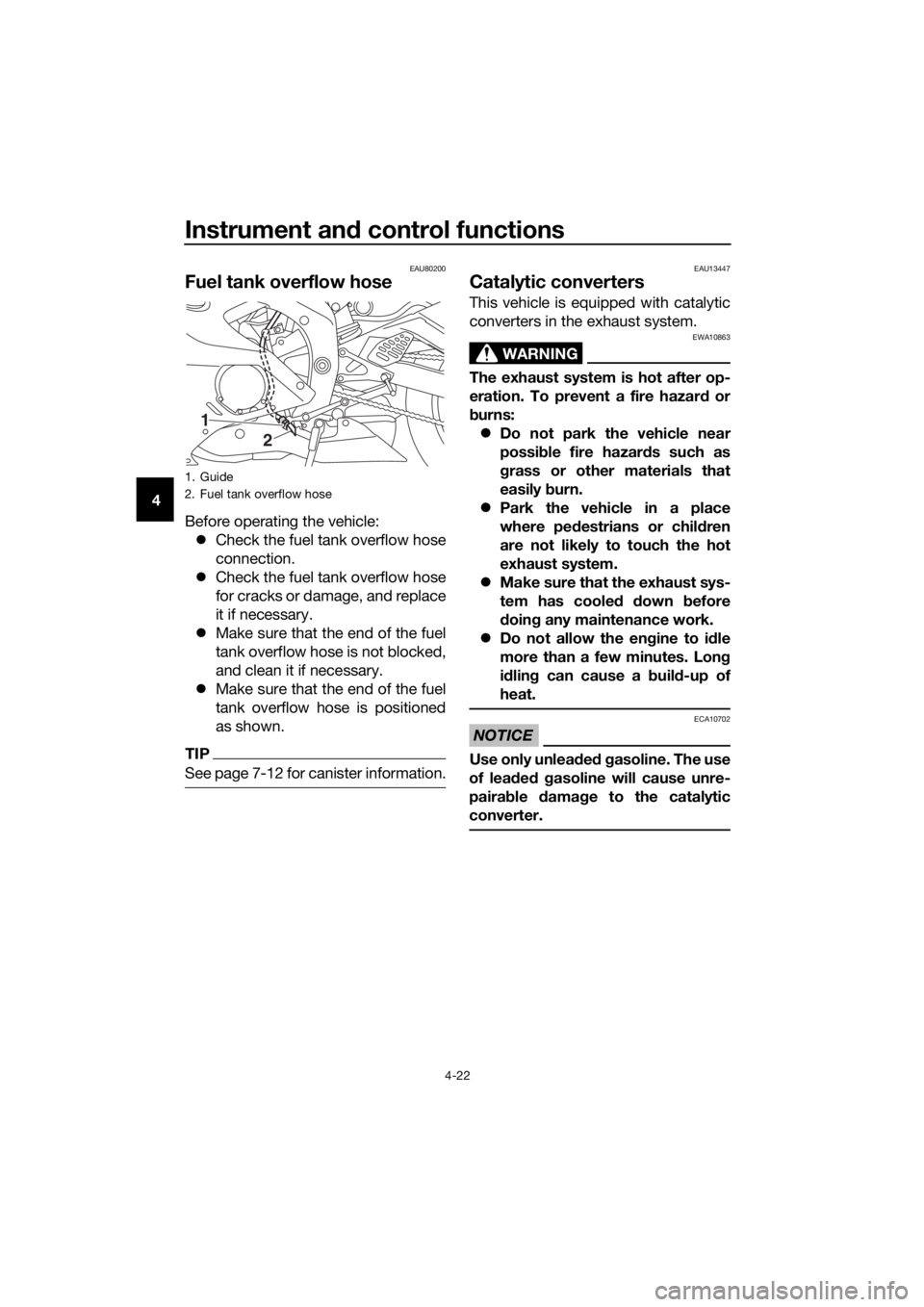
Fuel tank overflow hose
Before operating the vehicle:
Check the fuel tank overflow hose
connection.
Check the fuel tank overflow hose
for cracks or damage, and replace
it if necessary.
Make sure that the end of the fuel
tank overflow hose is not blocked,
and clean it if necessary.
Make sure that the end of the fuel
tank overflow hose is positioned
as shown.
TIP
See page 7-12 for canister information.
EAU13447
Catalytic converters
This vehicle is equipped with catalytic
converters in the exhaust system.
WARNING
EWA10863
The exhaust system is hot after op-
eration. To prevent a fire hazar d or
b urns:
Do not park the vehicle near
possi ble fire hazar ds such as
g rass or other materials that
easily burn.
Park the vehicle in a place
where ped estrians or child ren
are not likely to touch the hot
exhaust system.
Make sure that the exhaust sys-
tem has coole d down before
d oin g any maintenance work.
Do not allow the eng ine to idle
more than a few minutes. Lon g
i d lin g can cause a b uild-up of
heat.
NOTICE
ECA10702
Use only unlea ded g asoline. The use
of lead ed g asoline will cause unre-
paira ble damag e to the catalytic
converter.
1. Guide
2. Fuel tank overflow hose
1 2
UBN6E0E0.book Page 22 Wednesday, January 25, 2017 1:28 PM
Page 51 of 114
For your safety – pre-operation checks
5-1
5
EAU63440
Inspect your vehicle each time you use it to make sure the vehicle is in safe oper-
ating condition. Always follow the inspection and maintenance procedures and
schedules described in the Owner’s Manual.
WARNING
EWA11152
Failure to inspect or maintain the vehicle properly increases the possibility
of an acci dent or equipment d amage. Do not operate the vehicle if you fin d
any prob lem. If a pro blem cannot be corrected b y the proce dures provi ded
in this manual, have the vehicle inspecte d b y a Yamaha d ealer.
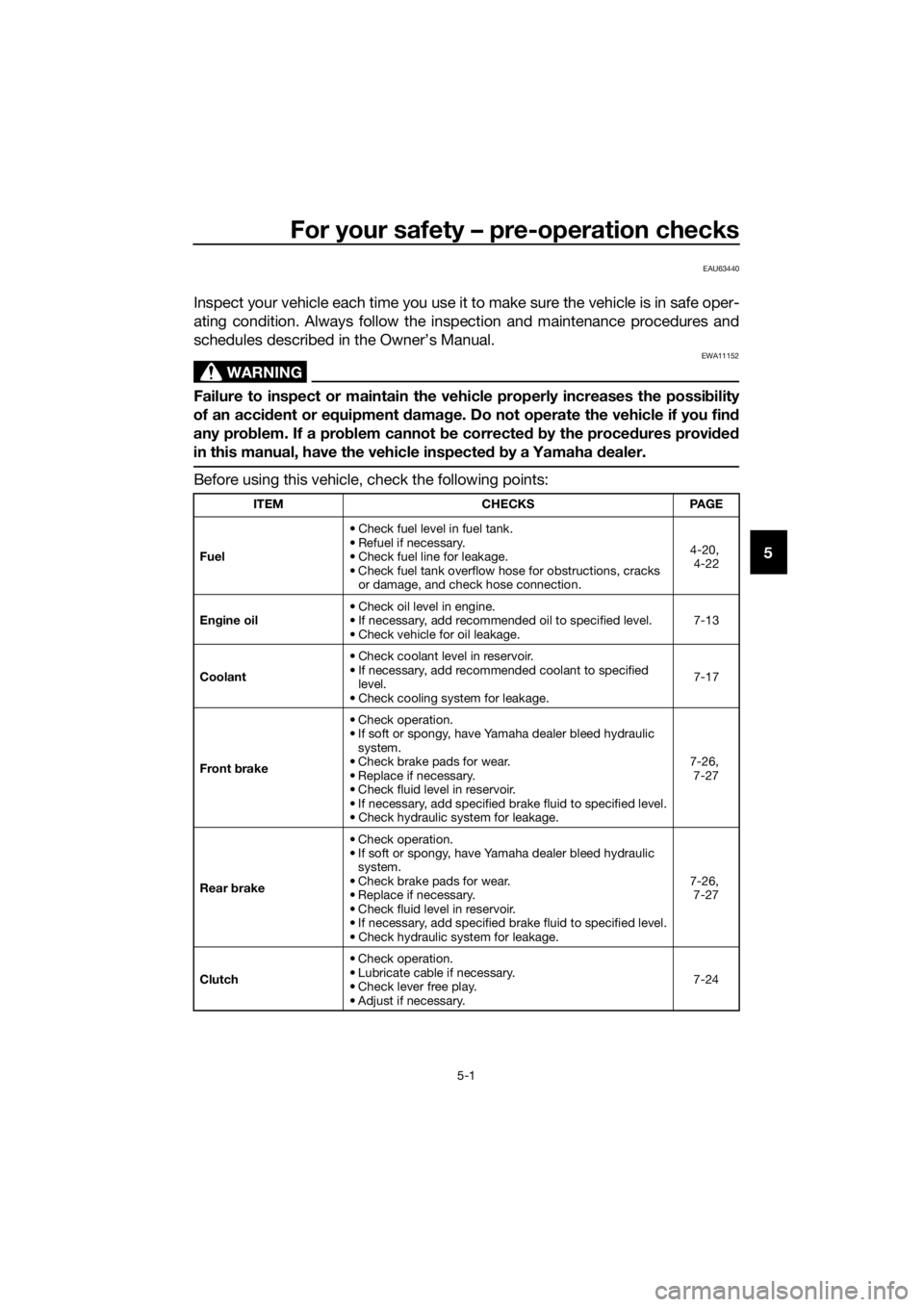
Before using this vehicle, check the following points:
ITEM CHECKSPAGE
Fuel • Check fuel level in fuel tank.
• Refuel if necessary.
• Check fuel line for leakage.
• Check fuel tank overflow hose for obstructions, cracks
or damage, and check hose connection. 4-20,
4-22
En gine oil • Check oil level in engine.
• If necessary, add recommended oil to specified level.
• Check vehicle for oil leakage. 7-13
Coolant • Check coolant level in reservoir.
• If necessary, add recommended coolant to specified
level.
• Check cooling system for leakage. 7-17
Front brake • Check operation.
• If soft or spongy, have Yamaha dealer bleed hydraulic
system.
• Check brake pads for wear.
• Replace if necessary.
• Check fluid level in reservoir.
• If necessary, add specified brake fluid to specified level.
• Check hydraulic system for leakage. 7-26,
7-27
Rear brake • Check operation.
• If soft or spongy, have Yamaha dealer bleed hydraulic
system.
• Check brake pads for wear.
• Replace if necessary.
• Check fluid level in reservoir.
• If necessary, add specified brake fluid to specified level.
• Check hydraulic system for leakage. 7-26,
7-27
Clutch • Check operation.
• Lubricate cable if necessary.
• Check lever free play.
• Adjust if necessary. 7-24
UBN6E0E0.book Page 1 Wednesday, January 25, 2017 1:28 PM
Page 54 of 114
Operation and important rid ing points
6-2
6
EAU80211
Startin g the en gine
In order for the ignition circuit cut-off
system (page 4-31) to enable starting,
one of the following conditions must be
met:
The transmission is in the neutral
position.
The transmission is in gear with
the clutch lever pulled and the
sidestand up.
To start the engine
1. Turn the key to “ON” and make sure that the engine stop switch is
set to “ ”.
2. Confirm that the following lights perform a circuit check (come on
for a few seconds and then go off). Engine trouble warning light
ABS warning light*
Oil level warning light
Fuel level warning light*
Coolant temperature warning
light
Traction control system indi-
cator light
Shift timing indicator light
Immobilizer system indicator
light
TIP
The ABS warning light should
come on and stay on until the ve-
hicle reaches a traveling speed of
10 km/h (6 mi/h).
The fuel level warning light will
stay on if you are low on fuel.
NOTICE
ECA24110
If a warnin g or in dicator li ght does
not work as descri bed a bove, have a
Yamaha dealer check the vehicle.
3. Shift the transmission into the
neutral position (or hold the clutch
lever pulled with the sidestand up).
4. Push the start switch “ ” to crank the engine with the starter.
Release the start switch when the
engine starts, or after 5 seconds.
Wait 10 seconds before pressing
the switch again to allow battery
voltage to restore.
NOTICE
ECA11043
For maximum eng ine life, never ac-
celerate har d when the en gine is
col d!
UBN6E0E0.book Page 2 Wednesday, January 25, 2017 1:28 PM
Page 56 of 114
Operation and important rid ing points
6-4
6
EAU16811
Tips for re ducin g fuel con-
sumption
Fuel consumption depends largely on
your riding style. Consider the follow-
ing tips to reduce fuel consumption:
Shift up swiftly, and avoid high en-
gine speeds during acceleration.
Do not rev the engine while shift-
ing down, and avoid high engine
speeds with no load on the en-
gine.
Turn the engine off instead of let-
ting it idle for an extended length
of time (e.g., in traffic jams, at traf-
fic lights or at railroad crossings).
EAU16842
Engine break-in
There is never a more important period
in the life of your engine than the period
between 0 and 1600 km (1000 mi). For
this reason, you should read the fol-
lowing material carefully.
Since the engine is brand new, do not
put an excessive load on it for the first
1600 km (1000 mi). The various parts in
the engine wear and polish themselves
to the correct operating clearances.
During this period, prolonged full-throt-
tle operation or any condition that
might result in engine overheating
must be avoided.
EAU17085
0–1000 km (0–600 mi)
Avoid prolonged operation above 8300
r/min. NOTICE: After 1000 km (600
mi) of operation, the en gine oil must
b e chan ged an d the oil filter car-
tri dge or element replace d.
[ECA10303]
1000–1600 km (600–1000 mi)
Avoid prolonged operation above 9900
r/min.
1600 km (1000 mi) an d b eyon d
The vehicle can now be operated nor-
mally.
NOTICE
ECA10311
Keep the en gine spee d out of
the tachometer red zone.
If any en gine trou ble shoul d oc-
cur durin g the en gine break-in
perio d, imme diately have a
Yamaha dealer check the vehi-
cle.
UBN6E0E0.book Page 4 Wednesday, January 25, 2017 1:28 PM
Page 57 of 114

Operation and important ri din g points
6-5
6
TIP
During and after the engine break-in
period, the exhaust heat may cause
discoloration of the exhaust pipe, but
this is normal.
EAU17214
Parkin g
When parking, stop the engine, and
then remove the key from the main
switch.
WARNING
EWA10312
Since the en gine an d exhaust
system can become very hot,
park in a place where ped estri-
ans or chil dren are not likely to
touch them and b e burne d.
Do not park on a slope or on soft
groun d, otherwise the vehicle
may overturn, increasin g the
risk of a fuel leak an d fire.
Do not park near grass or other
flammab le materials which
mi ght catch fire.
UBN6E0E0.book Page 5 Wednesday, January 25, 2017 1:28 PM
Page 60 of 114

Periodic maintenance an d a djustment
7-3
7
EAU71031
TIP
The annual checks must be performe d every year, except if a d istance-
b ased maintenance is performe d instea d.
From 50000 km (30000 mi), repeat the maintenance intervals starting from
10000 km (6000 mi).
Items marked with an asterisk should be performed by a Yamaha dealer as
they require special tools, data and technical skills.
EAU71071
Perio dic maintenance chart for the emission control system
NO. ITEM
1 *Fuel line • Check fuel hoses for cracks or
damage.
• Replace if necessary. √√√√√
2 *Spark plu gs • Check condition.
• Adjust gap and clean.
√√
• Replace. √√
3 *Valve clearance • Check and adjust. Every 40000 km (24000 mi)
4 *Fuel injection • Check engine idle speed.
√√√√√√
• Check and adjust synchroniza- tion. √√√√√
5 *Exhaust system • Check for leakage.
• Tighten if necessary.
• Replace gaskets if necessary. √√√√√
6 *Evaporative emis-
sion control sys-
tem • Check control system for dam-
age.
• Replace if necessary. √√
7 *Air in
duction sys-
tem • Check the air cut-off valve, reed
valve, and hose for damage.
• Replace any damaged parts if necessary. √√√√√X 1000 km
CHECK OR
MAINTENANCE JOB
X 1000 mi ODOMETER
READINGS
ANNUAL CHECK
1 10203040
0.6 6 12 18 24
UBN6E0E0.book Page 3 Wednesday, January 25, 2017 1:28 PM
Page 69 of 114

Periodic maintenance an d a djustment
7-12
7
Clean the surface of the spark plug
gasket and its mating surface, and
then wipe off any grime from the spark
plug threads.
TIP
If a torque wrench is not available
when installing a spark plug, a good
estimate of the correct torque is 1/4–
1/2 turn past finger tight. However, the
spark plug should be tightened to the
specified torque as soon as possible.
NOTICE
ECA10841
Do not use any tools to remove or in-
stall the spark plu
g cap, otherwise
the i gnition coil coupler may get
d ama ged . The spark plu g cap may
b e difficult to remove b ecause the
ru bber seal on the en d of the cap fits
ti g htly. To remove the spark plu g
cap, simply twist it b ack and forth
while pullin g it out; to install it, twist
it back an d forth while pushin g it in.
EAU36112
Canister
This model is equipped with a canister
to prevent the discharging of fuel vapor
into the atmosphere. Before operating
this vehicle, make sure to check the
following:
Check each hose connection.
Check each hose and canister for
cracks or damage. Replace if
damaged.
Make sure that the canister
breather is not blocked, and if
necessary, clean it.
1. Spark plug gap
Spark plu g g ap:
0.6–0.7 mm (0.024–0.028 in)
Ti ghtening torque:
Spark plug: 13 N·m (1.3 kgf·m, 9.4 lb·ft)
11
1. Canister
2. Canister breather
2
1
UBN6E0E0.book Page 12 Wednesday, January 25, 2017 1:28 PM
Page 71 of 114
Periodic maintenance an d a djustment
7-14
7
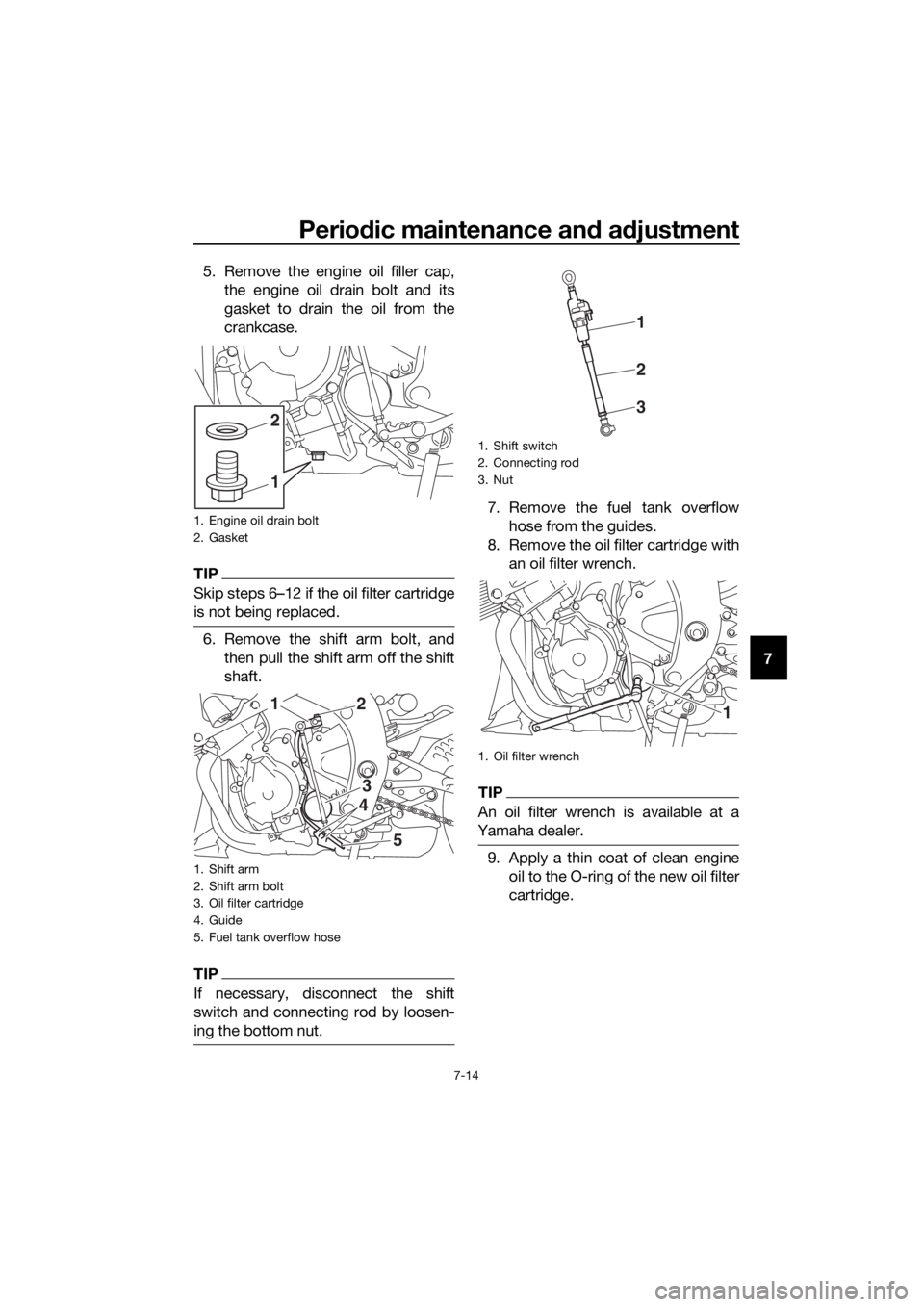
5. Remove the engine oil filler cap,
the engine oil drain bolt and its
gasket to drain the oil from the
crankcase.
TIP
Skip steps 6–12 if the oil filter cartridge
is not being replaced.
6. Remove the shift arm bolt, andthen pull the shift arm off the shift
shaft.
TIP
If necessary, disconnect the shift
switch and connecting rod by loosen-
ing the bottom nut.
7. Remove the fuel tank overflowhose from the guides.
8. Remove the oil filter cartridge with an oil filter wrench.
TIP
An oil filter wrench is available at a
Yamaha dealer.
9. Apply a thin coat of clean engine oil to the O-ring of the new oil filter
cartridge.
1. Engine oil drain bolt
2. Gasket
1. Shift arm
2. Shift arm bolt
3. Oil filter cartridge
4. Guide
5. Fuel tank overflow hose
1
2
3
4
5
2
1
1. Shift switch
2. Connecting rod
3. Nut
1. Oil filter wrench
1
3
2
1
UBN6E0E0.book Page 14 Wednesday, January 25, 2017 1:28 PM
Page 72 of 114
Periodic maintenance an d a djustment
7-15
7
TIP
Make sure that the O-ring is properly
seated.
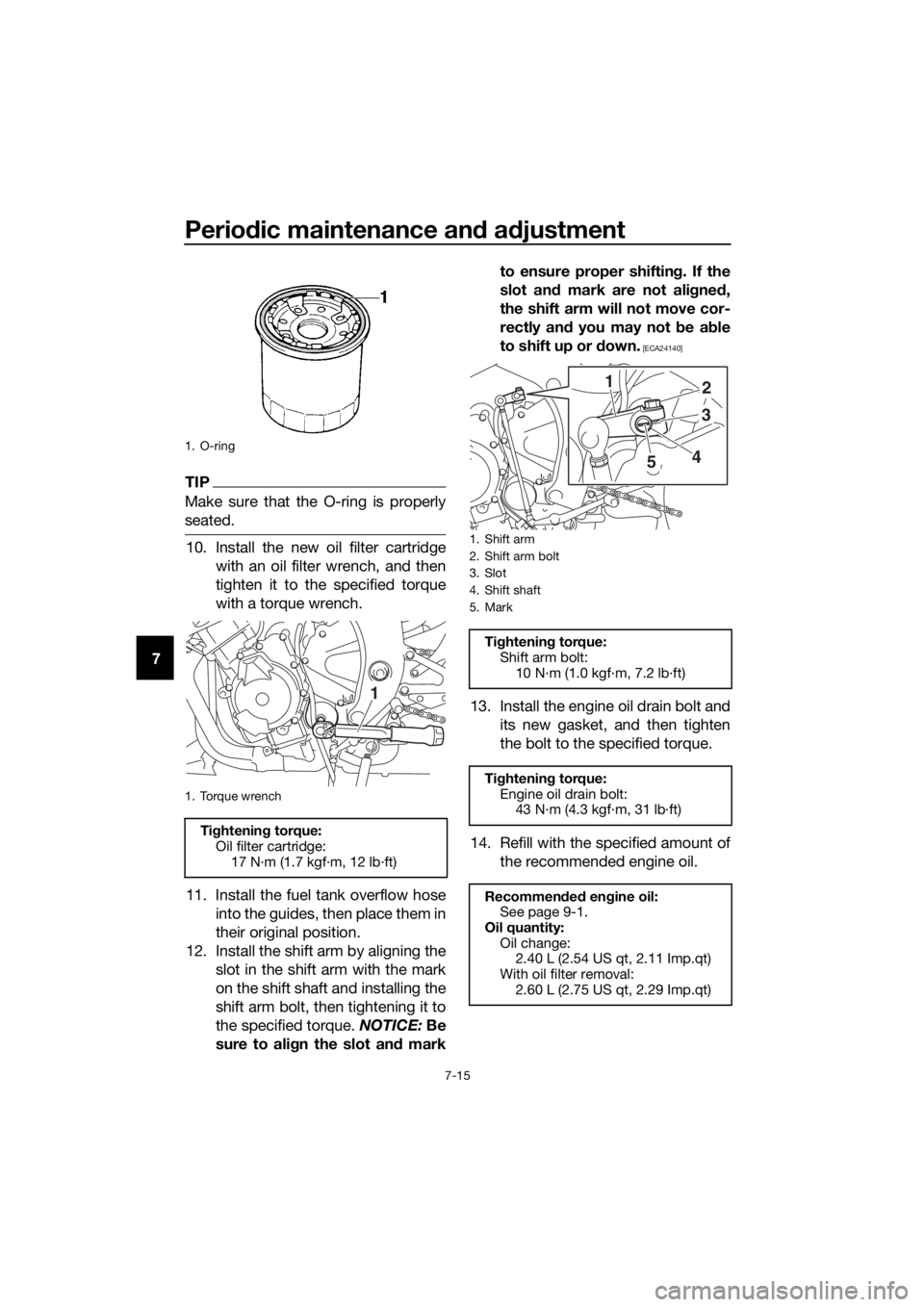
10. Install the new oil filter cartridge
with an oil filter wrench, and then
tighten it to the specified torque
with a torque wrench.
11. Install the fuel tank overflow hose into the guides, then place them in
their original position.
12. Install the shift arm by aligning the slot in the shift arm with the mark
on the shift shaft and installing the
shift arm bolt, then tightening it to
the specified torque. NOTICE: Be
sure to ali gn the slot an d mark to ensure proper shiftin
g. If the
slot an d mark are not ali gne d,
the shift arm will not move cor-
rectly an d you may not be ab le
to shift up or down.
[ECA24140]
13. Install the engine oil drain bolt and
its new gasket, and then tighten
the bolt to the specified torque.
14. Refill with the specified amount of the recommended engine oil.
1. O-ring
1. Torque wrench
Tightenin g torque:
Oil filter cartridge: 17 N·m (1.7 kgf·m, 12 lb·ft)
1
1. Shift arm
2. Shift arm bolt
3. Slot
4. Shift shaft
5. Mark
Tightening torque:
Shift arm bolt: 10 N·m (1.0 kgf·m, 7.2 lb·ft)
Ti ghtening torque:
Engine oil drain bolt: 43 N·m (4.3 kgf·m, 31 lb·ft)
Recommen ded en gine oil:
See page 9-1.
Oil quantity: Oil change:2.40 L (2.54 US qt, 2.11 Imp.qt)
With oil filter removal: 2.60 L (2.75 US qt, 2.29 Imp.qt)
2
1
3
4
5
UBN6E0E0.book Page 15 Wednesday, January 25, 2017 1:28 PM
Page 78 of 114

Periodic maintenance an d a djustment
7-21
7
EAU21402
Valve clearance
The valve clearance changes with use,
resulting in improper air-fuel mixture
and/or engine noise. To prevent this
from occurring, the valve clearance
must be adjusted by a Yamaha dealer
at the intervals specified in the periodic
maintenance and lubrication chart.
EAU70961
Tires
Tires are the only contact between the
vehicle and the road. Safety in all con-
ditions of riding depends on a relatively
small area of road contact. Therefore, it
is essential to maintain the tires in good
condition at all times and replace them
at the appropriate time with the speci-
fied tires.
Tire air pressure
The tire air pressure should be
checked and, if necessary, adjusted
before each ride.
WARNING
EWA18370
Operation of this vehicle with
improper tire air pressure may
cause severe injury or death
from loss of control.
The tire air pressure must be
checked and a djuste d on col d
tires (i.e., when the temperature
of the tires equals the am bient
temperature).
WARNING
EWA10512
Never overloa d your vehicle. Opera-
tion of an overloa ded vehicle coul d
cause an acci dent.
Col d tire air pressure:
Front: 250 kPa (2.50 kgf/cm², 36 psi)
Rear:
290 kPa (2.90 kgf/cm², 42 psi)
Maximum loa d*:
185 kg (408 lb)
* Total weight of rider, passenger, car- go and accessories
UBN6E0E0.book Page 21 Wednesday, January 25, 2017 1:28 PM