fuel YAMAHA YZF-R6 2020 Owners Manual
[x] Cancel search | Manufacturer: YAMAHA, Model Year: 2020, Model line: YZF-R6, Model: YAMAHA YZF-R6 2020Pages: 112, PDF Size: 5.44 MB
Page 6 of 112

Table of contentsSafety information ............................ 1-1
Description ....................................... 2-1
Left view ......................................... 2-1
Right view ....................................... 2-2
Controls and instruments ............... 2-3
Special features ............................... 3-1
D-mode (drive mode)...................... 3-1
Traction control system .................. 3-2
Quick shift system .......................... 3-4
Instrument an d control functions ... 4-1
Immobilizer system......................... 4-1
Main switch/steering lock............... 4-2
Handlebar switches ........................ 4-3
Indicator lights and warning
lights............................................ 4-5
Multi-function meter unit ................ 4-8
Clutch lever .................................. 4-16
Shift pedal .................................... 4-17
Brake lever.................................... 4-17
Brake pedal .................................. 4-17
ABS .............................................. 4-18
Fuel tank cap ................................ 4-19
Fuel ............................................... 4-19
Fuel tank overflow hose ............... 4-21
Catalytic converter ....................... 4-22
Seats ............................................ 4-22
Rear view mirrors.......................... 4-23
Adjusting the front fork ................. 4-24 Adjusting the shock absorber
assembly.................................... 4-26
EXUP system ................................ 4-28
Auxiliary DC connector ................. 4-29
Sidestand ...................................... 4-29
Ignition circuit cut-off system ....... 4-30
For your safety – pre-operation
checks ............................................... 5-1
Operation an d important ri din g
points ................................................. 6-1
Starting the engine .......................... 6-1
Shifting ............................................ 6-2
Tips for reducing fuel consumption ................................ 6-3
Engine break-in ............................... 6-4
Parking ............................................ 6-4
Perio dic maintenance an d
a d justment ........................................ 7-1
Tool kit ............................................ 7-2
Periodic maintenance charts .......... 7-3
Periodic maintenance chart for the emission control system .............. 7-3
General maintenance and
lubrication chart ........................... 7-5
Removing and installing cowlings and panels ................................... 7-9
Checking the spark plugs ............. 7-13
Canister ......................................... 7-14 Engine oil and oil filter cartridge ... 7-15
Why Yamalube.............................. 7-18
Coolant ......................................... 7-19
Air filter element ............................ 7-20
Checking the engine idling
speed ........................................ 7-20
Checking the throttle grip free play ............................................ 7-21
Valve clearance............................. 7-21
Tires .............................................. 7-21
Cast wheels .................................. 7-24
Adjusting the clutch lever free play ............................................ 7-24
Checking the brake lever free
play ............................................ 7-25
Brake light switches ..................... 7-26
Checking the front and rear brake pads ................................ 7-26
Checking the brake fluid level ...... 7-27
Changing the brake fluid .............. 7-28
Drive chain slack........................... 7-29
Cleaning and lubricating the drive chain ................................. 7-30
Checking and lubricating the cables ........................................ 7-31
Checking and lubricating the
throttle grip and cable ............... 7-31
Checking and lubricating the brake and shift pedals............... 7-32
Checking and lubricating the brake and clutch levers ............. 7-32UBN6E2E0.book Page 1 Friday, December 7, 2018 2:56 PM
Page 12 of 112

Safety information
1-5
1operator and may limit control
ability, therefore, such accesso-
ries are not recommended.
Use caution when adding electri-
cal accessories. If electrical ac-
cessories exceed the capacity of
the motorcycle’s electrical sys-
tem, an electric failure could re-
sult, which could cause a
dangerous loss of lights or engine
power.
Aftermarket Tires an d Rims
The tires and rims that came with your
motorcycle were designed to match
the performance capabilities and to
provide the best combination of han-
dling, braking, and comfort. Other
tires, rims, sizes, and combinations
may not be appropriate. See page 7-21
for tire specifications and for informa-
tion on servicing and replacing your
tires.
Transportin g the Motorcycle
Be sure to observe following instruc-
tions before transporting the motorcy-
cle in another vehicle.
Remove all loose items from the
motorcycle.
Check that the fuel cock (if
equipped) is in the off position and
that there are no fuel leaks.
Shift the transmission into gear
(for models with a manual trans-
mission).
Secure the motorcycle with tie-
downs or suitable straps that are
attached to solid parts of the mo-
torcycle, such as the frame or up-
per front fork triple clamp (and not,
for example, to rubber-mounted
handlebars or turn signals, or
parts that could break). Choose
the location for the straps carefully
so the straps will not rub against
painted surfaces during transport.
The suspension should be com-
pressed somewhat by the tie-
downs, if possible, so that the mo-
torcycle will not bounce exces-
sively during transport.
UBN6E2E0.book Page 5 Friday, December 7, 2018 2:56 PM
Page 13 of 112

Description
2-1
2
EAU10411
Left view
16789
3 4,5
2
1. Fuses (page 7-36)
2. Fuel tank cap (page 4-19)
3. Spring preload adjuster (page 4-26)
4. Fast compression damping force adjuster (page 4-26)
5. Slow compression damping force adjuster (page 4-26)
6. Rebound damping force adjuster (page 4-26)
7. Shift pedal (page 4-17)
8. Engine oil filter cartridge (page 7-15)
9. Engine oil drain bolt (page 7-15)
UBN6E2E0.book Page 1 Friday, December 7, 2018 2:56 PM
Page 24 of 112
Instrument and control functions
4-5
4
EAU73931
Drive mo de switch “MODE”
See page 3-1 for an explanation of the
drive mode.
EAU4939G
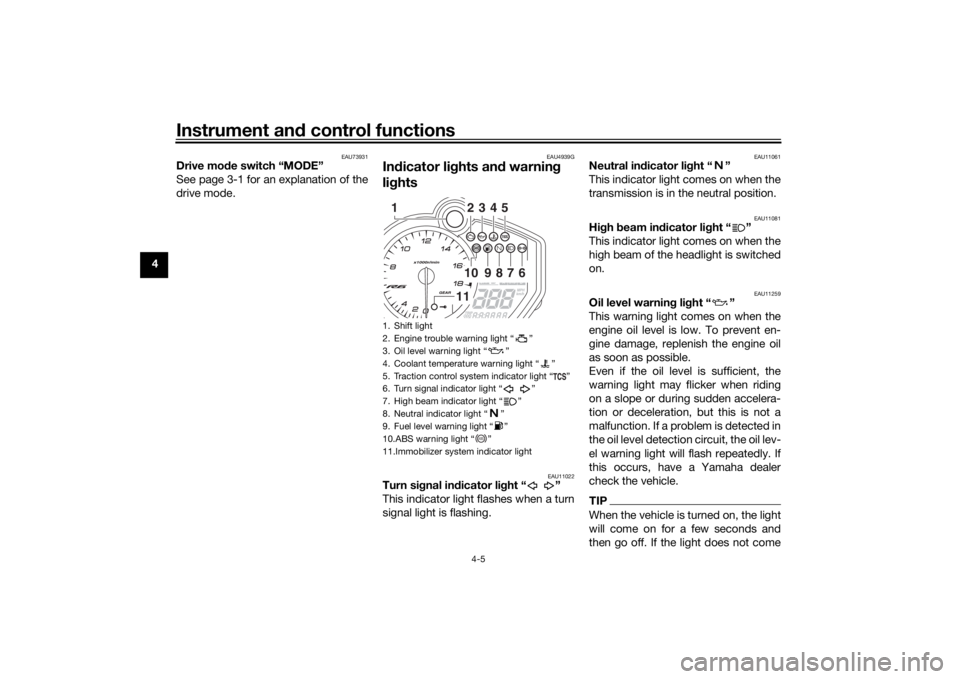
In dicator li ghts an d warnin g
li g hts
EAU11022
Turn si gnal in dicator li ght “ ”
This indicator light flashes when a turn
signal light is flashing.
EAU11061
Neutral in dicator li ght “ ”
This indicator light comes on when the
transmission is in the neutral position.
EAU11081
Hi gh beam in dicator li ght “ ”
This indicator light comes on when the
high beam of the headlight is switched
on.
EAU11259
Oil level warnin g li ght “ ”
This warning light comes on when the
engine oil level is low. To prevent en-
gine damage, replenish the engine oil
as soon as possible.
Even if the oil level is sufficient, the
warning light may flicker when riding
on a slope or during sudden accelera-
tion or deceleration, but this is not a
malfunction. If a problem is detected in
the oil level detection circuit, the oil lev-
el warning light will flash repeatedly. If
this occurs, have a Yamaha dealer
check the vehicle.TIPWhen the vehicle is turned on, the light
will come on for a few seconds and
then go off. If the light does not come
1. Shift light
2. Engine trouble warning light “ ”
3. Oil level warning light “ ”
4. Coolant temperature warning light “ ”
5. Traction control system indicator light “ ”
6. Turn signal indicator light “ ”
7. High beam indicator light “ ”
8. Neutral indicator light “ ”
9. Fuel level warning light “ ”
10.ABS warning light “ ”
11.Immobilizer system indicator light
234510
9
8
7
6
11
1
ABS
UBN6E2E0.book Page 5 Friday, December 7, 2018 2:56 PM
Page 25 of 112
Instrument and control functions
4-6
4
on, or if the light remains on after con-
firming that the oil level is correct (see
page 7-15), have a Yamaha dealer
check the vehicle.
EAU11369
Fuel level warnin
g li ght “ ”
This warning light comes on when you
are low on fuel. When the fuel level
drops below approximately 3.4 L (0.90
US gal, 0.75 Imp.gal), the light will
come on to remind you to refuel as
soon as possible.
When the vehicle is turned on, the light
will perform a circuit check (come on
for a few seconds and then go off).
If the warning light does not come on
during the circuit check, or if the warn-
ing light remains on after refueling,
have a Yamaha dealer check the vehi-
cle.TIPIf a malfunction is detected, the fuel
level warning light will flash repeatedly.
Have a Yamaha dealer check the vehi-
cle.
EAU72931
Coolant temperature warnin g
li g ht “ ”
This warning light comes on if the en-
gine overheats. If this occurs, reduce
the load on the engine immediately. If
message “HI” flashes in the coolant
temperature display, stop the vehicle,
then stop the engine and let the engine
cool.
The electrical circuit of the warning
light can be checked by turning the ve-
hicle on. The warning light should
come on for a few seconds, and then
go off.
If the warning light does not come on
initially when the vehicle is turned on,
or if the warning light remains on, have
a Yamaha dealer check the electrical
circuit.NOTICE
ECA10022
Do not continue to operate the en-
g ine if it is overheatin g.
TIP For radiator-fan-equipped vehi-
cles, the radiator fan(s) automati-
cally switch on or off according to
the coolant temperature in the ra-
diator.
If the engine overheats, see page
7-42 for further instructions.
EAU73172
Engine trou ble warnin g li ght “ ”
This warning light comes on if a prob-
lem is detected in the engine or other
vehicle control system. If this occurs,
have a Yamaha dealer check the on-
board diagnostic system.TIPWhen the vehicle is turned on, the light
will come on for a few seconds and
then go off. If the light does not come
on, or if the light remains on, have a
Yamaha dealer check the vehicle.
UBN6E2E0.book Page 6 Friday, December 7, 2018 2:56 PM
Page 32 of 112

Instrument and control functions
4-13
4 The multi-function display is equipped
with the following:
odometer
two tripmeters
fuel reserve tripmeter
instantaneous fuel consumption
average fuel consumption
total fuel used
Navi gatin g the multi-function dis-
play
Push the “SELECT” button to change
between the odometer “ODO”, tripme-
ters “TRIP 1” and “TRIP 2”, instanta-
neous fuel consumption “km/L”,
“L/100 km” or “MPG”, average fuel
consumption “AVE _ _ _._ km/L”, “AVE
_ _ _._ L/100 km” or “AVE _ _ _._ MPG”,
and total fuel used “_ _._” in the follow-
ing order:
ODO → TRIP 1 → TRIP 2 → km/L,
L/100 km or MPG → AVE _ _ _._ km/L,
AVE _ _ _._ L/100 km or AVE _ _ _._
MPG → _ _._ → ODO
O dometer an d tripmeters
The odometer shows the total distance
traveled by the vehicle. The tripmeters show the distance trav-
eled since they were last reset. To reset
a tripmeter, push the “RESET” button
for one second.
TIP
The odometer will lock at 999999.
The tripmeters will reset and con-
tinue counting after 9999.9 is
reached.Fuel reserve tripmeter
If the fuel level warning light comes on,
the display will automatically change to
the fuel reserve tripmeter “TRIP F” and
start counting the distance traveled
from that point. In this case, push the
“SELECT” button to switch the display
in the following order:
TRIP F → km/L, L/100 km or MPG →
AVE _ _ _._ km/L, AVE _ _ _._ L/100 km
or AVE _ _ _._ MPG → _ _._ → ODO →
TRIP 1 → TRIP 2 → TRIP F
TIPIf you do not reset the fuel reserve trip-
meter manually, after refueling and
traveling 5 km (3 mi), it will reset auto-
matically and disappear from the dis-
play.Instantaneous fuel consumption
This function calculates the fuel con-
sumption under current riding condi-
tions.
The instantaneous fuel consumption
display can be set to either “km/L” or
“L/100 km” when using kilometers, or
to “MPG” when using miles. When us-1. Instantaneous fuel consumption display
1
UBN6E2E0.book Page 13 Friday, December 7, 2018 2:56 PM
Page 33 of 112

Instrument and control functions
4-14
4
ing kilometers, push the “SELECT”
button for one second to switch be-
tween “km/L” and “L/100 km”.
“km/L”: The distance that can be
traveled on 1.0 L of fuel under the
current riding conditions is shown.
“L/100 km”: The amount of fuel
necessary to travel 100 km under
the current riding conditions is
shown.
“MPG”: The distance that can be
traveled on 1.0 US gal of fuel un-
der the current riding conditions is
shown.
TIPIf traveling at speeds under 20 km/h
(12 mi/h), “_ _ _._” is displayed.
Avera ge fuel consumption
This function calculates the average
fuel consumption since it was last re-
set.
The average fuel consumption display
can be set to either “AVE _ _ _._ km/L”
or “AVE _ _ _._ L/100 km” when using
kilometers, or to “AVE _ _ _._ MPG”
when using miles. When using kilome-
ters, push the “SELECT” button for one
second to switch between “AVE _ _ _._
km/L” and “AVE _ _ _._ L/100 km”. “AVE _ _ _._ km/L”: The average
distance that can be traveled on
1.0 L of fuel is shown.
“AVE _ _ _._ L/100 km”: The aver-
age amount of fuel necessary to
travel 100 km is shown.
“AVE _ _ _._ MPG”: The average
distance that can be traveled on
1.0 US gal of fuel is shown.
TIPTo reset the average fuel con-
sumption display, push the “RE-
SET” button for one second.
After resetting the average fuel
consumption display, “_ _ _._” will
be shown until the vehicle has
traveled 1 km (0.6 mi).Total fuel use d
This display shows the total amount of
fuel that has been used since it was
last reset.
1. Average fuel consumption display
1
1. Total fuel used display
1
UBN6E2E0.book Page 14 Friday, December 7, 2018 2:56 PM
Page 34 of 112
Instrument and control functions
4-15
4 When using kilometers, this figure is
shown in liters. When using miles, this
figure is shown in gallons.
To reset the total fuel used display,
push the “RESET” button for one sec-
ond.
TIPAfter the total fuel used display is reset,
“_ _ . _” will be shown until the vehicle
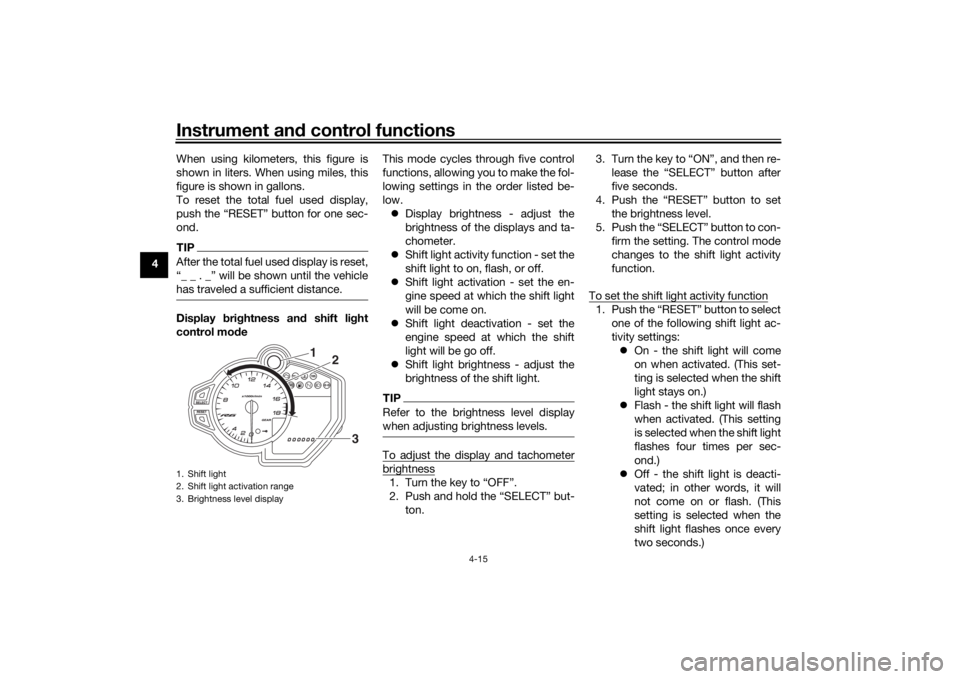
has traveled a sufficient distance.Display
bri ghtness an d shift li ght
control mo de This mode cycles through five control
functions, allowing you to make the fol-
lowing settings in the order listed be-
low.
Display brightness - adjust the
brightness of the displays and ta-
chometer.
Shift light activity function - set the
shift light to on, flash, or off.
Shift light activation - set the en-
gine speed at which the shift light
will be come on.
Shift light deactivation - set the
engine speed at which the shift
light will be go off.
Shift light brightness - adjust the
brightness of the shift light.
TIPRefer to the brightness level display
when adjusting brightness levels.To adjust the display and tachometerbrightness1. Turn the key to “OFF”.
2. Push and hold the “SELECT” but-
ton. 3. Turn the key to “ON”, and then re-
lease the “SELECT” button after
five seconds.
4. Push the “RESET” button to set the brightness level.
5. Push the “SELECT” button to con- firm the setting. The control mode
changes to the shift light activity
function.
To set the shift light activity function
1. Push the “RESET” button to select one of the following shift light ac-
tivity settings: On - the shift light will come
on when activated. (This set-
ting is selected when the shift
light stays on.)
Flash - the shift light will flash
when activated. (This setting
is selected when the shift light
flashes four times per sec-
ond.)
Off - the shift light is deacti-
vated; in other words, it will
not come on or flash. (This
setting is selected when the
shift light flashes once every
two seconds.)
1. Shift light
2. Shift light activation range
3. Brightness level display
1
2
3
UBN6E2E0.book Page 15 Friday, December 7, 2018 2:56 PM
Page 38 of 112

Instrument and control functions
4-19
4
EAU13076
Fuel tank capTo open the fuel tank cap
Open the fuel tank cap lock cover, in-
sert the key into the lock, and then turn
it 1/4 turn clockwise. The lock will be
released and the fuel tank cap can be
opened.
To close the fuel tank cap
With the key still inserted in the lock,
push down the fuel tank cap. Turn the
key 1/4 turn counterclockwise, remove
it, and then close the lock cover.
TIPThe fuel tank cap cannot be closed un-
less the key is in the lock. In addition,
the key cannot be removed if the cap is
not properly closed and locked.
WARNING
EWA11092
Make sure that the fuel tank cap is
properly close d after fillin g fuel.
Leakin g fuel is a fire hazar d.
EAU13222
FuelMake sure there is sufficient gasoline in
the tank.
WARNING
EWA10882
Gasoline an d g asoline vapors are
extremely flamma ble. To avoi d fires
an d explosions an d to re duce the
risk of injury when refuelin g, follow
these instructions.1. Before refueling, turn off the en- gine and be sure that no one is sit-
ting on the vehicle. Never refuel
while smoking, or while in the vi-
cinity of sparks, open flames, or
other sources of ignition such as
the pilot lights of water heaters
and clothes dryers.
2. Do not overfill the fuel tank. When refueling, be sure to insert the
pump nozzle into the fuel tank filler
hole. Stop filling when the fuel
reaches the bottom of the filler
tube. Because fuel expands when
it heats up, heat from the engine or
the sun can cause fuel to spill out
of the fuel tank.
1. Fuel tank cap lock cover
2. Unlock.
1
2
UBN6E2E0.book Page 19 Friday, December 7, 2018 2:56 PM
Page 39 of 112

Instrument and control functions
4-20
4
3. Wipe up any spilled fuel immedi- ately. NOTICE: Immediately
wipe off spilled fuel with a clean,
dry, soft cloth, since fuel may
deteriorate painted surfaces or
plastic parts.
[ECA10072]
4. Be sure to securely close the fuel tank cap.
WARNING
EWA15152
Gasoline is poisonous and can
cause injury or death. Handle gaso-
line with care. Never siphon gasoline
by mouth. If you should swallow
some gasoline or inhale a lot of gas-
oline vapor, or get some gasoline in
your eyes, see your doctor immedi- ately. If gasoline spills on your skin,
wash with soap and water. If gaso-
line spills on your clothing, change
your clothes.
EAU86072
Your Yamaha engine was designed to
use unleaded gasoline with a research
octane number of 95 or higher. If en-
gine knocking or pinging occurs, use a
gasoline of a different brand or higher
octane rating.
TIP
This mark identifies the recom-
mended fuel for this vehicle as
specified by European regulation
(EN228).
Confirm the gasoline pump nozzle
has the same fuel identification
mark.Gasohol
There are two types of gasohol: gaso-
hol containing ethanol and that con-
taining methanol. Gasohol containing
ethanol can be used if the ethanol con-
tent does not exceed 10% (E10). Gas-
ohol containing methanol is not
recommended by Yamaha because it
can cause damage to the fuel system
or vehicle performance problems.
1. Fuel tank filler tube
2. Maximum fuel level
1
2
Recommended fuel:
Unleaded gasoline (E10 acceptable)
Octane number (RON): 95
Fuel tank capacity: 17 L (4.5 US gal, 3.7 Imp.gal)
Fuel tank reserve:
3.4 L (0.90 US gal, 0.75 Imp.gal)
E5
E10
UBN6E3E0.book Page 20 Monday, September 2, 2019 6:55 PM