warning YAMAHA YZF-R7 1999 Owners Manual
[x] Cancel search | Manufacturer: YAMAHA, Model Year: 1999, Model line: YZF-R7, Model: YAMAHA YZF-R7 1999Pages: 381, PDF Size: 18.88 MB
Page 5 of 381
EC080000
HOW TO USE
THIS MANUAL
EC081000
PARTICULARLY IMPORTANT
INFORMATION
The Safety Alert Symbol means ATTEN-
TION! BECOME ALERT! YOUR SAFETY IS
INVOLVED!
Failure to follow WARNING instructions
could result in severe injury or death to the
machine operator, a bystander, or a person
inspecting or repairing the motorcycle.
A CAUTION indicates special precautions
that must be taken to avoid damage to the
motorcycle.
NOTE:
A NOTE provides key information to make
procedures easier or clearer.
WARNING
CAUTION:
EC082000
FINDING THE REQUIRED PAGE
1. This manual consists of eight chapters;
“General Information”, “Specifica-
tions”, “Periodic checks and adjust-
ments”, “Engine”, “Cooling system”,
“Electronic fuel injection”, “Chassis”,
“Electrical”.
2. The table of contents is at the begin-
ning of the manual. Look over the gen-
eral layout of the book before finding
the required chapter and item.
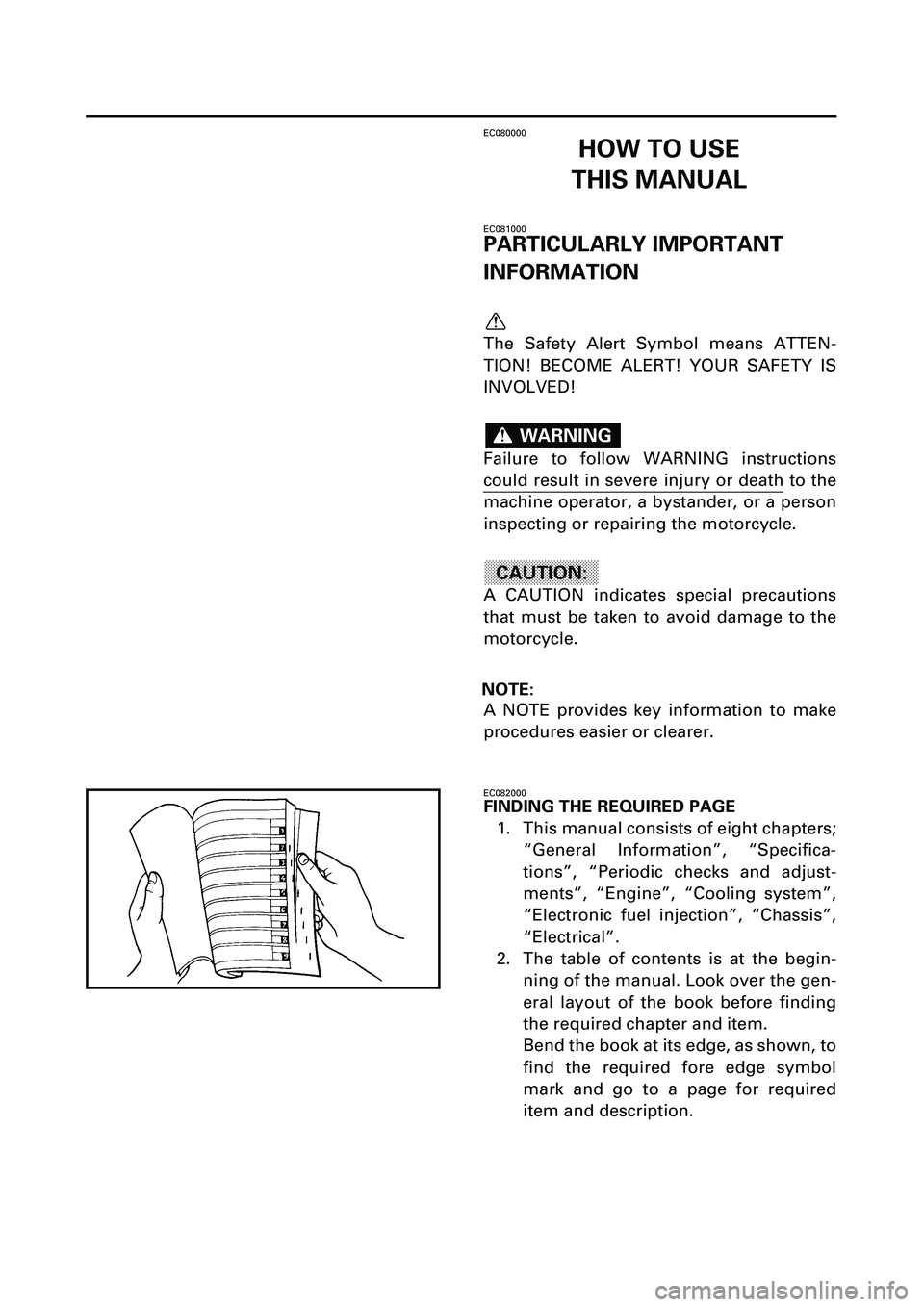
Bend the book at its edge, as shown, to
find the required fore edge symbol
mark and go to a page for required
item and description.
Page 16 of 381
1 - 4
INSTRUMENT AND CONTROL FUNCTIONS
INSTRUMENT AND CONTROL FUNCTIONS
EAU00029
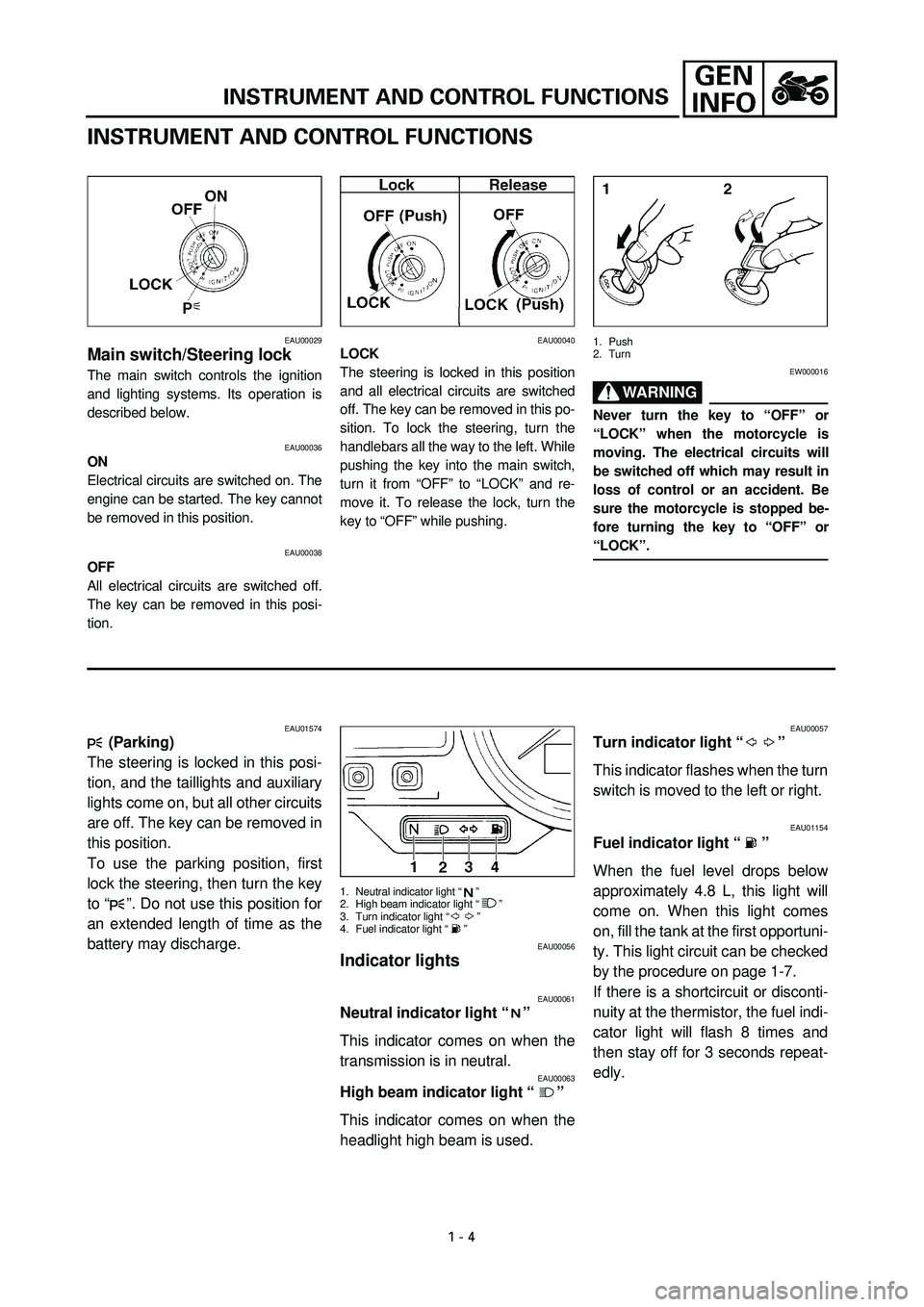
Main switch/Steering lock
The main switch controls the ignition
and lighting systems. Its operation is
described below.
EAU00036
ON
Electrical circuits are switched on. The
engine can be started. The key cannot
be removed in this position.
EAU00038
OFF
All electrical circuits are switched off.
The key can be removed in this posi-
tion.
EAU00040
LOCK
The steering is locked in this position
and all electrical circuits are switched
off. The key can be removed in this po-
sition. To lock the steering, turn the
handlebars all the way to the left. While
pushing the key into the main switch,
turn it from “OFF” to “LOCK” and re-
move it. To release the lock, turn the
key to “OFF” while pushing.
1. Push
2. Turn
EW000016
WARNING
Never turn the key to “OFF” or
“LOCK” when the motorcycle is
moving. The electrical circuits will
be switched off which may result in
loss of control or an accident. Be
sure the motorcycle is stopped be-
fore turning the key to “OFF” or
“LOCK”.
EAU01574
(Parking)
The steering is locked in this posi-
tion, and the taillights and auxiliary
lights come on, but all other circuits
are off. The key can be removed in
this position.
To use the parking position, first
lock the steering, then turn the key
to “ ”. Do not use this position for
an extended length of time as the
battery may discharge.
1.
Neutral indicator light “ ”
2. High beam indicator light “ ”
3. Turn indicator light “ ”
4. Fuel indicator light “ ”
EAU00056
Indicator lights
EAU00061
Neutral indicator light “ ”
This indicator comes on when the
transmission is in neutral.
EAU00063
High beam indicator light “ ”
This indicator comes on when the
headlight high beam is used.
EAU00057
Turn indicator light “ ”
This indicator flashes when the turn
switch is moved to the left or right.
EAU01154
Fuel indicator light “ ”
When the fuel level drops below
approximately 4.8 L, this light will
come on. When this light comes
on, fill the tank at the first opportuni-
ty. This light circuit can be checked
by the procedure on page 1-7.
If there is a shortcircuit or disconti-
nuity at the thermistor, the fuel indi-
cator light will flash 8 times and
then stay off for 3 seconds repeat-
edly.
Page 17 of 381

1 - 5
INSTRUMENT AND CONTROL FUNCTIONS
4 681012
14
x1000r/min
0
1 12
3 3
4
1. Warning light
2. Oil level symbol “ ”
3. Coolant temperature symbol “ ”
4. Engine trouble symbol “ ”
EAU01564
Warning light
This indicator light has three functions.
l
The light will come on and symbol
“ ” will flash if the engine oil
level is low.
If this symbol flashes, stop the en-
gine immediately and fill it with oil
to the specified level.
l
The light will come on and symbol
“ ” will flash if trouble occurs in
a monitoring circuit. In such a
case, take the motorcycle to a
Yamaha dealer to have the self-
diagnostic systems checked.
l
The light will come on and symbol
“ ” will flash if the coolant tem-
perature is too high. The following
chart shows the conditions of the
indicator light, symbol and tem-
perature display in accordance to
coolant temperature.
The light circuit can be checked by the
procedure on page 1-6.
EC000118
CAUTION:
l
Do not run the motorcycle until
you know it has sufficient en-
gine oil.
l
Do not run the motorcycle if the
engine is overheated.
NOTE:
Even if the oil is filled to the specified
level, the indicator light may flicker
when riding on a slope or during sud-
den acceleration or deceleration, but
this is normal.
CB-74ECB-74E
Coolant
temperatureDisplay Conditions What to do
~ 39 ˚CSymbol is on and “LO” is
displayed.OK. Go ahead with riding.
40 ˚C ~ 120 ˚CSymbol is on and temper-
ature is displayed.OK. Go ahead with riding.
121 ˚C ~ 139 ˚CSymbol and temperature
flash.
Warning light comes on.Stop the motorcycle and al-
low it to idle until coolant tem-
perature goes down.
If the temperature does not
go down, stop the engine.
140 ˚C ~ Symbol and message
“HI” flash.
Warning light comes on.Stop the engine and allow it
to cool. Seen page 1-19 if the
engine overheats.
—Symbol and message
“Err” flash.
Warning light comes on.Ask a Yamaha dealer to in-
spect the motorcycle.
C
C
C
C
C
Page 18 of 381

1 - 6
INSTRUMENT AND CONTROL FUNCTIONS
Warning light circuit check
CB-75ECB-75E
Warning light comes on. After a few seconds:Warning light does not come on.
Have a Yamaha
dealer inspect the
electrical circuit.
Turn the main switch to “ON”.
Have a Yamaha dealer inspect
the electrical circuit.
If symbol “ ” is on, check the
engine temperature. (See page 1-5.)
Warning light goes off.
No symbol is on.Symbol “ ”,
“ ” “ ” is on.
OK. Go ahead
with riding.
Warning light does not go off.
If symbol “ ”
is on, inspect the
oil level.
Oil level is OK.Oil level is low.
Have a Yamaha dealer
inspect the electrical
circuit.Supply
recommended
engine oil.
If the engine is hot,
allow it to cool and see
“Engine overheating”
in the troubleshooting
chart on page 1-19 for
instructions.If the engine
temperature is
normal, have a
Yamaha dealer
inspect the
electrical circuit.
If symbol “ ” is on.
Have a Yamaha dealer
inspect the self-
diagnostic systems.
Page 22 of 381

1 - 10
INSTRUMENT AND CONTROL FUNCTIONS
1 1
1. Shift pedal
EAU00157
Shift pedal
This motorcycle is equipped with a con-
stant-mesh 6-speed transmission.
The shift pedal is located on the left
side of the engine and is used in com-
bination with the clutch when shifting.
1. Lever position adjusting dial
2. Arrow mark
a. Lever distance
EAU00161
Front brake lever
The front brake lever is located on the
right handlebar and is equipped with a
brake lever adjusting dial.
To activate the front brake, pull the le-
ver toward the handlebar.
To adjust the front brake lever position,
turn the brake lever adjusting dial while
pulling the lever forward. Make sure the
setting on the brake lever adjusting dial
is aligned with the arrow mark.
1 1
1. Rear brake pedalEAU00162
Rear brake pedal
The rear brake pedal is on the right
side of the motorcycle. Press down on
the brake pedal to apply the rear brake.
1. OpenEAU00172
Fuel tank cap
To open
Insert the key and turn it 1/4 turn clock-
wise. The lock will be released and the
cap can be opened.
To close
Push the tank cap into position with the
key inserted. To remove the key, turn it
counterclockwise to the original posi-
tion.
1 1NOTE:
This tank cap cannot be closed unless
the key is in the lock. The key cannot
be removed if the cap is not locked
properly.
EW000023
WARNING
Be sure the cap is properly installed
and locked in place before riding the
motorcycle.
1. Filler tube
2. Fuel level
EAU01183
Fuel
Make sure there is sufficient fuel in the
tank. Fill the fuel tank to the bottom of
the filler tube as shown in the illustra-
tion.
EW000130
WARNING
Do not overfill the fuel tank. Avoid
spilling fuel on the hot engine. Do
not fill the fuel tank above the bot-
tom of the filler tube or it may over-
flow when the fuel heats up later and
expands.
Page 23 of 381

1 - 11
INSTRUMENT AND CONTROL FUNCTIONS
EAU00185
CAUTION:
Always wipe off spilled fuel immedi-
ately with a dry and clean soft cloth.
Fuel may deteriorate painted surfac-
es or plastic parts.
EAU00191
NOTE:
If knocking or pinging occurs, use a dif-
ferent brand of gasoline or higher oc-
tane grade.Recommended fuel:
Premium unleaded gasoline
with a research octane
number of 95 or higher.
Fuel tank capacity:
Total:
23 L
Reserve:
4.8 L
1 1
a a b b
1. Starter (choke) “ ”EAU00210
Starter (choke) “ ”
Starting a cold engine requires a richer
air-fuel mixture. A separate starter cir-
cuit supplies this mixture.
Move in direction
a to turn on the
starter (choke).
Move in direction
b to turn off the
starter (choke).
EAU00331
Sidestand/clutch switch
operation check
Check the operation of the sidestand
switch and clutch switch against the in-
formation below.
COPY CD-11ECD-11E
TRANSMISSION IS IN GEAR AND
SIDESTAND IS UP.
PULL IN CLUTCH LEVER AND
PUSH THE START SWITCH.
ENGINE WILL START.
SIDESTAND IS DOWN.
CLUTCH SWITCH IS OK.
TURN THE MAIN SWITCH TO “ON”
AND THE ENGINE STOP SWITCH TO
“”.
CD-11E
EW000045
WARNING
If improper operation is noted, con-
sult a Yamaha dealer immediately.
ENGINE WILL STALL.
SIDESTAND SWITCH IS OK.
Page 24 of 381

1 - 12
OPERATION AND IMPORTANT RIDING POINTS
OPERATION AND IMPORTANT RIDING POINTS
EAU00373
WARNING
lBefore riding this motorcycle,
become thoroughly familiar
with all operating controls and
their functions. Consult a
Yamaha dealer regarding any
control or function that you do
not thoroughly understand.
lNever start your engine or let it
run for any length of time in a
closed area. The exhaust fumes
are poisonous and can cause
loss of consciousness and
death within a short time. Al-
ways operate your motorcycle
in an area with adequate venti-
lation.
lBefore starting out, always be
sure the sidestand is up. Fail-
ure to retract the sidestand
completely can result in a seri-
ous accident when you try to
turn a corner.
EAU01382*
Starting the engine
NOTE:
This motorcycle is equipped with an ig-
nition circuit cut-off system.
The engine can be started only under
one of the following conditions:
lThe transmission is in neutral.
lThe sidestand is up, the transmis-
sion is in gear and the clutch is
disengaged.
The motorcycle must not be ridden
when the sidestand is down.
EW000054
WARNING
Before going through the following
steps, check the function of the sid-
estand switch and clutch switch.
(Refer to page 1-11.)
COPY CF-28ECF-28E
TURN THE MAIN SWITCH TO “ON” AND THE
ENGINE STOP SWITCH TO “ ”.
IF TRANSMISSION IS IN NEUTRAL AND
SIDESTAND IS DOWN,
PUSH THE START SWITCH.
ENGINE WILL START.
RETRACT SIDESTAND AND PUT
TRANSMISSION IN GEAR.
IF TRANSMISSION IS IN GEAR AND
SIDESTAND IS UP,
PULL IN THE CLUTCH LEVER AND PUSH START
SWITCH. ENGINE WILL START.
MOTORCYCLE CAN BE RIDDEN.MOTORCYCLE CAN BE RIDDEN.
Page 25 of 381

1 - 13
OPERATION AND IMPORTANT RIDING POINTS
1. Turn the main switch to “ON” and
the engine stop switch to “ ”.
ECA00005
CAUTION:
The warning light and fuel indicator
light should come on for a few sec-
onds and then go off. If an indicator
light does not go off, refer to the cor-
responding indicator light circuit
check in the “INSTRUMENT AND
CONTROL FUNCTIONS” section.
2. Shift the transmission into neutral.
NOTE:
When the transmission is in neutral, the
neutral indicator light should be on. If
the light does not come on, ask a
Yamaha dealer to inspect it.
3. Turn on the starter (choke) and
completely close the throttle grip.
4. Start the engine by pushing the
start switch.
NOTE:
If the engine fails to start, release the
start switch, wait a few seconds, then
try again. Each attempt should be as
short as possible to preserve the bat-
tery. Do not crank the engine more
than 10 seconds on any one attempt.5. After starting the engine, move
the starter (choke) to the halfway
position.
NOTE:
For maximum engine life, never accel-
erate hard with a cold engine!
6. After the engine is warm, turn off
the starter (choke) completely.
NOTE:
The engine is warm when it responds
normally to the throttle with the starter
(choke) turned off.
EAU01258
Starting a warm engine
The starter (choke) is not required
when the engine is warm.
EC000046
CAUTION:
See the “Engine break-in” section
prior to operating the motorcycle for
the first time.
1 16
65
5
4 4
3 3
N N2 2
1 1
1. Shift pedal
N. Neutral
EAU00423
Shifting
The transmission lets you control the
amount of power you have available at
a given speed for starting, accelerating,
climbing hills, etc. The use of the shift
pedal is shown in the illustration.
To shift into neutral, depress the shift
pedal repeatedly until it reaches the
end of its travel, then raise the pedal
slightly.
EC000048
CAUTION:
lDo not coast for long periods
with the engine off, and do not
tow the motorcycle a long dis-
tance. Even with gears in neu-
tral, the transmission is only
properly lubricated when the
engine is running. Inadequate
lubrication may damage the
transmission.
lAlways use the clutch when
changing gears. The engine,
transmission, and driveline are
not designed to withstand the
shock of forced shifting and
can be damaged by shifting
without using the clutch.
Page 26 of 381

1 - 14
OPERATION AND IMPORTANT RIDING POINTS/
INCLUDED ACCESSORIES
EAU01128
Engine break-in
There is never a more important period
in the life of your motorcycle than the
period between zero and 1,600 km. For
this reason we ask that you carefully
read the following material. Because
the engine is brand new, you must not
put an excessive load on it for the first
1,600 km. The various parts in the en-
gine wear and polish themselves to the
correct operating clearances. During
this period, prolonged full throttle oper-
ation, or any condition which might re-
sult in excessive heating of the engine,
must be avoided.
EAU013290 ~ 1,000 km
Avoid operation above 5,500 r/min.
1,000 ~ 1,600 km
Avoid cruising speeds in excess of
7,000 r/min.
EC000052
CAUTION:
After 1,000 km of operation, be sure
to replace the engine oil and oil fil-
ter.
1,600 km and beyond
Proceed with normal riding.
EC000053
CAUTION:
lNever let engine speeds enter
the red zone.
lIf any engine trouble should oc-
cur during the break-in period,
consult a Yamaha dealer imme-
diately.
EAU00460
Parking
When parking the motorcycle, stop the
engine and remove the ignition key.
EW000058
WARNING
The exhaust system is hot. Park the
motorcycle in a place where pedes-
trians or children are not likely to
touch the motorcycle. Do not park
the motorcycle on a slope or soft
ground; the motorcycle may over-
turn.
INCLUDED ACCESSORIES
EAU01575
Tool kit
The tools provided in the owner’s tool
kit are to assist you in the performance
of periodic maintenance. However,
some other tools such as a torque
wrench are also necessary to perform
the maintenance correctly.
The service information included in this
manual is intended to provide you, the
owner, with the necessary information
for completing some of your own pre-
ventive maintenance and minor re-
pairs.
NOTE:
If you do not have necessary tools re-
quired during a service operation, take
your motorcycle to a Yamaha dealer
for service.
EW000063
WARNING
Modifications to this motorcycle not
approved by Yamaha may cause
loss of performance, and render it
unsafe for use. Consult a Yamaha
dealer before attempting any chang-
es.
Page 28 of 381

1 - 16
MOTORCYCLE CARE AND STORAGE
1. Clean your motorcycle with cold
water and soap after the engine
has cooled down.
ECA00012
CAUTION:
Do not use warm water since it in-
creases the corrosive action of the
salt.
2. Be sure to apply a corrosion pro-
tection spray on all (even chrome-
and nickel-plated) metal surfaces
to prevent corrosion.After cleaning
1. Dry the motorcycle with a cham-
ois or an absorbing cloth.
2. Immediately dry the drive chain
and lubricate it to prevent it from
rusting.
3. Use a chrome polish to shine
chrome, aluminum and stainless-
steel parts, including the exhaust
system. (Even the thermally in-
duced discoloring of stainless-
steel exhaust systems can be re-
moved through polishing.)
4. To prevent corrosion, it is recom-
mended to apply a corrosion pro-
tection spray on all (even chrome-
and nickel-plated) metal surfaces.
5. Use spray oil as a universal clean-
er to remove any remaining dirt.
6. Touch up minor paint damage
caused by stones, etc.
7. Wax all painted surfaces.
CAUTION:
Do not wax the frame, swingarm and
other similar matte metal parts, as
this may deteriorate their finish.
8. Let the motorcycle dry completely
before storing it or covering it.
EWA00001
WARNING
Make sure that there is no oil or wax
on the brakes and tires. If necessary,
clean the brake discs and linings
with a regular brake disc cleaner or
acetone, and wash the tires with
warm water and mild soap. Then,
carefully test the motorcycle for its
braking performance and cornering
behavior.
ECA00013
CAUTION:
lApply spray oil and wax spar-
ingly and wipe off any excess.
lNever apply oil or wax on rub-
ber and plastic parts, but treat
them with a suitable care prod-
uct.
lAvoid using abrasive polishing
compounds as they wear away
the paint.
NOTE:
Consult a Yamaha dealer for advice on
what products to use.
Storage
Short-term
Always store your motorcycle in a cool,
dry place and, if necessary, protect it
against dust with a porous cover.
ECA00014
CAUTION:
lStoring the motorcycle in a
poorly ventilated room or cov-
ering it with a tarp while it is still
wet will allow water and humid-
ity to seep in and cause rust.
lTo prevent corrosion, avoid
damp cellars, stables (because
of the presence of ammonia)
and areas where strong chemi-
cals are stored.Long-term
Long term storage (60 days or more) of
your motorcycle will require some pre-
ventive procedures to guard against
deterioration. After throughly cleaning
the motorcycle, prepare for storage as
follows:
1. Drain the fuel tank.
2. Remove the empty fuel tank, pour
a cup of engine oil in the tank,
shake the tank to coat the inner
surfaces thoroughly and drain off
the excess oil. Reinstall the tank.
3. Remove the spark plug, pour
about one tablespoon of engine
oil in the spark plug hole and rein-
stall the spark plug. Turn the en-
gine over several times (ground
spark plug lead wires) to coat the
cylinder walls with oil.