warning YAMAHA YZF1000 2021 User Guide
[x] Cancel search | Manufacturer: YAMAHA, Model Year: 2021, Model line: YZF1000, Model: YAMAHA YZF1000 2021Pages: 108, PDF Size: 11.75 MB
Page 32 of 108
INSTRUMENT AND CONTROL FUNCTIONS
3-17
3
EAU00315
WARNING
_ This shock absorber contains high-
ly pressurized nitrogen gas. For
proper handling, read and under-
stand the following information be-
fore handling the shock absorber.
The manufacturer cannot be held re-
sponsible for property damage or
personal injury that may result from
improper handling.l
Do not tamper with or attempt to
open the gas cylinder.
l
Do not subject the shock ab-
sorber to an open flame or other
high heat sources, otherwise it
may explode due to excessive
gas pressure.
l
Do not deform or damage the
gas cylinder in any way, as this
will result in poor damping per-
formance.
l
Always have a Yamaha dealer
service the shock absorber.
_
EAU00324
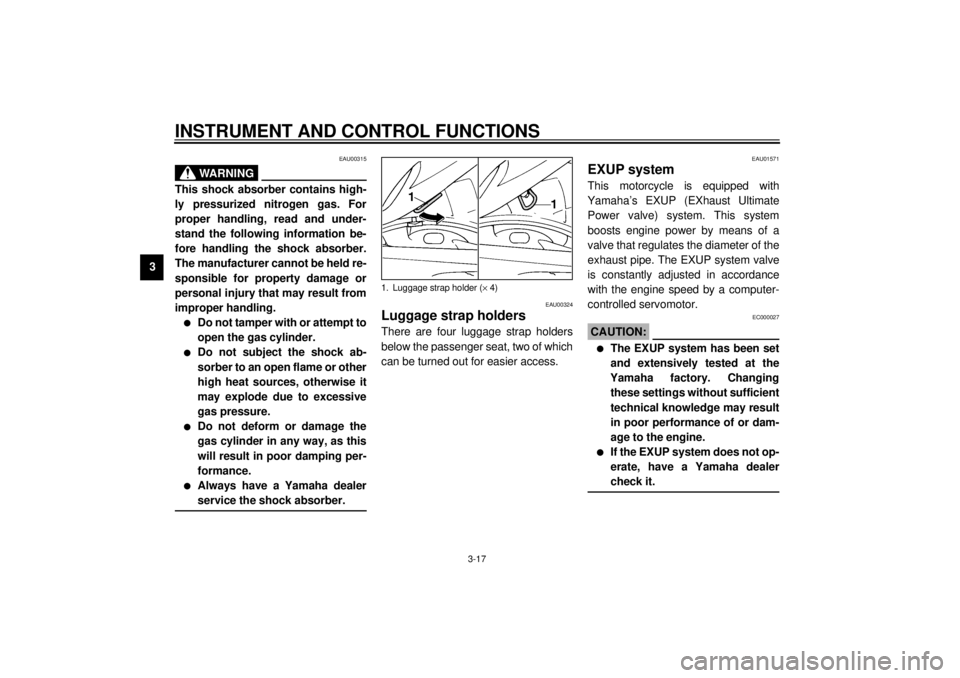
Luggage strap holders There are four luggage strap holders
below the passenger seat, two of which
can be turned out for easier access.
EAU01571
EXUP system This motorcycle is equipped with
Yamaha’s EXUP (EXhaust Ultimate
Power valve) system. This system
boosts engine power by means of a
valve that regulates the diameter of the
exhaust pipe. The EXUP system valve
is constantly adjusted in accordance
with the engine speed by a computer-
controlled servomotor.
EC000027
CAUTION:_ l
The EXUP system has been set
and extensively tested at the
Yamaha factory. Changing
these settings without sufficient
technical knowledge may result
in poor performance of or dam-
age to the engine.
l
If the EXUP system does not op-
erate, have a Yamaha dealer
check it.
_
1. Luggage strap holder (´ 4)
E_4sv.book Page 17 Friday, November 10, 2000 3:03 PM
Page 33 of 108
INSTRUMENT AND CONTROL FUNCTIONS
3-18
3
EAU00330
Sidestand The sidestand is located on the left side
of the frame. Raise the sidestand or
lower it with your foot while holding the
motorcycle upright.NOTE:_ The built-in sidestand switch is part of
the ignition circuit cut-off system, which
cuts the ignition in certain situations.
(See further down for an explanation of
the ignition circuit cut-off system.) _
EW000044
WARNING
_ The motorcycle must not be ridden
with the sidestand down, or if the
sidestand cannot be properly
moved up (or does not stay up), oth-
erwise the sidestand could contact
the ground and distract the opera-
tor, resulting in a possible loss of
control. Yamaha’s ignition circuit
cut-off system has been designed to
assist the operator in fulfilling the
responsibility of raising the side-
stand before starting off. Therefore,
check this system regularly as de-
scribed below and have a Yamaha
dealer repair it if it does not function
properly. _
EAU03720
Ignition circuit cut-off system The ignition circuit cut-off system (com-
prising the sidestand switch, clutch
switch and neutral switch) has the fol-
lowing functions.l
It prevents starting when the trans-
mission is in gear and the side-
stand is up, but the clutch lever is
not pulled.
l
It prevents starting when the trans-
mission is in gear and the clutch
lever is pulled, but the sidestand is
still down.
l
It cuts the running engine when
the transmission is in gear and the
sidestand is moved down.
Periodically check the operation of the
ignition circuit cut-off system according
to the following procedure.
EW000045
WARNING
_ If a malfunction is noted, have a
Yamaha dealer check the system
before riding. _
E_4sv.book Page 18 Friday, November 10, 2000 3:03 PM
Page 37 of 108
PRE-OPERATION CHECKS
4-2
4
NOTE:_ Pre-operation checks should be made each time the motorcycle is used. Such an inspection can be accomplished in a very
short time; and the added safety it assures is more than worth the time involved. _
EWA00033
WARNING
_ If any item in the Pre-operation check list is not working properly, have it inspected and repaired before operating
the motorcycle. _Control cables• Make sure that operation is smooth.
• Lubricate if necessary.6-27
Drive chain• Check chain slack.
• Adjust if necessary.
• Check chain condition.
• Lubricate if necessary.6-25
Wheels and tires• Check for damage.
• Check tire condition and tread depth.
• Check air pressure.
• Correct if necessary.6-17–6-21
Brake and shift pedals• Make sure that operation is smooth.
• Lubricate pedal pivoting points if necessary.6-27
Brake and clutch levers• Make sure that operation is smooth.
• Lubricate lever pivoting points if necessary.6-27
Sidestand• Make sure that operation is smooth.
• Lubricate pivot if necessary.6-28
Chassis fasteners• Make sure that all nuts, bolts and screws are properly tightened.
• Tighten if necessary.—
Instruments, lights, signals
and switches• Check operation.
• Correct if necessary.—
Sidestand switch• Check operation of ignition circuit cut-off system.
• If system is defective, have Yamaha dealer check vehicle.3-18 ITEM CHECKS PAGE
E_4sv.book Page 2 Friday, November 10, 2000 3:03 PM
Page 40 of 108
5-1
5
EAU00372
5-OPERATION AND IMPORTANT RIDING POINTS
EAU00373
WARNING
_ l
Become thoroughly familiar
with all operating controls and
their functions before riding.
Consult a Yamaha dealer re-
garding any control or function
that you do not thoroughly un-
derstand.
l
Never start the engine or oper-
ate it in a closed area for any
length of time. Exhaust fumes
are poisonous, and inhaling
them can cause loss of con-
sciousness and death within a
short time. Always make sure
that there is adequate ventila-
tion.
l
Before starting out, make sure
that the sidestand is up. If the
sidestand is not raised com-
pletely, it could contact the
ground and distract the opera-
tor, resulting in a possible loss
of control.
_
EAU03818*
Starting the engine In order for the ignition circuit cut-off
system to enable starting, one of the
following conditions must be met:l
The transmission is in the neutral
position.
l
The transmission is in gear with
the clutch lever pulled and the
sidestand up.
EW000054
WARNING
_ l
Before starting the engine,
check the function of the igni-
tion circuit cut-off system ac-
cording to the procedure
described on page 3-19.
l
Never ride with the sidestand
down.
_
1. Turn the key to “ON” and make
sure that the engine stop switch is
set to “ ”.
EC000035
CAUTION:_ If the fuel level warning light comes
on, check the fuel level, and, if nec-
essary, refuel as soon as possible. _2. Shift the transmission into the neu-
tral position.NOTE:_ When the transmission is in the neutral
position, the neutral indicator light
should be on, otherwise have a
Yamaha dealer check the electrical cir-
cuit. _3. Turn the starter (choke) on and
completely close the throttle. (See
page 3-10 for starter (choke) oper-
ation.)
4. Start the engine by pushing the
start switch.
E_4sv.book Page 1 Friday, November 10, 2000 3:03 PM
Page 41 of 108
OPERATION AND IMPORTANT RIDING POINTS
5-2
5
NOTE:_ If the engine fails to start, release the
start switch, wait a few seconds, and
then try again. Each starting attempt
should be as short as possible to pre-
serve the battery. Do not crank the en-
gine more than 10 seconds on any one
attempt. _
EC000038
CAUTION:_ l
The oil level warning light and
fuel level warning light should
come on when the start switch
is pushed, and they should go
off when the start switch is re-
leased.
l
If the oil level warning light flick-
ers or remains on after starting,
immediately stop the engine,
and then check the engine oil
level and the vehicle for oil leak-
age. If necessary, add engine
oil, and then check the warning
light again. If the warning light
does not come on when push-
ing the start switch, or if it doesnot go off after starting with suf-
ficient engine oil, have a
Yamaha dealer check the elec-
trical circuit.
l
If the fuel level warning light re-
mains on after starting, stop the
engine, and then check the fuel
level. If necessary, refuel as
soon as possible, and then
check the warning light again. If
the warning light does not come
on when pushing the start
switch, or if it does not go off af-
ter starting with sufficient fuel,
have a Yamaha dealer check the
electrical circuit.
_5. After starting the engine, move the
starter (choke) lever back halfway.
ECA00045
CAUTION:_ For maximum engine life, never ac-
celerate hard when the engine is
cold! _
6. When the engine is warm, turn the
starter (choke) off.NOTE:_ The engine is warm when it responds
normally to the throttle with the starter
(choke) turned off. _
E_4sv.book Page 2 Friday, November 10, 2000 3:03 PM
Page 44 of 108
OPERATION AND IMPORTANT RIDING POINTS
5-5
5
EAU00440*
0–150 kml
Avoid prolonged operation above
5,000 r/min.
l
After every hour of operation, stop
the engine, and then let it cool for
five to ten minutes.
l
Vary the engine speed from time
to time. Do not operate the engine
at one set throttle position.
150–500 km
l
Avoid prolonged operation above
6,000 r/min.
l
Rev the engine freely through the
gears, but do not use full throttle at
any time.
500–1,000 km
l
Avoid prolonged full-throttle oper-
ation.
l
Avoid prolonged operation above
7,000 r/min.
EC000052*
CAUTION:_ After 1,000 km of operation, the en-
gine oil must be changed and the oil
filter cartridge replaced. _1,000 km and beyond
The vehicle can now be operated nor-
mally.
EC000053
CAUTION:_ l
Keep the engine speed out of
the tachometer red zone.
l
If any engine trouble should oc-
cur during the engine break-in
period, immediately have a
Yamaha dealer check the vehi-
cle.
_
EAU00460
Parking When parking, stop the engine, and
then remove the key from the main
switch.
EW000058
WARNING
_ l
Since the engine and exhaust
system can become very hot,
park in a place where pedestri-
ans or children are not likely to
touch them.
l
Do not park on a slope or on
soft ground, otherwise the
motorcycle may overturn.
_
E_4sv.book Page 5 Friday, November 10, 2000 3:03 PM
Page 46 of 108
6-1
6
EAU00462
6-PERIODIC MAINTENANCE AND MINOR REPAIR
EAU00464
Safety is an obligation of the owner.
Periodic inspection, adjustment and lu-
brication will keep your vehicle in the
safest and most efficient condition pos-
sible. The most important points of in-
spection, adjustment, and lubrication
are explained on the following pages.
The intervals given in the periodic
maintenance and lubrication chart
should be simply considered as a gen-
eral guide under normal riding condi-
tions. However, DEPENDING ON THE
WEATHER, TERRAIN, GEOGRAPHI-
CAL LOCATION, AND INDIVIDUAL
USE, THE MAINTENANCE INTER-
VALS MAY NEED TO BE SHORT-
ENED.
EW000060
WARNING
_ If you are not familiar with motor-
cycle maintenance work, have a
Yamaha dealer do it for you. _
EAU03713
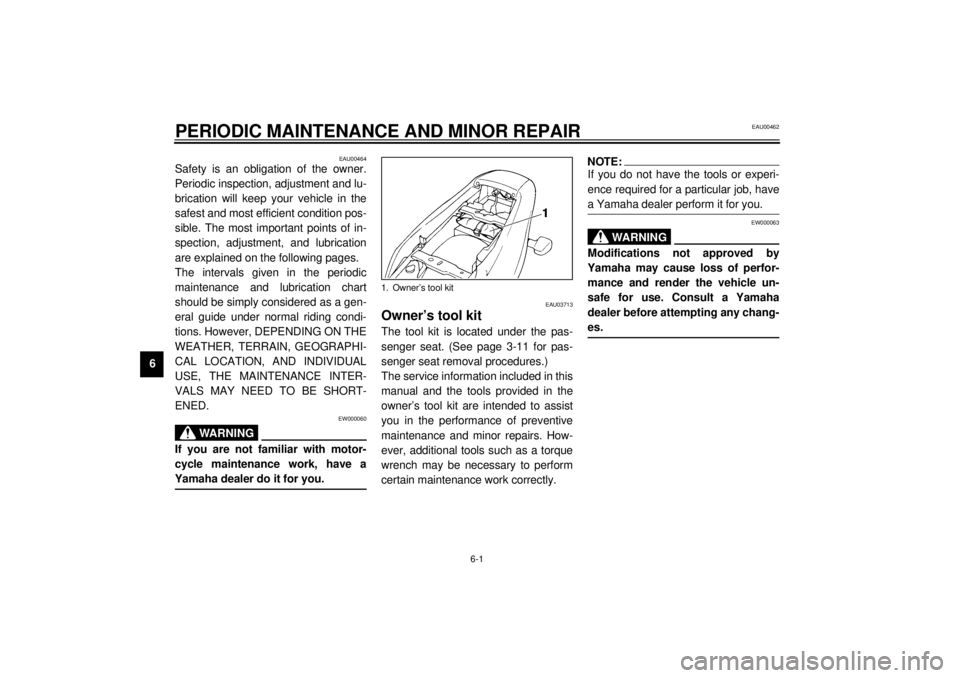
Owner’s tool kit The tool kit is located under the pas-
senger seat. (See page 3-11 for pas-
senger seat removal procedures.)
The service information included in this
manual and the tools provided in the
owner’s tool kit are intended to assist
you in the performance of preventive
maintenance and minor repairs. How-
ever, additional tools such as a torque
wrench may be necessary to perform
certain maintenance work correctly.
NOTE:_ If you do not have the tools or experi-
ence required for a particular job, have
a Yamaha dealer perform it for you. _
EW000063
WARNING
_ Modifications not approved by
Yamaha may cause loss of perfor-
mance and render the vehicle un-
safe for use. Consult a Yamaha
dealer before attempting any chang-
es. _
1. Owner’s tool kit
E_4sv.book Page 1 Friday, November 10, 2000 3:03 PM
Page 56 of 108
PERIODIC MAINTENANCE AND MINOR REPAIR
6-11
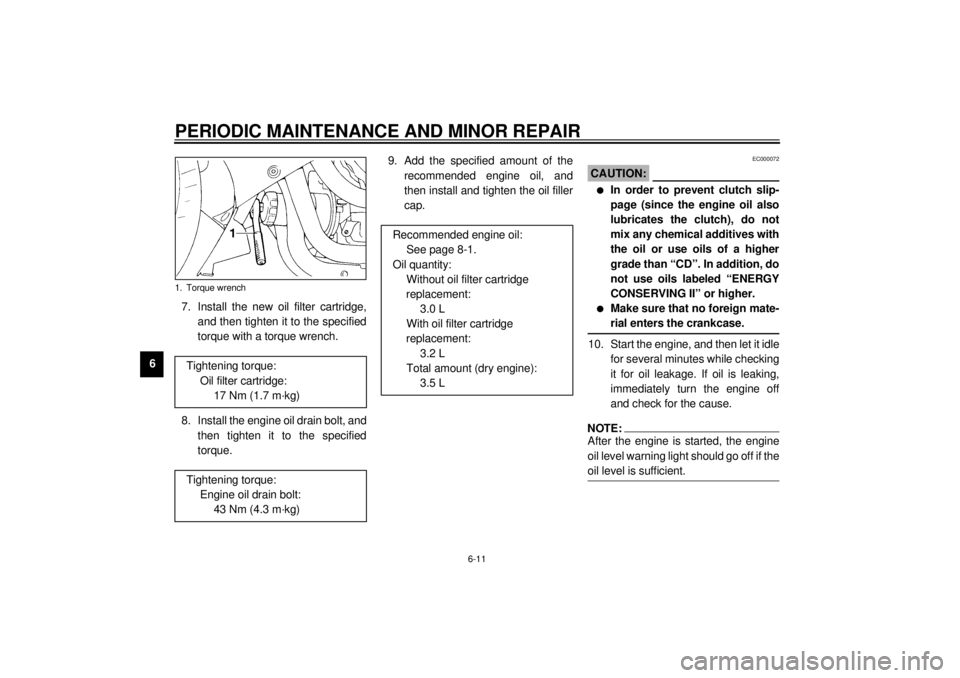
67. Install the new oil filter cartridge,
and then tighten it to the specified
torque with a torque wrench.
8. Install the engine oil drain bolt, and
then tighten it to the specified
torque.9. Add the specified amount of the
recommended engine oil, and
then install and tighten the oil filler
cap.
EC000072
CAUTION:_ l
In order to prevent clutch slip-
page (since the engine oil also
lubricates the clutch), do not
mix any chemical additives with
the oil or use oils of a higher
grade than “CD”. In addition, do
not use oils labeled “ENERGY
CONSERVING II” or higher.
l
Make sure that no foreign mate-
rial enters the crankcase.
_10. Start the engine, and then let it idle
for several minutes while checking
it for oil leakage. If oil is leaking,
immediately turn the engine off
and check for the cause.NOTE:_ After the engine is started, the engine
oil level warning light should go off if the
oil level is sufficient. _
1. Torque wrenchTightening torque:
Oil filter cartridge:
17 Nm (1.7 m·kg)
Tightening torque:
Engine oil drain bolt:
43 Nm (4.3 m·kg)
Recommended engine oil:
See page 8-1.
Oil quantity:
Without oil filter cartridge
replacement:
3.0 L
With oil filter cartridge
replacement:
3.2 L
Total amount (dry engine):
3.5 L
E_4sv.book Page 11 Friday, November 10, 2000 3:03 PM
Page 57 of 108
PERIODIC MAINTENANCE AND MINOR REPAIR
6-12
6
EC000067
CAUTION:_ If the oil level warning light flickers
or remains on, immediately turn the
engine off and have a Yamaha deal-
er check the vehicle. _11. Turn the engine off, and then
check the oil level and correct it if
necessary.
12. Install the cowling.
EAU03947*
Checking the coolant levelThe coolant level should be checked
before each ride. In addition, the cool-
ant must be changed at the intervals
specified in the periodic maintenance
and lubrication chart.
1. Place the motorcycle on a level
surface and hold it in an upright
position.NOTE:_ l
The coolant level must be checked
on a cold engine since the level
varies with engine temperature.
l
Make sure that the motorcycle is
positioned straight up when
checking the coolant level. A slight
tilt to the side can result in a false
reading.
_
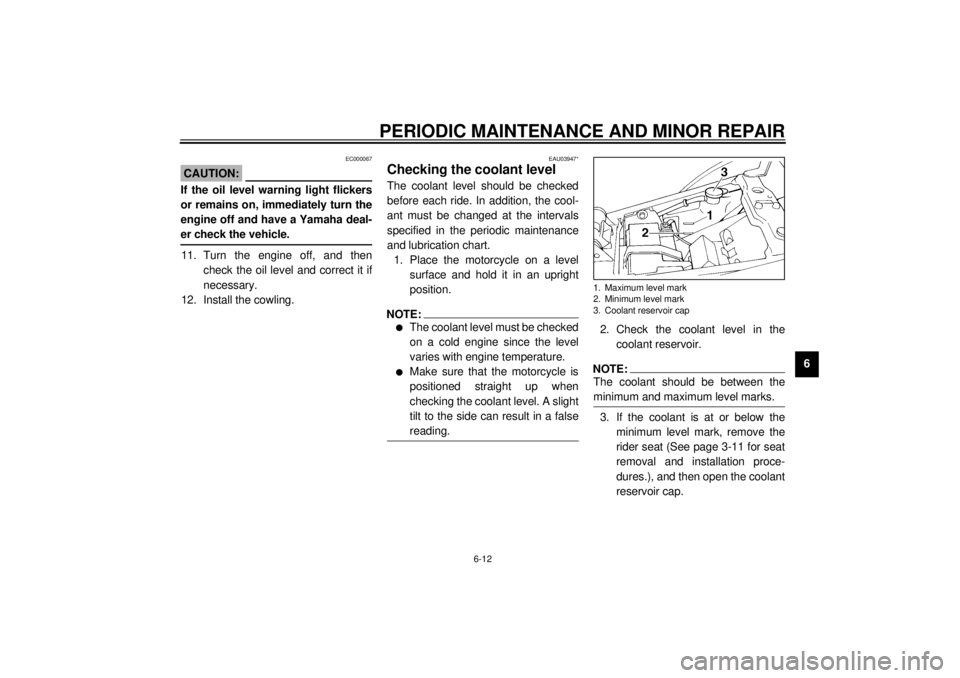
2. Check the coolant level in the
coolant reservoir.NOTE:_ The coolant should be between the
minimum and maximum level marks. _3. If the coolant is at or below the
minimum level mark, remove the
rider seat (See page 3-11 for seat
removal and installation proce-
dures.), and then open the coolant
reservoir cap.1. Maximum level mark
2. Minimum level mark
3. Coolant reservoir cap
E_4sv.book Page 12 Friday, November 10, 2000 3:03 PM
Page 58 of 108
PERIODIC MAINTENANCE AND MINOR REPAIR
6-13
64. Add coolant or distilled water to
raise the coolant to the specified
level, close the coolant reservoir
cap, and then install the rider seat.
EC000080
CAUTION:_ l
If coolant is not available, use
distilled water or soft tap water
instead. Do not use hard water
or salt water since it is harmful
to the engine.
l
If water has been used instead
of coolant, replace it with cool-
ant as soon as possible, other-
wise the engine may not be
sufficiently cooled and the cool-
ing system will not be protected
against frost and corrosion.
l
If water has been added to the
coolant, have a Yamaha dealer
check the antifreeze content of
the coolant as soon as possible,
otherwise the effectiveness of
the coolant will be reduced.
_
EW000067
WARNING
_ Never attempt to remove the radia-
tor cap when the engine is hot. _NOTE:_ l
The radiator fan is automatically
switched on or off according to the
coolant temperature in the radia-
tor.
l
If the engine overheats, see
page 6-42 for further instructions.
_
EAU03948*
Cleaning the air filter element The air filter element should be cleaned
at the intervals specified in the periodic
maintenance and lubrication chart.
Clean the air filter element more fre-
quently if you are riding in unusually
wet or dusty areas.
1. Remove the rider seat. (See page
3-11 for rider seat removal and in-
stallation procedures.)
2. Remove cowling B from both
sides. (See page 6-5 for cowling
removal and installation proce-
dures.)
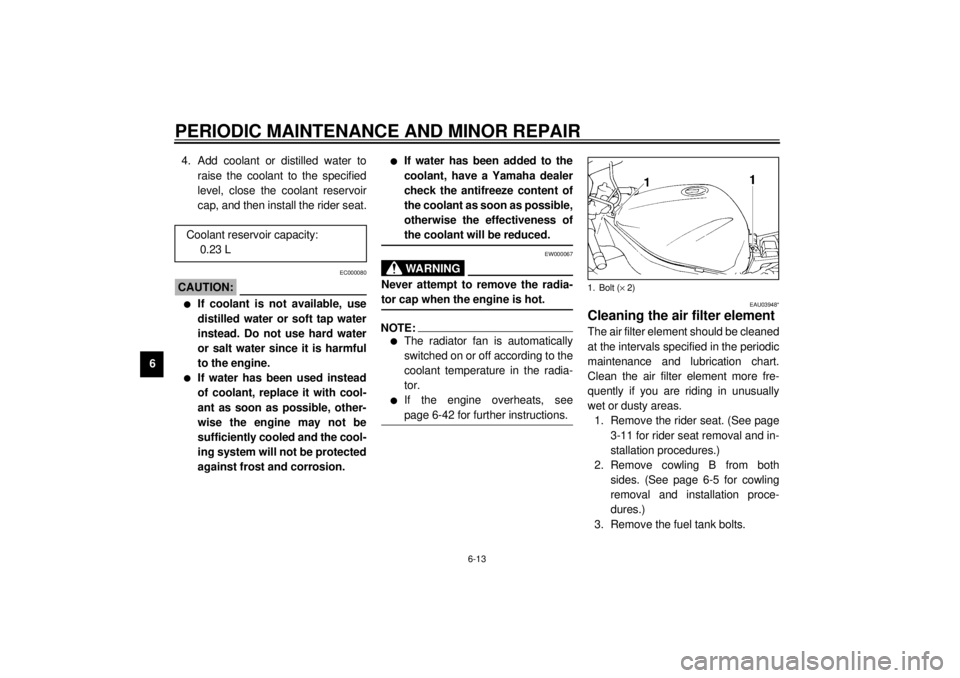
3. Remove the fuel tank bolts. Coolant reservoir capacity:
0.23 L1. Bolt (´ 2)
E_4sv.book Page 13 Friday, November 10, 2000 3:03 PM