light YAMAHA YZF1000 2021 Owner's Manual
[x] Cancel search | Manufacturer: YAMAHA, Model Year: 2021, Model line: YZF1000, Model: YAMAHA YZF1000 2021Pages: 108, PDF Size: 11.75 MB
Page 60 of 108
PERIODIC MAINTENANCE AND MINOR REPAIR
6-15
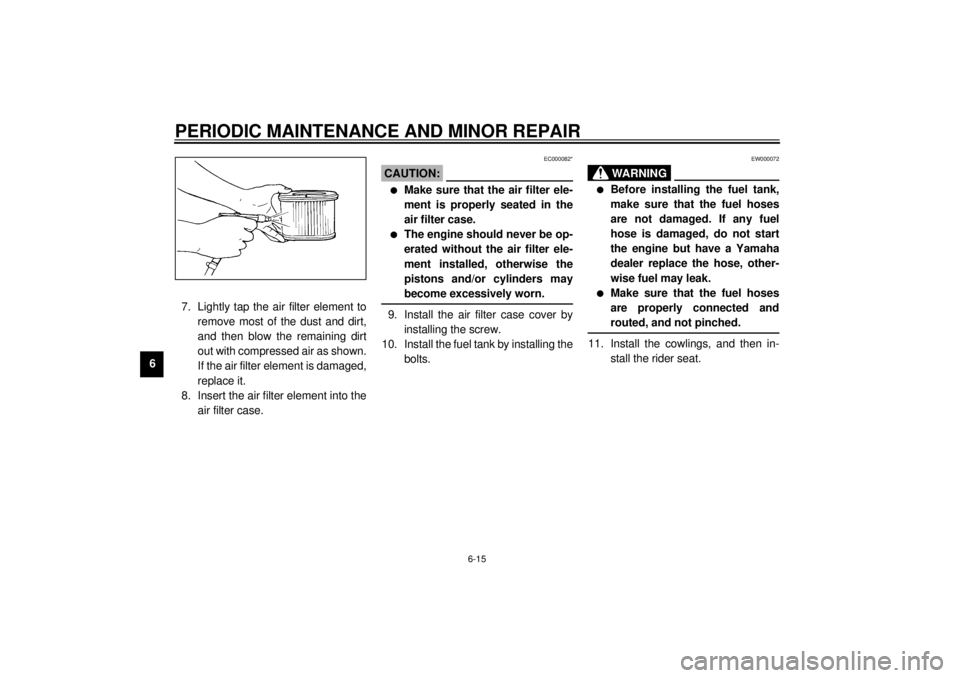
67. Lightly tap the air filter element to
remove most of the dust and dirt,
and then blow the remaining dirt
out with compressed air as shown.
If the air filter element is damaged,
replace it.
8. Insert the air filter element into the
air filter case.
EC000082*
CAUTION:_ l
Make sure that the air filter ele-
ment is properly seated in the
air filter case.
l
The engine should never be op-
erated without the air filter ele-
ment installed, otherwise the
pistons and/or cylinders may
become excessively worn.
_9. Install the air filter case cover by
installing the screw.
10. Install the fuel tank by installing the
bolts.
EW000072
WARNING
_ l
Before installing the fuel tank,
make sure that the fuel hoses
are not damaged. If any fuel
hose is damaged, do not start
the engine but have a Yamaha
dealer replace the hose, other-
wise fuel may leak.
l
Make sure that the fuel hoses
are properly connected and
routed, and not pinched.
_11. Install the cowlings, and then in-
stall the rider seat.
E_4sv.book Page 15 Friday, November 10, 2000 3:03 PM
Page 66 of 108
PERIODIC MAINTENANCE AND MINOR REPAIR
6-21
6
EAU03773
Cast wheels To maximize the performance, durabil-
ity, and safe operation of your motor-
cycle, note the following points
regarding the specified wheels.l
The wheel rims should be checked
for cracks, bends or warpage be-
fore each ride. If any damage is
found, have a Yamaha dealer re-
place the wheel. Do not attempt
even the smallest repair to the
wheel. A deformed or cracked
wheel must be replaced.
l
The wheel should be balanced
whenever either the tire or wheel
has been changed or replaced. An
unbalanced wheel can result in
poor performance, adverse han-
dling characteristics, and a short-
ened tire life.
l
Ride at moderate speeds after
changing a tire since the tire sur-
face must first be “broken in” for it
to develop its optimal characteris-
tics.
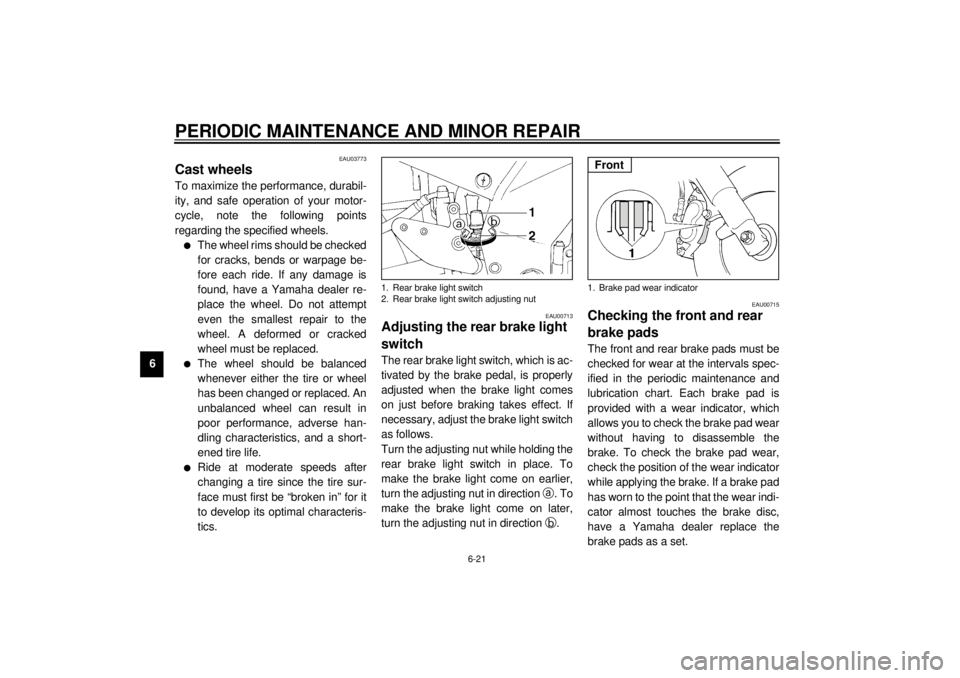
EAU00713
Adjusting the rear brake light
switch The rear brake light switch, which is ac-
tivated by the brake pedal, is properly
adjusted when the brake light comes
on just before braking takes effect. If
necessary, adjust the brake light switch
as follows.
Turn the adjusting nut while holding the
rear brake light switch in place. To
make the brake light come on earlier,
turn the adjusting nut in direction
a. To
make the brake light come on later,
turn the adjusting nut in direction
b.
EAU00715
Checking the front and rear
brake pads The front and rear brake pads must be
checked for wear at the intervals spec-
ified in the periodic maintenance and
lubrication chart. Each brake pad is
provided with a wear indicator, which
allows you to check the brake pad wear
without having to disassemble the
brake. To check the brake pad wear,
check the position of the wear indicator
while applying the brake. If a brake pad
has worn to the point that the wear indi-
cator almost touches the brake disc,
have a Yamaha dealer replace the
brake pads as a set.
1. Rear brake light switch
2. Rear brake light switch adjusting nut
1. Brake pad wear indicatorFront
E_4sv.book Page 21 Friday, November 10, 2000 3:03 PM
Page 77 of 108
PERIODIC MAINTENANCE AND MINOR REPAIR
6-32
6
EC000102
CAUTION:_ l
Always keep the battery
charged. Storing a discharged
battery can cause permanent
battery damage.
l
To charge a sealed-type (MF)
battery, a special (constant-
voltage) battery charger is re-
quired. Using a conventional
battery charger will damage the
battery. If you do not have ac-
cess to a sealed-type (MF) bat-
tery charger, have a Yamaha
dealer charge your battery.
_
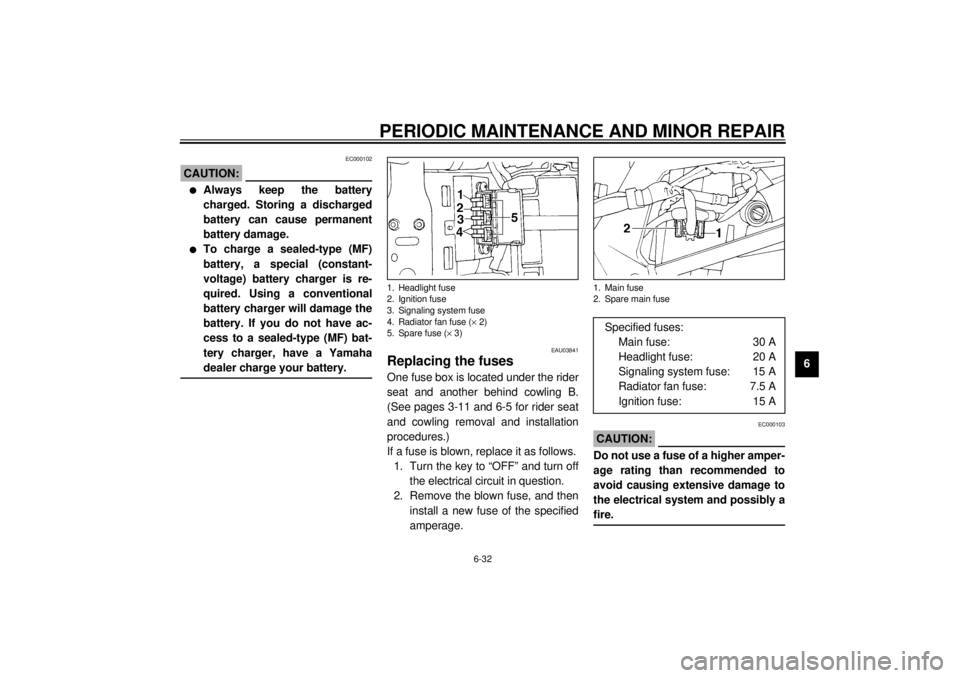
EAU03841
Replacing the fuses One fuse box is located under the rider
seat and another behind cowling B.
(See pages 3-11 and 6-5 for rider seat
and cowling removal and installation
procedures.)
If a fuse is blown, replace it as follows.
1. Turn the key to “OFF” and turn off
the electrical circuit in question.
2. Remove the blown fuse, and then
install a new fuse of the specified
amperage.
EC000103
CAUTION:_ Do not use a fuse of a higher amper-
age rating than recommended to
avoid causing extensive damage to
the electrical system and possibly a
fire. _
1. Headlight fuse
2. Ignition fuse
3. Signaling system fuse
4. Radiator fan fuse (´ 2)
5. Spare fuse (´ 3)
1. Main fuse
2. Spare main fuseSpecified fuses:
Main fuse: 30 A
Headlight fuse: 20 A
Signaling system fuse: 15 A
Radiator fan fuse: 7.5 A
Ignition fuse: 15 A
E_4sv.book Page 32 Friday, November 10, 2000 3:03 PM
Page 78 of 108
PERIODIC MAINTENANCE AND MINOR REPAIR
6-33
63. Turn the key to “ON” and turn on
the electrical circuit in question to
check if the device operates.
4. If the fuse immediately blows
again, have a Yamaha dealer
check the electrical system.
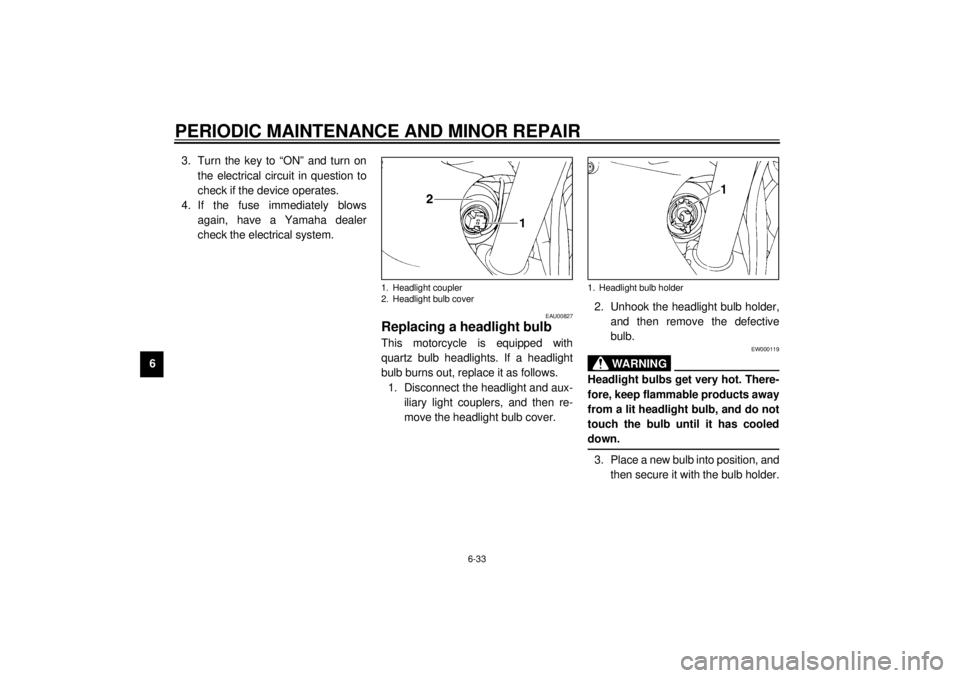
EAU00827
Replacing a headlight bulb This motorcycle is equipped with
quartz bulb headlights. If a headlight
bulb burns out, replace it as follows.
1. Disconnect the headlight and aux-
iliary light couplers, and then re-
move the headlight bulb cover.2. Unhook the headlight bulb holder,
and then remove the defective
bulb.
EW000119
WARNING
_ Headlight bulbs get very hot. There-
fore, keep flammable products away
from a lit headlight bulb, and do not
touch the bulb until it has cooled
down. _3. Place a new bulb into position, and
then secure it with the bulb holder.
1. Headlight coupler
2. Headlight bulb cover
1. Headlight bulb holder
E_4sv.book Page 33 Friday, November 10, 2000 3:03 PM
Page 79 of 108
PERIODIC MAINTENANCE AND MINOR REPAIR
6-34
6
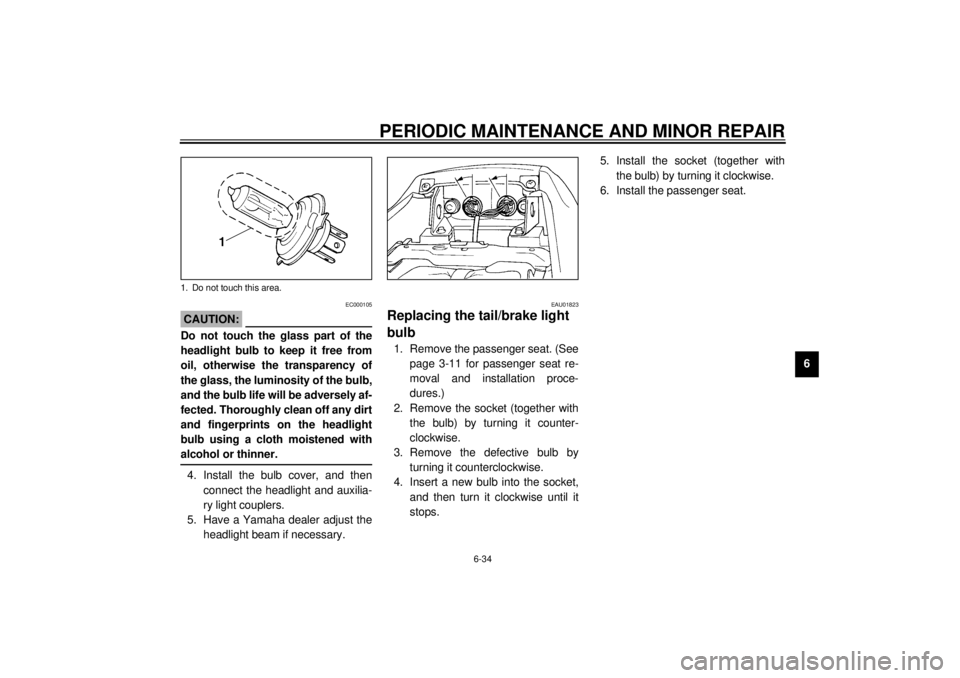
EC000105
CAUTION:_ Do not touch the glass part of the
headlight bulb to keep it free from
oil, otherwise the transparency of
the glass, the luminosity of the bulb,
and the bulb life will be adversely af-
fected. Thoroughly clean off any dirt
and fingerprints on the headlight
bulb using a cloth moistened with
alcohol or thinner. _4. Install the bulb cover, and then
connect the headlight and auxilia-
ry light couplers.
5. Have a Yamaha dealer adjust the
headlight beam if necessary.
EAU01823
Replacing the tail/brake light
bulb 1. Remove the passenger seat. (See
page 3-11 for passenger seat re-
moval and installation proce-
dures.)
2. Remove the socket (together with
the bulb) by turning it counter-
clockwise.
3. Remove the defective bulb by
turning it counterclockwise.
4. Insert a new bulb into the socket,
and then turn it clockwise until it
stops.5. Install the socket (together with
the bulb) by turning it clockwise.
6. Install the passenger seat.
1. Do not touch this area.
E_4sv.book Page 34 Friday, November 10, 2000 3:03 PM
Page 80 of 108
PERIODIC MAINTENANCE AND MINOR REPAIR
6-35
6
EAU03497
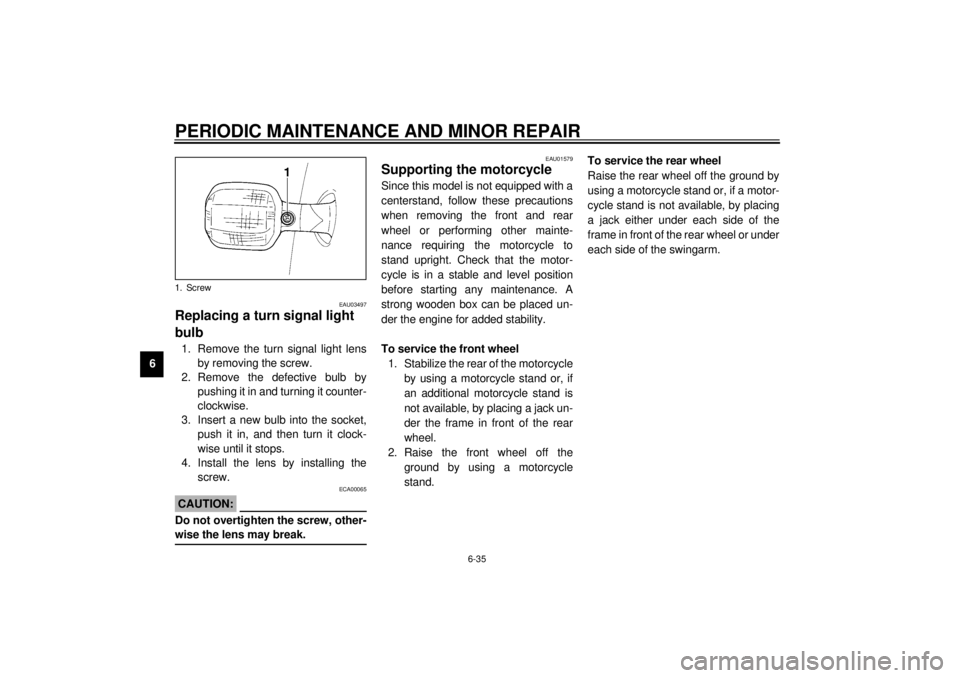
Replacing a turn signal light
bulb 1. Remove the turn signal light lens
by removing the screw.
2. Remove the defective bulb by
pushing it in and turning it counter-
clockwise.
3. Insert a new bulb into the socket,
push it in, and then turn it clock-
wise until it stops.
4. Install the lens by installing the
screw.
ECA00065
CAUTION:_ Do not overtighten the screw, other-
wise the lens may break. _
EAU01579
Supporting the motorcycle Since this model is not equipped with a
centerstand, follow these precautions
when removing the front and rear
wheel or performing other mainte-
nance requiring the motorcycle to
stand upright. Check that the motor-
cycle is in a stable and level position
before starting any maintenance. A
strong wooden box can be placed un-
der the engine for added stability.
To service the front wheel
1. Stabilize the rear of the motorcycle
by using a motorcycle stand or, if
an additional motorcycle stand is
not available, by placing a jack un-
der the frame in front of the rear
wheel.
2. Raise the front wheel off the
ground by using a motorcycle
stand.To service the rear wheel
Raise the rear wheel off the ground by
using a motorcycle stand or, if a motor-
cycle stand is not available, by placing
a jack either under each side of the
frame in front of the rear wheel or under
each side of the swingarm.
1. ScrewE_4sv.book Page 35 Friday, November 10, 2000 3:03 PM
Page 91 of 108
MOTORCYCLE CARE AND STORAGE
7-2
7
l
Do not use any harsh chemical
products on plastic parts. Be
sure to avoid using cloths or
sponges which have been in
contact with strong or abrasive
cleaning products, solvent or
thinner, fuel (gasoline), rust re-
movers or inhibitors, brake flu-
id, antifreeze or electrolyte.
l
Do not use high-pressure wash-
ers or steam-jet cleaners since
they cause water seepage and
deterioration in the following ar-
eas: seals (of wheel and swing-
arm bearings, fork and brakes),
electric components (couplers,
connectors, instruments, switch-
es and lights), breather hoses
and vents.
l
For motorcycles equipped with
a windshield: Do not use strong
cleaners or hard sponges as
they will cause dulling or
scratching. Some cleaning
compounds for plastic may
leave scratches on the wind-
shield. Test the product on a
small hidden part of the wind-
shield to make sure that it does
not leave any marks. If the wind-
shield is scratched, use a quali-
ty plastic polishing compound
after washing.
_After normal useRemove dirt with warm water, a mild
detergent, and a soft, clean sponge,
and then rinse thoroughly with clean
water. Use a toothbrush or bottlebrush
for hard-to-reach areas. Stubborn dirt
and insects will come off more easily if
the area is covered with a wet cloth for
a few minutes before cleaning.After riding in the rain, near the sea or
on salt-sprayed roadsSince sea salt or salt sprayed on roads
during winter are extremely corrosive in
combination with water, carry out the
following steps after each ride in the
rain, near the sea or on salt-sprayed
roads.NOTE:_ Salt sprayed on roads in the winter may
remain well into spring. _1. Clean the motorcycle with cold
water and a mild detergent, after
the engine has cooled down.
ECA00012
CAUTION:_ Do not use warm water since it in-
creases the corrosive action of the
salt. _2. Apply a corrosion protection spray
on all metal, including chrome-
and nickel-plated, surfaces to pre-
vent corrosion.
E_4sv.book Page 2 Friday, November 10, 2000 3:03 PM
Page 99 of 108

SPECIFICATIONS
8-4
8
Electrical systems
Ignition system T.C.I. (digital)
Charging system
Type A.C. generator
Standard output 12 V, 28 A @ 5,000 r/min
Battery
Model YTX14-BS
Voltage, capacity 12 V, 12 Ah
Headlight typeQuar tz bulb (halogen)
Bulb voltage, wattage ´ quantity
Headlight 12 V, 60/55 W ´ 1 (except for GB)
12 V, 35/35 W ´ 2 (for GB)
Auxiliary light 12 V, 5 W ´ 1
Tail/brake light 12 V, 5/21 W ´ 2
Turn signal light 12 V, 21 W ´ 4
Meter lighting 12 V, 1.7 W ´ 4
Neutral indicator light 12 V, 3.4 W ´ 1
High beam indicator light 12 V, 3.4 W ´ 1
Oil level warning light 12 V, 3.4 W ´ 1
Turn signal indicator light 12 V, 3.4 W ´ 1
Fuel level warning light 12 V, 3.4 W ´ 1Fuses
Main fuse 30 A
Ignition fuse 15 A
Signaling system fuse 15 A
Headlight fuse 20 A
Radiator fan fuse 7.5 A
E_4sv.book Page 4 Friday, November 10, 2000 3:03 PM
Page 104 of 108
INDEXAAir filter element, cleaning ...................... 6-13
Anti-theft alarm ........................................3-5BBattery ................................................... 6-31
Brake and clutch levers, checking and
lubricating ............................................ 6-27
Brake and shift pedals, checking and
lubricating ............................................ 6-27
Brake fluid, changing ............................. 6-24
Brake fluid level, checking...................... 6-22
Brake lever...............................................3-8
Brake light switch (rear), adjusting ......... 6-21
Brake pads, checking............................. 6-21
Brake pedal..............................................3-8CCables, checking and lubricating............ 6-27
Carburetors, adjusting............................ 6-16
Care.........................................................7-1
Clutch lever ..............................................3-7
Conversion table ......................................8-5
Coolant level, checking .......................... 6-12
Coolant temperature gauge .....................3-5
Cowlings, removing and installing ............6-5DDimmer switch .........................................3-5
Drive chain, lubricating ........................... 6-26
Drive chain slack .................................... 6-25
Adjusting .......................................... 6-25
Checking .......................................... 6-25
EEngine break-in ....................................... 5-4
Engine oil and oil filter cartridge ............... 6-9
Engine stop switch................................... 3-6
EXUP system ........................................ 3-17FFront fork, adjusting ............................... 3-13
Front fork, checking ............................... 6-29
Fuel ......................................................... 3-9
Fuel consumption, tips for reducing ......... 5-4
Fuel level warning light ............................ 3-3
Fuel tank breather hose ......................... 3-10
Fuel tank cap ........................................... 3-9
Fuses, replacing .................................... 6-32HHandlebar switches ................................. 3-5
Headlight bulb, replacing ....................... 6-33
Helmet holder ........................................ 3-12
High beam indicator light ......................... 3-3
Horn switch ............................................. 3-6IIdentification numbers ............................. 9-1
Idling speed, adjusting ........................... 6-16
Ignition circuit cut-off system.................. 3-18
Indicator and warning lights ..................... 3-2KKey identification number ........................ 9-1LLight switch.............................................. 3-6
Luggage strap holders ........................... 3-17
MMain switch/steering lock .........................3-1
Model label ..............................................9-2NNeutral indicator light ...............................3-2OOil level warning light ...............................3-2PParking.....................................................5-5
Part locations ...........................................2-1
Pass switch ..............................................3-5
Periodic maintenance and lubrication
chart ......................................................6-2
Pre-operation check list ............................4-1SSafety information ....................................1-1
Seats .....................................................3-11
Passenger seat.................................3-11
Rider seat .........................................3-11
Self-diagnosis device ...............................3-4
Shifting .....................................................5-3
Shift pedal ................................................3-7
Shift points (for Switzerland only) .............5-4
Shock absorber assembly, adjusting ......3-15
Sidestand ...............................................3-18
Sidestand, checking and lubricating .......6-28
Spark plugs, checking ..............................6-7
Specifications ...........................................8-1
Speedometer unit.....................................3-3
Starter (choke) lever ................................ 3-10
Starting a warm engine ............................5-3
E_4sv.book Page 1 Friday, November 10, 2000 3:03 PM
Page 105 of 108
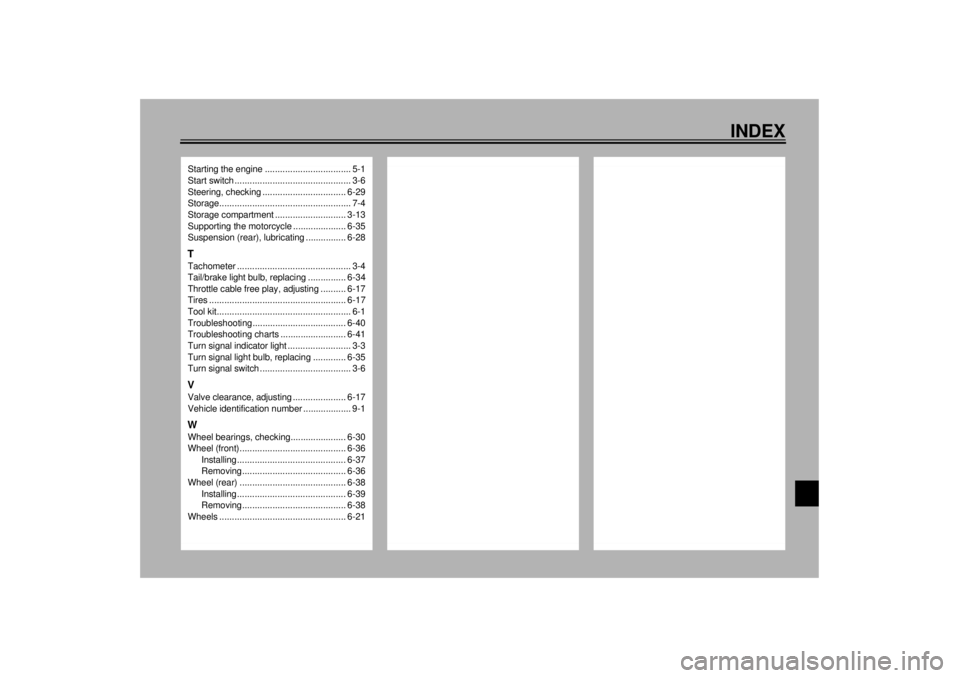
INDEX
Starting the engine .................................. 5-1
Start switch .............................................. 3-6
Steering, checking ................................. 6-29
Storage.................................................... 7-4
Storage compartment ............................ 3-13
Supporting the motorcycle ..................... 6-35
Suspension (rear), lubricating ................ 6-28TTachometer ............................................. 3-4
Tail/brake light bulb, replacing ............... 6-34
Throttle cable free play, adjusting .......... 6-17
Tires ...................................................... 6-17
Tool kit..................................................... 6-1
Troubleshooting..................................... 6-40
Troubleshooting charts .......................... 6-41
Turn signal indicator light ......................... 3-3
Turn signal light bulb, replacing ............. 6-35
Turn signal switch .................................... 3-6VValve clearance, adjusting ..................... 6-17
Vehicle identification number ................... 9-1WWheel bearings, checking...................... 6-30
Wheel (front).......................................... 6-36
Installing........................................... 6-37
Removing......................................... 6-36
Wheel (rear) .......................................... 6-38
Installing........................................... 6-39
Removing......................................... 6-38
Wheels .................................................. 6-21
E_4sv.book Page 2 Friday, November 10, 2000 3:03 PM