lock YAMAHA YZF600 2001 User Guide
[x] Cancel search | Manufacturer: YAMAHA, Model Year: 2001, Model line: YZF600, Model: YAMAHA YZF600 2001Pages: 114, PDF Size: 12.39 MB
Page 77 of 114
PERIODIC MAINTENANCE AND MINOR REPAIR
6-28
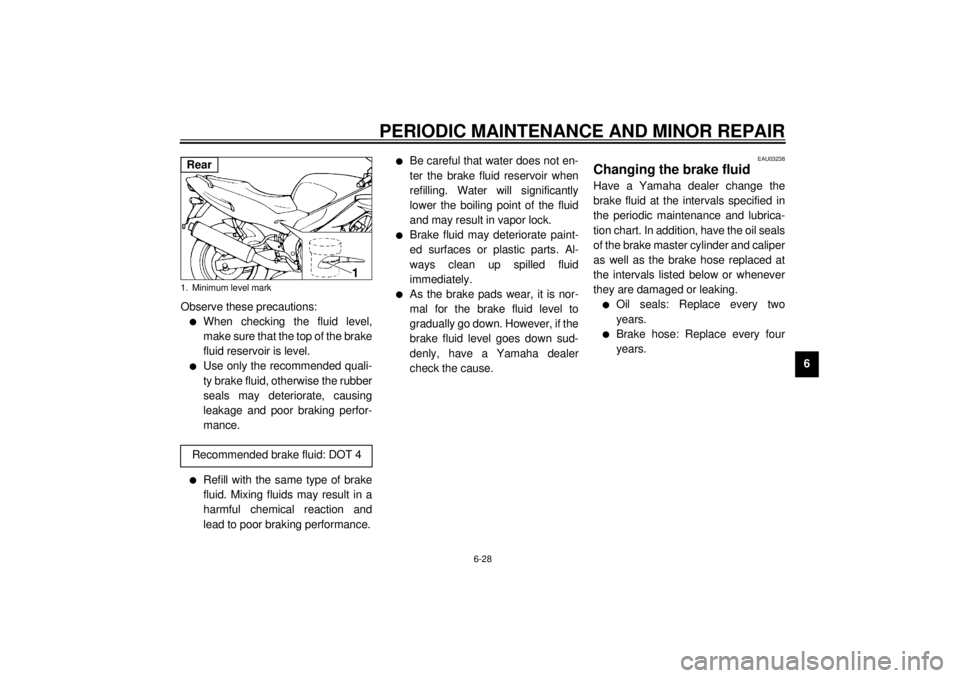
6 Observe these precautions:
l
When checking the fluid level,
make sure that the top of the brake
fluid reservoir is level.
l
Use only the recommended quali-
ty brake fluid, otherwise the rubber
seals may deteriorate, causing
leakage and poor braking perfor-
mance.
l
Refill with the same type of brake
fluid. Mixing fluids may result in a
harmful chemical reaction and
lead to poor braking performance.
l
Be careful that water does not en-
ter the brake fluid reservoir when
refilling. Water will significantly
lower the boiling point of the fluid
and may result in vapor lock.
l
Brake fluid may deteriorate paint-
ed surfaces or plastic parts. Al-
ways clean up spilled fluid
immediately.
l
As the brake pads wear, it is nor-
mal for the brake fluid level to
gradually go down. However, if the
brake fluid level goes down sud-
denly, have a Yamaha dealer
check the cause.
EAU03238
Changing the brake fluid Have a Yamaha dealer change the
brake fluid at the intervals specified in
the periodic maintenance and lubrica-
tion chart. In addition, have the oil seals
of the brake master cylinder and caliper
as well as the brake hose replaced at
the intervals listed below or whenever
they are damaged or leaking.l
Oil seals: Replace every two
years.
l
Brake hose: Replace every four
years.
1. Minimum level mark
Recommended brake fluid: DOT 4Rear
E_4tv.book Page 28 Wednesday, October 4, 2000 2:15 PM
Page 78 of 114
PERIODIC MAINTENANCE AND MINOR REPAIR
6-29
6
EAU00744
Drive chain slack The drive chain slack should be
checked before each ride and adjusted
if necessary.
To check the drive chain slack
1. Place the motorcycle on a level
surface and hold it in an upright
position.NOTE:_ When checking and adjusting the drive
chain slack, the motorcycle should be
positioned straight up and there should
be no weight on it. _
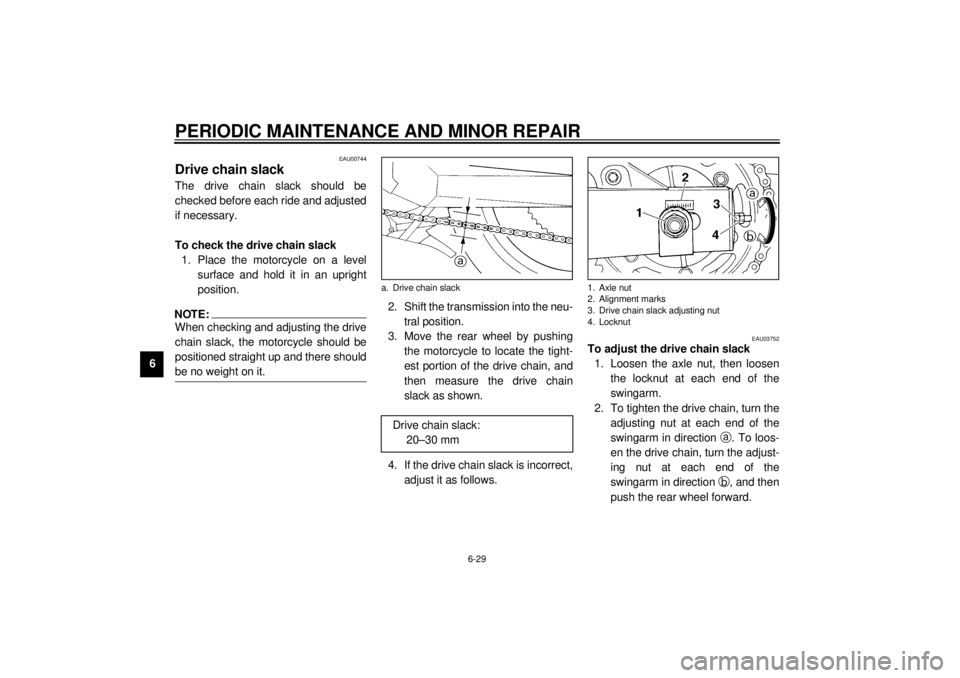
2. Shift the transmission into the neu-
tral position.
3. Move the rear wheel by pushing
the motorcycle to locate the tight-
est portion of the drive chain, and
then measure the drive chain
slack as shown.
4. If the drive chain slack is incorrect,
adjust it as follows.
EAU03752
To adjust the drive chain slack
1. Loosen the axle nut, then loosen
the locknut at each end of the
swingarm.
2. To tighten the drive chain, turn the
adjusting nut at each end of the
swingarm in direction
a. To loos-
en the drive chain, turn the adjust-
ing nut at each end of the
swingarm in direction
b, and then
push the rear wheel forward.
a. Drive chain slack
Drive chain slack:
20–30 mm
1. Axle nut
2. Alignment marks
3. Drive chain slack adjusting nut
4. Locknut
E_4tv.book Page 29 Wednesday, October 4, 2000 2:15 PM
Page 79 of 114
PERIODIC MAINTENANCE AND MINOR REPAIR
6-30
6
NOTE:_ Using the alignment marks on each
side of the swingarm, make sure that
both adjusting nuts are in the same po-
sition for proper wheel alignment. _
EC000096
CAUTION:_ Improper drive chain slack will over-
load the engine as well as other vital
parts of the motorcycle and can lead
to chain slippage or breakage. To
prevent this from occurring, keep
the drive chain slack within the
specified limits. _3. Tighten the locknuts, and then
tighten the axle nut to the specified
torque.
EAU03006
Lubricating the drive chain The drive chain must be cleaned and
lubricated at the intervals specified in
the periodic maintenance and lubrica-
tion chart, otherwise it will quickly wear
out, especially when riding in dusty or
wet areas. Service the drive chain as
follows.
EC000097
CAUTION:_ The drive chain must be lubricated
after washing the motorcycle or
riding in the rain. _1. Clean the drive chain with kero-
sene and a small soft brush.
ECA00053
CAUTION:_ To prevent damaging the O-rings,
do not clean the drive chain with
steam cleaners, high-pressure
washers or inappropriate solvents. _2. Wipe the drive chain dry.
3. Thoroughly lubricate the drive
chain with a special O-ring chain
lubricant.
ECA00052
CAUTION:_ Do not use engine oil or any other
lubricants for the drive chain, as
they may contain substances that
could damage the O-rings. _
Tightening torque:
Axle nut:
117 Nm (11.7 m·kg)
E_4tv.book Page 30 Wednesday, October 4, 2000 2:15 PM
Page 87 of 114
PERIODIC MAINTENANCE AND MINOR REPAIR
6-38
6
EW000119
WARNING
_ Headlight bulbs get very hot. There-
fore, keep flammable products away
from a lit headlight bulb, and do not
touch the bulb until it has cooled
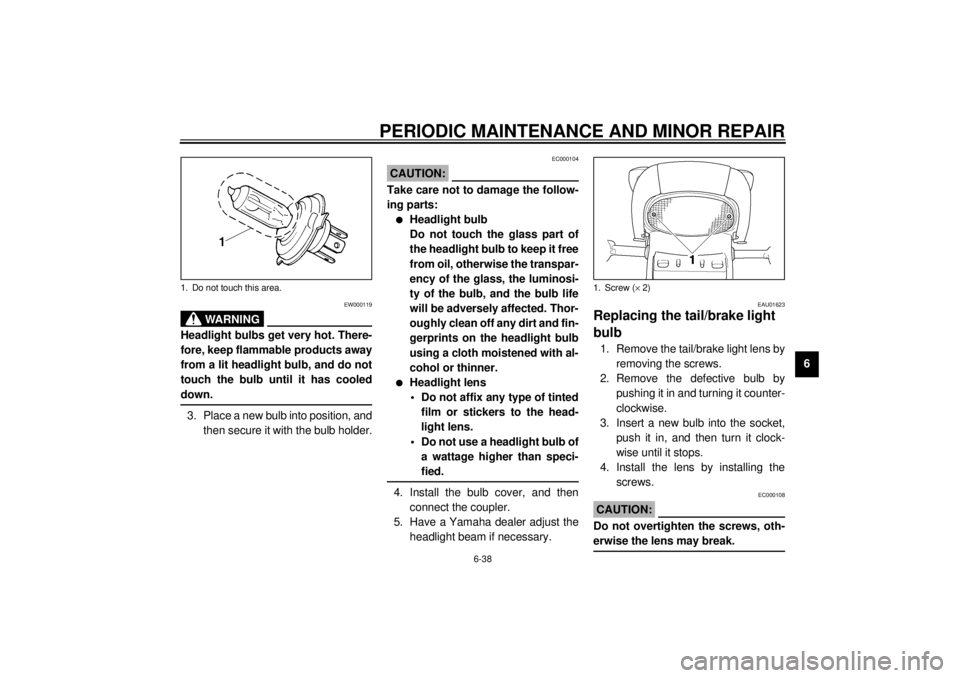
down. _3. Place a new bulb into position, and
then secure it with the bulb holder.
EC000104
CAUTION:_ Take care not to damage the follow-
ing parts:l
Headlight bulb
Do not touch the glass part of
the headlight bulb to keep it free
from oil, otherwise the transpar-
ency of the glass, the luminosi-
ty of the bulb, and the bulb life
will be adversely affected. Thor-
oughly clean off any dirt and fin-
gerprints on the headlight bulb
using a cloth moistened with al-
cohol or thinner.
l
Headlight lens
• Do not affix any type of tinted
film or stickers to the head-
light lens.
• Do not use a headlight bulb of
a wattage higher than speci-
fied.
_4. Install the bulb cover, and then
connect the coupler.
5. Have a Yamaha dealer adjust the
headlight beam if necessary.
EAU01623
Replacing the tail/brake light
bulb 1. Remove the tail/brake light lens by
removing the screws.
2. Remove the defective bulb by
pushing it in and turning it counter-
clockwise.
3. Insert a new bulb into the socket,
push it in, and then turn it clock-
wise until it stops.
4. Install the lens by installing the
screws.
EC000108
CAUTION:_ Do not overtighten the screws, oth-
erwise the lens may break. _
1. Do not touch this area.
1. Screw (´ 2)
E_4tv.book Page 38 Wednesday, October 4, 2000 2:15 PM
Page 88 of 114
PERIODIC MAINTENANCE AND MINOR REPAIR
6-39
6
EAU03497
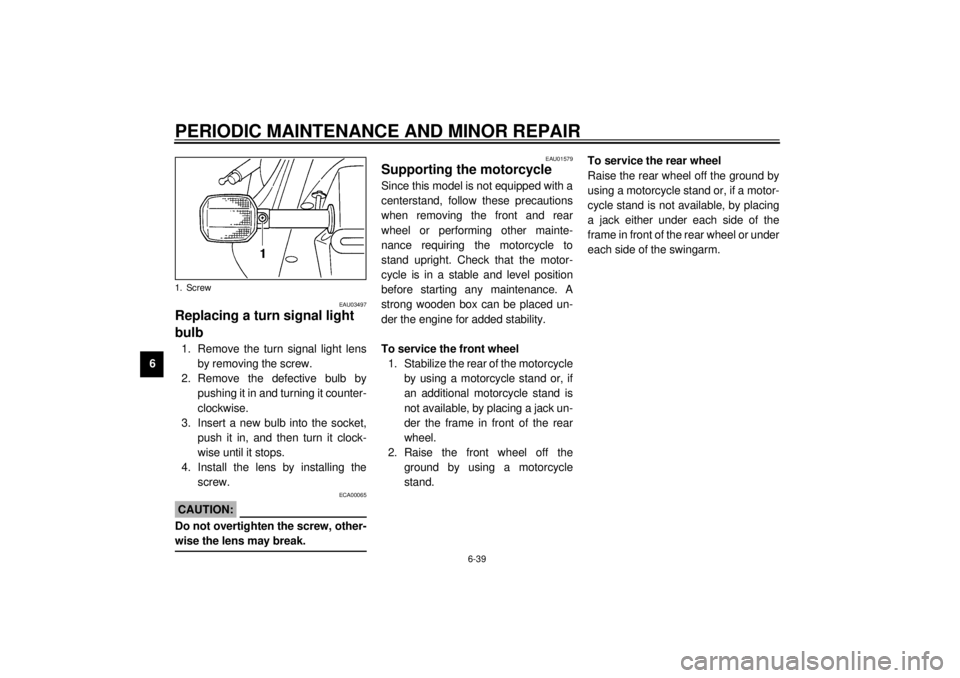
Replacing a turn signal light
bulb 1. Remove the turn signal light lens
by removing the screw.
2. Remove the defective bulb by
pushing it in and turning it counter-
clockwise.
3. Insert a new bulb into the socket,
push it in, and then turn it clock-
wise until it stops.
4. Install the lens by installing the
screw.
ECA00065
CAUTION:_ Do not overtighten the screw, other-
wise the lens may break. _
EAU01579
Supporting the motorcycle Since this model is not equipped with a
centerstand, follow these precautions
when removing the front and rear
wheel or performing other mainte-
nance requiring the motorcycle to
stand upright. Check that the motor-
cycle is in a stable and level position
before starting any maintenance. A
strong wooden box can be placed un-
der the engine for added stability.
To service the front wheel
1. Stabilize the rear of the motorcycle
by using a motorcycle stand or, if
an additional motorcycle stand is
not available, by placing a jack un-
der the frame in front of the rear
wheel.
2. Raise the front wheel off the
ground by using a motorcycle
stand.To service the rear wheel
Raise the rear wheel off the ground by
using a motorcycle stand or, if a motor-
cycle stand is not available, by placing
a jack either under each side of the
frame in front of the rear wheel or under
each side of the swingarm.
1. ScrewE_4tv.book Page 39 Wednesday, October 4, 2000 2:15 PM
Page 90 of 114
PERIODIC MAINTENANCE AND MINOR REPAIR
6-41
6
EAU03583
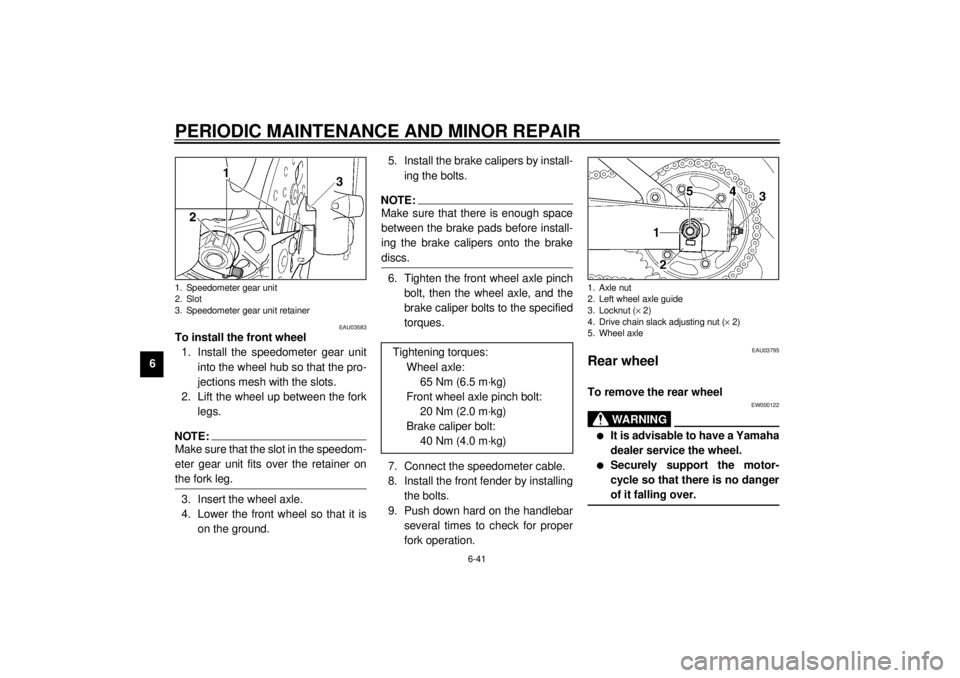
To install the front wheel
1. Install the speedometer gear unit
into the wheel hub so that the pro-
jections mesh with the slots.
2. Lift the wheel up between the fork
legs.NOTE:_ Make sure that the slot in the speedom-
eter gear unit fits over the retainer on
the fork leg. _3. Insert the wheel axle.
4. Lower the front wheel so that it is
on the ground.5. Install the brake calipers by install-
ing the bolts.
NOTE:_ Make sure that there is enough space
between the brake pads before install-
ing the brake calipers onto the brake
discs. _6. Tighten the front wheel axle pinch
bolt, then the wheel axle, and the
brake caliper bolts to the specified
torques.
7. Connect the speedometer cable.
8. Install the front fender by installing
the bolts.
9. Push down hard on the handlebar
several times to check for proper
fork operation.
EAU03795
Rear wheel To remove the rear wheel
EW000122
WARNING
_ l
It is advisable to have a Yamaha
dealer service the wheel.
l
Securely support the motor-
cycle so that there is no danger
of it falling over.
_
1. Speedometer gear unit
2. Slot
3. Speedometer gear unit retainer
Tightening torques:
Wheel axle:
65 Nm (6.5 m·kg)
Front wheel axle pinch bolt:
20 Nm (2.0 m·kg)
Brake caliper bolt:
40 Nm (4.0 m·kg)
1. Axle nut
2. Left wheel axle guide
3. Locknut (´ 2)
4. Drive chain slack adjusting nut (´ 2)
5. Wheel axle
E_4tv.book Page 41 Wednesday, October 4, 2000 2:15 PM
Page 91 of 114
PERIODIC MAINTENANCE AND MINOR REPAIR
6-42
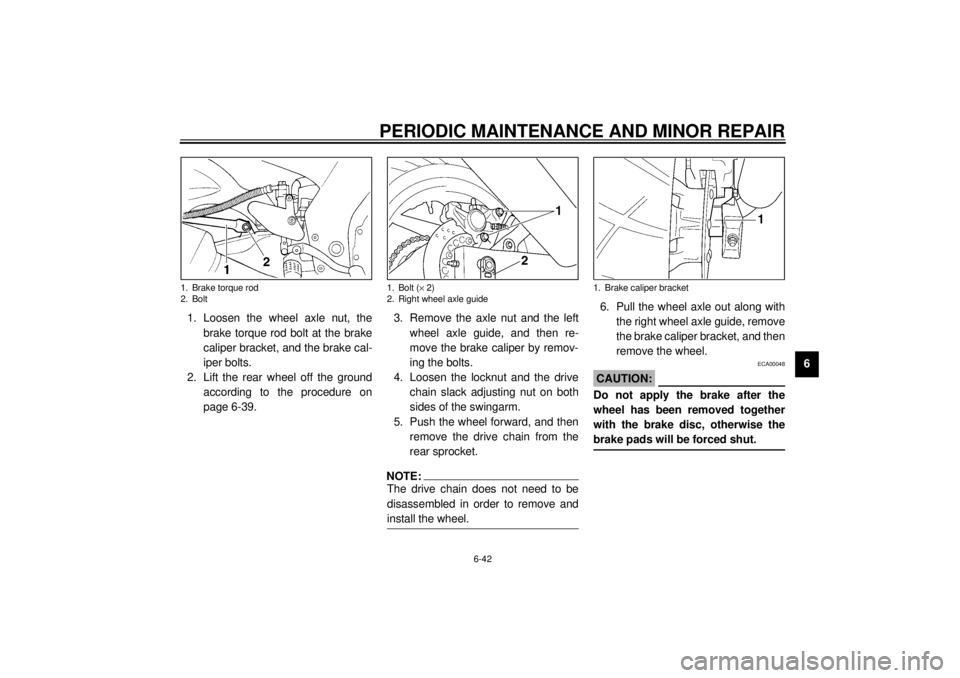
6 1. Loosen the wheel axle nut, the
brake torque rod bolt at the brake
caliper bracket, and the brake cal-
iper bolts.
2. Lift the rear wheel off the ground
according to the procedure on
page 6-39.3. Remove the axle nut and the left
wheel axle guide, and then re-
move the brake caliper by remov-
ing the bolts.
4. Loosen the locknut and the drive
chain slack adjusting nut on both
sides of the swingarm.
5. Push the wheel forward, and then
remove the drive chain from the
rear sprocket.
NOTE:_ The drive chain does not need to be
disassembled in order to remove and
install the wheel. _
6. Pull the wheel axle out along with
the right wheel axle guide, remove
the brake caliper bracket, and then
remove the wheel.
ECA00048
CAUTION:_ Do not apply the brake after the
wheel has been removed together
with the brake disc, otherwise the
brake pads will be forced shut. _
1. Brake torque rod
2. Bolt
1. Bolt (´ 2)
2. Right wheel axle guide
1. Brake caliper bracket
E_4tv.book Page 42 Wednesday, October 4, 2000 2:15 PM
Page 94 of 114
PERIODIC MAINTENANCE AND MINOR REPAIR
6-45
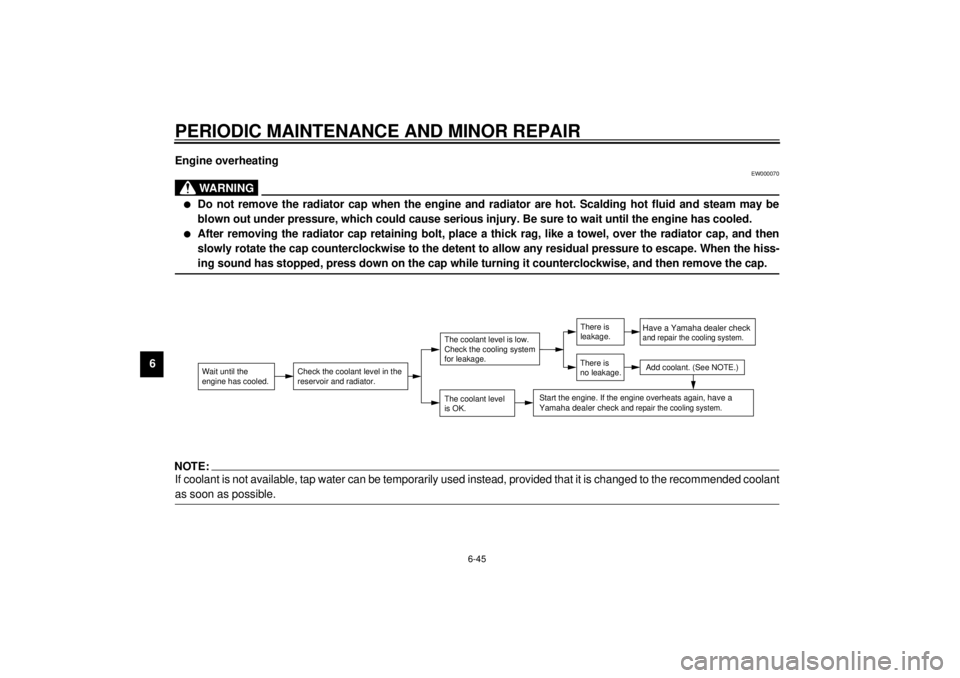
6Engine overheating
EW000070
WARNING
_ l
Do not remove the radiator cap when the engine and radiator are hot. Scalding hot fluid and steam may be
blown out under pressure, which could cause serious injury. Be sure to wait until the engine has cooled.
l
After removing the radiator cap retaining bolt, place a thick rag, like a towel, over the radiator cap, and then
slowly rotate the cap counterclockwise to the detent to allow any residual pressure to escape. When the hiss-
ing sound has stopped, press down on the cap while turning it counterclockwise, and then remove the cap.
_NOTE:_ If coolant is not available, tap water can be temporarily used instead, provided that it is changed to the recommended coolant
as soon as possible. _
Wait until the
engine has cooled.
Check the coolant level in the
reservoir and radiator.
The coolant level
is OK.The coolant level is low.
Check the cooling system
for leakage.
Have a Yamaha dealer checkand repair the cooling system.Add coolant. (See NOTE.)
Start the engine. If the engine overheats again,
have a
Yamaha dealer check
and repair the cooling system.
There is
leakage.
There is
no leakage.
E_4tv.book Page 45 Wednesday, October 4, 2000 2:15 PM
Page 110 of 114
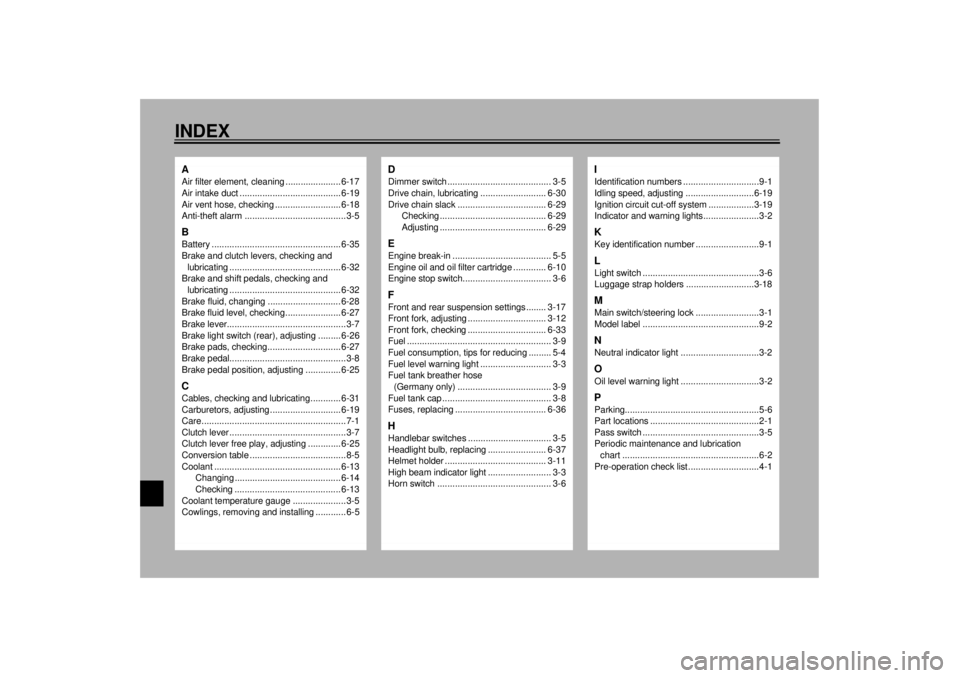
INDEXAAir filter element, cleaning ...................... 6-17
Air intake duct ........................................ 6-19
Air vent hose, checking .......................... 6-18
Anti-theft alarm ........................................3-5BBattery ................................................... 6-35
Brake and clutch levers, checking and
lubricating ............................................ 6-32
Brake and shift pedals, checking and
lubricating ............................................ 6-32
Brake fluid, changing ............................. 6-28
Brake fluid level, checking...................... 6-27
Brake lever...............................................3-7
Brake light switch (rear), adjusting ......... 6-26
Brake pads, checking............................. 6-27
Brake pedal..............................................3-8
Brake pedal position, adjusting .............. 6-25CCables, checking and lubricating............ 6-31
Carburetors, adjusting............................ 6-19
Care.........................................................7-1
Clutch lever ..............................................3-7
Clutch lever free play, adjusting ............. 6-25
Conversion table ......................................8-5
Coolant .................................................. 6-13
Changing .......................................... 6-14
Checking .......................................... 6-13
Coolant temperature gauge .....................3-5
Cowlings, removing and installing ............6-5
DDimmer switch ......................................... 3-5
Drive chain, lubricating .......................... 6-30
Drive chain slack ................................... 6-29
Checking .......................................... 6-29
Adjusting .......................................... 6-29EEngine break-in ....................................... 5-5
Engine oil and oil filter cartridge ............. 6-10
Engine stop switch................................... 3-6FFront and rear suspension settings ........ 3-17
Front fork, adjusting ............................... 3-12
Front fork, checking ............................... 6-33
Fuel ......................................................... 3-9
Fuel consumption, tips for reducing ......... 5-4
Fuel level warning light ............................ 3-3
Fuel tank breather hose
(Germany only) ..................................... 3-9
Fuel tank cap ........................................... 3-8
Fuses, replacing .................................... 6-36HHandlebar switches ................................. 3-5
Headlight bulb, replacing ....................... 6-37
Helmet holder ........................................ 3-11
High beam indicator light ......................... 3-3
Horn switch ............................................. 3-6
IIdentification numbers ..............................9-1
Idling speed, adjusting ...........................6-19
Ignition circuit cut-off system ..................3-19
Indicator and warning lights......................3-2KKey identification number .........................9-1LLight switch ..............................................3-6
Luggage strap holders ...........................3-18MMain switch/steering lock .........................3-1
Model label ..............................................9-2NNeutral indicator light ...............................3-2OOil level warning light ...............................3-2PParking.....................................................5-6
Part locations ...........................................2-1
Pass switch ..............................................3-5
Periodic maintenance and lubrication
chart ......................................................6-2
Pre-operation check list ............................4-1
E_4tv.book Page 1 Wednesday, October 4, 2000 2:15 PM