brake light Abarth 124 Spider 2018 Owner handbook (in English)
[x] Cancel search | Manufacturer: ABARTH, Model Year: 2018, Model line: 124 Spider, Model: Abarth 124 Spider 2018Pages: 220, PDF Size: 2.91 MB
Page 162 of 220
PERIODIC CHECKS
Every1,000 kmor before long trips
check and, if necessary, top up:
engine coolant level;
brake fluid level;
windscreen washer fluid level;
tire inflation pressure and condition;
operation of lighting system
(headlights, direction indicators, hazard
warning lights, etc.);
operation of windscreen
washer/wiper system and
positioning/wear of windscreen window
wiper blades.
Every 3,000 km, check and top up if
required: engine oil level.
HEAVY-DUTY USE OF THE
VEHICLE
If the vehicle is used under one of the
following conditions:
dusty roads;
short, repeated journeys (less than
7-8 km) at sub-zero outside
temperatures;
engine often idling or driving long
distances at low speeds or long periods
of inactivity;
the following checks must be carried
out more often than indicated in the
Scheduled Servicing Plan:
check front disc brake pad condition
and wear;
check cleanliness of bonnet and
luggage compartment locks,
cleanliness and lubrication of linkage;
visually inspect conditions of: engine,
gearbox, transmission, pipes and hoses
(exhaust/fuel system/brakes) and
rubber elements (gaiters/sleeves/
bushes, etc.);
check battery charge and battery
fluid level (electrolyte);
visually inspect conditions of the
accessory drive belts;
check and, if necessary, change
engine oil and replace oil filter;
check and, if necessary, replace
pollen filter;
check and, if necessary, replace air
cleaner.
160
MAINTENANCE AND CARE
Page 163 of 220
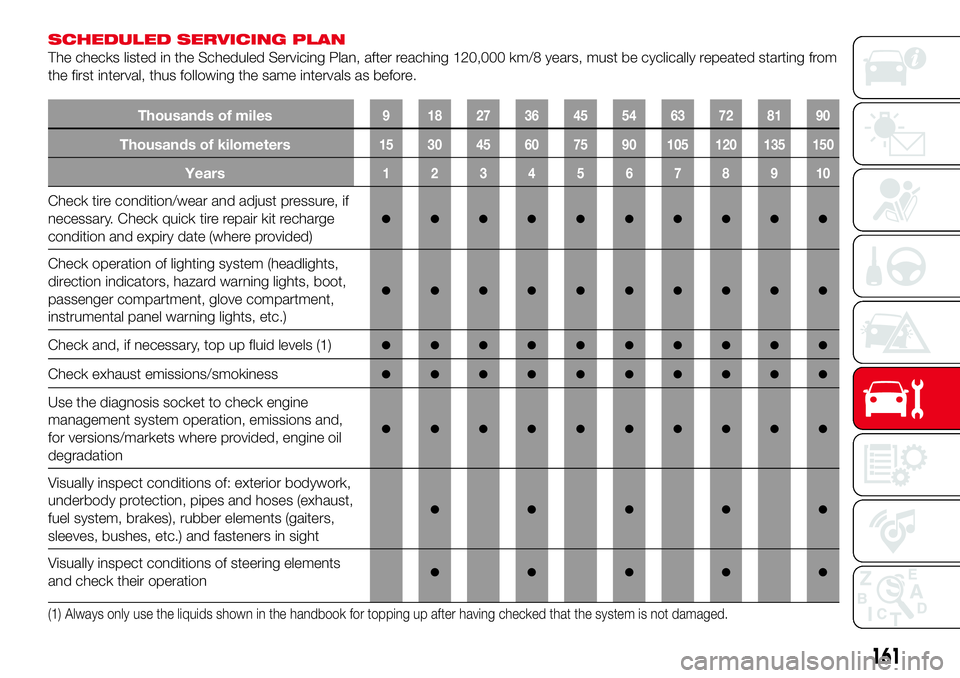
SCHEDULED SERVICING PLAN
The checks listed in the Scheduled Servicing Plan, after reaching 120,000 km/8 years, must be cyclically repeated starting from
the first interval, thus following the same intervals as before.
Thousands of miles9 182736455463728190
Thousands of kilometers15 30 45 60 75 90 105 120 135 150
Years12345678910
Check tire condition/wear and adjust pressure, if
necessary. Check quick tire repair kit recharge
condition and expiry date (where provided)
●●●●●●●●●●
Check operation of lighting system (headlights,
direction indicators, hazard warning lights, boot,
passenger compartment, glove compartment,
instrumental panel warning lights, etc.)
●●●●●●●●●●
Check and, if necessary, top up fluid levels (1)●●●●●●●●●●
Check exhaust emissions/smokiness●●●●●●●●●●
Use the diagnosis socket to check engine
management system operation, emissions and,
for versions/markets where provided, engine oil
degradation
●●●●●●●●●●
Visually inspect conditions of: exterior bodywork,
underbody protection, pipes and hoses (exhaust,
fuel system, brakes), rubber elements (gaiters,
sleeves, bushes, etc.) and fasteners in sight
●●●●●
Visually inspect conditions of steering elements
and check their operation●●●●●
(1) Always only use the liquids shown in the handbook for topping up after having checked that the system is not damaged.
161
Page 167 of 220
ENGINE COMPARTMENT
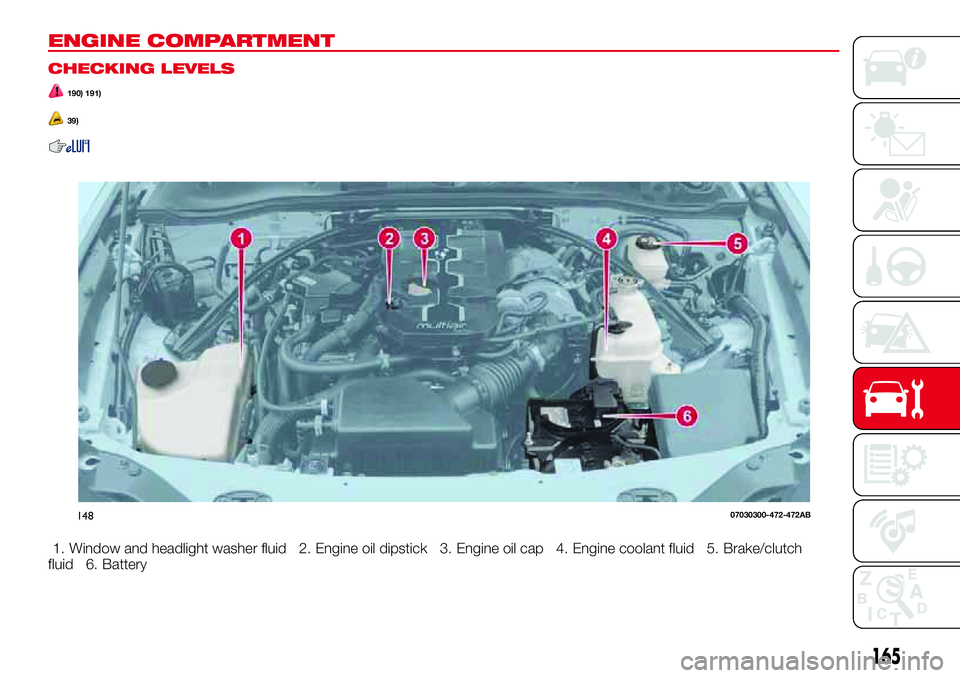
CHECKING LEVELS
190) 191)
39)
1. Window and headlight washer fluid 2. Engine oil dipstick 3. Engine oil cap 4. Engine coolant fluid 5. Brake/clutch
fluid 6. Battery
14807030300-472-472AB
165
Page 169 of 220

BRAKE / CLUTCH FLUID
198) 203)
46)
It should be kept between the MAX and
MIN lines fig. 151.
The level normally drops with
accumulated distance, a condition
associated with wear of brake and
clutch linings. If it is excessively low,
have the brake/clutch system contact
an Abarth Dealership.
NOTE On right-hand drive versions the
reservoir is located on the left side of
the engine compartment.
WINDOW AND
HEADLIGHT WASHER
FLUID
196) 197) 204)
Inspect fluid level in the washer fluid
reservoir fig. 152; open the cap and
add fluid if necessary.
AUTOMATIC
TRANSMISSION
CONTROL UNIT
5)
The transmission control oil level should
only be checked at Abarth Dealership.
BATTERY MAINTENANCE
199) 200) 201) 202)
47)
6)
To get the best service from a battery:
keep it securely mounted;
keep the top clean and dry;
keep terminals and connections
clean, tight, and coated with petroleum
jelly or terminal grease;
rinse off spilled electrolyte
immediately with a solution of water
and baking soda;
if the vehicle will not be used for an
extended time, disconnect the battery
leads and charge the battery every six
weeks.
NOTE
Every time the battery is reconnected
after being disconnected, it is
necessary to perform the following
procedure:
warm up the engine;
with the vehicle stationary, the engine
running and the transmission in the
neutral or N/P (for automatic
transmission) position, press the
accelerator down fully to bring the
engine speed to over 6000 rpm;
release the accelerator pedal and
wait for the engine to return naturally to
idling speed.
If this procedure is not performed, the
warning light could turn on: in this
case, contact Abarth Dealership.
IMPORTANT If, after the first press of
the accelerator pedal to bring the
engine to over 6000 rpm, another
follows immediately after without the
15107030601-121-002AB
15207030901-121-001AB
167
Page 170 of 220
engine naturally reaching idling speed,
the learning procedure is invalidated
and the
warning light on the
instrument panel will turn on. If the
engine is not brought to over 6000 rpm,
or it is not warmed up, the control unit
will keep open the possibility to repeat
the described procedure.
Inspecting electrolyte level
A low level of electrolyte fluid will cause
the battery to discharge quickly.
Inspect the electrolyte level at least
once a week. If it is low, remove the
caps and add enough distilled water to
bring the level between the upper and
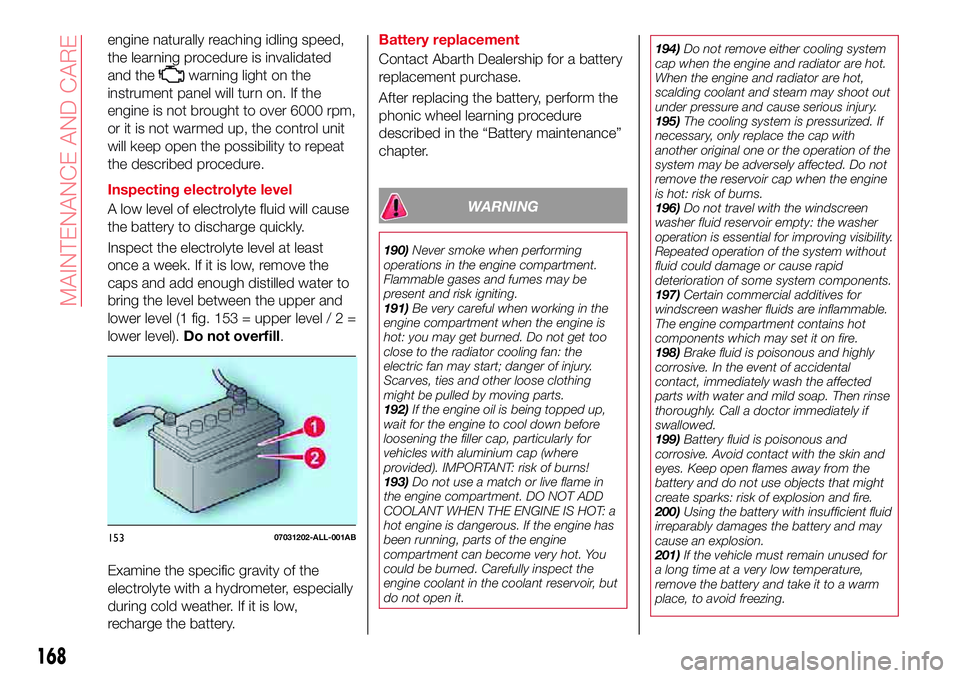
lower level (1 fig. 153 = upper level/2=
lower level).Do not overfill.
Examine the specific gravity of the
electrolyte with a hydrometer, especially
during cold weather. If it is low,
recharge the battery.Battery replacement
Contact Abarth Dealership for a battery
replacement purchase.
After replacing the battery, perform the
phonic wheel learning procedure
described in the “Battery maintenance”
chapter.
WARNING
190)Never smoke when performing
operations in the engine compartment.
Flammable gases and fumes may be
present and risk igniting.
191)Be very careful when working in the
engine compartment when the engine is
hot: you may get burned. Do not get too
close to the radiator cooling fan: the
electric fan may start; danger of injury.
Scarves, ties and other loose clothing
might be pulled by moving parts.
192)If the engine oil is being topped up,
wait for the engine to cool down before
loosening the filler cap, particularly for
vehicles with aluminium cap (where
provided). IMPORTANT: risk of burns!
193)Do not use a match or live flame in
the engine compartment. DO NOT ADD
COOLANT WHEN THE ENGINE IS HOT: a
hot engine is dangerous. If the engine has
been running, parts of the engine
compartment can become very hot. You
could be burned. Carefully inspect the
engine coolant in the coolant reservoir, but
do not open it.194)Do not remove either cooling system
cap when the engine and radiator are hot.
When the engine and radiator are hot,
scalding coolant and steam may shoot out
under pressure and cause serious injury.
195)The cooling system is pressurized. If
necessary, only replace the cap with
another original one or the operation of the
system may be adversely affected. Do not
remove the reservoir cap when the engine
is hot: risk of burns.
196)Do not travel with the windscreen
washer fluid reservoir empty: the washer
operation is essential for improving visibility.
Repeated operation of the system without
fluid could damage or cause rapid
deterioration of some system components.
197)Certain commercial additives for
windscreen washer fluids are inflammable.
The engine compartment contains hot
components which may set it on fire.
198)Brake fluid is poisonous and highly
corrosive. In the event of accidental
contact, immediately wash the affected
parts with water and mild soap. Then rinse
thoroughly. Call a doctor immediately if
swallowed.
199)Battery fluid is poisonous and
corrosive. Avoid contact with the skin and
eyes. Keep open flames away from the
battery and do not use objects that might
create sparks: risk of explosion and fire.
200)Using the battery with insufficient fluid
irreparably damages the battery and may
cause an explosion.
201)If the vehicle must remain unused for
a long time at a very low temperature,
remove the battery and take it to a warm
place, to avoid freezing.
15307031202-ALL-001AB
168
MAINTENANCE AND CARE
Page 175 of 220
repair the affected area could lead to
serious rusting and expensive repairs.
Versions with opaque paint
(where provided)
Your vehicle could be equipped with an
exclusive opaque paint needing special
care for its preservation.
To correctly wash the vehicle, proceed
as follows:
wash the body using a low pressure
jet of water. Remember that the build
up of water can damage the car over a
period of time;
wipe a sponge with a slightly soapy
solution over the bodywork, frequently
rinsing the sponge;
rinse well with water and dry with a
jet of air or chamois leather, without
wiping localised areas repeatedly.
MAINTAINING THE
FINISH
Washing
To help protect the finish from rust and
deterioration, wash your vehicle
thoroughly and frequently, at least once
a month, with lukewarm or cold water.
IMPORTANT FCA is not responsible for
scratches caused by automatic car
washes or improper washing.
Scratches are more noticeable on
vehicles with darker paint finishes.IMPORTANT Keep hands and scrapers
clear of the windscreen when the wiper
lever is in the AUTO position and the
ignition is switched ON as fingers could
be pinched or the wipers and wiper
blades damaged when the wipers
activate automatically. If you are going
to clean the windscreen, be sure the
wipers are turned off completely (when
it is most likely that the engine is left
running) this is particularly important
when clearing ice and snow.
IMPORTANT Do not spray water in the
engine compartment. Otherwise, it
could result in engine-starting problems
or damage to electrical parts.
IMPORTANT When washing and
waxing the vehicle, be careful not to
apply excessive force to any single area
of the vehicle bonnet. Otherwise, you
could dent the vehicle.
IMPORTANT Do not use automatic car
washing machines and car washing
devices using high water pressure.
IMPORTANT Make sure that the fuel
flap is closed and lock the doors.
Otherwise, the fuel flap may be
forcefully opened by water pressure
causing damage to the vehicle or fuel
flap.IMPORTANT Do not use steel wool,
abrasive cleaners, or strong detergents
containing highly alkaline or caustic
agents on chromeplated or anodised
aluminium parts. This may damage the
protective coating; also, cleaners and
detergents may discolour or deteriorate
the paint.
Thoroughly rinse off all soap with
lukewarm or cold water. Do not allow
soap to dry on the finish.
212)
WARNING
212)Dry off brakes that have become wet
by driving slowly, releasing the accelerator
pedal and lightly applying the brakes
several times until the brake performance
returns to normal. Driving with wet brakes
is dangerous. Increased stopping distance
or the vehicle pulling to one side when
braking could result in a serious accident.
Light braking will indicate whether the
brakes have been affected.
IMPORTANT
51)In order to preserve the appearance of
the paint abrasive products and/or polishes
should not be used for cleaning the vehicle.
173
Page 215 of 220
INDEX
ABS system................68
Accessory socket.............37
Active bonnet................69
Active safety systems...........68
Advanced Keyless Entry System....14
AFS (Adaptive Front Lighting
System)..................27
Attaching the tow hooks........155
Auto-wiper control............28
Automatic climate control system.......................34
Automatic lighting.............25
Automatic transmission.........113
Auxiliary driving systems.........72
Battery (maintenance).........167
Battery charging procedure......170
Battery recharging............169
Bodywork (care and
maintenance).............172
Bonnet....................40
Bootlid ...................38
Boot lid (opening).............38
Brake Assist................111
Brake/clutch fluid (level check). . . .167
Checking levels.............165
Child restraint system suitability
for various seat position.......86
Child seat installation position.....85
Child-restraint precautions.......81Child-restraint system types......84
Climate control system..........30
CO2 emissions..............188
Coming Home light system.......25
Constant monitoring..........108
Control panel and instruments.....47
Convertible Top (lowering)........42
Convertible Top (Soft Top)........42
Cruise Control..............117
Dashboard..................8
Dead lock device.............16
Dimensions................182
Doors.....................16
Drive selection..............116
Driver Air Bag................96
DRL (Daytime Running Lights).....24
DSC system................68
Emergency flap opening.......125
Emergency stop signal system. . . .132
Emergency towing............157
Engine...................178
Engine compartment..........165
Engine coolant (level check)......166
Engine oil (level check).........166
Essential information............3
Exterior lights................24
Flash to pass...............25
Fluid capacities..............183
Fluids and lubricants..........184Front fog lights...............26
Fuel consumption............187
Fuel filler cap...............125
Fuse block (engine compartment)......................143
Fuse block (left side of the vehicle)......................146
Fuses (under the bonnet)........142
Fuses (vehicle's left side)........141
Gear lever positions..........113
Gear Shift Indicator............51
Hazard warning lights.........132
Hazard warning lights (control). . . .132
Head restraints...............21
Headlight washer.............29
Headlights..................24
Heated seats................19
Heavy-dute use of the vehicle
(scheduled servicing)........160
Highbeams.................25
HLA function................75
How the SRS Air bags work......96
How to use this manual..........3
Identification data............177
Ignition switch...............11
Immobilizer system............14
INFO switch.................50
Installing child restraint systems....90
Interior care................174
Interiors..................174
Internal equipment............37
Page 216 of 220
Jump starting..............153
Jump starting (procedure).......154
Key battery replacement........10
Keyless Entry System...........9
Keys......................9
Lane change signals...........27
Load limiter (pretensioner)........80
Maintaining the finish.........173
Manual climate control system.....32
Manual transmission..........112
Mechanical Limited Slip
Differential................74
Message indicated on display.....66
Mirrors....................22
Multimedia.................190
Navigation................202
Occupant protection systems.....76
Odometer/Trip meter...........49
Outside mirrors...............22
Owner maintenance precautions . . .159
Paintwork (preserving).........172
Parking...................110
Parking brake...............111
Parking Sensor System.........123
Passenger Air Bag............96
Passenger occupant classification
system.................101
Passive Entry................17
Performance...............186Periodic checks (scheduled
servicing)................160
Powermirrors ...............23
Power window lock switch.......37
Power windows..............36
Prescriptions for handling the
vehicle at the end of its life.....189
Pretensioners................80
Push button start positions.......11
Radio 3”.................192
Radio 7”..................197
Read this carefully..............2
Rear camera (ParkView rear
backup camera)...........127
Rear fog lights...............26
Refuelling procedure..........125
Refuelling the vehicle..........125
Replacing a bulb.............133
Replacing a tire..............170
Replacing exterior light bulbs.....136
Replacing fuses.............141
Rimsandtires ..............179
Rims and tires provided........180
SBA system (Seat Belt Alert)......79
Scheduled servicing plan.......161
Seat belt precautions...........77
Seat belt pretensioner and load
limiting systems.............80
Seat Belt pretensioners.........96
Seat belts..................77Seat belts (fastening/unfastening)}.......................77
Seats.....................19
Seats (manual adjustment).......19
Seats and fabric parts (cleaning) . . .174
Shift-lock override (automatic
gearbox)................114
Shift-lock system (automatic
gearbox)................114
Side Air Bags................96
Snow chains...............171
Speed limiter...............120
SPORTmode...............116
Starting the engine.........11,110
Steering wheel...............21
Supplementary restraint system
(SRS) - Air bag.............94
Symbols....................3
TCS (Traction Control System).....68
Theft deterrent system..........15
Tips, controls and general
information...............191
Tire service kit..............148
Tires rotation (recommendations) . .171
Tool storage................148
Towing the vehicle............155
Towing trailers..............130
TPMS (Tire Pressure Monitoring
System)..................72
Turn signals.................27
Turning the engine off...........13
INDEX