transmission Abarth 124 Spider 2020 Owner handbook (in English)
[x] Cancel search | Manufacturer: ABARTH, Model Year: 2020, Model line: 124 Spider, Model: Abarth 124 Spider 2020Pages: 224, PDF Size: 3.9 MB
Page 127 of 224
INCREASING SPEED
To increase speed using cruise
control switch
Press the RES/+ switch and hold it your
vehicle will accelerate. Release the
switch at the desired speed.
Press the RES/+ switch and release it
immediately to adjust the preset speed.
Multiple operations will increase the
preset speed according to the number
of times it is operated.
Increasing speed with a single
RES/+ switch operation
Meter display for vehicle speed
indicated in km/h: 1 km/h.
To increase speed using
accelerator pedal
Depress the accelerator pedal to
accelerate to the desired speed.
Press the SET/– switch and release it
immediately.
IMPORTANT Accelerate if you want to
speed up temporarily when the cruise
control is on. Greater speed will not
interfere with or change the set speed.
Take your foot off the accelerator to
return to the set speed.
DECREASING SPEED
Press the SET/– switch and hold it the
vehicle will gradually slow. Release the
switch at the desired speed.
Press the SET/– switch and release it
immediately to adjust the preset speed.
Multiple operations will decrease the
preset speed according to the number
of times it is operated.
Decreasing speed with a single
SET/– switch operation
Meter display for vehicle speed
indicated in km/h: 1 km/h.
INCREASING /
DECREASING SPEED
To increase speed
With cruise control switch: press the
RES/+ switch and hold it your vehicle
will accelerate. Release the switch at
the desired speed. Press the RES/+
switch and release it immediately to
adjust the preset speed. Multiple
operations will increase the preset
speed according to the number of
times it is operated.
Using accelerator pedal: depress the
accelerator pedal to accelerate to the
desired speed. Press the SET/– switch
and release it immediately.
IMPORTANT Accelerate if you want to
speed up temporarily when the cruise
control is on. Greater speed will not
interfere with or change the set speed.
Take your foot off the accelerator to
return to the set speed.
RESUME SPEED
If the cruise control system temporarily
cancelled (such as by applying the
brake pedal) and the system is still
activated, the most recent set speed
will automatically resume when the
RES/+ switch is pressed.
If vehicle speed is below 40 km/h
(25 mph), increase the vehicle speed up
to 40 km/h (25 mph) or more and press
the RES/+ switch.
TEMPORARILY
CANCELLING THE
SYSTEM
To temporarily cancel the system, use
one of these methods: slightly depress
the brake pedal/depress the clutch
pedal (versions with manual
transmission)/press the OFF/CANCEL
switch.
If the RES/+ switch is pressed when the
vehicle speed is 40 km/h or higher, the
system reverts to the previously set
speed.
125
Page 128 of 224

Note
If any of the following conditions occur,
the cruise control system is temporarily
canceled:
the parking brake is applied;
Versions with Speed limiter: the
MODE switch for the adjustable speed
limiter is pressed;
Automatic transmission: the
selector lever is in the P or N position or
on versions withmanual
transmission: the shift lever is in the
neutral position;
Automatic transmission: the cruise
control cannot be cancelled while
driving in manual mode (selector lever
shifted from D to M position). Therefore,
engine braking will not be applied even
if the transaxle is shifted down to a
lower gear. If deceleration is required,
lower the set speed or depress the
brake pedal;
When the cruise control system is
temporarily canceled by even one of the
applicable cancel conditions, the speed
cannot be reset.
WARNING
149)Always turn off the cruise control
system when it is not in use: leaving the
cruise control system in an activation-ready
state while the cruise control is not in use is
dangerous as the cruise control could
unexpectedly activate if the activation
button is accidentally pressed, and result in
loss of vehicle control and an accident.
150)While travelling with the device
activated, do not move the gear lever to
neutral.
151)In the event of device faults or failures,
go to an Abarth Dealership.
152)The cruise control can be dangerous
if the system cannot keep a constant
speed. In specific conditions speed may be
excessive, resulting in the risk of losing
control of the vehicle and causing
accidents. Do not use the device in heavy
traffic or on winding, icy, snowy or slippery
roads.
SPEED LIMITER
(where provided)
153) 154)
The speed limiter can be set between
30 km/h and 200 km/h.
The system consists of the speed
limiter display and the switch on the
steering wheel fig. 95.
9505281500-12A-002AB
126
STARTING AND OPERATING
Page 131 of 224
WARNING
153)Always turn off the system when
changing drivers. If the driver is changed
and the new driver is unaware of the speed
limiter function, the vehicle may not
accelerate when the driver depresses the
accelerator pedal, leading to an accident.
154)Always verify the safety of the
surrounding area and keep a safer distance
between vehicles ahead and behind you
when setting the speed limiter. If the speed
is set lower than the current vehicle speed,
the vehicle speed is decreased to the set
speed.
PARKING SENSOR
SYSTEM
(where provided)
155) 156)
26) 27) 28)
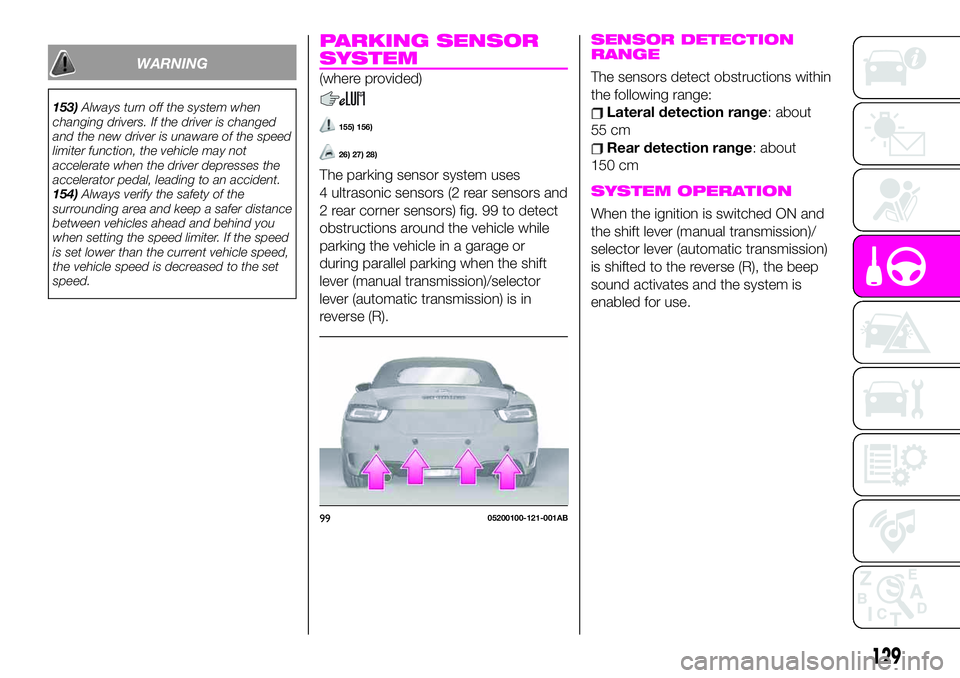
The parking sensor system uses
4 ultrasonic sensors (2 rear sensors and
2 rear corner sensors) fig. 99 to detect
obstructions around the vehicle while
parking the vehicle in a garage or
during parallel parking when the shift
lever (manual transmission)/selector
lever (automatic transmission) is in
reverse (R).
SENSOR DETECTION
RANGE
The sensors detect obstructions within
the following range:
Lateral detection range: about
55 cm
Rear detection range: about
150 cm
SYSTEM OPERATION
When the ignition is switched ON and
the shift lever (manual transmission)/
selector lever (automatic transmission)
is shifted to the reverse (R), the beep
sound activates and the system is
enabled for use.
9905200100-121-001AB
129
Page 152 of 224

DESCRIPTION FUSE RATING PROTECTED COMPONENT
F03 HORN2 7.5 A Horn
F06 — — —
F07 INTERIOR 15 A Overhead light
F09 AUDIO2 15 A Audio system
F10 METER1 10 A Instrument cluster
F11 SRS1 7.5 A Air bag
F12 — — —
F13 RADIO 7.5 A Audio system
F17 AUDIO1 25 A Audio system
F18 A/C MAG 7.5 A Air conditioner
F20 AT 15 A Transmission control system (where provided)
F21 D LOCK 25 A Power door locks
F22 H/L RH 20 A Headlight (RH)
F24 TAIL 20 A Taillights/Number plate lights/Position lights
F25 DRL 15 A Daylight Running Lights
F26 ROOM 25 A Overhead light
F27 FOG 15 A Fog lights
F28 H/CLEAN 20 A Headlight washer (where provided)
F29 STOP 10 A Stop lights/Rear fog light (where provided)
F30 HORN 15 A Horn
F31 H/L LH 20 A Headlight (LH)
F33 HAZARD 15 A Hazard warning flashers/Direction indicators lights
F36 WIPER 20 A Windscreen wipers
150
IN CASE OF EMERGENCY
Page 157 of 224

TIRE SERVICE USAGE
PRECAUTIONS
NoteThe tire sealant cannot be reused.
Purchase new tire sealant at an Abarth
Dealership.
The tire service kit cannot be used in
the following cases. Consult an Abarth
Dealership:
– the period of effective use for the
tire sealant has expired (the period
of effectiveness is indicated on the
bottle label);
– the tear or puncture exceeds about
4 mm;
– the damage has occurred to an
area of the tire other than the tread;
– the vehicle has been driven with
nearly no air remaining in the tire;
– the tire has come off the wheel rim;
– damage to the wheel rim has
occurred;
– the tire has two or more punctures.
SEALING A TIRE WITH
TIRE SERVICE
Proceed as follows:
move the vehicle off the right-of-way
to a safe place on a level and hard
surface where the vehicle does not
obstruct traffic;
shift the shift lever to the 1 or
Reverse (R) position (manual
transmission), and shift the selector
lever to the P position (automatic
transmission);
apply the parking brake with the
brake pedal depressed and turn off the
engine;
if necessary, flash the hazard warning
lights and set up the roadside
emergency triangle;
unload passengers and cargo and
remove the tire service kit;
shake the tire sealant well.
IMPORTANT If the bottle is shaken after
the injection hose is screwed on, tire
sealant could spray out from the
injection hose. Tire sealant contacting
clothing or other objects may be
impossible to remove. Shake the bottle
before screwing on the injection hose.
IMPORTANT The sealant hardens easily
and injecting it will be difficult under
cold weather conditions (0°C or below).
Warm the sealant inside the vehicle to
facilitate injection.
remove the cap 1 from the bottle 2
fig. 135. Screw on the injection hose
3 with the bottle's inner cap left on to
break the inner cap;
remove the valve cap 4 fig. 136 from
the flat tire. Press the back of a valve
core tool 6 to the core of the tire valve
5 and bleed all the remaining air;
13508020202-03A-003AB
155
Page 164 of 224

IMPORTANT Do not use excessive
force as it may damage the cap or
scratch the painted bumper surface.
NOTE Remove the cap completely and
store it so as not to lose it.
securely install the towing eyelet
using the wheel brace or equivalent
front fig. 149 and rear fig. 150;
hook the towing rope to the towing
eyelet.
IMPORTANT If the towing eyelet is not
securely tightened, it may loosen or
disengage from the bumper when
towing the vehicle. Make sure that the
towing eyelet is securely tightened to
the bumper.
IMPORTANT Be careful not to damage
the towing eyelet and towing hook,
vehicle body, or transmission system
when towing under the following
conditions:
do not tow a vehicle heavier than yours;do not suddenly accelerate your vehicle
as it will apply a severe shock to the towing
eyelet and towing hook or rope;
do not attach any rope other than to the
towing eyelet and towing hook.
IMPORTANT The towing eyelet should
be used in an emergency (to get the
vehicle out of a ditch or a snow bank,
for example).IMPORTANT When using the towing
eyelets, always pull the lead or chain in
a straight direction with respect to the
eyelet. Never apply a sideways force.
IMPORTANT When towing with chain
or lead, wrap the chain or lead with a
soft cloth near the bumper to prevent
damage to the bumper.
IMPORTANT
35)Before starting towing operations, put
the ignition switch to OFF position.
36)Before tightening the tow hook, clean
the threaded housing thoroughly. Make
sure that the tow hook is fully fastened in
the housing before towing the vehicle.
37)The front and rear tow hooks should be
used only for emergencies on the road. You
are allowed to tow the vehicle for short
distances using an appropriate device in
accordance with the highway code (a rigid
bar), to move the vehicle on the road in
readiness for towing or transport via a
breakdown vehicle. Tow hooks MUST NOT
be used to tow vehicles off the road or
where there are obstacles and/or for
towing operations using ropes or other
non-rigid devices. Respecting the above
conditions, towing must take place with
two vehicles (one towing, the other towed)
aligned as much as possible along the
same center line.
14808060203-122-001AB
14908060201-121-001AB
15008060201-122-001AB
162
IN CASE OF EMERGENCY
Page 165 of 224
EMERGENCY
TOWING
TOWING DESCRIPTION
Proper lifting and towing are necessary
to prevent damage to the vehicle.
Government and local laws must be
followed.
A towed vehicle usually should have its
drive wheels (rear wheels) off the
ground. If excessive damage or other
conditions prevent this, use wheel
dollies.
When towing with the rear wheels on
the ground, release the parking brake.
IMPORTANT Do not tow the vehicle
pointed backward with driving wheels
on the ground. This may cause internal
damage to the transmission.
IMPORTANT Do not tow with sling-type
equipment. This could damage your
vehicle. Use wheel-lift or flatbed
equipment.
If towing service is not available in an
emergency, the vehicle may be towed
with all four wheels on the ground using
the towing hook at the front of the
vehicle. Only tow the vehicle on paved
surfaces for short distances at low
speeds.Follow these instructions when towing
the vehicle with all wheels on the
ground:
shift to neutral (manual transmission),
or the N position (automatic
transmission);
switch the ignition to ACC;
release the parking brake.
NOTE Remember that power assist for
the brakes and steering will not be
available when the engine is not
running.
163
Page 168 of 224
fluids. Please dispose of your waste
properly and with due regard to the
environment.
We recommend that you entrust the oil
and fluid changes of your vehicle to an
Abarth Dealership.
PERIODIC CHECKS
Every1,000 kmor before long trips
check and, if necessary, top up:
engine coolant level;
brake fluid level;
windscreen washer fluid level;
tire inflation pressure and condition;
operation of lighting system
(headlights, direction indicators, hazard
warning lights, etc.);
operation of windscreen
washer/wiper system and
positioning/wear of windscreen window
wiper blades.
Every 3,000 km, check and top up if
required: engine oil level.
HEAVY-DUTY USE OF THE
VEHICLE
If the vehicle is used under one of the
following conditions:
dusty roads;
short, repeated journeys (less than
7-8 km) at sub-zero outside
temperatures;
engine often idling or driving long
distances at low speeds or long periods
of inactivity;
the following checks must be carried
out more often than indicated in the
Scheduled Servicing Plan:
check front disc brake pad condition
and wear;
check cleanliness of bonnet and
luggage compartment locks,
cleanliness and lubrication of linkage;
visually inspect conditions of: engine,
gearbox, transmission, pipes and hoses
(exhaust/fuel system/brakes) and
rubber elements (gaiters/sleeves/
bushes, etc.);
check battery charge and battery
fluid level (electrolyte);
visually inspect conditions of the
accessory drive belts;
check and, if necessary, change
engine oil and replace oil filter;
check and, if necessary, replace
pollen filter;
check and, if necessary, replace air
cleaner.
166
MAINTENANCE AND CARE
Page 170 of 224
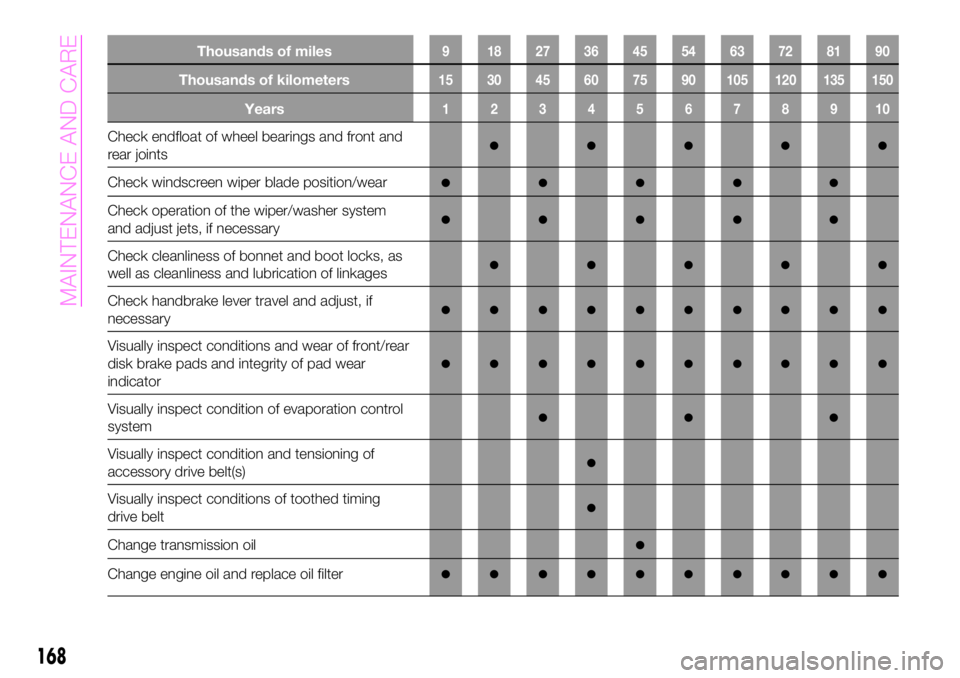
Thousands of miles9 182736455463728190
Thousands of kilometers15 30 45 60 75 90 105 120 135 150
Years12345678910
Check endfloat of wheel bearings and front and
rear joints●●●●●
Check windscreen wiper blade position/wear●●●●●
Check operation of the wiper/washer system
and adjust jets, if necessary●●●●●
Check cleanliness of bonnet and boot locks, as
well as cleanliness and lubrication of linkages●●●●●
Check handbrake lever travel and adjust, if
necessary●●●●●●●●●●
Visually inspect conditions and wear of front/rear
disk brake pads and integrity of pad wear
indicator
●●●●●●●●●●
Visually inspect condition of evaporation control
system●●●
Visually inspect condition and tensioning of
accessory drive belt(s)●
Visually inspect conditions of toothed timing
drive belt●
Change transmission oil●
Change engine oil and replace oil filter●●●●●●●●●●
168
MAINTENANCE AND CARE
Page 175 of 224
IMPORTANT Use only soft
(demineralised) water in the coolant
mixture. Water that contains minerals
will cut down on the coolant's
effectiveness.
IMPORTANT Do not add only water.
Always add a proper coolant mixture.
IMPORTANT The engine has aluminium
parts and must be protected by an
ethylene-glycol-based coolant to
prevent corrosion and freezing.
IMPORTANT DO NOT USE coolants
Containing Alcohol, methanol, Borate
or Silicate. These coolants could
damage the cooling system.
IMPORTANT DO NOT MIX alcohol or
methanol with the coolant. This could
damage the cooling system.
IMPORTANT Do not use a solution that
contains more than 60% antifreeze.
This would reduce effectiveness.
IMPORTANT If the “FL22” mark is
shown on or near the cooling system
cap, use of FL-22 is recommended
when replacing engine coolant. Using
engine coolant other than FL-22 may
cause serious damage to the engine
and cooling system.BRAKE / CLUTCH FLUID
202) 207)
41)
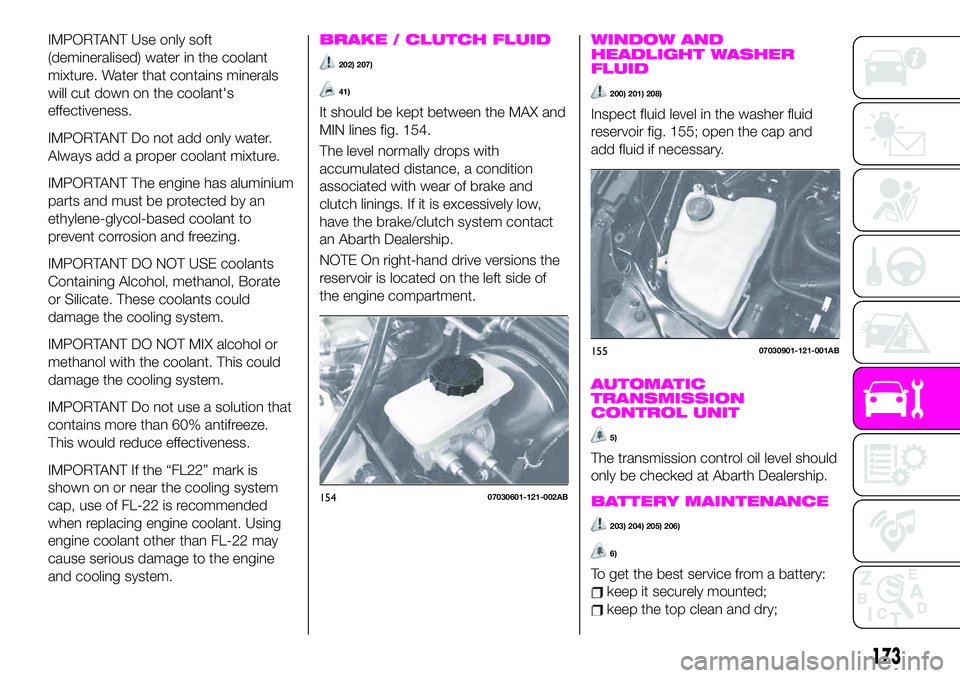
It should be kept between the MAX and
MIN lines fig. 154.
The level normally drops with
accumulated distance, a condition
associated with wear of brake and
clutch linings. If it is excessively low,
have the brake/clutch system contact
an Abarth Dealership.
NOTE On right-hand drive versions the
reservoir is located on the left side of
the engine compartment.
WINDOW AND
HEADLIGHT WASHER
FLUID
200) 201) 208)
Inspect fluid level in the washer fluid
reservoir fig. 155; open the cap and
add fluid if necessary.
AUTOMATIC
TRANSMISSION
CONTROL UNIT
5)
The transmission control oil level should
only be checked at Abarth Dealership.
BATTERY MAINTENANCE
203) 204) 205) 206)
6)
To get the best service from a battery:
keep it securely mounted;
keep the top clean and dry;
15407030601-121-002AB
15507030901-121-001AB
173