transmission Abarth 124 Spider 2020 Owner handbook (in English)
[x] Cancel search | Manufacturer: ABARTH, Model Year: 2020, Model line: 124 Spider, Model: Abarth 124 Spider 2020Pages: 224, PDF Size: 3.9 MB
Page 176 of 224
keep terminals and connections
clean, tight, and coated with petroleum
jelly or terminal grease;
rinse off spilled electrolyte
immediately with a solution of water
and baking soda;
if the vehicle will not be used for an
extended time, disconnect the battery
leads and charge the battery every six
weeks.
NOTE
Every time the battery is reconnected
after being disconnected, it is
necessary to perform the following
procedure:
warm up the engine;
with the vehicle stationary, the engine
running and the transmission in the
neutral or N/P (for automatic
transmission) position, press the
accelerator down fully to bring the
engine speed to over 6000 rpm;
release the accelerator pedal and
wait for the engine to return naturally to
idling speed.
If this procedure is not performed, the
warning light could turn on: in this
case, contact Abarth Dealership.
IMPORTANT If, after the first press of
the accelerator pedal to bring the
engine to over 6000 rpm, another
follows immediately after without the
engine naturally reaching idling speed,the learning procedure is invalidated
and the
warning light on the
instrument panel will turn on. If the
engine is not brought to over 6000 rpm,
or it is not warmed up, the control unit
will keep open the possibility to repeat
the described procedure.
Inspecting electrolyte level
A low level of electrolyte fluid will cause
the battery to discharge quickly.
Inspect the electrolyte level at least
once a week. If it is low, remove the
caps and add enough distilled water to
bring the level between the upper and
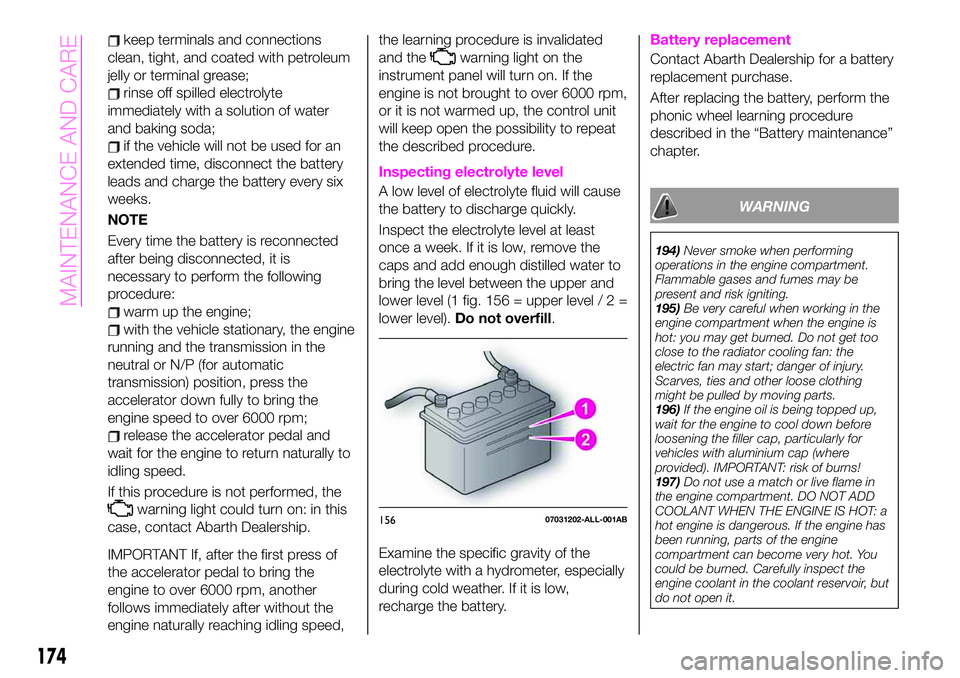
lower level (1 fig. 156 = upper level/2=
lower level).Do not overfill.
Examine the specific gravity of the
electrolyte with a hydrometer, especially
during cold weather. If it is low,
recharge the battery.
Battery replacement
Contact Abarth Dealership for a battery
replacement purchase.
After replacing the battery, perform the
phonic wheel learning procedure
described in the “Battery maintenance”
chapter.
WARNING
194)Never smoke when performing
operations in the engine compartment.
Flammable gases and fumes may be
present and risk igniting.
195)Be very careful when working in the
engine compartment when the engine is
hot: you may get burned. Do not get too
close to the radiator cooling fan: the
electric fan may start; danger of injury.
Scarves, ties and other loose clothing
might be pulled by moving parts.
196)If the engine oil is being topped up,
wait for the engine to cool down before
loosening the filler cap, particularly for
vehicles with aluminium cap (where
provided). IMPORTANT: risk of burns!
197)Do not use a match or live flame in
the engine compartment. DO NOT ADD
COOLANT WHEN THE ENGINE IS HOT: a
hot engine is dangerous. If the engine has
been running, parts of the engine
compartment can become very hot. You
could be burned. Carefully inspect the
engine coolant in the coolant reservoir, but
do not open it.
15607031202-ALL-001AB
174
MAINTENANCE AND CARE
Page 177 of 224
198)Do not remove either cooling system
cap when the engine and radiator are hot.
When the engine and radiator are hot,
scalding coolant and steam may shoot out
under pressure and cause serious injury.
199)The cooling system is pressurized. If
necessary, only replace the cap with
another original one or the operation of the
system may be adversely affected. Do not
remove the reservoir cap when the engine
is hot: risk of burns.
200)Do not travel with the windscreen
washer fluid reservoir empty: the washer
operation is essential for improving visibility.
Repeated operation of the system without
fluid could damage or cause rapid
deterioration of some system components.
201)Certain commercial additives for
windscreen washer fluids are inflammable.
The engine compartment contains hot
components which may set it on fire.
202)Brake fluid is poisonous and highly
corrosive. In the event of accidental
contact, immediately wash the affected
parts with water and mild soap. Then rinse
thoroughly. Call a doctor immediately if
swallowed.
203)Battery fluid is poisonous and
corrosive. Avoid contact with the skin and
eyes. Keep open flames away from the
battery and do not use objects that might
create sparks: risk of explosion and fire.
204)Using the battery with insufficient fluid
irreparably damages the battery and may
cause an explosion.
205)If the vehicle must remain unused for
a long time at a very low temperature,
remove the battery and take it to a warm
place, to avoid freezing.206)When performing any operation on
the battery or near it, always protect your
eyes with special goggles.
207)If the brake/clutch fluid level is low,
have the brakes inspected. A low
brake/clutch fluid level is dangerous. A low
level could indicate brake lining wear or a
brake system leak which could cause the
brakes to fail and lead to an accident.
208)Use only windscreen washer fluid or
plain water in the reservoir. Using radiator
antifreeze as washer fluid is dangerous. If
sprayed on the windscreen, it will dirty the
windscreen, affect your visibility, and could
result in an accident.
IMPORTANT
39)Be careful not to confuse the various
types of fluids while topping up: they are
not compatible with each other! Topping up
with an unsuitable fluid could severly
damage your vehicle.
40)The oil level should never exceed the
MAX mark.
41)Avoid allowing brake fluid, which is
extremely corrosive, to come into contact
with painted areas. Should it happen, wash
immediately with water.
IMPORTANT
4)Used engine oil and oil filters contain
substances which are harmful to the
environment. You are advised to contact an
Abarth Dealership to have the oil and filters
changed.
5)Used transmission fluid contains
substances that are harmful to the
environment. It is advisable to contact an
Abarth Dealership to have the fluid
changed.
6)Batteries contain substances which are
very dangerous for the environment. For
battery replacement, contact an Abarth
Dealership.
175
Page 189 of 224

WEIGHTS
Curb weight (manual transmission): 1060 kg
Curb weight (automatic transmission): 1080 kg
187
Page 191 of 224

FLUID CAPACITIES
Item Capacities
Fuel tank (litres)45
Engine oil (without oil filter replacement) (litres) 3.2
Engine oil (with oil filter replacement) (litres) 3.8
Coolant (versions with manual transmission) (litres)
7.2
(*)/ 6.7(**)
Coolant (versions with automatic transmission) (litres)
7.1(*)/ 6.5(**)
Manual transmission oil (litres)2.1
Automatic transmission fluid (litres) 7.5
Rear differential oil (litres)0.6
LSD oil (litres)0.6
Brake oil (& Clutch oil) (litres)0.55
(*) Left-hand drive versions.
(**) Right-hand drive versions.
189
Page 193 of 224
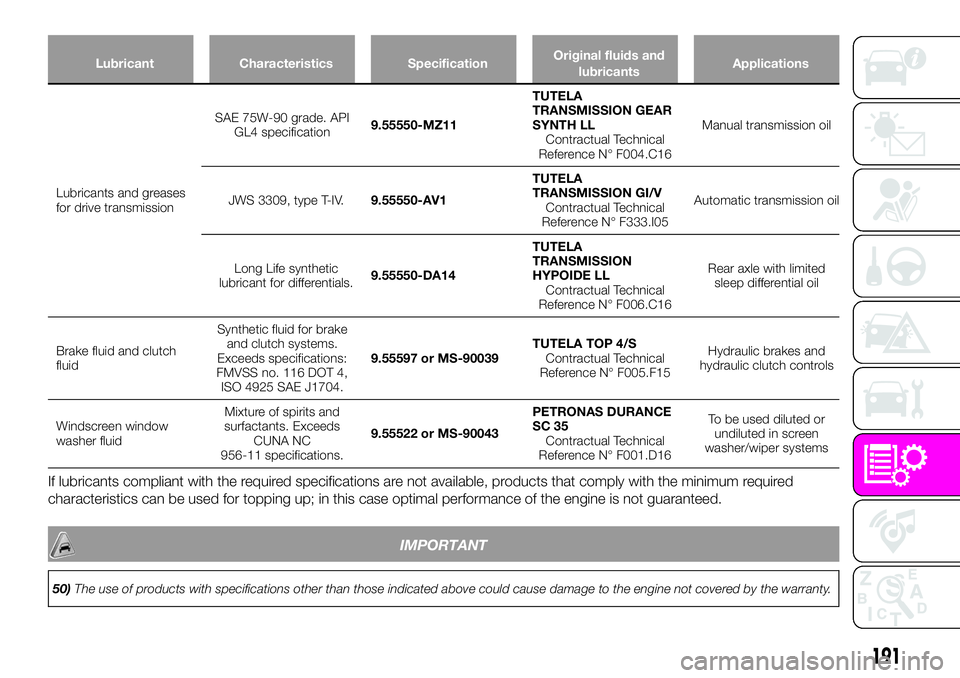
Lubricant Characteristics SpecificationOriginal fluids and
lubricantsApplications
Lubricants and greases
for drive transmissionSAE 75W-90 grade. API
GL4 specification9.55550-MZ11TUTELA
TRANSMISSION GEAR
SYNTH LL
Contractual Technical
Reference N° F004.C16Manual transmission oil
JWS 3309, type T-IV.9.55550-AV1TUTELA
TRANSMISSION GI/V
Contractual Technical
Reference N° F333.I05Automatic transmission oil
Long Life synthetic
lubricant for differentials.9.55550-DA14TUTELA
TRANSMISSION
HYPOIDE LL
Contractual Technical
Reference N° F006.C16Rear axle with limited
sleep differential oil
Brake fluid and clutch
fluidSynthetic fluid for brake
and clutch systems.
Exceeds specifications:
FMVSS no. 116 DOT 4,
ISO 4925 SAE J1704.9.55597 or MS-90039TUTELA TOP 4/S
Contractual Technical
Reference N° F005.F15Hydraulic brakes and
hydraulic clutch controls
Windscreen window
washer fluidMixture of spirits and
surfactants. Exceeds
CUNA NC
956-11 specifications.9.55522 or MS-90043PETRONAS DURANCE
SC 35
Contractual Technical
Reference N° F001.D16To be used diluted or
undiluted in screen
washer/wiper systems
If lubricants compliant with the required specifications are not available, products that comply with the minimum required
characteristics can be used for topping up; in this case optimal performance of the engine is not guaranteed.
IMPORTANT
50)The use of products with specifications other than those indicated above could cause damage to the engine not covered by the warranty.
191
Page 194 of 224

PERFORMANCE
Top speed after the initial period of usage of the vehicle.
Version km/h
1.4 Turbo Multi Air 170HP232 (*) / 229 (**)
(*) Versions with manual transmission
(**) Versions with automatic transmission
192
TECHNICAL SPECIFICATIONS
Page 219 of 224
INDEX
ABS system................73
Accessory socket.............38
Active bonnet................74
Active safety systems...........73
Advanced Keyless Entry System....14
AFS (Adaptive Front Lighting
System)..................27
Attaching the tow hooks........161
Auto-wiper control............29
Automatic climate control system.......................34
Automatic lighting.............25
Automatic transmission.........119
Auxiliary driving systems.........77
Battery (maintenance).........173
Battery charging procedure......176
Battery recharging............176
Bodywork (care and
maintenance).............178
Bonnet....................41
Boot lid...................38
Boot lid (opening).............38
Brake Assist................117
Brake/clutch fluid (level check). . . .173
Checking levels.............171
Child seat installation position.....90
Child-restraint precautions.......86
Child-restraint system suitability
for various seat position.......91Child-restraint system types......89
Climate control system..........31
Coming Home light system.......25
Constant monitoring..........114
Control panel and instruments.....48
Convertible Top (lowering)........42
Convertible Top (Soft Top)........42
Cruise Control..............123
Dashboard..................8
Dead lock device.............16
Dimensions................188
Doors.....................16
Drive selection..............123
Driver Air Bag...............102
DRL (Daytime Running Lights).....24
DSC system................73
Emergency flap opening.......131
Emergency stop signal system. . . .138
Emergency towing............163
Engine...................184
Engine compartment..........171
Engine coolant (level check)......172
Engine oil (level check).........172
Essential information............3
Exterior lights................24
Flash to pass...............25
Fluid capacities..............189
Fluids and lubricants..........190Front fog lights...............25
Fuel consumption and
CO2 emissions............193
Fuel filler cap...............131
Fuse block (engine compartment)......................149
Fuse block (left side of the vehicle)......................152
Fuses (under the bonnet)........148
Fuses (vehicle's left side)........147
Gear lever positions..........119
Gear Shift Indicator............52
Hazard warning lights.........138
Hazard warning lights (control). . . .138
Head restraints...............21
Headlight washer.............30
Headlights..................24
Heated seats................19
Heavy-dute use of the vehicle
(scheduled servicing)........166
High beams.................25
HLA function................80
How the SRS Air bags work......102
How to use this manual..........3
Identification data............183
Ignition switch...............11
Immobilizer system............14
INFO switch.................51
Installing child-restraint systems....95
Interior care................180
Interiors..................180
Page 220 of 224
Internal equipment............38
Jump starting..............159
Jump starting (procedure).......160
Key battery replacement........10
Keyless Entry System...........9
Keys......................9
Lane change signals...........27
Leaving Home Light system.......27
Load limiter (pretensioner)........85
Maintaining the finish.........179
Maintenance monitor...........53
Manual climate control system.....32
Manual transmission..........118
Mechanical Limited Slip
Differential................79
Message indicated on display.....71
Mirrors....................22
Multimedia.................195
Navigation................208
Occupant protection systems.....81
Odometer/Trip meter...........50
Outside mirrors...............22
Owner maintenance precautions . . .165
Paintwork (preserving).........178
Parking...................116
Parking brake...............117
Parking Sensor System.........129
Passenger Air Bag............102Passenger occupant classification
system.................107
Passive Entry................17
Performance...............192
Periodic checks (scheduled
servicing)................166
Power mirrors...............23
Power window lock switch.......37
Power windows..............36
Prescriptions for handling the
vehicle at the end of its life.....194
Pretensioners................85
Push button start positions.......11
Radio 3”.................197
Radio 7”..................202
Read this carefully..............2
Rear camera (ParkView rear
backup camera)...........133
Rear fog lights...............26
Refuelling procedure..........131
Refuelling the vehicle..........131
Replacing a bulb.............139
Replacing a tire..............177
Replacing exterior light bulbs.....142
Replacing fuses.............147
Rims and tires..............185
Rims and tires provided........186
SBA system (Seat Belt Alert)......84
Scheduled servicing plan.......167Seat belt precautions...........82
Seat belt pretensioner and load
limiting systems.............85
Seat Belt pretensioners.........102
Seat belts..................82
Seat belts (fastening/unfastening)}.......................82
Seats.....................19
Seats (manual adjustment).......19
Seats and fabric parts (cleaning) . . .181
Shift-lock override (automatic
gearbox)................120
Shift-lock system (automatic
gearbox)................120
Side Air Bags...............103
Snow chains...............177
Speed limiter...............126
SPORT mode...............123
Starting the engine.........11,116
Steering wheel...............21
Supplementary restraint system
(SRS) - Air bag............100
Symbols....................3
TCS (Traction Control System).....73
Theft deterrent system..........15
Tips, controls and general
information...............196
Tire service kit..............154
Tires rotation (recommendations) . .177
Tool storage................154
Towing the vehicle............161
INDEX