brake light Abarth 500 2015 Owner handbook (in English)
[x] Cancel search | Manufacturer: ABARTH, Model Year: 2015, Model line: 500, Model: Abarth 500 2015Pages: 215, PDF Size: 19.08 MB
Page 101 of 215

Warning lights on
displayWhat it means What to do
amberEXTERIOR LIGHTS FAILURE
On some versions, the display will show the
symbol and a dedicated message if a fault is
detected in one of the following lights:
❒daytime running lights (DRL)
❒side lights
❒direction indicators
❒rear fog light
❒number plate lights.The fault may be caused by a blown bulb, a
blown protective fuse or a break in the electrical
connection.
amberASR SYSTEM
The symbol on the display flashes to indicate the
intervention of the ASR system.
amberPOSSIBLE ICE ON ROAD
The symbol is displayed when the outside
temperature falls to or below 3°C.
The display shows the dedicated message.
amberBRAKE LIGHT FAILURE
The display will show the symbol together with a
dedicated message if there is a fault in the brake
lights.
amberPARKING SENSOR FAILURE
The symbol is shown on the display together with
a dedicated message if there is a fault in the
parking sensors.
97
Page 126 of 215
STARTING THE
ENGINE
The car is fitted with an electronic
engine lock device: if the engine fails to
start, see the paragraph "Fiat CODE
system" in the "Knowing your car"
chapter.
The engine may be noisier during the
first few seconds of operation,
especially after a long period of
inactivity. This characteristic feature of
the hydraulic tappet system does
not compromise functionality or
reliability: the system chosen for your
car was designed to limit maintenance
interventions.
PROCEDURE
Proceed as follows:
❒engage the handbrake and place the
gear lever in neutral;
❒fully press the clutch pedal without
touching the accelerator;
❒turn the ignition key to AVV and
release it as soon as the engine
starts.
If the engine does not start at the first
attempt, return the ignition key to STOP
before repeating the starting procedure.If, with key at MAR-ON, the
symbol
on the display stays on together with
the
warning light on the instrument
panel, it is advisable to turn the key
to STOP and then back to MAR-ON. If
the warning light remains on, try with
the other keys provided with the car.
Contact an Abarth Dealership if you still
cannot start the engine.
17) 18)
96) 97)
WARMING UP THE
ENGINE JUST AFTER IT
HAS STARTED
Proceed as follows:
❒drive off slowly, letting the engine turn
at medium revs. Do not accelerate
abruptly;
❒do not demand full performance at
first. It is advisable to wait until the
engine coolant temperature indicator
starts moving.
19)
STOPPING THE ENGINE
Turn the ignition key to STOP while the
engine is idling.IMPORTANT After a taxing drive, you
should allow the engine to "catch
its breath" before turning it off by letting
it idle to allow the temperature in the
engine compartment to fall.
20)
IMPORTANT
17) It is advisable not to demand
maximum performance from
your car (e.g. excessive
acceleration, long distances at
maximum rpm, excessively
intense braking, etc.) when it is
first used.
18) When the engine is off, do not
leave the key turned to MAR-ON
to prevent unnecessary electrical
consumption from draining the
battery.
19) Never bump start the engine by
pushing, towing or coasting
downhill. This could cause fuel to
flow into the catalytic converter
and damage it beyond repair.
122
STARTING AND DRIVING
Page 127 of 215
20) A quick burst on the accelerator
before turning off the engine
serves absolutely no practical
purpose; it wastes fuel and is
especially damaging to
turbocharged engines.
WARNING
96) It is dangerous to run the engine
in enclosed areas. The engine
takes in oxygen and releases
carbon dioxide, carbon monoxide
and other toxic gases.
97) Remember that the brake servo
and electric power steering are
not active until the engine is
started. A much greater effort will
therefore be required to use the
brake pedal or turn the steering
wheel.
PARKING
Proceed as follows:
❒stop the engine and engage the
handbrake;
❒engage a gear (first gear if parked
uphill or reverse if facing downhill)
and leave the wheels turned.
Block the wheels with a wedge or a
stone if the car is parked on a steep
slope.
Do not leave the ignition key on
MAR-ON to avoid draining the battery.
Always remove the key when you
leave the car.
98)
HANDBRAKE
The handbrake lever fig. 94 is located
between the two front seats.To use the handbrake pull the lever
upwards until the car cannot be moved.
99)
When the handbrake is on and the
ignition key is at MAR-ON, the
instrument panel warning light
will
come on.
Proceed as follows to release the
handbrake:
❒slightly lift the lever and press release
button A fig. 94;
❒keep button A pressed and lower the
lever. The
warning light in the
instrument panel will switch off.
Press the brake pedal when carrying
out this operation to prevent the car
from moving accidentally.
WARNING
98) Never leave children unattended
in the car. Always remove the
ignition key when leaving the car
and take it out with you.
99) The car should be braked after a
few clicks of the lever. If it is not,
contact an Abarth Dealership
to have it adjusted.
94AB0A0076
123
Page 130 of 215

CONDITIONS OF USE
Cold starting
Short journeys and frequent cold starts
do not allow the engine to reach
optimum operating temperature. This
results in a significant increase in
consumption levels (from +15 to +30%
on the urban cycle) and emissions.
Traffic and road
conditions
High fuel consumption is caused by
heavy traffic, for instance when
travelling in a queue with frequent use
of low gears or in cities with many traffic
lights. Winding mountain roads and
rough road surfaces also adversely
affect consumption.
Stops in traffic
During prolonged hold-ups (e.g. level
crossings) switch off the engine.TOWING TRAILERS
IMPORTANT
INFORMATION
For towing caravans or trailers the car
must be fitted with a certified tow hook
and an adequate electrical system.
Installation should be carried out by
specialised personnel who will issue the
required papers for travelling on roads.
Install any specific and/or additional
door mirrors as specified by the
Highway Code.
Remember that when towing a trailer,
steep hills are harder to climb, braking
distances increase and overtaking
takes longer depending on the overall
weight of the trailer.
Engage a low gear when driving
downhill, rather than constantly using
the brake.
The weight the trailer exerts on the car
tow hook reduces the car's loading
capacity by the same amount. To make
sure that the maximum towable weight
is not exceeded (given in the car
registration document) account should
be taken of the fully laden trailer,
including accessories and luggage.Respect the speed limits specific to
each country for vehicles towing
trailers.
In any case, the top speed must not
exceed 100 km/h.
101) 102)
WARNING
101) The ABS with which the car is
equipped will not control the
braking system of the trailer.
Particular caution is therefore
required on slippery surfaces.
102) Never modify the braking
system of the car to control the
trailer brake. The trailer braking
system must be fully independent
of the car’s hydraulic system.
126
STARTING AND DRIVING
Page 132 of 215
CAR INACTIVITY
If the car is to be left inactive for longer
than a month, the following precautions
should be noted:
❒park the car in covered, dry and if
possible well-ventilated premises and
slightly open the windows;
❒check that the handbrake is not
engaged;
❒engage a gear;
❒disconnect the negative battery
terminal and check the battery
charge. Repeat this check once
every three months during storage;
❒if the battery is not disconnected
from the electrical system, check
its state of charge every thirty days;
❒clean and protect the painted parts
using protective wax;
❒clean and protect the shiny metal
parts using special compounds
available commercially;
❒sprinkle talcum powder on the
windscreen and rear window wiper
rubber blades and lift them off the
glass;❒cover the car with a cloth or
perforated plastic sheet. Do not use
compact plastic sheets which do
not allow humidity to evaporate from
the surface of the car;
❒inflate tyres to +0.5 bar above the
standard prescribed pressure and
check it periodically;
❒do not drain the engine cooling
system;
128
STARTING AND DRIVING
Page 134 of 215
STARTING THE
ENGINE
If thesymbol on the display turns
on constantly, contact an Abarth
Dealership immediately.
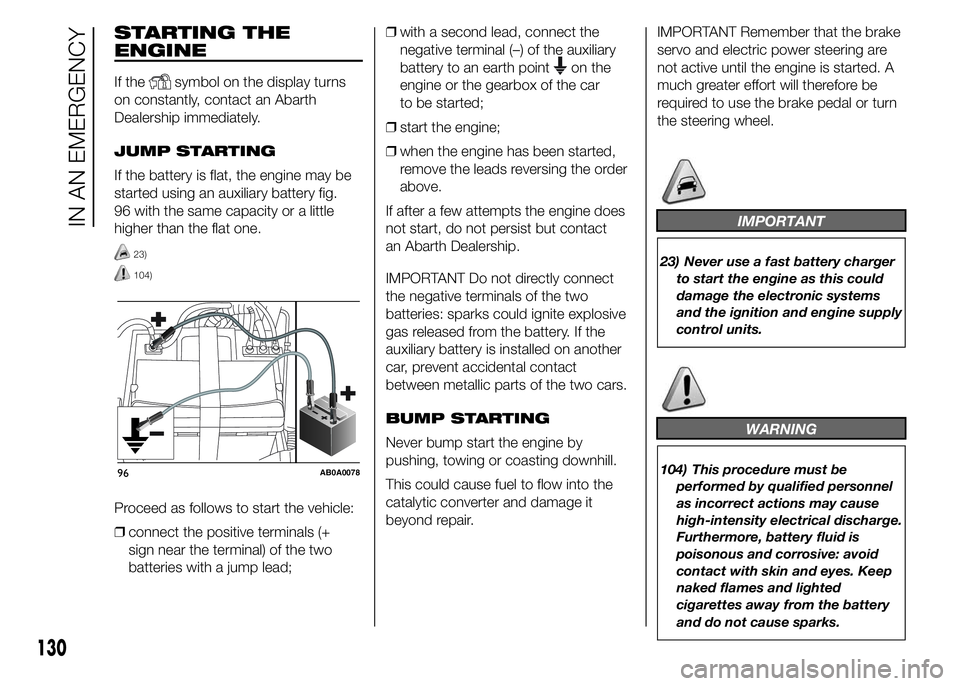
JUMP STARTING
If the battery is flat, the engine may be
started using an auxiliary battery fig.
96 with the same capacity or a little
higher than the flat one.
23)
104)
Proceed as follows to start the vehicle:
❒connect the positive terminals (+
sign near the terminal) of the two
batteries with a jump lead;❒with a second lead, connect the
negative terminal (–) of the auxiliary
battery to an earth point
on the
engine or the gearbox of the car
to be started;
❒start the engine;
❒when the engine has been started,
remove the leads reversing the order
above.
If after a few attempts the engine does
not start, do not persist but contact
an Abarth Dealership.
IMPORTANT Do not directly connect
the negative terminals of the two
batteries: sparks could ignite explosive
gas released from the battery. If the
auxiliary battery is installed on another
car, prevent accidental contact
between metallic parts of the two cars.
BUMP STARTING
Never bump start the engine by
pushing, towing or coasting downhill.
This could cause fuel to flow into the
catalytic converter and damage it
beyond repair.IMPORTANT Remember that the brake
servo and electric power steering are
not active until the engine is started. A
much greater effort will therefore be
required to use the brake pedal or turn
the steering wheel.
IMPORTANT
23) Never use a fast battery charger
to start the engine as this could
damage the electronic systems
and the ignition and engine supply
control units.
WARNING
104) This procedure must be
performed by qualified personnel
as incorrect actions may cause
high-intensity electrical discharge.
Furthermore, battery fluid is
poisonous and corrosive: avoid
contact with skin and eyes. Keep
naked flames and lighted
cigarettes away from the battery
and do not cause sparks.96AB0A0078
130
IN AN EMERGENCY
Page 135 of 215

"Fix&Go Automatic"
kit
The kit (see fig. 97) in the luggage
compartment consists of:
❒a spray bottle A with the sealant,
equipped with filling pipe B,
separated by the compressor C;
❒compressor C with pressure gauge,
fitting valve to couple the bottle A,
cable with supply socket D and pipe
N to restore pressure (this is inside
the body as shown);
❒adhesive label under the spray bottle
A, with the message "max. 80 km/h"
to be placed where the driver can
easily see it (for example on the
dashboard) after repairing the tyre;
❒instruction booklet fig. 98, for using
the Fix&Go quickly and correctly;
❒a pair of protective gloves.
24)
105) 106) 107)
IMPORTANT
INFORMATION
The sealant of the Fix&Go kit is effective
at external temperatures of between
-20°C and +50°C.
The sealant has an expiry date.
108) 109)
2)
INFLATION PROCEDURE
110)
Proceed as follows:
❒engage the handbrake;
❒place the Fix&Go kit close to the tyre
to be repaired;
❒locate the fig. 100 filling pipe B
already connected to the spray bottle
A;
❒open the side lid E then connect the
spray bottle A to the fitting, following
the direction of the arrow;
❒undo the cap of the tyre valve F and
connect the filling pipe B, tightening
the relevant ring nut on the tyre valve;
❒make sure that the switch G fig. 101
is in position0(off), then start the
engine;
❒place the electric plug H fig. 102 in
the cigar lighter socket of the car
(12 V);
97AB0A0079
98AB0A0080
ON
OFF
99AB0A0081
131
Page 141 of 215

Bulbs
Use Type Power Ref. Figure
Main beam headlights HI 55 W D
Dipped headlights H7 55 W D
Dipped headlights with gas discharge bulbs
(Xenon) (for versions/markets, where provided)DIS 35 W F
Front side lights/daytime running lights W2I/5W 5/2IW A
Front direction indicators WY2IW 21 W B
Front direction indicators (with xenon gas
discharge bulbs)PY24W 24 W B
Side direction indicators W5W 5 W A
Rear direction indicators PY2IW 2IW B
Rear side lights RI0W I0W B
Brake lights P2IW 2IW B
Reversing light P2IW 2IW B
Rear fog light P2IW 2IW B
Roof light C5W 5 W C
Luggage compartment light W5W 5 W A
Number plate light C5W 5 W C
Fog lights HI 55 W E
Third brake lights W5W 5 W A
137
Page 145 of 215
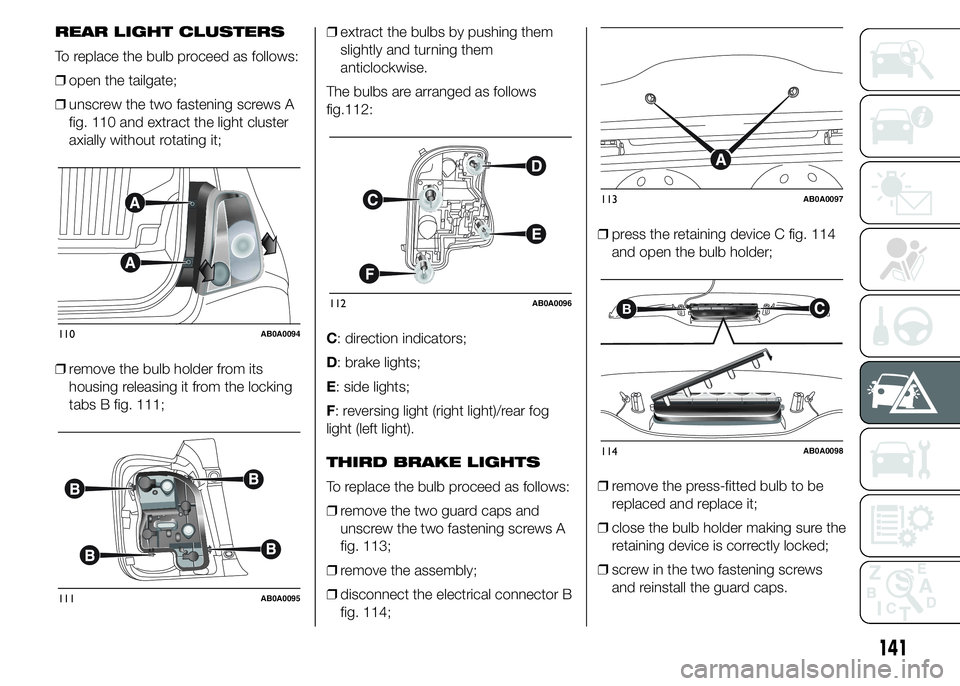
REAR LIGHT CLUSTERS
To replace the bulb proceed as follows:
❒open the tailgate;
❒unscrew the two fastening screws A
fig. 110 and extract the light cluster
axially without rotating it;
❒remove the bulb holder from its
housing releasing it from the locking
tabs B fig. 111;❒extract the bulbs by pushing them
slightly and turning them
anticlockwise.
The bulbs are arranged as follows
fig. 112:
C: direction indicators;
D: brake lights;
E: side lights;
F: reversing light (right light)/rear fog
light (left light).
THIRD BRAKE LIGHTS
To replace the bulb proceed as follows:
❒remove the two guard caps and
unscrew the two fastening screws A
fig. 113;
❒remove the assembly;
❒disconnect the electrical connector B
fig. 114;❒press the retaining device C fig. 114
and open the bulb holder;
❒remove the press-fitted bulb to be
replaced and replace it;
❒close the bulb holder making sure the
retaining device is correctly locked;
❒screw in the two fastening screws
and reinstall the guard caps.
110AB0A0094
111AB0A0095
112AB0A0096
113AB0A0097
B
114AB0A0098
141
Page 150 of 215
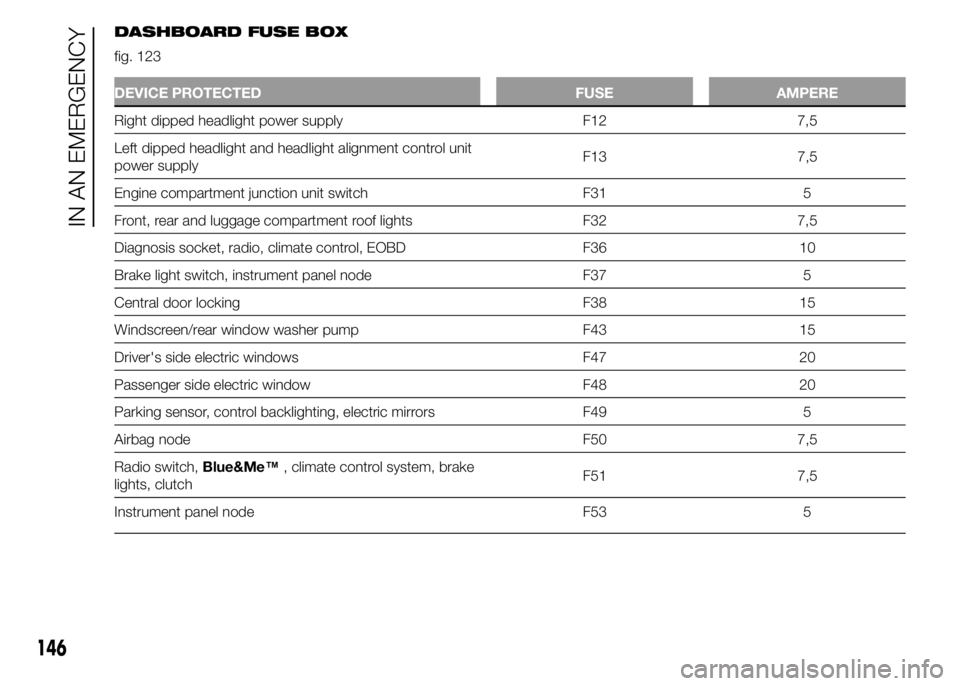
DASHBOARD FUSE BOX
fig. 123
DEVICE PROTECTED FUSE AMPERE
Right dipped headlight power supply F12 7,5
Left dipped headlight and headlight alignment control unit
power supplyF13 7,5
Engine compartment junction unit switch F31 5
Front, rear and luggage compartment roof lights F32 7,5
Diagnosis socket, radio, climate control, EOBD F36 10
Brake light switch, instrument panel node F37 5
Central door locking F38 15
Windscreen/rear window washer pump F43 15
Driver's side electric windows F47 20
Passenger side electric window F48 20
Parking sensor, control backlighting, electric mirrors F49 5
Airbag node F50 7,5
Radio switch,Blue&Me™, climate control system, brake
lights, clutchF51 7,5
Instrument panel node F53 5
146
IN AN EMERGENCY