maintenance Abarth 500 2015 Owner handbook (in English)
[x] Cancel search | Manufacturer: ABARTH, Model Year: 2015, Model line: 500, Model: Abarth 500 2015Pages: 215, PDF Size: 19.08 MB
Page 158 of 215

SCHEDULED
SERVICING
Correct servicing is crucial for
guaranteeing a long life for the car
under the best conditions.
For this reason, Abarth has planned a
series of checks and services at fixed
distance intervals or fixed time intervals,
as described in the Scheduled
Servicing Plan.
Before each service, it is always
necessary to carefully follow the
instructions in the Scheduled Servicing
Plan (e.g. periodically check level of
fluids, tyre pressure, etc.).
Scheduled Servicing is offered by all
Abarth Dealerships according to a set
time schedule. If, during each
operation, in addition to the ones
scheduled, the need arises for further
replacements or repairs, these may
be carried out only with the explicit
agreement of the Customer. If your car
is used frequently for towing, the
interval between one service operation
and the next should be reduced.IMPORTANT
INFORMATION
The Scheduled Servicing services are
set out by the Manufacturer. Failure
to have them carried out may invalidate
the warranty.
It is advisable to inform an Abarth
Dealership of any small operating
irregularities without waiting for the next
service.
For versions fitted with specific
equipment (e.g. Abarth Competizione
gearbox), in addition to what is
described in the Scheduled Servicing
Plan, refer to the relevant additional
items in the dedicated supplements.
154
SERVICING AND MAINTENANCE
Page 160 of 215
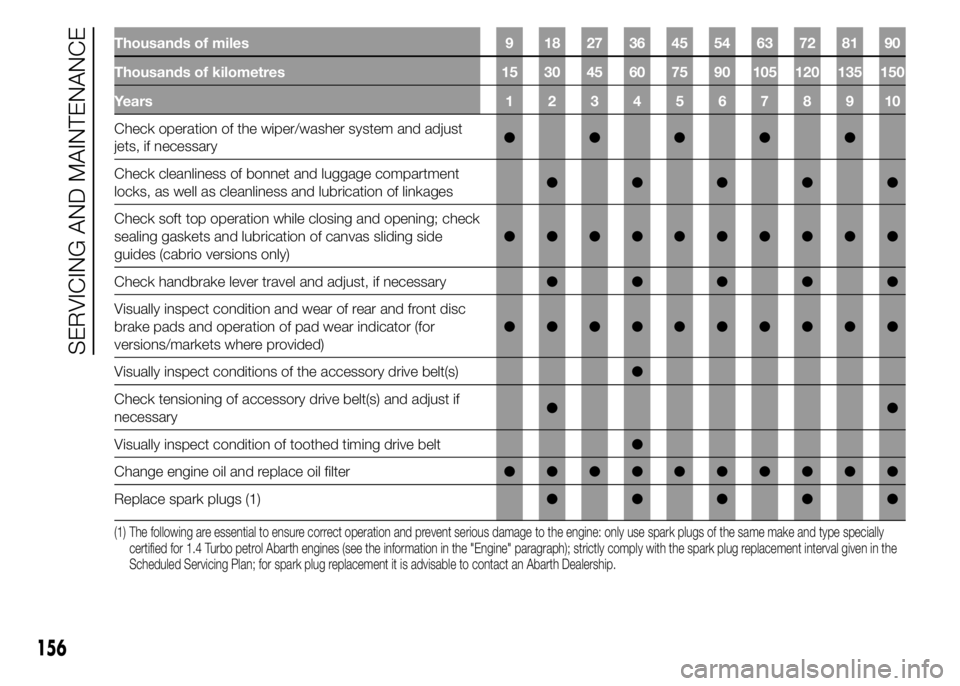
Thousands of miles 9 18 27 36 45 54 63 72 81 90
Thousands of kilometres 15 30 45 60 75 90 105 120 135 150
Years12345678910
Check operation of the wiper/washer system and adjust
jets, if necessary●●●●●
Check cleanliness of bonnet and luggage compartment
locks, as well as cleanliness and lubrication of linkages●●●●●
Check soft top operation while closing and opening; check
sealing gaskets and lubrication of canvas sliding side
guides (cabrio versions only)●●●●●●●●●●
Check handbrake lever travel and adjust, if necessary●●●●●
Visually inspect condition and wear of rear and front disc
brake pads and operation of pad wear indicator (for
versions/markets where provided)●●●●●●●●●●
Visually inspect conditions of the accessory drive belt(s)●
Check tensioning of accessory drive belt(s) and adjust if
necessary●●
Visually inspect condition of toothed timing drive belt●
Change engine oil and replace oil filter●●●●●●●●●●
Replace spark plugs (1)●●●●●
(1) The following are essential to ensure correct operation and prevent serious damage to the engine: only use spark plugs of the same make and type specially
certified for 1.4 Turbo petrol Abarth engines (see the information in the "Engine" paragraph); strictly comply with the spark plug replacement interval given in the
Scheduled Servicing Plan; for spark plug replacement it is advisable to contact an Abarth Dealership.
156
SERVICING AND MAINTENANCE
Page 162 of 215
PERIODIC CHECKS
Every 1,000 km or before long
journeys, check and, if necessary, top
up the following:
❒engine coolant level;
❒brake fluid level;
❒windscreen washer fluid level;
❒tyre inflation pressure and condition;
❒operation of lighting system
(headlights, direction indicators,
hazard warning lights, etc.);
❒operation of screen washer/wiper
system and positioning/wear of
windscreen/rear window wiper
blades.
Every 3,000 km check and, if
necessary, top up: engine oil level.
You are advised to use PETRONAS
LUBRICANTS products, which have
been designed and produced
specifically for Abarth cars (see table
"Capacities" in the "Technical
specifications" chapter).
HEAVY-DUTY USE OF
THE CAR
If the car is used mainly under one of
the following conditions:
❒towing a trailer or caravan;
❒dusty roads;
❒short, repeated journeys (less than
7-8 km) at sub-zero outside
temperatures;
❒engine often idling or driving long
distances at low speeds or long
periods of inactivity;
the following checks must be carried
out more often than indicated in the
Scheduled Servicing Plan:
❒check front disc brake pad condition
and wear;
❒check cleanliness of bonnet and
luggage compartment locks,
cleanliness and lubrication of linkage;
❒visually inspect condition of: engine,
gearbox, transmission, pipes and
hoses (exhaust - fuel system -
brakes) and rubber elements (boots -
sleeves - bushes - etc.);
❒check battery charge and battery
fluid level (electrolyte);
❒visually inspect condition of the
accessory drive belts;❒check and, if necessary, change
engine oil and replace oil filter;
❒check and, if necessary, replace
pollen filter;
❒check and, if necessary, replace air
cleaner.
158
SERVICING AND MAINTENANCE
Page 164 of 215
ENGINE OIL
30)
3)
Check the oil level a few minutes (about
five) after the engine has stopped,
with the car parked on level ground.
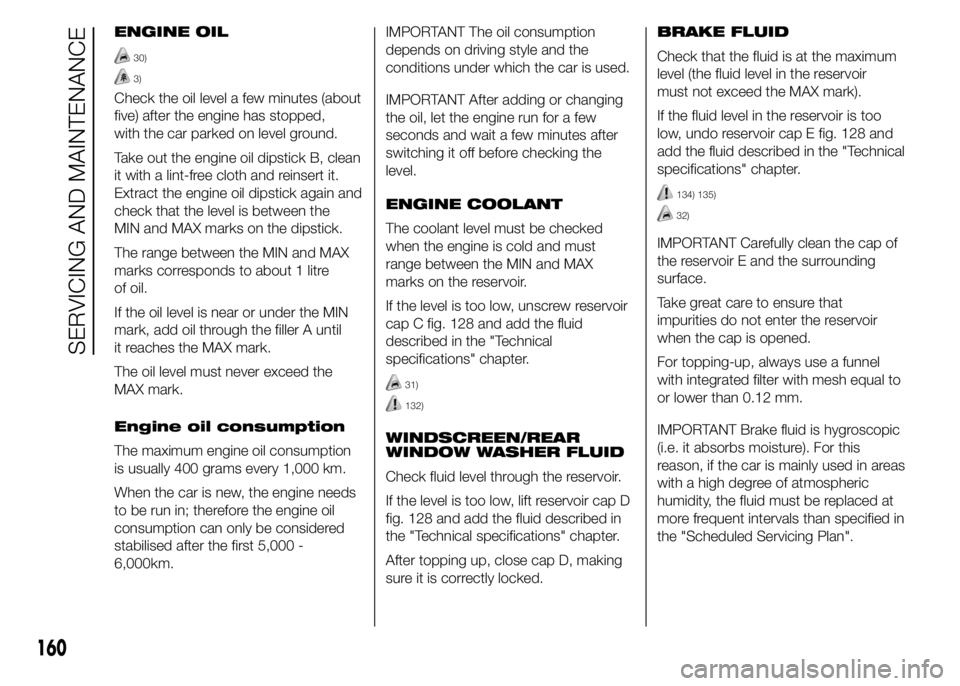
Take out the engine oil dipstick B, clean
it with a lint-free cloth and reinsert it.
Extract the engine oil dipstick again and
check that the level is between the
MIN and MAX marks on the dipstick.
The range between the MIN and MAX
marks corresponds to about 1 litre
of oil.
If the oil level is near or under the MIN
mark, add oil through the filler A until
it reaches the MAX mark.
The oil level must never exceed the
MAX mark.
Engine oil consumption
The maximum engine oil consumption
is usually 400 grams every 1,000 km.
When the car is new, the engine needs
to be run in; therefore the engine oil
consumption can only be considered
stabilised after the first 5,000 -
6,000 km.IMPORTANT The oil consumption
depends on driving style and the
conditions under which the car is used.
IMPORTANT After adding or changing
the oil, let the engine run for a few
seconds and wait a few minutes after
switching it off before checking the
level.
ENGINE COOLANT
The coolant level must be checked
when the engine is cold and must
range between the MIN and MAX
marks on the reservoir.
If the level is too low, unscrew reservoir
cap C fig. 128 and add the fluid
described in the "Technical
specifications" chapter.
31)
132)
WINDSCREEN/REAR
WINDOW WASHER FLUID
Check fluid level through the reservoir.
If the level is too low, lift reservoir cap D
fig. 128 and add the fluid described in
the "Technical specifications" chapter.
After topping up, close cap D, making
sure it is correctly locked.BRAKE FLUID
Check that the fluid is at the maximum
level (the fluid level in the reservoir
must not exceed the MAX mark).
If the fluid level in the reservoir is too
low, undo reservoir cap E fig. 128 and
add the fluid described in the "Technical
specifications" chapter.
134) 135)
32)
IMPORTANT Carefully clean the cap of
the reservoir E and the surrounding
surface.
Take great care to ensure that
impurities do not enter the reservoir
when the cap is opened.
For topping-up, always use a funnel
with integrated filter with mesh equal to
or lower than 0.12 mm.
IMPORTANT Brake fluid is hygroscopic
(i.e. it absorbs moisture). For this
reason, if the car is mainly used in areas
with a high degree of atmospheric
humidity, the fluid must be replaced at
more frequent intervals than specified in
the "Scheduled Servicing Plan".
160
SERVICING AND MAINTENANCE
Page 166 of 215
AIR CLEANER/
POLLEN FILTER
For filter replacement, contact an
Abarth Dealership.
BATTERY
The car is fitted with a low-maintenance
battery: no electrolyte top-ups with
distilled water are needed in standard
conditions of use.
INSPECTING THE
CHARGE AND THE
ELECTROLYTE LEVEL
The operations must be carried out as
described in this Owner Handbook only
by specialised personnel. Any top-up
operations must be carried out by
skilled personnel and by an Abarth
Dealership.
REPLACING THE
BATTERY
136) 137) 138) 139)
33)
4)
If required, replace the battery with an
original spare part with the same
specifications.
If a battery with different specifications
is fitted, the service intervals given in
the "Scheduled Servicing Plan" will no
longer be valid.
Follow the battery manufacturer's
instructions for maintenance.USEFUL ADVICE FOR
EXTENDING THE LIFE OF
YOUR BATTERY
To avoid draining your battery and
make it last longer, observe the
following instructions:
❒when you park the car, ensure that
the doors, tailgate and bonnet are
closed properly, to prevent any lights
from remaining on inside the
passenger compartment;
❒switch off all roof lights inside the car:
the car is however equipped with a
system which switches all interior
lights off automatically;
❒do not keep accessories (e.g. radio,
hazard warning lights, etc.) switched
on for a long time when the engine
is not running;
❒before performing any operation on
the electrical system, disconnect
the negative battery pole;
❒completely tighten the battery
terminals.
IMPORTANT If the charge level remains
under 50% for a long time, the battery
is damaged by sulphation, reducing
its capacity and efficiency at start-up.
162
SERVICING AND MAINTENANCE
Page 168 of 215
WHEELS AND TYRES
Check the pressure of each tyre,
including the space-saver wheel,
approximately every two weeks and
before long journeys: the pressure
should be checked with the tyre rested
and cold.
140) 141) 142) 143)
It is normal for the pressure to increase
when the car is used; for the correct
tyre inflation pressure, see "Wheels" in
the "Technical specifications" chapter.
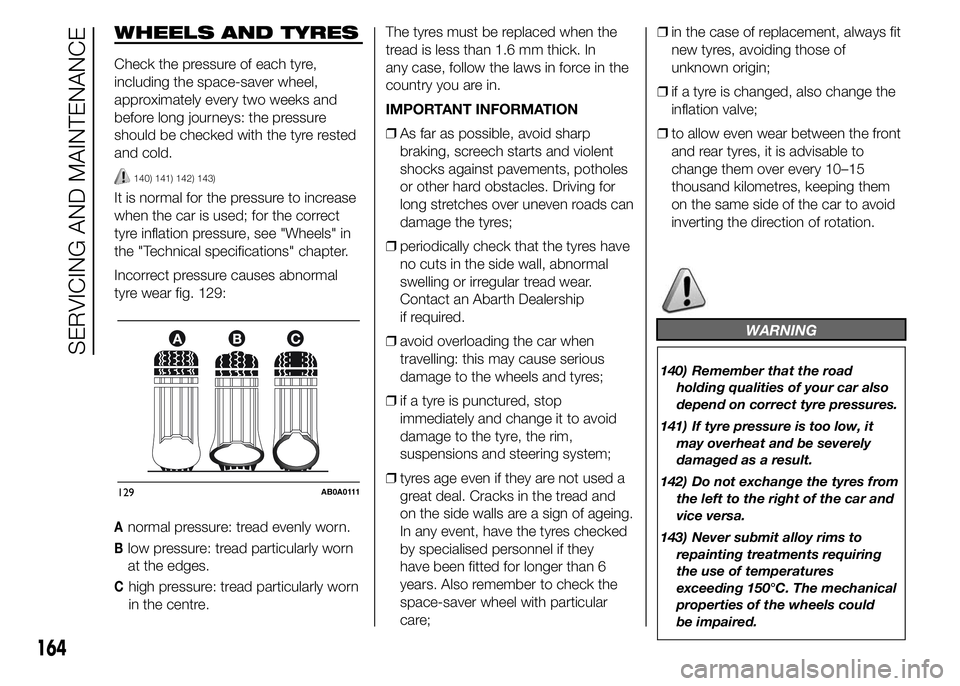
Incorrect pressure causes abnormal
tyre wear fig. 129:
Anormal pressure: tread evenly worn.
Blow pressure: tread particularly worn
at the edges.
Chigh pressure: tread particularly worn
in the centre.The tyres must be replaced when the
tread is less than 1.6 mm thick. In
any case, follow the laws in force in the
country you are in.
IMPORTANT INFORMATION
❒As far as possible, avoid sharp
braking, screech starts and violent
shocks against pavements, potholes
or other hard obstacles. Driving for
long stretches over uneven roads can
damage the tyres;
❒periodically check that the tyres have
no cuts in the side wall, abnormal
swelling or irregular tread wear.
Contact an Abarth Dealership
if required.
❒avoid overloading the car when
travelling: this may cause serious
damage to the wheels and tyres;
❒if a tyre is punctured, stop
immediately and change it to avoid
damage to the tyre, the rim,
suspensions and steering system;
❒tyres age even if they are not used a
great deal. Cracks in the tread and
on the side walls are a sign of ageing.
In any event, have the tyres checked
by specialised personnel if they
have been fitted for longer than 6
years. Also remember to check the
space-saver wheel with particular
care;❒in the case of replacement, always fit
new tyres, avoiding those of
unknown origin;
❒if a tyre is changed, also change the
inflation valve;
❒to allow even wear between the front
and rear tyres, it is advisable to
change them over every 10–15
thousand kilometres, keeping them
on the same side of the car to avoid
inverting the direction of rotation.
WARNING
140) Remember that the road
holding qualities of your car also
depend on correct tyre pressures.
141) If tyre pressure is too low, it
may overheat and be severely
damaged as a result.
142) Do not exchange the tyres from
the left to the right of the car and
vice versa.
143) Never submit alloy rims to
repainting treatments requiring
the use of temperatures
exceeding 150°C. The mechanical
properties of the wheels could
be impaired.
129AB0A0111
164
SERVICING AND MAINTENANCE
Page 169 of 215
RUBBER HOSES
As far as the maintenance of the brake
system and fuel supply system rubber
hoses is concerned, follow the
"Scheduled Servicing Plan" in this
chapter carefully.
Ozone, high temperatures and
prolonged lack of fluid in the system
may cause hardening and cracking of
the hoses, with possible leaks. Careful
checking is therefore necessary.
WINDSCREEN/REAR
WINDOW WIPER
BLADES
Replace the blades if the rubber edge is
deformed or worn. In any case, it is
advisable to replace them
approximately once a year.
144)
A few simple precautions can reduce
the possibility of damage to the blades:
❒if the temperature falls below zero,
make sure that ice has not frozen
the rubber against the glass. Use a
de-icing product to release it if
required;
❒remove any snow from the glass: in
addition to protecting the blades,
this prevents effort on the motor and
overheating;
❒do not operate the windscreen and
rear window wipers on dry glass.REPLACING THE
WINDSCREEN WIPER
BLADES
Proceed as follows:
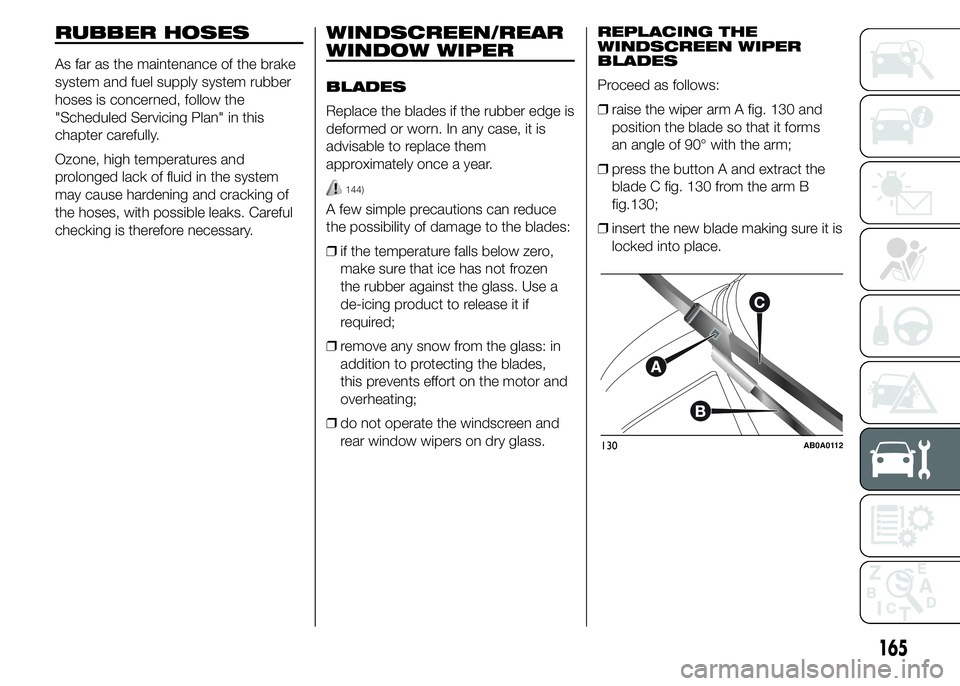
❒raise the wiper arm A fig. 130 and
position the blade so that it forms
an angle of 90° with the arm;
❒press the button A and extract the
blade C fig. 130 from the arm B
fig. 130;
❒insert the new blade making sure it is
locked into place.
130AB0A0112
165
Page 170 of 215
REPLACING THE REAR
WINDOW WIPER BLADE
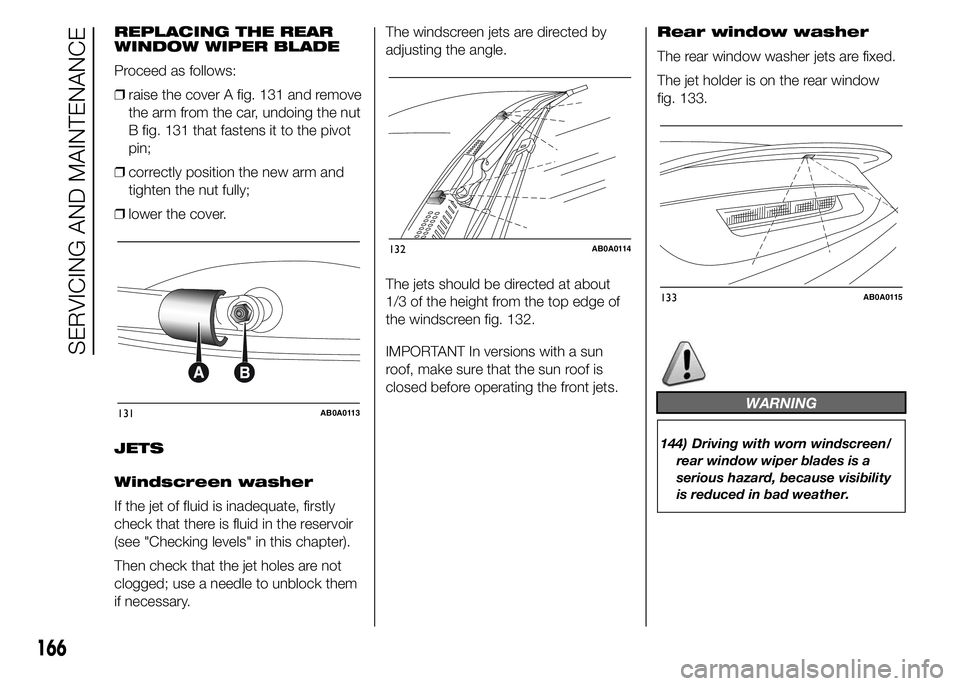
Proceed as follows:
❒raise the cover A fig. 131 and remove
the arm from the car, undoing the nut
B fig. 131 that fastens it to the pivot
pin;
❒correctly position the new arm and
tighten the nut fully;
❒lower the cover.
JETS
Windscreen washer
If the jet of fluid is inadequate, firstly
check that there is fluid in the reservoir
(see "Checking levels" in this chapter).
Then check that the jet holes are not
clogged; use a needle to unblock them
if necessary.The windscreen jets are directed by
adjusting the angle.
The jets should be directed at about
1/3 of the height from the top edge of
the windscreen fig. 132.
IMPORTANT In versions with a sun
roof, make sure that the sun roof is
closed before operating the front jets.Rear window washer
The rear window washer jets are fixed.
The jet holder is on the rear window
fig. 133.
WARNING
144) Driving with worn windscreen/
rear window wiper blades is a
serious hazard, because visibility
is reduced in bad weather.
131AB0A0113
132AB0A0114
133AB0A0115
166
SERVICING AND MAINTENANCE
Page 171 of 215

BODYWORK
PROTECTION AGAINST
ATMOSPHERIC AGENTS
The main causes of corrosion are the
following:
❒atmospheric pollution
❒salty air and humidity (coastal areas,
or hot humid climates);
❒seasonal environmental conditions.
The abrasive action of wind-borne
atmospheric dust and sand, as well as
mud and gravel raised by other vehicles
is also not to be underestimated.
Abarth has used the best
manufacturing technologies on your car
to effectively protect the bodywork
against corrosion.
These include:
❒painting products and systems which
give the car particular resistance to
corrosion and abrasion;
❒use of galvanised (or pretreated)
sheet metal, with high resistance
to corrosion;
❒spraying of underbody, engine
compartment, wheel arch interiors
and other parts with highly protective
wax products;❒spraying of plastic parts, with a
protective function in the more
exposed points: underdoor, inner
wing, edges, etc.;
❒use of "open" boxed sections to
prevent condensation and pockets of
moisture from triggering rust inside.
BODY AND UNDERBODY
WARRANTY
Your car is covered by warranty against
perforation due to rust of any original
element of the structure or bodywork.
For the general terms of this warranty,
refer to the Warranty Booklet.
PRESERVING THE
BODYWORK
Paintwork
Paintwork does not only serve an
aesthetic purpose, but also protects the
underlying sheet metal.
Touch up abrasions and scratches
immediately to prevent rust formation.
Use only original paint products for
touch-ups (see "Bodywork paint
identification plate" in the "Technical
specifications" chapter).Normal maintenance of paintwork
consists in washing the car: the
frequency depends on the conditions
and environment where the car is used.
For example, in highly polluted areas,
or if the roads are spread with salt, it is
advisable to wash the car more
frequently.
To correctly wash the car, proceed as
follows:
❒remove the aerial from the roof to
prevent damage to it if the car is
washed in an automatic system;
❒if high pressure jets or cleaners are
used to wash the car, keep a
distance of at least 40 cm from the
bodywork to avoid damage or
alteration. Remember that the build
up of water can damage the car over
a period of time;
❒wash the bodywork using a low
pressure jet of water;
❒wipe a sponge with a slightly soapy
solution over the bodywork,
frequently rinsing the sponge;
❒rinse well with water and dry with a
jet of air or a chamois.
167
Page 172 of 215
Dry the less visible parts with special
care, such as the door frames, bonnet
and the headlight frames, where water
may stagnate more easily. The car
should not be taken to a closed area
immediately, but left outside so that
residual water can evaporate.
Do not wash the car after it has been
left in the sun or with the bonnet hot:
this may alter the shine of the
paintwork.
Exterior plastic parts must be cleaned
in the same way as the rest of the car.
Where possible, do not park under
trees; the resinous substance that
many species release give the paint a
dull appearance and increase the
possibility of triggering rusting
processes.
IMPORTANT Bird droppings must be
washed off immediately and thoroughly
as the acid they contain is particularly
aggressive.
5)
34)
Windows
To clean glasses, use specific cleaning
products.
Use clean cloths to avoid scratching
the glass or damaging the
transparency.
IMPORTANT Wipe the rear window
inside gently with a cloth following the
direction of the filaments to avoid
damaging the heating device.
Headlights
Use a soft cloth soaked in water and
detergent for washing cars.
IMPORTANT Never use aromatic
substances (e.g. petrol) or ketones (e.g.
acetone) for cleaning the plastic lenses
of the headlights.
IMPORTANT When cleaning with a
pressure washer, keep the water jet at
least 20 cm away from the headlights.Engine compartment
Wash the engine compartment
thoroughly at the end of every winter.
Be careful not to direct the jet of water
onto electronic control units.
Adequately protect the upper air
intakes to prevent damage to the
windscreen wiper motor. Have this
operation performed at a specialised
workshop.
IMPORTANT The washing should take
place with the engine cold and the
ignition key in the STOP position. After
the washing operation, make sure
that the various protections (e.g. rubber
caps and guards) have not been
removed or damaged.
IMPORTANT
5) Detergents cause water pollution.
The vehicle should be washed in
areas equipped for collecting
and purifying the liquid used in
the washing process.
168
SERVICING AND MAINTENANCE