light Abarth 500 2015 Owner handbook (in English)
[x] Cancel search | Manufacturer: ABARTH, Model Year: 2015, Model line: 500, Model: Abarth 500 2015Pages: 215, PDF Size: 19.08 MB
Page 134 of 215
STARTING THE
ENGINE
If thesymbol on the display turns
on constantly, contact an Abarth
Dealership immediately.
JUMP STARTING
If the battery is flat, the engine may be
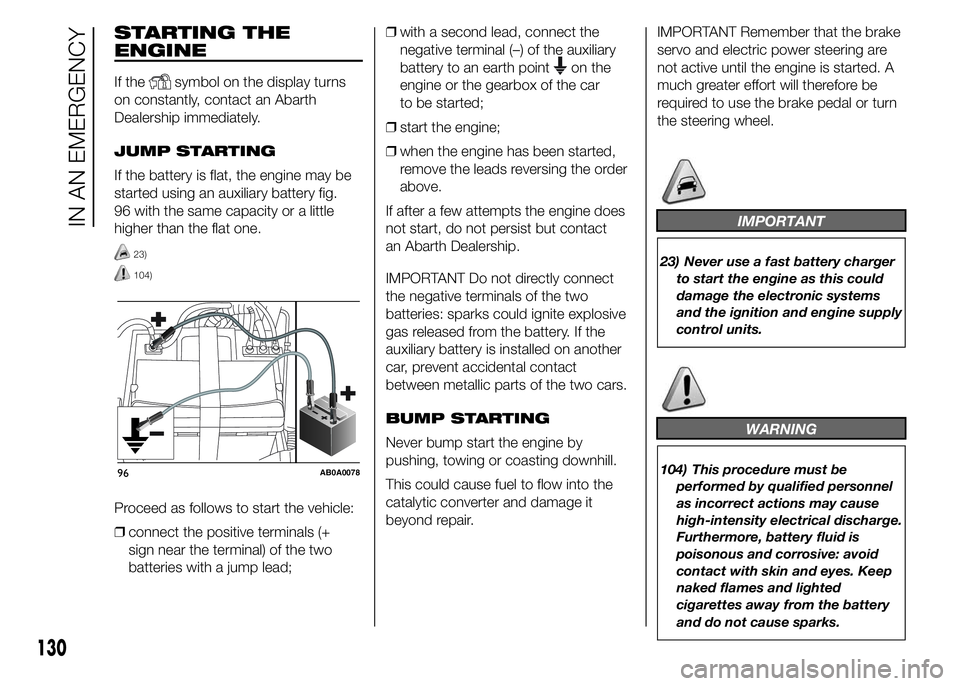
started using an auxiliary battery fig.
96 with the same capacity or a little
higher than the flat one.
23)
104)
Proceed as follows to start the vehicle:
❒connect the positive terminals (+
sign near the terminal) of the two
batteries with a jump lead;❒with a second lead, connect the
negative terminal (–) of the auxiliary
battery to an earth point
on the
engine or the gearbox of the car
to be started;
❒start the engine;
❒when the engine has been started,
remove the leads reversing the order
above.
If after a few attempts the engine does
not start, do not persist but contact
an Abarth Dealership.
IMPORTANT Do not directly connect
the negative terminals of the two
batteries: sparks could ignite explosive
gas released from the battery. If the
auxiliary battery is installed on another
car, prevent accidental contact
between metallic parts of the two cars.
BUMP STARTING
Never bump start the engine by
pushing, towing or coasting downhill.
This could cause fuel to flow into the
catalytic converter and damage it
beyond repair.IMPORTANT Remember that the brake
servo and electric power steering are
not active until the engine is started. A
much greater effort will therefore be
required to use the brake pedal or turn
the steering wheel.
IMPORTANT
23) Never use a fast battery charger
to start the engine as this could
damage the electronic systems
and the ignition and engine supply
control units.
WARNING
104) This procedure must be
performed by qualified personnel
as incorrect actions may cause
high-intensity electrical discharge.
Furthermore, battery fluid is
poisonous and corrosive: avoid
contact with skin and eyes. Keep
naked flames and lighted
cigarettes away from the battery
and do not cause sparks.96AB0A0078
130
IN AN EMERGENCY
Page 135 of 215

"Fix&Go Automatic"
kit
The kit (see fig. 97) in the luggage
compartment consists of:
❒a spray bottle A with the sealant,
equipped with filling pipe B,
separated by the compressor C;
❒compressor C with pressure gauge,
fitting valve to couple the bottle A,
cable with supply socket D and pipe
N to restore pressure (this is inside
the body as shown);
❒adhesive label under the spray bottle
A, with the message "max. 80 km/h"
to be placed where the driver can
easily see it (for example on the
dashboard) after repairing the tyre;
❒instruction booklet fig. 98, for using
the Fix&Go quickly and correctly;
❒a pair of protective gloves.
24)
105) 106) 107)
IMPORTANT
INFORMATION
The sealant of the Fix&Go kit is effective
at external temperatures of between
-20°C and +50°C.
The sealant has an expiry date.
108) 109)
2)
INFLATION PROCEDURE
110)
Proceed as follows:
❒engage the handbrake;
❒place the Fix&Go kit close to the tyre
to be repaired;
❒locate the fig. 100 filling pipe B
already connected to the spray bottle
A;
❒open the side lid E then connect the
spray bottle A to the fitting, following
the direction of the arrow;
❒undo the cap of the tyre valve F and
connect the filling pipe B, tightening
the relevant ring nut on the tyre valve;
❒make sure that the switch G fig. 101
is in position0(off), then start the
engine;
❒place the electric plug H fig. 102 in
the cigar lighter socket of the car
(12 V);
97AB0A0079
98AB0A0080
ON
OFF
99AB0A0081
131
Page 137 of 215
CHECKING AND
RESTORING TYRE
PRESSURE
The compressor may also be used for
checking and possibly restoring tyre
pressure.
Proceed as follows:
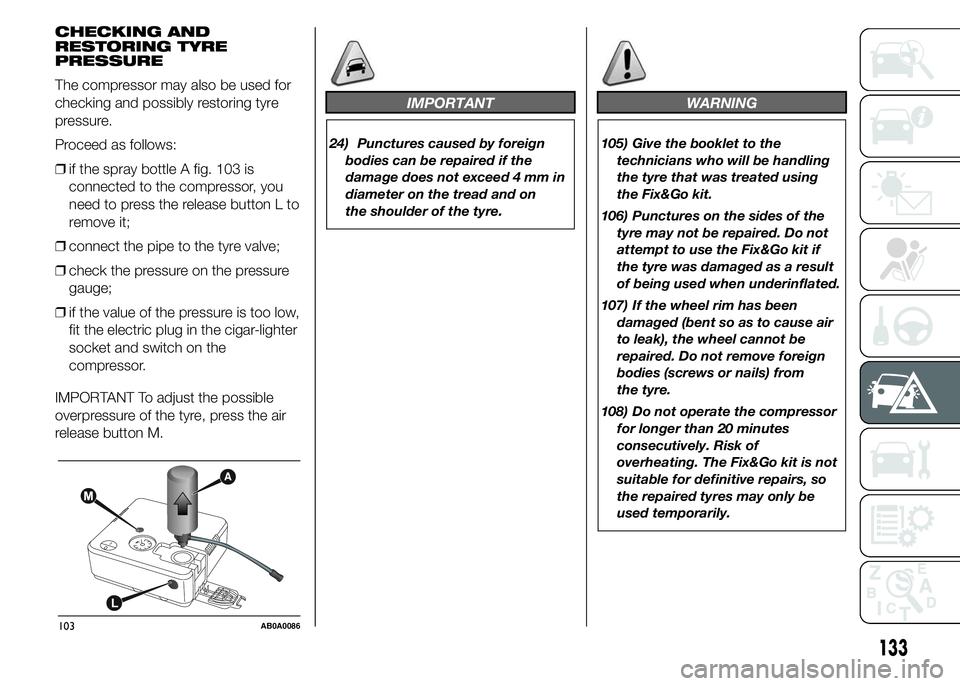
❒if the spray bottle A fig. 103 is
connected to the compressor, you
need to press the release button L to
remove it;
❒connect the pipe to the tyre valve;
❒check the pressure on the pressure
gauge;
❒if the value of the pressure is too low,
fit the electric plug in the cigar-lighter
socket and switch on the
compressor.
IMPORTANT To adjust the possible
overpressure of the tyre, press the air
release button M.
IMPORTANT
24) Punctures caused by foreign
bodies can be repaired if the
damage does not exceed 4 mm in
diameter on the tread and on
the shoulder of the tyre
.
WARNING
105) Give the booklet to the
technicians who will be handling
the tyre that was treated using
the Fix&Go kit.
106) Punctures on the sides of the
tyre may not be repaired. Do not
attempt to use the Fix&Go kit if
the tyre was damaged as a result
of being used when underinflated.
107) If the wheel rim has been
damaged (bent so as to cause air
to leak), the wheel cannot be
repaired. Do not remove foreign
bodies (screws or nails) from
the tyre.
108) Do not operate the compressor
for longer than 20 minutes
consecutively. Risk of
overheating. The Fix&Go kit is not
suitable for definitive repairs, so
the repaired tyres may only be
used temporarily.
103AB0A0086
133
Page 139 of 215

REPLACING A BULB
GENERAL
INSTRUCTIONS
❒Before replacing a bulb check the
contacts for oxidation;
❒burnt bulbs must be replaced by
others of the same type and power;
❒always check the headlight beam
alignment after replacing a bulb;
❒when a light is not working, check
that the corresponding fuse is intact
before replacing a bulb. For the
location of fuses, refer to the
paragraph "Replacing fuses" in this
chapter.
114) 115)
25) 26)
IMPORTANT When the weather is cold
or damp or after heavy rain or washing,
the surface of headlights or rear lights
may steam up and/or form drops of
condensation on the inside. This is
a natural phenomenon due to the
difference in temperature and humidity
between the inside and the outside
of the glass which does not indicate a
fault and does not compromise the
normal operation of lighting devices.
The mist disappears quickly when the
lights are turned on, starting from
the centre of the diffuser, extending
progressively towards the edges.
135
Page 141 of 215

Bulbs
Use Type Power Ref. Figure
Main beam headlights HI 55 W D
Dipped headlights H7 55 W D
Dipped headlights with gas discharge bulbs
(Xenon) (for versions/markets, where provided)DIS 35 W F
Front side lights/daytime running lights W2I/5W 5/2IW A
Front direction indicators WY2IW 21 W B
Front direction indicators (with xenon gas
discharge bulbs)PY24W 24 W B
Side direction indicators W5W 5 W A
Rear direction indicators PY2IW 2IW B
Rear side lights RI0W I0W B
Brake lights P2IW 2IW B
Reversing light P2IW 2IW B
Rear fog light P2IW 2IW B
Roof light C5W 5 W C
Luggage compartment light W5W 5 W A
Number plate light C5W 5 W C
Fog lights HI 55 W E
Third brake lights W5W 5 W A
137
Page 142 of 215

WARNING
114) Changes or repairs to the electrical system carried out incorrectly and without due consideration for the technical
specifications of the system may lead to malfunctioning and generate a fire hazard.
115) Halogen bulbs contain pressurised gas. If they break, glass fragments could fly everywhere.
IMPORTANT
25) Halogen bulbs must be handled by holding the metallic part only. Touching the transparent part of the bulb with
your fingers may reduce the intensity of the emitted light and even reduce the lifespan of the bulb. In the event of
accidental contact, wipe the bulb with a cloth moistened with alcohol and let the bulb dry.
26) Where possible, it is advisable to have bulbs changed at an Abarth Dealership. The correct operation and alignment
of the external lights are absolutely essential for the safety of the car and of compliance with the law.
138
IN AN EMERGENCY
Page 143 of 215
REPLACING AN
EXTERIOR BULB
For the type of bulb and power rating,
see paragraph "Replacing a bulb".
FRONT LIGHT CLUSTERS
The front light clusters contain side
lights, dipped headlights, main beam
headlights and direction indicator bulbs.
Access to the direction
indicator bulbs
Operating from the engine
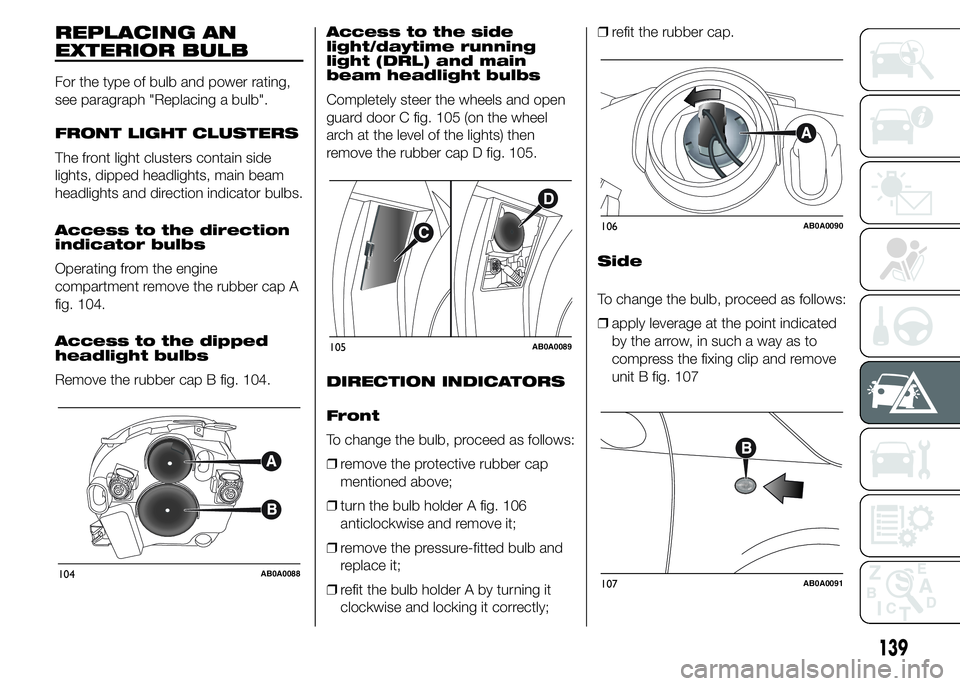
compartment remove the rubber cap A
fig. 104.
Access to the dipped
headlight bulbs
Remove the rubber cap B fig. 104.Access to the side
light/daytime running
light (DRL) and main
beam headlight bulbs
Completely steer the wheels and open
guard door C fig. 105 (on the wheel
arch at the level of the lights) then
remove the rubber cap D fig. 105.
DIRECTION INDICATORS
Front
To change the bulb, proceed as follows:
❒remove the protective rubber cap
mentioned above;
❒turn the bulb holder A fig. 106
anticlockwise and remove it;
❒remove the pressure-fitted bulb and
replace it;
❒refit the bulb holder A by turning it
clockwise and locking it correctly;❒refit the rubber cap.
Side
104AB0A0088
105AB0A0089
106AB0A0090
107AB0A0091
139
To change the bulb, proceed as follows:
❒apply leverage at the point indicated
by the arrow, in such a way as to
compress the fixing clip and remove
unit B fig. 107
Page 144 of 215
❒turn the bulb holder anticlockwise,
extract the press-fitted bulb and
replace it;
❒refit the bulb holder in the lens, then
position unit B, ensuring that the
fastening clip clicks into place.
DIPPED HEADLIGHTS
To change the bulb, proceed as follows:
❒remove the protective rubber cap
mentioned above;
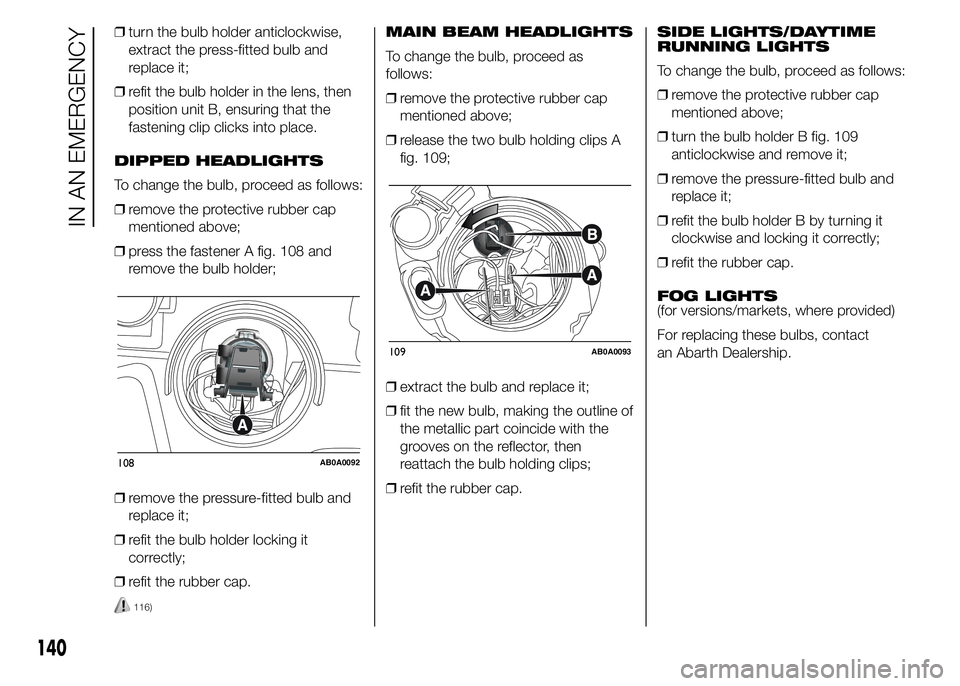
❒press the fastener A fig. 108 and
remove the bulb holder;
❒remove the pressure-fitted bulb and
replace it;
❒refit the bulb holder locking it
correctly;
❒refit the rubber cap.
116)
MAIN BEAM HEADLIGHTS
To change the bulb, proceed as
follows:
❒remove the protective rubber cap
mentioned above;
❒release the two bulb holding clips A
fig. 109;
❒extract the bulb and replace it;
❒fit the new bulb, making the outline of
the metallic part coincide with the
grooves on the reflector, then
reattach the bulb holding clips;
❒refit the rubber cap.SIDE LIGHTS/DAYTIME
RUNNING LIGHTS
To change the bulb, proceed as follows:
❒remove the protective rubber cap
mentioned above;
❒turn the bulb holder B fig. 109
anticlockwise and remove it;
❒remove the pressure-fitted bulb and
replace it;
❒refit the bulb holder B by turning it
clockwise and locking it correctly;
❒refit the rubber cap.
FOG LIGHTS
(for versions/markets, where provided)
For replacing these bulbs, contact
an Abarth Dealership.
108AB0A0092
109AB0A0093
140
IN AN EMERGENCY
Page 145 of 215
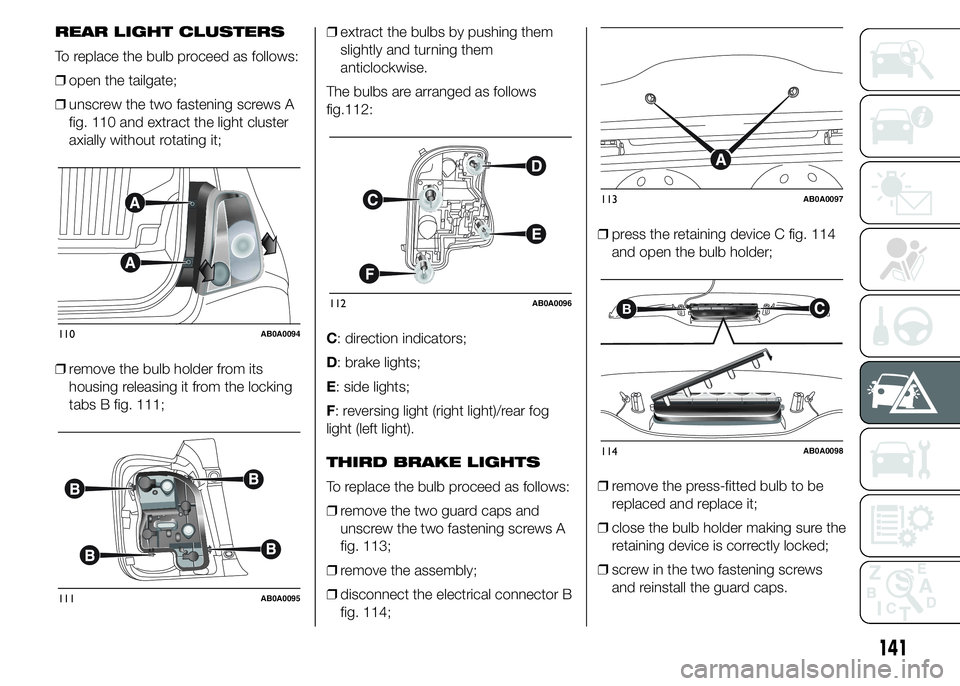
REAR LIGHT CLUSTERS
To replace the bulb proceed as follows:
❒open the tailgate;
❒unscrew the two fastening screws A
fig. 110 and extract the light cluster
axially without rotating it;
❒remove the bulb holder from its
housing releasing it from the locking
tabs B fig. 111;❒extract the bulbs by pushing them
slightly and turning them
anticlockwise.
The bulbs are arranged as follows
fig. 112:
C: direction indicators;
D: brake lights;
E: side lights;
F: reversing light (right light)/rear fog
light (left light).
THIRD BRAKE LIGHTS
To replace the bulb proceed as follows:
❒remove the two guard caps and
unscrew the two fastening screws A
fig. 113;
❒remove the assembly;
❒disconnect the electrical connector B
fig. 114;❒press the retaining device C fig. 114
and open the bulb holder;
❒remove the press-fitted bulb to be
replaced and replace it;
❒close the bulb holder making sure the
retaining device is correctly locked;
❒screw in the two fastening screws
and reinstall the guard caps.
110AB0A0094
111AB0A0095
112AB0A0096
113AB0A0097
B
114AB0A0098
141
Page 146 of 215

NUMBER PLATE LIGHTS
To replace the bulbs proceed as
follows:
❒apply pressure to the point shown by
the arrow fig. 115 and remove the
lens;
❒change the bulb, releasing it from the
side contacts;
❒fit the new bulb and make sure that it
is correctly clamped between the
contacts;
❒then refit the lens.
WARNING
116) Due to the high power supply
voltage, gas discharge bulbs
(Xenon) should only be replaced
by specialised personnel: danger
of death! Contact an Abarth
Dealership.
REPLACING AN
INTERIOR BULB
For the type of bulb and power rating,
see paragraph "Replacing a bulb".
INTERIOR ROOF LIGHT
To replace the bulb, proceed as follows:
❒using the screwdriver provided,
extract the roof light A fig. 116
working in the point shown by the
arrow;
115AB0A0099
116AB0A0100
142
IN AN EMERGENCY