bonnet Abarth 500 2015 Owner handbook (in English)
[x] Cancel search | Manufacturer: ABARTH, Model Year: 2015, Model line: 500, Model: Abarth 500 2015Pages: 215, PDF Size: 19.08 MB
Page 9 of 215
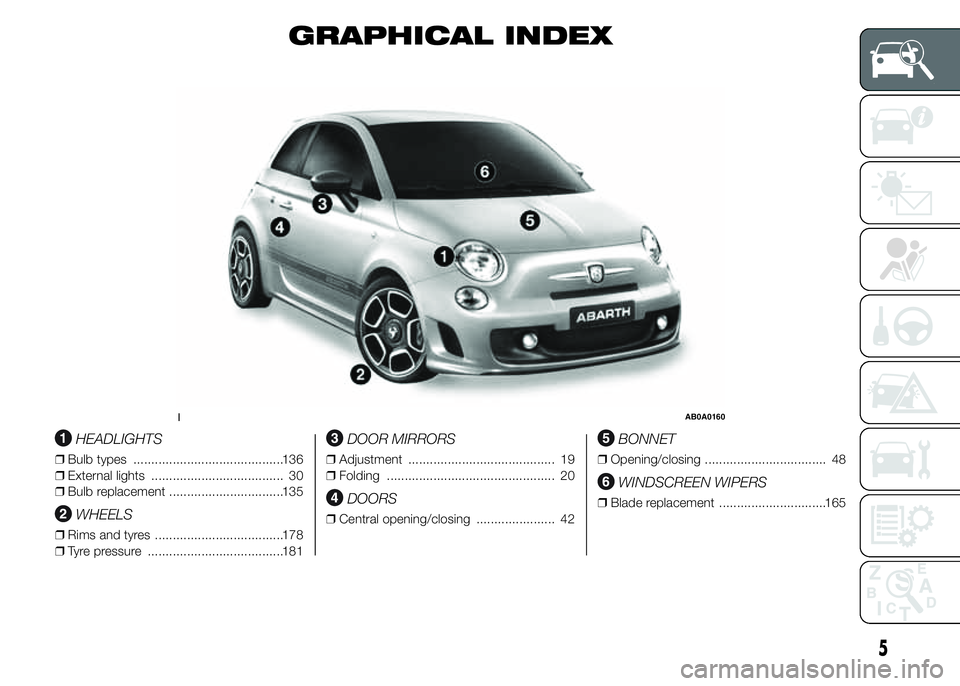
GRAPHICAL INDEX
.
HEADLIGHTS
❒Bulb types ..........................................136
❒External lights ..................................... 30
❒Bulb replacement ................................135
WHEELS
❒Rims and tyres ....................................178
❒Tyre pressure ......................................181
DOOR MIRRORS
❒Adjustment ......................................... 19
❒Folding ............................................... 20
DOORS
❒Central opening/closing ...................... 42
BONNET
❒Opening/closing .................................. 48
WINDSCREEN WIPERS
❒Blade replacement ..............................165
1AB0A0160
5
Page 13 of 215
GETTING TO KNOW YOUR CAR
In-depth knowledge of your new vehicle
starts here.
The handbook that you are reading
simply and directly explains how it
is made and how it works.
That’s why we advise you to read it
seated comfortably on board, so that
you can see what is described here for
yourself.SYMBOLS ...................................... 10
FIAT CODE SYSTEM ....................... 10
THE KEYS....................................... 11
IGNITION SWITCH .......................... 14
SEATS ............................................ 15
HEAD RESTRAINTS ........................ 17
STEERING WHEEL ......................... 18
REAR VIEW MIRRORS .................... 19
CLIMATIC COMFORT ..................... 21
HEATING AND VENTILATION.......... 22
MANUAL CLIMATE CONTROL
SYSTEM ......................................... 24
AUTOMATIC CLIMATE CONTROL
SYSTEM ......................................... 26
EXTERNAL LIGHTS......................... 30
WINDOW CLEANING ...................... 32
ROOF LIGHTS ................................ 33
CONTROLS .................................... 34
INTERIOR FITTINGS ....................... 36
FIXED GLASS ROOF ....................... 40
ELECTRIC SUN ROOF .................... 40
DOORS ........................................... 42
ELECTRIC WINDOWS .................... 44
LUGGAGE COMPARTMENT ........... 45
BONNET ......................................... 48
ROOF RACK/SKI RACK .................. 50
HEADLIGHTS.................................. 51ESC SYSTEM ................................. 52
ITPMS (INDIRECT TYRE
PRESSURE MONITORING
SYSTEM) ........................................ 56
EOBD SYSTEM............................... 59
DUALDRIVE ELECTRIC POWER
STEERING ...................................... 59
RADIO SYSTEM .............................. 60
ACCESSORIES PURCHASED BY
THE OWNER................................... 60
PARKING SENSORS....................... 62
REFUELLING THE CAR .................. 64
PROTECTING THE
ENVIRONMENT .............................. 65
9
Page 14 of 215
SYMBOLS
Some car components have coloured
labels whose symbols indicate
precautions to be observed when using
this component. Under the bonnet
there is also a label that summarises all
the symbols.
FIAT CODE SYSTEM
IN BRIEF
This is an electrical engine locking
system which increases protection
against an attempted theft of the. It is
automatically activated when the
ignition key is removed.
Each key contains an electronic
device which modulates the signal
emitted during ignition by an antenna
built into the ignition device. The
signal, which changes each time the
engine is started, is the “password”,
by means of which the control unit
recognises the key and enables
starting.
1)
Operation
Each time the vehicle is started turning
the ignition key toMAR-ON, the Fiat
CODE system control unit sends a
recognition code to the Powertrain
Control Module to deactivate the
immobiliser.
The acknowledgement code is sent
only if the Fiat CODE system control
unit has recognised the code
transmitted from the key.
Each time the ignition key is turned to
STOP, the Fiat CODE system
deactivates the functions of the
Powertrain Control Module.
Irregular operation
If, during starting, the code is not
correctly recognised, the symbol
comes on in the display.
In this case, turn the key toSTOPand
then back toMAR-ON; if the lock
continues, try with the other keys
provided with the vehicle. Contact an
Abarth Dealership if you still cannot
start the engine.
IMPORTANT Each key has its own
code which must be stored by the
system's control unit. Contact an
Abarth Dealership to have new keys (up
to 8) stored with a code.
10
GETTING TO KNOW YOUR CAR
Page 52 of 215
IMPORTANT
9) Take care not to knock objects on
the roof rack when opening the
tailgate.
BONNET
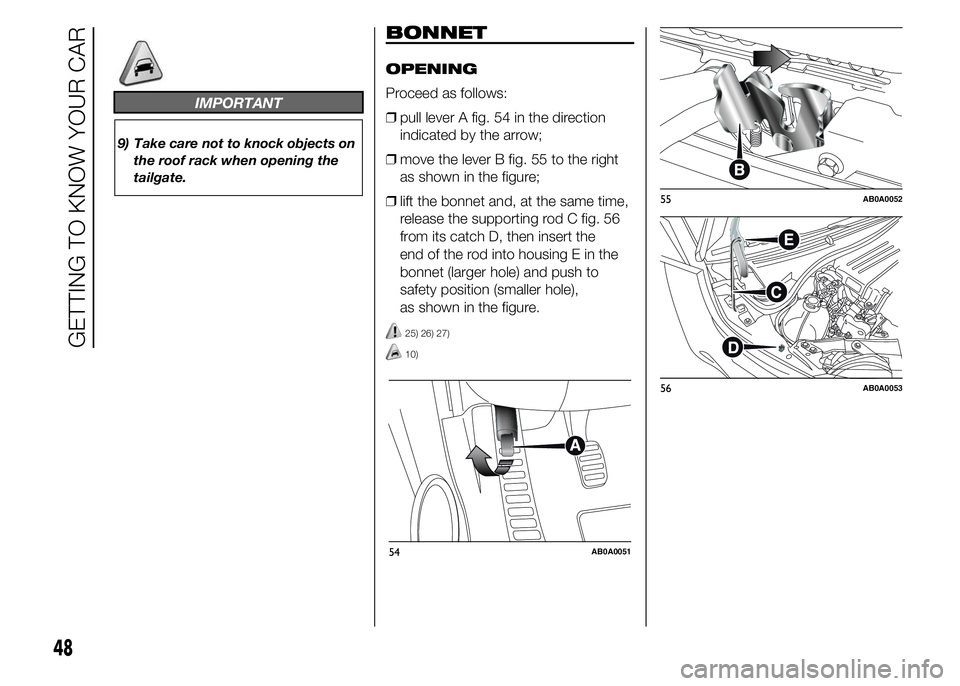
OPENING
Proceed as follows:
❒pull lever A fig. 54 in the direction
indicated by the arrow;
❒move the lever B fig. 55 to the right
as shown in the figure;
❒lift the bonnet and, at the same time,
release the supporting rod C fig. 56
from its catch D, then insert the
end of the rod into housing E in the
bonnet (larger hole) and push to
safety position (smaller hole),
as shown in the figure.
25) 26) 27)
10)
54AB0A0051
55AB0A0052
56AB0A0053
48
GETTING TO KNOW YOUR CAR
Page 53 of 215

CLOSING
Proceed as follows:
❒hold the bonnet up with one hand
and with the other remove rod C
fig. 56 from housing E and fit it back
into its catch D
❒lower the bonnet to approximately 20
centimetres above the engine
compartment and let it come down.
Make sure that the bonnet is
completely closed and not just
secured in safety position. If it is not
perfectly closed, do not try to press
the bonnet down but open it and
repeat the procedure.
28)
WARNING
25) Incorrect positioning of the
supporting rod may cause the
bonnet to drop suddenly. Only
perform these operations when
the car is stationary.
26) When the engine is warm, work
carefully inside the engine
compartment to avoid getting
burnt. Do not place your hands
near the engine fan as it may be
activated even when the key is
removed. Wait for the engine
to cool down.
27) Pay attention to scarves, ties and
other loose-fitting garments. If
they accidentally come into
contact with moving parts, they
may get caught up and dragged
with serious risks for those
wearing them.28) For safety reasons, the bonnet
must always be properly closed
while driving. Make sure that the
bonnet is perfectly closed and
that the lock is engaged. If you
notice when driving that the
bonnet has not been properly
locked, stop immediately
and close the bonnet correctly.
IMPORTANT
10) Before opening the bonnet,
make sure that windscreen wiper
arm is not raised, but is rather
positioned against the
windscreen.
49
Page 100 of 215

Warning lights on
displayWhat it means What to do
amberFUEL RESERVE/LIMITED RANGE
This symbol comes on when the ignition key is
turned to MAR-ON, but it should switch off after a
few seconds.
The symbol switches on in the display when
about 5 litres of fuel are left in the tank.
The triangle on the right side of thesymbol
indicates the side of the car with the fuel filler.IMPORTANT If the symbol flashes or is constantly
on, depending on the version, there is a fault in
the system. If this is the case, go to an Abarth
Dealership to have the system checked.
amberFUEL CUT-OFF
The display will show the symbol and a dedicated
message if the fuel cut-off system intervenes.For the fuel cut-off system reactivation procedure,
refer to the "Fuel cut-off system" section of the
"Controls" paragraph, in the "Knowing your car"
chapter. If it is still not possible to restore the fuel
supply, contact an Abarth Dealership.
amberFUEL CUT-OFF SYSTEM FAILURE
The display will show the symbol and a dedicated
message if the fuel cut-off system is faulty.See the "Fuel cut-off system" paragraph, in the
"Knowing your car" chapter.
red
red
redINCOMPLETE DOOR LOCKING
The symbol on the display switches on, together
with a dedicated message, when one or more
doors, the tailgate or the bonnet (for versions/
markets where provided) are not properly closed.
An acoustic signal is activated with the doors
open and the car moving.
96
KNOWING THE INSTRUMENT PANEL
Page 160 of 215
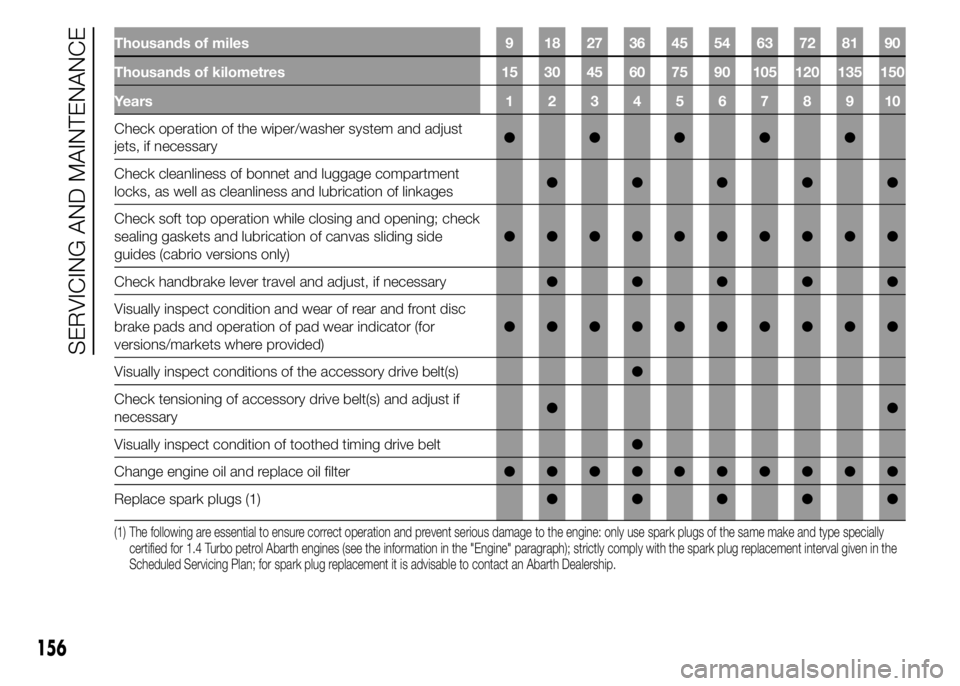
Thousands of miles 9 18 27 36 45 54 63 72 81 90
Thousands of kilometres 15 30 45 60 75 90 105 120 135 150
Years12345678910
Check operation of the wiper/washer system and adjust
jets, if necessary●●●●●
Check cleanliness of bonnet and luggage compartment
locks, as well as cleanliness and lubrication of linkages●●●●●
Check soft top operation while closing and opening; check
sealing gaskets and lubrication of canvas sliding side
guides (cabrio versions only)●●●●●●●●●●
Check handbrake lever travel and adjust, if necessary●●●●●
Visually inspect condition and wear of rear and front disc
brake pads and operation of pad wear indicator (for
versions/markets where provided)●●●●●●●●●●
Visually inspect conditions of the accessory drive belt(s)●
Check tensioning of accessory drive belt(s) and adjust if
necessary●●
Visually inspect condition of toothed timing drive belt●
Change engine oil and replace oil filter●●●●●●●●●●
Replace spark plugs (1)●●●●●
(1) The following are essential to ensure correct operation and prevent serious damage to the engine: only use spark plugs of the same make and type specially
certified for 1.4 Turbo petrol Abarth engines (see the information in the "Engine" paragraph); strictly comply with the spark plug replacement interval given in the
Scheduled Servicing Plan; for spark plug replacement it is advisable to contact an Abarth Dealership.
156
SERVICING AND MAINTENANCE
Page 162 of 215
PERIODIC CHECKS
Every 1,000 km or before long
journeys, check and, if necessary, top
up the following:
❒engine coolant level;
❒brake fluid level;
❒windscreen washer fluid level;
❒tyre inflation pressure and condition;
❒operation of lighting system
(headlights, direction indicators,
hazard warning lights, etc.);
❒operation of screen washer/wiper
system and positioning/wear of
windscreen/rear window wiper
blades.
Every 3,000 km check and, if
necessary, top up: engine oil level.
You are advised to use PETRONAS
LUBRICANTS products, which have
been designed and produced
specifically for Abarth cars (see table
"Capacities" in the "Technical
specifications" chapter).
HEAVY-DUTY USE OF
THE CAR
If the car is used mainly under one of
the following conditions:
❒towing a trailer or caravan;
❒dusty roads;
❒short, repeated journeys (less than
7-8 km) at sub-zero outside
temperatures;
❒engine often idling or driving long
distances at low speeds or long
periods of inactivity;
the following checks must be carried
out more often than indicated in the
Scheduled Servicing Plan:
❒check front disc brake pad condition
and wear;
❒check cleanliness of bonnet and
luggage compartment locks,
cleanliness and lubrication of linkage;
❒visually inspect condition of: engine,
gearbox, transmission, pipes and
hoses (exhaust - fuel system -
brakes) and rubber elements (boots -
sleeves - bushes - etc.);
❒check battery charge and battery
fluid level (electrolyte);
❒visually inspect condition of the
accessory drive belts;❒check and, if necessary, change
engine oil and replace oil filter;
❒check and, if necessary, replace
pollen filter;
❒check and, if necessary, replace air
cleaner.
158
SERVICING AND MAINTENANCE
Page 166 of 215
AIR CLEANER/
POLLEN FILTER
For filter replacement, contact an
Abarth Dealership.
BATTERY
The car is fitted with a low-maintenance
battery: no electrolyte top-ups with
distilled water are needed in standard
conditions of use.
INSPECTING THE
CHARGE AND THE
ELECTROLYTE LEVEL
The operations must be carried out as
described in this Owner Handbook only
by specialised personnel. Any top-up
operations must be carried out by
skilled personnel and by an Abarth
Dealership.
REPLACING THE
BATTERY
136) 137) 138) 139)
33)
4)
If required, replace the battery with an
original spare part with the same
specifications.
If a battery with different specifications
is fitted, the service intervals given in
the "Scheduled Servicing Plan" will no
longer be valid.
Follow the battery manufacturer's
instructions for maintenance.USEFUL ADVICE FOR
EXTENDING THE LIFE OF
YOUR BATTERY
To avoid draining your battery and
make it last longer, observe the
following instructions:
❒when you park the car, ensure that
the doors, tailgate and bonnet are
closed properly, to prevent any lights
from remaining on inside the
passenger compartment;
❒switch off all roof lights inside the car:
the car is however equipped with a
system which switches all interior
lights off automatically;
❒do not keep accessories (e.g. radio,
hazard warning lights, etc.) switched
on for a long time when the engine
is not running;
❒before performing any operation on
the electrical system, disconnect
the negative battery pole;
❒completely tighten the battery
terminals.
IMPORTANT If the charge level remains
under 50% for a long time, the battery
is damaged by sulphation, reducing
its capacity and efficiency at start-up.
162
SERVICING AND MAINTENANCE
Page 172 of 215
Dry the less visible parts with special
care, such as the door frames, bonnet
and the headlight frames, where water
may stagnate more easily. The car
should not be taken to a closed area
immediately, but left outside so that
residual water can evaporate.
Do not wash the car after it has been
left in the sun or with the bonnet hot:
this may alter the shine of the
paintwork.
Exterior plastic parts must be cleaned
in the same way as the rest of the car.
Where possible, do not park under
trees; the resinous substance that
many species release give the paint a
dull appearance and increase the
possibility of triggering rusting
processes.
IMPORTANT Bird droppings must be
washed off immediately and thoroughly
as the acid they contain is particularly
aggressive.
5)
34)
Windows
To clean glasses, use specific cleaning
products.
Use clean cloths to avoid scratching
the glass or damaging the
transparency.
IMPORTANT Wipe the rear window
inside gently with a cloth following the
direction of the filaments to avoid
damaging the heating device.
Headlights
Use a soft cloth soaked in water and
detergent for washing cars.
IMPORTANT Never use aromatic
substances (e.g. petrol) or ketones (e.g.
acetone) for cleaning the plastic lenses
of the headlights.
IMPORTANT When cleaning with a
pressure washer, keep the water jet at
least 20 cm away from the headlights.Engine compartment
Wash the engine compartment
thoroughly at the end of every winter.
Be careful not to direct the jet of water
onto electronic control units.
Adequately protect the upper air
intakes to prevent damage to the
windscreen wiper motor. Have this
operation performed at a specialised
workshop.
IMPORTANT The washing should take
place with the engine cold and the
ignition key in the STOP position. After
the washing operation, make sure
that the various protections (e.g. rubber
caps and guards) have not been
removed or damaged.
IMPORTANT
5) Detergents cause water pollution.
The vehicle should be washed in
areas equipped for collecting
and purifying the liquid used in
the washing process.
168
SERVICING AND MAINTENANCE