fuel pressure Abarth 500 2015 Owner handbook (in English)
[x] Cancel search | Manufacturer: ABARTH, Model Year: 2015, Model line: 500, Model: Abarth 500 2015Pages: 215, PDF Size: 19.08 MB
Page 13 of 215
GETTING TO KNOW YOUR CAR
In-depth knowledge of your new vehicle
starts here.
The handbook that you are reading
simply and directly explains how it
is made and how it works.
That’s why we advise you to read it
seated comfortably on board, so that
you can see what is described here for
yourself.SYMBOLS ...................................... 10
FIAT CODE SYSTEM ....................... 10
THE KEYS....................................... 11
IGNITION SWITCH .......................... 14
SEATS ............................................ 15
HEAD RESTRAINTS ........................ 17
STEERING WHEEL ......................... 18
REAR VIEW MIRRORS .................... 19
CLIMATIC COMFORT ..................... 21
HEATING AND VENTILATION.......... 22
MANUAL CLIMATE CONTROL
SYSTEM ......................................... 24
AUTOMATIC CLIMATE CONTROL
SYSTEM ......................................... 26
EXTERNAL LIGHTS......................... 30
WINDOW CLEANING ...................... 32
ROOF LIGHTS ................................ 33
CONTROLS .................................... 34
INTERIOR FITTINGS ....................... 36
FIXED GLASS ROOF ....................... 40
ELECTRIC SUN ROOF .................... 40
DOORS ........................................... 42
ELECTRIC WINDOWS .................... 44
LUGGAGE COMPARTMENT ........... 45
BONNET ......................................... 48
ROOF RACK/SKI RACK .................. 50
HEADLIGHTS.................................. 51ESC SYSTEM ................................. 52
ITPMS (INDIRECT TYRE
PRESSURE MONITORING
SYSTEM) ........................................ 56
EOBD SYSTEM............................... 59
DUALDRIVE ELECTRIC POWER
STEERING ...................................... 59
RADIO SYSTEM .............................. 60
ACCESSORIES PURCHASED BY
THE OWNER................................... 60
PARKING SENSORS....................... 62
REFUELLING THE CAR .................. 64
PROTECTING THE
ENVIRONMENT .............................. 65
9
Page 62 of 215
OPERATING CONDITIONS
48), 49), 50), 51), 52), 53)
The system is active for speeds above
15 km/h.
In a few situations such as sporty
driving, particular conditions of the road
surface (e.g. icy, snowy, unsurfaced
roads...) the signalling may be delayed
or partial in detecting the contemporary
deflation of more than one tyre.
Under special conditions (e.g. car
loaded asymmetrically on one side,
damaged or worn tyre, fitting the
space-saver wheel, fitting snow chains,
fitting different tyres on the axles) the
system may give false indications or be
temporarily deactivated.
If the system is temporarily deactivated
the
warning light flashes for about
75 seconds and then is continuously
on; at the same time, the display shows
a warning message.
This indication is displayed also after
the engine has been switched off and
then on again if the correct operating
conditions are not restored.
WARNING
48) If the system signals a pressure
decrease on a specific tyre, it is
recommended to check the
pressure on all four tyres.
49) iTPMS does not relieve the
driver from the obligation to check
the tyre pressure every month; it
is not even to be considered a
replacing system for maintenance
or a safety system.
50) Tyre pressure must be checked
with tyres cold. Should it become
necessary for whatever reason
to check pressure with warm
tyres, do not reduce pressure
even though it is higher than the
prescribed value, but repeat the
check when tyres are cold.
51) The iTPMS cannot indicate
sudden tyre pressure drops (for
example when a tyre bursts).
In this case, stop the car, braking
with caution and avoiding abrupt
steering.
52) The system only warns that the
tyre pressure is low: it is not able
to inflate them.53) Insufficient tyre inflation
increases fuel consumption,
reduces the tread duration and
may affect the capacity to drive
safely.
58
GETTING TO KNOW YOUR CAR
Page 68 of 215
IMPORTANT
11) The sensors must be clean of
mud, dirt, snow or ice in order
for the system to operate
correctly. Be careful not to
scratch or damage the sensors
while cleaning them. Avoid using
dry, rough or hard cloths. The
sensors must be washed using
clean water, with the addition of
car shampoo if necessary. When
using special washing equipment
such as high pressure jets or
steam cleaning, clean the sensors
very quickly keeping the jet more
than 10 cm away.
WARNING
57) Parking and other dangerous
manoeuvres are, however, always
the driver’s responsibility. While
carrying out these manoeuvres,
always make sure that no people
(especially children) or animals are
in the area concerned. The
parking sensors are an aid for the
driver, but the driver must never
allow their attention to lapse
during potentially dangerous
manoeuvres, even those executed
at low speeds.
REFUELLING THE
CAR
IN BRIEF
Stop the engine before refuelling.
Only refuel with unleaded petrol with
octane rating (RON) not less than
95, in compliance with the European
specification EN 228.
In order to prevent damage to the
catalytic converter never introduce
even the smallest amount of leaded
petrol, even in the event of an
emergency.
IMPORTANT An inefficient catalytic
converter leads to harmful exhaust
emissions, thus contributing to air
pollution.
IMPORTANT Never use leaded petrol,
even in small amounts or in an
emergency, as this would damage the
catalytic converter beyond repair.
64
GETTING TO KNOW YOUR CAR
Page 69 of 215
FILLING THE TANK
To fill the tank completely, top-up twice
after the first click of the fuel supply
gun. Further top-ups could cause faults
in the fuel supply system.
FUEL TANK PLUG
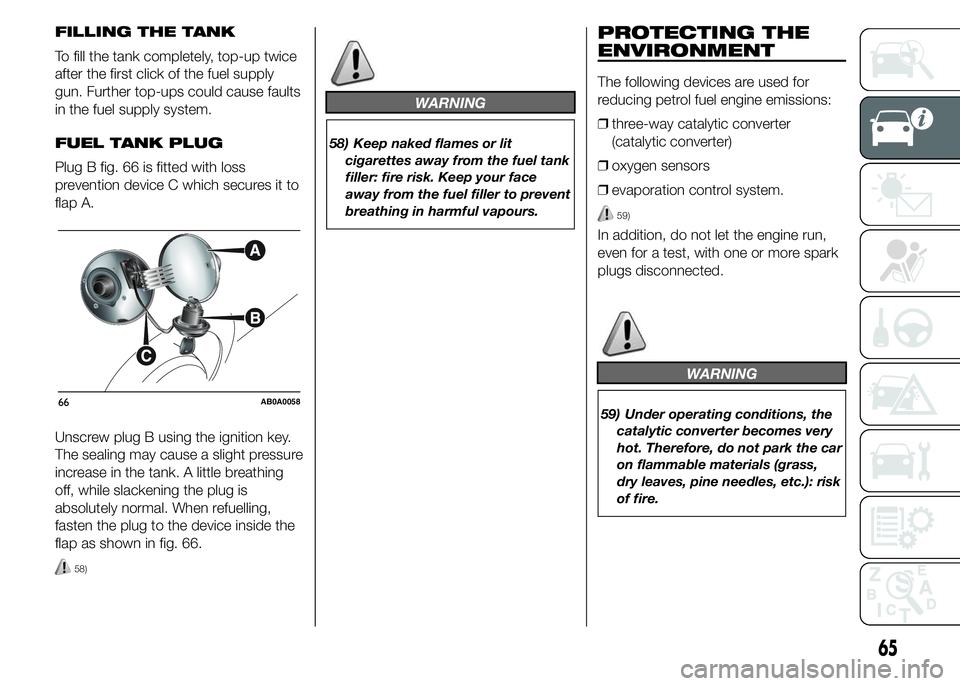
Plug B fig. 66 is fitted with loss
prevention device C which secures it to
flap A.
Unscrew plug B using the ignition key.
The sealing may cause a slight pressure
increase in the tank. A little breathing
off, while slackening the plug is
absolutely normal. When refuelling,
fasten the plug to the device inside the
flap as shown in fig. 66.
58)
WARNING
58) Keep naked flames or lit
cigarettes away from the fuel tank
filler: fire risk. Keep your face
away from the fuel filler to prevent
breathing in harmful vapours.
PROTECTING THE
ENVIRONMENT
The following devices are used for
reducing petrol fuel engine emissions:
❒three-way catalytic converter
(catalytic converter)
❒oxygen sensors
❒evaporation control system.
59)
In addition, do not let the engine run,
even for a test, with one or more spark
plugs disconnected.
WARNING
59) Under operating conditions, the
catalytic converter becomes very
hot. Therefore, do not park the car
on flammable materials (grass,
dry leaves, pine needles, etc.): risk
of fire.66AB0A0058
65
Page 71 of 215
KNOWING THE INSTRUMENT PANEL
This section of the handbook gives you
all the information you need to
understand, interpret and use the
instrument panel correctly.DISPLAY ......................................... 68
MENU ITEMS .................................. 71
CONTROL PANEL AND
ON-BOARD INSTRUMENTS ........... 78
TRIP COMPUTER ........................... 80
WARNING LIGHTS AND
MESSAGES .................................... 83
- LOW BRAKE FLUID/HANDBRAKE
ENGAGED .......................................... 83
- EBD FAILURE .................................. 84
- AIRBAG FAILURE ............................. 84
- SEAT BELTS NOT FASTENED .......... 85
- ABS FAILURE ................................... 86
- PASSENGER SIDE AIRBAG
DEACTIVATED .................................... 86
- INJECTION/EOBD SYSTEM
FAILURE ............................................. 87
- ELECTRONIC STABILITY CONTROL
(ESC) SYSTEM ................................... 88
- SIDE LIGHTS AND DIPPED
HEADLIGHTS ..................................... 89
- FOLLOW ME HOME ........................ 89
- LEFT-HAND DIRECTION INDICATOR
............................................................ 89
- RIGHT-HAND DIRECTION
INDICATOR ........................................ 90
- MAIN BEAM HEADLIGHTS .............. 90
-FOG LIGHTS ..................................... 90
-REAR FOG LIGHT ............................. 90
-WORN BRAKE PADS ........................ 91
-DUALDRIVE ELECTRIC POWER
STEERING FAILURE ........................... 91
- INSUFFICIENT ENGINE OIL
PRESSURE/ENGINE OIL
DETERIORATED ................................. 92
-ENGINE OIL DETERIORATED ........... 93
- ENGINE COOLANT TEMPERATURE
TOO HIGH .......................................... 94-LOW BATTERY CHARGE .................. 95
-HILL HOLDER FAILURE .................... 95
- FIAT CODE SYSTEM FAILURE ......... 95
- FUEL RESERVE/LIMITED RANGE .... 96
- FUEL CUT-OFF ................................ 96
- FUEL CUT-OFF SYSTEM FAILURE ... 96
-INCOMPLETE DOOR LOCKING ........ 96
-EXTERIOR LIGHTS FAILURE ............. 97
-ASR SYSTEM ................................... 97
- POSSIBLE ICE ON ROAD ................ 97
- BRAKE LIGHT FAILURE ................... 97
- PARKING SENSOR FAILURE ........... 97
-iTPMS ............................................... 98
-SERVICE (SCHEDULED SERVICING)
............................................................ 99
-SPEED LIMIT EXCEEDED ................. 99
-ENGAGEMENT OF SPORT
FUNCTION ......................................... 99
67
Page 83 of 215
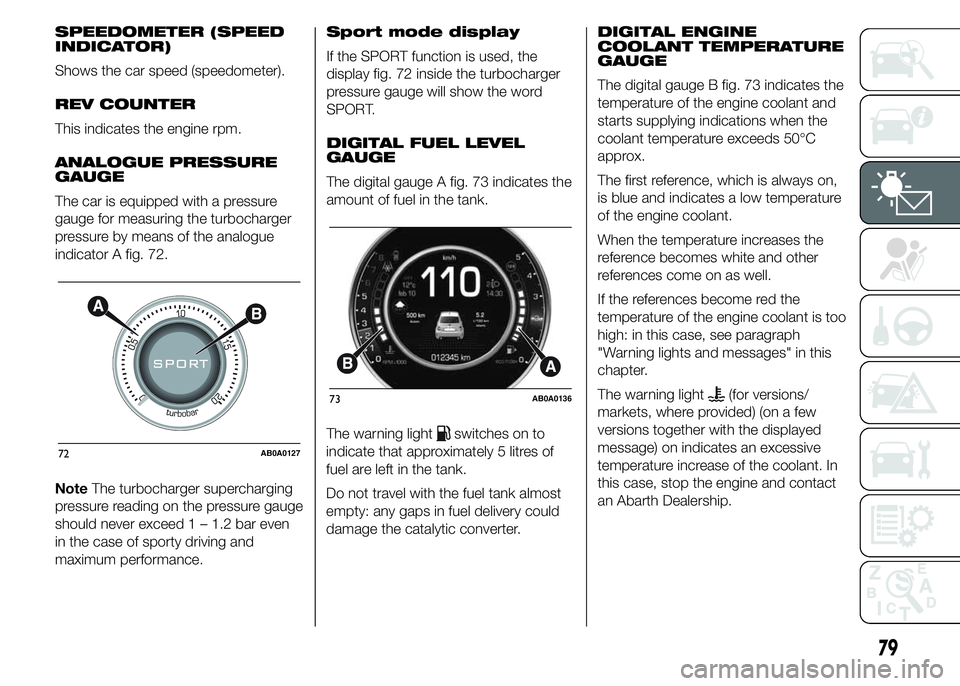
SPEEDOMETER (SPEED
INDICATOR)
Shows the car speed (speedometer).
REV COUNTER
This indicates the engine rpm.
ANALOGUE PRESSURE
GAUGE
The car is equipped with a pressure
gauge for measuring the turbocharger
pressure by means of the analogue
indicator A fig. 72.
NoteThe turbocharger supercharging
pressure reading on the pressure gauge
should never exceed 1 – 1.2 bar even
in the case of sporty driving and
maximum performance.Sport mode display
If the SPORT function is used, the
display fig. 72 inside the turbocharger
pressure gauge will show the word
SPORT.
DIGITAL FUEL LEVEL
GAUGE
The digital gauge A fig. 73 indicates the
amount of fuel in the tank.
The warning light
switches on to
indicate that approximately 5 litres of
fuel are left in the tank.
Do not travel with the fuel tank almost
empty: any gaps in fuel delivery could
damage the catalytic converter.DIGITAL ENGINE
COOLANT TEMPERATURE
GAUGE
The digital gauge B fig. 73 indicates the
temperature of the engine coolant and
starts supplying indications when the
coolant temperature exceeds 50°C
approx.
The first reference, which is always on,
is blue and indicates a low temperature
of the engine coolant.
When the temperature increases the
reference becomes white and other
references come on as well.
If the references become red the
temperature of the engine coolant is too
high: in this case, see paragraph
"Warning lights and messages" in this
chapter.
The warning light
(for versions/
markets, where provided) (on a few
versions together with the displayed
message) on indicates an excessive
temperature increase of the coolant. In
this case, stop the engine and contact
an Abarth Dealership.
72AB0A0127
73AB0A0136
79
Page 85 of 215

VALUES DISPLAYED
Range (for versions/markets, where
provided)
This indicates the distance that can still
be travelled with the fuel in the tank,
assuming that driving style remains
unvaried. The display will show the
reading "----"when the following
events take place:
❒range value lower than 50 km (or 30
mi)
❒car parked with engine running for a
long period.
IMPORTANT The range can be affected
by several factors: driving style (see
"Driving style" paragraph in the
"Starting and driving" chapter), type of
route (motorway, towns and cities,
mountain roads, etc.), conditions of use
(load, tyre pressure, etc.). Trip planning
must therefore take the above into
account.
Distance travelled
This value shows the distance covered
from the start of the new journey.Average consumption
This value shows the approximate
average fuel consumption from the start
of the new journey.
Instant consumption (for versions/
markets, where provided)
This value shows the fuel consumption.
The value is constantly updated. The
display will show "----"ifthecar
is parked with the engine running.
Average speed
This value shows the car's average
speed based on the overall time
elapsed since the start of the new
journey.
Trip time
Time elapsed since the start of the new
journey.TRIP BUTTON
The TRIP button is located on the
right-hand stalk fig. 74. With the ignition
key turned to MAR-ON, this button
allows you to view the previously
described values and also zero them to
begin a new mission:
❒brief pressto access the various
value displays;
❒long pressto reset and then start a
new mission.
TRIPTRIP
74AB0A0140
81
Page 102 of 215

Warning lights on
displayWhat it means What to do
amberiTPMS
(for versions/markets, where provided)
When the key is turned to MAR-ON, the warning
light switches on but it should switch off after a
few seconds.IMPORTANT Do not continue driving with one or
more flat tyres as handling may be compromised.
Stop the vehicle, avoiding sharp braking and
steering.
Low tyre pressure
The warning light switches to indicate that the
pressure of one or more tyres is lower than the
recommended value, in order to guarantee long
tyre life and low fuel consumption, or to indicate a
slow loss of pressure.
In this way the iTPMS warns the driver that one or
more tyres may be flat and probably punctured.In this case it is advisable to restore the correct
pressure value (see the "Wheels" paragraph in the
"Technical specifications" section).
Once the normal operating conditions of the
vehicle are restored, carry out the Reset
procedure.
iTPMS failure/iTPMS temporarily deactivated
The warning light flashes for about 75 seconds
and then stays on constantly (together with a
message on the display) (see “Operating
conditions” paragraph) to indicate that the system
is temporarily deactivated or faulty.
The system goes back to normal operation when
the operating conditions allow it. If this is not the
case, carry out the Reset procedure after
restoring the normal operating conditions.If the malfunction warning persists, contact an
Abarth Dealership as soon as possible.
98
KNOWING THE INSTRUMENT PANEL
Page 129 of 215
SAVING FUEL
GENERAL
CONSIDERATIONS
Car maintenance
Checks and adjustments should be
carried out in accordance with the
"Scheduled Servicing Plan" (see
chapter "Maintenance and care").
Tyres
Check the tyre pressures at least once
every four weeks: if the pressure is
too low, consumption levels increase as
resistance to rolling is higher.
Unnecessary loads
Do not travel with an overloaded
luggage compartment. The weight of
the car and its arrangement greatly
affect fuel consumption and stability.
When transporting particularly large
objects, use a trailer if possible.
Roof rack/ski rack
Remove the roof rack or the ski rack
from the roof after use. These
accessories lower aerodynamic
penetration and adversely affect
consumption levels.Electrical devices
Use electrical devices only for the
amount of time needed. The heated
rear window, additional headlights,
screen wipers and heater fan require a
considerable amount of energy;
increasing the current uptake increases
fuel consumption (by up to +25% in
an urban cycle).
Climate control system
Using the climate control system will
increase consumption: use the air vents
when the temperature outside permits.
Devices for
aerodynamic control
The use of non-certified devices for
aerodynamic control may adversely
affect air drag and consumption levels.
DRIVING STYLE
Cranking
Do not warm up the engine at low or
high revs when the car is stationary;
this causes the engine to warm up
more slowly, thereby increasing fuel
consumption and emissions. It is
therefore advisable to move off
immediately, slowly, avoiding high
speeds: in this way the engine will
warm up more quickly.Unnecessary actions
Avoid accelerating when stopped at
traffic lights or before switching off the
engine. The latter action, as well as
double-declutching, is unnecessary and
causes increased fuel consumption
and pollution.
Gear selection
Use a high gear when traffic and road
conditions allow it. Using a low gear for
faster acceleration will increase
consumption. In the same way
improper use of a high gear increases
consumption, emissions and engine
wear.
Max. speed
Fuel consumption considerably
increases as speed increases. Maintain
a constant speed, avoiding
unnecessary braking and acceleration,
which cost in terms of both fuel
consumption and emissions.
Acceleration
Accelerating violently severely affects
consumption and emissions:
acceleration should be gradual and
should not exceed the maximum
torque.
125
Page 159 of 215
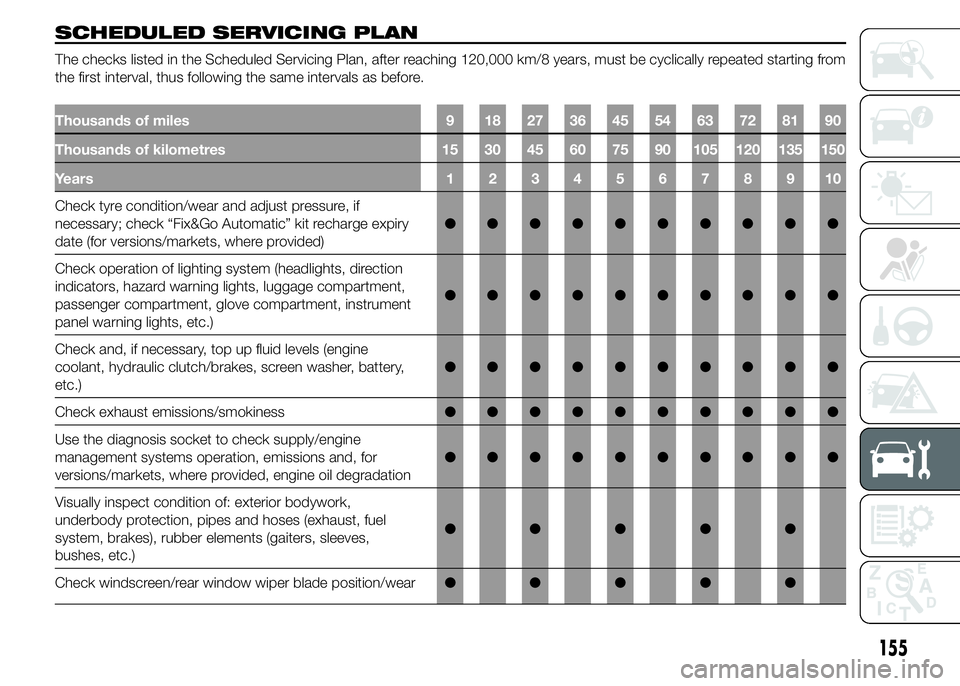
SCHEDULED SERVICING PLAN
The checks listed in the Scheduled Servicing Plan, after reaching 120,000 km/8 years, must be cyclically repeated starting from
the first interval, thus following the same intervals as before.
Thousands of miles 9 18 27 36 45 54 63 72 81 90
Thousands of kilometres 15 30 45 60 75 90 105 120 135 150
Years12345678910
Check tyre condition/wear and adjust pressure, if
necessary; check “Fix&Go Automatic” kit recharge expiry
date (for versions/markets, where provided)●●●●●●●●●●
Check operation of lighting system (headlights, direction
indicators, hazard warning lights, luggage compartment,
passenger compartment, glove compartment, instrument
panel warning lights, etc.)●●●●●●●●●●
Check and, if necessary, top up fluid levels (engine
coolant, hydraulic clutch/brakes, screen washer, battery,
etc.)●●●●●●●●●●
Check exhaust emissions/smokiness●●●●●●●●●●
Use the diagnosis socket to check supply/engine
management systems operation, emissions and, for
versions/markets, where provided, engine oil degradation●●●●●●●●●●
Visually inspect condition of: exterior bodywork,
underbody protection, pipes and hoses (exhaust, fuel
system, brakes), rubber elements (gaiters, sleeves,
bushes, etc.)●●●●●
Check windscreen/rear window wiper blade position/wear●●●●●
155