belt Abarth 500 2016 Owner handbook (in English)
[x] Cancel search | Manufacturer: ABARTH, Model Year: 2016, Model line: 500, Model: Abarth 500 2016Pages: 215, PDF Size: 19.08 MB
Page 109 of 215
69) Removing or otherwise
tampering with seat belt and
pretensioner components is
strictly prohibited. Any operations
on these components must be
performed by qualified and
authorised technicians. Always
contact an Abarth Dealership.
70) If the belt has been subjected to
a high level of stress, for example
after an accident, it must be
completely replaced together with
the attachments, attachment
fixing screws and the
pretensioner. In fact, even if the
belt has no visible defects, it could
have lost its resilience.
IMPORTANT
15) Operations which lead to
impacts, vibrations or localised
heating (over 100°C for a
maximum of six hours) in the area
around the pretensioner may
damage or deploy it. Contact an
Abarth Dealership should
intervention be necessary on
these components.
CARRYING
CHILDREN SAFELY
For optimal protection in the event of an
impact, all occupants must be seated
and wearing adequate restraint
systems, including newborn and
children!
This prescription is compulsory in all EC
countries according to EC Directive
2003/20/EC.
Compared with an adult, a child's head
is larger and heavier in proportion to
their body and the child's muscular and
bone structures are not fully developed.
Therefore, correct restraint systems
other than adult seat belts are
necessary to reduce as much as
possible the risk of injuries in case of
accident, braking or sudden
manoeuvre.
Children must be seated safely and
comfortably. Depending on the
characteristics of the child restraint
systems used, you are advised to keep
children in rear facing child restraint
systems for as long as possible (at least
until 3–4 years old), since this is the
most protected position in the event of
an impact.
71) 72) 73)
16)
The choice of the most suitable child
restraint device depends on the weight
of the child; there are various types of
child restraint systems and you are
advised always to choose the one that
is most suitable for the child.
When over 1.50 m in height, from the
point of view of restraint systems,
children are considered as adults and
wear seat belts normally.
In Europe the characteristics of child
restraint systems are ruled by the
regulation ECE-R44, dividing them into
five weight groups:
Group Weight range
Group0 upto10kg
Group 0+ up to 13 kg
Group 1 9-18 kg
Group 2 15-25 kg
Group 3 22-36 kg
105
Page 111 of 215
FITTING
"UNIVERSAL" CHILD
RESTRAINT SYSTEM
(with seat belts)
GROUP 0 and 0+
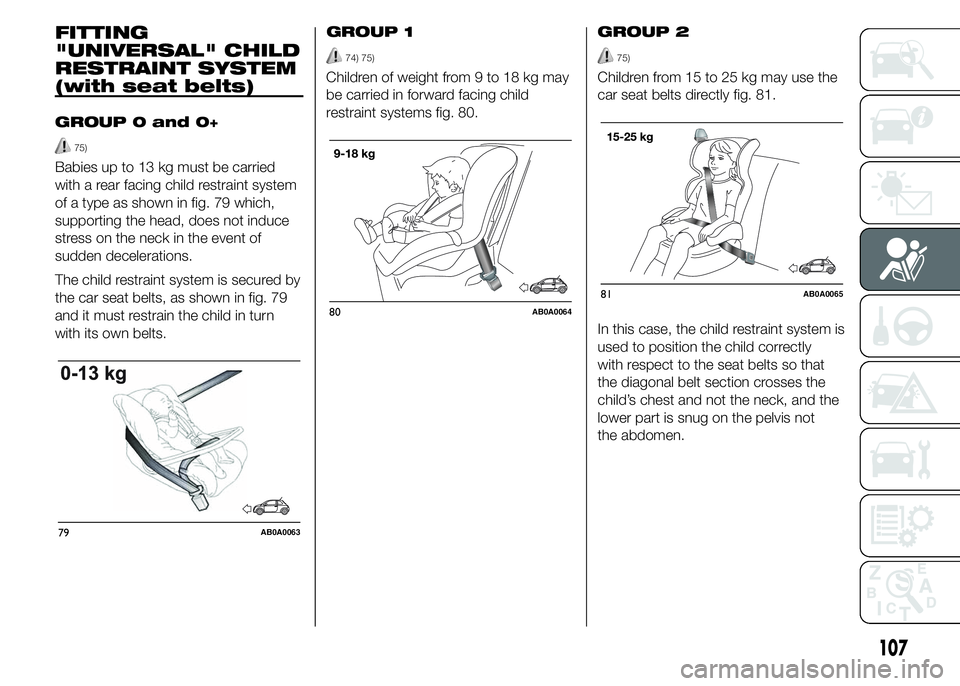
75)
Babies up to 13 kg must be carried
with a rear facing child restraint system
of a type as shown in fig. 79 which,
supporting the head, does not induce
stress on the neck in the event of
sudden decelerations.
The child restraint system is secured by
the car seat belts, as shown in fig. 79
and it must restrain the child in turn
with its own belts.GROUP 1
74) 75)
Children of weight from 9 to 18 kg may
be carried in forward facing child
restraint systems fig. 80.GROUP 2
75)
Children from 15 to 25 kg may use the
car seat belts directly fig. 81.
In this case, the child restraint system is
used to position the child correctly
with respect to the seat belts so that
the diagonal belt section crosses the
child’s chest and not the neck, and the
lower part is snug on the pelvis not
the abdomen.
79AB0A0063
80AB0A0064
81AB0A0065
107
Page 112 of 215
GROUP 3
75)
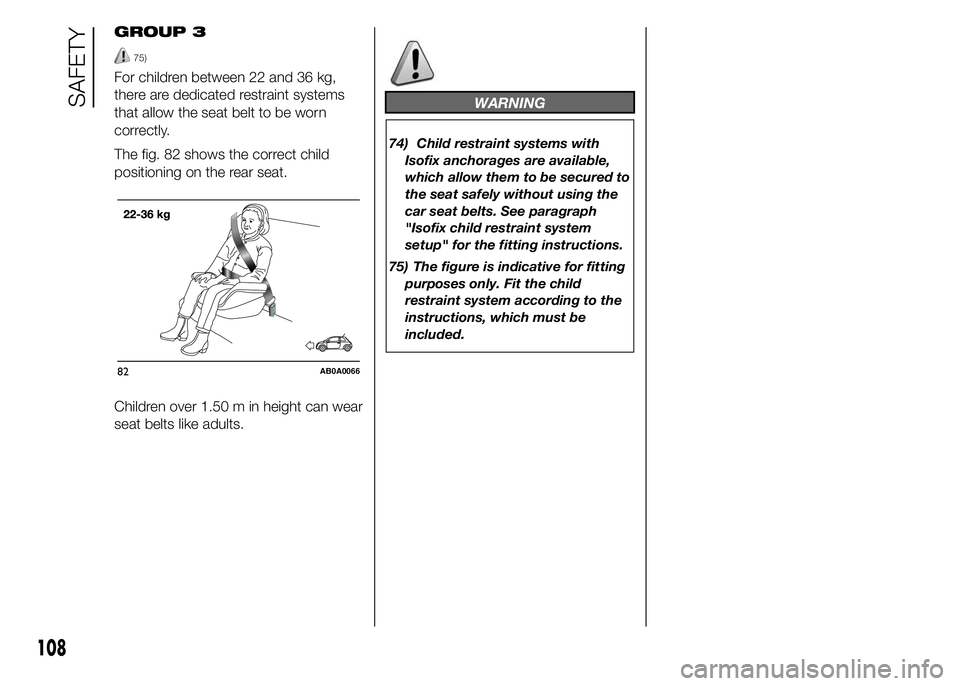
For children between 22 and 36 kg,
there are dedicated restraint systems
that allow the seat belt to be worn
correctly.
The fig. 82 shows the correct child
positioning on the rear seat.
Children over 1.50 m in height can wear
seat belts like adults.
WARNING
74) Child restraint systems with
Isofix anchorages are available,
which allow them to be secured to
the seat safely without using the
car seat belts. See paragraph
"Isofix child restraint system
setup" for the fitting instructions.
75) The figure is indicative for fitting
purposes only. Fit the child
restraint system according to the
instructions, which must be
included.
82AB0A0066
108
SAFETY
Page 117 of 215
Main recommendations
to carry children safely
❒Install the child restraint systems
on the rear seat, which is the most
protected position in the event of an
impact.
❒Keep children in rear facing child
restraint systems for as long as
possible, at least until 2 years old.
❒Should a rear facing child restraint
system be installed on the rear seats,
it is advisable to position it as far
forward as the position of the front
seat allows.
❒If the passenger's front airbag is
deactivated always check the
permanent switching on of the
warning light to make sure that it
has actually been deactivated.
❒Carefully follow the instructions
supplied with the child restraint
system itself. Keep the instructions in
the car along with the other
documents and this handbook. Do
not use second-hand child restraint
systems without instructions.
❒Only one child is to be strapped into
each restraint system; never carry
two children simultaneously.
❒Always check that the seat belts do
not rest on the child’s neck.❒Always check that the seat belt is
well fastened by pulling on it.
❒While travelling, do not let the child sit
incorrectly or unfasten the belts.
❒Never allow a child to put the belt's
diagonal section under an arm or
behind their back.
❒Never carry children on your lap,
even newborns. No-one can restrain
a child in the event of an accident.
❒In the event of an accident, replace
the child restraint system with a
new one.
WARNING
76) The figure is indicative for fitting
purposes only. Fit the child
restraint system according to the
instructions, which must be
included.
77) If a Universal Isofix child
restraint system is not fixed to all
three anchorages, it will not be
able to protect the child correctly.
In a crash, the child could be
seriously or fatally injured.
78) Fit the child restraint system only
when the car is stationary. The
child restraint system is correctly
secured to the brackets when
you hear the click. Follow the
instructions for assembly,
disassembly and positioning that
the manufacturer must supply
with the child restraint system.
79) Fit the child restraint system
according to the instructions,
which must be included.
113
Page 118 of 215

FRONT AIRBAGS
The front driver/passenger airbags and
the driver's knee bag (for versions/
markets, where provided) protect the
front seat occupants in the event of
frontal impacts of medium/high severity,
by placing the bag between the
occupant and the steering wheel or
dashboard.
Therefore non-activation in other types
of collisions (side impacts, rear shunts,
roll-overs, etc.) does not indicate a
system malfunction.
An electronic control unit will make the
bag inflate in the event of a frontal
impact.
The bag will inflate instantaneously
placing itself between the front
occupants body and the structures
which could cause injury. It will deflate
immediately afterwards.
Front airbags are not a replacement of
but complementary to the seat belts,
which you are recommended to always
wear, as specified by law in Europe
and most non-European countries.In the event of an impact, someone not
wearing a seat belt will move forward
and come into contact with the bag
which is still in the opening stage. The
protection offered by the bag is
compromised in these circumstances.
Front airbags may not be activated
in the following situations:
❒frontal impacts against highly
deformable objects not involving the
front surface of the car (e.g. wing
collision against guard rail);
❒jamming of the car underneath other
vehicles or protective barriers (e.g.
underneath a truck or a guard rail)
since the bags would offer no
additional protection with respect to
the seat belt and their deployment
would be inappropriate. In these
cases, non-deployment does not
indicate a system malfunction.
80)
The front airbags (driver, passenger,
driver's knee bags) are designed and
calibrated to protect front seat
passengers wearing seat belts.Their volume at the moment of
maximum inflation fills most of the
space between the steering wheel and
the driver, between the lower steering
column guard and the knees on driver
side and between the dashboard and
the passenger.
The airbags are not deployed in the
event of minor frontal impacts (for
which the restraining action of the seat
belts is sufficient). Seat belts must
always be worn. In the event of frontal
impacts they guarantee correct
positioning of the passenger.
DRIVER'S SIDE FRONT
AIRBAG
This consists of an instantly inflating
cushion contained in a special
compartment in the centre of the
steering wheel fig. 86.
86AB0A0070
114
SAFETY
Page 124 of 215

88) Always drive keeping your hands
on the steering wheel rim so that
the airbag can inflate freely if
necessary. Do not drive with your
body bent forward. Keep your
back straight against the
backrest.
89) If the car has been subject to
theft, attempted theft, vandalism,
or flooding, have the airbag
system inspected at an Abarth
Dealership.90) Airbags may be deployed if
another vehicle crashes into the
car, if the key is inserted and
at MAR-ON even if the engine is
not running and the car is
stationary. Therefore, even if the
car is stationary, when an active
front passenger airbag is fitted,
DO NOT install rear facing child
restraint systems on the front
passenger seat. Deployment of
the airbag following an impact
could cause fatal injuries to the
child. Therefore, always
deactivate the passenger airbag
when a rear facing child restraint
system is installed on the front
passenger seat. The front
passenger seat must also be
positioned back as far as possible
in order to prevent the child
restraint system from coming into
contact with the dashboard.
Immediately reactivate the
passenger airbag as soon as the
child restraint system has been
removed. Also remember that,
if the key is turned to STOP, none
of the safety devices (airbags or
pretensioners) will be deployed in
the event of collision. Non-
deployment in such cases does
not indicate a system malfunction.91) When the ignition key is turned
to MAR-ON, the
warning light
turns on and flashes for a few
seconds to remind you that the
passenger's airbag will be
deployed in a crash, after which it
should switch off.
92) Do not wash the seats with
water or pressurised steam (wash
by hand or at automatic car seat
washing stations).
93) The front airbag deployment
threshold is higher than that of
the pretensioners. For collisions in
the range between the two
thresholds, it is normal for only
the pretensioners to be activated.
94) Do not affix rigid objects to the
coat hooks or support handles.
95) The airbag does not replace seat
belts but increases their
effectiveness. Furthermore, since
front airbags are not deployed
in low-speed frontal impacts, side
impacts, rear shunts or roll-overs,
the passengers are protected
only by the seat belts which must
therefore be fastened at all times.
120
SAFETY
Page 160 of 215
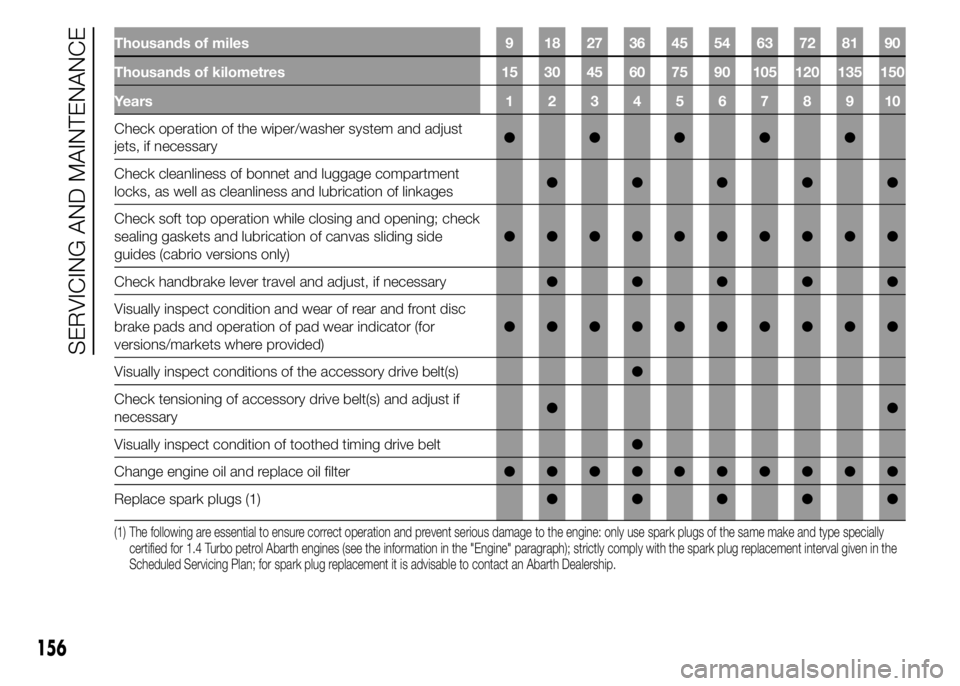
Thousands of miles 9 18 27 36 45 54 63 72 81 90
Thousands of kilometres 15 30 45 60 75 90 105 120 135 150
Years12345678910
Check operation of the wiper/washer system and adjust
jets, if necessary●●●●●
Check cleanliness of bonnet and luggage compartment
locks, as well as cleanliness and lubrication of linkages●●●●●
Check soft top operation while closing and opening; check
sealing gaskets and lubrication of canvas sliding side
guides (cabrio versions only)●●●●●●●●●●
Check handbrake lever travel and adjust, if necessary●●●●●
Visually inspect condition and wear of rear and front disc
brake pads and operation of pad wear indicator (for
versions/markets where provided)●●●●●●●●●●
Visually inspect conditions of the accessory drive belt(s)●
Check tensioning of accessory drive belt(s) and adjust if
necessary●●
Visually inspect condition of toothed timing drive belt●
Change engine oil and replace oil filter●●●●●●●●●●
Replace spark plugs (1)●●●●●
(1) The following are essential to ensure correct operation and prevent serious damage to the engine: only use spark plugs of the same make and type specially
certified for 1.4 Turbo petrol Abarth engines (see the information in the "Engine" paragraph); strictly comply with the spark plug replacement interval given in the
Scheduled Servicing Plan; for spark plug replacement it is advisable to contact an Abarth Dealership.
156
SERVICING AND MAINTENANCE
Page 161 of 215

Thousands of miles 9 18 27 36 45 54 63 72 81 90
Thousands of kilometres 15 30 45 60 75 90 105 120 135 150
Years12345678910
Replace the toothed timing drive belt(2)
Replace accessory drive belt(s)(2)
Replace air cleaner cartridge (3)●●●●●
Change the brake fluid●●●●●
Replace passenger compartment cleaner (3) (O) (●)O●O●O●O●O●
(2) Areas that are not dusty: advised maximum mileage 120,000 km. Regardless of the mileage, the belt must be replaced every 6 years.
Dusty areas and/or demanding use (cold climates, town use, long periods of idling): advised maximum mileage 60,000 km. Regardless of the mileage,
the belt
must be replaced every 4 years.
(3) If the car is used in dusty areas, this cleaner must be replaced every 15,000 km
(O) Recommended operations
(●) Mandatory operations
157
Page 162 of 215
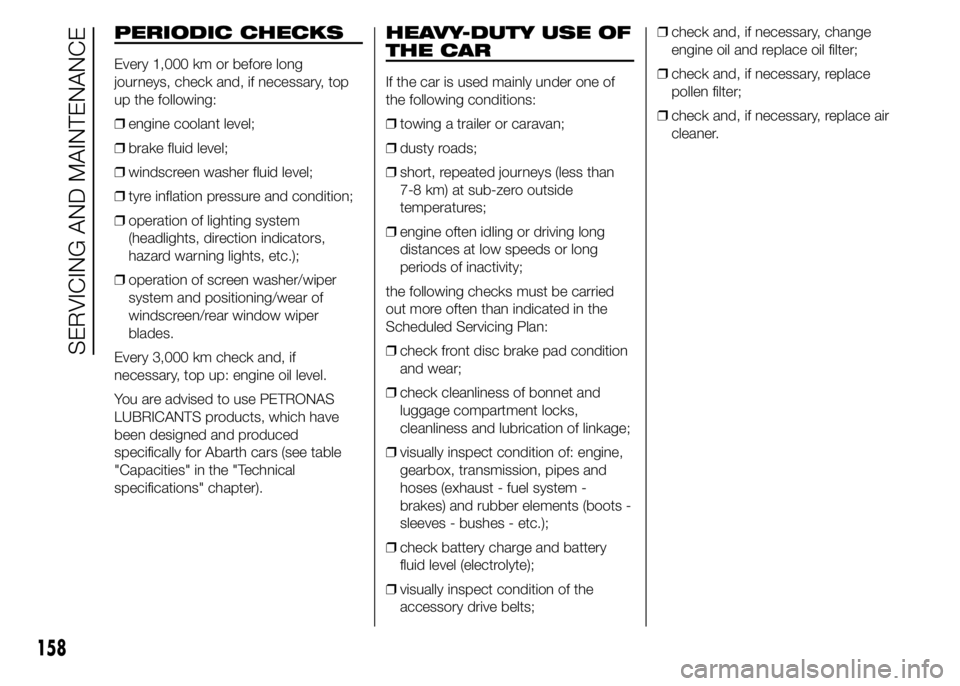
PERIODIC CHECKS
Every 1,000 km or before long
journeys, check and, if necessary, top
up the following:
❒engine coolant level;
❒brake fluid level;
❒windscreen washer fluid level;
❒tyre inflation pressure and condition;
❒operation of lighting system
(headlights, direction indicators,
hazard warning lights, etc.);
❒operation of screen washer/wiper
system and positioning/wear of
windscreen/rear window wiper
blades.
Every 3,000 km check and, if
necessary, top up: engine oil level.
You are advised to use PETRONAS
LUBRICANTS products, which have
been designed and produced
specifically for Abarth cars (see table
"Capacities" in the "Technical
specifications" chapter).
HEAVY-DUTY USE OF
THE CAR
If the car is used mainly under one of
the following conditions:
❒towing a trailer or caravan;
❒dusty roads;
❒short, repeated journeys (less than
7-8 km) at sub-zero outside
temperatures;
❒engine often idling or driving long
distances at low speeds or long
periods of inactivity;
the following checks must be carried
out more often than indicated in the
Scheduled Servicing Plan:
❒check front disc brake pad condition
and wear;
❒check cleanliness of bonnet and
luggage compartment locks,
cleanliness and lubrication of linkage;
❒visually inspect condition of: engine,
gearbox, transmission, pipes and
hoses (exhaust - fuel system -
brakes) and rubber elements (boots -
sleeves - bushes - etc.);
❒check battery charge and battery
fluid level (electrolyte);
❒visually inspect condition of the
accessory drive belts;❒check and, if necessary, change
engine oil and replace oil filter;
❒check and, if necessary, replace
pollen filter;
❒check and, if necessary, replace air
cleaner.
158
SERVICING AND MAINTENANCE
Page 213 of 215

Refuelling the car ........................... 64
Replacing an exterior bulb .............. 139
Replacing an interior bulb ............... 142
Rev counter ................................... 79
Rim Protector (tyres)....................... 181
Rims and tyres ............................... 180
Roof lights...................................... 33
Roof rack/ski rack .......................... 50
Rubber hoses ................................ 165
Safety ........................................... 102
– seat belts .................................. 102
Saving fuel ..................................... 125
SBR system ................................... 102
Scheduled Servicing Plan ............... 155
Seat belts
– using the seat belts ................... 102
Seat belts (maintenance) ................ 104
Seats ............................................. 15
– Front seats ................................ 15
Sensors
– parking ...................................... 62
Side airbags (Side bags -
Window bags) .............................. 118
Side bags (front side airbags) ......... 118
Side lights/daytime running lights
(bulb replacement) ....................... 140
Snow chains .................................. 127
Snow tyres ..................................... 127
Speedometer ................................. 79
Sport front seats ............................ 16SPORT .......................................... 34
Starting the engine ......................... 122
Starting the engine ......................... 130
Steering ......................................... 179
Steering wheel ............................... 18
Storage compartment .................... 37
Storage compartment under
passenger seat ............................ 38
Sun roof ......................................... 40
Sun visors ...................................... 37
Supplies ......................................... 187
Suspension .................................... 178
Symbols......................................... 10
Technical specifications ................ 172
The keys ........................................ 11
– CODE Card ............................... 11
– Key without remote control........ 11
– Key with remote control............. 12
Third brake lights (bulb
replacement) ................................ 141
Towing the car ............................... 150
Towing trailers ................................ 126
Transmission .................................. 176
TRIP button.................................... 81
Trip Computer ................................ 80
TTC system ................................... 55
Ty r e s
– inflation pressures ..................... 183
– snow tyres................................. 182
– tyres provided ........................... 182Tyres - maintenance ....................... 164
Using the gearbox ........................ 124
Warning lights and messages ....... 83
Weights.......................................... 186
Wheel rims
– dimensions................................ 182
– wheels and tyres ....................... 164
Wheels and tyres ........................... 164
– tyre inflation pressure................. 183
Window bags (side airbags for
head protection) ........................... 118
Window cleaning............................ 32
Windows (cleaning) ........................ 168
Windscreen/rear window washer
fluid .............................................. 160
Windscreen/rear window wiper
(blades) ........................................ 165
Windscreen washer (jets) ............... 166
Windscreen wiper/washer .............. 32