warning Abarth 500 2017 Owner handbook (in English)
[x] Cancel search | Manufacturer: ABARTH, Model Year: 2017, Model line: 500, Model: Abarth 500 2017Pages: 192, PDF Size: 6.46 MB
Page 85 of 192
PARKING THE
VEHICLE
When parking and leaving the car,
proceed as follows:
engage a gear (1st gear if facing
uphill or reverse if facing downhill) and
leave the wheels turned;
stop the engine and engage the
handbrake;
always remove the ignition key.
Block the wheels with a wedge or a
stone if the car is parked on a steep
slope.
On versions equipped with sequential
robotised transmission, wait for letter P
to be displayed before releasing the
brake pedal.
IMPORTANT NEVER leave the car with
the gearbox in neutral (or, on versions
equipped with sequential robotised
transmission, before placing the gear
lever at P).
112)
HANDBRAKE
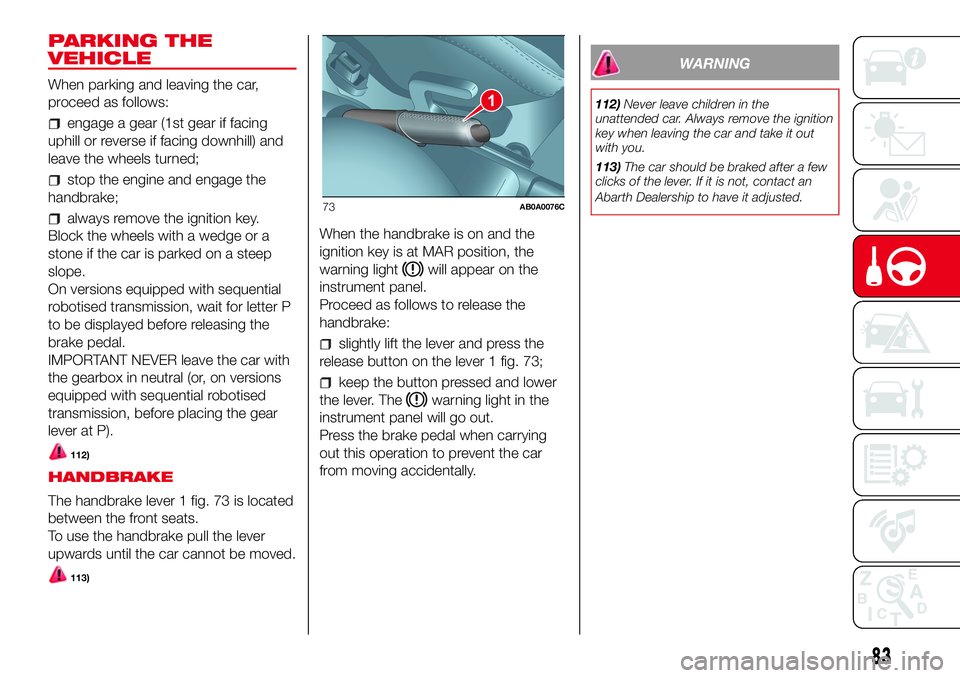
The handbrake lever 1 fig. 73 is located
between the front seats.
To use the handbrake pull the lever
upwards until the car cannot be moved.
113)
When the handbrake is on and the
ignition key is at MAR position, the
warning light
will appear on the
instrument panel.
Proceed as follows to release the
handbrake:
slightly lift the lever and press the
release button on the lever 1 fig. 73;
keep the button pressed and lower
the lever. The
warning light in the
instrument panel will go out.
Press the brake pedal when carrying
out this operation to prevent the car
from moving accidentally.
WARNING
112)Never leave children in the
unattended car. Always remove the ignition
key when leaving the car and take it out
with you.
113)The car should be braked after a few
clicks of the lever. If it is not, contact an
Abarth Dealership to have it adjusted.1
73AB0A0076C
83
Page 86 of 192
USING THE MANUAL
GEARBOX
To engage the gears, fully depress the
clutch pedal and put the gear lever
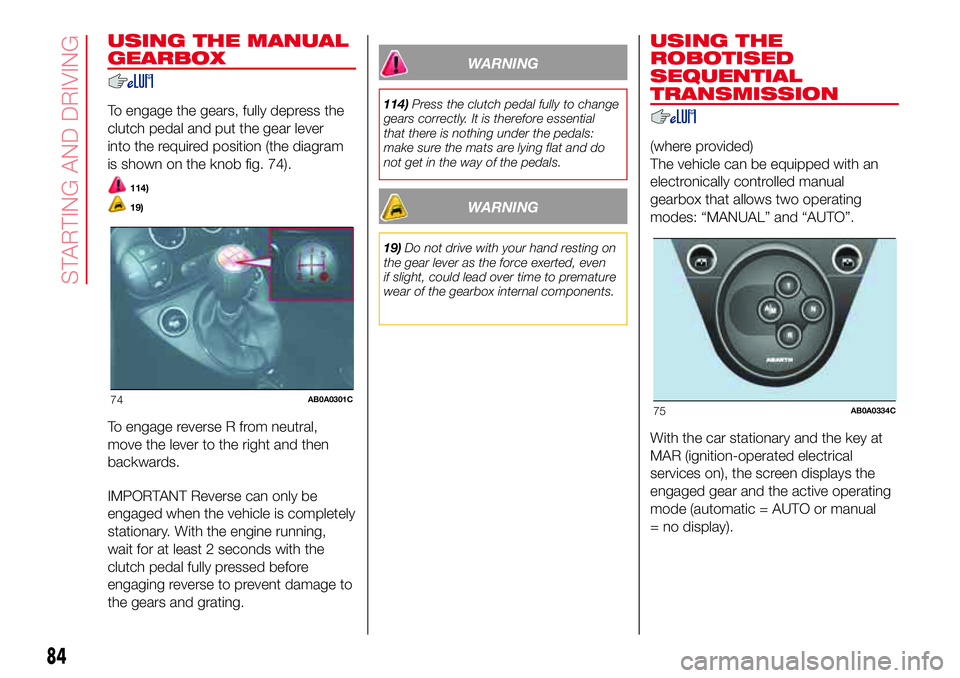
into the required position (the diagram
is shown on the knob fig. 74).
114)
19)
To engage reverse R from neutral,
move the lever to the right and then
backwards.
IMPORTANT Reverse can only be
engaged when the vehicle is completely
stationary. With the engine running,
wait for at least 2 seconds with the
clutch pedal fully pressed before
engaging reverse to prevent damage to
the gears and grating.
WARNING
114)Press the clutch pedal fully to change
gears correctly. It is therefore essential
that there is nothing under the pedals:
make sure the mats are lying flat and do
not get in the way of the pedals.
WARNING
19)Do not drive with your hand resting on
the gear lever as the force exerted, even
if slight, could lead over time to premature
wear of the gearbox internal components.
USING THE
ROBOTISED
SEQUENTIAL
TRANSMISSION
(where provided)
The vehicle can be equipped with an
electronically controlled manual
gearbox that allows two operating
modes: “MANUAL” and “AUTO”.
With the car stationary and the key at
MAR (ignition-operated electrical
services on), the screen displays the
engaged gear and the active operating
mode (automatic = AUTO or manual
= no display).
74AB0A0301C75AB0A0334C
84
STARTING AND DRIVING
Page 88 of 192
operate the “+” lever on the steering
wheel keeping the brake pedal
depressed (only for setting off in 2nd
gear);
release the brake pedal and press
the accelerator pedal (fully depressing
the pedal quickly to its end of travel and
switching off the ASR, if fitted, results
in a “lively” departure).
Engaging reverse (R)
To engage reverse gear, press the R
button on the gearbox panel instead of
the 1 button. When reverse is engaged,
the system emits an acoustic signal.
Engaging neutral (N)
Press the (N) button to engage neutral.
Neutral (N) can only be engaged with
accelerator pedal released, regardless
of the brake pedal’s state (pressed
or not). In any case, pressing the brake
pedal is recommended.
ACOUSTIC SIGNAL
For safety reasons, there is a buzzer
warning when parking the car with the
gearbox in neutral (N) (the warning is
heard when the ignition key is turned to
the STOP position).
With the car stationary, the engine
started and (1st), (2nd) or (R)
gear engaged, the system activates the
acoustic signal and automatically
places the transmission in neutral (N)
when:
the accelerator and/or brake pedal
are not operated for at least 3 minutes;
the brake pedal is pressed for longer
than 10 minutes;
the driver's door is opened and the
accelerator pedal or the brake pedal
are not operated for at least 1.5
seconds;
a fault has been detected in the
transmission.
PARKING THE CAR
The 1st or reverse gear must be
engaged with the foot on the brake
pedal and, if on a slope, the handbrake
must be operated in order to park
safely. Wait until the indication of the
gear engaged disappears on the
display before releasing the brake
pedal.
IMPORTANT NEVER leave the car with
the gearbox in neutral (N).
IMPORTANT NOTES
With car stationary and gear
engaged, always keep the brake pedal
pressed until you decide to set off,
then release the brake and accelerate
gradually.
During prolonged stops with the
engine running, it is advisable to keep
the gearbox in neutral (N).
In order to safeguard the efficiency
of the clutch, do not use the
accelerator to keep the car stationary
(e.g. when stopped on an incline); if the
clutch overheats it could be damaged.
Use the brake pedal or the handbrake
instead and use the accelerator pedal
only when you decide to set off.
Only use 2nd gear when you need
greater control when setting off for
manoeuvres on surfaces with poor grip.
If, with reverse gear (R) engaged,
you have to engage 1st gear or vice
versa, only do this when the car is
completely stationary and with
the brake pedal pressed.
Although it is strongly unadvisable, if
you are driving downhill and, for
unexpected reasons, you let the car
move forward with the transmission in
neutral (N), when there is a request
to engage a gear, depending on the
actual speed of the car, the system will
automatically engage the best gear
for the correct transmission of drive
torque to the wheels.
86
STARTING AND DRIVING
Page 89 of 192
When necessary, it is possible to
engage 1st gear, reverse (R) or neutral
(N) with the engine off, the key at
MAR-ON and the brake pressed. In this
case, it is advisable to change allowing
at least 5 seconds to elapse between
one gear change and the next to
safeguard the operation of the hydraulic
system and the pump in particular.
Fully and quickly depressing the
accelerator pedal activates a function
that allows a "lively" departure.
For departures on a hill, accelerating
gradually but fully immediately after
having released the handbrake or the
brake pedal allows the engine to greatly
increase the rpm and tackle the
steepest gradients with more torque to
the wheels.
WARNING
20)Using the levers incorrectly (levers
pushed towards the dashboard) could
break them.
SPORT FUNCTION
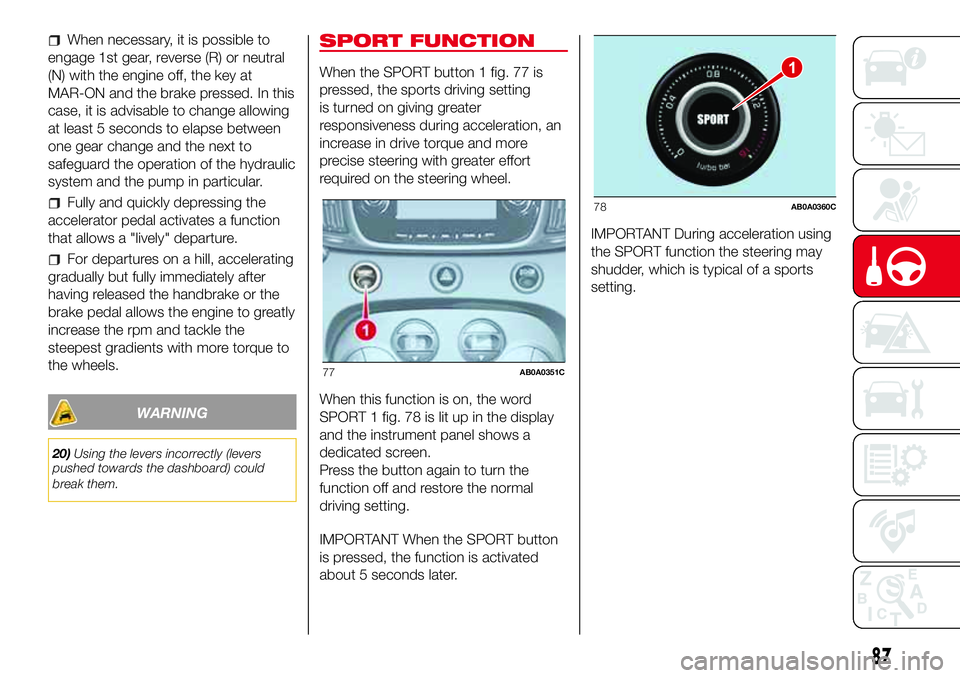
When the SPORT button 1 fig. 77 is
pressed, the sports driving setting
is turned on giving greater
responsiveness during acceleration, an
increase in drive torque and more
precise steering with greater effort
required on the steering wheel.
When this function is on, the word
SPORT 1 fig. 78 is lit up in the display
and the instrument panel shows a
dedicated screen.
Press the button again to turn the
function off and restore the normal
driving setting.
IMPORTANT When the SPORT button
is pressed, the function is activated
about 5 seconds later.IMPORTANT During acceleration using
the SPORT function the steering may
shudder, which is typical of a sports
setting.
77AB0A0351C
1
78AB0A0360C
87
Page 91 of 192
WARNING
21)For correct operation of the system,
sensors must always be clean from mud,
dirt, snow or ice. Be careful not to scratch
or damage the sensors while cleaning
them. Avoid using dry, rough or hard
cloths. The sensors must be washed using
clean water, with the addition of vehicle
shampoo if necessary. When using special
washing equipment such as high pressure
jets or steam cleaning, clean the sensors
very quickly keeping the jet more than
10 cm away.
22)Have interventions on the bumper in
the area of the sensors carried out only by
an Abarth Dealership. Interventions on
the bumper that are not carried out
properly may compromise the operation of
the parking sensors.
WARNING
115)Parking and other dangerous
manoeuvres are, however, always the
driver’s responsibility. While carrying out
these manoeuvres, always make sure that
no people (especially children) or animals
are in the area concerned. The parking
sensors are an aid for the driver, but the
driver must never allow their attention
to lapse during potentially dangerous
manoeuvres, even those executed at low
speeds.
REFUELLING THE
VEHICLE
Stop the engine before refuelling.
IMPORTANT Never introduce leaded
petrol to the tank, even in small
amounts in an emergency, as this
would damage the catalytic converter
beyond repair.
REFUELLING CAPACITY
To ensure that you fill the tank
completely, top up twice after the first
click of the fuel supply gun. Further
top-ups could cause faults in the fuel
feeding system.
FUEL TANK CAP
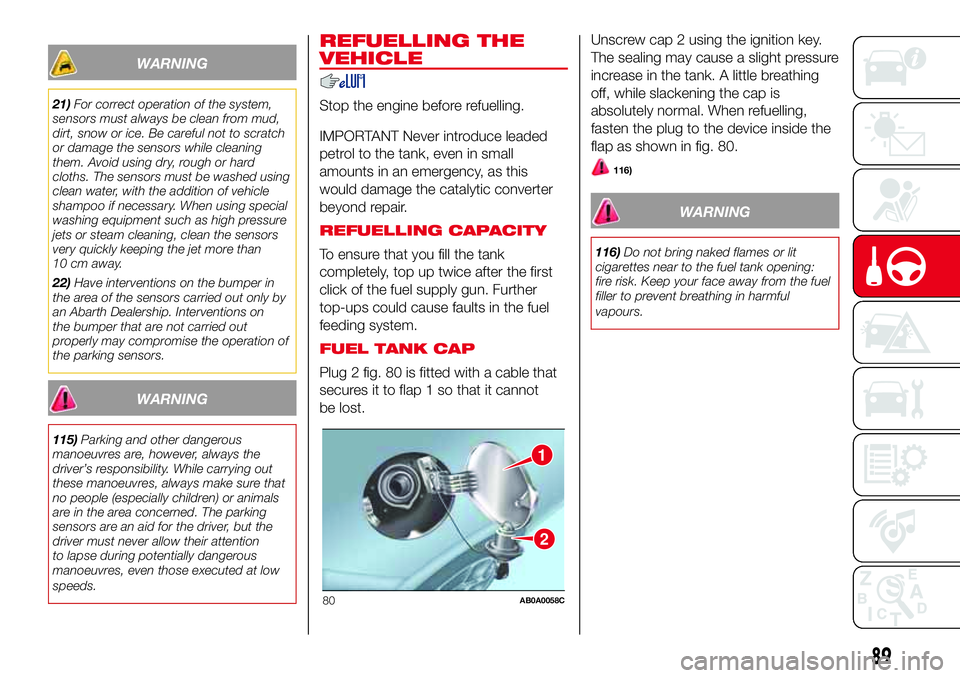
Plug 2 fig. 80 is fitted with a cable that
secures it to flap 1 so that it cannot
be lost.Unscrew cap 2 using the ignition key.
The sealing may cause a slight pressure
increase in the tank. A little breathing
off, while slackening the cap is
absolutely normal. When refuelling,
fasten the plug to the device inside the
flap as shown in fig. 80.
116)
WARNING
116)Do not bring naked flames or lit
cigarettes near to the fuel tank opening:
fire risk. Keep your face away from the fuel
filler to prevent breathing in harmful
vapours.
1
2
80AB0A0058C
89
Page 92 of 192
TOWING TRAILERS
IMPORTANT NOTES
For towing caravans or trailers the
vehicle must be fitted with an approved
tow hook and an adequate electrical
system. Installation should be carried
out by specialised personnel who
will issue the required papers for
travelling on roads.
Install any specific and/or additional
door mirrors as specified by the
Highway Code.
Remember that, when towing a trailer,
steep hills are harder to climb, braking
distances increase and overtaking
takes longer depending on the overall
weight of the trailer.
Engage a low gear when driving
downhill, rather than constantly using
the brake.
The weight the trailer exerts on the
vehicle tow hook reduces the vehicle's
loading capacity by the same amount.
To make sure that the maximum
towable weight is not exceeded (given
in the vehicle registration document)
account should be taken of the fully
laden trailer, including accessories and
luggage.
Respect the speed limits specific to
each country for vehicles towing
trailers.In any case, the top speed must not
exceed 100 km/h.117) 118)
WARNING
117)The ABS with which the car is
equipped will not control the braking
system of the trailer. Particular caution is
required on slippery roads.
118)Never modify the braking system of
the vehicle to control the trailer brake. The
trailer braking system must be fully
independent of the car’s hydraulic system.
90
STARTING AND DRIVING
Page 93 of 192
IN AN EMERGENCY
A punctured tyre or a burnt-out bulb?
At times, a problem may interfere
with our journey.
The pages on emergencies can help
you to deal with critical situations
independently and with calm.
In an emergency we recommend that
you call the freephone number found in
the Warranty Booklet.
It is also possible to call the 00 800
3428 0000 freephone number to
search the nearest Abarth Authorised
Dealership.HAZARD WARNING LIGHTS........... 92
REPLACING A BULB ..................... 92
REPLACING AN EXTERIOR BULB .. 96
REPLACING FUSES........................ 99
“FIX&GO” KIT ..................................104
JUMP STARTING ............................108
FUEL CUT-OFF SYSTEM ................109
TOWING THE VEHICLE ..................110
91
Page 94 of 192
HAZARD WARNING
LIGHTS
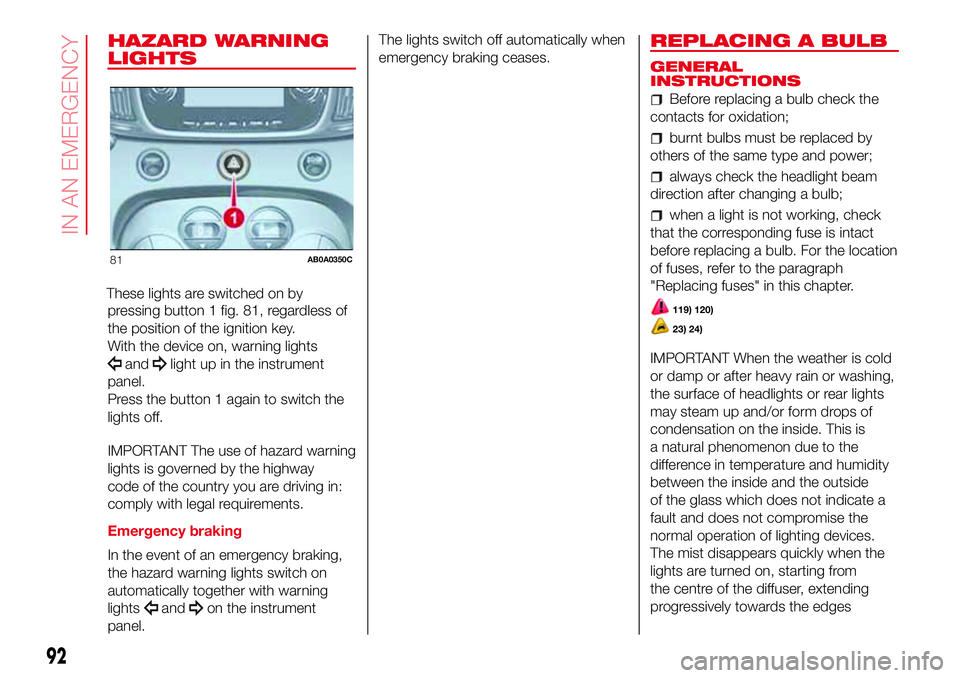
These lights are switched on by
pressing button 1 fig. 81, regardless of
the position of the ignition key.
With the device on, warning lights
andlight up in the instrument
panel.
Press the button 1 again to switch the
lights off.
IMPORTANT The use of hazard warning
lights is governed by the highway
code of the country you are driving in:
comply with legal requirements.
Emergency braking
In the event of an emergency braking,
the hazard warning lights switch on
automatically together with warning
lights
andon the instrument
panel.The lights switch off automatically when
emergency braking ceases.
REPLACING A BULB
GENERAL
INSTRUCTIONS
Before replacing a bulb check the
contacts for oxidation;
burnt bulbs must be replaced by
others of the same type and power;
always check the headlight beam
direction after changing a bulb;
when a light is not working, check
that the corresponding fuse is intact
before replacing a bulb. For the location
of fuses, refer to the paragraph
"Replacing fuses" in this chapter.
119) 120)
23) 24)
IMPORTANT When the weather is cold
or damp or after heavy rain or washing,
the surface of headlights or rear lights
may steam up and/or form drops of
condensation on the inside. This is
a natural phenomenon due to the
difference in temperature and humidity
between the inside and the outside
of the glass which does not indicate a
fault and does not compromise the
normal operation of lighting devices.
The mist disappears quickly when the
lights are turned on, starting from
the centre of the diffuser, extending
progressively towards the edges
81AB0A0350C
92
IN AN EMERGENCY
Page 96 of 192
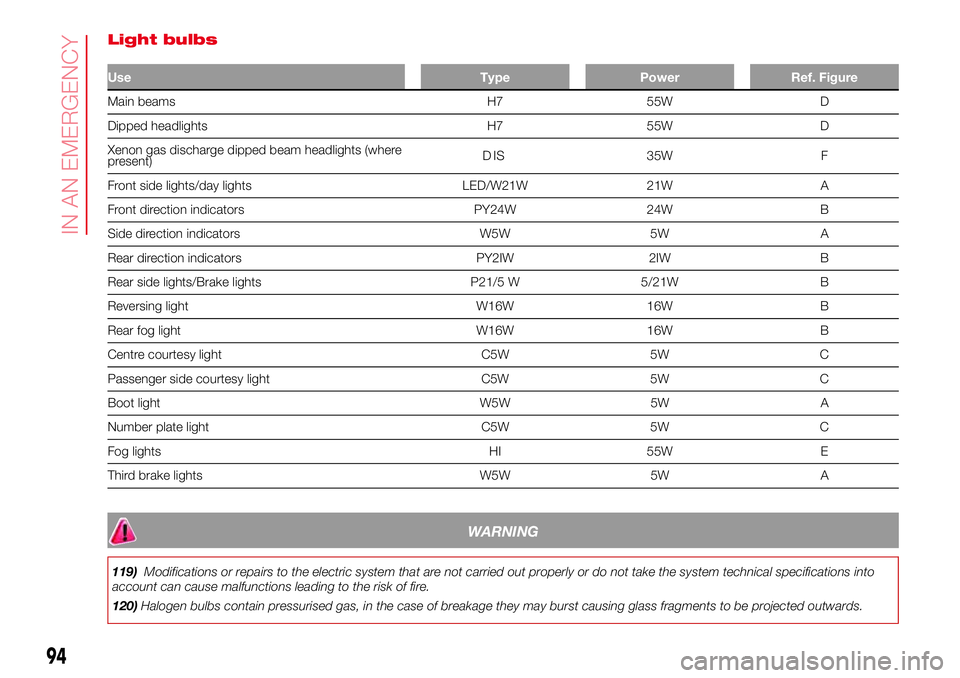
Light bulbs
Use Type Power Ref. Figure
Main beams H7 55W D
Dipped headlights H7 55W D
Xenon gas discharge dipped beam headlights (where
present)DSI 35W F
Front side lights/day lights LED/W21W 21W A
Front direction indicators PY24W 24W B
Side direction indicators W5W 5W A
Rear direction indicators PY2IW 2IW B
Rear side lights/Brake lights P21/5 W 5/21W B
Reversing light W16W 16W B
Rear fog light W16W 16W B
Centre courtesy light C5W 5W C
Passenger side courtesy light C5W 5W C
Boot light W5W 5W A
Number plate light C5W 5W C
Fog lights HI 55W E
Third brake lights W5W 5W A
WARNING
119)Modifications or repairs to the electric system that are not carried out properly or do not take the system technical specifications into
account can cause malfunctions leading to the risk of fire.
120)Halogen bulbs contain pressurised gas, in the case of breakage they may burst causing glass fragments to be projected outwards.
94
IN AN EMERGENCY
Page 97 of 192
WARNING
23)Halogen bulbs must be handled holding the metallic part only. Touching the transparent part of the bulb with your fingers may reduce the
intensity of the emitted light and even reduce the lifespan of the bulb. In the event of accidental contact, wipe the bulb with a cloth moistened
with alcohol and let the bulb dry.
24)Where possible, it is advisable to have bulbs changed at an Abarth Dealership. The correct operation and direction of the external lights
are absolutely essential for the safety of the car and of compliance with the law.
95