engine Abarth 500 2018 Owner handbook (in English)
[x] Cancel search | Manufacturer: ABARTH, Model Year: 2018, Model line: 500, Model: Abarth 500 2018Pages: 192, PDF Size: 5.86 MB
Page 34 of 192
It is recommended to have the
engine running always when opening or
closing the soft top.
If required, remove the battery with
open or closed soft top, but NOT when
the soft top is moving.
Do not fix luggage transport devices
to the soft top and do not travel with
objects resting on the open top.
If requested by the user, the heated
rear window is only turned on if the
soft top is fully closed. If the soft top is
closed incorrectly, the heated rear
window will not function and the
corresponding warning light will not turn
on.
Do not remove ice from the soft top
with a sharp item.
To prevent damage, do not use
scrapers or sprays to remove ice from
the heated rear window.
Do not put objects on the soft top:
they could fall if the it is operated,
causing damage and injury.
It is advisable to cover the soft top
with a protective sheet if the car is
left parked in the open for a long time.
Do not keep the soft top folded for a
long time: this could cause folds and
creases in the fabric.
Before moving the soft top, check
that there is enough room to carry
out the operation and that there are no
obstacles or people close to its moving
parts.
The cooled air flow into the
passenger compartment may decrease
if the automatic climate control system
is on and the top is not completely
closed.
With the soft top open and the car
travelling, the voice recognition system
may not recognise voice commands
because of the background noise: with
the soft top closed and at a high speed,
the voice function for number dialling
may not be recognised.EMERGENCY OPERATION
If the buttons fail, the soft top can be
moved manually proceeding as
described below:
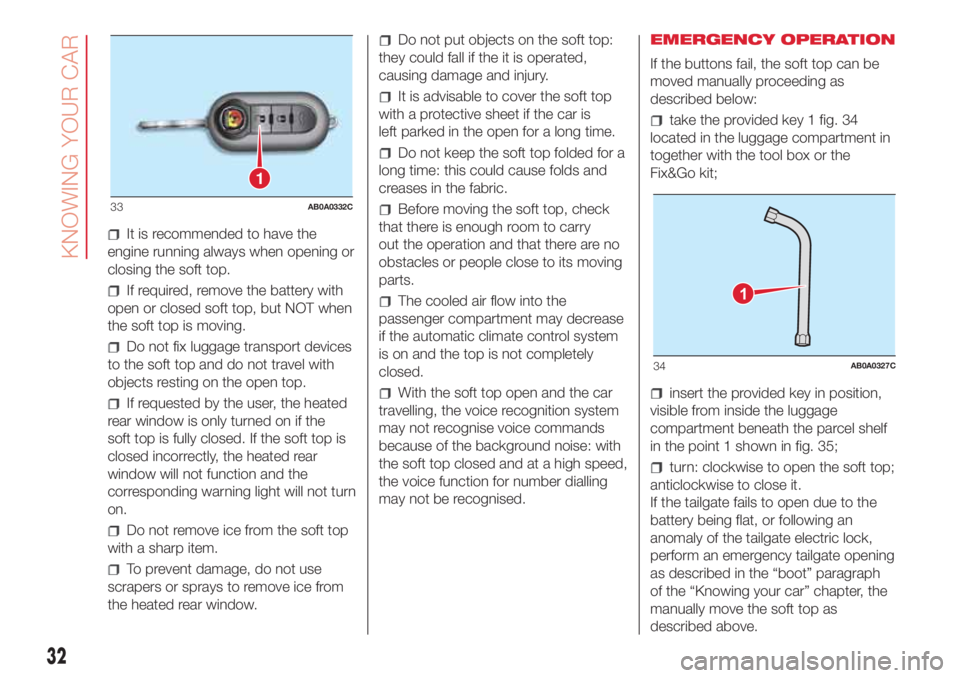
take the provided key 1 fig. 34
located in the luggage compartment in
together with the tool box or the
Fix&Go kit;
insert the provided key in position,
visible from inside the luggage
compartment beneath the parcel shelf
in the point 1 shown in fig. 35;
turn: clockwise to open the soft top;
anticlockwise to close it.
If the tailgate fails to open due to the
battery being flat, or following an
anomaly of the tailgate electric lock,
perform an emergency tailgate opening
as described in the “boot” paragraph
of the “Knowing your car” chapter, the
manually move the soft top as
described above.
1
33AB0A0332C
1
34AB0A0327C
32
KNOWING YOUR CAR
Page 35 of 192
To restore automatic movement,
contact an Abarth Dealership.
INITIALISATION
PROCEDURE
The soft top must be re-initialised after
disconnecting the battery or if the
relevant protection fuse is blown.
Proceed as follows:
before carrying out any other
operation, make sure the engine is on
during the whole initialisation
procedure;
keep the opening button pressed
until the soft top is completely open;
when the soft top is completely
open, keep the button pressed for at
least 2 seconds;
keep the closing button pressed
until the soft top is completely closed;
when the soft top is completely
closed, keep the button pressed for at
least 2 seconds.
When the procedure is terminated, the
soft top will automatically carry out a
complete opening and closing cycle (up
to 25 cm from the completely closed
position) to inform the driver that
correct operation has been restored.
If the soft top is already initialised,
proceed as follows:
before carrying out any other
operation, make sure the engine is on
during the whole initialisation
procedure;
keep the opening button pressed
until the soft top is completely open;
when the soft top is completely
open, keep the button pressed for at
least 10 seconds;
keep the closing button pressed
until the soft top is completely closed;
when the soft top is completely
closed, keep the button pressed for at
least 2 seconds.
When the procedure is terminated, the
soft top will automatically carry out a
complete opening and closing cycle (up
to 25 cm from the completely closed
position) to inform the driver that
correct operation has been restored.WIND STOP
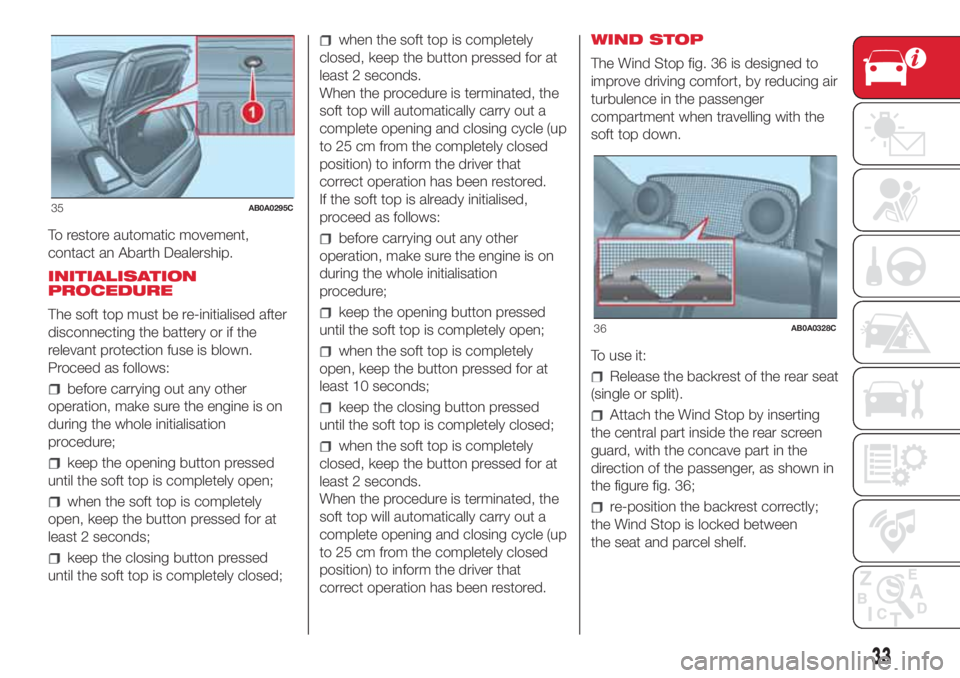
The Wind Stop fig. 36 is designed to
improve driving comfort, by reducing air
turbulence in the passenger
compartment when travelling with the
soft top down.
To use it:
Release the backrest of the rear seat
(single or split).
Attach the Wind Stop by inserting
the central part inside the rear screen
guard, with the concave part in the
direction of the passenger, as shown in
the figure fig. 36;
re-position the backrest correctly;
the Wind Stop is locked between
the seat and parcel shelf.
35AB0A0295C
36AB0A0328C
33
Page 37 of 192
ENGINE BONNET
OPENING
Proceed as follows:
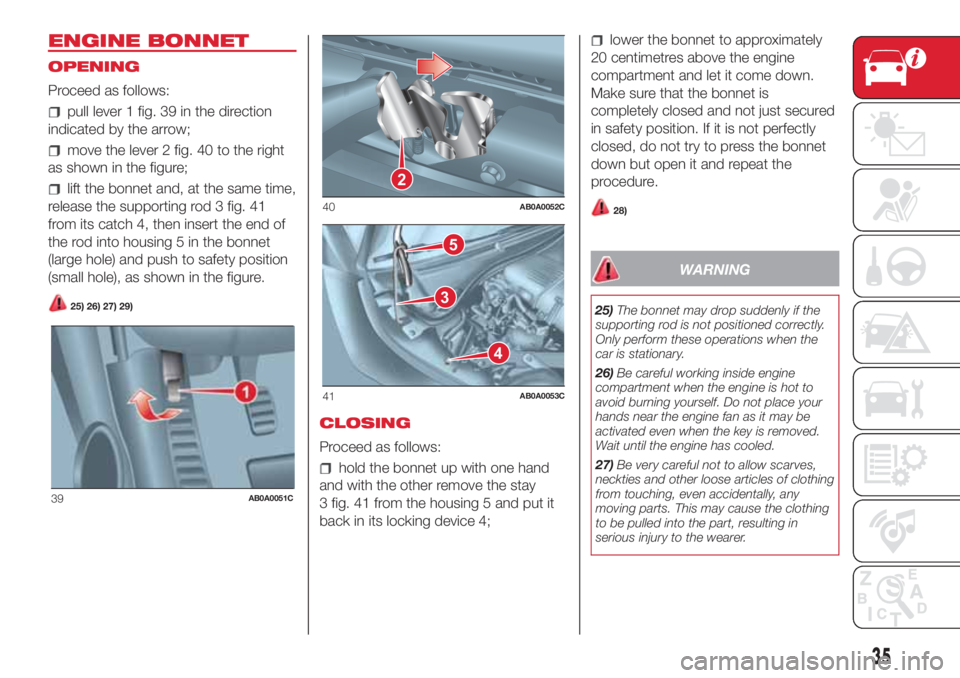
pull lever 1 fig. 39 in the direction
indicated by the arrow;
move the lever 2 fig. 40 to the right
as shown in the figure;
lift the bonnet and, at the same time,
release the supporting rod 3 fig. 41
from its catch 4, then insert the end of
the rod into housing 5 in the bonnet
(large hole) and push to safety position
(small hole), as shown in the figure.
25) 26) 27) 29)
CLOSING
Proceed as follows:
hold the bonnet up with one hand
and with the other remove the stay
3 fig. 41 from the housing 5 and put it
back in its locking device 4;
lower the bonnet to approximately
20 centimetres above the engine
compartment and let it come down.
Make sure that the bonnet is
completely closed and not just secured
in safety position. If it is not perfectly
closed, do not try to press the bonnet
down but open it and repeat the
procedure.
28)
WARNING
25)The bonnet may drop suddenly if the
supporting rod is not positioned correctly.
Only perform these operations when the
car is stationary.
26)Be careful working inside engine
compartment when the engine is hot to
avoid burning yourself. Do not place your
hands near the engine fan as it may be
activated even when the key is removed.
Wait until the engine has cooled.
27)Be very careful not to allow scarves,
neckties and other loose articles of clothing
from touching, even accidentally, any
moving parts. This may cause the clothing
to be pulled into the part, resulting in
serious injury to the wearer.
39AB0A0051C
2
40AB0A0052C
5
3
4
41AB0A0053C
35
Page 40 of 192
KNOWING THE INSTRUMENT PANEL
This section of the handbook gives you
all the information you need to
understand, interpret and use the
instrument panel correctly.CONTROL PANEL AND
ON-BOARD INSTRUMENTS ........... 39
MENU OPTIONS ............................. 41
TRIP COMPUTER ........................... 42
WARNING LIGHTS AND
MESSAGES .................................... 45
-SEAT BELTS REMINDER.................... 45
-EBD FAILURE .................................... 45
-AIR BAG FAILURE .............................. 46
-LOW BRAKE FLUID/HANDBRAKE
ENGAGED........................................... 46
-“DUALDRIVE” ELECTRIC POWER
STEERING FAILURE ............................ 47
-BRAKE PAD WEAR ............................ 47
-ESC SYSTEM .................................... 48
-INJECTION / EOBD SYSTEM
FAILURE .............................................. 48
-REAR FOG LIGHT .............................. 49
-ABS FAILURE..................................... 49
-iTPMS ................................................ 49
-SIDE LIGHTS AND DIPPED BEAM
HEADLIGHTS/FOLLOW ME HOME ..... 50
-FRONT FOG LIGHTS ......................... 50
-LEFT DIRECTION INDICATOR ............ 50
-RIGHT DIRECTION INDICATOR ......... 50
-MAIN BEAM HEADLIGHTS ................ 50
-DOORS/BONNET/LUGGAGE
COMPARTMENT OPEN ...................... 51
-LOW BATTERY CHARGE ................... 51
-INSUFFICIENT ENGINE OIL
PRESSURE/ENGINE OIL
DETERIORATED .................................. 51
-ENGINE COOLANT TEMPERATURE
TOO HIGH........................................... 52
-ROBOTISED SEQUENTIAL
GEARBOX FAILURE ............................ 52
-SPEED LIMIT EXCEEDED .................. 52-POSSIBLE ICE ON ROAD .................. 53
-PARKING SENSOR FAILURE ............. 53
-SERVICE (SCHEDULED SERVICING)
EXPIRED ............................................. 53
-ASR SYSTEM .................................... 53
-HILL HOLDER FAILURE ..................... 53
-FUEL CUT-OFF SYSTEM.................... 53
-FUEL CUT-OFF SYSTEM FAILURE ..... 54
-EXTERIOR LIGHTS FAILURE .............. 54
-BRAKE LIGHT FAILURE ..................... 54
-FIAT CODE SYSTEM FAILURE ........... 54
-FUEL RESERVE - LIMITED RANGE .... 55
-ENGINE OIL PRESSURE SENSOR
FAILURE INDICATOR........................... 55
-OIL CHANGE ..................................... 55
-PRESS THE CLUTCH PEDAL TO
START ................................................. 55
-FUEL LEVEL SENSOR FAILURE......... 55
-HEADLIGHT ALIGNMENT
CORRECTOR ...................................... 55
38
KNOWING THE INSTRUMENT PANEL
Page 41 of 192
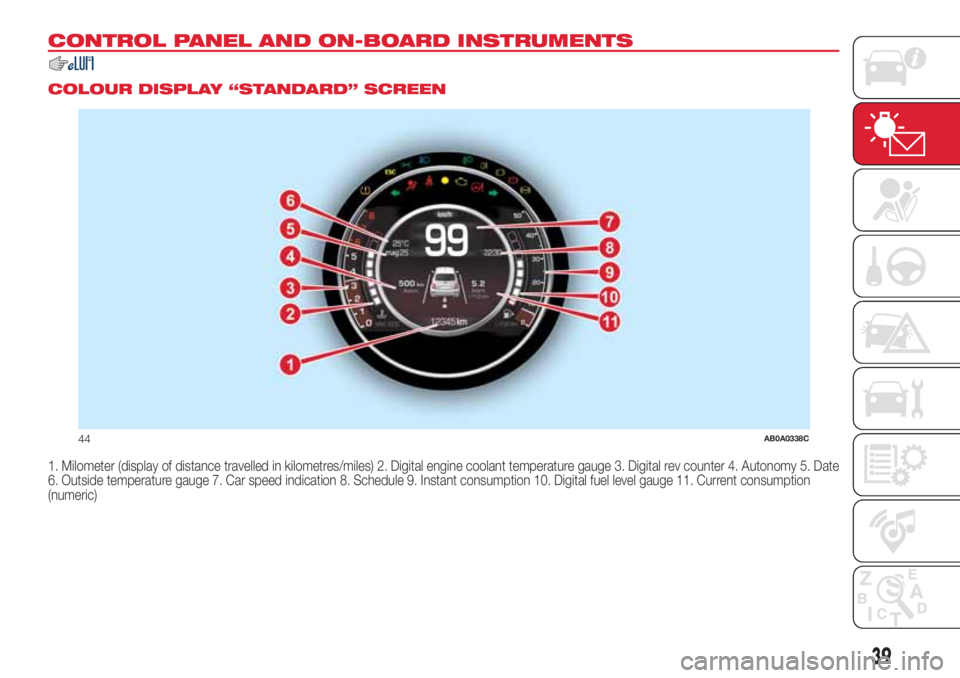
CONTROL PANEL AND ON-BOARD INSTRUMENTS
.
COLOUR DISPLAY “STANDARD” SCREEN
1. Milometer (display of distance travelled in kilometres/miles) 2. Digital engine coolant temperature gauge 3. Digital rev counter 4. Autonomy 5. Date
6. Outside temperature gauge 7. Car speed indication 8. Schedule 9. Instant consumption 10. Digital fuel level gauge 11. Current consumption
(numeric)
44AB0A0338C
39
Page 42 of 192
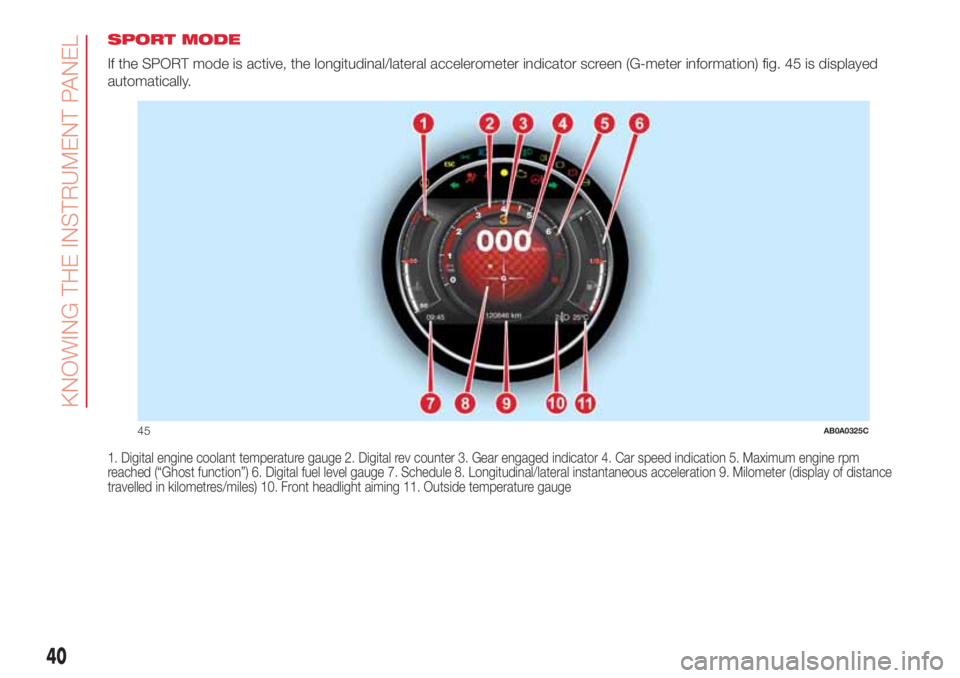
SPORT MODE
If the SPORT mode is active, the longitudinal/lateral accelerometer indicator screen (G-meter information) fig. 45 is displayed
automatically.
1. Digital engine coolant temperature gauge 2. Digital rev counter 3. Gear engaged indicator 4. Car speed indication 5. Maximum engine rpm
reached (“Ghost function”) 6. Digital fuel level gauge 7. Schedule 8. Longitudinal/lateral instantaneous acceleration 9. Milometer (display of distance
travelled in kilometres/miles) 10. Front headlight aiming 11. Outside temperature gauge
45AB0A0325C
40
KNOWING THE INSTRUMENT PANEL
Page 45 of 192
"Trip B" allows the display of the
following parameters:
Distance travelled B
Average consumption B
Average speed B
Trip time B (driving time)
Reset Trip B.
The "Trip B" function can be disabled
(see the "Menu items" paragraph).
"Range" and "Instant consumption"
values cannot be reset.
“Instantaneous info" displays the
following values (where present, when
they are not displayed in the main
screen):
Range
Instantaneous consumption
VALUES DISPLAYED
Range (where present)
This indicates the distance that can still
be travelled with the fuel in the tank,
assuming that driving style remains
unvaried. The display will show the
reading "----"when the following
events take place:
range value lower than 50 km (or 30
mi)
car parked with engine running for a
long period.IMPORTANT The range can be affected
by several factors: driving style (see
“Driving style” paragraph in the
“Starting and driving” chapter), type of
route (motorway, towns and cities,
mountain roads, etc.), conditions of use
(load, tyre pressures, etc.). Trip
planning must therefore take the above
into account.
Distance travelled
This value shows the distance covered
from the start of the new journey.
Average consumption
This value shows the approximate
average fuel consumption from the start
of the new journey.
Instantaneous fuel consumption
(where present)
This value shows the fuel consumption.
The value is constantly updated. The
message "----"will appear on the
display if the car is parked with the
engine running.
Average speed
This value shows the car's average
speed based on the overall time
elapsed since the start of the new
journey.Journey time
Time elapsed since the start of the new
journey.
TRIP BUTTON
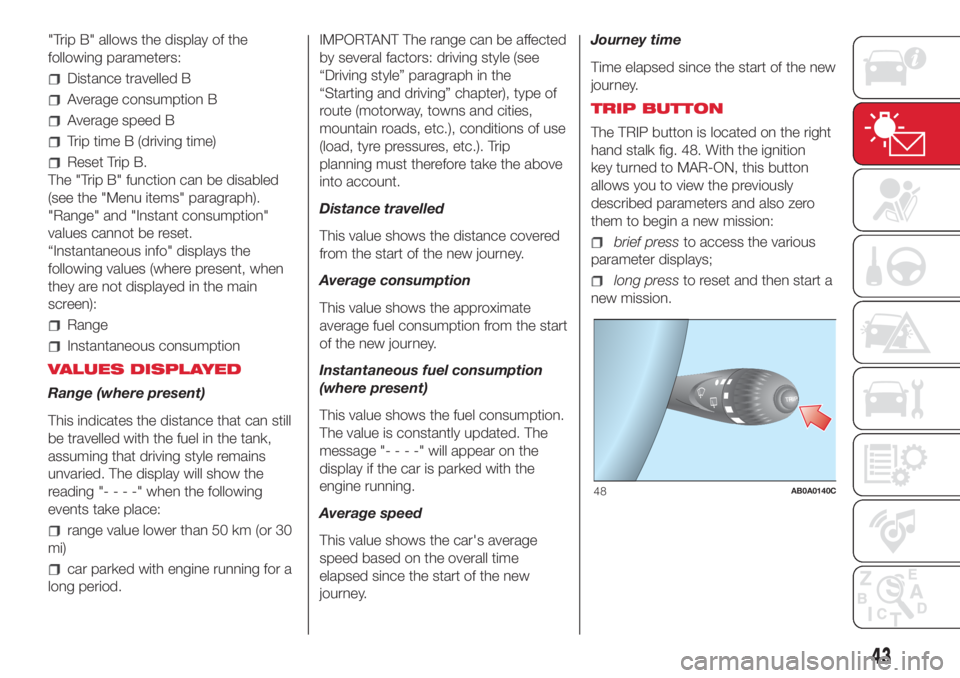
The TRIP button is located on the right
hand stalk fig. 48. With the ignition
key turned to MAR-ON, this button
allows you to view the previously
described parameters and also zero
them to begin a new mission:
brief pressto access the various
parameter displays;
long pressto reset and then start a
new mission.
TRIPTRIP
48AB0A0140C
43
Page 47 of 192
WARNING LIGHTS AND MESSAGES
IMPORTANT The warning light switches on in the instrument panel together with a dedicated message and/or acoustic signal
when applicable. These indications are indicative and precautionary and as such must not be considered as exhaustive and/or
alternative to the information contained in the Owner Handbook, which you are advised to read carefully in all cases. In the
event of a failure indication, always refer to the contents of this chapter.
IMPORTANT Failure indications displayed are divided into two categories: very serious and less serious failures. Serious faults
are indicated by a repeated and prolonged warning "cycle". Less serious faults are indicated by a warning "cycle" with a shorter
duration. The display cycle of both categories can be interrupted. The instrument panel warning light will stay on until the
cause of the malfunction is eliminated.
WARNING LIGHTS ON INSTRUMENT PANEL
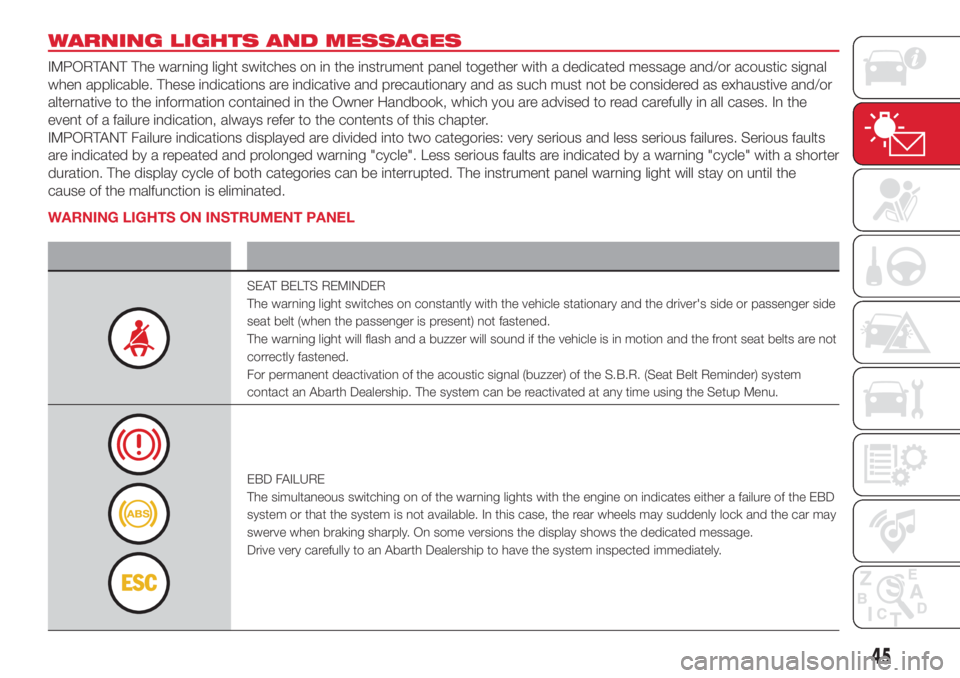
Warning light What it means
SEAT BELTS REMINDER
The warning light switches on constantly with the vehicle stationary and the driver's side or passenger side
seat belt (when the passenger is present) not fastened.
The warning light will flash and a buzzer will sound if the vehicle is in motion and the front seat belts are not
correctly fastened.
For permanent deactivation of the acoustic signal (buzzer) of the S.B.R. (Seat Belt Reminder) system
contact an Abarth Dealership. The system can be reactivated at any time using the Setup Menu.
EBD FAILURE
The simultaneous switching on of the warning lights with the engine on indicates either a failure of the EBD
system or that the system is not available. In this case, the rear wheels may suddenly lock and the car may
swerve when braking sharply. On some versions the display shows the dedicated message.
Drive very carefully to an Abarth Dealership to have the system inspected immediately.
45
Page 49 of 192
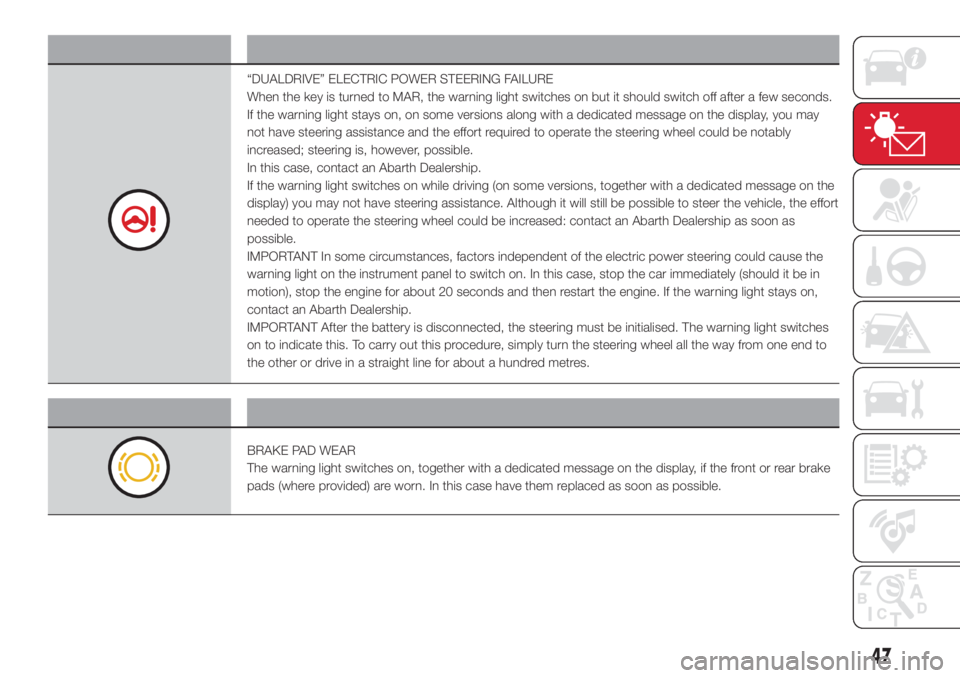
Warning light What it means
“DUALDRIVE” ELECTRIC POWER STEERING FAILURE
When the key is turned to MAR, the warning light switches on but it should switch off after a few seconds.
If the warning light stays on, on some versions along with a dedicated message on the display, you may
not have steering assistance and the effort required to operate the steering wheel could be notably
increased; steering is, however, possible.
In this case, contact an Abarth Dealership.
If the warning light switches on while driving (on some versions, together with a dedicated message on the
display) you may not have steering assistance. Although it will still be possible to steer the vehicle, the effort
needed to operate the steering wheel could be increased: contact an Abarth Dealership as soon as
possible.
IMPORTANT In some circumstances, factors independent of the electric power steering could cause the
warning light on the instrument panel to switch on. In this case, stop the car immediately (should it be in
motion), stop the engine for about 20 seconds and then restart the engine. If the warning light stays on,
contact an Abarth Dealership.
IMPORTANT After the battery is disconnected, the steering must be initialised. The warning light switches
on to indicate this. To carry out this procedure, simply turn the steering wheel all the way from one end to
the other or drive in a straight line for about a hundred metres.
Warning light What it means
BRAKE PAD WEAR
The warning light switches on, together with a dedicated message on the display, if the front or rear brake
pads (where provided) are worn. In this case have them replaced as soon as possible.
47
Page 50 of 192
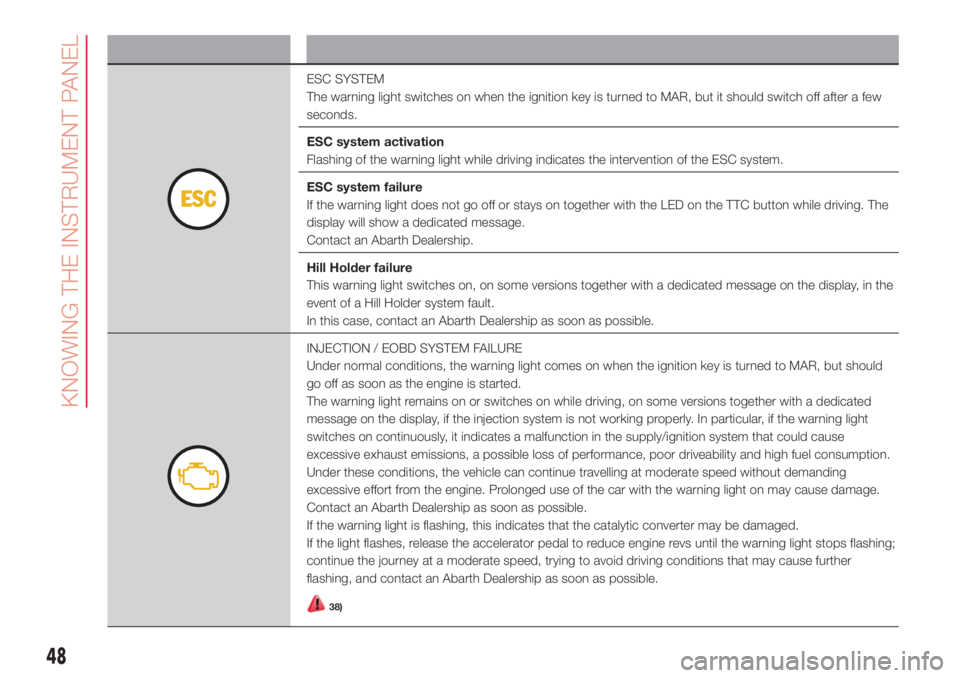
Warning light What it means
ESC SYSTEM
The warning light switches on when the ignition key is turned to MAR, but it should switch off after a few
seconds.
ESC system activation
Flashing of the warning light while driving indicates the intervention of the ESC system.
ESC system failure
If the warning light does not go off or stays on together with the LED on the TTC button while driving. The
display will show a dedicated message.
Contact an Abarth Dealership.
Hill Holder failure
This warning light switches on, on some versions together with a dedicated message on the display, in the
event of a Hill Holder system fault.
In this case, contact an Abarth Dealership as soon as possible.
INJECTION / EOBD SYSTEM FAILURE
Under normal conditions, the warning light comes on when the ignition key is turned to MAR, but should
go off as soon as the engine is started.
The warning light remains on or switches on while driving, on some versions together with a dedicated
message on the display, if the injection system is not working properly. In particular, if the warning light
switches on continuously, it indicates a malfunction in the supply/ignition system that could cause
excessive exhaust emissions, a possible loss of performance, poor driveability and high fuel consumption.
Under these conditions, the vehicle can continue travelling at moderate speed without demanding
excessive effort from the engine. Prolonged use of the car with the warning light on may cause damage.
Contact an Abarth Dealership as soon as possible.
If the warning light is flashing, this indicates that the catalytic converter may be damaged.
If the light flashes, release the accelerator pedal to reduce engine revs until the warning light stops flashing;
continue the journey at a moderate speed, trying to avoid driving conditions that may cause further
flashing, and contact an Abarth Dealership as soon as possible.
38)
48
KNOWING THE INSTRUMENT PANEL