airbag Abarth 500 2018 Owner handbook (in English)
[x] Cancel search | Manufacturer: ABARTH, Model Year: 2018, Model line: 500, Model: Abarth 500 2018Pages: 192, PDF Size: 5.86 MB
Page 12 of 192
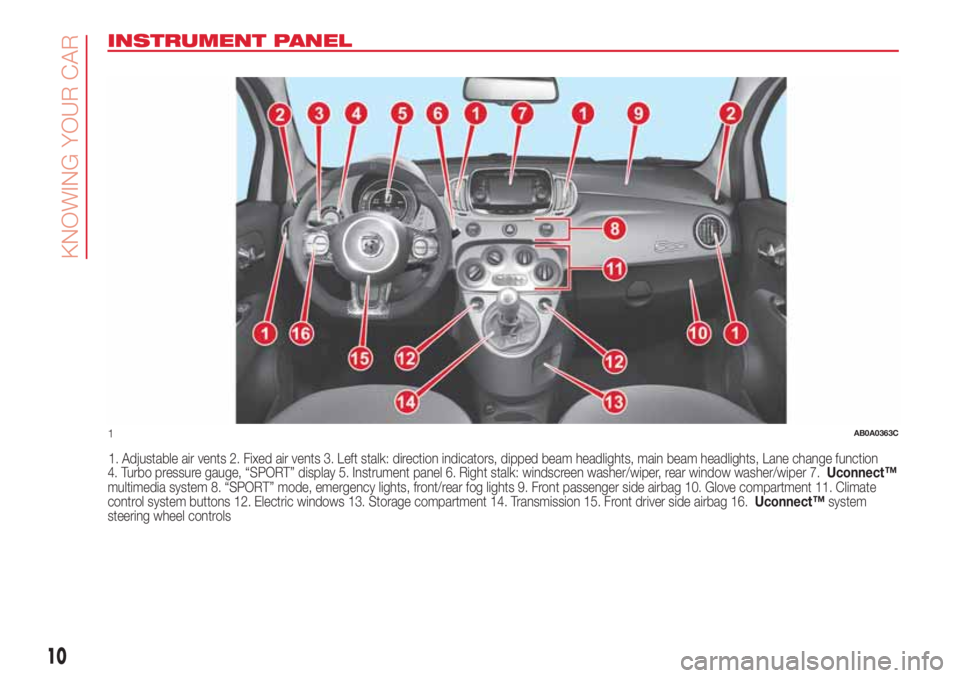
INSTRUMENT PANEL
1. Adjustable air vents 2. Fixed air vents 3. Left stalk: direction indicators, dipped beam headlights, main beam headlights, Lane change function
4. Turbo pressure gauge, “SPORT” display 5. Instrument panel 6. Right stalk: windscreen washer/wiper, rear window washer/wiper 7.Uconnect™
multimedia system 8. “SPORT” mode, emergency lights, front/rear fog lights 9. Front passenger side airbag 10. Glove compartment 11. Climate
control system buttons 12. Electric windows 13. Storage compartment 14. Transmission 15. Front driver side airbag 16.Uconnect™system
steering wheel controls
1AB0A0363C
10
KNOWING YOUR CAR
Page 44 of 192
NOTE Buttons+and–activate different
functions according to the following
situations:
within the menu, they allow you to
scroll up or down through the options;
during setting operations, they
increase or decrease values.
The menu comprises the following
functions:
LIGHTING: adjusts the dashboard
and instrument panel lighting
SPEED BEEP: sets the vehicle
speed limit (km/h or mph). The driver is
alerted when this speed is exceeded.
TRIP B ACTIVATION/DATA: activates
(”On”) and deactivates (”Off”) the Trip
B display (partial trip counter)
SET TIME: set the display clock
SET DATE: sets the display date
AUTOCLOSE: enables or disables
automatic door locking on exceeding a
speed of 20 km/h
MEASUREMENT UNITS: sets the
measurement units for distance and
fuel consumption
LANGUAGE: sets the display
language
WARNING VOLUME: sets the
volume (on 8 levels) of the audible
warning (buzzer) that accompanies the
failure/warning display
SEAT BELT BUZZER: reactivation of
the SBR buzzer (displayed only if the
SBR system was disabled by the
Abarth Dealership)
SERVICE: displays mileage intervals
for scheduled servicing
AIRBAG/PASSENGER BAG:
enables/disables the passenger side
airbag
DAYTIME RUNNING LIGHTS:
enables/disables daytime running lights
ITPMS RESET: resets the iTPMS
system (”self-learning”, see the “iTPMS
System” paragraph)
SEE RADIO (if present): enables/
disables duplicating some of the radio
information shown on theUconnect™
system display on the instrument panel
display.
SEE PHONE (if present): enables/
disables duplicating some of the call
information shown on theUconnect™
system display on the instrument panel
display.
SEE NAVIGATION (if present):
enables/disables duplicating some of
the navigation information shown on
theUconnect™system display on the
instrument panel display.
EXIT MENU
TRIP COMPUTER
The Trip computer is used to display
information on car operation when the
key is turned to MAR.
This function is characterised by two
separate memories, called "Trip A" and
"Trip B", where the car's "complete
missions" (journeys) are recorded in a
reciprocally independent manner, as
well as, for versions where present,
"Instant info" and "Best average
consumption".
Both memories can be reset: i.e. start
of a new journey.
"Trip A" can be used to display the
values relating to:
Range (where present)
Distance travelled A
Average consumption A
Instantaneous fuel consumption
(where present)
Average speed A
Trip time A (driving time)
Reset Trip A.
“Best average consumption": in ECO
mode, displays a screen summarising
the best average consumption (where
provided). The
icon indicates the
best performance. This information can
be reset by resetting Trip A.
42
KNOWING THE INSTRUMENT PANEL
Page 48 of 192
Warning light What it means
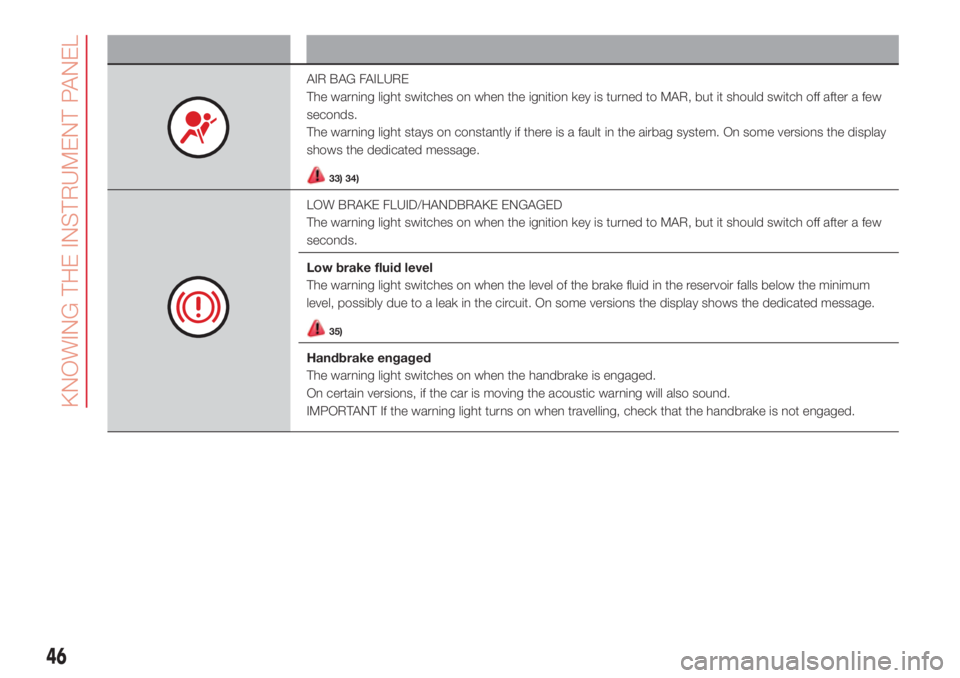
AIR BAG FAILURE
The warning light switches on when the ignition key is turned to MAR, but it should switch off after a few
seconds.
The warning light stays on constantly if there is a fault in the airbag system. On some versions the display
shows the dedicated message.
33) 34)
LOW BRAKE FLUID/HANDBRAKE ENGAGED
The warning light switches on when the ignition key is turned to MAR, but it should switch off after a few
seconds.
Low brake fluid level
The warning light switches on when the level of the brake fluid in the reservoir falls below the minimum
level, possibly due to a leak in the circuit. On some versions the display shows the dedicated message.
35)
Handbrake engaged
The warning light switches on when the handbrake is engaged.
On certain versions, if the car is moving the acoustic warning will also sound.
IMPORTANT If the warning light turns on when travelling, check that the handbrake is not engaged.
46
KNOWING THE INSTRUMENT PANEL
Page 54 of 192

Symbol What it means
ENGINE COOLANT TEMPERATURE TOO HIGH
On some versions, the symbol appears on the display when the engine is overheated together with a
dedicated message on the display.
In normal driving conditions: stop the car, switch off the engine and check that the fluid level in the
reservoir is not below the MIN mark. In this case, wait for the engine to cool down, then slowly and
carefully open the cap, top up with coolant and check that the level is between the MIN and MAX marks on
the reservoir itself. Also check visually for any fluid leaks. Contact an Abarth Dealership if the warning light
switches on when the engine is started again;
If the car is used under demanding conditions(e.g. when fully loaded): slow down and, if the
warning light stays on, stop the car. Stop for two or three minutes with the engine running and slightly
accelerated to facilitate better coolant circulation, then turn the engine off. Check that the coolant level is
correct as described above.
IMPORTANT Over demanding routes, it is advisable to keep the engine running and slightly accelerated for
a few minutes before turning it off
ROBOTISED SEQUENTIAL GEARBOX FAILURE
When the ignition key is turned to MAR, the icon appears but should disappear after a few seconds.
The icon flashes, along with a dedicated message on the display and an acoustic warning, to indicate
transmission failure.
13)
Airbag warning light failure(where present)
The icon lights up when a fault is detected in the warning light
.
SPEED LIMIT EXCEEDED
The symbol is shown on the display, together with a dedicated message and an acoustic warning, when
the car exceeds the speed limit set in the Setup Menu (e.g. 120 km/h). For some markets, the symbol is
red.
52
KNOWING THE INSTRUMENT PANEL
Page 57 of 192
Symbol What it means
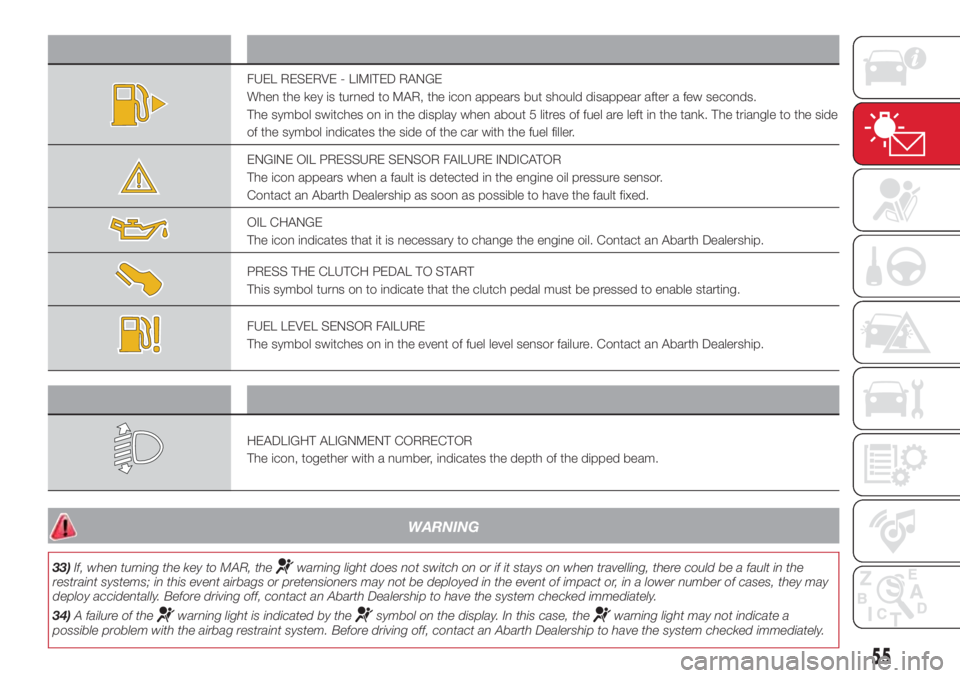
FUEL RESERVE - LIMITED RANGE
When the key is turned to MAR, the icon appears but should disappear after a few seconds.
The symbol switches on in the display when about 5 litres of fuel are left in the tank. The triangle to the side
of the symbol indicates the side of the car with the fuel filler.
ENGINE OIL PRESSURE SENSOR FAILURE INDICATOR
The icon appears when a fault is detected in the engine oil pressure sensor.
Contact an Abarth Dealership as soon as possible to have the fault fixed.
OIL CHANGE
The icon indicates that it is necessary to change the engine oil. Contact an Abarth Dealership.
PRESS THE CLUTCH PEDAL TO START
This symbol turns on to indicate that the clutch pedal must be pressed to enable starting.
FUEL LEVEL SENSOR FAILURE
The symbol switches on in the event of fuel level sensor failure. Contact an Abarth Dealership.
Symbol What it means
HEADLIGHT ALIGNMENT CORRECTOR
The icon, together with a number, indicates the depth of the dipped beam.
WARNING
33)If, when turning the key to MAR, thewarning light does not switch on or if it stays on when travelling, there could be a fault in the
restraint systems; in this event airbags or pretensioners may not be deployed in the event of impact or, in a lower number of cases, they may
deploy accidentally. Before driving off, contact an Abarth Dealership to have the system checked immediately.
34)A failure of the
warning light is indicated by thesymbol on the display. In this case, thewarning light may not indicate a
possible problem with the airbag restraint system. Before driving off, contact an Abarth Dealership to have the system checked immediately.
55
Page 59 of 192
SAFETY
The chapter that you are about to read
is very important: it describes the
safety systems with which the vehicle is
equipped and provides instructions on
how to use them correctly.ACTIVE SAFETY SYSTEMS ............ 58
ITPMS (INDIRECT TYRE
PRESSURE MONITORING
SYSTEM) ........................................ 61
OCCUPANT PROTECTION
SYSTEMS ....................................... 63
SEAT BELTS ................................... 64
SBR SYSTEM (SEAT BELT
REMINDER) .................................... 65
PRE-TENSIONERS ......................... 65
CHILD PROTECTION SYSTEMS ..... 67
SUPPLEMENTARY RESTRAINT
SYSTEM (SRS) – AIRBAG ............... 74
57
Page 65 of 192
In the case of abnormal signals, it is
recommended to perform the RESET
procedure. If the warnings reappear
once the RESET procedure has started,
check that the same type of tyre is
used on all four wheels and that the
tyres are not damaged; if the
space-saver spare wheel is being used,
refit a wheel with a tyre of normal
dimensions in place of the space-saver
wheel as soon as possible; if possible
remove the snow chains; make sure
that the load is distributed correctly and
repeat the RESET procedure, driving
on a clean and surfaced road. If the
warning persist, contact an Abarth
Dealership.
WARNING
66)If the system signals a pressure drop
on one or more tyres, it is recommended
to always check the pressure on all tyres.
67)The iTPMS does not relieve the driver
from the obligation to check the tyre
pressure every month; it is not to
be considered a system to replace
maintenance or a safety system.
68)Tyre pressure must be checked with
tyres cold. Should it become necessary for
whatever reason to check pressure with
warm tyres, do not reduce pressure even
though it is higher than the prescribed
value, but repeat the check when tyres are
cold.69)The iTPMS cannot indicate sudden
tyre pressure drops (for example when
a tyre bursts). In this case, stop the vehicle,
braking with caution and avoiding abrupt
steering.
70)The system only warns that the tyre
pressure is low: it is not able to inflate
them.
71)Insufficient tyre inflation increases fuel
consumption, reduces the tread duration
and may affect the capacity to drive safely.
OCCUPANT
PROTECTION
SYSTEMS
Some of the most important safety
equipment of the car comprise the
following protection systems:
seat belts;
SBR (Seat Belt Reminder) system;
head restraints;
child restraint systems;
Front airbags and side bags (where
present).
Read the information given the
following pages with the utmost care. It
is of fundamental importance that the
protection systems are used in the
correct way to guarantee the maximum
possible safety level for the driver and
the passengers.
For the description of the head restraint
adjustment see the "Head restraints"
paragraph in the "Knowing your car"
chapter.
63
Page 72 of 192
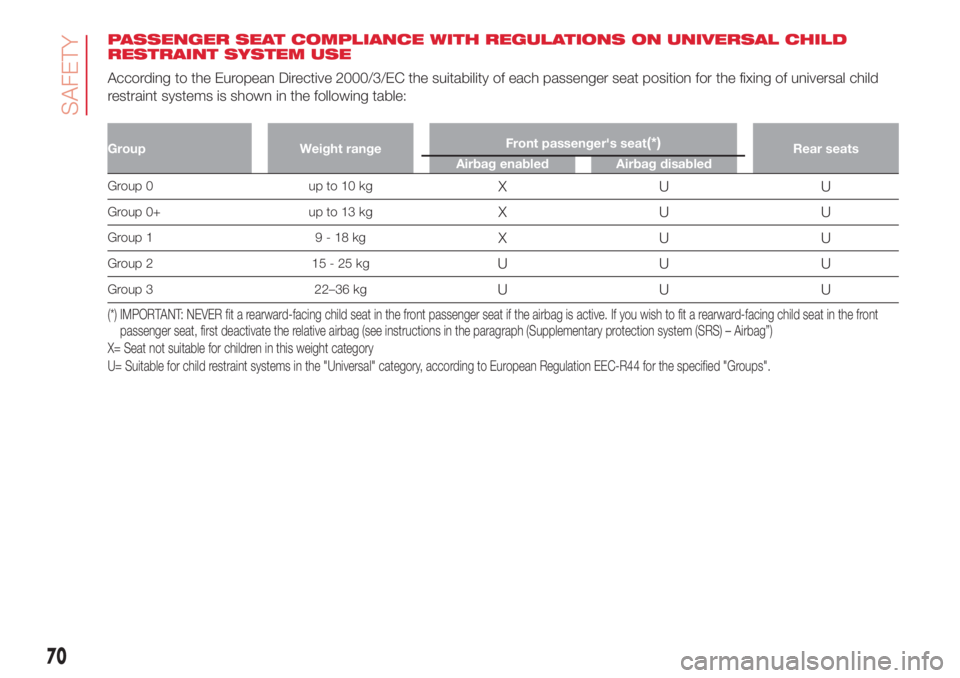
PASSENGER SEAT COMPLIANCE WITH REGULATIONS ON UNIVERSAL CHILD
RESTRAINT SYSTEM USE
According to the European Directive 2000/3/EC the suitability of each passenger seat position for the fixing of universal child
restraint systems is shown in the following table:
Group Weight rangeFront passenger's seat(*)Rear seats
Airbag enabled Airbag disabled
Group0 upto10kgXUU
Group 0+ up to 13 kgXUU
Group 1 9 - 18 kgXUU
Group 2 15 - 25 kgUUU
Group 3 22–36 kgUUU
(*) IMPORTANT: NEVER fit a rearward-facing child seat in the front passenger seat if the airbag is active. If you wish to fit a rearward-facing child seat in the front
passenger seat, first deactivate the relative airbag (see instructions in the paragraph (Supplementary protection system (SRS) – Airbag”)
X= Seat not suitable for children in this weight category
U= Suitable for child restraint systems in the "Universal" category, according to European Regulation EEC-R44 for the specified "Groups".
70
SAFETY
Page 75 of 192

Main recommendations to carry
children safely
Install the child restraint systems on
the rear seat, which is the most
protected position in the event of an
impact.
Keep children in rearward facing
child restraint systems for as long as
possible, ideally until they are 2 years
old.
Should a rearward facing child
restraint system be installed on the rear
seats, it is advisable to position it as
far forward as the position of the front
seat allows.
If the passenger's front airbag is
deactivated always check the
permanent switching on of the
warning light to make sure that it
has actually been deactivated.
Carefully follow the instructions
supplied with the child restraint system.
Keep the instructions in the vehicle
along with the other documents and
this handbook. Do not use second-
hand child seats without instructions.
Only one child is to be strapped into
each restraint system; never carry two
children simultaneously.
Always check that the seat belts do
not rest on the child’s neck.
Always check that the seat belt is
well fastened by pulling on it.
While travelling, do not let the child
sit incorrectly or unfasten the belts.
Never allow a child to put the belt's
diagonal section under an arm or
behind their back.
Never carry children on your lap,
even newborns. No-one can hold
a child in the case of a crash.
In the event of an accident, replace
the child restraint system with a new
one. In addition, and depending on the
type of child restraint system installed,
replace the ISOFIX anchors or the
seat belt with which the child restraint
system was connected.
The rear headrest (where provided)
can be removed if needed to install
a child restraint system. The headrest
must always be fitted in the car if the
seat is used by an adult passenger or a
child sitting in a restraint system without
a backrest.
WARNING
78)SERIOUS DANGER. When an active
passenger airbag is fitted, DO NOT install
rear facing child restraint systems on
the front seat. Deployment of the airbag in
a crash could cause fatal injuries to the
child regardless of the severity of the
collision. It is advisable to always carry
children in a child restraint system on the
rear seat, which is the most protected
position in the event of a collision.
79)On the sun visor there is a label with
suitable symbols reminding the user that it
is compulsory to deactivate the airbag if
a rearward facing child restraint system is
fitted. Always comply with the instructions
on the passenger side sun visor (see the
"Front airbags" paragraph).
80)Should it be necessary to carry a child
on the passenger side front seat in a rear
facing child restraint system, the passenger
side front and side airbags must be
deactivated through the display main
menu, verifying deactivation by checking
that the warning light
located in the
central part of the dashboard has switched
on. Move the passenger's seat as far
back as possible to avoid contact between
the child seat and the dashboard.
81)Do not move the front or rear seat if a
child is seated on it or on the dedicated
child restraint system.
73
Page 76 of 192
82)Child restraint systems with ISOFIX
attachments are available for safely
anchoring to the seat without using the car
seat belts. See paragraph "Installing an
ISOFIX child restraint system" for the
installation instructions.
83)Incorrect fitting of the child restraint
system may result in an inefficient
protection system. In the event of an
accident the child restraint system may
become loose and the child may be
injured, even fatally. When fitting a restraint
system for newborns or children, strictly
comply with the instructions provided
by the Manufacturer.
84)When the child restraint system is not
used, secure it with the seat belt or with
the ISOFIX anchorages, or remove it from
the vehicle. Do not leave it unsecured
inside the passenger compartment. In this
way, in the case of sudden braking or an
accident, it will not cause injuries to the
occupants.
85)After installing a child restraint system,
do not move the seat: always remove
the child restraint system before making
any adjustment.
86)If a Universal ISOFIX child seat system
is not fixed to all three anchorages, it will
not be able to protect the child correctly. In
an accident, the child could be seriously
or fatally injured.
87)Fit the child restraint system when the
car is stationary. The child restraint system
is correctly fixed to the brackets when
you hear the click. Follow the instructions
for assembly, disassembly and positioning
that the Manufacturer must supply with
the child restraint system.88)Always make sure that the chest
section of the seat belt does not pass
under the arms or behind the back of the
child. In the event of an accident the seat
belt will not be able to secure the child,
with the risk of injury, including fatal injury.
Therefore the child must always wear
the seat belt correctly.
89)Do not use the same lower anchoring
to install more than one child restraint
system.SUPPLEMENTARY
RESTRAINT SYSTEM
(SRS) – AIRBAG
The vehicle may be equipped with:
front driver airbag;
front passenger airbag;
driver's side knee bag;
driver and passenger front side bags
for pelvis, chest and shoulder
protection (Side bags);
side bags for head protection of
front seat passengers and rear side
seat passengers (window bag).
FRONT AIRBAGS
90) 107)
The front driver/passenger airbags and
the driver's knee bag (where provided)
protect the front seat occupants in
the event of frontal impacts of
medium/high severity, by placing the
bag between the occupant and the
steering wheel or dashboard.
Therefore non-activation of airbags in
other types of collisions (side impacts,
rear shunts, roll-overs, etc.) does not
indicate a system malfunction.
An electronic control unit will make the
bag inflate in the event of a frontal
impact.
74
SAFETY