flat tire Acura ILX 2013 User Guide
[x] Cancel search | Manufacturer: ACURA, Model Year: 2013, Model line: ILX, Model: Acura ILX 2013Pages: 351, PDF Size: 8.21 MB
Page 304 of 351

303
Handling the Unexpected
This chapter explains how to handle unexpected troubles.
Tools
Types of Tools .................................. 304
If a Tire Goes Flat
Changing a Flat Tire ......................... 305
Engine Does Not Start
Checking the Engine ........................ 311
If the Keyless Access Remote Battery is
Weak ............................................. 312
Emergency Engine Stop ................... 313
Jump Starting.................................... 314
Shift Lever Does Not Move.............. 317Overheating
How to Handle Overheating............. 318
Indicator, Coming On/Blinking
If the Low Oil Pressure Indicator Comes
On ............................................. 320If the Charging System Indicator Comes
On ................................................. 320
If the Malfunction Indicator Lamp Comes
On or Blinks ................................... 321If the Brake System Indicator Comes On ....... 322If the EPS System Indicator Comes On ..... 322
If the Low Tire Pressure/TPMS Indicator
Comes On or Blinks ....................... 323
Fuses
Fuse Locations ................................. 324
Inspecting and Changing Fuses ........ 326
Emergency Towing........................... 327
Page 306 of 351
305
Continued
Handling the Unexpected
If a Tire Goes FlatChanging a Flat TireIf a tire goes flat while driving, grasp the steering wheel firmly, and brake gradually
to reduce speed. Then, stop in a safe place. Replace the flat tire with a compact
spare tire. Go to a dealer as soon as possible to have the full size tire repaired or
replaced.
1.Park the vehicle on firm, level, and non-slippery and apply the parking brake.
2.Move the shift lever in
(P.
2.Move the shift lever in (R.
3.Set the parking brake.
4.Turn on the hazard warning lights and set the power mode to VEHICLE OFF
(LOCK).
1Changing a Flat Tire
Periodically check the tire pressure of the compact
spare. It should be set to the specified pressure.
Specified Pressure: 60 psi (420 kPa, 4.2 kgf/cm
2)
When driving with the compact spare tire, keep the
vehicle speed under 50 mph (80 km/h). Replace with
a full size tire as soon as possible.
The compact spare tire and wheel in your vehicle are
specifically for this model.
Do not use them with another vehicle.
Do not use another type of compact spare tire or
wheel with your vehicle.
Do not mount tire chains on a compact spare tire.
If a chain-mounted front tire goes flat, remove one of
the full-size rear tires and replace it with the compact
spare tire. Remove the flat front tire and replace it
with the full size tire that was removed from the rear.
Mount the tire chains on the front tire.
Do not use a puncture-repairing agent on a flat tire,
as it can damage the tire pressure sensor.
U.S. models only
Automatic transmission modelsManual transmission modelsAll models
Page 307 of 351
uuIf a Tire Goes FlatuChanging a Flat Tire
306Handling the Unexpected
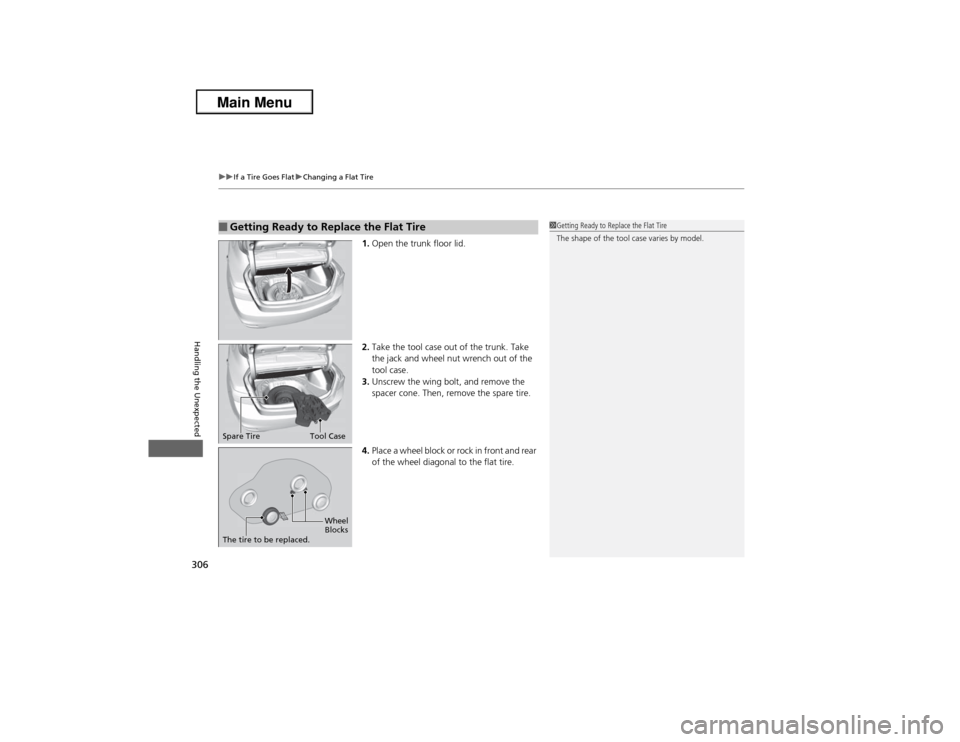
1.Open the trunk floor lid.
2.Take the tool case out of the trunk. Take
the jack and wheel nut wrench out of the
tool case.
3.Unscrew the wing bolt, and remove the
spacer cone. Then, remove the spare tire.
4.Place a wheel block or rock in front and rear
of the wheel diagonal to the flat tire.
■Getting Ready to Replace the Flat Tire
1Getting Ready to Replace the Flat Tire
The shape of the tool case varies by model.
Spare Tire
Tool Case
Wheel
Blocks
The tire to be replaced.
Page 308 of 351
307
uuIf a Tire Goes FlatuChanging a Flat Tire
Continued
Handling the Unexpected
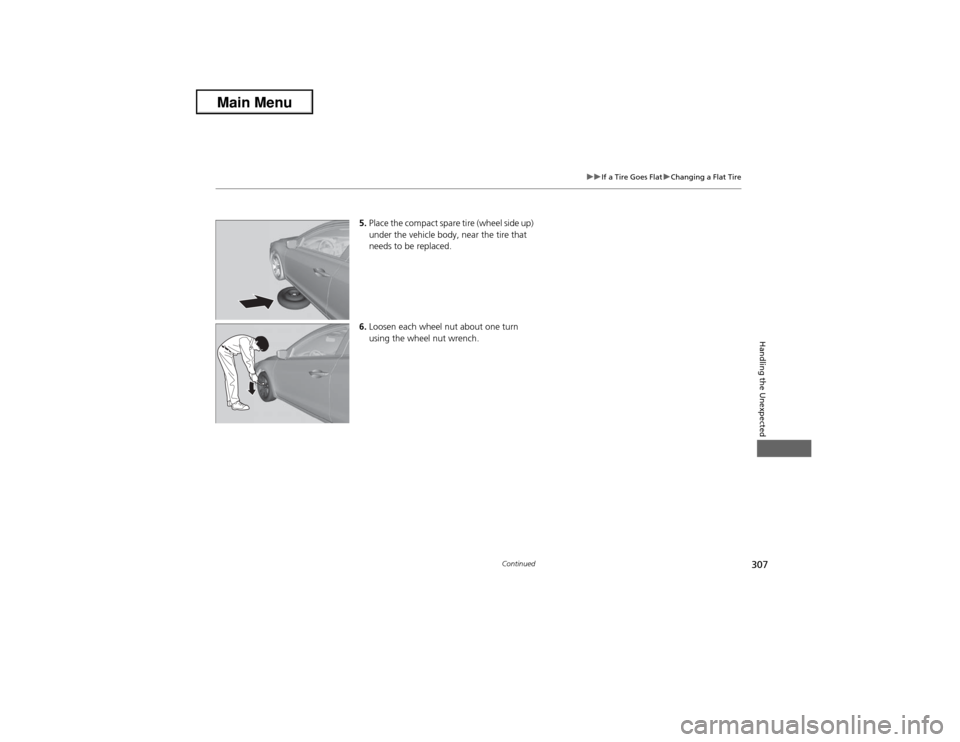
5.Place the compact spare tire (wheel side up)
under the vehicle body, near the tire that
needs to be replaced.
6.Loosen each wheel nut about one turn
using the wheel nut wrench.
Page 309 of 351
uuIf a Tire Goes FlatuChanging a Flat Tire
308Handling the Unexpected
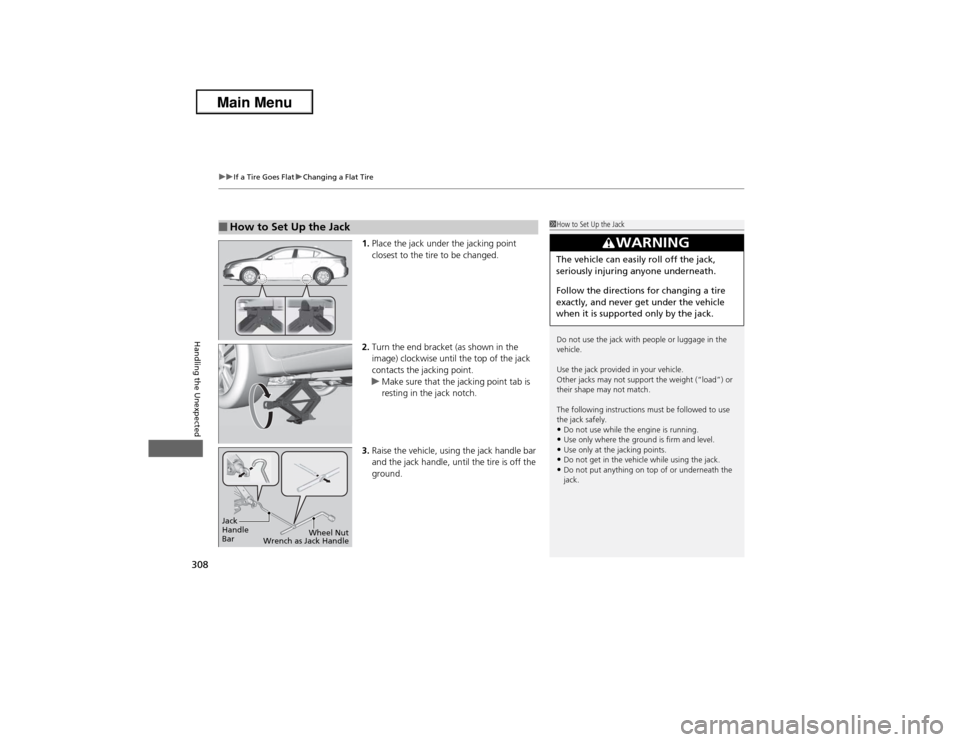
1.Place the jack under the jacking point
closest to the tire to be changed.
2.Turn the end bracket (as shown in the
image) clockwise until the top of the jack
contacts the jacking point.
uMake sure that the jacking point tab is
resting in the jack notch.
3.Raise the vehicle, using the jack handle bar
and the jack handle, until the tire is off the
ground.
■How to Set Up the Jack
1How to Set Up the Jack
Do not use the jack with people or luggage in the
vehicle.
Use the jack provided in your vehicle.
Other jacks may not support the weight (“load”) or
their shape may not match.
The following instructions must be followed to use
the jack safely.•Do not use while the engine is running.•Use only where the ground is firm and level.•Use only at the jacking points.•Do not get in the vehicle while using the jack.•Do not put anything on top of or underneath the
jack.
3
WARNING
The vehicle can easily roll off the jack,
seriously injuring anyone underneath.
Follow the directions for changing a tire
exactly, and never get under the vehicle
when it is supported only by the jack.
Jack
Handle
BarWheel Nut
Wrench as Jack Handle
Page 310 of 351
Continued
309
uuIf a Tire Goes FlatuChanging a Flat Tire
Handling the Unexpected
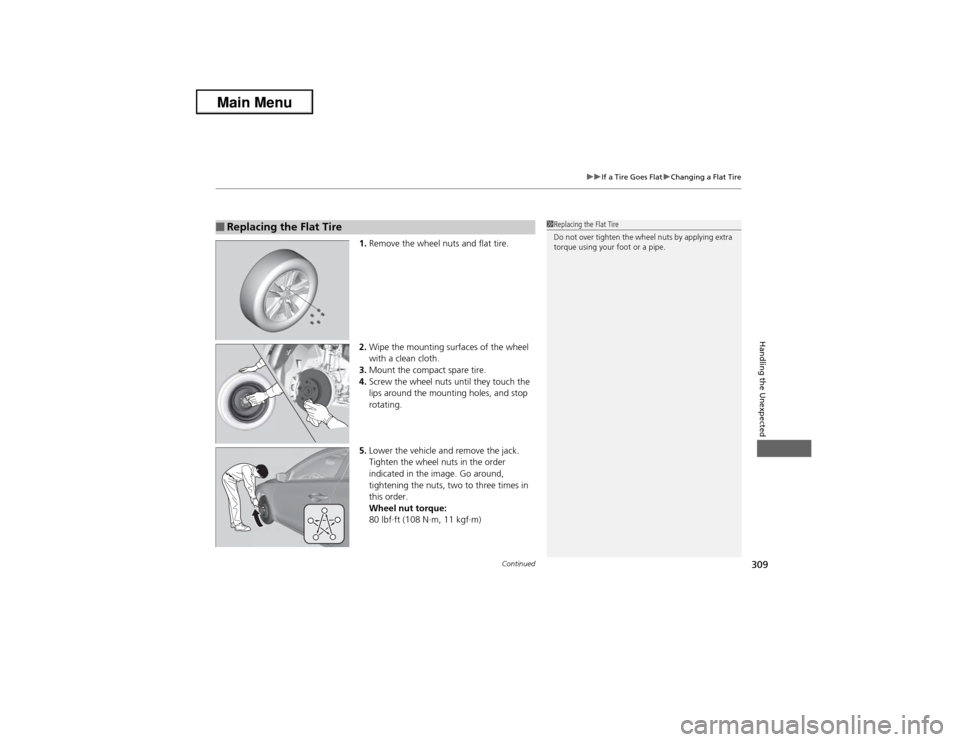
1.Remove the wheel nuts and flat tire.
2.Wipe the mounting surfaces of the wheel
with a clean cloth.
3.Mount the compact spare tire.
4.Screw the wheel nuts until they touch the
lips around the mounting holes, and stop
rotating.
5.Lower the vehicle and remove the jack.
Tighten the wheel nuts in the order
indicated in the image. Go around,
tightening the nuts, two to three times in
this order.
Wheel nut torque:
80 lbf∙ft (108 N∙m, 11 kgf∙m)
■Replacing the Flat Tire
1Replacing the Flat Tire
Do not over tighten the wheel nuts by applying extra
torque using your foot or a pipe.
Page 311 of 351
uuIf a Tire Goes FlatuChanging a Flat Tire
310Handling the Unexpected
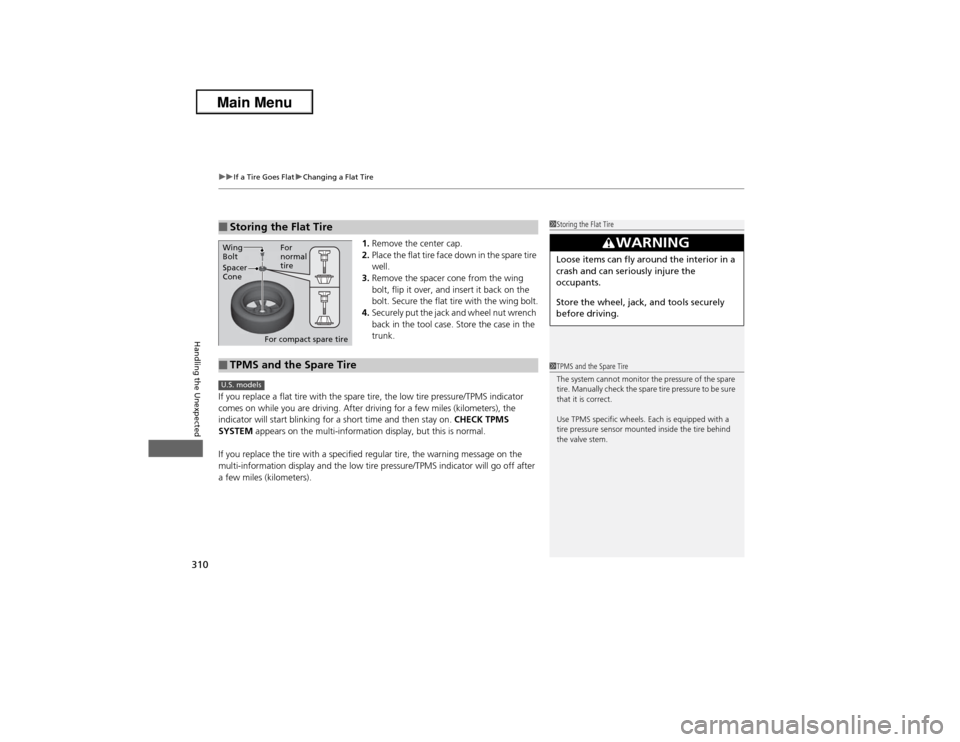
1.Remove the center cap.
2.Place the flat tire face down in the spare tire
well.
3.Remove the spacer cone from the wing
bolt, flip it over, and insert it back on the
bolt. Secure the flat tire with the wing bolt.
4.Securely put the jack and wheel nut wrench
back in the tool case. Store the case in the
trunk.
If you replace a flat tire with the spare tire, the low tire pressure/TPMS indicator
comes on while you are driving. After driving for a few miles (kilometers), the
indicator will start blinking for a short time and then stay on. CHECK TPMS
SYSTEM appears on the multi-information display, but this is normal.
If you replace the tire with a specified regular tire, the warning message on the
multi-information display and the low tire pressure/TPMS indicator will go off after
a few miles (kilometers).
■Storing the Flat Tire
1Storing the Flat Tire
3
WARNING
Loose items can fly around the interior in a
crash and can seriously injure the
occupants.
Store the wheel, jack, and tools securely
before driving.
Spacer
Cone Wing
Bolt
For compact spare tireFor
normal
tire■TPMS and the Spare TireU.S. models
1TPMS and the Spare Tire
The system cannot monitor the pressure of the spare
tire. Manually check the spare tire pressure to be sure
that it is correct.
Use TPMS specific wheels. Each is equipped with a
tire pressure sensor mounted inside the tire behind
the valve stem.
Page 324 of 351
323
uuIndicator, Coming On/BlinkinguIf the Low Tire Pressure/TPMS Indicator Comes On or Blinks
Handling the Unexpected
If the Low Tire Pressure/TPMS Indicator Comes On or Blinks
■Reasons for the indicator to come on or blink
A tire pressure is significantly low. If there is a problem with the TPMS or
the compact spare tire is installed, the indicator blinks for about one
minute, and then stays on.■What to do when the indicator comes on
Stop your vehicle in a safe place. Check the tire pressure and adjust the
pressure to the specified level. The specified tire pressure is on a label on
the driver side doorjamb.■What to do when the indicator blinks
Have the tire inspected by a dealer as soon as possible. If the compact
spare tire has triggered the indicator to blink, change the tire to a full
size tire. The indicator goes off after a while.
U.S. models
1If the Low Tire Pressure/TPMS Indicator Comes On or BlinksNOTICEDriving on an extremely underinflated tire can cause
it to overheat. An overheated tire can fail. Always
inflate your tires to the prescribed level.
Page 328 of 351
327Handling the Unexpected
Emergency TowingCall a professional towing service if you need to tow your vehicle.■Flat bed equipment
The operator loads your vehicle on the back of a truck.
This is the best way to transport your vehicle.■Wheel lift equipment
The tow truck uses two pivoting arms that go under the front tires and lift them off
the ground. The rear tires remain on the ground. This is an acceptable way to
tow your vehicle.
1Emergency TowingNOTICETrying to lift or tow your vehicle by the bumpers will
cause serious damage. The bumpers are not designed
to support the vehicle's weight.NOTICEImproper towing such as towing behind a
motorhome or other motor vehicle can damage the
transmission.
Never tow your vehicle with just a rope or chain.
It is very dangerous, since ropes or chains may shift
from side to side or break.
Page 346 of 351

345Index
Braking ................................................... 237
Cruise Control ........................................ 229
Shifting Gear .................................. 222, 226
Starting the Engine ................................. 216
Dust and Pollen Filter.............................. 297EElapsed Time.............................................. 81
Electric Power Steering System (EPS)
Indicator ........................................... 68, 322
Electronic Stability Control (ESC)............ 232
Emergency................................................ 327
Emissions Testing (Readiness Codes)...... 337
Engine....................................................... 334
Coolant .................................................. 268
Jump Starting ......................................... 314
Oil .......................................................... 261
Starting................................................... 216
Switch Buzzer ......................................... 112
Engine Compartment Cover.................... 259
Engine Coolant........................................ 268
Adding to the Radiator ........................... 269
Adding to the Reserve Tank .................... 268
Overheating ............................................ 318
Temperatue Guage ................................... 78
Engine Oil................................................. 261
Adding ................................................... 264
Checking ................................................ 262
Displaying Oil Life ................................... 252
Low Oil Pressure Indicator ................. 64, 320Recommended Engine Oil........................ 261
ENGINE START/STOP Button.................... 112
EPS (Electric Power Steering)
System............................................... 68, 322
Exhaust Gas Hazard
(Carbon Monoxide).................................. 60
Expanded View Driver’s Mirror............... 122
Exterior Care (Cleaning)........................... 300
Exterior Mirrors........................................ 122
FFeatures..................................................... 141
Filters
Dust and Pollen ....................................... 297
Oil ........................................................... 265
Flat Tire..................................................... 305
Floor Mats................................................. 299
Fluids
Automatic Transmission........................... 270
Brake/Clutch............................................ 272
Engine Coolant........................................ 268
Manual Transmission ............................... 271
Windshield Washer.................................. 273
Fog Light Indicator..................................... 70
Folding Down the Rear Seat.................... 129
Foot Brake................................................. 238
Front Airbags (SRS)..................................... 36
Front Seats................................................ 123
Adjusting................................................. 123
Fuel...................................................... 14, 243Economy ................................................. 245
Gauge ....................................................... 78
Instant Fuel Economy ................................ 81
Low Fuel Indicator ..................................... 67
Range ....................................................... 81
Recommendation .................................... 243
Refueling................................................. 243
Fuel Economy........................................... 245
Fuel Fill Cap........................................ 14, 244
Message.................................................. 321
Fuel Fill Door...................................... 14, 244
Fuses.......................................................... 324
Inspecting and Changing......................... 326
Locations......................................... 324, 325
GGasoline (Fuel)
Economy ................................................. 245
Gauge ....................................................... 78
Information ............................................. 243
Instant Fuel Economy ................................ 81
Low Fuel Indicator ..................................... 67
Refueling................................................. 243
Gauges........................................................ 78
Gear Shift Lever Positions
Automatic Transmission .......................... 222
Manual Transmission ............................... 227
Glass (care)................................................ 301
Glove Box.................................................. 132