height Acura Integra 2000 Sedan Owner's Manual
[x] Cancel search | Manufacturer: ACURA, Model Year: 2000, Model line: Integra, Model: Acura Integra 2000Pages: 273, PDF Size: 4.4 MB
Page 19 of 273

Protectin
g Adult s
If the seat belt touches or crosses
your neck, or if it crosses your arm instead of your shoulder, you need to
adjust the seat belt anchor height. To adjust the height of a front seat
belt anchor, squeeze the two release
buttons and slide the anchor up or down as needed (it has four
positions).
Never place the shoulder portion of alap/shoulder belt under your arm or
behind your back. This could cause
very serious injuries in a crash.
Using the Lap Belt
Insert the latch plate into the buckle
marked CENTER. If the belt is too short, hold the latch
plate at a right angle and pull on the
plate to extend the belt. Then insert
the latch plate into the buckle, and
tug on the belt to make sure the belt
is securely latched.
Drive r an d Passenge r Safet y
RELEAS
E
BUTTO N
RELEAS E
BUTTO N
Page 32 of 273
Protectin
g Childre n
Protectin g Infant s
Child Seat Type
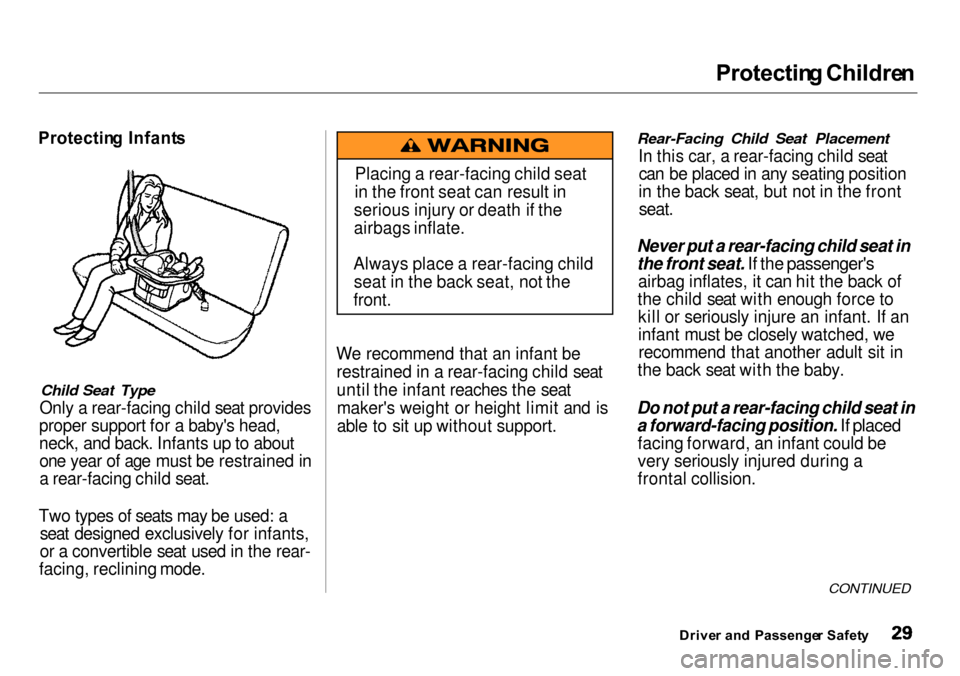
Only a rear-facing child seat provides
proper support for a baby's head,
neck, and back. Infants up to about one year of age must be restrained in
a rear-facing child seat.
Two types of seats may be used: a seat designed exclusively for infants,
or a convertible seat used in the rear-
facing, reclining mode. We recommend that an infant be
restrained in a rear-facing child seat
until the infant reaches the seatmaker's weight or height limit and is
able to sit up without support.
Rear-Facing Child Seat Placement
In this car, a rear-facing child seatcan be placed in any seating position
in the back seat, but not in the front
seat.
Never put a rear-facing child seat in
the front seat. If the passenger's
airbag inflates, it can hit the back of
the child seat with enough force to kill or seriously injure an infant. If an
infant must be closely watched, werecommend that another adult sit in
the back seat with the baby.
Do not put a rear-facing child seat in
a forward-facing position. If placed
facing forward, an infant could be
very seriously injured during a
frontal collision.
CONTINUED
Drive r an d Passenge r Safet y
Placing a rear-facing child seat
in the front seat can result in
serious injury or death if the
airbags inflate.
Always place a rear-facing child seat in the back seat, not the
front.
Page 36 of 273

Protectin
g Childre n
Additional Precautions for Infants
Never hold an infant on your lap.
If you are not wearing a seat belt
in a crash, you could be thrown
forward into the dashboard and crush the infant.
If you are wearing a seat belt, theinfant can be torn from your arms.
For example, if your car crashes
into a parked vehicle at 30 mph (48 km/h), a 20-lb (9 kg) infant
will become a 600-lb (275 kg) force, and you will not be able to hold on.
Never put a seat belt over yourself
and an infant. During a crash, the
belt could press deep into the
infant and cause very serious
injuries. Protectin
g Smal l Childre n
Child Seat Type
A child who can sit up without
support, and who fits within the child
seat maker's weight and height
limits, should be restrained in a
forward-facing, upright child seat.
Of the different seats available, we
recommend those that have a five-
point harness system as shown. We also recommend that a small
child stay in the child seat as long as
possible, until the child reaches the
weight or height limit for the seat.
Child Seat Placement
In this car, the best place to install a
forward-facing child seat is in one of the seating positions in the back seat.
Placing a forward-facing child seat in
the front seat of a vehicle equipped
with a passenger airbag can be
hazardous. If the car seat is too far
forward, or the child's head is
thrown forward during a collision, an inflating passenger's airbag canstrike the child with enough force to
cause very serious or fatal injuries. If
a small child must be closely
watched, we recommend that another adult sit in the back seat
with the child.
CONTINUED
Drive r an d Passenge r Safet y
Page 40 of 273
Protectin
g Childre n
Protectin g Large r Childre n
When a child reaches the recommended weight or height limit
for a forward-facing child seat, the child should sit in one of the outer
back seats and wear a lap/shoulder
belt. The lap/shoulder belt provides
better protection than the lap belt.
If a child is too short for the shoulder
part of the belt to properly fit, we
recommend that the child use a
booster seat until tall enough to use
the seat belt without a booster.
The following pages give
instructions on how to check properseat belt fit, what kind of booster
seat to use if one is needed, and
important precautions for children
who must sit in the front seat.
Checking Seat Belt Fit
To determine if a lap/shoulder belt
properly fits a child, have the child
put on the seat belt. Follow the
instructions on page 15 . Then check
how the belt fits.
CONTINUED
Drive r an d Passenge r Safet y
Allowing a larger child to sit
improperly in the front seat can
result in injury or death if the
airbags inflate.
If a larger child must sit in front,
make sure the child moves the
seat as far back as possible
and wears the seat belt properly.
Page 42 of 273

Protectin
g Childre n
Using a Booster Seat
If a child needs a booster seat, we
recommend choosing a style that allows the child to use the lap/shoulder belt directly, without a
shield, as shown.
Whichever style you select, follow
the booster seat maker's instructions. A child may continue using a booster
seat until the tops of the ears are
even with the top of the seat-back. A
child of this height should be tall
enough to use the lap/shoulder belt
without a booster. When Can a Larger Child Sit in Front
The National Highway Traffic Safety
Administration and Transport
Canada recommend that all children
ages 12 and under be properly restrained in a back seat.
The back seat is the safest place for a child of any age or size.
In addition, the passenger's airbag
poses serious risks to children. If the
seat is too far forward, or the child's
head is thrown forward during a collision, or the child is unrestrained
or out of position, an inflating airbag
can kill or seriously injure the child.
Of course, children vary widely. And
while age may be one indicator of
when a child can safely ride in the
front, there are other important factors you should consider.
CONTINUED
Drive r an d Passenge r Safet y
Page 54 of 273

Instrument
s an d Control s
This section gives information about the controls and displays that
contribute to the daily operation of
your Acura. All the essential controls
are within easy reach.
Control Locations............................ 52
Indicator Lights................................ 53
Gauges.............................................. 57
Speedometer................................ 57
Tachometer.................................. 57
Odometer...................................... 57
Trip Meter.................................... 57
Fuel Gauge................................... 58
Temperature Gauge....................
58
Maintenance Require
d
Indicator.................................... 59
Controls Near the Steering
Wheel........................................ 60
Headlights.................................... 61
Instrument Panel Brightness.....
62
Turn S
ignals.................................
62
Windshield Wipers.
..................... 63
Windshield Washers..................
. 63
Hazard Warning...........................
64
Rear Windo
w Defogger.............. 64
Steering Wheel Adjustment....... 65
Steering Wheel Controls................ 66
Cruise Control.............................. 66
Keys and Locks................................ 69
Keys............................................... 69
Immobilizer System..................... 69
Ignition Switch............................. 70
Power Door Locks....................... 72
Childproof Door Locks............... 73
Trunk............................................ 73
Glove Box..................................... 75
Seat Adjustments............................. 75
Driver's Seat Height
Adjustment............................... 76
Driver's Lumbar Support............ 76
Head Restraints........................... 77
Folding Rear Seat............................ 77
Power Windows............................... 79
Moonroof.......................................... 80
Mirrors.............................................. 81
Adjusting the Power Mirrors..... 81
Parking Brake.................................. 82
Digital Clock..................................... 83
Beverage Holder.............................. 84 Console Compartment.................... 85
Cigarette Lighter............................. 85
Ashtrays............................................ 86
Interior Lights.................................. 87
Instrument s an d Control s
Page 79 of 273
Sea
t Adjustment s
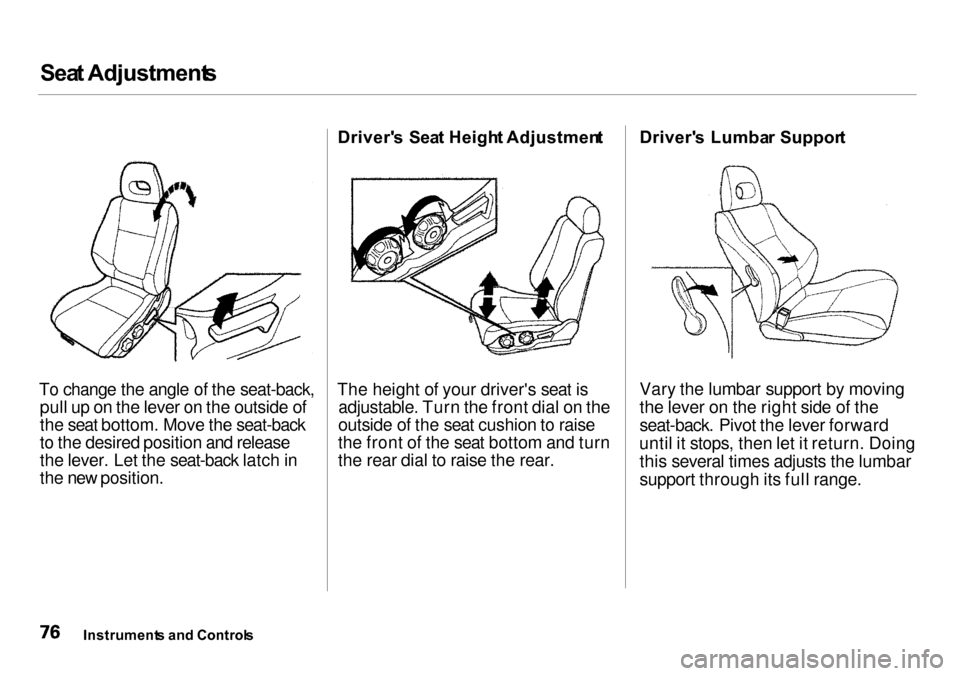
To change the angle of the seat-back, pull up on the lever on the outside of
the seat bottom. Move the seat-back
to the desired position and release
the lever. Let the seat-back latch in
the new position. Driver'
s Sea t Heigh t Adjustmen t
The height of your driver's seat is adjustable. Turn the front dial on the
outside of the seat cushion to raise
the front of the seat bottom and turn
the rear dial to raise the rear. Driver'
s Lumba r Suppor t
Vary the lumbar support by moving
the lever on the right side of the
seat-back. Pivot the lever forward
until it stops, then let it return. Doing this several times adjusts the lumbar
support through its full range.
Instrument s an d Control s
Page 80 of 273

Sea
t Adjustments , Foldin g Rea r Sea t
Hea d Restraint s
See page 14 for important safety
information and a warning about how to
properly position the head restraints.
The front head restraints help
protect you and your passenger from whiplash and other injuries. They are
most effective when you adjust them so the back of the occupant's head
rests against the center of the
restraint. A taller person should adjust the restraint as high as
possible.
The front head restraints adjust forheight. You need both hands toadjust the restraint. Do not attempt
to adjust it while driving. To raise it,
pull upward. To lower the restraint,
push the release button sideways
and push the restraint down.
To remove a head restraint for
cleaning or repair, pull it up as far as it will go. Push the release button
and pull the restraint out of the seat-
back.
Foldin
g Rea r Sea t
The back of the rear seat folds down, giving you direct access to the trunk. The seat-back can be released from
inside the vehicle or inside the trunk.
CONTINUED
Instrument s an d Control s
RELEAS
E
BUTTO N
Page 129 of 273
Accessorie
s an d Modification s
Modification s
Do not remove any original
equipment or modify your car in any
way that would alter its design or operation. This could make your car
unsafe and illegal to drive.
For example, do not make any
modifications that would change the
ride height of your car, or install
wheels and tires with a different overall diameter.
Such modifications can adverselyaffect handling, and interfere with
the operation of the car's anti-lock
brakes and other systems. In addition, any modifications that
decrease ground clearance increase
the chance of undercarriage parts striking a curb, speed bump, or other
raised object, which could cause your airbags to deploy.
Do not modify your steering wheel or any other part of your
Supplemental Restraint System. Modifications could make the
system ineffective. Additiona
l Safet y Precautio n
Do not attach or place objects on the
airbag covers. Any object attached to
or placed on the covers marked "SRS
AIRBAG," in the center of the steering wheel and on top of the
dashboard, could interfere with the
proper operation of the airbags. Or, if the airbags inflate, the objects
could be propelled inside the car and
hurt someone.
Befor e Drivin g
Page 154 of 273
Towin
g a Traile r
Drivin g Safel y Wit h a Traile r
The added weight, length, and height of a trailer will affect your
vehicle's handling and performance, so driving with a trailer requires
some special driving skills and
techniques.
For your safety and the safety of others, take time to practice driving
maneuvers before heading for the open road, and follow the guidelines
discussed below.
Towing Speeds and Gears
Driving slower than normal in all
driving situations, and obey posted speed limits for vehicles with trailers.
If you have automatic transmission,
use D4 position when towing a trailer
on level roads. D3 is the proper shift
lever position to use when towing a
trailer in hilly terrain. (See "Driving on Hills" in the next column for
additional gear information.)
Making Turns and Braking
Make turns more slowly and wider
than normal. The trailer tracks a smaller arc than your vehicle, and it
can hit or run over something the
vehicle misses. Allow more time and distance for braking. Do not brake or
turn suddenly as this could cause the
trailer to jackknife or turn over.
Driving on Hills
When climbing hills, closely watch your temperature gauge. If it nears the red mark, turn the air
conditioning off, reduce speed and, if necessary, pull to the side of the
road to let the engine cool.
If the automatic transmission shifts
frequently between 3rd and 4th gears while going up a hill, shift to
D3.
If you must stop when facing uphill,
use the foot brake or parking brake.
Do not try to hold the vehicle in
place by pressing on the accelerator, as this can cause the automatic
transmission to overheat.
When driving down hills, reduce
your speed and shift down to 2nd gear. Do not "ride" the brakes, andremember it will take longer to slowdown and stop when towing a trailer.
Driving
CONTINUED