air conditioning Acura Integra 2000 Sedan Owner's Manual
[x] Cancel search | Manufacturer: ACURA, Model Year: 2000, Model line: Integra, Model: Acura Integra 2000Pages: 273, PDF Size: 4.4 MB
Page 92 of 273

Comfor
t an d Convenienc e Feature s
The heating and air conditioning systems in your Acura provide a com-
fortable driving environment in all
weather conditions.
The standard audio system has
many features. This section de-
scribes those features and how to
use them. (If you selected an
optional audio system, refer to the
operating instructions that came
with it.)
Your Acura has an anti-theft audio system that requires a code number
to enable it.Heating and
Cooling..................... 90
What Each Control Does............ 90
How to Use the System............... 92
To Turn Everything Off............. 97
Audio System................................... 98
Operating the Radio.................... 99
Adjusting the Sound.................. 102 Radio Frequencies..................... 103
Radio Reception......................... 103 Operating the CD Player.......... 105
Operating the Optional CD Changer.................................. 107
Protecting Compact Discs........ 108
CD Player Error Indications..... 109
CD Changer Error Indications.............................. 110
Operating the Optional Cassette Player...................... 111
Tape Search Functions............. 112
Caring for the Cassette Player...................................... 114
Theft Protection............................. 115
Comfor t an d Convenienc e Feature s
Page 95 of 273

Heatin
g an d Coolin g
Ven t Control s
You can adjust the direction of the
air coming from the dashboard vents
by moving the tab in the center of
each vent up-and-down and side-to-
side.
The vents in the corners of the
dashboard can be opened and closed
with the dials underneath them. Ho
w to Us e th e Syste m
This section covers how to set up the
system controls for ventilation, heating, cooling, dehumidifying, and
defrosting.
The engine must be running for the
heater and air conditioning to generate hot and cold air. The heater
uses engine coolant to warm the air.
If the engine is cold, it will be several
minutes before you feel warm air
coming from the system.
The air conditioning does not rely on
engine temperature.
Comfor t an d Convenienc e Feature s
SID
E VEN T
CENTE R VEN T
Page 98 of 273

Heatin
g an d Coolin g
If the interior is very warm from
being parked in the sun, you can cool it down more rapidly by setting up
the controls this way:
1. Start the engine.
2. Turn on the A/C by pressing the button. Make sure the tempera-ture control lever is all the way to
the left.
3. Set the fan to maximum speed.
4. Open the windows partially. Select and Fresh Air mode.
When the interior has cooled down to a more comfortable temperature,
close the windows and set the
controls as described for normal
cooling.
Air conditioning places an extra load
on the engine. Watch the engine
coolant temperature gauge (see page
58) when driving in stop-and-go
traffic or climbing a long, steep hill.
If it moves near the red zone, turn off the A/C until the gauge reads
normally.
To Heat
To warm the interior:
1. Start the engine. 2. Select and Fresh Air mode.
3. Set the fan to the desired speed.
4. Adjust the warmth of the air with
the temperature control lever.
To Heat and Dehumidify with Air
Conditioning
Air conditioning, as it cools, removes
moisture from the air. When used in
combination with the heater, it
makes the interior warm and dry.
1. Switch the fan on.
2. Turn on the air conditioning.
3. Select
and Fresh Air mode.
4. Adjust the temperature control
lever so the mixture of heated andcooled air feels comfortable.
This setting is suitable for all driving conditions whenever the outside
temperature is above 32°F (0°C).
CONTINUED
Comfor t an d Convenienc e Feature s
Page 99 of 273

Heatin
g an d Coolin g
To Defog and Defrost
To remove fog from the inside of the
windows:
1. Switch the fan on.
2. Turn on the air conditioning. 3. Select Fresh Air mode and
4. Adjust the temperature control
lever so the air flow from the
defroster vents feels warm.
5. Turn on the rear window defogger to help clear the rear window.
Comfor t an d Convenienc e Feature s AI
R CONDITIONIN G
BUTTO N
RECIRCULATIO
N
BUTTO N
MOD
E BUTTON S
FAN CONTRO L
LEVE R
TEMPERATUR
E
CONTRO L LEVE R
Page 127 of 273

Fue
l Econom y
The condition of your car and your
driving habits are the two most
important things that affect the fuel
mileage you get.
Vehicl e Conditio n
Always maintain your car according
to the maintenance schedule. This
will keep it in top operating condition.
An important part of that mainte-
nance is the Owne r Maintenanc e
Check s (see page 165 ). For
example, an underinflated tire
causes more "rolling resistance,"
which uses fuel. It. also wears out
faster, so check the tire pressure at
least monthly.
In winter, the build-up of snow on
your car's underside adds weight and
rolling resistance. Frequent cleaning
helps your fuel mileage and reduces the chance of corrosion. Drivin
g Habit s
You can improve fuel economy by
driving moderately. Rapid acceler-
ation, abrupt cornering, and hard
braking use more fuel.
Always drive in the highest gear that
allows the engine to run and acceler- ate smoothly.
Depending on traffic conditions, try to maintain a constant speed. Every
time you slow down and speed up, your car uses extra fuel. Use the
cruise control, when appropriate, to increase fuel economy. A cold engine uses more fuel than a
warm engine. It is not necessary to
"warm-up" a cold engine by letting it idle for a long time. You can drive away in about a minute, no matter
how cold it is outside. The engine
will warm up faster, and you get
better fuel economy. To cut down on the number of "cold starts," try to combine several short trips into one.
The air conditioning puts an extra
load on the engine which makes it
use more fuel. Turn off the A/C to
cut down on air conditioning use. Use the flow-through ventilation
when the outside air temperature is
moderate.
Befor e Drivin g
Page 148 of 273
Drivin
g in Ba d Weathe r
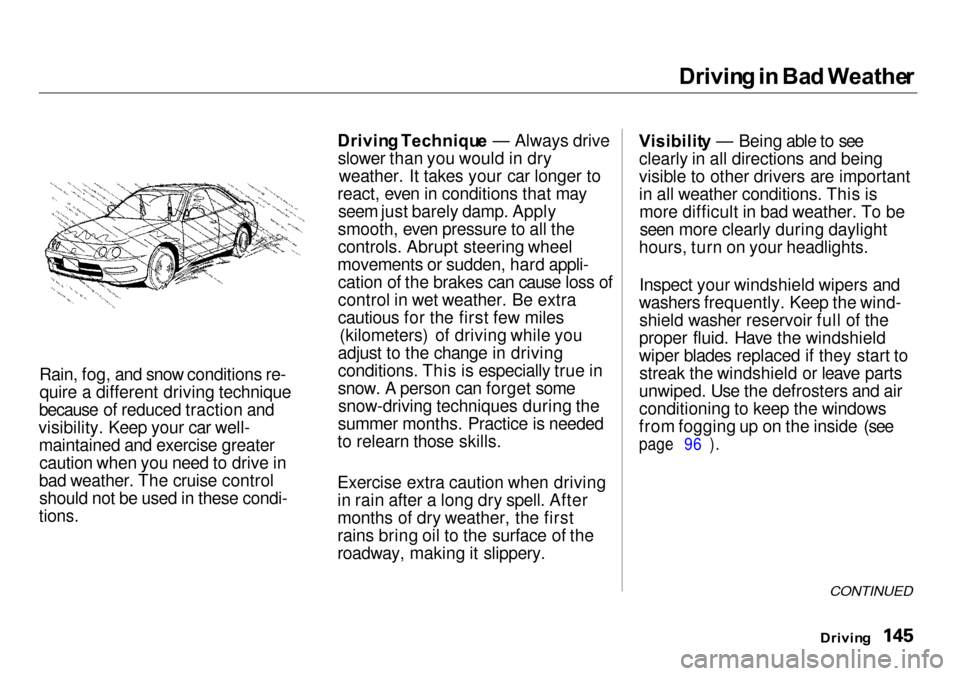
Rain, fog, and snow conditions re- quire a different driving technique
because of reduced traction and
visibility. Keep your car well- maintained and exercise greatercaution when you need to drive in
bad weather. The cruise control should not be used in these condi-
tions.
Drivin
g Techniqu e — Always drive
slower than you would in dry weather. It takes your car longer to
react, even in conditions that may seem just barely damp. Apply
smooth, even pressure to all the
controls. Abrupt steering wheel
movements or sudden, hard appli- cation of the brakes can cause loss of
control in wet weather. Be extra
cautious for the first few miles (kilometers) of driving while you
adjust to the change in driving
conditions. This is especially true in
snow. A person can forget some snow-driving techniques during the
summer months. Practice is needed
to relearn those skills.
Exercise extra caution when driving
in rain after a long dry spell. After
months of dry weather, the first
rains bring oil to the surface of the
roadway, making it slippery. Visibilit
y — Being able to see
clearly in all directions and being
visible to other drivers are important
in all weather conditions. This is more difficult in bad weather. To beseen more clearly during daylight
hours, turn on your headlights.
Inspect your windshield wipers and
washers frequently. Keep the wind- shield washer reservoir full of the
proper fluid. Have the windshield
wiper blades replaced if they start to streak the windshield or leave parts
unwiped. Use the defrosters and air
conditioning to keep the windows
from fogging up on the inside (see
page 96 ).
CONTINUED
Drivin g
Page 154 of 273

Towin
g a Traile r
Drivin g Safel y Wit h a Traile r
The added weight, length, and height of a trailer will affect your
vehicle's handling and performance, so driving with a trailer requires
some special driving skills and
techniques.
For your safety and the safety of others, take time to practice driving
maneuvers before heading for the open road, and follow the guidelines
discussed below.
Towing Speeds and Gears
Driving slower than normal in all
driving situations, and obey posted speed limits for vehicles with trailers.
If you have automatic transmission,
use D4 position when towing a trailer
on level roads. D3 is the proper shift
lever position to use when towing a
trailer in hilly terrain. (See "Driving on Hills" in the next column for
additional gear information.)
Making Turns and Braking
Make turns more slowly and wider
than normal. The trailer tracks a smaller arc than your vehicle, and it
can hit or run over something the
vehicle misses. Allow more time and distance for braking. Do not brake or
turn suddenly as this could cause the
trailer to jackknife or turn over.
Driving on Hills
When climbing hills, closely watch your temperature gauge. If it nears the red mark, turn the air
conditioning off, reduce speed and, if necessary, pull to the side of the
road to let the engine cool.
If the automatic transmission shifts
frequently between 3rd and 4th gears while going up a hill, shift to
D3.
If you must stop when facing uphill,
use the foot brake or parking brake.
Do not try to hold the vehicle in
place by pressing on the accelerator, as this can cause the automatic
transmission to overheat.
When driving down hills, reduce
your speed and shift down to 2nd gear. Do not "ride" the brakes, andremember it will take longer to slowdown and stop when towing a trailer.
Driving
CONTINUED
Page 156 of 273
This section explains why it is important to keep your car well
maintained and to follow basic
maintenance safety precautions.
This section also includes Maintenance Schedules for normaldriving and severe driving conditions,
a Maintenance Record, and instruc-
tions for simple maintenance tasks
you may want to take care of
yourself.
If you have the skills and tools to per-
form more complex maintenance tasks on your Acura, you may want
to purchase the Service Manual. Seepage 259 for information on how to
obtain a copy, or see your Acura
dealer.
Maintenance Safety....................... 154
Important Safety Precautions.. 155
Maintenance Schedule.................. 156
Maintenance Record..................... 163
Owner Maintenance Checks........ 165
Fluid Locations............................... 166
Engine Oil......................................
. 167
Adding Oil................................... 167
Recommended Oil..................... 167
Synthetic Oil............................... 169
Additives..................................... 169
Changing the Oil and Filter...... 170
Cooling System.............................. 172 Adding Engine Coolant............. 172Replacing Engine Coolant........ 174
Windshield Washers..................... 177
Transmission Fluid........................ 178 AutomaticTransmission.......................... 178
5-speed Manual
Transmission.......................... 179
Brake and Clutch Fluid................. 179 Brake System............................. 180Clutch System............................
181
Power Steering..............................
. 181
Air Cleaner Element....................... 182 Hood Latch..................................... 183
Spark Plugs..................................... 183 Replacement............................... 183
Specifications............................. 185
Battery............................................ 186
Wiper Blades.................................. 188
Air Conditioning System............... 190
Drive Belts...................................... 191
Timing Belt..................................... 191
Tires................................................ 192 Inflation....................................... 192
Inspection...................................
194
Maintenance............................... 194
Tire Rotation.............................. 195 Replacing Tires and Wheels.... 195
Wheels and Tires....................... 196 Winter Driving........................... 196
Snow Tires.............................. 197
Tire Chains............................. 197
Lights.............................................. 198
Headlight Aiming.....................
. 200
Replacing Bulbs......................... 202
Storing Your Car............................ 210
Maintenance
Page 193 of 273

Ai
r Conditionin g Syste m
Your car's air conditioning is a sealed system. Any major maintenance,
such as recharging, should be done
by a qualified mechanic. You can do a couple of things to make sure theair conditioning works efficiently. Periodically check the engine's
radiator and air conditioning
condenser for leaves, insects, and
dirt stuck to the front surface. These
block the air flow and reduce cooling efficiency. Use a light spray from a
hose or a soft brush to remove them.
The condenser and radiator fins bend
easily. Only use a low-pressure, spray
or soft-bristle brush to clean them.
Run the air conditioning at least once a week during the cold weather
months. Run it for at least ten
minutes while you are driving at a steady speed with the engine at
normal operating temperature. This
circulates the lubricating oil con-
tained in the refrigerant. If the air conditioning does not get as
cold as before, have your dealer
check the system. Recharge the
system with Refrigerant HFC-134a (R-134a). (See Specifications on page 246.)
Whenever you have the air conditioning
system serviced, make sure the service
facility uses a refrigerant recycling
system. This system captures the
refrigerant for reuse. Releasing
refrigerant into the atmosphere can
damage the environment.
Maintenanc e
AI
R CONDITIONIN G
CONDENSE R
NOTICE NOTIC
E
Page 264 of 273

Inde
x
Accessories and Modifications.... 125 Accessories................................. 125
Additional Safety Precaution.... 126 Modifications............................. 126
ACCESSORY (Ignition Key Position)........................................ 71
Adding Automatic Transmission
Fluid........................................ 178
Brake Fluid................................. 179 Clutch Fluid................................ 181
Engine Coolant........................... 172
Engine Oil................................... 167
Manual Transmission Fluid..... 179
Power Steering Fluid................. 181
Windshield Washer Fluid......... 177
Additional Information About Your Seat Belts........................ 42
Lap Belt......................................... 43
Lap/Shoulder Belt....................... 42 Seat Belt Maintenance................ 44
Seat Belt System Components... 42
Additional Information About
Your SRS................................... 45
Additional Safety Precautions.... 48
How the SRS Indicator Light
Works........................................ 47
How Your Airbags Work............ 45
SRS Components......................... 45
Additives, Engine Oil..................... 169
Adjustments
Headlights.................................. 200
Head Restraints........................... 76
Mirrors.......................................... 81
Seats.............................................. 76
Steering Wheel............................ 65
Airbag (SRS)...................................... 9
Air Cleaner Element...................... 182
Air Conditioning............................... 90 Maintenance............................... 190
Usage............................................. 90
Air Outlets (Vents).......................... 92
Air Pressure, Tires........................ 192
Alcohol in Gasoline........................ 250
Aluminum Wheels, Cleaning........ 213 Antifreeze....................................... 172
Anti-lock Brakes (ABS) Indicator Light.................... 55, 144 Operation.................................... 142
Anti-theft Steering Column
Lock............................................... 71
Appearance Care........................... 211
Ashtrays............................................ 86
Audio System................................... 98
Automatic Speed Control................ 66 Automatic Transmission............... 136
Capacity, Fluid........................... 247
Checking Fluid Level................ 178
Shifting........................................ 136
Shift Lever Position Indicator.. 136
Shift Lever Positions................. 136
Shift Lock Release..................... 139
Battery Charging System Indicator........................... 54, 232
Jump Starting............................. 227
Maintenance............................... 186
Specifications............................. 247
Before Driving............................... 117
CONTINUED