instrument panel Acura Integra 2000 Sedan Owner's Manual
[x] Cancel search | Manufacturer: ACURA, Model Year: 2000, Model line: Integra, Model: Acura Integra 2000Pages: 273, PDF Size: 4.4 MB
Page 1 of 273

2000 Integra Sedan Online Reference Owner's Manual
Use these links (and links throughout this manual) to navigate through this reference.
For a printed owner's manual, click on authorized manuals or go to www.helminc.com. Contents
Owner's Identification Form
Introduction........................................................................\
...................................................... .................... i
A Few Words About Safety ........................................................................\
................................................ ii
Your Vehicle at a Glance........................................................................\
.................................................... 2
Driver and Passenger Safety ........................................................................\
.............................................
5
Proper use and care of your vehicle's seat belts, and Supplemental Restraint System.
Instruments and Controls........................................................................\
................................................. 51
Instrument panel indica tor and gauge, and how to use dashboard and steering column controls.
Comfort and Convenience Features........................................................................\
...............................
89
How to operate the climate control system, the audio system, and other convenience features.
Before Driving ........................................................................\
.....................................................................117
What gasoline to use, how to break-in your new vehicle, and how to load luggage and other cargo.
Driving........................................................................\
...................................................................................131
The proper way to start the engine, shift the transmission, and park, plus towing a trailer.
Maintenance........................................................................\
.........................................................................153
The Maintenance Schedule shows you when you need to take your vehicle to the dealer.
Appearance Care........................................................................\
.................................................................211
Tips on cleaning and protecting your vehicle. Things to look for if your car ever needs body repairs.
Taking Care of the Unexpected........................................................................\
.......................................219
This section covers several problems motorists sometimes experience, and how to handle them.
Technical Information........................................................................\
.......................................................243
ID numbers, dimensions, capaciti es, and technical information.
Warranty and Customer Relations (U.S. & Canada)..........................................................................255
A summary of the warranties covering your new Honda, and how to contact us.
Authorized Manuals (U.S. only)........................................................................\
.......................................259
How to order manuals and other technical literature.
Index ........................................................................\
......................................................................................... I
Service Information Summary
A summary of information you need when you pull up to the fuel pump.
Page 11 of 273

You
r Car' s Safet y Feature s
Sea t Belt s
For your safety, and the safety of
your passengers, your car is equipped with seat belts in all seating
positions.
Your seat belt system alsoincludes a light on the
instrument panel to remind you and
your passengers to fasten your seat belts.
Why Wear Seat Belts
Seat belts are the single most
effective safety device for adults and
larger children. (Infants and smaller children must be properly restrained
in child seats.)
Not wearing a seat belt properly
increases the chance of serious
injury or death in a crash, even
though your car has airbags. In addition, most states and all
Canadian provinces require you to
wear seat belts.
When properly worn, seat belts:
Keep you connected to the vehicleso you can take advantage of the
car's built-in safety features.
Help protect you in almost every
type of crash, including side and
rear impacts and rollovers. (Your airbag can only be helpful in a
moderate to severe frontal
collision.) Help keep you from being thrown
against the inside of the vehicle
and against other occupants.
Keep you from being thrown out
of the vehicle.
Help keep you in a good position
should the airbags ever deploy. A
good position reduces the risk of
injury from an inflating airbag, and
allows you to get the best
advantage from the airbag.
Of course, seat belts cannot
completely protect you in every
crash. But in most cases, seat belts
can reduce your risk of serious
injury.
What you should do: Always wear
your seat belt, and make sure you
wear it properly.
Drive r an d Passenge r Safet y
Not wearing a seat belt properly
increases the chance of serious
injury or death in a crash, even
if you have airbags.
Be sure you and your
passengers always wear seat
belts and wear them properly.
Page 12 of 273

You
r Car' s Safet y Feature s
Airbag s
Your car has a Supplemental Restraint System (SRS) with frontalairbags to help protect the driver and
a front seat passenger.
This system also includesan indicator light on the
instrument panel to alert you to a
possible problem with the system. The. most important things you need
to know about your airbags are: Airbags do not replace seat belts.
The seat belts are the occupants' primary protection in all types of
collisions. The airbags supplementthe seat belts by providing extra
protection for the head and chest of each front seat occupant in a
moderate to severe frontal
collision.
Airbags offer
no protection in side
impacts, rear impacts, rollovers, or minor collisions. Airbags are
designed to deploy only during a
moderate to severe frontal
collision.
Airbags can pose serious hazards.
To do their job, airbags must inflate with tremendous force and
speed. So while airbags save lives,
they can cause serious injuries to
adults and larger children who are not wearing seat belts, are not
wearing them properly, are sitting too close to the airbag, or are notsitting in a proper position. Infants
and small children are at an even
greater risk of injury or death.
What you should do: Always wear
your seat belt properly, and sit upright and as far back as possible
from the steering wheel or
dashboard.
Driver an d Passenge r Safet y
S
R S
Page 15 of 273

Protectin
g Adult s
Introductio n
The following pages provide instructions on how to properly
protect the driver and other adult
occupants.
These instructions also apply to children who have outgrown childseats and are large enough to wear
lap/shoulder belts. (See page 37 for
important additional guidelines on
how to properly protect larger children.)
1 . Clos e an d Loc k th e Door s
After everyone has entered the car, be sure the doors
are closed and locked. Your car has a door monitor light on
the instrument panel to indicate
when a specific door is not tightly
closed.
For safety, locking the doors reduces
the chance that a passenger,
especially a child, will open a door
while the car is moving and accidentally fall out. It also reducesthe chance of someone being thrown
out of the car during a crash.
For security, locked doors can
prevent an outsider from unexpectedly opening a door when
you come to a stop.
See page 72 for how to lock the
doors.
2.Adjus
t th e Fron t Seat s
Any driver who sits too close to the steering wheel is at risk of being
seriously injured or killed by striking
the steering wheel, or from being struck by an inflating airbag during a
crash.
Drive r an d Passenge r Safet y
Page 45 of 273

Additiona
l Informatio n Abou t You r Sea t Belt s
Sea t Bel t Syste m Component s
Your seat belt system includes lap/ shoulder belts in the front seats and
the outer back seats, and a lap belt in the center back seat.
The seat belt system alsoincludes a light on the
instrument panel to remind you and your passengers to fasten your belts.
If the driver's seat belt is not
fastened before the ignition is turned
ON (II), the light will come on and a
beeper will also sound. The beeper
will stop after a few seconds, but the
light will stay on until the driver's seat belt is fastened.
Lap/Shoulde
r Bel t
This seat belt has a single belt that
goes over your shoulder, across your
chest and across your hips.
To fasten the belt, insert the latch
plate into the buckle, then tug on the belt to make sure the buckle is
latched.
To unlock the belt, push the red
PRESS button on the buckle.
Guide the belt across your body to the door pillar. After exiting the car,
be sure the belt is out of the way and
will not get closed in the door.
All lap/shoulder belts have an emergency locking retractor.
In normal driving, the retractor lets
you move freely in your seat while it
keeps some tension on the belt. During a collision or sudden stop,
the retractor automatically locks the
belt to help restrain your body.
All the lap/shoulder belts except the
driver's have an additional locking
mechanism that must be activated to secure a child seat. (See pages 30 and 34 for instructions on how to
secure child seats with this type of
seat belt.)
Drive r an d Passenge r Safet y
Page 48 of 273

Additiona
l Informatio n Abou t You r SR S
SR S Component s
Your Supplemental Restraint System
(SRS) includes: Two front airbags. The driver's
airbag is stored in the center of
the steering wheel; the front
passenger's airbag is stored in the dashboard. Both are marked "SRS
AIRBAG."
Sensors that can detect a
moderate to severe frontal
collision.
A sophisticated electronic system
that continually monitors thesensors, control unit, the airbag
activators, and all related wiring
when the ignition is ON (II). An indicator light on the
instrument panel that alerts you toa possible problem with the
system (see page 47 ). Emergency backup power in case
your car's electrical system is
disconnected in a crash.
Ho
w You r Airbag s Wor k
If you ever have a moderate to
severe frontal collision, the sensors
will detect rapid deceleration and
signal the control unit to instantly
inflate the airbags.
During a crash, your seat belt helps
restrain your lower body and torso.
Your airbag provides a cushion to
help restrain and protect your head and chest.
Driver an d Passenge r Safet y
CONTINUED
Page 54 of 273

Instrument
s an d Control s
This section gives information about the controls and displays that
contribute to the daily operation of
your Acura. All the essential controls
are within easy reach.
Control Locations............................ 52
Indicator Lights................................ 53
Gauges.............................................. 57
Speedometer................................ 57
Tachometer.................................. 57
Odometer...................................... 57
Trip Meter.................................... 57
Fuel Gauge................................... 58
Temperature Gauge....................
58
Maintenance Require
d
Indicator.................................... 59
Controls Near the Steering
Wheel........................................ 60
Headlights.................................... 61
Instrument Panel Brightness.....
62
Turn S
ignals.................................
62
Windshield Wipers.
..................... 63
Windshield Washers..................
. 63
Hazard Warning...........................
64
Rear Windo
w Defogger.............. 64
Steering Wheel Adjustment....... 65
Steering Wheel Controls................ 66
Cruise Control.............................. 66
Keys and Locks................................ 69
Keys............................................... 69
Immobilizer System..................... 69
Ignition Switch............................. 70
Power Door Locks....................... 72
Childproof Door Locks............... 73
Trunk............................................ 73
Glove Box..................................... 75
Seat Adjustments............................. 75
Driver's Seat Height
Adjustment............................... 76
Driver's Lumbar Support............ 76
Head Restraints........................... 77
Folding Rear Seat............................ 77
Power Windows............................... 79
Moonroof.......................................... 80
Mirrors.............................................. 81
Adjusting the Power Mirrors..... 81
Parking Brake.................................. 82
Digital Clock..................................... 83
Beverage Holder.............................. 84 Console Compartment.................... 85
Cigarette Lighter............................. 85
Ashtrays............................................ 86
Interior Lights.................................. 87
Instrument s an d Control s
Page 56 of 273
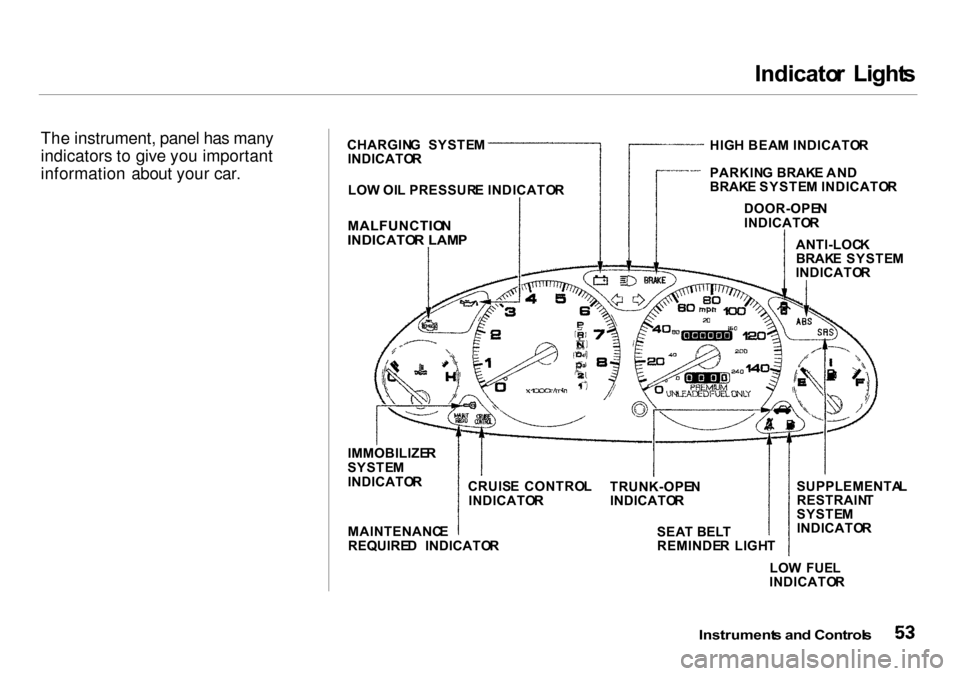
Indicato
r Light s
The instrument, panel has many
indicators to give you important
information about your car.
Instruments an d Control s
LO
W FUE L
INDICATO R
MAINTENANC
E
REQUIRE D INDICATO R
CRUIS
E CONTRO L
INDICATO R
IMMOBILIZE
R
SYSTE M
INDICATO R
TRUNK-OPEN
INDICATO R
SEA T BEL T
REMINDE R LIGH TSUPPLEMENTA
L
RESTRAIN T
SYSTE M
INDICATO R
HIG
H BEA M INDICATO R
CHARGIN
G SYSTE M
INDICATO R
LO W OI L PRESSUR E INDICATO R
MALFUNCTIO N
INDICATO R LAM P
PARKIN
G BRAK E AN D
BRAK E SYSTE M INDICATO R
DOOR-OPE N
INDICATO R
ANTI-LOC K
BRAK E SYSTE M
INDICATO R
Page 63 of 273

Control
s Nea r th e Steerin g Whee l
The two levers on the steering
column contain controls for driving
features you use most often. The left
lever controls the turn signals,
headlights, and high beams. The right lever controls the windshield
washers and wipers.
The controls on the dashboard to the right of the steering column are for
the instrument panel brightness,
hazard warning lights and rear
window defogger.
The moonroof switch and cruise
control switch are to the left of thesteering column.
The tilt adjustment lever on the
underside of the steering column allows you to tilt the steering wheel.
Instrument s an d Control s
WINDSHIEL
D
WIPERS/WASHER S
HOR
N
BUTTON S
TIL T ADJUSTMEN T
HEADLIGHTS /
TUR N SIGNAL S
MOONROO
F
HAZAR
D WARNIN G
REA
R WINDO W
DEFOGGE R
INSTRUMEN
T PANE L
BRIGHTNES S
CRUIS
E
CONTRO L
Page 64 of 273

Control
s Nea r th e Steerin g Whee l
Headlight s
The rotating switch on the left lever
controls the lights. Turning this switch to the position turns
on the parking lights, taillights,
instrument panel lights, side-marker
lights, and rear license plate lights. Turning the switch to the
position turns on the headlights. If you leave the lights on with the
ignition switch in ACCESSORY (I)
or LOCK (0), you will hear a
reminder chime when you open the driver's door.
To change between low beams and high beams, pull the turn signal lever
until you hear a click, then let go.
The blue high beam indicator will
light (see page 56). To flash the high beams, pull the
turn signal lever back lightly, then
release it. The high beams will come
on and go off.
The high beams will stay on for as long as you hold the lever back, no
matter what position the headlight
switch is in.
CONTINUED
Instrument s an d Control s