service Acura Integra 2001 User Guide
[x] Cancel search | Manufacturer: ACURA, Model Year: 2001, Model line: Integra, Model: Acura Integra 2001Pages: 285, PDF Size: 3.79 MB
Page 166 of 285

Maintenanc
e Schedul e
Your authorized Acura dealer knows your car best and can provide competent, efficient service.
However, service at a dealer is not
mandatory to keep your warranties in effect. Maintenance may be done
by any qualified service facility or person who is skilled in this type ofautomotive service. Keep all the
receipts as proof of completion, and
have the person who does the work fill out the Maintenance Record. Check your warranty booklet for
more information. We recommend the use of Genuine
Acura parts and fluids whenever you
have maintenance done. These are
manufactured to the same high-quality standards as the original
components, so you can be confidentof their performance and durability.
U.S. Vehicles:
Maintenance , replacemen t o r
repai r o f emission s contro l
device s an d system s may be don e
b y an y automotiv e repai r
establishmen t o r individua l usin g
part s tha t ar e "certified " t o EP A
standards . According to state and federal
regulations, failure to perform
maintenance on the items marked
with # will not void your emissions
warranties. However, Acura recommends that all maintenance services be performed at the
recommended time or mileage
period to ensure long-term reliability.
Maintenance
Page 168 of 285
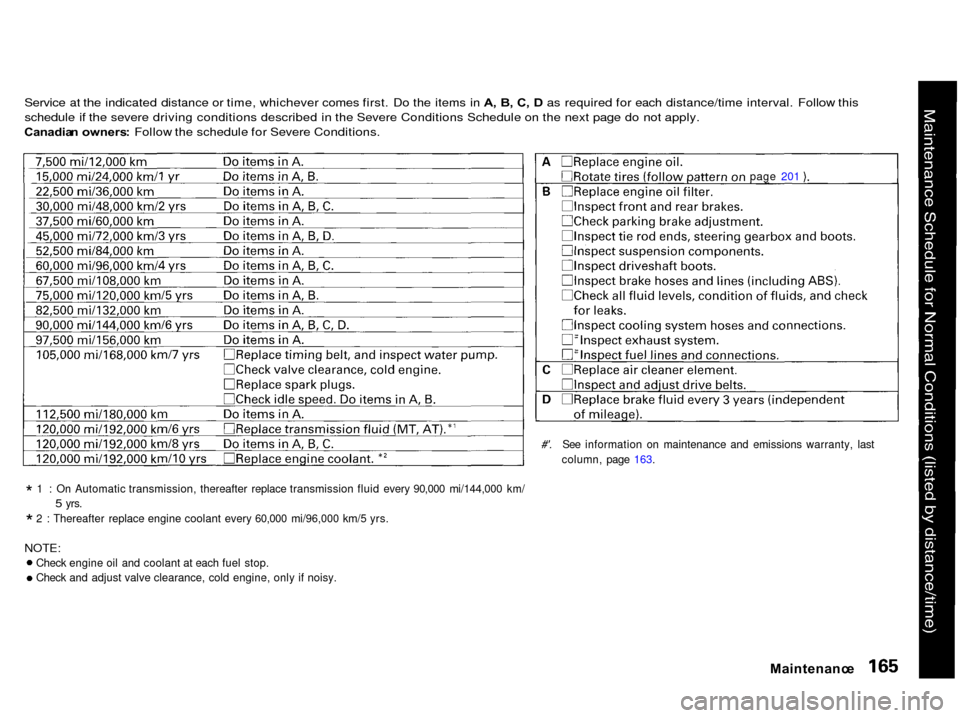
Service at the indicated distance or time, whichever comes first. Do the items in A
, B , C , D as required for each distance/time interval. Follow this
schedule if the severe driving conditions described in the Severe Conditions Schedule on the next page do not apply.
Canadia n owners : Follow the schedule for Severe Conditions.
#'. See information on maintenance and emissions warranty, lastcolumn, page 163.
* 1 : On Automatic transmission, thereafter replace transmission fluid every 90,000 mi/144,000 km/
5
yrs.
* 2 : Thereafter replace engine coolant every 60,000 mi/96,000 km/5 yrs.
NOTE:
Check engine oil and coolant at each fuel stop.
Check and adjust valve clearance, cold engine, only if noisy.
Maintenanc
e
page 201
Page 170 of 285
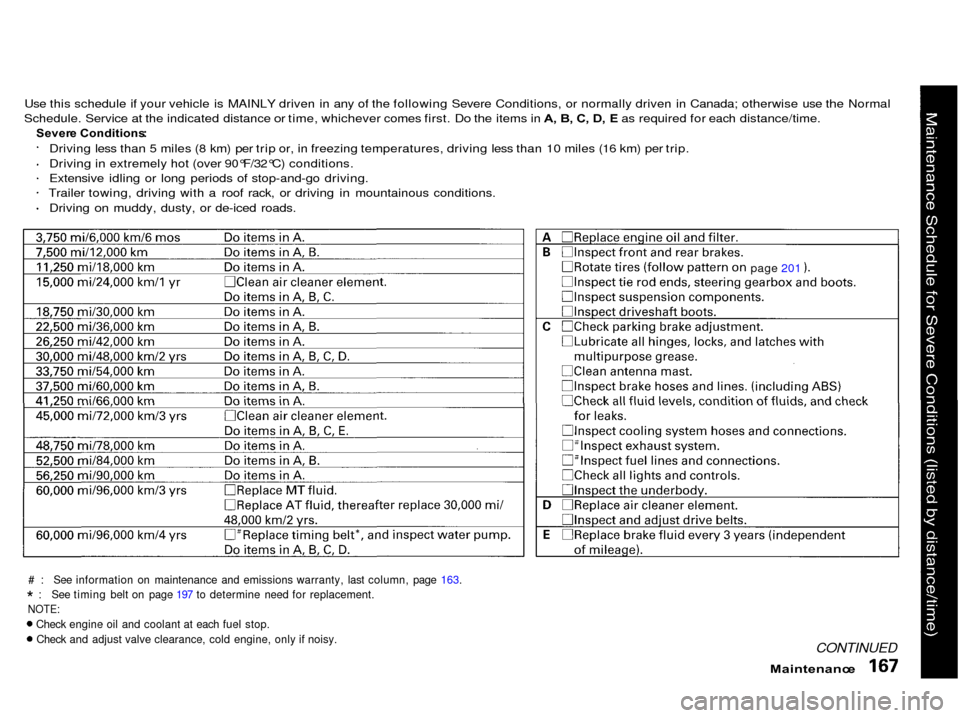
Use this schedule if your vehicle is MAINLY driven in any of the following Severe Conditions, or normally driven in Canada; otherwise use the Normal
Schedule. Service at the indicated distance or time, whichever comes first. Do the items in A , B , C , D , E as required for each distance/time.
Sever e Conditions :
Driving less than 5 miles (8 km) per trip or, in freezing temperatures, driving less than 10 miles (16 km) per trip.
Driving in extremely hot (over 90°F/32°C) conditions.
Extensive idling or long periods of stop-and-go driving.
Trailer towing, driving with a roof rack, or driving in mountainous conditions.
Driving on muddy, dusty, or de-iced roads.
# : See information on maintenance and emissions warranty, last column, page 163.
* : See timing belt on page 197 to determine need for replacement.
NOTE:
Check engine oil and coolant at each fuel stop.
Check and adjust valve clearance, cold engine, only if noisy.
CONTINUED
page
201
Maintenanc
e
Page 176 of 285
Engin
e Oi l
Addin g Oi l
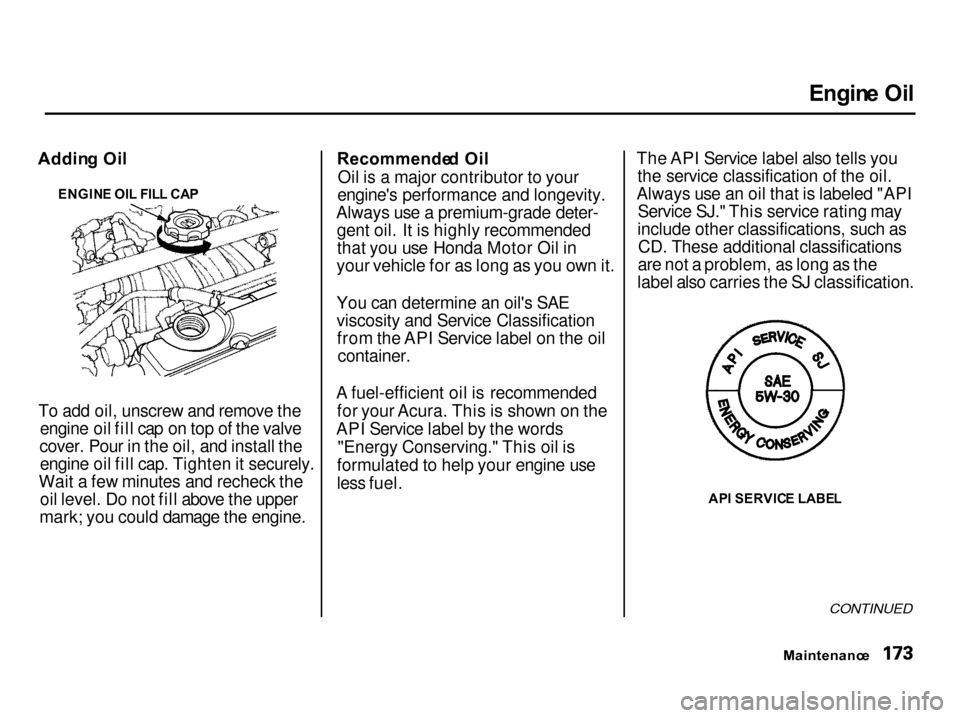
To add oil, unscrew and remove the engine oil fill cap on top of the valve
cover. Pour in the oil, and install the engine oil fill cap. Tighten it securely.
Wait a few minutes and recheck the oil level. Do not fill above the upper
mark; you could damage the engine. Recommende
d Oi l
Oil is a major contributor to your
engine's performance and longevity.
Always use a premium-grade deter- gent oil. It is highly recommended
that you use Honda Motor Oil in
your vehicle for as long as you own it.
You can determine an oil's SAE
viscosity and Service Classification from the API Service label on the oil container.
A fuel-efficient oil is recommended for your Acura. This is shown on the
API Service label by the words "Energy Conserving." This oil is
formulated to help your engine use
less fuel. The API Service label also tells you
the service classification of the oil.
Always use an oil that is labeled "API Service SJ." This service rating may
include other classifications, such as CD. These additional classifications
are not a problem, as long as the
label also carries the SJ classification.
API SERVIC E LABE L
CONTINUED
Maintenanc e
ENGIN
E OI L FIL L CA P
Page 178 of 285
Engin
e Oi l
Syntheti c Oi l
You may use a synthetic motor oil if it meets the same requirements
given for conventional motor oil:energy conserving, a service
classification of SJ, and the proper
weight as shown on the chart. When using synthetic oil, you must follow
the oil and filter change intervalsgiven in the maintenance schedule. Additive
s
Your Acura does not need any oil additives. Purchasing additives for
the engine or transmission will not
increase your car's performance or
longevity. It only increases the cost of operating your car. Changin
g th e Oi l an d Filte r
Always change the oil and filter according to the time and distance (miles/kilometers) recommenda-
tions in the maintenance schedule.
The oil and filter collect contami- nants that can damage your engine if
they are not removed regularly.
Changing the oil and filter requires
special tools and access from
underneath the car. The car should
be raised on a service station-type
hydraulic lift for this service. Unless
you have the knowledge and proper equipment, you should have this
maintenance done by a skilled
mechanic.
CONTINUED
Maintenanc e
Page 188 of 285
Transmissio
n Fluid , Brak e an d Clutc h Flui d
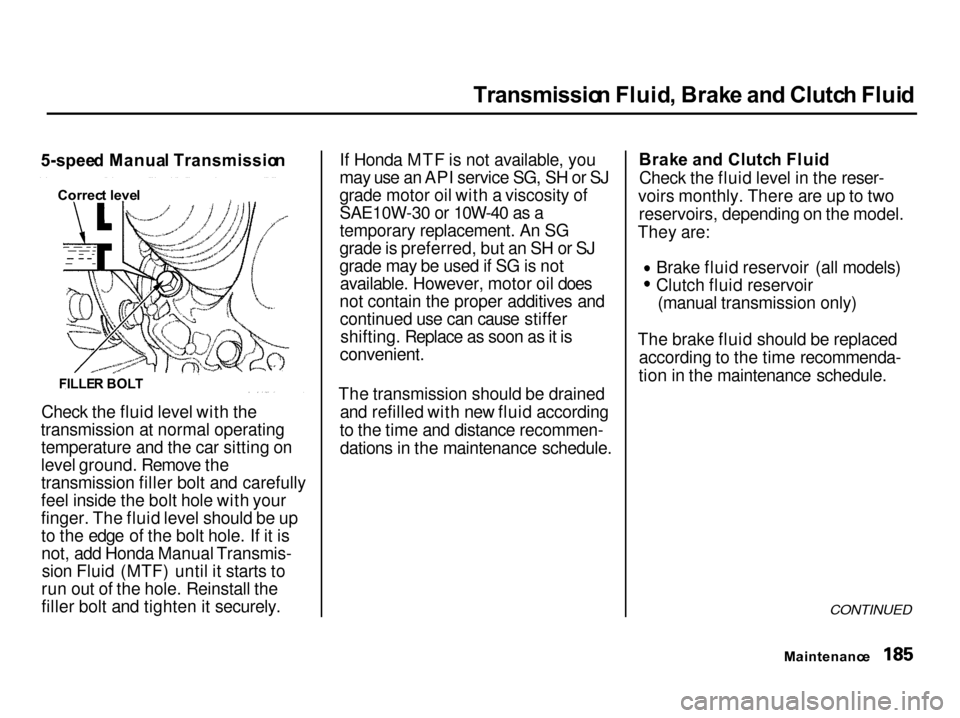
5-spee d Manua l Transmissio n
Check the fluid level with the
transmission at normal operating temperature and the car sitting on
level ground. Remove the
transmission filler bolt and carefully
feel inside the bolt hole with your
finger. The fluid level should be up
to the edge of the bolt hole. If it isnot, add Honda Manual Transmis-sion Fluid (MTF) until it starts to
run out of the hole. Reinstall the
filler bolt and tighten it securely. If Honda MTF is not available, you
may use an API service SG, SH or SJ
grade motor oil with a viscosity of
SAE10W-30 or 10W-40 as a
temporary replacement. An SG
grade is preferred, but an SH or SJ
grade may be used if SG is not
available. However, motor oil does
not contain the proper additives and continued use can cause stiffershifting. Replace as soon as it is
convenient.
The transmission should be drained and refilled with new fluid according
to the time and distance recommen- dations in the maintenance schedule. Brak
e an d Clutc h Flui d
Check the fluid level in the reser-
voirs monthly. There are up to two reservoirs, depending on the model.
They are: Brake fluid reservoir (all models)
Clutch fluid reservoir
(manual transmission only)
The brake fluid should be replaced according to the time recommenda-
tion in the maintenance schedule.
CONTINUED
Maintenanc e
FILLE
R BOL T
Correc
t leve l
Page 191 of 285

Ai
r Cleane r Elemen t
The air cleaner element should be cleaned or replaced according to the
time and distance recommendations in the maintenance schedule.
Cleanin g (Sever e Conditions )
Clean the air cleaner element by
blowing compressed air through it in
the opposite direction to normal air
flow. If you do not have access to compressed air (such as a service
station), ask your Acura dealer to do
this service.
Follow the replacement procedure
for removal and reinstallation.
Replacemen t
The air cleaner element is inside the air cleaner housing on the passenger'sside of the engine compartment. To replace it:
1. Loosen the three bolts and remove the air cleaner housing cover.
2. Lift up the old air cleaner element and pull it out of the duct.
3. Carefully clean the inside of the air cleaner housing with a damp
rag.
4. Attach the new air cleaner
element to the duct. Make sure
the tab on the duct fits in the
notch on the air cleaner element.
Install the new air cleaner element
in the air cleaner housing correctly
placing the square part of the
flange on the element in the
mating recess on the housing.
5. Reinstall the air cleaner housing cover, and tighten the three bolts.
Maintenanc e
AI
R CLEANE R ELEMEN T
BOLT
S
Page 199 of 285

Ai
r Conditionin g Syste m
Optional for Canadian Type-R model
Your car's air conditioning is a sealed system. Any major maintenance,
such as recharging, should be done
by a qualified mechanic. You can do a couple of things to make sure the
air conditioning works efficiently. Periodically check the engine's
radiator and air conditioning condenser for leaves, insects, and
dirt stuck to the front surface. These
block the air flow and reduce cooling efficiency. Use a light spray from a
hose or a soft brush to remove them.
The condenser and radiator fins bend
easily. Only use a low-pressure spray
or soft-bristle brush to clean them.
Run the air conditioning at least once a week during the cold weather
months. Run it for at least ten
minutes while you are driving at asteady speed with the engine at
normal operating temperature. This circulates the lubricating oil con-
tained in the refrigerant. If the air conditioning does not get as
cold as before, have your dealer
check the system. Recharge the
system with Refrigerant HFC-134a
(R-134a). (See Specifications on page 254.)
Whenever you have the air conditioning
system serviced, make sure the service
facility uses a refrigerant recycling
system. This system captures the
refrigerant for reuse. Releasing
refrigerant into the atmosphere can
damage the environment.
Maintenanc e
NOTIC
E
NOTIC E
AI
R CONDITIONIN G
CONDENSE R
Page 233 of 285

Changin
g a Fla t Tir e
12. Put on the spare tire. Put the wheel nuts back on finger-tight,then tighten them in a crisscross
pattern with the wheel wrench
until the wheel is firmly against
the hub. Do not try to tighten
them fully. 13. Lower the car to the ground and
remove the jack.
14. Tighten the wheel nuts securely in
the same crisscross pattern. Havethe wheel nut torque checked at
the nearest automotive service
facility.
Tighten the wheel nuts to:
80 lbf.ft (108 N.m , 11 kgf.m)
Takin g Car e o f th e Unexpecte d (Excep
t Type-R )
(Type-R )
Page 242 of 285

Chargin
g Syste m Indicato r
This indicator should come on when the ignition switch is ON (II), and goout after the engine starts. If it
comes on brightly when the engine
is running, it indicates that the
charging system has stopped
charging the battery. Immediately turn off all electrical
accessories: radio, heater, A/C, rear
defogger, cruise control, etc. Try not
to use other electrically-operated controls such as the power windows.Keep the engine running and take
extra care not to stall it. Starting the
engine will discharge the battery
rapidly. By eliminating as much of the
electrical load as possible, you can
drive several miles (kilometers)
before the battery is too discharged
to keep the engine running. Drive to a service station or garage where
you can get technical assistance.
Takin g Car e o f th e Unexpecte d
CHARGIN
G SYSTE M INDICATO R