trailer Acura Integra 2001 User Guide
[x] Cancel search | Manufacturer: ACURA, Model Year: 2001, Model line: Integra, Model: Acura Integra 2001Pages: 285, PDF Size: 3.79 MB
Page 159 of 285

Towin
g a Traile r
Drivin g Safel y Wit h a Traile r
The added weight, length, and height of a trailer will affect your
vehicle's handling and performance, so driving with a trailer requires
some special driving skills and
techniques.
For your safety and the safety ofothers, take time to practice driving
maneuvers before heading for the open road, and follow the guidelines
discussed below.
Towing Speeds and Gears
Drive slower than normal in all driving situations, and obey posted
speed limits for vehicles with trailers.
If you have an automatic
transmission, use D4 position when
towing a trailer on level roads. D3 is the proper shift lever position to use
when towing a trailer in hilly terrain.
(See "Driving on Hills" in the next
column for additional gear
information.)
Making Turns and Braking
Make turns more slowly and wider
than normal. The trailer tracks a smaller arc than your vehicle, and it
can hit or run over something the
vehicle misses. Allow more time and distance for braking. Do not brake or
turn suddenly as this could cause the
trailer to jackknife or turn over.
Driving on Hills
When climbing hills, closely watch your temperature gauge. If it nears
the red (Hot) mark, turn the air conditioning off, reduce speed and, if
necessary, pull to the side of the
road to let the engine cool.
If the automatic transmission shifts
frequently between 3rd and 4th gears while going up a hill, shift to
D3.
If you must stop when facing uphill,
use the foot brake or parking brake.
Do not try to hold the vehicle in
place by pressing on the accelerator, as this can cause the automatic
transmission to overheat.
When driving down hills, reduce
your speed and shift down to 2nd gear. Do not "ride" the brakes, andremember it will take longer to slowdown and stop when towing a trailer.
Drivin g
Page 160 of 285

Towin
g a Traile r
Handling Crosswinds and Buffeting
Crosswinds and air turbulence
caused by passing trucks can disrupt
your steering and cause trailer
swaying. When being passed by a
large vehicle, keep a constant speed
and steer straight ahead. Do not try
to make quick steering or braking
corrections.
Backing Up
Always drive slowly and have someone guide you when backing up.
Grip the bottom of the steering
wheel; then turn the wheel to the left to get the trailer to move to the left,and turn the wheel right to move the
trailer to the right.
Parking
Follow all normal precautions when
parking, including firmly setting the parking brake and putting the
transmission in Park (automatic) or in 1st or Reverse (manual). Also,
place wheel chocks at each of the
trailer's tires.
Driving
Page 169 of 285

U.S
. Owner s
Follow the Severe Conditions
Maintenance Schedule if you
drive your vehicle MAINLY
under one or more of the
following conditions:
Driving less than 5 miles (8
km) per trip or, in freezing
temperatures, driving less
than 10 miles (16 km) per trip. Driving in extremely hot [over 90°F (32°C)] conditions.
Extensive idling or long
periods of stop-and-go driving.
Trailer towing, driving with a roof rack, or driving in
mountainous conditions. Driving on muddy, dusty, or
de-iced roads.
Canadia n Owner s
Follow the Maintenance
Schedule for Severe Conditions.
* : Refer to page 197 for replacement information under special driving conditions.
# : See information on maintenance and emissions warranty, last column, page 163.
Maintenanc e
Page 170 of 285
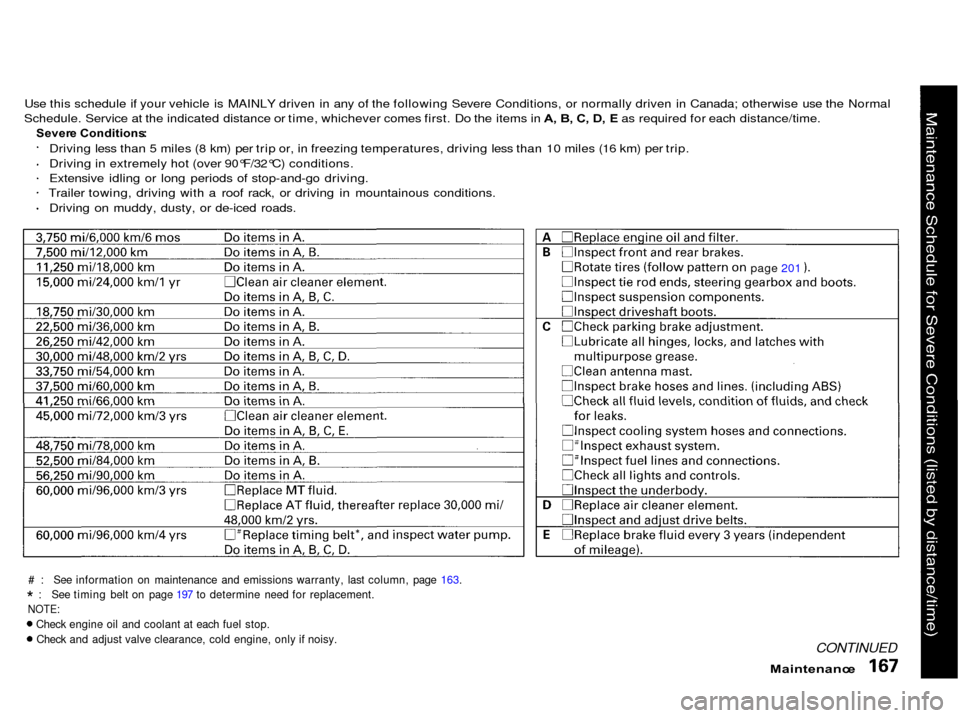
Use this schedule if your vehicle is MAINLY driven in any of the following Severe Conditions, or normally driven in Canada; otherwise use the Normal
Schedule. Service at the indicated distance or time, whichever comes first. Do the items in A , B , C , D , E as required for each distance/time.
Sever e Conditions :
Driving less than 5 miles (8 km) per trip or, in freezing temperatures, driving less than 10 miles (16 km) per trip.
Driving in extremely hot (over 90°F/32°C) conditions.
Extensive idling or long periods of stop-and-go driving.
Trailer towing, driving with a roof rack, or driving in mountainous conditions.
Driving on muddy, dusty, or de-iced roads.
# : See information on maintenance and emissions warranty, last column, page 163.
* : See timing belt on page 197 to determine need for replacement.
NOTE:
Check engine oil and coolant at each fuel stop.
Check and adjust valve clearance, cold engine, only if noisy.
CONTINUED
page
201
Maintenanc
e
Page 210 of 285

Light
s
Headligh t Aimin g
The headlights were properly aimed when your car was new. You should check their aim if you regularly carry
heavy items in the cargo area or pull a trailer. Each headlight assembly
has horizontal and vertical adjust- ment indicators. These are set to
their "0" positions after the head-
lights are aimed at the factory. To check these settings:
1. Make sure the fuel tank is full. Park the car on level ground.
2. The driver or someone who weighs the same should be sittingin the driver's seat for all checksand adjustments.
Load your vehicle with the items
you normally carry.
If you usually pull a trailer, load it as
you would normally and attach it to the car. Push down on the front andrear bumpers several times to makesure the car is sitting normally. 4. Check the horizontal angle gauge.
The line on the adjustment screwindicator should line up with the
"0" mark on the gauge.
CONTINUED
Maintenanc e
HORIZONTA
L ANGL E GAUG E
Lef t headligh tRigh
t headligh t
3. Open the hood.
Page 230 of 285

Changin
g a Fla t Tir e
If you have a flat tire while driving, stop in a safe place to change it.
Stopping in traffic or on the shoulder
of a busy road is dangerous. Driveslowly along the shoulder until you
get to an exit or an area to stop that is far away from the traffic lanes.
JAC
K
SPAR E TIR E
TOOL KI T
1. Park the car on firm, level and non-slippery ground away from
traffic. Put the transmission in Park (automatic) or Reverse (manual). Apply the parking brake.
If you are towing a trailer, unhitch
the trailer. 2. Turn on the hazard warning lights
and turn the ignition switch to
LOCK (0). Have all the
passengers get out of the car while
you change the tire.
3. Open the hatch. Pull up the floor mat and remove the spare tire
cover.
4. Take the tool kit out of the spare tire well.
5. Unscrew the wing bolt and take the spare tire out of its well.
CONTINUED
Takin g Car e o f th e Unexpecte d
The car can easily roll off the
jack, seriously injuring anyone
underneath.
Follow the directions for
changing a tire exactly, and never get under the car when it
is supported only by the jack.
Page 283 of 285

Inde
x
Technical Descriptions................. 251 Emissions Control Systems...... 260Oxygenated Fuels...................... 258
Three Way Catalytic
Converter................................ 262
Temperature Gauge........................ 59
Tether Anchorage Points............... 41
Three Way Catalytic Converter... 262
Time, Setting the............................. 88
Timing Belt..................................... 197
Tire Chains..................................... 204
Tire, How to Change a Flat.......... 227
Tires................................................ 198 Air Pressure............................... 198Checking Wear.......................... 199
Compact Spare........................... 226
DOT Tire Quality Grading....... 256
Inflation....................................... 198
Inspection................................... 199
Maintenance............................... 200
Replacing.................................... 202
Rotating....................................... 201
Snow............................................ 204
Specifications............................. 255
Tire Chains................................. 204
Winter Driving........................... 203 Tools, Tire Changing.................... 227
Towing
A Trailer...................................... 151
Emergency................................. 248
Transmission
Checking Fluid Level,Automatic............................... 183
Checking Fluid Level, Manual.................................... 185
Fluid Selection.................. 184,
185
Identification Number..............
. 253
Shifting the Automatic.............. 140
Shifting the Manual................... 138
Treadwear...................................... 256
Trip Meter........................................ 58
Turn Signals..................................... 63
Underside, Cleaning...................... 223
Unexpected, Taking Care
of the........................................... 225
Uniform Tire Quality Grading..... 256
Unleaded Gasoline......................... 123
Upholstery Cleaning...................... 220
Used Oil, How to Dispose of........ 177 Vehicle Capacity Load.................. 133
Vehicle Dimensions....................... 254
Vehicle Identification Number..... 252
Vehicle Storage.............................. 216
Ventilation......................................... 97
VIN 252
Vinyl Cleaning................................ 221
Viscosity, Oil................................... 174
WARNING, Explanation of.............. ii
Warning Labels, Location of.......... 50
Warranty Coverages*................... 268
Washer, Windshield
Checking the Fluid Level......... 182
Operation...................................... 64
Washing.......................................... 218
Waxing and Polishing................... 219
Wheels Adjusting the Steering................ 66
Alignment and Balance............. 200
Cleaning Aluminum Alloys....... 219