transmission Acura Integra 2001 Owner's Guide
[x] Cancel search | Manufacturer: ACURA, Model Year: 2001, Model line: Integra, Model: Acura Integra 2001Pages: 285, PDF Size: 3.79 MB
Page 219 of 285

Storin
g You r Ca r
If you need to park your car for an
extended period (more than one
month), there are several things you should do to prepare it for storage.
Proper preparation helps prevent
deterioration and makes it easier to
get your car back on the road. If
possible, store your car indoors. Fill the fuel tank.
Change the engine oil and filter
(see page 175). Wash and dry the exterior
completely.
Clean the interior. Make sure the
carpeting, floor mats, etc. are
completely dry.
Leave the parking brake off. Put
the transmission in Reverse
(5-speed manual) or Park
(automatic).
Block the rear wheels.
If the car is to be stored for a
longer period, it should be
supported on jackstands so the
tires are off the ground. Leave one window open slightly (if
the car is being stored indoors). Disconnect the battery.
Support the front and rear wiper
blade arms with a folded towel or
rag so they do not touch the
windshield.
To minimize sticking, apply a
silicone spray lubricant to all door
and hatch seals. Also, apply a body
wax to the painted surfaces that mate with the door and hatch seals. Cover the car with a "breathable"
cover, one made from a porous
material such as cotton. Nonporous materials, such as
plastic sheeting, trap moisture,
which can damage the paint. If possible, run the engine for a
while periodically (preferably once a month).
If you store your car for 12 months or longer, have your Acura dealer
perform the inspections called for in
the 24 months/30,000 miles (48,000
km) maintenance schedule (Normal Conditions) as soon as you take it
out of storage (see page 164). The
replacements called for in the
maintenance schedule are not
needed unless the car has actually
reached that time or mileage.
Maintenanc e
Page 230 of 285

Changin
g a Fla t Tir e
If you have a flat tire while driving, stop in a safe place to change it.
Stopping in traffic or on the shoulder
of a busy road is dangerous. Driveslowly along the shoulder until you
get to an exit or an area to stop that is far away from the traffic lanes.
JAC
K
SPAR E TIR E
TOOL KI T
1. Park the car on firm, level and non-slippery ground away from
traffic. Put the transmission in Park (automatic) or Reverse (manual). Apply the parking brake.
If you are towing a trailer, unhitch
the trailer. 2. Turn on the hazard warning lights
and turn the ignition switch to
LOCK (0). Have all the
passengers get out of the car while
you change the tire.
3. Open the hatch. Pull up the floor mat and remove the spare tire
cover.
4. Take the tool kit out of the spare tire well.
5. Unscrew the wing bolt and take the spare tire out of its well.
CONTINUED
Takin g Car e o f th e Unexpecte d
The car can easily roll off the
jack, seriously injuring anyone
underneath.
Follow the directions for
changing a tire exactly, and never get under the car when it
is supported only by the jack.
Page 235 of 285

I
f You r Engin e Won' t Star t
Nothin g Happen s o r th e Starte r
Moto r Operate s Ver y Slowl y
When you turn the ignition switch to START (III), you do not hear the
normal noise of the engine trying tostart. You may hear a clicking sound
or series of clicks, or nothing at all.
Check these things: Your car has the Immobilizer
System. You should use a
properly-coded master or valet key
to start the engine (see page 72 ).
A key that is not properly coded will cause the immobilizer systemindicator in the dash panel to blink
rapidly. Check the transmission interlock.
If you have a manual transmission,
the clutch pedal must be pushed all the way to the floor or thestarter will not operate. With an
automatic transmission, it must be
in Park or Neutral. Turn the ignition switch to ON (II).
Turn on the headlights and check
their brightness. If the headlightsare very dim or don't light at all,
the battery is discharged. See
Jum p Startin g on page 233. Turn the ignition switch to START
(III). If the headlights do not dim,
check the condition of the fuses. If
the fuses are OK, there is proba-
bly something wrong with the electrical circuit for the ignitionswitch or starter motor. You will
need a qualified technician to determine the problem. (See
Emergenc y Towin g on page 248.)
If the headlights dim noticeably or
go out when you try to start the engine, either the battery is dis-
charged or the connections are
corroded. Check the condition of
the battery and terminal connec-
tions (see page 189 ). You can
then try jump starting the car from
a booster battery (see page 233 ).
Takin g Car e o f th e Unexpecte d
Page 236 of 285

I
f You r Engin e Won' t Start , Jum p Startin g
Th e Starte r Operate s Normall y
In this case, the starter motor's speed sounds normal, or even faster
than normal, when you turn the
ignition switch to START (III), but
the engine does not run. Are you using the proper starting
procedure? Refer to Startin g th e
Engin e on page 137. Do you have fuel? Turn the
ignition switch to ON (II) for a
minute and watch the fuel gauge.
The low fuel level warning light may not be working, so you were
not reminded to fill the tank. There may be an electrical
problem, such as no power to the
fuel pump. Check all the fuses (see page 243).
If you find nothing wrong, you will
need a qualified technician to find
the problem. See Emergenc y
Towin g on page 248. Jum
p Startin g
If your car's battery has run down,
you may be able to start the engine by using a booster battery. Although
this seems like a simple procedure,
you should take several precautions.
You cannot start an Acura with anautomatic transmission by pushingor pulling it.
CONTINUED
Takin g Car e o f th e Unexpecte d
A battery can explode if you do
not follow the correct procedure,
seriously injuring anyone nearby.
Keep all sparks, open flames,
and smoking materials away
from the battery.
Page 237 of 285

Jum
p Startin g
To jump start your car, follow these directions closely:
1. Open the hood and check the physical condition of the battery(see page 191 ). In very cold
weather, check the condition of the electrolyte. If it seems slushy or like ice, do not try jump starting
until it thaws.
If a battery sits in extreme cold, the electrolyte inside can freeze.
Attempting to jump start with a frozen battery can cause it to rupture.
2. Turn off all the electrical acces- sories: heater, A/C, stereo system,
lights, etc.
Put the transmission in Neutral orPark and set the parking brake. 3. Connect one jumper cable to the
positive (+) terminal on your
Acura's battery. Connect the other end to the positive (+) terminalon the booster battery. 4. Connect the second jumper cable
to the negative (—) terminal on
the booster battery. Connect theother end to the grounding strap
as shown. Do not connect this
jumper cable to any other part of the engine.
5. If the booster battery is in another vehicle, have an assistant startthat vehicle and run it at a fast idle.
Takin g Car e o f th e Unexpecte d
NOTIC
E
Page 239 of 285

I
f You r Engin e Overheat s
The pointer of your car's tempera- ture gauge should stay in the mid-range under most conditions. It may
go higher if you are driving up a longsteep hill on a very hot day. If it
climbs to the red mark, you should determine the reason.
Driving with the temperature gauge
pointer at the red mark can cause serious damage to your engine.
Your car can overheat for several
reasons, such as lack of coolant or a
mechanical problem. The only
indication may be the temperature
gauge climbing to or above the red
mark. Or you may see steam or spray coming from under the hood.
In either case, you should take
immediate action.
1. Safely pull to the side of the road. Put the transmission in Neutral or
Park and set the parking brake.
Turn off the heating and cooling system and all other accessories.
Turn on the hazard warning indicators. 2. If you see steam and/or spray
coming from under the hood, turnoff the engine.
3. If you do not see steam or spray, leave the engine running and
watch the temperature gauge. If the high heat is due to overloading (climbing a long, steep hill on a
hot day with the A/C running, for example), the engine should start
to cool down almost immediately. If it does, wait until the tempera-
ture gauge comes down to the mid-
point then continue driving.
4. If the temperature gauge stays at the red mark, turn off the engine.
5. Wait until you see no more signs of steam or spray, then open the
hood.
Takin g Car e o f th e Unexpecte d
Steam and spray from an
overheated engine can
seriously scald you.
Do not open the hood if steam
is coming out.
NOTIC
E
Page 251 of 285

Emergenc
y Towin g
If your car needs to be towed, call a
professional towing service or, if you
belong to one, an organization that
provides roadside assistance. Never
tow your car behind another vehicle
with just a rope or chain. It is very
dangerous.
There are three popular types of professional towing equipment.
Flat-bed Equipment — The operator
loads your car on the back of a truck.
Thi s is th e bes t wa y to transpor t
you r Acura .
Wheel-lift Equipment — The tow
truck uses two pivoting arms that go under the tires (front or rear) and lift
them off the ground. The other two
tires remain on the ground. Thi s is
a n acceptabl e wa y to to w you r
Acura .
Sling-type Equipment — The tow
truck uses metal cables with hooks on the ends. These hooks go around
parts of the frame or suspension and
the cables lift that end of the car off
the ground. Your car's suspension and body can be seriously damaged.
Thi s metho d o f towin g is
unacceptable .
If your Acura cannot be transported
by flat-bed, it should be towed by
wheel-lift equipment with the front
wheels off the ground. If, due to damage, your car must be towed
with the front wheels on the ground, do the following.
5-speed Manual Transmission
Release the parking brake.
Shift the transmission to Neutral.
Automatic Transmission
Release the parking brake.
Start the engine.
Shift to D4, then to N.
Turn off the engine.
Improper towing preparation will damage the transmission. Follow the
above procedure exactly. If you cannot
shift the transmission or start the engine (automatic transmission), your
car must be transported with the front
wheels off the ground.
With the front wheels on the ground, it is best to tow the vehicle no farther
than 50 miles (80 km), and keep thespeed below 35 mph (55 km/h).
Takin g Car e o f th e Unexpecte d
NOTIC
E
Page 256 of 285

Identificatio
n Number s
The Engine Number is stamped into the engine block.
The Transmission Number is on a label on top of the transmission.
Technical Informatio n
MANUA
L TRANSMISSIO N NUMBE RAUTOMATI
C TRANSMISSIO N NUMBE R
ENGIN E NUMBE R
Page 266 of 285

Stat
e Emission s Testin g
Testin g o f Readines s Code s
If you take your vehicle for a state emissions test shortly after the
battery has been disconnected or
gone dead, it may not pass the test.
This is because of certain "readiness codes" that must be set in the on-
board diagnostics for the emissions systems. These codes are erased
when the battery is disconnected, and set again only after several daysof driving under a variety of
conditions.
If the testing facility determines that
the readiness codes are not set, you
will be requested to return at a later date to complete the test. If you must
get the vehicle re-tested within the
next two or three days, you can condition the vehicle for re-testing
by doing the following. Make sure the gas tank is nearly,
but not completely, full (around 3/4). Make sure the vehicle has been
parked with the engine off for 8
hours or more. Make sure the ambient
temperature is between 20° and 95°
F.
Without touching the accelerator
pedal, start the engine and let it
idle for 20 seconds. Keep the vehicle in Park
(automatic transmission) or
Neutral (manual transmission).
Increase the engine speed to 2,000
rpm and hold it there until the
temperature gauge rises to at least 1/4 of the scale (approximately 3
minutes).
CONTINUED
Technica l Informatio n
Page 276 of 285
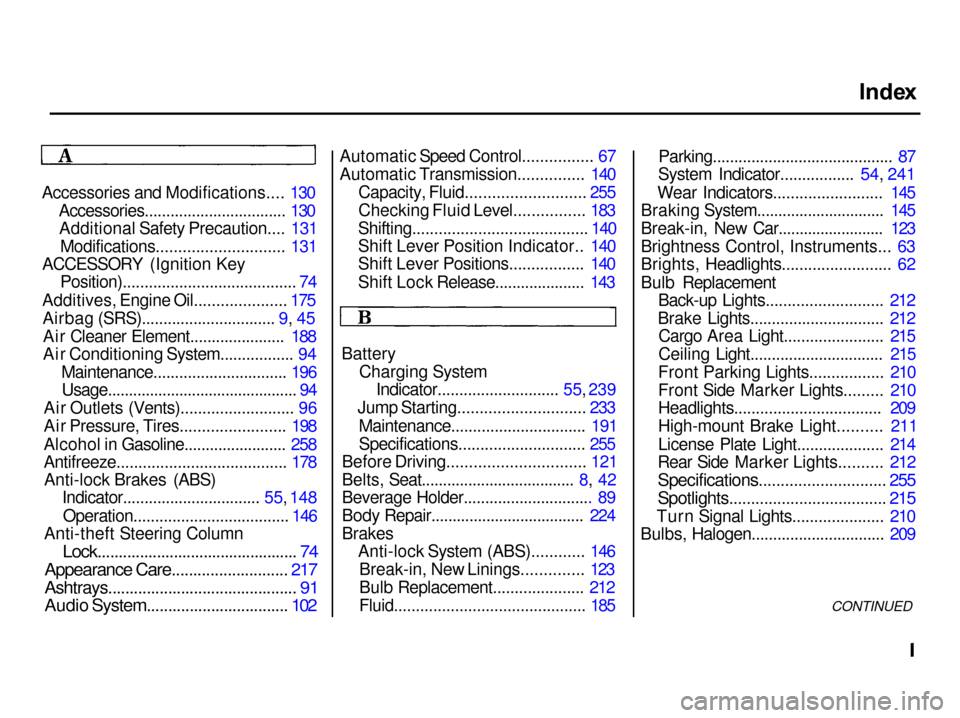
Inde
x
Accessories and Modifications.... 130 Accessories................................. 130Additional Safety Precaution.... 131
Modifications............................. 131
ACCESSORY (Ignition Key Position)........................................ 74
Additives, Engine Oil..................... 175
Airbag (SRS)............................... 9, 45Ai
r Cleane
r Element...................... 188
Air Conditioning System................. 94
Maintenance............................... 196Usage............................................. 94
Air Outlets (Vents).......................... 96
Air Pressure, Tires........................ 198
Alcohol in Gasoline........................ 258
Antifreeze....................................... 178 Anti-lock Brakes (ABS) Indicator................................ 55
, 148
Operation.................................... 14
6
Anti-theft Steering Column
Lock............................................... 74
Appearance Care........................... 217
Ashtrays............................................ 91
Audio System................................. 102
Automatic Speed Control................ 67
Automatic Transmission............... 140
Capacity, Fluid........................... 255
Checking Fluid Level................ 183
Shifting........................................ 140
Shift Lever Position Indicator.. 140
Shift Lever Positions................. 140
Shift Lock Release..................... 143
Battery Charging SystemIndicator............................ 55,
239
Jump Starting............................
. 233
Maintenance............................... 191
Specifications............................. 255
Before Driving............................... 121
Belts, Seat.................................... 8, 42
Beverage Holder.............................. 89
Body Repair.................................... 224
Brakes Anti-lock System (ABS)............ 146
Break-in, New Linings.............. 123
Bulb Replacement..................... 212
Fluid............................................ 185
Parking.......................................... 87
System Indicator................. 54,
241
Wear Indicators........................
. 145
Braking System.............................. 145
Break-in, New Car......................... 123
Brightness Control, Instruments... 63
Brights, Headlights......................... 62
Bulb Replacement Back-up Lights........................... 212
Brake Lights............................... 212 Cargo Area Light....................... 215
Ceiling Light............................... 215
Front Parking Lights................. 210
Front Side Marker Lights......... 210
Headlights.................................. 209
High-mount Brake Light.......... 211
License Plate Light.................... 214
Rear Side Marker Lights.......... 212
Specifications............................. 255
Spotlights.................................... 215
Turn Signal Lights..................... 210
Bulbs, Halogen............................... 209
CONTINUED