fuel cap Acura Integra 2001 Owner's Manual
[x] Cancel search | Manufacturer: ACURA, Model Year: 2001, Model line: Integra, Model: Acura Integra 2001Pages: 285, PDF Size: 3.79 MB
Page 1 of 285
 to navigate through\
this reference.
For a printed owners manual, click on authorized manu")
2001 Integra Hatchback Online Reference Owner's Manual
Use these links (and links throughout this manual) to navigate through\
this reference.
For a printed owner's manual, click on authorized manuals or go to www.h\
elminc.com.
Contents
Owner's Identification Form
Introduction ........................................................................\
................................................................. i
A Few Words About Safet y........................................................................\
.........................................ii
Your Vehicle at a Glance........................................................................\
............................................ .2
Driver and Passenger Safety ........................................................................\
......................................5
Proper use and care of your vehicle's seat belts, and Supplemental Restr\
aint System.
Instruments and Controls........................................................................\
........................................ .51
Instrume nt panel indicator and gauge, and how to use dashboard and steering colu\
mn controls.
Comfort and Convenience Features ........................................................................\
..................... . 93
How to operate the climate control system, the audio system, and other c\
onvenience features.
Before Driving........................................................................\
..........................................................121
What gasoline to use, how to break -in your new vehicle, and how to load luggage and other cargo.
Driving ........................................................................\
..................................................................... .135
The proper way to start the engine, shift the transmission, and park, pl\
us towing a trailer.
Maintenance........................................................................\
.............................................................159
The Maintenance Schedule shows you when you need to take you r vehicle to the dealer.
Appearance Care........................................................................\
..................................................... .217
Tips on cleaning and protecting your vehicle. Things to look for if your\
vehicle ever needs body repairs.
Taking Care of the Unexpected........................................................................\
..............................225
This section covers several problems motorists sometimes experience, an d how to handle them.
Technical Information........................................................................\
............................................ .251
ID numbers, dimensions, capacities, and technical information.
Warranty and Customer Relations (U.S. and Canada)................................................................265
A summary of the warranties covering your new Acura, and how to contact \
us.
Authorized Manuals (U.S. only)........................................................................\
..............................271
How to order manuals and other technical literature.
Index........................................................................\
........................................................................\
...... I
Service Information Summary
A summary of information you need when you pull up to the fuel pump.
Page 127 of 285

Servic
e Statio n Procedure s
Fillin g th e Fue l Tan k
Pull
1. Because the fuel fill cap is on the driver's side of the car, park with
that side closest to the service
station pumps.
2. Open the fuel fill door by pulling on the handle to the left of the
driver's seat.
FUEL FIL L CA P 3. Remove the fuel fill cap slowly.
You may hear a hissing sound aspressure inside the tank escapes.Place the cap in the holder on the
fuel fill door.
4. Stop filling the tank after the fuel nozzle automatically clicks off. Do
not tr
y to "top off" the tank, leave
some room for the fuel to expand
with temperature changes.
Your car has an on-board refueling
vapor recovery system to help keep fuel vapors from going into theatmosphere. If the fuel pump keeps
clicking off even though the tank is
not full, there may be a problem with
this system. Consult your dealer.
Befor e Drivin g
Gasoline is highly flammable
and explosive. You can be
burned or seriously injured
when handling fuel.
Stop the engine and keep
heat, sparks, and flame away.
Handle fuel only outdoors.
Wipe up spills immediately.
Page 128 of 285

Servic
e Statio n Procedure s
5. Screw the fuel fill cap back on, tighten it until it clicks several
times. If you do not properly
tighten the cap, the Malfunction
Indicator Lamp may come on (see
page 240).
6. Push the fuel fill door closed until it latches. Openin
g th e Hoo d
1. Shift to Park or Neutral and set the parking brake. Pull the hoodrelease handle located under the
lower left corner of the dashboard.
The hood will pop up slightly. 2. Standing in front of the car, put
your fingers under the front edge
of the hood to the left of center.
Slide your hand to the right until
you feel the hood latch handle.
Push this handle to the right until
it releases the hood. Lift the hood.
CONTINUED
Befor e Drivin g
HOO
D RELEAS E HANDL E
LATC
H
Page 176 of 285
Engin
e Oi l
Addin g Oi l
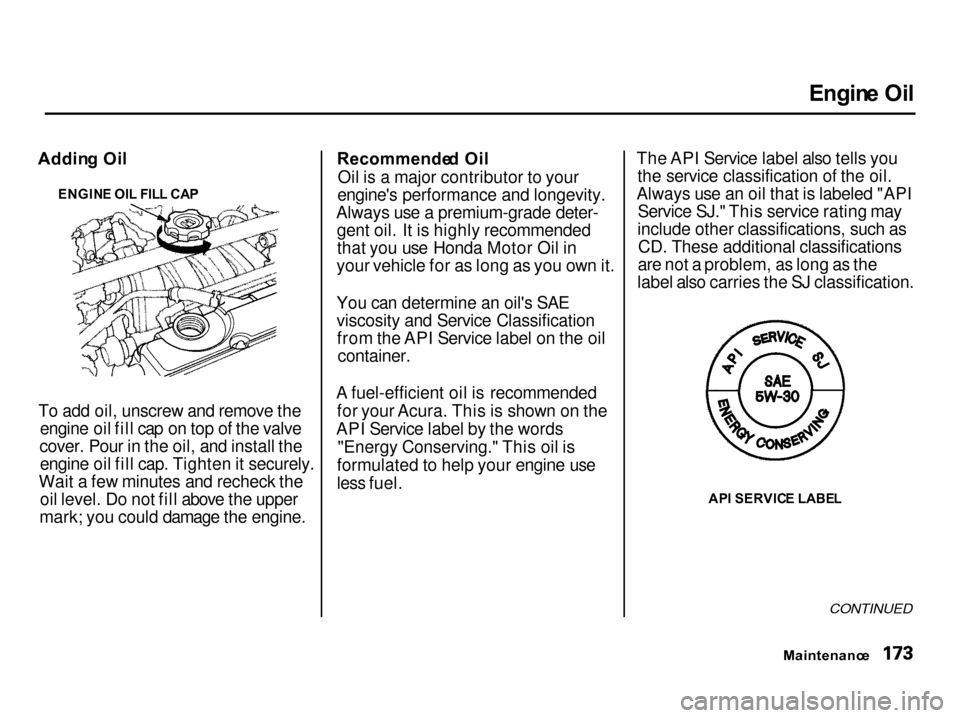
To add oil, unscrew and remove the engine oil fill cap on top of the valve
cover. Pour in the oil, and install the engine oil fill cap. Tighten it securely.
Wait a few minutes and recheck the oil level. Do not fill above the upper
mark; you could damage the engine. Recommende
d Oi l
Oil is a major contributor to your
engine's performance and longevity.
Always use a premium-grade deter- gent oil. It is highly recommended
that you use Honda Motor Oil in
your vehicle for as long as you own it.
You can determine an oil's SAE
viscosity and Service Classification from the API Service label on the oil container.
A fuel-efficient oil is recommended for your Acura. This is shown on the
API Service label by the words "Energy Conserving." This oil is
formulated to help your engine use
less fuel. The API Service label also tells you
the service classification of the oil.
Always use an oil that is labeled "API Service SJ." This service rating may
include other classifications, such as CD. These additional classifications
are not a problem, as long as the
label also carries the SJ classification.
API SERVIC E LABE L
CONTINUED
Maintenanc e
ENGIN
E OI L FIL L CA P
Page 185 of 285

Coolin
g System , Windshiel d Washer s
8. Start the engine and let it run for about 30 seconds. Then turn off
the engine.
9. Fill the radiator with coolant up to the base of the filler neck.
10. Fill the reserve tank to the MAX mark. Install the reserve tank cap.
11. Install the radiator cap, and tighten it to the first stop.
12. Start the engine and let it run until the radiator cooling fan comes on
at least twice. Then stop the
engine.
13. Remove the radiator cap. Fill the radiator with coolant up to thebase of the filler neck. 14. Start the engine and hold it at
1,500 rpm until the radiator fan
comes on. Turn off the engine.
Check the coolant level in the
radiator and add coolant if needed.
15. Install the radiator cap, and tighten it fully.
16. If necessary, fill the reserve tank to the MAX mark. Install the
reserve tank cap. Windshiel
d Washer s
Check the level in the windshield
washer reservoir at least monthly during normal usage. In bad weather,
when you use the washers often, check the level every time you stop
for fuel. This reservoir supplies the
windshield and rear window washers.
Maintenanc e
Page 243 of 285

Malfunctio
n Indicato r Lam p
This indicator comes on for a few seconds when you turn the ignition
switch ON (II). If it comes on at any
other time, it indicates one of the
engine's emissions control systems
may have a problem. Even though
you may feel no difference in your car's performance, it can reduce
your fuel economy and cause your car to put out excessive emissions.
Continued operation may causeserious damage. If you have recently refueled your
car, the cause of this indicator
coming on could be a loose or
missing fuel fill cap. Check the cap and tighten it until it clicks several
times. Replace the fuel fill cap if it is missing. Tightening the cap will not
make the indicator turn off
immediately; it takes three driving
trips.
If the indicator remains on past threedriving trips, or the fuel cap was not
loose or missing, have the car checked by the dealer as soon as
possible. Drive moderately until thedealer has inspected the problem.
Avoid full-throttle acceleration and driving at high speed. You should also have the dealer
inspect your car if this indicator
comes on repeatedly, even though it
may turn off as you continue driving.
If you keep driving with the
malfunction indicator lamp on, you can damage your car's emissions controls
and engine. Those repairs may not be
covered by your car's warranties.
Takin g Car e o f th e Unexpecte d
MALFUNCTIO
N INDICATO R LAM P
NOTICE
Page 254 of 285

Technica
l Informatio n
The diagrams in this section give you the dimensions and capacities of
your Acura, and the locations of the identification numbers. It alsoincludes information you should
know about your vehicle's tires and emissions control systems. Identification Numbers................. 252
Specifications................................. 254
DOT Tire Quality Grading
(U.S. Cars)..............................256
Treadwear.................................. 256
Traction — AA, A, B, C............ 256
Temperature — A, B, C..........
257
Oxygenated Fuels.........................
. 258
Driving in Foreign Countries....... 259 Emissions Controls........................ 260
The Clean Air Act...................... 260
Crankcase Emissions Control System..................................... 260
Evaporative Emissions Control System..................................... 260
Onboard Refueling Vapor Recovery................................. 261
Exhaust Emissions Controls.... 261 PGM-FI System..................... 261
Ignition Timing ControlSystem................................. 261
Three Way Catalytic Converter............................ 261
Replacement Parts..................... 261
Three Way Catalytic Converter... 262 State Emissions Testing............... 263
Technical Informatio n
Page 264 of 285

Emission
s Control s
Onboar d Refuelin g Vapo r
Recover y
The Onboard Refueling Vapor Recovery (ORVR) system captures
the fuel vapors during refueling. The
vapors are adsorbed in a canister filled with activated carbon. While driving, the fuel vapors are drawn
into the engine and burned off.
Exhaus t Emission s Control s
The exhaust emissions controls include three systems: PGM-FI,
Ignition Timing Control and Three
Way Catalytic Converter. These three systems work together tocontrol the engine's combustion and
minimize the amount of HC, CO, and
NOx that comes out the tailpipe. The
exhaust emissions control systems
are separate from the crankcase andevaporative emissions control
systems.
PGM-FI System
The PGM-FI System uses sequential multiport fuel injection.
It has three subsystems: Air Intake,
Engine Control, and Fuel Control.
The Engine Control Module (ECM) or the Powertrain Control Module(PCM) uses various sensors to
determine how much air is going
into the engine. It then controls how
much fuel to inject under all operat- ing conditions.
Ignition Timing Control System
This system constantly adjusts the ignition timing, reducing the amountof HC, CO and NOx produced.
Three Way Catalytic Converter
The three way catalytic converter is in the exhaust system. Through
chemical reactions, it converts HC,CO, and NOx in the engine's exhaust
to carbon dioxide (C02), dinitrogen (N2), and water vapor. Replacemen
t Part s
The emissions control systems are designed and certified to work to-
gether in reducing emissions to
levels that comply with the Clean Air
Act. To make sure the emissions remain low, you should use only newGenuine Acura replacement parts or
their equivalent for repairs. Using
lower quality parts may increase the emissions from your car.
The emissions control systems are covered by warranties separate from
the rest of your car. Read your
warranty manual for more informa- tion.
Technical Informatio n
Page 279 of 285

Inde
x
Fuel.................................................. 123
Fill Door and Cap....................... 124
Gauge............................................ 59
Octane Requirement................. 123
Oxygenated................................ 258
Reserve Indicator......................... 54
Tank, Filling the......................... 124
Fuses, Checking the...................... 243
Gas Mileage, Improving................ 129
Gasohol........................................... 258
Gasoline.......................................... 123
Fuel Reserve Indicator................ 54
Gauge............................................ 59
Octane Requirement................. 123
Tank, Filling the......................... 124
Gas Station Procedures................. 124
Gauges
Engine Coolant Temperature.... 59
Fuel................................................ 59
Speedometer................................ 58
Tachometer.................................. 58
Gearshift Lever Positions
Automatic Transmission........... 140
5-speed Manual
Transmission.......................... 138
Glass Cleaning............................... 222
Glove Box......................................... 78
Halogen Headlight Bulbs.............. 209
Hatch................................................. 76
Opening the.................................. 76
Open Monitor Light.................... 56
Hazard Warning Flashers............... 65
Headlights
Aiming......................................... 207
Daytime Running Lights............. 62High Beam Indicator................... 57
Reminder Chime.......................... 62
Replacing Halogen Bulbs......... 209
Turning on....................................
62
Head Restraints..............................
. 82
Heating and Cooling........................ 94
High Altitude, Starting at.............. 137
High-Low Beam Switch.................. 62
High-mount Brake Light............... 211
Hood Latch..................................... 189
Hood, Opening the........................ 125
Horn................................................... 61
Hydraulic Clutch............................ 186
Hydroplaning.................................. 150
Identification Number, Vehicle.... 252
Ignition Keys............................................... 71
Switch............................................ 73
Timing Control System............. 261
Immobilizer System......................... 72
Important Safety Precautions.......... 6
Indicators, Instrument
Panel.............................................. 53
Infant Restraint................................ 21
Infant Seats....................................... 30
Tether Anchorage Points........... 41
Inflation, Proper Tire.................... 198
Inside Mirror.................................... 86
Inspection, Tire.............................. 199 Instrument Panel......................... 2, 52
Instrument Panel Brightness......... 63
Interior Cleaning............................ 220
Interior Lights.................................. 92
Introduction......................................... i
Page 283 of 285

Inde
x
Technical Descriptions................. 251 Emissions Control Systems...... 260Oxygenated Fuels...................... 258
Three Way Catalytic
Converter................................ 262
Temperature Gauge........................ 59
Tether Anchorage Points............... 41
Three Way Catalytic Converter... 262
Time, Setting the............................. 88
Timing Belt..................................... 197
Tire Chains..................................... 204
Tire, How to Change a Flat.......... 227
Tires................................................ 198 Air Pressure............................... 198Checking Wear.......................... 199
Compact Spare........................... 226
DOT Tire Quality Grading....... 256
Inflation....................................... 198
Inspection................................... 199
Maintenance............................... 200
Replacing.................................... 202
Rotating....................................... 201
Snow............................................ 204
Specifications............................. 255
Tire Chains................................. 204
Winter Driving........................... 203 Tools, Tire Changing.................... 227
Towing
A Trailer...................................... 151
Emergency................................. 248
Transmission
Checking Fluid Level,Automatic............................... 183
Checking Fluid Level, Manual.................................... 185
Fluid Selection.................. 184,
185
Identification Number..............
. 253
Shifting the Automatic.............. 140
Shifting the Manual................... 138
Treadwear...................................... 256
Trip Meter........................................ 58
Turn Signals..................................... 63
Underside, Cleaning...................... 223
Unexpected, Taking Care
of the........................................... 225
Uniform Tire Quality Grading..... 256
Unleaded Gasoline......................... 123
Upholstery Cleaning...................... 220
Used Oil, How to Dispose of........ 177 Vehicle Capacity Load.................. 133
Vehicle Dimensions....................... 254
Vehicle Identification Number..... 252
Vehicle Storage.............................. 216
Ventilation......................................... 97
VIN 252
Vinyl Cleaning................................ 221
Viscosity, Oil................................... 174
WARNING, Explanation of.............. ii
Warning Labels, Location of.......... 50
Warranty Coverages*................... 268
Washer, Windshield
Checking the Fluid Level......... 182
Operation...................................... 64
Washing.......................................... 218
Waxing and Polishing................... 219
Wheels Adjusting the Steering................ 66
Alignment and Balance............. 200
Cleaning Aluminum Alloys....... 219