seats Acura MDX 2009 Owner's Manual
[x] Cancel search | Manufacturer: ACURA, Model Year: 2009, Model line: MDX, Model: Acura MDX 2009Pages: 489, PDF Size: 11.91 MB
Page 9 of 489
This section gives you important
information about how to protect
yourself and your passengers. It shows
you how to use seat belts. It explains
how your airbags work. And it tells you
how to properly restrain infants and
children in your vehicle.
Important Safety Precautions
.............
6
Your Vehicle's Safety Features
..........
7
Seat Belts
.....................................
8
Airbags
........................................
9
Protecting Adults and Teens
...........
11
1. Close and Lock the Doors
.........
11
2. Adjust the Front Seats
..............
12
3. Adjust the Seat-Backs
...............
13
4. Adjust the Head Restraints
.......
14
5. Fasten and Position the Seat
Belts
...................................
15
6. Maintain a Proper Sitting
Position
...............................
17
Advice for Pregnant Women
.........
18
Additional Safety Precautions
.......
19
Additional Information About Your Seat Belts
...............................
20
Seat Belt System Components
......
20 Lap/Shoulder Belt
.......................
21
Automatic Seat Belt Tensioners
..............................
22
Seat Belt Maintenance
.................
23
Additional Information About Your Airbags
..................................
24
Airbag System Components
.........
24
How Your Front Airbags Work
......................................
27
How Your Side Airbags Work
.......
30
How Your Side Curtain Airbags Work
......................................
32
How the SRS Indicator Works
......
33
How the Side Airbag Off Indicator Works
.....................................
33
How the Passenger Airbag Off Indicator Works
......................
34
Airbag Service
.............................
35
Additional Safety Precautions
.......
35
Protecting Children -General
Guidelines
..............................
37
All Children Must Be Restrained
...............................
37
All Children Should Sit in a Back Seat
........................................
38
The Passenger's Front Airbag Can Pose Serious Risks
..................
38 If You Must Drive with Several
Children
.................................
40
If a Child Requires Close Attention
.................................
40
Additional Safety Precautions
.......
41
Protecting Infants and Small Children
.................................
42
Protecting Infants
........................
42
Protecting Small Children
............
43
Selecting a Child Seat
.....................
45
Installing a Child Seat
.....................
46
Installing a Child Seat with
LATCH
...................................
47
Installing a Child Seat with a Lap/ Shoulder Belt
..........................
50
Installing a Child Seat with a Tether
....................................
51
Protecting Larger Children
.............
54
Checking Seat Belt Fit
.................
54
Using a Booster Seat
....................
55
When Can a Larger Child Sit in
Front
......................................
56
Additional Safety Precautions
.......
57
Carbon Monoxide Hazard
...............
58
Safety Labels
..................................
59
Driver and Passenger Safety
5
Driver and Passenger Saf et y
08/06/06 16:58:07 09 ACURA MDX MMC North America Owner's M 50 31STX620 enu
2009 MDX
Page 11 of 489
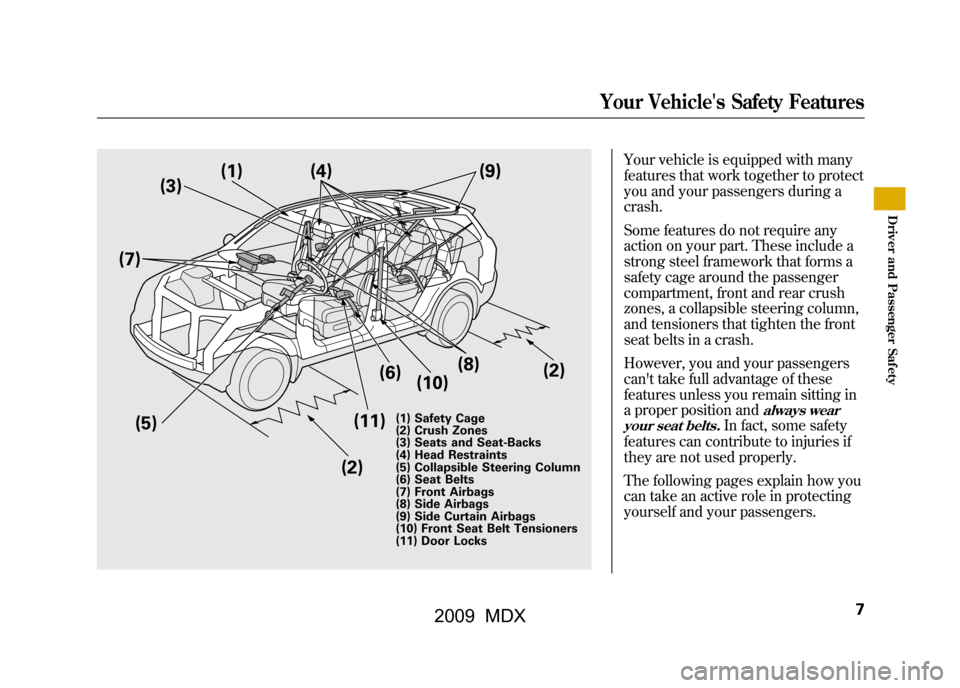
Your vehicle is equipped with many
features that work together to protect
you and your passengers during a
crash.
Some features do not require any
action on your part. These include a
strong steel framework that forms a
safety cage around the passenger
compartment, front and rear crush
zones, a collapsible steering column,
and tensioners that tighten the front
seat belts in a crash.
However, you and your passengers
can't take full advantage of these
features unless you remain sitting in
a proper position and
always wear
your seat belts.
In fact, some safety
features can contribute to injuries if
they are not used properly.
The following pages explain how you
can take an active role in protecting
yourself and your passengers.
(1) Safety Cage
(2) Crush Zones
(3) Seats and Seat-Backs
(4) Head Restraints
(5) Collapsible Steering Column
(6) Seat Belts
(7) Front Airbags
(8) Side Airbags
(9) Side Curtain Airbags
(10) Front Seat Belt Tensioners
(11) Door Locks
(1)
(3)
(7)
(5) (2)(11) (6)
(10) (8)
(2)
(9)
(4)
Your Vehicle's Safety Features
7
Driver and Passenger Saf et y
08/06/06 16:58:07 09 ACURA MDX MMC North America Owner's M 50 31STX620 enu
2009 MDX
Page 12 of 489
Seat Belts
Your vehicle is equipped with seat
belts in all seating positions.
Your seat belt system also includes
an indicator on the instrument panel
and a beeper to remind you and your
passengers to fasten your seat belts.Why Wear Seat BeltsSeat belts are the single most
effective safety device for adults and
larger children. (Infants and smaller
children must be properly restrained
in child seats.)
Not wearing a seat belt properly
increases the chance of serious
injury or death in a crash, even
though your vehicle has airbags.
In addition, most states and all
Canadian provinces require you to
wear seat belts.
Not wearing a seat belt properly
increases the chance of serious
injury or death in a crash, even
though your vehicle has
airbags.
Be sure you and your
passengers always wear seat
belts and wear them properly.
When properly worn, seat belts:●Keep you connected to the vehicle
so you can take advantage of the
vehicle's built-in safety features.●Help protect you in almost every
type of crash, including: – frontal impacts
– side impacts
– rear impacts
– rollovers
●Help keep you from being thrown
against the inside of the vehicle
and against other occupants.●Keep you from being thrown out of
the vehicle.●Help keep you in a good position
should the airbags ever deploy. A
good position reduces the risk of
injury from an inflating airbag and
allows you to get the best
advantage from the airbag.
Of course, seat belts cannot
completely protect you in every
crash. But in most cases, seat belts
can reduce your risk of serious
injury.What you should do:
Always wear
your seat belt, and make sure you
wear it properly.
Your Vehicle's Safety Features808/06/06 16:58:07 09 ACURA MDX MMC North America Owner's M 50 31STX620 enu
2009 MDX
Page 16 of 489

When both tailgate and one or more
doors are not tightly closed, the
‘‘DOOR & TAILGATE OPEN’’
message will come on. Locking the doors reduces the
chance of someone being thrown out
of the vehicle during a crash, and it
helps prevent passengers from
accidentally opening a door and
falling out.
Locking the doors also helps prevent
an outsider from unexpectedly
opening a door when you come to a
stop.
Your vehicle has the auto door
locking/unlocking feature. For more
information, see page130.
2. Adjust the Front Seats
Adjust the driver's seat as far to the
rear as possible while allowing you to
maintain full control of the vehicle.
Have a front passenger adjust their
seat as far to the rear as possible.
Protecting Adults and Teens1208/06/06 16:58:07 09 ACURA MDX MMC North America Owner's M 50 31STX620 enu
2009 MDX
Page 17 of 489
If you sit too close to the steering
wheel or dashboard, you can be
seriously injured by an inflating front
airbag, or by striking the steering
wheel or dashboard.
The National Highway Traffic Safety
Administration and Transport
Canada recommend that drivers
allow at least 10 inches (25 cm)
between the center of the steering
wheel and the chest. In addition to
adjusting the seat, you can adjust the
steering wheel up and down, and in
and out (see page124).
If you cannot get far enough away
from the steering wheel and still
reach the controls, we recommend
that you investigate whether some
type of adaptive equipment may help.
Sitting too close to a front
airbag can result in serious
injury or death if the front
airbags inflate.
Always sit as far back from the
front airbags as possible.
See page140for how to adjust the
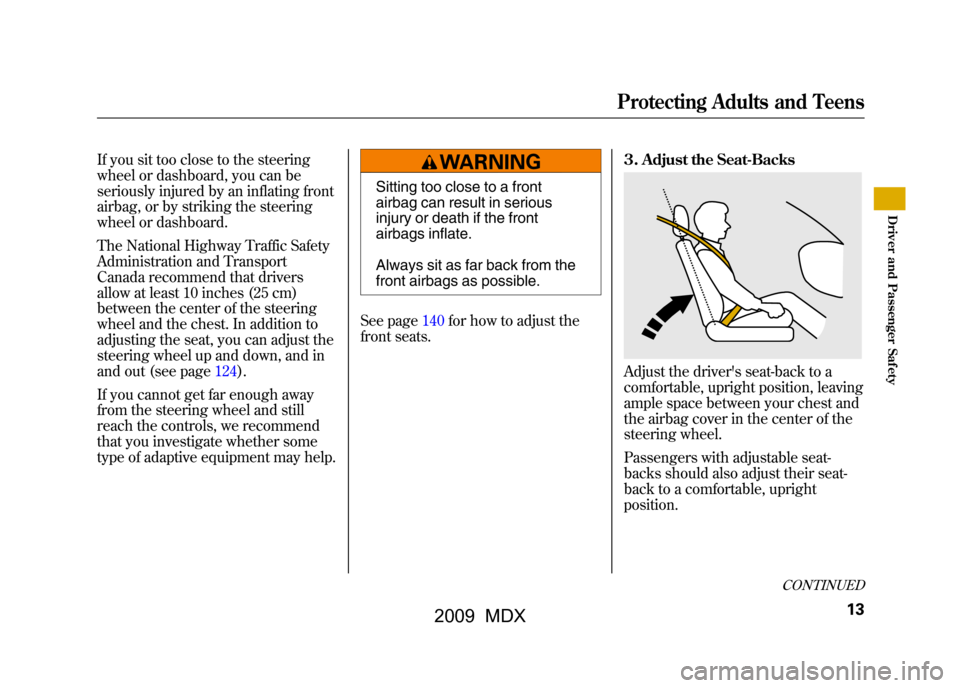
front seats. 3. Adjust the Seat-Backs
Adjust the driver's seat-back to a
comfortable, upright position, leaving
ample space between your chest and
the airbag cover in the center of the
steering wheel.
Passengers with adjustable seat-
backs should also adjust their seat-
back to a comfortable, upright
position.
CONTINUED
Protecting Adults and Teens
13
Driver and Passenger Saf et y
08/06/06 16:58:07 09 ACURA MDX MMC North America Owner's M 50 31STX620 enu
2009 MDX
Page 19 of 489
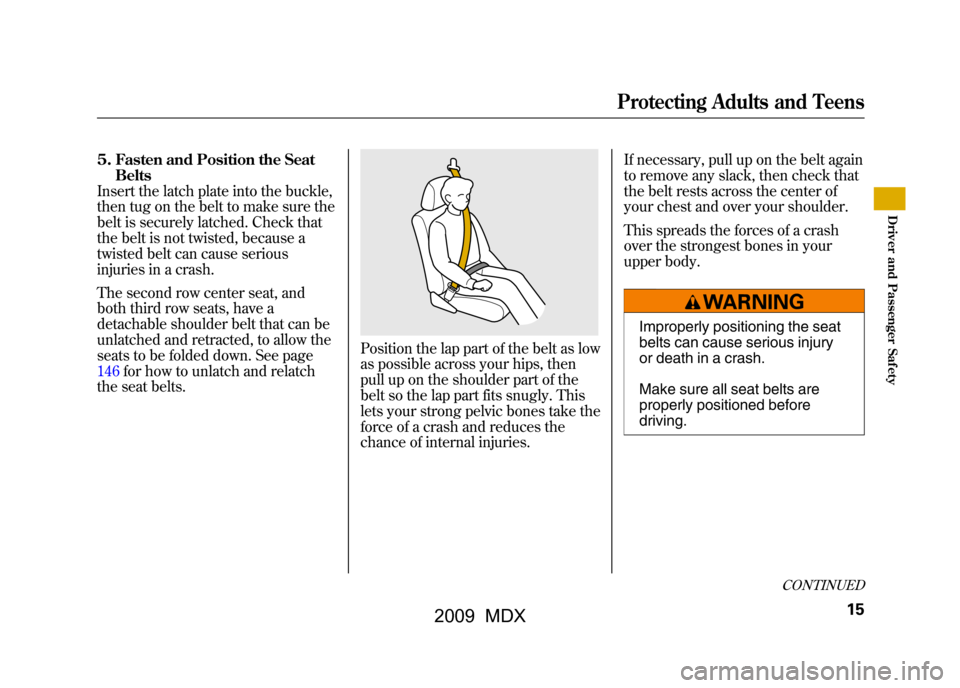
5. Fasten and Position the SeatBelts
Insert the latch plate into the buckle,
then tug on the belt to make sure the
belt is securely latched. Check that
the belt is not twisted, because a
twisted belt can cause serious
injuries in a crash.
The second row center seat, and
both third row seats, have a
detachable shoulder belt that can be
unlatched and retracted, to allow the
seats to be folded down. See page
146for how to unlatch and relatch
the seat belts.
Position the lap part of the belt as low
as possible across your hips, then
pull up on the shoulder part of the
belt so the lap part fits snugly. This
lets your strong pelvic bones take the
force of a crash and reduces the
chance of internal injuries. If necessary, pull up on the belt again
to remove any slack, then check that
the belt rests across the center of
your chest and over your shoulder.
This spreads the forces of a crash
over the strongest bones in your
upper body.
Improperly positioning the seat
belts can cause serious injury
or death in a crash.
Make sure all seat belts are
properly positioned before
driving.
CONTINUED
Protecting Adults and Teens
15
Driver and Passenger Saf et y
08/06/06 16:58:07 09 ACURA MDX MMC North America Owner's M 50 31STX620 enu
2009 MDX
Page 20 of 489
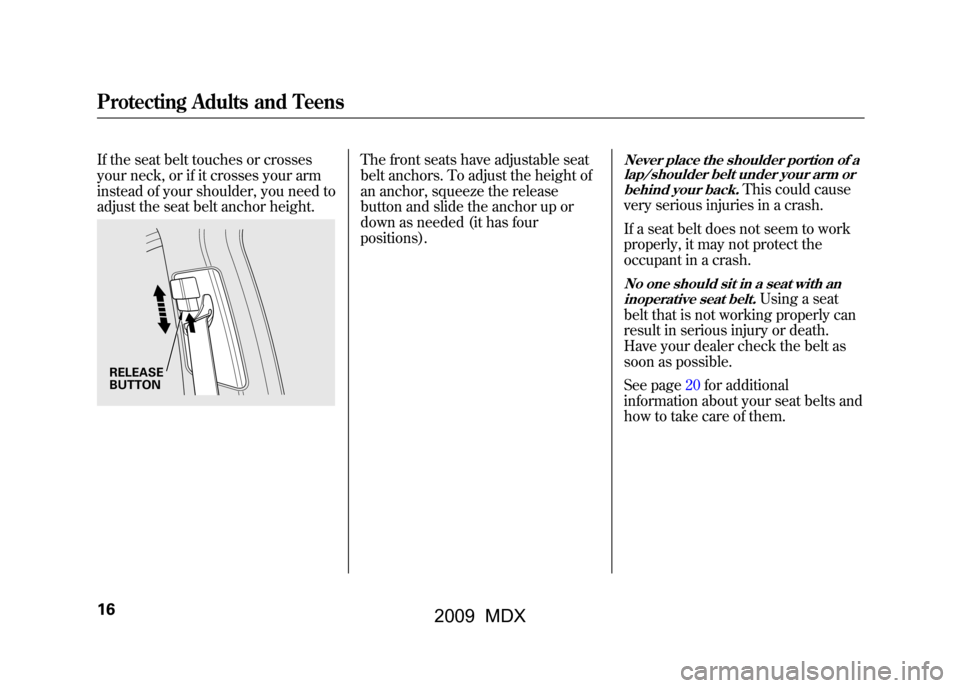
If the seat belt touches or crosses
your neck, or if it crosses your arm
instead of your shoulder, you need to
adjust the seat belt anchor height.
The front seats have adjustable seat
belt anchors. To adjust the height of
an anchor, squeeze the release
button and slide the anchor up or
down as needed (it has four
positions).
Never place the shoulder portion of alap/shoulder belt under your arm or
behind your back.
This could cause
very serious injuries in a crash.
If a seat belt does not seem to work
properly, it may not protect the
occupant in a crash.
No one should sit in a seat with an
inoperative seat belt.
Using a seat
belt that is not working properly can
result in serious injury or death.
Have your dealer check the belt as
soon as possible.
See page20for additional
information about your seat belts and
how to take care of them.
RELEASE
BUTTONProtecting Adults and Teens1608/06/06 16:58:07 09 ACURA MDX MMC North America Owner's M 50 31STX620 enu
2009 MDX
Page 21 of 489
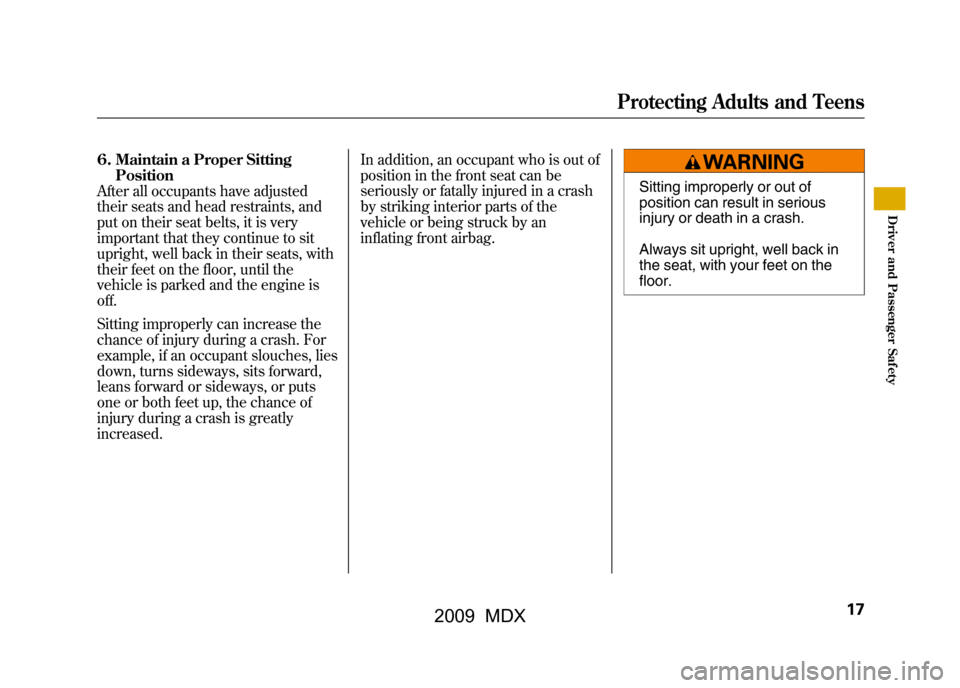
6. Maintain a Proper SittingPosition
After all occupants have adjusted
their seats and head restraints, and
put on their seat belts, it is very
important that they continue to sit
upright, well back in their seats, with
their feet on the floor, until the
vehicle is parked and the engine is
off.
Sitting improperly can increase the
chance of injury during a crash. For
example, if an occupant slouches, lies
down, turns sideways, sits forward,
leans forward or sideways, or puts
one or both feet up, the chance of
injury during a crash is greatly
increased. In addition, an occupant who is out of
position in the front seat can be
seriously or fatally injured in a crash
by striking interior parts of the
vehicle or being struck by an
inflating front airbag.
Sitting improperly or out of
position can result in serious
injury or death in a crash.
Always sit upright, well back in
the seat, with your feet on the
floor.
Protecting Adults and Teens
17
Driver and Passenger Saf et y
08/06/06 16:58:07 09 ACURA MDX MMC North America Owner's M 50 31STX620 enu
2009 MDX
Page 23 of 489
Additional Safety Precautions●Never let passengers ride in thecargo area or on top of a folded-
down back seat.
If they do, they
could be very seriously injured in a
crash.
●Passengers should not stand up or change seats while the vehicle is
moving.
A passenger who is not
wearing a seat belt during a crash
or emergency stop can be thrown
against the inside of the vehicle,
against other occupants, or out of
the vehicle.
●Two people should never use the
same seat belt.
If they do, they
could be very seriously injured in a
crash.
●Do not put any accessories on seat
belts.
Devices intended to improve
occupant comfort or reposition the
shoulder part of a seat belt can
reduce the protective capability of
the belt and increase the chance of
serious injury in a crash.
●Do not place hard or sharp objects between yourself and a front
airbag.
Carrying hard or sharp
objects on your lap, or driving with
a pipe or other sharp object in your
mouth, can result in injuries if your
front airbag inflates.
●Keep your hands and arms away
from the airbag covers.
If your
hands or arms are close to an
airbag cover, they could be injured
if the airbag inflates.
●Do not attach or place objects on
the front airbag covers.
Objects on
the covers marked ‘‘SRS AIRBAG ’’
could interfere with the proper
operation of the airbags or be
propelled inside the vehicle and
hurt someone if the airbags inflate.
●Do not attach hard objects on or
near a door.
If a side airbag or a
side curtain airbag inflates, a cup
holder or other hard object
attached on or near the door could
be propelled inside the vehicle and
hurt someone.
Protecting Adults and Teens
19
Driver and Passenger Saf et y
08/06/06 16:58:07 09 ACURA MDX MMC North America Owner's M 50 31STX620 enu
2009 MDX
Page 26 of 489
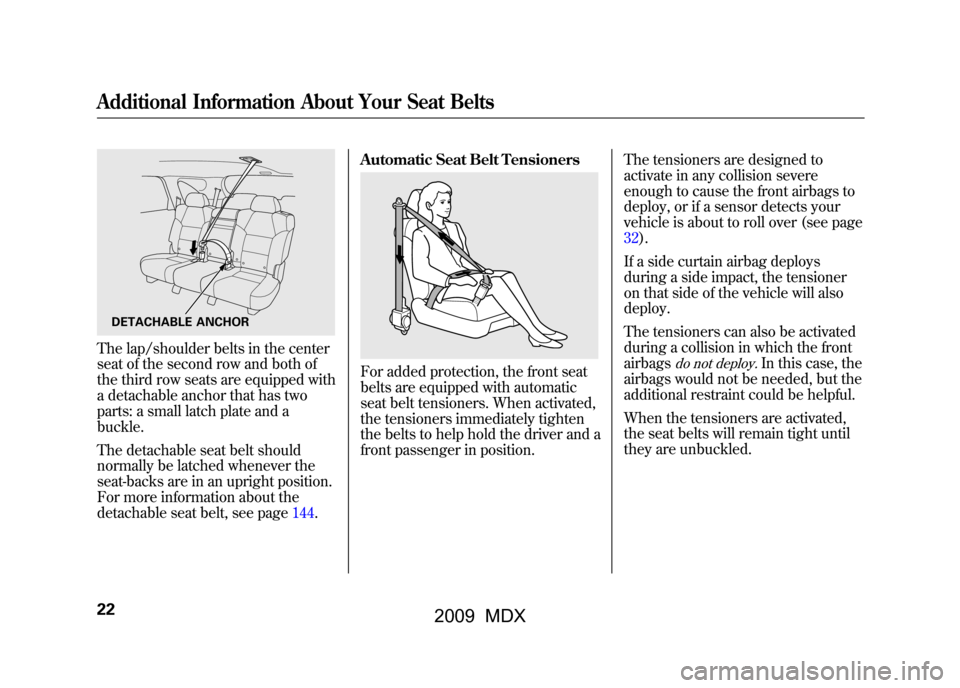
The lap/shoulder belts in the center
seat of the second row and both of
the third row seats are equipped with
a detachable anchor that has two
parts: a small latch plate and a
buckle.
The detachable seat belt should
normally be latched whenever the
seat-backs are in an upright position.
For more information about the
detachable seat belt, see page144.Automatic Seat Belt Tensioners
For added protection, the front seat
belts are equipped with automatic
seat belt tensioners. When activated,
the tensioners immediately tighten
the belts to help hold the driver and a
front passenger in position.
The tensioners are designed to
activate in any collision severe
enough to cause the front airbags to
deploy, or if a sensor detects your
vehicle is about to roll over (see page
32).
If a side curtain airbag deploys
during a side impact, the tensioner
on that side of the vehicle will also
deploy.
The tensioners can also be activated
during a collision in which the front
airbags
do not deploy.
In this case, the
airbags would not be needed, but the
additional restraint could be helpful.
When the tensioners are activated,
the seat belts will remain tight until
they are unbuckled.
DETACHABLE ANCHORAdditional Information About Your Seat Belts2208/06/06 16:58:07 09 ACURA MDX MMC North America Owner's M 50 31STX620 enu
2009 MDX