oil Acura MDX 2012 Owner's Guide
[x] Cancel search | Manufacturer: ACURA, Model Year: 2012, Model line: MDX, Model: Acura MDX 2012Pages: 621, PDF Size: 11.15 MB
Page 524 of 621
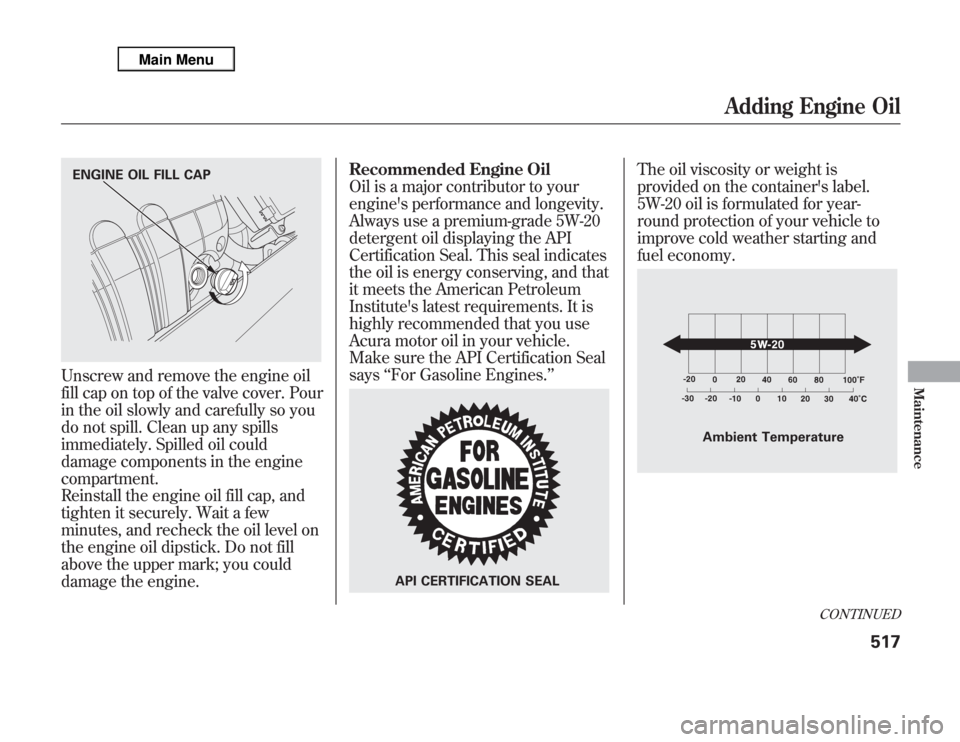
Unscrew and remove the engine oil
fill cap on top of the valve cover. Pour
in the oil slowly and carefully so you
do not spill. Clean up any spills
immediately. Spilled oil could
damage components in the engine
compartment.
Reinstall the engine oil fill cap, and
tighten it securely. Wait a few
minutes, and recheck the oil level on
the engine oil dipstick. Do not fill
above the upper mark; you could
damage the engine.Recommended Engine Oil
Oil is a major contributor to your
engine's performance and longevity.
Always use a premium-grade 5W-20
detergent oil displaying the API
Certification Seal. This seal indicates
the oil is energy conserving, and that
it meets the American Petroleum
Institute's latest requirements. It is
highly recommended that you use
Acura motor oil in your vehicle.
Make sure the API Certification Seal
says‘‘For Gasoline Engines.’’
The oil viscosity or weight is
provided on the container's label.
5W-20 oil is formulated for year-
round protection of your vehicle to
improve cold weather starting and
fuel economy.
ENGINE OIL FILL CAP
API CERTIFICATION SEAL
Ambient Temperature
CONTINUED
Adding Engine Oil
517
Maintenance
Page 525 of 621

Synthetic Oil
You may use a synthetic motor oil if
it meets the same requirements
given for a conventional motor oil: it
displays the API Certification Seal
and it is the proper weight. You must
follow the oil and filter change
intervals shown on the multi-
information display.
Engine Oil Additives
Your vehicle does not require any oil
additives. Additives may adversely
affect the engine or transmission
performance and durability.Changing the Engine Oil and
Filter
Always change the oil and filter
according to the maintenance
messages shown on the multi-
information display. The oil and filter
collect contaminants that can
damage your engine if they are not
removed regularly.
Changing the oil and filter requires
special tools and access from
underneath the vehicle. The vehicle
should be raised on a service station-
type hydraulic lift for this service.
Unless you have the knowledge and
proper equipment, you should have
this maintenance done by a skilled
mechanic.
1. Run the engine until it reaches
normal operating temperature,
then shut it off.
2. Open the hood, and remove the
engine oil fill cap. Remove the oil
drain bolt and washer from the
bottom of the engine. Drain the oil
into an appropriate container.
WASHER DRAIN BOLT
Adding Engine Oil, Changing the Engine Oil and Filter518
Page 526 of 621

3. Remove the oil filter, and let the
remaining oil drain. A special
wrench (available from your
dealer) is required.
Make sure the oil filter gasket is
not stuck to the engine block. If it
is, remove it before installing a
new oil filter.4. Install a new oil filter according to
the instructions that come with it.
Make sure to clean off any dirt and
dust on the connecting surface of a
new oil filter.
5. Put a new washer on the drain
bolt, then reinstall the drain bolt.
Tighten the drain bolt to:
29 lbf·ft (39 N·m, 4.0 kgf·m)
6. Refill the engine with the
recommended oil.
Engine oil change capacity
(including filter):
4.5 US qt (4.3 L)7. Reinstall the engine oil fill cap.
Start the engine. The oil pressure
indicator should go out within 5
seconds. If it does not, turn off the
engine, and check your work.
8. Let the engine run for several
minutes, then check the drain bolt
and oil filter for leaks.
9. Turn off the engine and let it sit for
several minutes, then check the oil
level on the dipstick. If necessary,
add more oil.
Improper disposal of engine oil can be
harmful to the environment. If you
change your own oil, please dispose of
the used oil properly. Put it in a sealed
container, and take it to a recycling
center. Do not discard it in a trash bin
or dump it on the ground.
OIL FILTER
Changing the Engine Oil and Filter
519
Maintenance
Page 534 of 621
Headlight Aiming
The headlights were properly aimed
when your vehicle was new. If you
regularly carry heavy items in the
cargo area or pull a trailer,
readjustment may be required.
Adjustments should be done by your
dealer or another qualified
technician.
Low Beam Headlight Bulb
Replacement
The low beam headlight bulbs are a
type of high voltage discharge tube.
High voltage can remain in the
circuit even with the light switch off
and the key removed. Because of
this, you should not attempt to
examine or change a low beam
headlight bulb yourself. If a low
beam headlight bulb fails, take the
vehicle to your dealer to have it
replaced.Replacing a High Beam Headlight
Bulb
Your vehicle has halogen headlight
bulbs. When replacing a bulb, handle
it by its base, and protect the glass
from contact with your skin or hard
objects. If you touch the glass, clean
it with denatured alcohol and a clean
cloth.
Halogen headlight bulbs get very hot
when lit. Oil, perspiration, or a scratch
on the glass can cause the bulb to
overheat and shatter.
1. Open the hood.
2. Remove the front bulkhead cover
(see page 516).
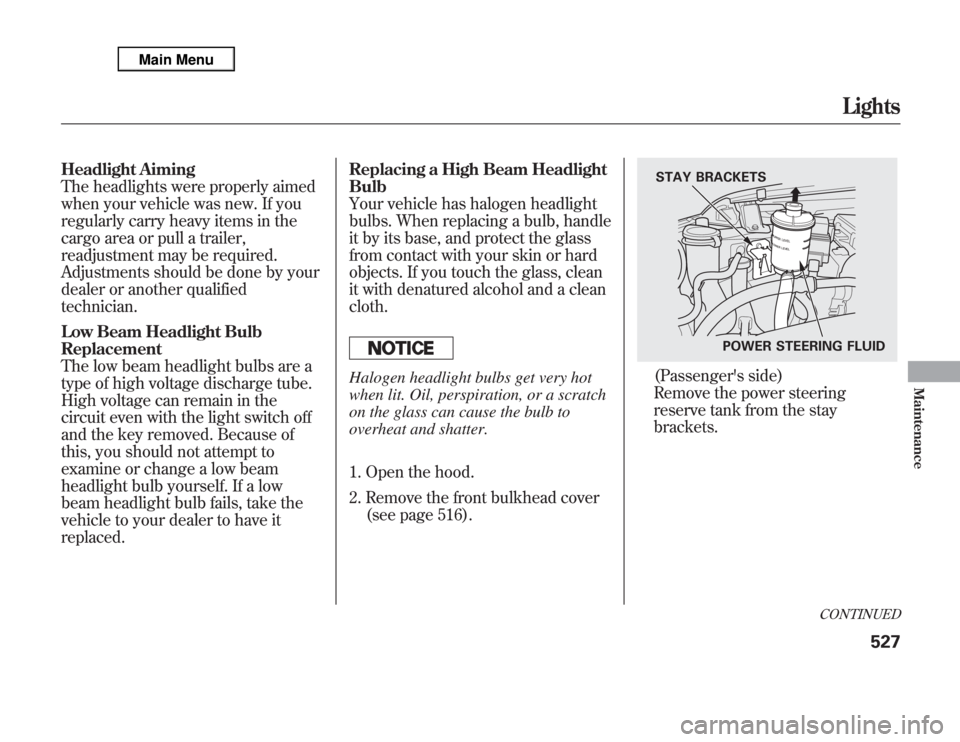
(Passenger's side)
Remove the power steering
reserve tank from the stay
brackets.STAY BRACKETS
POWER STEERING FLUID
CONTINUED
Lights
527
Maintenance
Page 537 of 621
Replacing Front Fog/Daytime
Running Light Bulbs
Your vehicle uses halogen light
bulbs. When replacing a bulb, handle
it by its plastic case, and protect the
glass from contact with your skin or
hard objects. If you touch the glass,
clean it with denatured alcohol and a
clean cloth.Halogen bulbs get very hot when lit.
Oil, perspiration, or a scratch on the
glass can cause the bulb to overheat
and shatter.
1. To change the bulb on the driver's
side, start the engine, turn the
steering wheel all the way to the
right, then turn off the engine. To
change the bulb on the
passenger's side, turn the steering
wheel to the left.
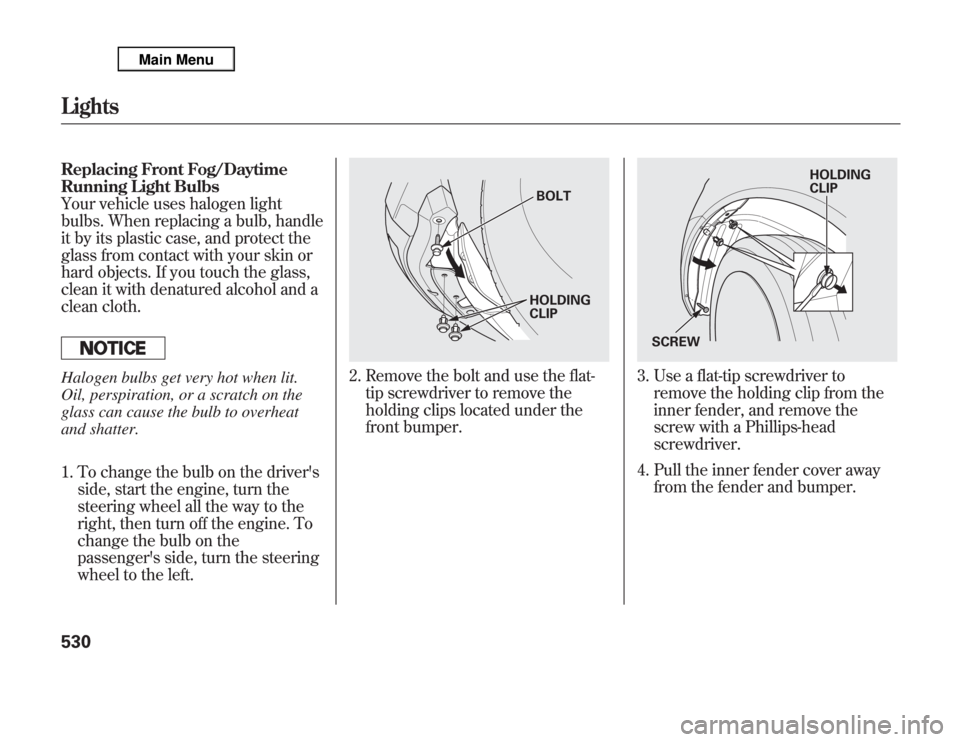
2. Remove the bolt and use the flat-
tip screwdriver to remove the
holding clips located under the
front bumper.
3. Use a flat-tip screwdriver to
remove the holding clip from the
inner fender, and remove the
screw with a Phillips-head
screwdriver.
4. Pull the inner fender cover away
from the fender and bumper.
BOLT
HOLDING
CLIP
HOLDING
CLIP
SCREW
Lights530
Page 556 of 621

This section covers the more
common problems that motorists
experience with their vehicles. It
gives you information about how to
safely evaluate the problem and what
to do to correct it. If the problem has
stranded you on the side of the road,
you may be able to get going again. If
not, you will also find instructions on
getting your vehicle towed.Compact Spare Tire
....................
550
Changing a Flat Tire
...................
551
If the Engine Won't Start
.............
557
Jump Starting
..............................
558
If the Engine Overheats
..............
560
Low Oil Pressure Indicator
.........
562
Charging System Indicator
.........
562
Malfunction Indicator Lamp
........
563
Brake System Indicator
...............
564
Fuses
..........................................
565
Fuse Locations
............................
569
Opening the Fuel Fill Door
Manually
.................................
572
Emergency Towing
.....................
572
If Your Vehicle Gets Stuck
..........
573
Taking Care of the Unexpected
549
Taking Care of the Unexpected
Page 569 of 621

Low Oil Pressure Indicator
This indicator should never
come on when the engine is
running. If it starts flashing or stays
on, the oil pressure has dropped very
low or lost pressure. Serious engine
damage is possible, and you should
take immediate action.
You will also see a‘‘CHECK
ENGINE OIL LEVEL’’message on
the multi-information display when
this indicator comes on.
Running the engine with low oil
pressure can cause serious mechanical
damage almost immediately. Turn off
the engine as soon as you can safely get
the vehicle stopped.1. Safely pull off the road, and shut
off the engine. Turn on the hazard
warning indicators.
2. Let the vehicle sit for a minute.
Open the hood, and check the oil
level (see page 427). An engine
very low on oil can lose pressure
during cornering and other driving
maneuvers.
3. If necessary, add oil to bring the
level back to the full mark on the
dipstick (see page 517).
4. Start the engine, and watch the oil
pressure indicator. If it does not go
out within 10 seconds, turn off the
engine. There is a mechanical
problem that needs to be repaired
before you can continue driving
(seeEmergency Towingon page
572).Charging System Indicator
If the charging system
indicator comes on brightly
when the engine is running, the
battery is not being charged.
You will also see a‘‘CHECK
CHARGING SYSTEM’’message on
the multi-information display (see
page 87).
Immediately turn off all electrical
accessories. Try not to use other
electrically operated controls such as
the power windows. Keep the engine
running; starting the engine will
discharge the battery rapidly.
Go to a service station or garage
where you can get technical
assistance.
Low Oil Pressure Indicator, Charging System Indicator562
Page 577 of 621

SECONDARY UNDER-HOOD FUSE BOXNo. Amps. Circuits Protected
1 10 A Left Daytime Running Light
2 10 A Right Daytime Running
Light
3 10 A Left Headlight High
4 10 A Right Headlight High
5 7.5 A Small Lights (Exterior)
6 30 A Headlight Low Main
7 7.5 A Cooling Fan Timer
8 15 A IGP
9 15 A IG Coil
10 15 A DBW
11 15 A AFHT
12 40 A Front Blower MotorNo. Amps. Circuits Protected
13 20 A Fog Lights
14 30 A Headlight Washer
ᤳ
15 30 A Condenser Fan
16 30 A Cooling Fan
17 7.5 A A/C Clutch
18 15 A Left Headlight Low
19 15 A Right Headlight Low
22 7.5 A Small Lights (Interior)
ᤳ: Canadian modelSUB FUSE BOXIf equippedNo. Amps. Circuits Protected
1 10 A ACC/CMBS, BSI, ADS, EPT,
AVS
REAR FUSE BOXNo. Amps. Circuits Protected
1-Not Used
2-Not Used
3-Not Used
4-Not Used
5 10 A Rear ACC Socket
6 20 A Power Tailgate
7-Not Used
8 7.5 A Interior Light
9-Not Used
10 30 A Rear Defroster
11 40 A Power Tailgate
Fuse Locations570
Page 578 of 621

INTERIOR FUSE BOXNo. Amps. Circuits Protected
1 7.5 A TPMS
2 10 A Driver's Lumbar Support
Motor
3 15 A Moonroof
4 20 A Front Heated Seats
5 10 A Audio
6 7.5 A Interior Light
7 10 A Back Up
8 20 A Door Lock
9 15 A ACC Socket
10 15 A IG Coil
11 30 A Windshield Wiper
12 10 A Subwoofer
13 20 A Passenger's Power ReclineNo. Amps. Circuits Protected
14 20 A Driver's Power Slide
15 20 A Telescopic Steering Wheel
16 20 A Driver's Power Recline
17 20 A Passenger's Power Slide
18 10 A Alternator
19 20 A Fuel Pump
20 10 A SH-AWD, ODS
21 7.5 A Gauges
22 10 A SRS
23-Not Used
24 20 A Left Rear Power Window
25 20 A Right Rear Power Window
26 30 A Passenger's Power Window
27 30 A Driver's Power Window
28 20 A Tilt Steering Wheel
29 10 A ABS VSA
30 10 A A/C
31 15 A Washer
32 10 A ACC
33-Not Used
Auxiliary (Holder1)No. Amps. Circuits Protected
1 7.5 A Starter DIAG
2 7.5 A SH-AWDAuxiliary (Holder2)No. Amps. Circuits Protected
1 7.5 A STS
2 7.5 A ODS
Auxiliary
(Holder1)Auxiliary
(Holder2)
Fuse Locations
571
Taking Care of the Unexpected
Page 585 of 621

Dimensions
Length 191.6 in (4,867 mm)
Width 78.5 in (1,994 mm)
Height 68.2 in (1,733 mm)
Wheelbase 108.3 in (2,750 mm)
Track Front 67.7 in (1,720 mm)
Rear 67.5 in (1,715 mm)
Weights
Gross vehicle weight rating See the tire information label
attached to the driver's doorjamb.
Gross combined weight
ᤳ1
rating (GCWR)10,053 lbs (4,560 kg)
ᤳ1: The GCWR must be reduced 2 percent for every 1,000 feet (305
meters) of elevation.
Air Conditioning
Refrigerant type HFC-134a (R-134a)
Charge quantity 21.2-22.9 oz (600-650 g)
Lubricant type ND-OIL 8
Seating Capacities
Total 7
Front 2
Second 3
Third 2Capacities
Fuel tank Approx.
21.00 US gal (79.5 L)
Engine
coolantChange
ᤳ1
1.93 US gal (7.3 L)
Total 2.43 US gal (9.2 L)
Engine oil Change
ᤳ2
4.5 US qt (4.3 L)
Including
filter
Without
filter4.2 US qt (4.0 L)
Total 5.3 US qt (5.0 L)
Automatic
transmission
fluidChange 3.3 US qt (3.1 L)
Total 8.5 US qt (8.0 L)
Rear
differential
fluidChange 2.6 US qt (2.5 L)
Total 3.0 US qt (2.8 L)
Transfer
assembly
fluidChange 0.4 US qt (0.4 L)
Total 0.4 US qt (0.4 L)
Windshield
washer
reservoirU.S. vehicles 4.2 US qt (4.0 L)
Canadian
vehicles6.1 US qt (5.8 L)
ᤳ1: Including the coolant in the reserve tank and that remaining in the
engine
Reserve tank capacity:
0.18 US gal (0.7 L)
ᤳ2: Excluding the oil remaining in the engine
Specifications578