Fluid Acura MDX 2014 User Guide
[x] Cancel search | Manufacturer: ACURA, Model Year: 2014, Model line: MDX, Model: Acura MDX 2014Pages: 500, PDF Size: 11.72 MB
Page 391 of 500

390
uuBefore Performing MaintenanceuParts and Fluids Used in Maintenance Service
Maintenance
Parts and Fluids Used in Maintenance ServiceThe use of Acura genuine parts and fluids is recommended when maintaining and
servicing your vehicle. Acura genuine parts are manufactured according to the same
high quality standards used in Acura vehicles.
Page 394 of 500
393
uuMaintenance Minder
TMuTo Use Maintenance Minder
TM
Continued
Maintenance
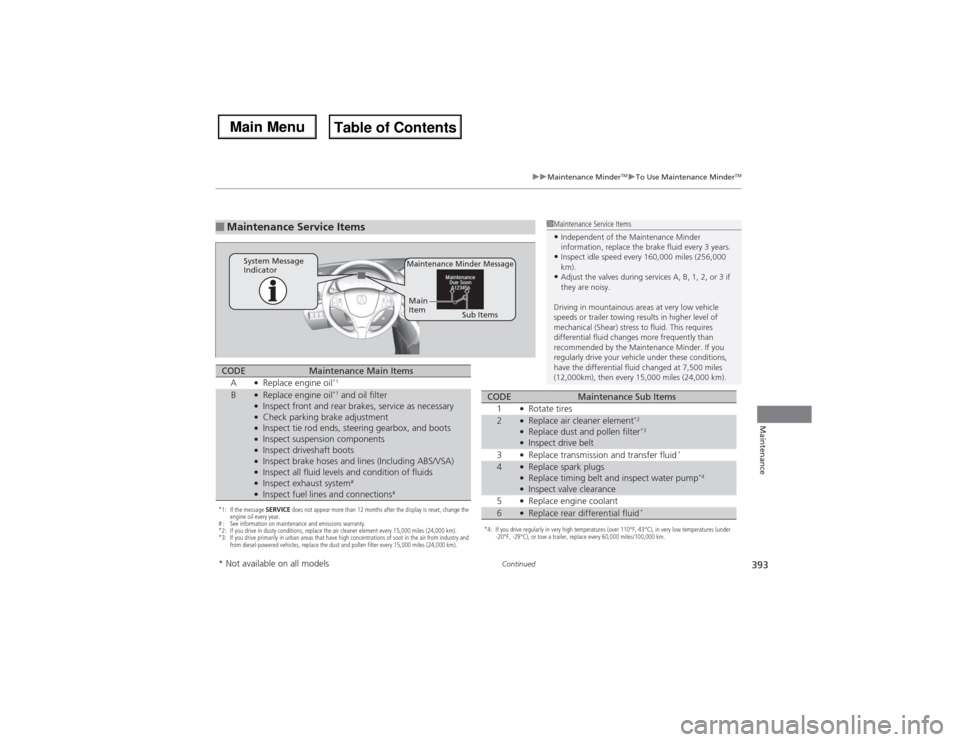
■Maintenance Service Items
1Maintenance Service Items•Independent of the Maintenance Minder
information, replace the brake fluid every 3 years.•Inspect idle speed every 160,000 miles (256,000
km).•Adjust the valves during services A, B, 1, 2, or 3 if
they are noisy.
Driving in mountainous areas at very low vehicle
speeds or trailer towing results in higher level of
mechanical (Shear) stress to fluid. This requires
differential fluid changes more frequently than
recommended by the Maintenance Minder. If you
regularly drive your vehicle under these conditions,
have the differential fluid changed at 7,500 miles
(12,000km), then every 15,000 miles (24,000 km).
Maintenance Minder Message
System Message
Indicator
Sub Items Main
Item
*1: If the message SERVICE does not appear more than 12 months after the display is reset, change the
engine oil every year.
# : See information on maintenance and emissions warranty.
*2: If you drive in dusty conditions, replace the air cleaner element every 15,000 miles (24,000 km).
*3: If you drive primarily in urban areas that have high concentrations of soot in the air from industry and
from diesel-powered vehicles, replace the dust and pollen filter every 15,000 miles (24,000 km).CODE
Maintenance Main Items
A
●Replace engine oil
*1
B
●Replace engine oil
*1 and oil filter
●Inspect front and rear brakes, service as necessary●Check parking brake adjustment●Inspect tie rod ends, steering gearbox, and boots●Inspect suspension components●Inspect driveshaft boots●Inspect brake hoses and lines (Including ABS/VSA)●Inspect all fluid levels and condition of fluids●Inspect exhaust system
#
●Inspect fuel lines and connections
#
*4: If you drive regularly in very high temperatures (over 110°F, 43°C), in very low temperatures (under
-20°F, -29°C), or tow a trailer, replace every 60,000 miles/100,000 km.CODE
Maintenance Sub Items
1
●Rotate tires
2
●Replace air cleaner element
*2
●Replace dust and pollen filter
*3
●Inspect drive belt
3●Replace transmission and transfer fluid
*
4
●Replace spark plugs●Replace timing belt and inspect water pump
*4
●Inspect valve clearance
5●Replace engine coolant
6
●Replace rear differential fluid
*
* Not available on all models
Page 396 of 500
395Maintenance
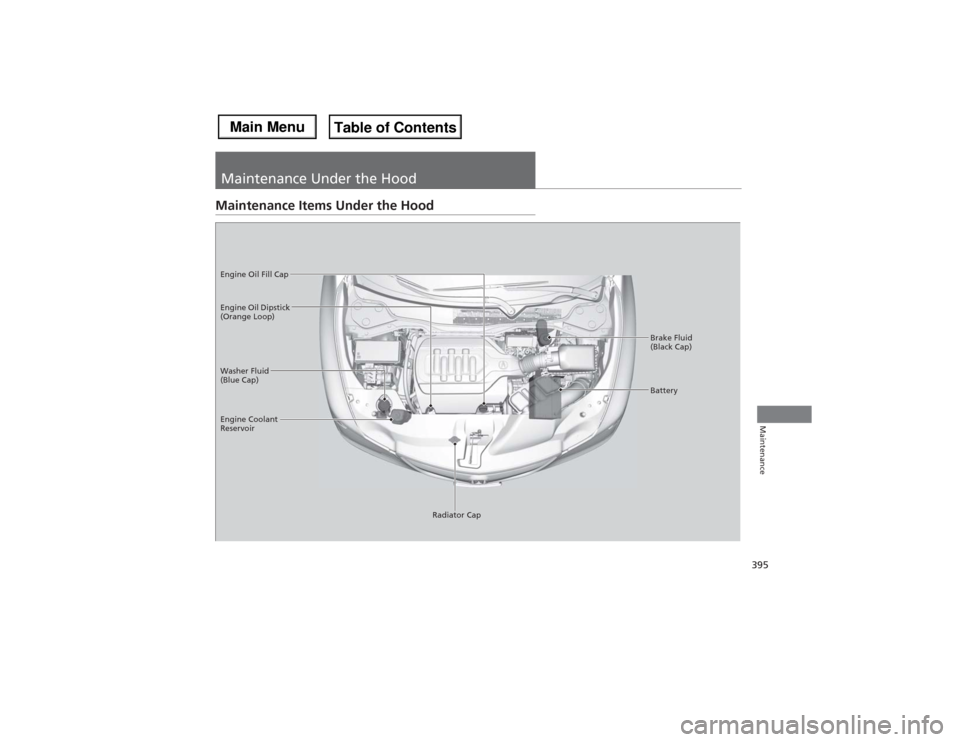
Maintenance Under the HoodMaintenance Items Under the Hood
Brake Fluid
(Black Cap)
Washer Fluid
(Blue Cap)
Radiator Cap Engine Coolant
Reservoir Engine Oil Dipstick
(Orange Loop) Engine Oil Fill Cap
Battery
Page 405 of 500

uuMaintenance Under the HooduEngine Coolant
404Maintenance
1. Make sure the engine and radiator are
cool.
2.Remove the engine compartment cover.
2Engine Compartment Cover P. 397
3.Turn the radiator cap counterclockwise and
relieve any pressure in the coolant system.
Do not push the cap down when turning.
4.Push down and turn the radiator cap
counterclockwise to remove it.
5.The coolant level should be up to the base
of the filler neck. Add coolant if it is low.
6.Put the radiator cap back on, and tighten it
fully.
7.Pour coolant into the reserve tank until it
reaches the MAX mark. Put the cap back
on the reserve tank.
■Radiator
1RadiatorNOTICEPour the fluid slowly and carefully so you do not spill
any. Clean up any spills immediately; they can
damage components in the engine compartment.
3
WARNING
Removing the radiator cap while the
engine is hot can cause the coolant to spray
out, seriously scalding you.
Always let the engine and radiator cool
down before removing the radiator cap.
Radiator Cap
Page 406 of 500

405
uuMaintenance Under the HooduTransmission Fluid
Maintenance
Transmission FluidHave a dealer check the fluid level and replace if necessary.■Automatic Transmission FluidSpecified fluid: Acura ATF DW-1 (automatic transmission fluid)
1Automatic Transmission FluidNOTICEDo not mix Acura ATF DW-1 with other
transmission fluids.
Using a transmission fluid other than Acura ATF DW-
1 may adversely affect the operation and durability of
your vehicle’s transmission, and damage the
transmission.
Any damage caused by using a transmission fluid that
is not equivalent to Acura ATF DW-1 is not covered
by Acura’s new vehicle warranty.
Page 407 of 500

406
uuMaintenance Under the HooduBrake Fluid
Maintenance
Brake Fluid
The fluid level should be between the MIN
and MAX marks on the side of the reservoir.
Refilling Window Washer FluidIf the washer fluid is low, a message appears on the MID.
Pour the washer fluid carefully. Do not overflow the reservoir.Specified fluid: Acura Heavy Duty Brake Fluid DOT 3■Checking the Brake Fluid
1Brake FluidNOTICEBrake fluid marked DOT 5 is not compatible with your
vehicle’s braking system and can cause extensive
damage.
If the specified brake fluid is not available, you should
use only DOT 3 or DOT 4 fluid from a sealed
container as a temporary replacement.
Using any non-Acura brake fluid can cause corrosion
and decrease the longevity of the system. Have the
brake system flushed and refilled with Acura Heavy
Duty Brake Fluid DOT 3 as soon as possible.
If the brake fluid level is at or below the MIN mark,
have a dealer inspect for leaks or worn brake pads as
soon as possible.
Brake Reservoir
MINMAX
1Refilling Window Washer FluidNOTICEDo not use engine antifreeze or a vinegar/water
solution in the windshield washer reservoir.
Antifreeze can damage your vehicle’s paint. A
vinegar/water solution can damage the windshield
washer pump.
Page 436 of 500

435
uuCleaninguExterior Care
Maintenance
A good coat of automotive body wax helps protect your vehicle’s paint from the
elements. Wax will wear off over time and expose your vehicle’s paint to the
elements, so reapply as necessary.
If you get gasoline, oil, engine coolant, or battery fluid on resin coated parts, they
may be stained or the coating may peel. Promptly wipe it away using a soft cloth and
clean water.
Wipe using a glass cleaner.
Aluminum is susceptible to deterioration caused by salt and other road
contaminants. Use a sponge and mild detergent to wipe away promptly.
Be careful not to use harsh chemicals (including some commercial wheel cleaners) or
a stiff brush. They can damage the clear coat of the aluminum alloy wheels that
helps keep the aluminum from corroding and tarnishing.■Applying Wax■Maintaining the Bumpers and Other Resin Coated Parts■Cleaning the Window■Maintaining Aluminum Wheels
1Applying WaxNOTICEChemical solvents and strong cleaners can damage
the paint, metal, and plastic on your vehicle. Wipe up
spills immediately.1Maintaining the Bumpers and Other Resin Coated Parts
Ask a dealer about the correct coating material when
you want to repair the painted surface of the parts
made of resin.1Cleaning the Window
Wires are mounted to the inside of the rear window.
Wipe along the same direction as the wires with a
soft cloth so as not to damage them.
Page 468 of 500

467
uuIndicator, Coming On/BlinkinguIf the Brake System Indicator (Red) Comes On
Handling the Unexpected
If the Brake System Indicator (Red) Comes On
■Reasons for the indicator to come on
•The brake fluid is low.
•There is a malfunction in the brake system.■What to do when the indicator comes on while driving
Press the brake pedal lightly to check pedal pressure.
•If normal, check the brake fluid level the next time you stop.
•If abnormal, take immediate action. If necessary, downshift the
transmission to slow the vehicle using engine braking.
If the Speed-Sensitive Electric Power Steering (EPS) System Indicator Comes On
■Reasons for the indicator to come on
•Comes on when there is a problem with the EPS system.
•If you depress the accelerator pedal repeatedly to increase the engine
speed while the engine is idling, the indicator comes on, and
sometimes the steering wheel becomes harder to operate.■What to do when the indicator comes on
Stop the vehicle in a safe place and restart the engine.
If the indicator comes on and stays on, immediately have your vehicle
inspected by a dealer.
1If the Brake System Indicator (Red) Comes On
Have your vehicle repaired immediately.
It is dangerous to drive with low brake fluid. If there
is no resistance from the brake pedal, stop
immediately in a safe place. If necessary downshift
the gears.
If the brake system indicator and ABS indicator come
on simultaneously, the electronic brake distribution
system is not working. This can result in vehicle
instability under sudden braking.
Have your vehicle inspected by a dealer immediately.
U.S.
Canada
Page 470 of 500
469
Continued
Handling the Unexpected
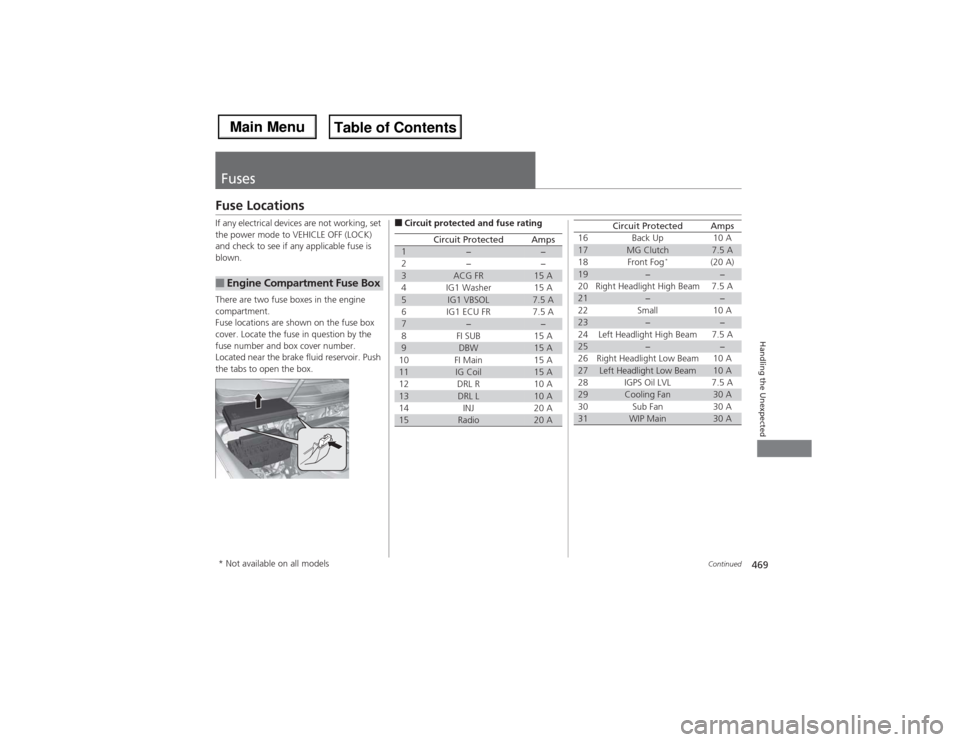
FusesFuse LocationsIf any electrical devices are not working, set
the power mode to VEHICLE OFF (LOCK)
and check to see if any applicable fuse is
blown.
There are two fuse boxes in the engine
compartment.
Fuse locations are shown on the fuse box
cover. Locate the fuse in question by the
fuse number and box cover number.
Located near the brake fluid reservoir. Push
the tabs to open the box.■Engine Compartment Fuse Box
■Circuit protected and fuse rating
Circuit Protected
Amps
1
−
−
2
−
−
3
ACG FR
15 A
4 IG1 Washer 15 A
5
IG1 VBSOL
7.5 A
6 IG1 ECU FR 7.5 A
7
−
−
8FI SUB 15A
9
DBW
15 A
10 FI Main 15 A
11
IG Coil
15 A
12 DRL R 10 A
13
DRL L
10 A
14 INJ 20 A
15
Radio
20 A
16 Back Up 10 A17
MG Clutch
7.5 A
18 Front Fog
*
(20 A)
19
−
−
20 Right Headlight High Beam 7.5 A
21
−
−
22 Small 10 A
23
−
−
24 Left Headlight High Beam 7.5 A
25
−
−
26 Right Headlight Low Beam 10 A
27
Left Headlight Low Beam
10 A
28 IGPS Oil LVL 7.5 A
29
Cooling Fan
30 A
30 Sub Fan 30 A
31
WIP Main
30 A
Circuit Protected
Amps
* Not available on all models
Page 481 of 500
480Information
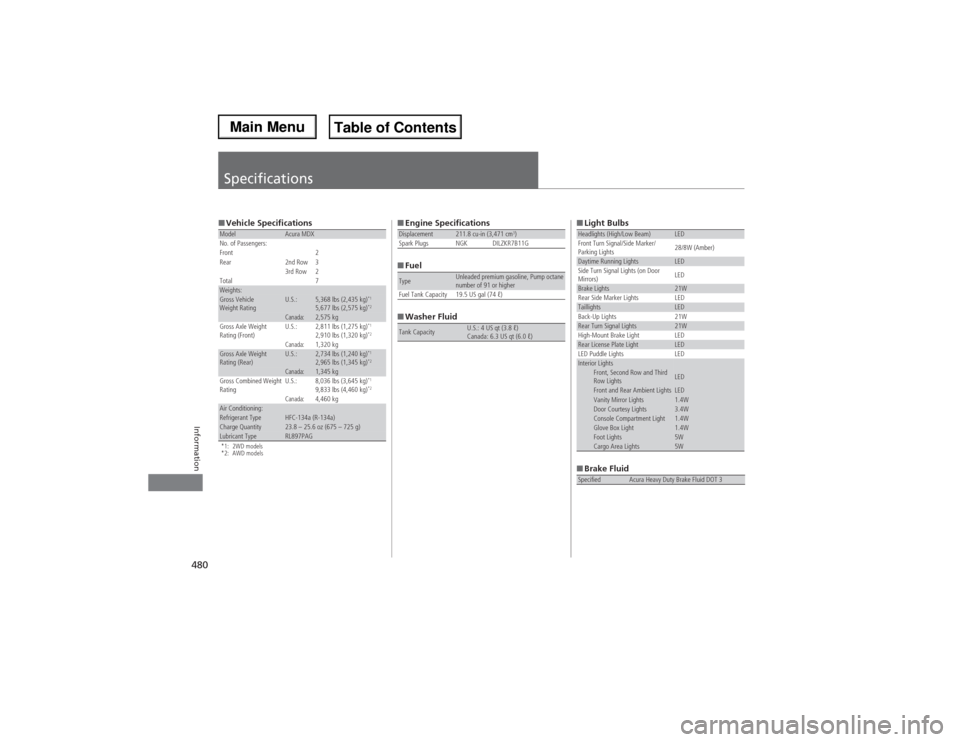
Specifications■Vehicle Specifications*1: 2WD models
*2: AWD modelsModel
Acura MDX
No. of Passengers:
Front 2
Rear 2nd Row 3
3rd Row 2
Total 7
Weights:Gross Vehicle
Weight Rating
U.S.:
5,368 lbs (2,435 kg)
*1
5,677 lbs (2,575 kg)
*2
Canada:
2,575 kg
Gross Axle Weight
Rating (Front)
U.S.:
2,811 lbs (1,275 kg)
*1
2,910 lbs (1,320 kg)
*2
Canada:
1,320 kg
Gross Axle Weight
Rating (Rear)
U.S.:
2,734 lbs (1,240 kg)
*1
2,965 lbs (1,345 kg)
*2
Canada:
1,345 kg
Gross Combined Weight
RatingU.S.: 8,036 lbs (3,645 kg)
*1
9,833 lbs (4,460 kg)
*2
Canada:
4,460 kg
Air Conditioning:Refrigerant Type
HFC-134a (R-134a)
Charge Quantity
23.8 – 25.6 oz (675 – 725 g)
Lubricant Type
RL897PAG
■Engine Specifications
■Fuel
■Washer FluidDisplacement
211.8 cu-in (3,471 cm
3)
Spark Plugs NGK DILZKR7B11G
Type
Unleaded premium gasoline, Pump octane
number of 91 or higher
Fuel Tank Capacity 19.5 US gal (74 ℓ)
Tank Capacity
U.S.: 4 US qt (3.8 ℓ)
Canada: 6.3 US qt (6.0 ℓ)
■Light Bulbs
■Brake FluidHeadlights (High/Low Beam)
LED
Front Turn Signal/Side Marker/
Parking Lights28/8W (Amber)
Daytime Running Lights
LED
Side Turn Signal Lights (on Door
Mirrors)LED
Brake Lights
21W
Rear Side Marker Lights LED
Taillights
LED
Back-Up Lights 21W
Rear Turn Signal Lights
21W
High-Mount Brake Light LED
Rear License Plate Light
LED
LED Puddle Lights LED
Interior Lights
Front, Second Row and Third
Row Lights
LED
Front and Rear Ambient Lights
LED
Vanity Mirror Lights
1.4W
Door Courtesy Lights
3.4W
Console Compartment Light
1.4W
Glove Box Light
1.4W
Foot Lights
5W
Cargo Area Lights
5W
Specified
Acura Heavy Duty Brake Fluid DOT 3