belt Acura NSX 2017 User Guide
[x] Cancel search | Manufacturer: ACURA, Model Year: 2017, Model line: NSX, Model: Acura NSX 2017Pages: 116, PDF Size: 7.19 MB
Page 20 of 116

34 || 35
SAFETYSAFETY
• Never put a seat belt over yourself or a passenger and a child. During a crash, the belt would
likely pr
ess deep into the child and cause serious or fatal injuries.
•
Never let two children use
the same seat belt. Both children could be very seriously injured
in a crash.
•
Do not allow childr
en to operate the doors, windows, or seat adjustments.
•
Do not leave children in the
vehicle unattended, especially in hot weather when the inside
of the vehicle can get hot enough to kill them. They could also activate vehicle controls,
causing it to move unexpectedly.
Allowing a child to play with a seat belt or wrap one around their neck can result in
serious injury or death.
Instruct children not to play with any seat belt and make sure any unused seat belt a
child can reach is buckled, fully retracted, and locked.
WARNING
Children who are unrestrained or improperly restrained can be seriously injured or
killed in a crash.
Any child too small for a seat belt should be properly restrained in a child seat.
A larger child should be properly restrained with a seat belt, using a booster seat if
necessary.
WARNING
n Protecting Infants
An infant must be properly r
estrained in a rear-facing, reclining child seat until the infant
reaches the seat maker’s weight or height limit for the seat, and the infant is at least one
year old. Because rear-facing child seats should not be used in this vehicle, you should
never carry an infant in this vehicle.
Placing a rear-facing child seat in the front seat can result in serious injury or
death during a crash.
Never install a rear-facing child seat in this vehicle.
WARNING
Page 22 of 116

38 || 39
SAFETYSAFETY
n Installing a Child Seat
1.
Move the passenger seat
to the rearmost position.
2.
Place the child seat on the passenger seat
.
3. Route the seat belt through the child seat according to
the seat manufacturer’s instructions, and insert the latch
plate into the buckle. Insert the latch plate fully until it
clicks.
4.
Slowly pull the shoulder
part of the belt all the way out
until it stops. This activates the lockable retractor.
5. Let the seat belt completely wind up into the retractor,
then try to pull it out to make sure the retractor is locked.
If you are able to pull the shoulder belt out, the lockable
retractor is not activated. Pull the seat belt all the way
out, and repeat steps 3–5.
6. Grab the shoulder part of the seat belt near the buckle,
and pull up to remo ve any slack from the lap part of the
belt. When doing this, place your weight on the child seat
and push it into the vehicle seat.
7.
Make sure the child seat is
firmly secured by rocking it
forward and back and side to side; little movement should
be felt.
To deactivate a lockable retractor, release the buckle and allow the seat belt to wind up all
the way.
Page 23 of 116

40 || 41
SAFETYSAFETY
n Adding Security with a Tether
A tether anchorage point is pr ovided behind the passenger seat. A child seat with a tether
can be installed, so long as the base of the child seat is secured using a seat belt.
Using an outer anchor
1.
Route the tether strap through the
head restraint legs.
Make sure the strap is not twisted.
2.
Secure the tether strap hook onto the
anchor.
Tether
PointAnchorage
3. Tighten the tether strap as instructed by the child seat
manufacturer.
Tether Strap Hook
Anchor
n Protecting Larger Children
Since this v
ehicle does not have a back seat, Acura recommends that you do not carry
a child age 12 or under as a passenger. This is because children who have outgrown child
seats are also at risk of being injured or killed by an inflating passenger’s front airbag. If a
larger child must ride in this vehicle, the information below provides guidelines to help you
decide when a given child may ride in this vehicle, and how to properly protect the child.
When a child is too big for a child seat, secure the child in the passenger’s seat using the lap/
shoulder seat belt.
Have the child sit upright and all the way back, then ensure the following:
•
The child’s knees bend comfortably o
ver the edge of the
seat.
•
The shoulder belt crosses between the child’s neck and
arm.
•
The lap part of the seat belt is as low as possible, touching
the
child’s thighs.
•
The child can stay seated for the whole
trip.
Page 24 of 116

42 || 43
SAFETYSAFETY
If a lap/shoulder belt cannot be used properly, position the child in a booster seat in the
passenger’s position. For the child’s safety, check that the child meets the booster seat
manufacturer’s recommendations.
Some U.S. states and Canadian provinces/territories require children to use a booster seat
until they reach a given age or weight (e.g., 6 years or 60 lbs). Be sure to check current laws
in the state or province/territory where you intend to drive.
Allowing a child age 12 or under to sit in the vehicle can result in injury or death
if the passenger’s front airbag inflates.
If a larger child must ride in front, move the vehicle seat as far to the rear as
possible, then have the child sit up properly and wear the seat belt properly,
using a booster seat if needed.
WARNING
Safety Label Locations
Safety labels are in the locations shown. They warn you of potential hazards that can cause
serious injury or death. Read these labels carefully.
Sun Visors
U.S. models
Inverter Coolant Filler
Tank Cap Canadian models
Engine Coolant
Reserve Tank Cap
U.S. models
High Voltage System Components
Canadian models
Dashboard
U.S. models only
49kPa
NEVER OPEN WHEN HO T
Hot coolant will scald yo uN’OUVREZ PAS QUAND CHAUD.NICHT BEI HEISSEM M OTOR ÖFFNEN .49kPa
DANGER
WA RNUNG
If driving at high speeds (over 168mph/270km/h),
adjust cold tire pressure as shown below to avoid
excess heat buildup and sudden tire failure.
DRIVING SPEED TIRE COLD TIRE PRESSUREOVER 168 mph/ 270 km/h FRONT
REAR 260
KPA, 38 PSI
260 KPA, 38 PSI
WARNINGIf driving at high\6 speeds (o ver 16\fmph/2\b0km/h),
adjust cold tire pr\6essure as shown be\6low to avoid
ex cess heat buildup a\6nd sudden tire fai\6lure. Pour conduire à gra\6nde vitesse (plus d\6e 16\f mph /
2\b0 km/h) ajuster la \6pression des pneus\6 à froid, comme
indiqué ci-dessous\6, afn d’éviter l’ac\6cumulation excessive
de chaleur et une d\6éfaillance soudaine \6du pneu.
DRIVING SPEED VITESSE DE CONDUITE COLD TIRE PRESSURE PRESSION DES PNEUS À FROIDTIRE/ PNEU
FRONT/AVANT
REAR/ARRIÈRE260 KPA, 38 PSI
260 KPA, 38 PSI
OVER/ PLUS DE
168 mph/ 270 km/h
WARNINGATTENTION
U.S. models Canadian models
Doorjamb
2DAAAA
Page 26 of 116
46 || 47
INSTRUMENT PANELINSTRUMENT PANEL
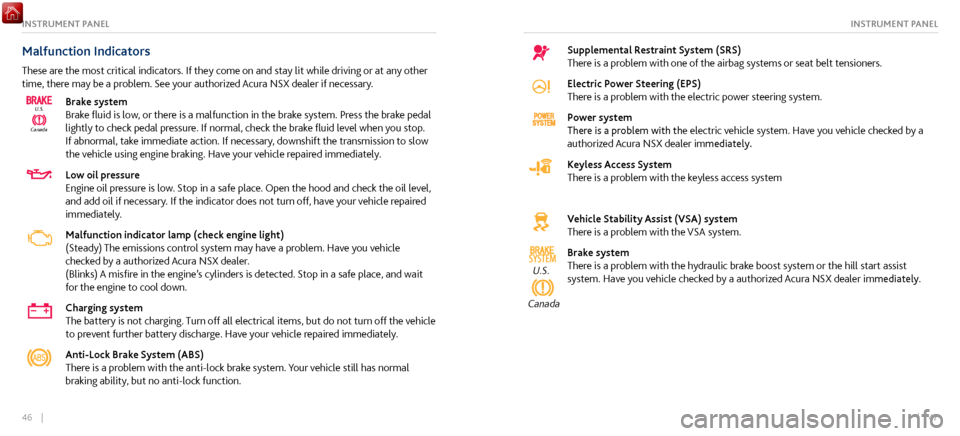
Malfunction Indicators
These are the most critical indicators. If they come on and stay lit while driving or at any other
time, there may be a problem. See your authorized Acura NSX dealer if necessary.
CanadaU.S.
Brake system
Brake fluid is low, or there is a malfunction in the brake system. Press the brake pedal
lightly to check pedal pressure. If normal, check the brake fluid level when you stop.
If abnormal, take immediate action. If necessary, downshift the transmission to slow
the vehicle using engine braking. Have your vehicle repaired immediately.
Low oil pressure
Engine oil pressure is low. Stop in a safe place. Open the hood and check the oil level,
and add oil if necessary. If the indicator does not turn off, have your vehicle repaired
immediately.
Malfunction indicator lamp (check engine light)
(Steady) The emissions control system may have a problem. Have you vehicle
checked by a authorized Acura NSX dealer.
(Blinks) A
misfire in the engine’s cylinders is
detected. Stop in a safe place, and wait
for the engine to cool down.
Charging system
The battery is not charging. Turn off all electrical items, but do not turn off the vehicle
to prevent further battery discharge. Have your vehicle repaired immediately.
Anti-Lock Brake System (ABS)
There is a problem with the anti-lock brake system. Your vehicle still has normal
braking ability, but no anti-lock function.
Supplemental Restraint System (SRS)
There is a problem with one of the airbag systems or seat belt tensioners.
Electric Power Steering (EPS)
There is a problem with the electric power steering system.
Power system
There is a problem with the electric vehicle system. Have you vehicle checked by a
authorized Acura NSX dealer immediately.
Keyless Access System
There is a problem with the keyless access system
Vehicle Stability Assist (VSA) system
There is a problem with the VSA system.
SYSTEMU.S.
Canada
Brake system
There is a problem with the hydraulic brake boost system or the hill start assist
system. Have you vehicle checked by a authorized Acura NSX dealer immediately.
Page 27 of 116
48 || 49
INSTRUMENT PANELINSTRUMENT PANEL
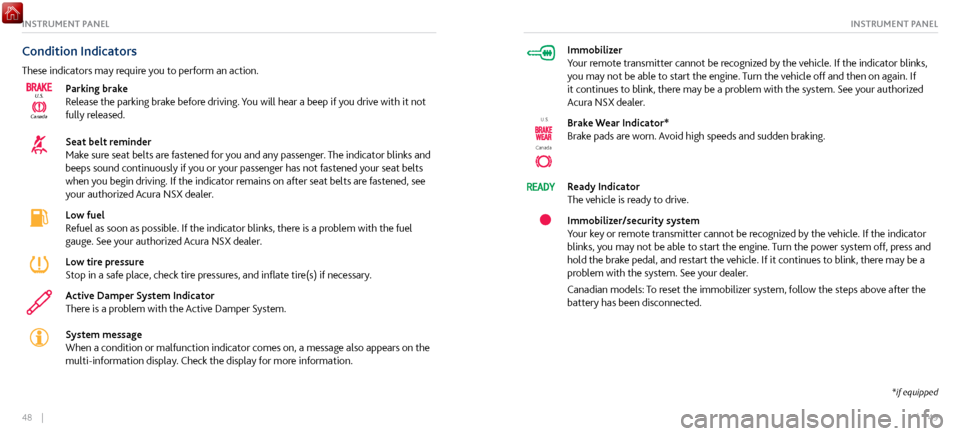
Condition Indicators
These indicators may require you to perform an action.
CanadaU.S.
Parking brake
Release the parking brake before driving. You will hear a beep if you drive with it not
fully released.
Seat belt reminder
Make sure seat belts are fastened for you and any passenger. The indicator blinks and
beeps sound continuously if you or your passenger has not fastened your seat belts
when you begin driving. If the indicator remains on after seat belts are fastened, see
your authorized Acura NSX dealer.
Low fuel
Refuel as soon as possible. If the indicator blinks, there is a problem with the fuel
gauge. See your authorized Acura NSX dealer.
Low tire pressure
Stop in a safe place, check tire pressures, and inflate tire(s) if necessary.
Active Damper System Indicator
There is a problem with the Active Damper System.
System message
When a condition or malfunction indicator comes on, a message also appears on the
multi-information display. Check the display for more information.
Immobilizer
Your remote transmitter cannot be recognized by the vehicle. If the indicator blinks,
you may not be able to start the engine. Turn the vehicle off and then on again. If
it continues to blink, there may be a problem with the system. See your authorized
Acura NSX dealer.
Canada
U.S.Brake Wear Indicator*
Brake pads are worn. Avoid high speeds and sudden braking.
Ready Indicator
The vehicle is ready to drive.
Immobilizer/security system
Your key or remote transmitter cannot be recognized by the vehicle. If the indicator
blinks, you may not be able to start the engine. Turn the power system off, press and
hold the brake pedal, and restart the vehicle. If it continues to blink, there may be a
problem with the system. See your dealer.
Canadian models: To reset the immobilizer system, follow the steps above after the
battery has been disconnected.
*if equipped
Page 66 of 116

126 || 127
DRIVINGDRIVING
If the doors are frozen shut, use warm water around the door edges to melt any ice. Do not
try to force them open, as this can damage the rubber trim around the doors. When done,
wipe dry to avoid further freezing.
NOTICE
n
Interior Checks
Store or secure all items
on board properly.
Do not pile items higher than the seat height.
Do not place anything in the footwells. Make sure to secure the floor mats.
If you have any animals on board, do not let them move freely in the vehicle.
Securely close and lock both doors.
Adjust your seating position, mirrors, and steering wheel properly.
Everyone in the vehicle must fasten their seat belt.
Make sure that the indicators in the instrument panel come on when you start the vehicle,
and go off soon after.
Improper accessories or modifications can affect your vehicle’s handling,
stability, and performance, and cause a crash in which you can be seriously hurt
or killed.
Follow all instructions in the vehicle owner’s manual regarding accessories and
modifications.
WARNING
Maximum Load Limit
Carrying too much cargo or improperly storing it can affect your vehicle’s handling, stability,
stopping distance, and tires, and make it unsafe.
The maximum load for your vehicle is 507 lbs (230 kg). See the Tire and Loading Information
label on the driver’s doorjamb. The maximum load in the trunk is 100 lbs (45 kg).
The vehicle maximum load includes the total weight of all occupants, cargo,
accessories, and the tongue load if you are towing a trailer. Below are the steps for
determining the correct load limit:
1. Locate the statement “The combined weight of occupants and cargo should never exceed
XXX kg or XXX lbs.” on your vehicle’s placard.
2.
Determine the combined weight of the driver
and passengers that will be riding in your
vehicle.
3.
Subtract the combined weight of the driver
and passengers from XXX kg or XXX lbs.
4.
The resulting figure equals
the available amount of cargo and luggage load capacity. For
example, if the “XXX” amount equals 1,400 lbs. and there will be five 150 lb. passengers in
your vehicle, the amount of available cargo and luggage load capacity is 650 lbs. (1,400 -
750 (5 x 150) = 650 lbs.)
High Voltage Battery Maintenance
All batteries discharge if not used. For best battery life and capacity, drive your vehicle for at
least 30 minutes, at least once every three months. Try to avoid parking under direct summer
sun. For battery maintenance while storing the vehicle, see page 207.
Page 73 of 116

140 || 141
DRIVINGDRIVING
n Parking Brake
Keep the
vehicle from moving when it is parked.
To apply: Pull up the switch. The parking brake indicator
appears in the instrument panel.
To release: Press the brake pedal and make sure your seat
belt is fastened. Press the switch down to release.
You can also lightly press the accelerator pedal if your seat
belt is fastened, the vehicle is on, and not in Park or Neutral.
Electric Parking Brake Switch
Electric Parking Brake Switch
Accelerator Pedal
Automatic Brake Hold
Maintains rear brake hold even after the brake pedal is released. Make sure the vehicle is on and
your seat belt is fastened when operating this feature.
1.
Press the BRAKE HOLD button. The BRAKE HOLD indicator
appears in
the instrument panel.
2.
With the transmission in D, M, or N, pr
ess the brake pedal and
come to a complete stop. The HOLD indicator appears, and
brake hold is applied. Release the brake pedal.
Press the accelerator pedal to cancel brake hold and start
moving.
Accelerator Peda lBrake PedalAutomatic Brake
Hold Button
Off
On OnGoes
On
On
On
U.S.
Canada
Accelerator Peda
lBrake PedalAutomatic Brake
Hold Button
Off
On OnGoes
On
On
On
U.S.
Canada
To turn off brake hold: Press the brake pedal and press the BRAKE
HOLD button again.
Automatic brake hold cancels when:
•
Braking is applied for more than 10 minutes.
•
The driver’
s seat belt is unfastened.
•
The power system is turned off.
Accelerator Peda lBrake PedalAutomatic Brake
Hold Button
Off
On OnGoes
On
On
On
U.S.
Canada
Page 110 of 116
214 || 215
CLIENT INFORMATIONCLIENT INFORMATION
When you call or write, please give us the following information:
•
Vehicle Identification Number
•
Date of purchase
•
Odometer reading of your
vehicle
•
Your name, address, and telephone number
•
A detailed description of the problem
•
Name of the dealer who sold the v
ehicle to you
Acura Total Luxury Care Roadside Assistance
Your Acura TLC Roadside Assistance representative is here to help you 24 hours a day, 7
days a week by calling (800) 594-8500 (U.S.) or (800) 565-7587 (Canada). Under your
4-year/50,000-mile (80,000 km) warranty, the following benefits are available:
Towing services—full cost of towing to the closest authorized Acura NSX dealer
Roadside assistance—jump starting, fuel delivery, lockout, and flat tire
Trip planning—detailed trip routing, emergency services, and more
EPA Contact Information
An owner may obtain further information
concerning emission warranties or report
violations of the terms of the emission
warranties by contacting:
U.S. Environmental Protection Agency
Office of Transportation and Air Quality
Compliance Division, Light-Duty Vehicles Group
Attn: Warranty Complaints
2000 Traverwood Drive
Ann Arbor, MI 48105
Email: [email protected]
Warranty Coverages
Below is a brief summary of the warranties covering your new vehicle.
New Vehicle Limited Warranty: Covers your new vehicle, except for the emissions control
system and accessories, against defects in materials and workmanship.
Emissions Control Systems Defects Warranty and Emissions Performance Warranty:
Covers your vehicle’s emissions control systems. Time, mileage, and coverage are conditional.
Seat Belt Limited Warranty: Covers seat belts that fail to function properly.
Rust Perforation Limited Warranty: Covers all exterior body panels that rust through from the
inside.
Accessory Limited Warranty: Covers Acura accessories.
Replacement Parts Limited Warranty: Covers all Acura replacement parts against defects in
materials and workmanship.
Replacement 12-Volt Battery Limited Warranty: Provides prorated coverage for a
replacement battery purchased from an Acura dealer.
Replacement Muffler Lifetime Limited Warranty: Covers a replacement muffler for the
duration of the ownership.
Restrictions and exclusions apply to all these warranties. See the Owner Information CD or
visit owners.acura.com (U.S.) or www.myacura.ca (Canada) for complete descriptions of each
warranty, including time, mileage, and other conditional limitations.
Your vehicle’s original tires are covered by their manufacturer. Tire warranty information can be
found on the Owner Information CD or owners.acura.com (U.S.) or www.myacura.ca (Canada).
Page 111 of 116

216 || 217
CLIENT INFORMATIONCLIENT INFORMATION
Disclosures
n Devices That Emit Radio Waves
The following products and systems
on your vehicle emit radio waves when in operation:
AcuraLink
Audio system
Bluetooth Audio
Bluetooth
HandsFreeLink
HomeLink Universal Transceiver
Immobilizer system Remote transmitter
Remote engine starter
Keyless Access System
Tire Pressure Monitoring System
Charging cable
Interactive remote control
Each of the above complies with the appropriate requirements or the required standards of
FCC (Federal Communications Commission) and Industry Canada, described below:
As required by the FCC:
This device complies with Part 15 of the FCC rules. Operation is subject to the following two
conditions: (1) This device may not cause harmful interference, and (2) this device must accept
any interference received, including interference that may cause undesired operation.
Changes or modifications not expressly approved by the party responsible for compliance
could void the user’s authority to operate the equipment.
As required by Industry Canada:
This device complies with Industry Canada licence-exempt RSS standard(s). Operation is
subject to the following two conditions: (1) this device may not cause interference, and (2)
this device must accept any interference, including interference that may cause undesired
operation of the device. n
California Perchlorate C
ontamination Prevention Act
The airbags, seat belt tensioners, and CR-type batteries in this vehicle may contain
perchlorate materials—special handling may apply. See www.dtsc.ca.gov/hazardouswaste/
perchlorate/ for more information.
n
California Proposition 65 Warning
W
ARNING: This product contains or emits chemicals known to the state of California to
cause cancer and birth defects or other reproductive harm.
n
Event Data Recorders
This
vehicle is equipped with an event data recorder (EDR). The main purpose of an EDR
is to record, in certain crash or near crash-like situations, such as an air bag deployment
or hitting a road obstacle, data that will assist in understanding how a vehicle’s systems
performed. The EDR is designed to record data related to vehicle dynamics and safety
systems for a short period of time, typically 30 seconds or less. The EDR in this vehicle
is designed to record such data as:
How various systems in your vehicle were operating;
Whether or not the driver and passenger safety belts were buckled/fastened;
How far (if at all) the driver was depressing the accelerator and/or brake pedal; and,
How fast the vehicle was traveling.
These data can help provide a better understanding of the circumstances in which crashes
and injuries occur.
NOTE: EDR data are recorded by your vehicle only if a non-trivial crash situation occurs;
no data are recorded by the EDR under normal driving conditions and no personal data
(e.g., name, gender, age, and crash location) are recorded. However, other parties, such as