engine Acura NSX 2017 Owner's Manual
[x] Cancel search | Manufacturer: ACURA, Model Year: 2017, Model line: NSX, Model: Acura NSX 2017Pages: 116, PDF Size: 7.19 MB
Page 83 of 116

160 || 161
HANDLING THE UNEXPECTEDHANDLING THE UNEXPECTED
Overheating
If the temperature gauge needle is at the H mark, the engine suddenly loses power, or steam or
spray comes out from under the hatch, your engine is overheating.
Immediately park the vehicle in a safe place. Turn off all accessories and turn on the hazard
warning lights. Change the gear position to (P).
If no steam or spray is present: Keep the power system on and open the hatch.
If steam or spray is present: Turn off the power system and wait until it subsides. Then, open
the hatch.
Check that the cooling fan is operating and turn the power system off once the temperature
gauge needle comes down. If the cooling fan is not operating, immediately turn the power
system off.
Once the engine has cooled down, inspect the coolant level and
check the cooling system components for leaks. If the coolant
level in the reserve tank is low, or no coolant is in the tank, check
that the radiator is cool. Cover the reserve tank cap with a heavy
cloth and open the cap. Add coolant until it reaches the MAX
mark, and put the cap back on.
Reserve TankMAXMIN
Once the engine has cooled sufficiently, turn the power system on and check the temperature
gauge. If the temperature needle has gone down, resume driving. If it has not gone down,
contact an authorized Acura NSX dealer for repairs.
Steam and spray from an overheated engine can seriously scald you.
Do not open the hatch if steam is coming out.
WARNING
Removing the radiator cap while the engine is hot can cause the coolant to spray
out, seriously scalding you.
Always let the engine and radiator cool down before removing the radiator cap.
WARNING
Continuing to drive with the temperature gauge needle at the H mark may damage the engine.
NOTICE
Page 90 of 116
174 || 175
MAINTENANCEHANDLING THE UNEXPECTED
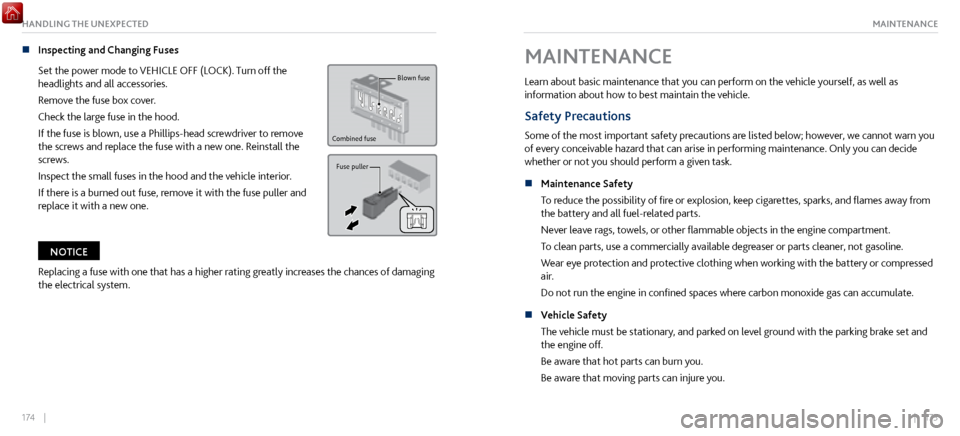
n Inspecting and Changing Fuses
Set the power mode to
VEHICLE OFF (LOCK). Turn off the
headlights and all accessories.
Remove the fuse box cover.
Check the large fuse in the hood.
If the fuse is blown, use a Phillips-head screwdriver to remove
the screws and replace the fuse with a new one. Reinstall the
screws.
Inspect the small fuses in the hood and the vehicle interior.
If there is a burned out fuse, remove it with the fuse puller and
replace it with a new one.
Blown fuse
Combined fuse
Fuse puller
Replacing a fuse with one that has a higher rating greatly increases the chances of damaging
the electrical system.
NOTICE
MAINTENANCE
Learn about basic maintenance that you can perform on the vehicle yourself, as well as
information about how to best maintain the vehicle.
Safety Precautions
Some of the most important safety precautions are listed below; however, we cannot warn you
of every conceivable hazard that can arise in performing maintenance. Only you can decide
whether or not you should perform a given task.
n
Maintenance Safety
To reduce the possibility
of fire or explosion, keep cigarettes, sparks, and flames away from
the battery and all fuel-related parts.
Never leave rags, towels, or other flammable objects in the engine compartment.
To clean parts, use a commercially available degreaser or parts cleaner, not gasoline.
Wear eye protection and protective clothing when working with the battery or compressed
air.
Do not run the engine in confined spaces where carbon monoxide gas can accumulate.
n
Vehicle Safety
The vehicle must be stationary
, and parked on level ground with the parking brake set and
the engine off.
Be aware that hot parts can burn you.
Be aware that moving parts can injure you.
Page 91 of 116

176 || 177
MAINTENANCEMAINTENANCE
Improperly maintaining this vehicle or failing to correct a problem before driving
can cause a crash in which you can be seriously hurt or killed.
Always follow the inspection and maintenance recommendations according to
the schedules in this guide.
WARNING
Failure to properly follow maintenance instructions and precautions can cause
you to be seriously hurt or killed.
Always follow the procedures and precautions in this guide.
WARNING
Maintenance Minder™
When maintenance is due, the system message indicator comes on and the Maintenance
Minder appears on the multi-information display every time you turn the vehicle on. Press the
Info (p/q) buttons on the steering wheel to change displays.
See page 179 to check the indicated maintenance service(s).
Maintenance Service Items
Remaining Engine Oil Life
Righ t Selector Whee l
Page 92 of 116
178 || 179
MAINTENANCEMAINTENANCE
Independent of the Maintenance Minder information:
•
Replace the brake
fluid every 3 years.
•
Inspect idle speed every 160,000 miles (256,000 km).
•
Adjust the val
ves during services A, B, 1, 2, or 3 if they are noisy.
•
Inspect the fuel injection systems every 3
years.
•
Inspect tire condition every 3,
100 miles (5,000 km).
For U.S. models: Maintenance, replacement, or repair of emissions control devices and systems may
be done by any automotive repair establishment or individuals using parts that are certified to EPA
standards.
According to state and federal regulations, failure to perform maintenance on the maintenance main items
marked with # will not void your emissions warranties. However, all maintenance services should be performed
in accordance with the intervals indicated by the multi-information display.
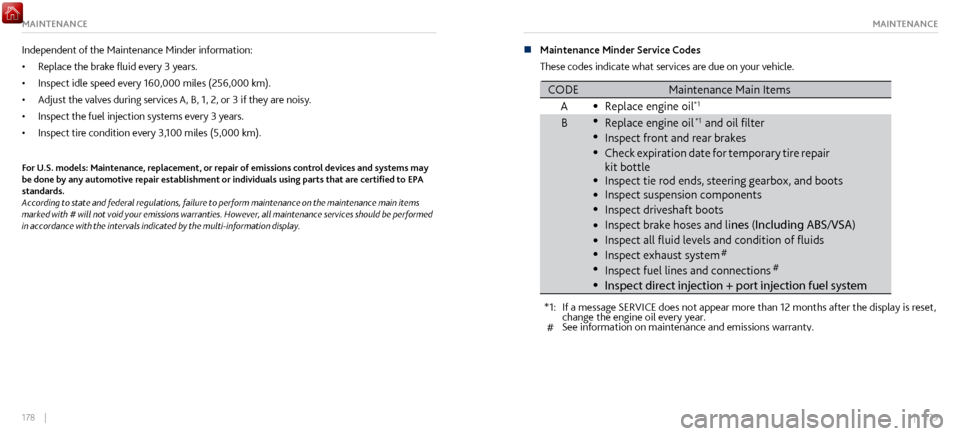
n Maintenance Minder Service Codes
These codes indicate what services are due on your vehicle.
*1: If a message SERVICE does not appear more than 12 months after the displ\
ay is reset,
CODE
change the engine oil every year.
See information on maintenance and emissions warranty.
A Maintenance Main Items
B
Inspect exhaust system#
Inspect fuel lines and connections#
Inspect direct injection + port injection fuel system
Replace engine oi
l*1
Replace engine oil*1 and oil lter
Inspect front and rear brakes
Check expiration date for temporary tire repair
kit bottle
Inspect tie rod ends, steering gearbox, and boots
Inspect suspension components
Inspect driveshaft boots
Inspect brake hoses and li nes (Including ABS/VSA)
Inspect all uid levels and condition of uids
#
Page 93 of 116

180 || 181
MAINTENANCEMAINTENANCE
every year.
*4:D riving in mountainous areas at very low vehicle speeds results in higher\
transmission temperature.
This requires transmission uid and clutch uid changes more frequ\
ently than recommended by the
*2: If you drive in dusty conditions, replace the air cleaner element every \
15,000 miles (24,000 km).
*3: If you drive primarily in urban areas that have high concentrations of s\
oot in the air from industry and
from diesel-powered vehicles, replace the dust and pollen lters ever\
y 15,000 miles (24,000 km) or
Maintenance Minder. If you regularly drive your vehicle under this condi\
tion, have the transmission
uid and clutch uid changed every 20,000 miles (32,000 km).
*5:D riving in mountainous areas at very low vehicle speeds results in higher\
level of mechanical (Shear)
CODE
1
Inspect tire condition
2
Maintenance Sub Items
stress to uid. This requires Twin Motor Unit uid changes more frequently than recommended by the
Maintenance Minder. If you regularly drive your vehicle under these cond\
itions, have the Twin Motor
Unit uid changed at 7,500 miles (12,000 km), then every 15,000 mil\
es (24,000 km).
3
Replace air cleaner element*2
Replace dust and pollen flters*3
4
Replace transmission fuid*4
Replace clutch fuid*4
Inspect Active Exhaust Valve function Replace spark plugs
Inspect valve clearance
5 Replace Intake Sound Control
6
Replace engine coolan
t
Replace Twin Motor Unit fuid*5
n Opening the Hood
Park the
vehicle on a level surface, and set the parking brake.
Pull the hood release handle under the lower left corner of
the dashboard.
Push the hood latch lever to release the lock mechanism, and
open the hood.
Lift the hood up most of the way. The hydraulic supports will
lift it up the rest of the way and hold it up.
When closing, lower it to approximately 12 inches (30 cm),
then press down firmly with your hands and ensure that both
left and right latches are locked in place.
Pull
Hood Release Handle
Lever
Page 94 of 116

182 || 183
MAINTENANCEMAINTENANCE
Under the Hood
Brake Fluid
(Black Cap)
Washer Fluid
(Black Cap)
12-Volt Battery
Inverter Coolant
Filler Tank
n Opening the Hatch
Park the
vehicle on a level surface, and set the parking brake.
Press the hatch release handle on the driver’s door.
Lift the hatch up most of the way. The hydraulic supports will
lift it up the rest of the way and hold it up.
When closing, lower it to approximately 12 inches (30 cm),
then press down firmly with your hands.
Hatch Release Button
n Removing the Engine Compartment Cover
Pull up on the co
ver to pull it off the pins.
Engine
CoversCompartment
Page 95 of 116
184 || 185
MAINTENANCEMAINTENANCE
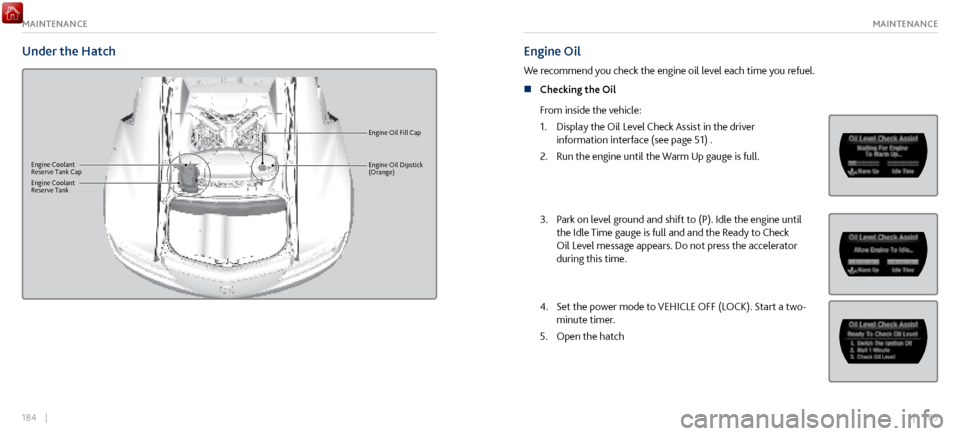
Under the Hatch
Engine Oil Fill Cap
Engine Coolant
Reserve Tank Cap
Reserve TankEngine Coolant
Engine Oil Dipstick
(Orange)
Engine Oil
We recommend you check the engine oil level each time you refuel.
n
Checking the Oil
From
inside the vehicle:
1.
Display the Oil Level
Check Assist in the driver
information interface (see page 51) .
2.
Run the engine until the W
arm Up gauge is full.
3. Park on level ground and shift to (P). Idle the engine until
the Idle Time gauge is full and and the Ready to Check
Oil Level message appears. Do not press the accelerator
during this time.
4. Set the power mode to VEHICLE OFF (LOCK). Start a two-
minute timer.
5.
Open the hatch
Page 96 of 116

186 || 187
MAINTENANCEMAINTENANCE
From outside the vehicle:
1.
Remove
the passenger-side engine cover (see page 183)
2.
When the two-minute timer completes, remo
ve the
dispstick (orange loop), wipe it clean, and reinsert it (flat
side of loop toward oil fill cap)
3.
Remove
the dipstick and check the oil level. It should be
between the upper and lower marks. Add oil if needed.
When finished, select a different display in the driver
information interface.
Upper Mark
Lower Mark
n Recommended Engine Oil
Use full synthetic, 0W-40 motor oil such as
Ultimate
Full Synthetic Motor Oil, Type 3, 0W-40, available at your
authorized Acura NSX dealer.
Ambient Temperature
Acura cannot ensure proper engine operation and durability if other engine oil is used..
NOTICE n
Adding Oil
Unscrew and remo
ve the engine oil fill cap.
Add oil slowly.
Reinstall the engine oil fill cap and tighten it securely.
Recheck the engine oil level (see page 185).
Oil Fill CapFlat Side
Do not fill the engine oil above the upper mark. Overfilling the engine oil can result in leaks
and engine damage.
NOTICE
Use only oil that displays an API Certification Seal on the
container. This seal indicates the oil is energy conserving
and that it meets the American Petroleum Institute’s latest
requirements.
Page 97 of 116
188 || 189
MAINTENANCEMAINTENANCE
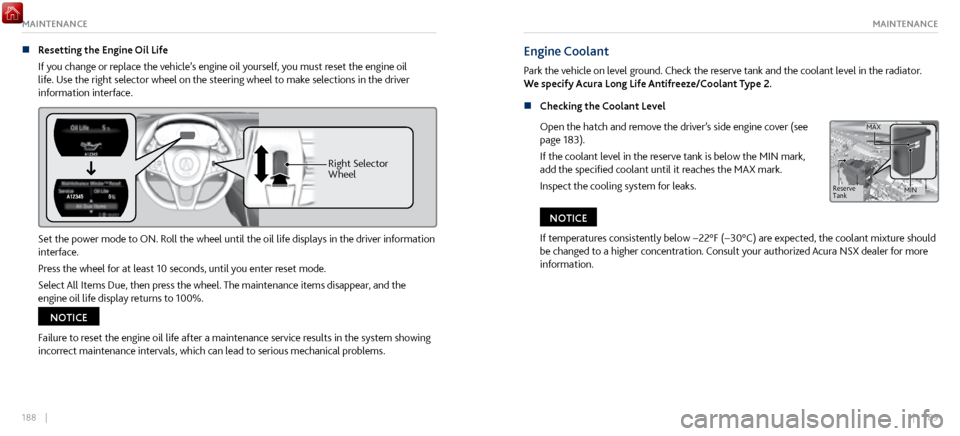
n Resetting the Engine Oil Life
If you change or
replace the vehicle’s engine oil yourself, you must reset the engine oil
life. Use the right selector wheel on the steering wheel to make selections in the driver
information interface.
Whee lRight Selector
Set the power mode to ON. Roll the wheel until the oil life displays in the driver information
interface.
Press the wheel for at least 10 seconds, until you enter reset mode.
Select All Items Due, then press the wheel. The maintenance items disappear, and the
engine oil life display returns to 100%.
Failure to reset the engine oil life after a maintenance service results in the system showing
incorrect maintenance intervals, which can lead to serious mechanical problems.
NOTICE
Engine Coolant
Park the vehicle on level ground. Check the reserve tank and the coolant level in the radiator.
We specify Acura Long Life Antifreeze/Coolant Type 2.
n
Checking the Coolant Lev
el
Open the hatch and remove the driver’s side engine cover (see
page 183).
If the coolant level in the reserve tank is below the MIN mark,
add the specified coolant until it reaches the MAX mark.
Inspect the cooling system for leaks.
Reserve Tank MAXMIN
If temperatures consistently below −22°F (−30°C) are expected, the coolant mixture should
be changed to a higher concentration. Consult your authorized Acura NSX dealer for more
information.
NOTICE
Page 98 of 116

190 || 191
MAINTENANCEMAINTENANCE
n Adding Coolant
Make sure
the engine and radiator are cool.
Turn the reserve tank cap counterclockwise and relieve any
pressure in the coolant system. Do not push the cap down
when turning.
Push down and turn the cap counterclockwise to remove it.
Pour coolant into the reserve tank until it reaches the MAX
mark. Put the cap back on the reserve tank and tighten.
Reserve Tank
Cap
Removing the reserve tank cap while the engine is hot can cause the coolant to
spray out, seriously scalding you.
Always let the engine and radiator cool down before removing the reserve tank
cap.
WARNING
Pour the fluid slowly and carefully so you do not spill any. Clean up any spills immediately;
they can damage components in the engine compartment.
NOTICE
Inverter Coolant
Check the inverter coolant level every time you refuel
n
Checking the Inverter
Coolant Level
Open the hood.
If the inverter coolant is below the MIN level, have your
vehicle serviced at an authorized Acura NSX dealer.
MA X
MIN
Filler
Tank
Window Washer Fluid
If the washer fluid is low, a message will appear on the driver information interface. Do not
overfill the reservoir.
Do not use engine antifreeze or a vinegar/water solution in the windshield washer reservoir.
Antifreeze can damage your vehicle’s paint. A vinegar/water solution can damage the windshield
washer pump.
NOTICE