flat tire Acura NSX 2017 Owner's Guide
[x] Cancel search | Manufacturer: ACURA, Model Year: 2017, Model line: NSX, Model: Acura NSX 2017Pages: 116, PDF Size: 7.19 MB
Page 3 of 116
*if equipped
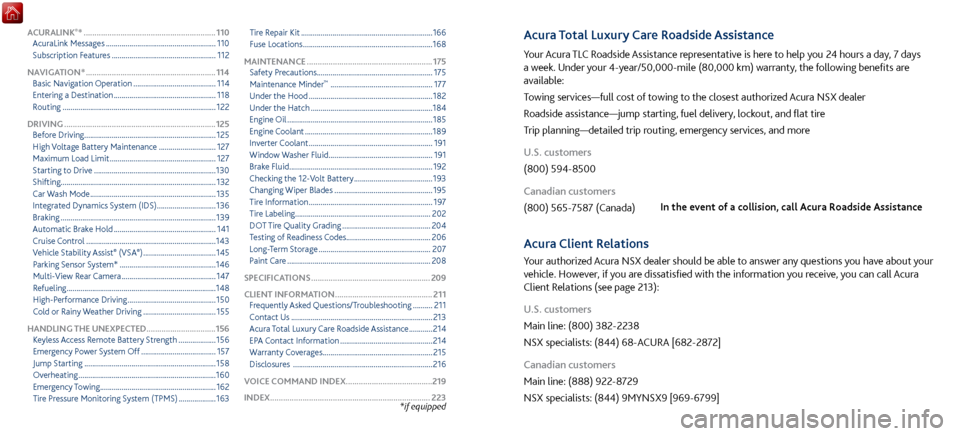
Acura Total Luxury Care Roadside Assistance
Your Acura TLC Roadside Assistance representative is here to help you 24 hours a day, 7 days
a week. Under your 4-year/50,000-mile (80,000 km) warranty, the following benefits are
available:
Towing services—full cost of towing to the closest authorized Acura NSX dealer
Roadside assistance—jump starting, fuel delivery, lockout, and flat tire
Trip planning—detailed trip routing, emergency services, and more
U.S. customers
(800) 594-8500
Canadian customers
(800) 565-7587 (Canada)
Acura Client Relations
Your authorized Acura NSX dealer should be able to answer any questions you have about your
vehicle. However, if you are dissatisfied with the information you receive, you can call Acura
Client Relations (see page 213):
U.S. customers
Main line: (800) 382-2238
NSX specialists: (844) 68-ACURA [682-2872]
Canadian customers
Main line: (888) 922-8729
NSX specialists: (844) 9MYNSX9 [969-6799]
ACURALINK®* .............................................................110
AcuraLink Messages ........................................................ 110
Subscription Features ..................................................... 112
NAVIGATION*
............................................................ 114
Basic Navigation Operation .......................................... 114
Entering a Destination .................................................... 118
Routing ........................................................................\
...... 122
DRIVING
...................................................................... 125
Before Driving ................................................................... 125
High Voltage Battery Maintenance ............................. 127
Maximum Load Limit ...................................................... 127
Starting to Drive .............................................................. 130
Shifting........................................................................\
....... 132
Car Wash Mode
................................................................ 135
Integrated Dynamics System (IDS) .............................. 136
Braking ........................................................................\
....... 139
Automatic Brake Hold .................................................... 141
Cruise Control .................................................................. 143
Vehicle Stability Assist® (VSA®) ..................................... 145
Parking Sensor System* ................................................. 146
Multi-View Rear Camera ................................................ 147
Refueling ........................................................................\
....148
High-Performance Driving ............................................. 150
Cold or Rainy Weather Driving ..................................... 155
HANDLING THE UNEXPECTED ................................156
Keyless Access Remote Battery Strength
................... 156
Emergency Power System Off ...................................... 157
Jump Starting ................................................................... 158
Overheating ...................................................................... 160
Emergency Towing ........................................................... 162
Tire Pressure Monitoring System (TPMS)
................... 163Tire Repair Kit
...................................................................
166
Fuse Locations .................................................................. 168
MAINTENANCE
.......................................................... 175
Safety Precautions........................................................... 175
Maintenance Minder
™ .................................................... 177
Under the Hood ............................................................... 182
Under the Hatch ..............................................................184
Engine Oil ........................................................................\
.. 185
Engine Coolant ................................................................. 189
Inverter Coolant ............................................................... 191
Window Washer Fluid ..................................................... 191
Brake Fluid ........................................................................\
. 192
Checking the 12-Volt Battery ........................................ 193
Changing Wiper Blades .................................................. 195
Tire Information ............................................................... 197
Tire Labeling..................................................................... 202
DOT Tire Quality Grading
............................................. 204
Testing of Readiness Codes ........................................... 206
Long-Term Storage
......................................................... 207
Paint Care ........................................................................\
. 208
SPECIFICATIONS
....................................................... 209
CLIENT INFORMATION
............................................. 211
Frequently Asked Questions/Troubleshooting .......... 211
Contact Us ........................................................................\
213
Acura Total Luxury Care Roadside Assistance ............ 214
EPA Contact Information ............................................... 214
Warranty Coverages ........................................................ 215
Disclosures ....................................................................... 216
VOICE COMMAND INDEX ........................................219
INDEX........................................................................\
.. 223 In the event of a collision, call Acura Roadside Assistance
Page 24 of 116

42 || 43
SAFETYSAFETY
If a lap/shoulder belt cannot be used properly, position the child in a booster seat in the
passenger’s position. For the child’s safety, check that the child meets the booster seat
manufacturer’s recommendations.
Some U.S. states and Canadian provinces/territories require children to use a booster seat
until they reach a given age or weight (e.g., 6 years or 60 lbs). Be sure to check current laws
in the state or province/territory where you intend to drive.
Allowing a child age 12 or under to sit in the vehicle can result in injury or death
if the passenger’s front airbag inflates.
If a larger child must ride in front, move the vehicle seat as far to the rear as
possible, then have the child sit up properly and wear the seat belt properly,
using a booster seat if needed.
WARNING
Safety Label Locations
Safety labels are in the locations shown. They warn you of potential hazards that can cause
serious injury or death. Read these labels carefully.
Sun Visors
U.S. models
Inverter Coolant Filler
Tank Cap Canadian models
Engine Coolant
Reserve Tank Cap
U.S. models
High Voltage System Components
Canadian models
Dashboard
U.S. models only
49kPa
NEVER OPEN WHEN HO T
Hot coolant will scald yo uN’OUVREZ PAS QUAND CHAUD.NICHT BEI HEISSEM M OTOR ÖFFNEN .49kPa
DANGER
WA RNUNG
If driving at high speeds (over 168mph/270km/h),
adjust cold tire pressure as shown below to avoid
excess heat buildup and sudden tire failure.
DRIVING SPEED TIRE COLD TIRE PRESSUREOVER 168 mph/ 270 km/h FRONT
REAR 260
KPA, 38 PSI
260 KPA, 38 PSI
WARNINGIf driving at high\6 speeds (o ver 16\fmph/2\b0km/h),
adjust cold tire pr\6essure as shown be\6low to avoid
ex cess heat buildup a\6nd sudden tire fai\6lure. Pour conduire à gra\6nde vitesse (plus d\6e 16\f mph /
2\b0 km/h) ajuster la \6pression des pneus\6 à froid, comme
indiqué ci-dessous\6, afn d’éviter l’ac\6cumulation excessive
de chaleur et une d\6éfaillance soudaine \6du pneu.
DRIVING SPEED VITESSE DE CONDUITE COLD TIRE PRESSURE PRESSION DES PNEUS À FROIDTIRE/ PNEU
FRONT/AVANT
REAR/ARRIÈRE260 KPA, 38 PSI
260 KPA, 38 PSI
OVER/ PLUS DE
168 mph/ 270 km/h
WARNINGATTENTION
U.S. models Canadian models
Doorjamb
2DAAAA
Page 27 of 116
48 || 49
INSTRUMENT PANELINSTRUMENT PANEL
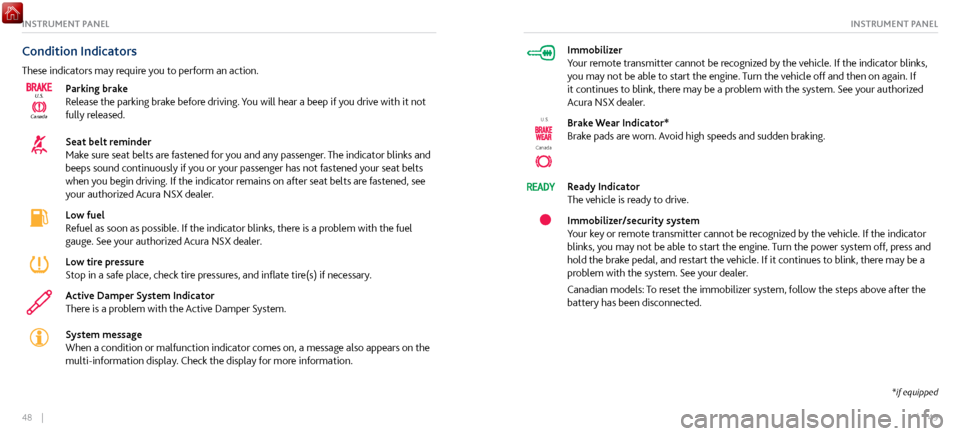
Condition Indicators
These indicators may require you to perform an action.
CanadaU.S.
Parking brake
Release the parking brake before driving. You will hear a beep if you drive with it not
fully released.
Seat belt reminder
Make sure seat belts are fastened for you and any passenger. The indicator blinks and
beeps sound continuously if you or your passenger has not fastened your seat belts
when you begin driving. If the indicator remains on after seat belts are fastened, see
your authorized Acura NSX dealer.
Low fuel
Refuel as soon as possible. If the indicator blinks, there is a problem with the fuel
gauge. See your authorized Acura NSX dealer.
Low tire pressure
Stop in a safe place, check tire pressures, and inflate tire(s) if necessary.
Active Damper System Indicator
There is a problem with the Active Damper System.
System message
When a condition or malfunction indicator comes on, a message also appears on the
multi-information display. Check the display for more information.
Immobilizer
Your remote transmitter cannot be recognized by the vehicle. If the indicator blinks,
you may not be able to start the engine. Turn the vehicle off and then on again. If
it continues to blink, there may be a problem with the system. See your authorized
Acura NSX dealer.
Canada
U.S.Brake Wear Indicator*
Brake pads are worn. Avoid high speeds and sudden braking.
Ready Indicator
The vehicle is ready to drive.
Immobilizer/security system
Your key or remote transmitter cannot be recognized by the vehicle. If the indicator
blinks, you may not be able to start the engine. Turn the power system off, press and
hold the brake pedal, and restart the vehicle. If it continues to blink, there may be a
problem with the system. See your dealer.
Canadian models: To reset the immobilizer system, follow the steps above after the
battery has been disconnected.
*if equipped
Page 84 of 116

162 || 163
HANDLING THE UNEXPECTEDHANDLING THE UNEXPECTED
Emergency Towing
This vehicle requires flat bed towing. Call a professional towing service if you need to tow
your vehicle. The operator loads your vehicle on the back of a truck.
Trying to lift or tow your vehicle by the bumpers will cause serious damage. The bumpers are
not designed to support the vehicle’s weight.
Improper towing such as towing behind a motorhome or other motor vehicle can damage the
transmission.
NOTICE
Tire Pressure Monitoring System (TPMS)
Monitors the tire pressure while you are driving.
If your vehicle’s tire pressure becomes significantly low, the low
tire pressure indicator comes on and a message appears on the
multi-information display. Roll the right selector wheel on the
steering wheel to view the tire pressure monitor.
n What to Do
Stop your
vehicle in a safe place. Check the tire pressure and adjust the pressure to the
specified level. The specified tire pressure is on a label on the driver’s doorjamb.
Driving on an extremely underinflated tire can cause it to overheat. An overheated tire can
fail. Always inflate your tires to the specified pressure.
NOTICE
Page 85 of 116

164 || 165
HANDLING THE UNEXPECTEDHANDLING THE UNEXPECTED
n Tire Pressure Monitoring System (TPMS) - Required Federal Explanation
Each tire, including
the spare (if provided), should be checked monthly when cold
and inflated to the inflation pressure recommended by the vehicle manufacturer
on the vehicle placard or tire inflation pressure label.
(If your vehicle has tires of a different size than the size indicated on the vehicle
placard or tire inflation pressure label, you should determine the proper tire
inflation pressure for those tires.)
As an added safety feature, your vehicle has been equipped with a tire
pressure monitoring system (TPMS) that illuminates a low tire pressure
telltale when one or more of your tires is significantly under-inflated.
Accordingly, when the low tire pressure telltale illuminates, you should stop and
check your tires as soon as possible, and inflate them to the proper pressure.
Driving on a significantly under-inflated tire causes the tire to overheat and can
lead to tire failure. Under-inflation also reduces fuel efficiency and tire tread life,
and may affect the vehicle’s handling and stopping ability.
Please note that the TPMS is not a substitute for proper tire maintenance, and it is
the driver’s responsibility to maintain correct tire pressure, even if under-inflation
has not reached the level to trigger illumination of the TPMS low tire pressure
telltale. Your vehicle has also been equipped with a TPMS malfunction indicator to indicate
when the system is not operating properly. The TPMS malfunction indicator
is combined with the low tire pressure telltale. When the system detects a
malfunction, the telltale will flash for approximately one minute and then remain
continuously illuminated. This sequence will continue upon subsequent vehicle
start-ups as long as the malfunction exists.
When the malfunction indicator is illuminated, the system may not be able to
detect or signal low tire pressure as intended.
TPMS malfunctions may occur for a variety of reasons, including the installation of
replacement or alternate tires or wheels on the vehicle that prevent the TPMS from
functioning properly.
Always check the TPMS malfunction telltale after replacing one or more tires
or wheels on your vehicle to ensure that the replacement or alternate tires and
wheels allow the TPMS to continue to function properly.
Page 86 of 116

166 || 167
HANDLING THE UNEXPECTEDHANDLING THE UNEXPECTED
Tire Repair Kit
If a tire has a small puncture, you can use the tire repair kit to temporarily repair it. The puncture
must be smaller than 3/16-inch (4 mm) and not in the tire sidewall. Go to a authorized Acura
NSX dealer to have the full-size tire permanently repaired or replaced.
n
Before Repairing
the Tire
•
Park the v
ehicle on a firm, level, and non-slippery surface.
•
Make sure the
vehicle is in Park (P), and apply the parking brake.
•
Turn on the hazard warning
lights, and turn the power system off. n
Getting Ready to R
epair the Tire
1. Open the hatch.
2.
Loosen the tool box tie-downs and
remove the tool box
lid.
3.
Take the kit out of the tool
box.
4.
Place the kit face up on
flat ground near the punctured
tire and away from traffic. Do not place the kit on its side.
Follow the instructions in the kit to repair the tire.Lid Tie Down
Tire Repair Kit
Do not use an unapproved puncture-repairing agent other than the one provided in the kit
that came with your vehicle. If a different agent is used, you may permanently damage the
tire pressure sensor.
NOTICE
Page 101 of 116

196 || 197
MAINTENANCEMAINTENANCE
4. Push to compress the wiper blade until it clears the end cap,
then pull to slide it up and out
of the holder.
Holder
5. Slide the new wiper blade into the holder and secure the end
into the cap. Slide the blade holder onto the wiper arm until
it clicks, then lower the arm.
6.
Set the power mode to ON. Hold
the wiper switch in MIST
until the wiper arms return to their normal position..Wiper Blade
the bottomEnd Cap at
Avoid dropping the wiper arm, as it may damage the windshield.
NOTICE
Tire Information
To safely operate your vehicle, your tires must be of the proper type and size, in good condition
with adequate tread, and properly inflated.
n
Inflation Guidelines
Properly inflated tir
es provide the best combination of handling, tread life, and comfort.
Refer to the driver’s doorjamb label or the specifications (see page 127) for the specified
pressure.
Underinflated tires wear unevenly, adversely affect handling and fuel economy, and are
more likely to fail from overheating.
Overinflated tires make your vehicle ride harshly, are more prone to road hazards, and wear
unevenly.
Every day before you drive, look at each of the tires. If one looks lower than the others,
check the pressure with a tire gauge.
Measure the air pressure when tires are cold. This means the vehicle has been parked for at
least 3 hours, or driven less than 1 mile (1.6 km). If necessary, add or release air until the
specified pressure is reached. If checked when hot, tire pressure can be as much as 4-6 psi
(30-40 kPa, 0.3-0.5 kgf/cm
2) higher than checked when cold.
At least once a month or before long trips, use a gauge to measure the pressure in all tires,
including the spare. Even tires in good condition can lose 1-2 psi
(10-20 kPa, 0.1-0.2 kgf/cm
2) per month.
Page 102 of 116
198 || 199
MAINTENANCEMAINTENANCE
n Inspection Guidelines
Every time you inflate the tir
es, check for the following:
•
Any damage to
tires, including bumps, bulges, cuts, splits, or cracks in the side or tread.
Remove any foreign objects and inspect for air leaks. Replace tires if you see fabric or cord.
•
Uneven or excessiv
e tread wear. Have an authorized Acura NSX dealer check the wheel
alignment.
•
Cracks or other damage around the val
ve stems.
n
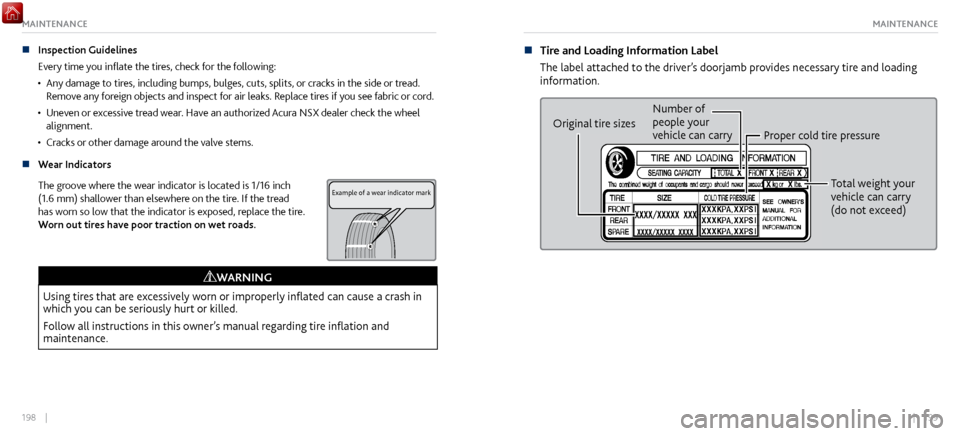
Wear Indicators
The groov
e where the wear indicator is located is 1/16 inch
(1.6 mm) shallower than elsewhere on the tire. If the tread
has worn so low that the indicator is exposed, replace the tire.
Worn out tires have poor traction on wet roads.
Example of a wear indicator mark
Using tires that are excessively worn or improperly inflated can cause a crash in
which you can be seriously hurt or killed.
Follow all instructions in this owner’s manual regarding tire inflation and
maintenance.
WARNING n
Tire and Loading Information Label
The label attached to the
driver’s doorjamb provides necessary tire and loading
information.
Original tire sizes Number of
people your
vehicle can carry
Proper cold tire pressure
Total weight your
vehicle can carry
(do not exceed)
Page 103 of 116

200 || 201
MAINTENANCEMAINTENANCE
n Tire and Wheel Replacement
Replace y
our tires with radials of the same size, load range, speed rating, and maximum
cold tire pressure rating (as shown on the tire’s sidewall). Using tires of a different size or
construction can cause certain vehicle systems to work incorrectly. It is best to replace all
four tires at the same time. If that isn’t possible, replace the front or rear tires in pairs.
If you change or replace a wheel, make sure that the wheel’s specifications match those of
the original wheels. Only use TPMS-specified wheels approved for your vehicle.
Installing improper tires on your vehicle can affect handling and stability.
This can cause a crash in which you can be seriously hurt or killed.
Always use the size and type of tires recommended in the owner’s manual.
WARNING
n Tire Service Life
The life of y
our tires is dependent on many factors, including driving habits, road conditions,
vehicle loading, inflation pressure, maintenance history, speed, and environmental
conditions (even when the tires are not in use).
In addition to regular inspections and inflation pressure maintenance, it is recommended
that you have annual inspections performed once the tires reach five years old. All tires,
including the spare, should be removed from service after 10 years from the date of
manufacture, regardless of their condition or state of wear. n
Winter Tires
If driving on snowy
or frozen roads, mount all season tires marked “M+S”, snow tires, or
tire chains; reduce speed; and maintain sufficient distance between vehicles when driving.
For winter tires, select the size and load ranges that are the same as the original tires, and
mount them to all four wheels.
n
Tire Chains
Tire chains can be used onl
y in conjunction with winter tires. Install tire chains on the rear
tires only.
For 295/30R20 (97V) winter tires: Auto-trac 232405
For 305/30R20 (103W) XL winter tires: K-Summit K-44
Mount chains as tightly as you can, and make sure that they do not touch the brake lines or
suspension.
Using the wrong chains, or not properly installing chains, can damage the brake
lines and cause a crash in which you can be seriously injured or killed.
Follow all instructions in this guide regarding the selection and use of tire chains.
WARNING
Traction devices that are the wrong size or improperly installed can damage your vehicle’s
brake lines, suspension, body, and wheels. Stop driving if they are hitting any part of the
vehicle.
NOTICE
Page 104 of 116

202 || 203
MAINTENANCEMAINTENANCE
Tire Labeling
The tires that came on your vehicle have a number of markings. Those you should be
aware of are described below.
Here is an example of what each marking means:
• P235/60R18 102V
•
P: vehicle type (passenger)
•
235: tire width in millimeters
•
60: aspect ratio (tire section height as a percentage
of its width)
•
R: tire construction code (radial)
•
18: rim diameter in inches
•
102: load index (code indicating maximum load tire can
carry)
•
V: speed symbol (code indicating maximum speed
rating)
Example Tire size
Tire
Identication
Number (TIN)
Ma ximum
ti re load
Maximum
tire pressure
Tire siz e
n Tire Identification Number (TIN)
The tire identification number (TIN) is a gr
oup of
numbers and letters that look like the example shown.
TIN is located on the sidewall of the tire.
DOT B97R FW6X 2209
DOT: This indicates that the tire meets all
requirements of the U.S. Department of
Transportation.
B97R: Manufacturer’s identication mark.
FW 6X: Tire type code.
22 09: Date of manufacture.
Year
Week
n Glossary of Tire Terminology
Cold Tire Pressure – The tire air pressure when the vehicle has been parked for at
least three hours or driven less than 1 mile (1.6 km).
Load Rating – The maximum load that a tire is rated to carry for a given inflation
pressure.
Maximum Inflation Pressure – The maximum tire air pressure that the tire can
hold.
Maximum Load Rating – The load rating for a tire at the maximum permissible
inflation pressure for that tire.
Recommended Inflation Pressure – The cold tire inflation pressure recommended
by the manufacturer.
Treadwear Indicators (TWI) – The projections within the principal grooves
designed to give a visual indication of the degrees of wear of the tread.