tire pressure Acura NSX 2017 Owner's Manual
[x] Cancel search | Manufacturer: ACURA, Model Year: 2017, Model line: NSX, Model: Acura NSX 2017Pages: 473, PDF Size: 16.01 MB
Page 17 of 473
16
Quick Reference Guide
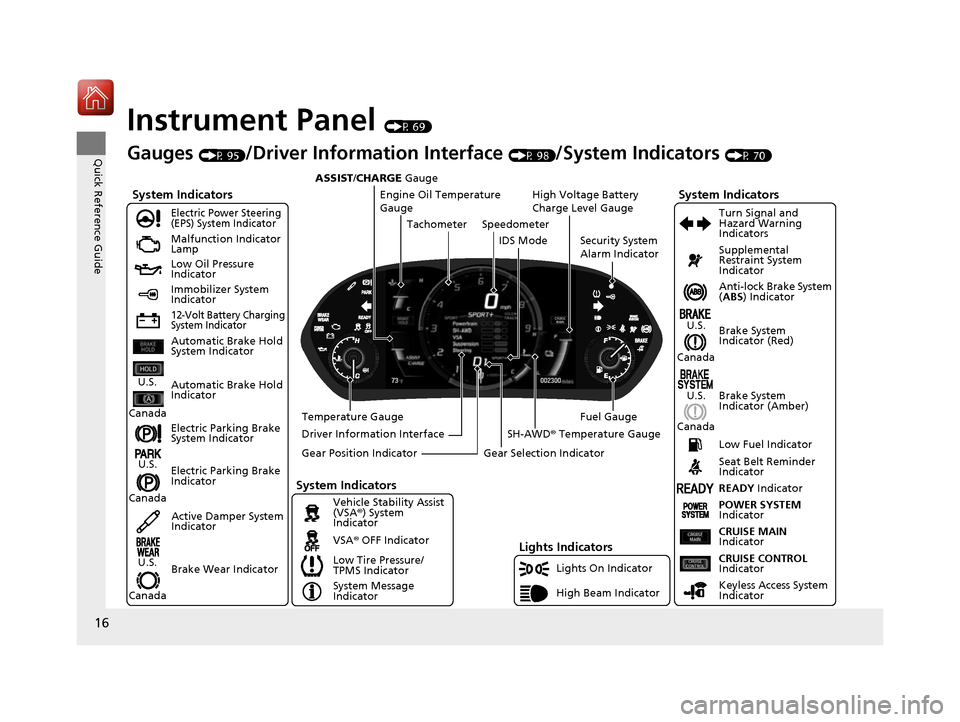
Instrument Panel (P 69)
System Indicators
Malfunction Indicator
Lamp
Low Oil Pressure
Indicator
12-Volt Battery Charging
System Indicator
Anti-lock Brake System
(ABS ) Indicator
Vehicle Stability Assist
(VSA® ) System
Indicator
VSA ® OFF Indicator
Electric Power Steering
(EPS) System Indicator
Lights Indicators
Lights On Indicator
High Beam Indicator
Immobilizer System
Indicator
Seat Belt Reminder
Indicator
System Indicators
System Message
IndicatorBrake System
Indicator (Red) Supplemental
Restraint System
Indicator
Low Fuel Indicator
Gauges (P 95)/Driver Information Interface (P 98)/System Indicators (P 70)
Low Tire Pressure/
TPMS Indicator Turn Signal and
Hazard Warning
Indicators
Keyless Access System
Indicator
High Voltage Battery
Charge Level Gauge
Security System
Alarm Indicator
Fuel Gauge
Tachometer
Driver Information Interface Speedometer
Gear Position Indicator Gear Selection Indicator
Electric Parking Brake
System Indicator
Electric Parking Brake
Indicator Automatic Brake Hold
System Indicator
Brake System
Indicator (Amber)
System Indicators
Automatic Brake Hold
IndicatorU.S.
Canada
U.S.
Canada
U.S.
Canada
U.S.
Canada
READY Indicator
POWER SYSTEM
Indicator
Temperature Gauge ASSIST
/CHARGE Gauge
U.S.
Canada Active Damper System
Indicator
Brake Wear Indicator
CRUISE MAIN
Indicator
CRUISE CONTROL
Indicator
Engine Oil Temperature
Gauge
IDS Mode
SH-AWD ® Temperature Gauge
17 NSX-31T6N6000.book 16 ページ 2016年4月22日 金曜日 午後3時44分
Page 26 of 473
25
Quick Reference Guide
VSA® OFF Button (P 334)
● The Vehicle Stability Assist (VSA® ) system
helps stabilize the vehicle during
cornering, and helps maintain traction
while accelerating on loose or slippery
road surfaces.
● VSA ® comes on automatically every time
you turn on the power system.
Tire Pressure Monitoring
System (TPMS)
(P 339)
● The TPMS monitors tire pressure.
● The TPMS is turned on automatically
every time you turn on the power system.
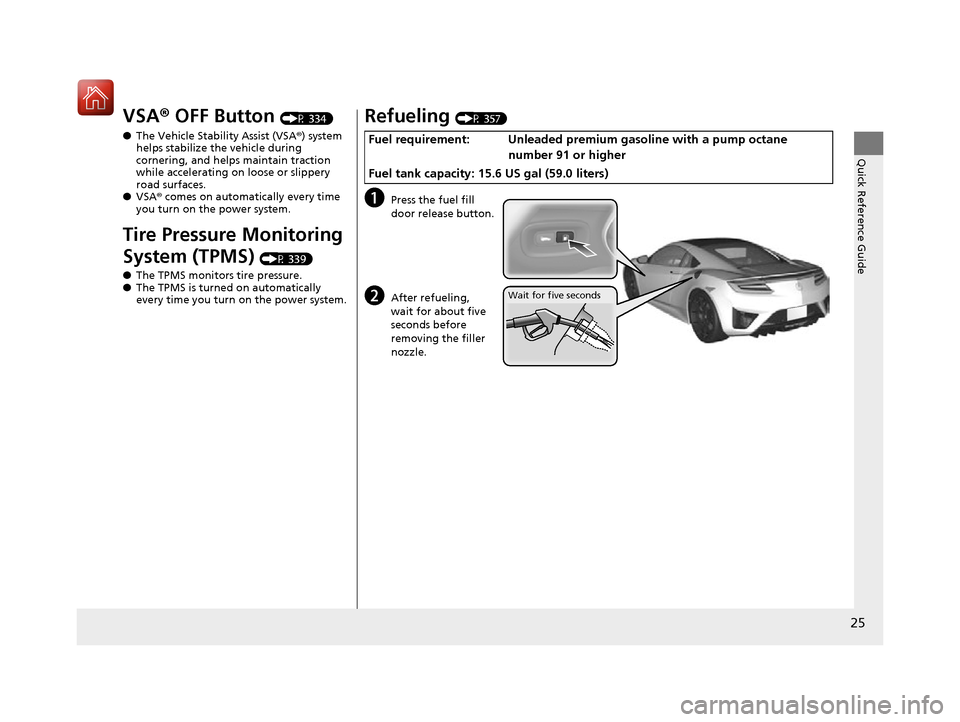
Refueling (P 357)
aPress the fuel fill
door release button.
bAfter refueling,
wait for about five
seconds before
removing the filler
nozzle.
Fuel requirement: Unleaded premiu m gasoline with a pump octane
number 91 or higher
Fuel tank capacity: 15.6 US gal (59.0 liters)
Wait for five seconds
17 NSX-31T6N6000.book 25 ページ 2016年4月22日 金曜日 午後3時44分
Page 27 of 473
26
Quick Reference Guide
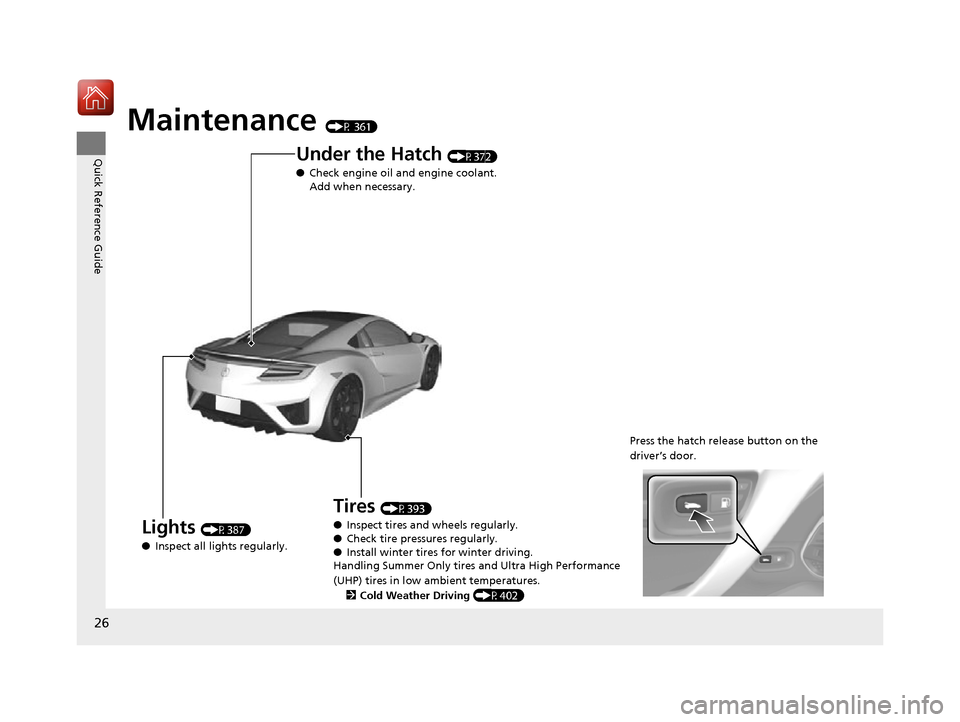
Maintenance (P 361)
Press the hatch release button on the
driver’s door.
Lights (P387)
● Inspect all lights regularly.
Under the Hatch (P372)
● Check engine oil and engine coolant.
Add when necessary.
Tires (P393)
● Inspect tires and wheels regularly.
● Check tire pressures regularly.
● Install winter tires for winter driving.
Handling Summer Only tires and Ultra High Performance
(UHP) tires in low ambient temperatures.
2 Cold Weather Driving (P402)
17 NSX-31T6N6000.book 26 ページ 2016年4月22日 金曜日 午後3時44分
Page 34 of 473
33
uuFor Safe Driving uImportant Safety Precautions
Safe Driving
■Pay appropriate attention to the task of driving safely
Engaging in cell phone conversation or other activities that keep you from paying
close attention to the road, other vehicles, and pedestrians could lead to a crash.
Remember, situations can change quickly, and only you can decide when it is safe to
divert some attention away from driving.
■Control your speed
Excessive speed is a major factor in crash injuries and deaths. Generally, the higher
the speed, the greater the risk, but serious injuries can also occur at lower speeds.
Never drive faster than is safe for current conditions, regardless of the maximum
speed posted.
■Keep your vehicle in safe condition
Having a tire blowout or a mechanical failure can be extremely hazardous.
To reduce the possibility of such problems, check your tire pressures and condition
frequently, and perform all regul arly scheduled maintenance.
17 NSX-31T6N6000.book 33 ページ 2016年4月22日 金曜日 午後3時44分
Page 81 of 473
80
uuIndicators u
Instrument Panel
IndicatorNameOn/BlinkingExplanationMessage
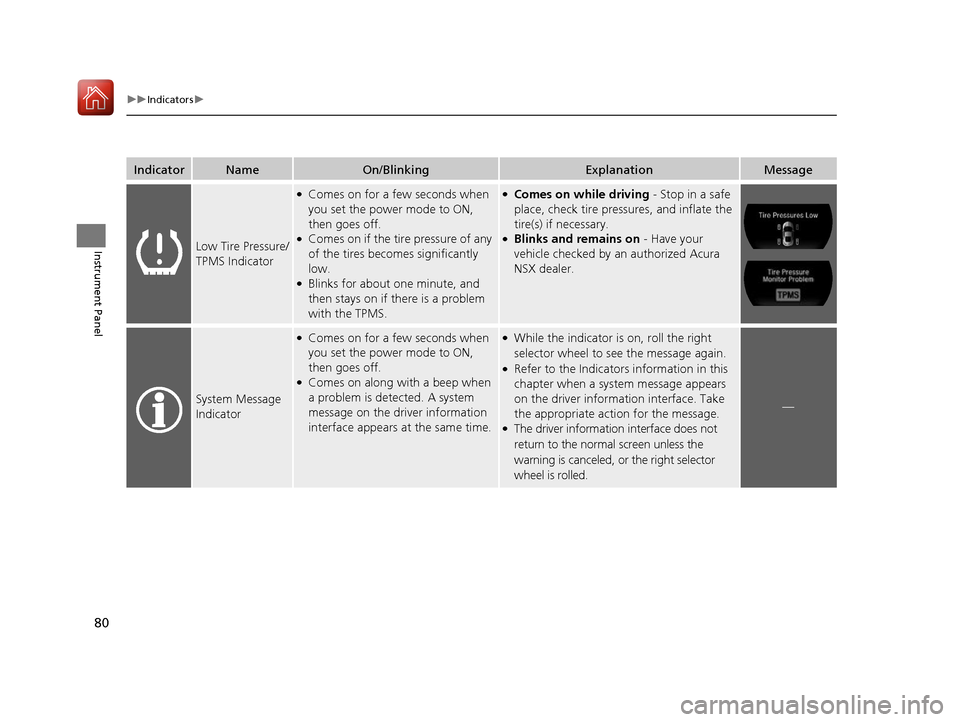
Low Tire Pressure/
TPMS Indicator
●Comes on for a few seconds when
you set the power mode to ON,
then goes off.
●Comes on if the tire pressure of any
of the tires becomes significantly
low.
●Blinks for about one minute, and
then stays on if there is a problem
with the TPMS.
●Comes on while driving - Stop in a safe
place, check tire pre ssures, and inflate the
tire(s) if necessary.
●Blinks and remains on - Have your
vehicle checked by an authorized Acura
NSX dealer.
System Message
Indicator
●Comes on for a few seconds when
you set the power mode to ON,
then goes off.
●Comes on along with a beep when
a problem is detected. A system
message on the driver information
interface appears at the same time.
●While the indicator is on, roll the right
selector wheel to see the message again.
●Refer to the Indicators information in this
chapter when a system message appears
on the driver informa tion interface. Take
the appropriate acti on for the message.
●The driver information interface does not
return to the normal screen unless the
warning is canceled, or the right selector
wheel is rolled.
—
17 NSX-31T6N6000.book 80 ページ 2016年4月22日 金曜日 午後3時44分
Page 99 of 473
98
uuGauges and Displays uDriver Information Interface
Instrument Panel
Driver Information Interface
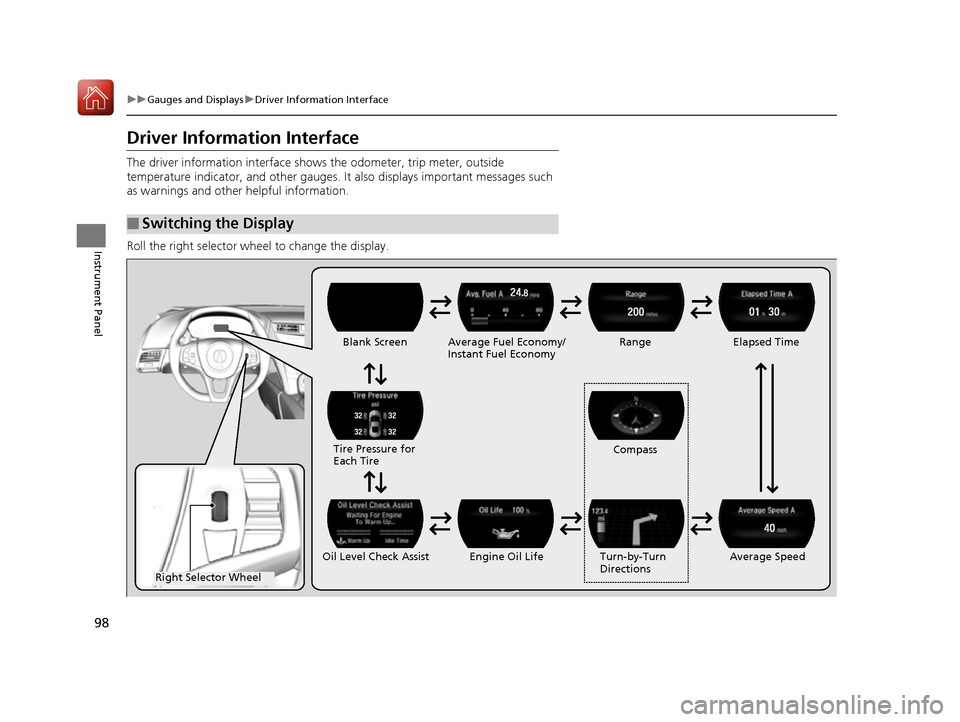
The driver information interface shows the odometer, trip meter, outside
temperature indicator, and other gauges. It also displays important messages such
as warnings and other helpful information.
Roll the right selector wheel to change the display.
■Switching the Display
Right Selector Wheel Engine Oil LifeElapsed Time
Blank Screen
Average Speed
Range
Average Fuel Economy/
Instant Fuel Economy
Tire Pressure for
Each Tire
Turn-by-Turn
Directions
Oil Level Check Assist Compass
17 NSX-31T6N6000.book 98 ページ 2016年4月22日 金曜日 午後3時44分
Page 103 of 473

uuGauges and Displays uDriver Information Interface
102
Instrument Panel
Shows you turn-by-turn driving directions to your destination linked with the
navigation system*.
2 Refer to the Navigation System Manual
Shows the remaining oil life and Maintenance MinderTM.
2Maintenance MinderTM P. 365
Shows the engine oil level check assist display.
2Oil Check P. 377
Shows each tire’s pressure.
2Tire Pressure Monitoring System (TPMS) P. 339
■Turn-by-Turn Directions
■Engine Oil Life
■Oil Level Check Assist
■Tire Pressure Monitor
1Turn-by-Turn Directions
The driver information in terface shows a compass
when the route guidance is not in use.
You can select whether th e turn-by-turn display
comes on or not during the route guidance.
2 Customized Features P. 232
* Not available on all models
17 NSX-31T6N6000.book 102 ページ 2016年4月22日 金曜日 午後3時44分
Page 298 of 473
297
Driving
This chapter discusses driving, refueling, and information on items such as accessories.
Before Driving
Driving Preparation .......................... 298
Maximum Load Limit........................ 301
High-Performance Driving ................ 303
Towing a Trailer Towing Your Vehicle ........................ 308
When Driving Turning on the Power ...................... 309
Precautions While Driving................. 312
Dual Clutch Transmission ................. 313
Shifting ............................................ 314
Integrated Dynamics System (IDS)..... 323
Launch Control ................................ 328 Cruise Control ................................. 330
Vehicle Stabilit
y Assist (VSA®), aka Electronic
Stability Control (ESC), System........... 333
Agile Handling Assist System............ 337
SPORT HYBRID Super Handling-All Wheel DriveTM (SPORT HYBRID SH-AWD®) .... 338
Tire Pressure Monitoring System (TPMS) ...... 339
Tire Pressure Monitoring System (TPMS) - Required Federal Explanation ......... 341
High Voltage Battery ........................ 343
Braking Brake System ................................... 344 Anti-lock Brake System (ABS) ........... 349
Brake Assist System ......................... 350
Parking Your Vehicle When Stopped ................................ 351
Parking Sensor System
*................... 352
Multi-View Rear Camera .................. 356
Refueling Fuel Information .............................. 357
How to Refuel ................................. 358
Fuel Economy and CO
2 Emissions .... 359
Turbo Engine Vehicle ....................... 360
* Not available on all models
17 NSX-31T6N6000.book 297 ページ 2016年4月22日 金曜日 午後3時44分
Page 299 of 473
298
Driving
Before Driving
Driving Preparation
Check the following items before you start driving.
• Make sure there are no obstructions on the windows, door mirrors, exterior
lights, or other parts of the vehicle.
u Remove any frost, snow, or ice.
u Remove any snow on the roof, as this can slip down and obstruct your field of
vision while driving. If frozen solid , remove ice once it has softened.
u When removing ice from around the wheels, be sure not to damage the wheel
or wheel components.
• Make sure the hood is securely closed.
u If the hood opens while driving, your front view will be blocked.
• Make sure the tires are in good condition.
u Check air pressures, and check for damage and excessive wear.
2Checking and Maintaining Tires P. 393
•Make sure there are no people or ob jects behind or around the vehicle.
u There are blind spots from the inside.
• Check the front bumper ducts and side intercooler ducts for mud, leaves, and
road debris that could build up and prevent proper cooling performance.
■Exterior Checks1Exterior Checks
NOTICE
When doors are frozen s hut, use warm water around
the door edges to melt any ice. Do not try to force
them open, as this can damage the rubber trim
around the doors. When done, wipe dry to avoid
further freezing.
Do not pour warm water into the key cylinder.
You will be unable to insert the key if the water
freezes in the hole.
Heat from the engine and exhaust can ignite
flammable materials left und er the hatch, causing a
fire. If you’ve parked y our vehicle for an extended
period, inspect and remove any debris that may have
collected, such as dried grass and leaves that have
fallen or have been carried in for use as a nest by a
small animal.
Also check under the hatch for leftover flammable
materials after you or someone else has performed
maintenance on your vehicle.
17 NSX-31T6N6000.book 298 ページ 2016年4月22日 金曜日 午後3時44分
Page 306 of 473
Continued305
uuBefore Driving uHigh-Performance Driving
Driving
• Burnish the brake pads shortly before high -performance driving so that they have
the performance characteristics necessary to repeatedly and quickly slow the NSX
when it is being operated at signific antly high speeds. (While the NSX’s brake
pads are properly burnished for the demands expected in ordinary day-to-day
driving, high-performance driving puts unique demands on the brake system
which require further burnishing.)
• Inspect ALL cooling openings to confirm th ey are open and free of debris such as
leaves, etc. Cooling openings include engine undercover ducts, heat resistance
ducts, brake ducts, radi ators, and intercoolers
• Remove Tire Repair Kit from the trunk, along with any other cargo area contents
• Check tire wear and tire pressure, and m ake certain wheel lug bolts are properly
torqued, as driving at high speed puts additional strain on tires and wheels. Never
use slick tires, and do not use Summer Only tires and Ultra High Performance tires
if temperatures will be lower than 45°F (7°C)
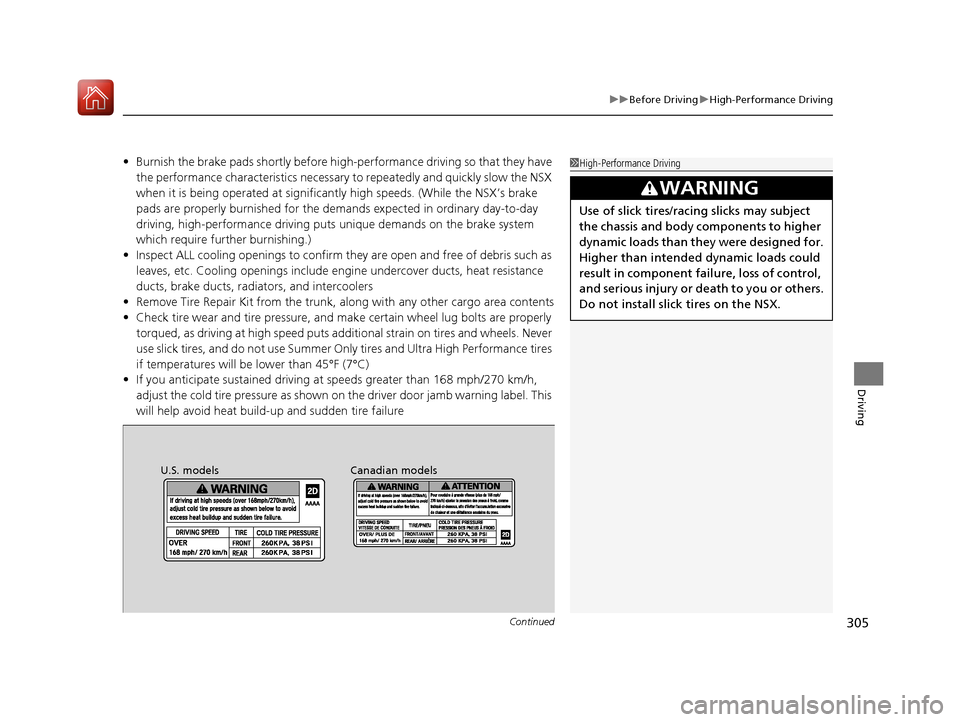
• If you anticipate sustained driving at speeds greater than 168 mph/270 km/h,
adjust the cold tire pressure as shown on the driver door jamb warning label. This
will help avoid heat build-up and sudden tire failure1 High-Performance Driving
3WARNING
Use of slick tires/racing slicks may subject
the chassis and body components to higher
dynamic loads than they were designed for.
Higher than intended dynamic loads could
result in component failu re, loss of control,
and serious injury or death to you or others.
Do not install slick tires on the NSX.
Canadian models
U.S. models
17 NSX-31T6N6000.book 305 ページ 2016年4月22日 金曜日 午後3時44分