tow Acura NSX 2018 User Guide
[x] Cancel search | Manufacturer: ACURA, Model Year: 2018, Model line: NSX, Model: Acura NSX 2018Pages: 489, PDF Size: 27.64 MB
Page 314 of 489
313
uuBefore Driving uMaximum Load Limit
Continued
Driving
Maximum Load Limit
The maximum load for your ve hicle is 507 lbs (230 kg).
The maximum load for the carg o area is 100 lbs (45 kg).
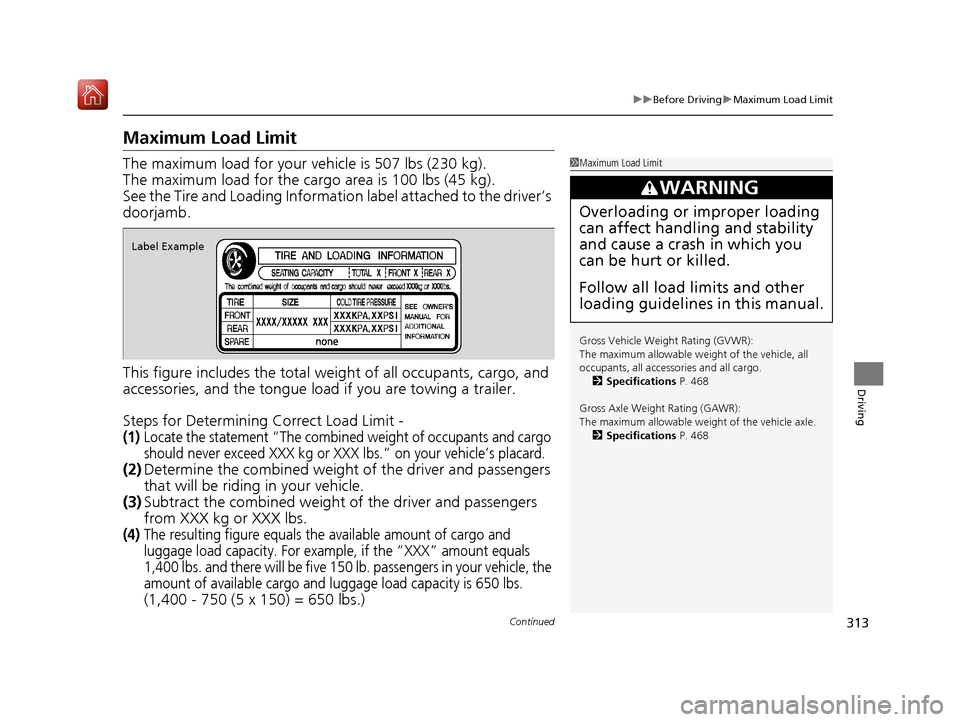
See the Tire and Loading Informatio n label attached to the driver’s
doorjamb.
This figure includes the total weig ht of all occupants, cargo, and
accessories, and the tongue load if you are towing a trailer.
Steps for Determining Correct Load Limit -
(1)Locate the statement “The combined weight of occupants and cargo
should never exceed XXX kg or XXX lbs.” on your vehicle’s placard.
(2)Determine the combined weight of the driver and passengers
that will be riding in your vehicle.
(3) Subtract the combined weight of the driver and passengers
from XXX kg or XXX lbs.
(4)The resulting figure equals the available amount of cargo and
luggage load capacity. For exampl e, if the “XXX” amount equals
1,400 lbs. and there will be five 150 lb. passengers in your vehicle, the
amount of available cargo and luggage load capacity is 650 lbs.
(1,400 - 750 (5 x 150) = 650 lbs.)
1 Maximum Load Limit
Gross Vehicle Weight Rating (GVWR):
The maximum allowable weight of the vehicle, all
occupants, all accesso ries and all cargo.
2 Specifications P. 468
Gross Axle Weight Rating (GAWR):
The maximum allowable weight of the vehicle axle. 2 Specifications P. 468
3WARNING
Overloading or improper loading
can affect handling and stability
and cause a crash in which you
can be hurt or killed.
Follow all load limits and other
loading guidelines in this manual.
Label Example
18 NSX-31T6N6100.book 313 ページ 2017年10月27日 金曜日 午後1時39分
Page 315 of 489
314
uuBefore Driving uMaximum Load Limit
Driving
(5) Determine the combined weight of luggage and cargo being
loaded on the vehicle. That we ight may not safely exceed the
available cargo and luggage load capacity calculated in step 4.
(6) If your vehicle will be towing a tra iler, load from your trailer will
be transferred to your vehicl e. Consult this manual to
determine how this reduces the available cargo and luggage
load capacity of your vehicle.
In addition, the total weight of the vehicle, all occupants,
accessories, cargo, and trailer tongue load must not exceed the
Gross Vehicle Weight Rating (GVW R) or the Gross Axle Weight
Rating (GAWR). Both are on a label on the driver’s doorjamb.
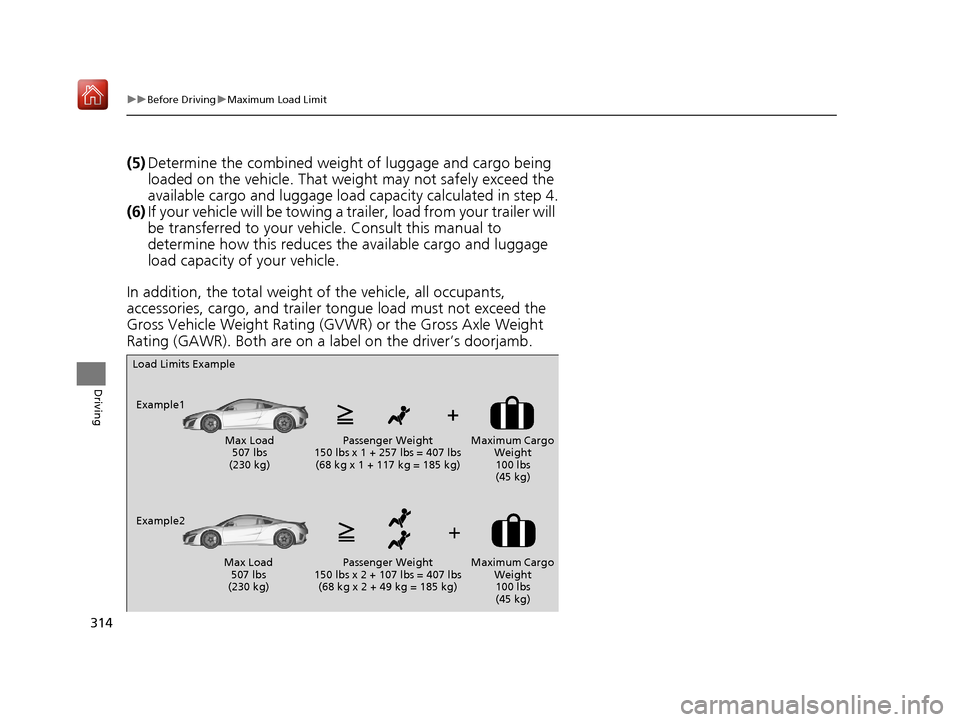
Load Limits Example
Example1 Max Load 507 lbs
(230 kg) Passenger Weight
150 lbs x 1 + 257 lbs = 407 lbs (68 kg x 1 + 117 kg = 185 kg) Maximum Cargo
Weight 100 lbs
(45 kg)
Example2 Max Load 507 lbs
(230 kg) Passenger Weight
150 lbs x 2 + 107 lbs = 407 lbs (68 kg x 2 + 49 kg = 185 kg) Maximum Cargo
Weight 100 lbs
(45 kg)
18 NSX-31T6N6100.book 314 ページ 2017年10月27日 金曜日 午後1時39分
Page 321 of 489
320
Driving
Towing a Trailer
Your vehicle is not designed to tow a trailer. Attempting to do so can void your
warranties.
Towing Your Vehicle
Your vehicle is not designed to be towed behind a motor home. If your vehicle needs
to be towed in an emergency, refer to the emergency towing information.
2Emergency Towing P. 462
18 NSX-31T6N6100.book 320 ページ 2017年10月27日 金曜日 午後1時39分
Page 325 of 489
324
uuWhen Driving uPrecautions While Driving
Driving
Precautions While Driving
Avoid driving in deep water and on flooded roads. This can damage the power
system or driveline, or caus e electrical component failure.
The vehicle is equipped with ultra high pe rformance summer tires that, due to their
decreased tread depth, are at greater risk of hydroplaning on wet roads compared
to regular tires. Exercise caut ion when driving on wet surfaces.
The vehicle is equipped with ultra high performance summer tires. These tires are
designed for optimum performance and handling in warm climates, and are not
suitable for below freezing, snowy or ic y weather conditions. If you drive under
these circumstances, use of winter tire s is recommended and may be mandatory,
depending on your region, province or territory.
2 Winter Tires P. 415
2 Cold Weather Driving P. 416
Due to limitations of the Lithium-ion Hi gh Voltage battery, the minimum starting
temperature for the vehicle is -4°F (-20°C).
Inability to start the vehicle and/or decrease d performance is expected if the vehicle
is operated at temperatures below -4°F (-20°C).
■In Rain
■In Snow and Ice
1 Precautions While Driving
NOTICE
Do not select a shift button while pressing the
accelerator pedal.
NOTICE
The following can damage the under spoiler, under
covers, front bumper, rear diffuser, brake cooling
components, and side sill:
•Parking the vehicle by a parking block•Parallel pa rking along the road shoulder•Driving toward the bottom of a hill•Driving up or down to a different surface level
(such as a road shoulder)
•Driving on a rutted or bumpy road•Driving on a road with potholes•Driving over speed bump
NOTICE
If you repeatedly turn the steering wheel at an
extremely low speed, or hold the steering wheel in
the full left or right position for a while, the electric
power steering (EPS) system heats up. The system
goes into a protective mode, and limits its
performance. The steering wheel becomes harder
and harder to operate. Once the system cools down,
the EPS system is restored.
Repeated operation under these conditions can
eventually damage the system.
If the power mode is set to ACCESSORY while
driving, the power system will shut down and all
steering and brake power a ssist functions will stop,
making it difficult to control the vehicle.
Driving in snow or icy c onditions may accumulate ice
on the brake disk surface, reducing br aking power.
18 NSX-31T6N6100.book 324 ページ 2017年10月27日 金曜日 午後1時39分
Page 378 of 489
377
uuBefore Performing Maintenance uSafety When Performing Maintenance
Maintenance
Safety When Performing Maintenance
Some of the most important safe ty precautions are given here.
However, we cannot warn you of every conceivable hazard that can arise in
performing maintenance. Only you can decide whether you should perform a given
task.
• To reduce the possibility of fire or explos ion, keep cigarettes, sparks, and flames
away from the 12-volt battery, all High Volt age system, and all fuel related parts.
• Never leave rags, towels, or other flam mable objects under the hood and hatch.
u Heat from the engine and exhaust can ignite them, causing a fire.
• To clean parts, use a co mmercially available degreaser or parts cleaner, not
gasoline.
• Wear eye protection and pr otective clothing when working with the 12-volt
battery or compressed air.
• Engine exhaust contains carbon monoxide, which is poisonous and can kill you.
u Only operate the engine if th ere is sufficient ventilation.
• The vehicle must be in a stationary condition.
u Make sure your vehicle is parked on le vel ground, the parking brake is set, and
the power system is turned off.
• Be aware that hot parts can burn you.
u Make sure to let the power system, including the engine and exhaust system,
cool thoroughly before touching vehicle parts.
• Be aware that moving parts can injure you.
u Do not activate the power system unle ss instructed, and keep your hands and
limbs away from moving parts. When the power system is on, the engine can
automatically start, or the radiator fa n may start operating without the engine
running.
■Maintenance Safety
■Vehicle Safety
1 Safety When Performing Maintenance
3WARNING
Improperly maintaining this vehicle or
failing to correct a pr oblem before driving
can cause a crash in which you can be
seriously hurt or killed.
Always follow the inspection and
maintenance recommendations according
to the schedules in this owner’s manual.
3WARNING
Failure to properly follow maintenance
instructions and prec autions can cause you
to be seriously hurt or killed.
Always follow the procedures and
precautions in this owner’s manual.
18 NSX-31T6N6100.book 377 ページ 2017年10月27日 金曜日 午後1時39分
Page 394 of 489
393
uuMaintenance Under the Hood and Hatch uOil Check
Maintenance
8. Open the hatch.
2 Opening the Hatch P. 387
9.Remove the right engine compartment
cover.
2 Engine Compartment Cover P. 389
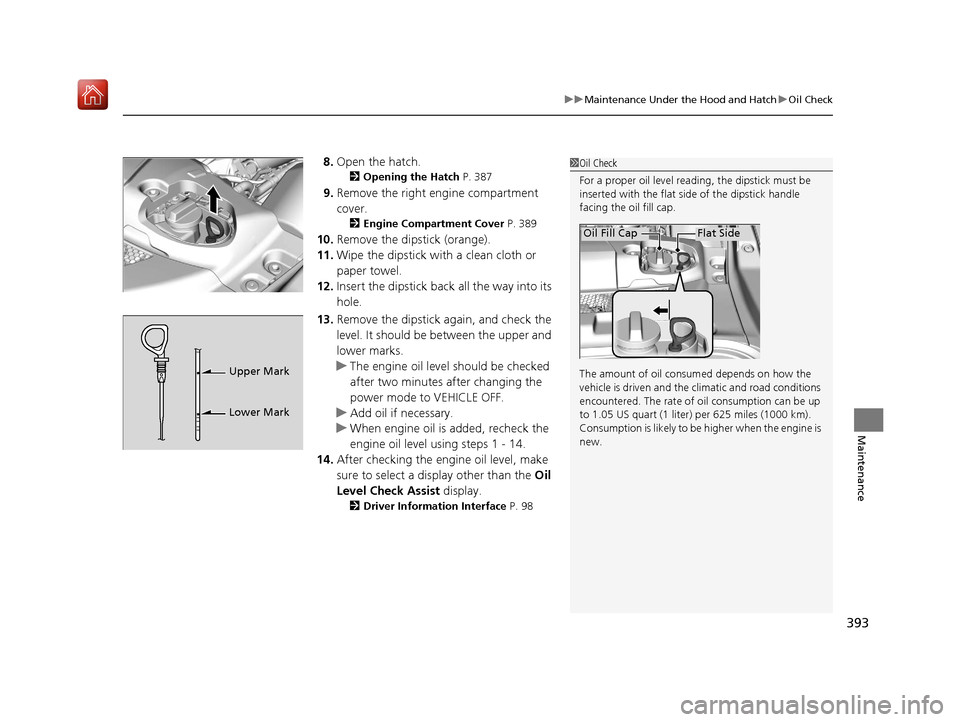
10.Remove the dipstick (orange).
11. Wipe the dipstick with a clean cloth or
paper towel.
12. Insert the dipstick back all the way into its
hole.
13. Remove the dipstick again, and check the
level. It should be between the upper and
lower marks.
u The engine oil level should be checked
after two minutes after changing the
power mode to VEHICLE OFF.
u Add oil if necessary.
u When engine oil is added, recheck the
engine oil level using steps 1 - 14.
14. After checking the engine oil level, make
sure to select a display other than the Oil
Level Check Assist display.
2Driver Information Interface P. 98
1Oil Check
For a proper oil level reading, the dipstick must be
inserted with the flat si de of the dipstick handle
facing the oil fill cap.
The amount of oil consum ed depends on how the
vehicle is driven and the cl imatic and road conditions
encountered. The rate of oil consumption can be up
to 1.05 US quart (1 liter) per 625 miles (1000 km).
Consumption is likely to be higher when the engine is
new.
Oil Fill CapFlat Side
Upper Mark
Lower Mark
18 NSX-31T6N6100.book 393 ページ 2017年10月27日 金曜日 午後1時39分
Page 418 of 489
417
Maintenance
12-Volt Battery
Checking the 12-Volt Battery
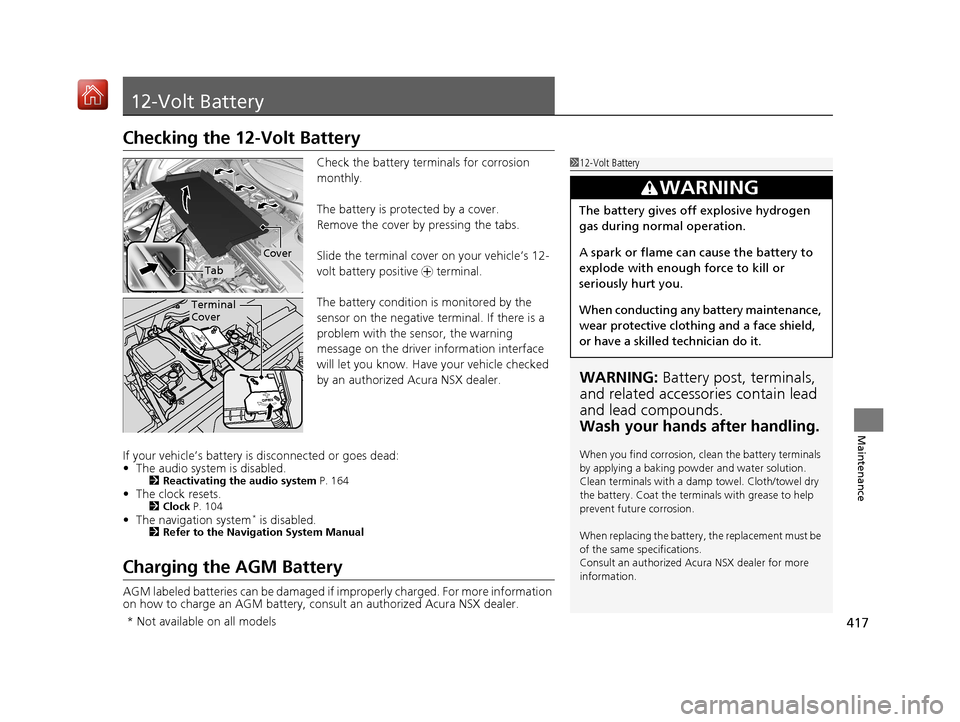
Check the battery terminals for corrosion
monthly.
The battery is protected by a cover.
Remove the cover by pressing the tabs.
Slide the terminal cover on your vehicle’s 12-
volt battery positive + terminal.
The battery condition is monitored by the
sensor on the negative terminal. If there is a
problem with the sensor, the warning
message on the driver information interface
will let you know. Have your vehicle checked
by an authorized Acura NSX dealer.
If your vehicle’s battery is disconnected or goes dead:
• The audio system is disabled.
2 Reactivating the audio system P. 164
•The clock resets.2 Clock P. 104
•The navigation system* is disabled.2 Refer to the Navigation System Manual
Charging the AGM Battery
AGM labeled batteries can be damaged if im properly charged. For more information
on how to charge an AGM battery, cons ult an authorized Acura NSX dealer.
112-Volt Battery
WARNING: Battery post, terminals,
and related accessories contain lead
and lead compounds.
Wash your hands after handling.
When you find corrosion, cl ean the battery terminals
by applying a baking powder and water solution.
Clean terminals with a damp towel. Cloth/towel dry
the battery. Coat the terminals with grease to help
prevent future corrosion.
When replacing the battery, the replacement must be
of the same specifications.
Consult an authorized Acura NSX dealer for more
information.
3WARNING
The battery gives off explosive hydrogen
gas during normal operation.
A spark or flame can cause the battery to
explode with enough force to kill or
seriously hurt you.
When conducting any battery maintenance,
wear protective clothing and a face shield,
or have a skilled technician do it.
Tab
Cover
Terminal
Cover
* Not available on all models
18 NSX-31T6N6100.book 417 ページ 2017年10月27日 金曜日 午後1時39分
Page 429 of 489
428
Maintenance
Storage
Vehicle Storage
If you need to park your vehicle for an extended period (more than one month),
there are several things you should do to prepare it for storage. This helps reduce
possible deterioration of vehicle components and overall condition, which allows
you to get the vehicle back on the road with minimal delay. These are:
• If possible, store your NSX in a garage or enclosed area.
• Fill the fuel tank completely.
• Change the engine oil and filter.
• Wash and dry the exterior completely.
• Clean the interior. Make sure the carpeti ng, floor mats, etc., are completely dry.
• Put the transmission in
(P.
Release the parking brake.
• Leave one window open slightly (if the vehicle is being stored indoors).
• To maintain the low-voltage 12-volt battery, connect it to an accessory battery
charger. For more information on how to maintain your 12-volt battery, consult
an authorized Acura NSX dealer.
2 Checking the 12-Volt Battery P. 417
•If the vehicle is to be stored for a longer period of time, it should be supported on
jack stands to raise the tires off the ground to prevent tire flat spotting.
2Handling of the Jack P. 444
•Support the front wiper blad e arms with a folded towel or rag so they do not
touch the windshield.
• Cover the vehicle with a “breathable” co ver, one made from a porous material
such as cotton. Nonporous materials (suc h as plastic sheeting) may trap moisture,
which can damage the paint.
• If possible, remove the vehicle from th e garage or enclosed area, remove
covering, and periodically run the engi ne until it reaches full operating
temperature (the cooling fa n cycles on and off twice).
Preferably, do this once a month.
18 NSX-31T6N6100.book 428 ページ 2017年10月27日 金曜日 午後1時39分
Page 432 of 489
431
Handling the Unexpected
This chapter explains how to handle unexpected troubles.
ToolsTypes of Tools .................................. 432
If a Tire Goes Flat Temporarily Repairi ng a Flat Tire....... 433
Handling of the Jack ........................ 444
Power System Won’t Start Checking the Procedure ................... 445
If the Keyless Access Remote Battery is Weak ............................................. 446
Emergency Power System Off........... 447
Jump Starting .................................... 448
Overheating How to Handle Overheating ............. 450 Indicator, Coming On/Blinking
If the 12-Volt Battery Charging System Indicator Comes On ....................... 452
If the Malfunction Indicator Lamp Comes On or Blinks ................................... 452
If the Brake System Indicator (Red) Comes On ................................................. 453
If the Electric Power Steering (EPS) System Indicator Comes On ....................... 453
If the Electric Parking Brake System Indicator Comes On ....................... 454 If the Low Tire Pressure/TPMS Indicator
Comes On or Blinks ....................... 455
If the Transmission System Indicator Blinks along with the Warning Message... 456
If the Low Oil Level Symbol Appears.....456Fuses Fuse Locations ................................. 457
Inspecting and Changing Fuses ........ 461
Emergency Towing ........................... 462
When You Cannot Unlock the Fuel Fill Door ................................................. 463
When You Cannot Open the Hatch.....464RefuelingRefueling from a Portable Fuel Container .... 465
18 NSX-31T6N6100.book 431 ページ 2017年10月27日 金曜日 午後1時39分
Page 433 of 489
432
Handling the Unexpected
Tools
Types of Tools
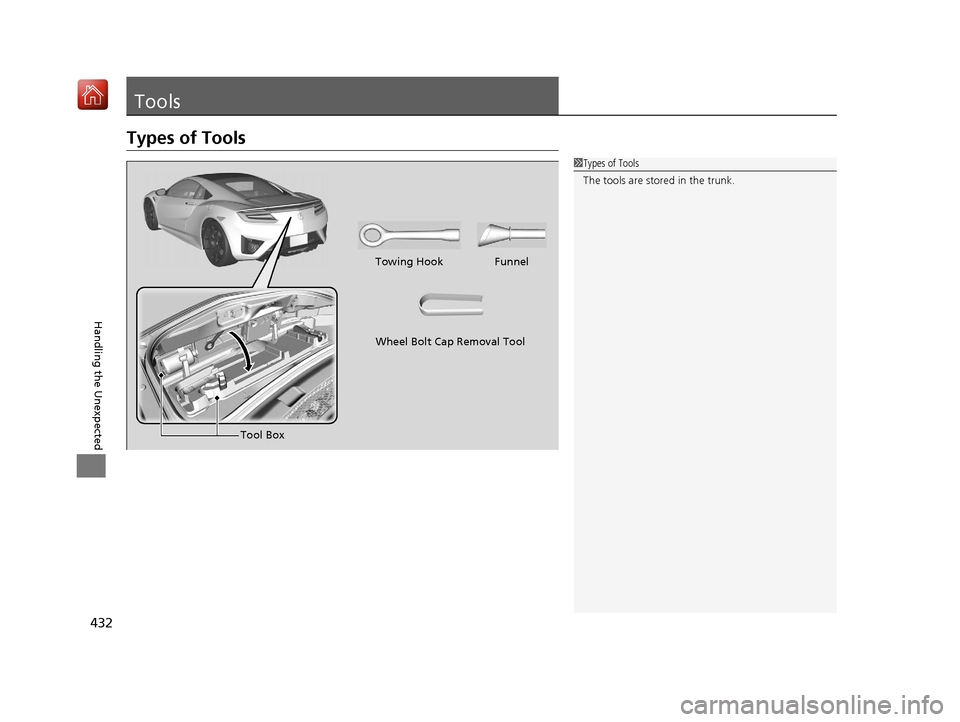
1Types of Tools
The tools are stored in the trunk.
Towing Hook Funnel
Tool Box
Wheel Bolt Cap Removal Tool
18 NSX-31T6N6100.book 432 ページ 2017年10月27日 金曜日 午後1時39分