air condition ACURA NSX 2020 User Guide
[x] Cancel search | Manufacturer: ACURA, Model Year: 2020, Model line: NSX, Model: ACURA NSX 2020Pages: 491, PDF Size: 20.24 MB
Page 312 of 491

310
Driving
Before Driving
Driving Preparation
Check the following items before you start driving.
• Make sure there are no obstructions on the windows, door mirrors, exterior
lights, or other parts of the vehicle.
uRemove any frost, snow, or ice.
uRemove any snow on the roof, as this can slip down and obstruct your field of
vision while driving. If frozen solid , remove ice once it has softened.
uWhen removing ice from around the wheels, be sure not to damage the wheel
or wheel components.
• Make sure the hood is securely closed.
uIf the hood opens while driving, your front view will be blocked.
• Make sure the tires are in good condition.
uCheck air pressures, and check for damage and excessive wear.
2 Checking and Maintaining Tires P. 407
• Make sure there are no people or ob jects behind or around the vehicle.
uThere are blind spots from the inside.
• Check the front bumper ducts and side intercooler ducts for mud, leaves, and
road debris that could build up and prevent proper cooling performance.
■Exterior Checks1Exterior Checks
NOTICE
When doors are frozen s hut, use warm water around
the door edges to melt any ice. Do not try to force
them open, as this can damage the rubber trim
around the doors. When done, wipe dry to avoid further freezing.
Do not pour warm water into the key cylinder.
You will be unable to insert the key if the water
freezes in the hole.
Heat from the engine and exhaust can ignite
flammable materials left und er the hatch, causing a
fire. If you’ve parked y our vehicle for an extended
period, inspect and remove any debris that may have
collected, such as dried grass and leaves that have
fallen or have been carried in for use as a nest by a
small animal.
Also check under the hatch for leftover flammable
materials after you or so meone else has performed
maintenance on your vehicle.
20 ACURA NSX PMC-31T6N6300.book 310 ページ 2019年9月11日 水曜日 午後4時51分
Page 318 of 491

316
uuBefore DrivinguHigh-Performance Driving
Driving
High-performance driving requires special skills, knowledge and experience, as the
safety risks are greatly increased when the NSX is operated at its upper performance
abilities. As a responsible NSX driver, you should not drive above your skill limits or
training, even if the NSX’s performance leve ls would otherwise allow you to do so.
If you intend to engage in high-performa nce driving, Acura strongly recommends
that: • You first obtain appropriate, professional training
• Turn off any devices or systems that may distract you from the driving task
High-performance driving in general, and the use of TRACK mode and Launch
Control in particular, puts very high loads on the NSX and its components, and
results in greater wear and tear on the vehicl e. Because of these high loads, if your
NSX is not in top condition or if certain com ponents, such as the brakes or tires, have
undue wear, those components could experience a loss of performance, or fail,
when engaging in high-performance drivin g. Therefore, Acura highly recommends
that you undertake more proactive and frequent maintenance than that required
under normal use and have your vehicle inspected at an authorized Acura NSX
dealer (and all necessary repairs or adju stments made) before you engage in any
high-performance driving. In addition to any required maintenance, there are
certain NSX specific items and protocols th at you should pay special attention to
before, during and after engaging in any high-performance driving. Ultimately, the
decision whether to engage in high-perfo rmance driving is yours, and depending on
your NSX’s condition and prior usage, the items and protocols listed below may or
may not be sufficient to ensure a safe driving experience.
BEFORE DRIVING •With the vehicle parked on level gro und, properly bleed brake system after
replacing with Acura Heavy Duty Brake Fluid DOT 4 or equivalent
• Inspect brake pad thickness an d replace if 6.0 mm or less
20 ACURA NSX PMC-31T6N6300.book 316 ページ 2019年9月11日 水曜日 午後4時51分
Page 348 of 491

346
uuWhen DrivinguVehicle Stability AssistTM
(VSA ®), aka Electronic Stability Control (ESC), System
Driving
Vehicle Stability Assist TM
(VSA ®), aka Electronic
Stability Control (ESC), System VSA ® helps to stabilize the vehicle during cornering if the vehicle turns more or less
than what was intended. It also assists in maintaining traction on slippery surfaces.
It does so by regulating engine and motor output and selectively applying the brakes.
When VSA® activates, you may notice that the
engine and motor do not respond to the
accelerator. You may also notice some noise
from the hydraulic system . You will also see
the indicator blink.
■VSA ® Operation
1Vehicle Stability Assist TM
(VSA ®), aka Electronic Stability Control
(ESC), System
VSA ® may not function properly if tire type and size
are mixed. Make sure to use the same size and type of tire, and the air pr essures as specified.
2 Tire and Wheel Replacement P. 413
When the VSA ® system indicator comes on and stays
on while driving, there ma y be a problem with the
system. While this may not interfere with normal
driving, have your vehicle checked by an authorized
Acura NSX dealer immediately.
VSA ® cannot enhance stability in all driving situations
and does not control the en tire braking system. You
still need to drive and corner at speeds appropriate
for the conditions and always leave a sufficient
margin of safety.
The main function of the VSA ® system is generally
known as Electronic Stab ility Control (ESC). The
system also includes a traction control function.
VSA® System
Indicator
20 ACURA NSX PMC-31T6N6300.book 346 ページ 2019年9月11日 水曜日 午後4時51分
Page 353 of 491

351
uuWhen DrivinguSPORT HYBRID Super Handling All-Wheel-DriveTM
(SPORT HYBRID SH-AWD ®)
Driving
SPORT HYBRID Super Handling All-Wheel-Drive TM
(SPORT HYBRID SH-AWD ®)
The system controls and transfers varying amounts of motor and/or engine torque
to each wheel in accordance with the driving conditions.
SPORT HYBRID SH-AWD ® helps to enhance driving stability, and lets you handle
situations like slippery surf aces better than when drivi ng with standard two wheel
drive. However, the system does not help to enhance braking. Be cautious about the
following:• It is still your responsibility to drive sa fely when you steer, accelerate, and apply
brakes.
• Leave a sufficient margin when braking on slippery surfaces.1SPORT HYBRID Super Handling All-Wheel-Drive TM
(SPORT
HYBRID SH-AWD ®)
Do not drive through deep water.
The SPORT HYBRID SH-AWD ® system may not
function properly if tire type and size are mixed.
Make sure to use the same size and type of tire, and
the air pressures as specified.
2 Tire and Wheel Replacement P. 413
20 ACURA NSX PMC-31T6N6300.book 351 ページ 2019年9月11日 水曜日 午後4時51分
Page 378 of 491

376
Maintenance
Before Performing Maintenance
Inspection and Maintenance
For your safety, perform all listed inspections and maintenance to keep your vehicle
in good condition. If you become aware of an y abnormality (noise, smell, insufficient
brake fluid, oil residue on the ground, etc .), have your vehicle inspected by an
authorized Acura NSX dealer. (Note, however, that service at an authorized Acura
NSX dealer is not mandatory to keep your wa rranties in effect.) Refer to the separate
maintenance booklet for detailed main tenance and inspection information.
■ Daily inspections
Perform inspections before long distance tri ps, when washing the vehicle, or when
refueling. ■ Periodic inspections
• Check the brake fluid level monthly.
2 Brake Fluid P. 400
• Check the tire pressure monthly. Examin e the tread for wear and foreign objects.
2 Checking and Maintaining Tires P. 407
• Check the operation of the exterior lights monthly.
2 Replacing Light Bulbs P. 401
• Check the condition of the wiper bl ades at least every six months.
2 Checking and Maintaining Wiper Blades P. 404
■Types of Inspection and Maintenance
1Inspection and Maintenance
Maintenance, replacement, or repair of
emissions control devices and systems may be
done by any automotive repair establishment or
individuals using parts that are “certified” to
EPA standards.
According to state and federal regulations, failure to
perform maintenance on the maintenance main
items marked with # will not void your emissions
warranties. However, all ma intenance services should
be performed in accordan ce with the intervals
indicated by the driver information interface.
2 Maintenance Service Items P. 382
If you want to perform complex maintenance tasks
that require more skills a nd tools, you can purchase a
subscription to the Service Express website at
www.techinfo.honda.com .
2 Authorized Manuals P. 477
If you want to perform ma intenance yourself, make
sure that you have the necessary tools and skills first.
After performing maintenanc e, update the records in
the separate maintenance booklet.
U.S. models
20 ACURA NSX PMC-31T6N6300.book 376 ページ 2019年9月11日 水曜日 午後4時51分
Page 379 of 491

377
uuBefore Performing MaintenanceuSafety When Performing Maintenance
Maintenance
Safety When Performing Maintenance
Some of the most important safety precautions are given here. However, we cannot
warn you of every conceivable hazard that can arise in performing maintenance.
Only you can decide whether you should perform a given task. • To reduce the possibility of fire or explos ion, keep cigarettes, sparks, and flames
away from the 12-volt battery, all High Volt age system, and all fuel related parts.
• Never leave rags, towels, or other flammable objects under the hood and hatch.
uHeat from the engine and exhaust can ignite them, causing a fire.
• To clean parts, use a co mmercially available degreas er or parts cleaner, not
gasoline.
• Wear eye protection and protective clothing when working with the 12-volt
battery or compressed air.
• Engine exhaust contains carbon monoxide, which is poisonous and can kill you.
uOnly operate the engine if th ere is sufficient ventilation.
• The vehicle must be in a stationary condition.
uMake sure your vehicle is parked on le vel ground, the parking brake is set, and
the power system is turned off.
• Be aware that hot parts can burn you.
uMake sure to let the power system, including the engine and exhaust system,
cool thoroughly before touching vehicle parts.
• Be aware that moving parts can injure you.
uDo not activate the power system unle ss instructed, and keep your hands and
limbs away from moving parts. When the power system is on, the engine can
automatically start, or the radiator fa n may start operating without the engine
running.
■Maintenance Safety
■Vehicle Safety
1Safety When Performing Maintenance
3WARNING
Improperly maintaining this vehicle or
failing to correct a pr oblem before driving
can cause a crash in which you can be
seriously hurt or killed.
Always follow the inspection and
maintenance recommendations according
to the schedules in this owner’s manual.
3WARNING
Failure to properly follow maintenance
instructions and precautions can cause you
to be seriously hurt or killed.
Always follow the procedures and
precautions in this owner’s manual.
20 ACURA NSX PMC-31T6N6300.book 377 ページ 2019年9月11日 水曜日 午後4時51分
Page 384 of 491
382
uuMaintenance MinderTMuTo Use Maintenance Minder TM
Maintenance
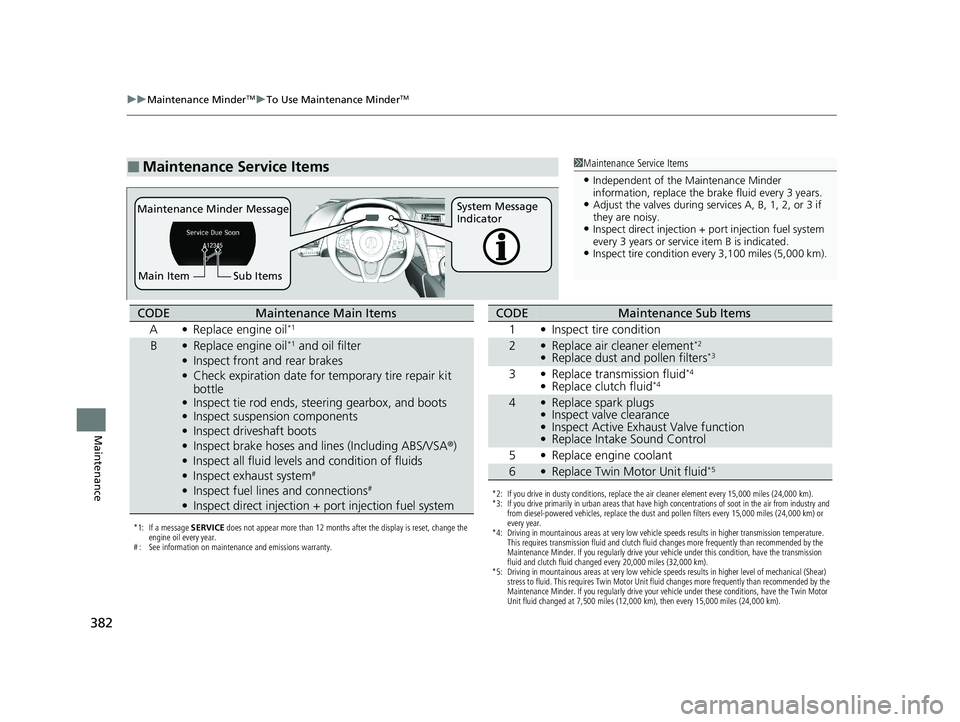
■Maintenance Service Items1Maintenance Service Items
• Independent of the Maintenance Minder
information, replace the brake fluid every 3 years.
• Adjust the valves during services A, B, 1, 2, or 3 if
they are noisy.
• Inspect direct injection + port injection fuel system
every 3 years or service item B is indicated.
• Inspect tire condition ev ery 3,100 miles (5,000 km).
Maintenance Minder Message System Message
Indicator
Main Item Sub Items
*1: If a message SERVICE does not appear more than 12 months after the display is reset, change the
engine oil every year.
# : See information on maintenance and emissions warranty.
CODEMaintenance Main Items
A •Replace engine oil *1
B•
Replace engine oil *1
and oil filter
• Inspect front and rear brakes
• Check expiration date for temporary tire repair kit bottle
• Inspect tie rod ends, steering gearbox, and boots
• Inspect suspension components
• Inspect driveshaft boots
• Inspect brake hoses and li nes (Including ABS/VSA®)
• Inspect all fluid levels and condition of fluids
• Inspect exhaust system #
• Inspect fuel lines and connections #
• Inspect direct injection + port injection fuel system
*2: If you drive in dusty conditions, replace the air cleaner element every 15,000 miles (24,000 km).
*3: If you drive primarily in urban areas that have high concentrations of soot in the air from industry and
from diesel-powered vehicles, replace the dust and pollen filters every 15,000 miles (24,000 km) or every year.
*4: Driving in mountainous areas at very low vehicle speeds results in higher transmission temperature. This requires transmission fluid and clutch fluid changes more frequently than recommended by the
Maintenance Minder. If you regularly drive your vehicle under this condition, have the transmission
fluid and clutch fluid changed every 20,000 miles (32,000 km).
*5: Driving in mountainous areas at very low vehicle speeds results in higher level of mechanical (Shear) stress to fluid. This requires Twin Motor Unit fluid changes more frequently than recommended by the
Maintenance Minder. If you regularly drive your vehicle under these conditions, have the Twin Motor
Unit fluid changed at 7,500 miles (12,000 km), then every 15,000 miles (24,000 km).
CODEMaintenance Sub Items
1 •Inspect tire condition
2•Replace air cleaner element *2
• Replace dust and pollen filters *3
3 •Replace transmission fluid *4
• Replace clutch fluid *4
4•
Replace spark plugs
• Inspect valve clearance
• Inspect Active Exhaust Valve function
• Replace Intake Sound Control
5 •Replace engine coolant
6• Replace Twin Motor Unit fluid *5
20 ACURA NSX PMC-31T6N6300.book 382 ページ 2019年9月11日 水曜日 午後4時51分
Page 409 of 491
407
Maintenance
Checking and Maintaining Tires
Checking Tires
To safely operate your vehicle, your tires must be of the proper type and size, in
good condition with adequate tread, and properly inflated.
■ Inflation guidelines
Properly inflated tires provide the best combination of handling, tread life, and
comfort. Refer to the driver’s doorjamb labe l or specifications page for the specified
pressure.
Underinflated tires wear unev enly, adversely affect handling and fuel economy, and
are more likely to fail from overheating.
Overinflated tires make your vehicle ride ha rshly, are more prone to road hazards,
and wear unevenly.
Every day before you drive, look at each of the tires. If one looks lower than the
others, check the pressure with a tire gauge.
At least once a month or before long trips, use a gauge to measure the pressure in all
tires. Even tires in good condition can lose 1 – 2 psi (10 – 20 kPa, 0.1 – 0.2 kgf/cm2
)
per month.
■ Inspection guidelines
Every time you check inflation, also examine the tires and valve stems. Look for: • Bumps or bulges on the side or in the tread. Replace the tire if you find any cuts,
splits, or cracks in the side of the tire . Replace it if you see fabric or cord.
• Remove any foreign objects and inspect for air leaks.
• Uneven tread wear. Have an authorized Acura NSX dealer check the wheel
alignment.
• Excessive tread wear.
2 Wear Indicators P. 412
• Cracks or other damage around valve stem.
1Checking Tires
Measure the air pressure when tires are cold. This
means the vehicle has been parked for at least three
hours, or driven less than 1 mile (1.6 km). If necessary, add or releas e air until the specified
pressure is reached.
If checked when hot, tire pressure can be as much as 4 – 6 psi (30 – 40 kPa, 0.3 – 0.4 kgf/cm 2
) higher than
if checked when cold.
Have an authorized Acura NSX dealer check the tires
if you feel a consistent vi bration while driving. New
tires and any that have be en removed and reinstalled
should be properly balanced.
3WARNING
Using tires that are excessively worn or
improperly inflated can cause a crash in
which you can be seriously hurt or killed.
Follow all instruction s in this owner’s
manual regarding ti re inflation and
maintenance.
20 ACURA NSX PMC-31T6N6300.book 407 ページ 2019年9月11日 水曜日 午後4時51分
Page 421 of 491
419
Maintenance
Climate Control System Maintenance
Air Conditioning
To ensure proper and safe operation, the Society of Automotive Engineers (SAE
J2845) recommends that the refrigerant sy stem only be serviced by trained and
certified technicians.
Never repair or replace the air conditio ning evaporator (cooling coil) with one
removed from a used or salvaged vehicle.
New replacement mobile air conditioning evaporators must be certified (and
labeled) as meeting SAE Standard J2842.
Dust and Pollen Filters
The climate control system is equipped wi th dust and pollen filters that collect
pollen, dust, and other debris in the air. The Maintenance Minder TM
messages will let
you know when to replace the filters.
We recommend that you replace the dust an d pollen filters sooner when using your
vehicle in areas with high concentrations of dust.
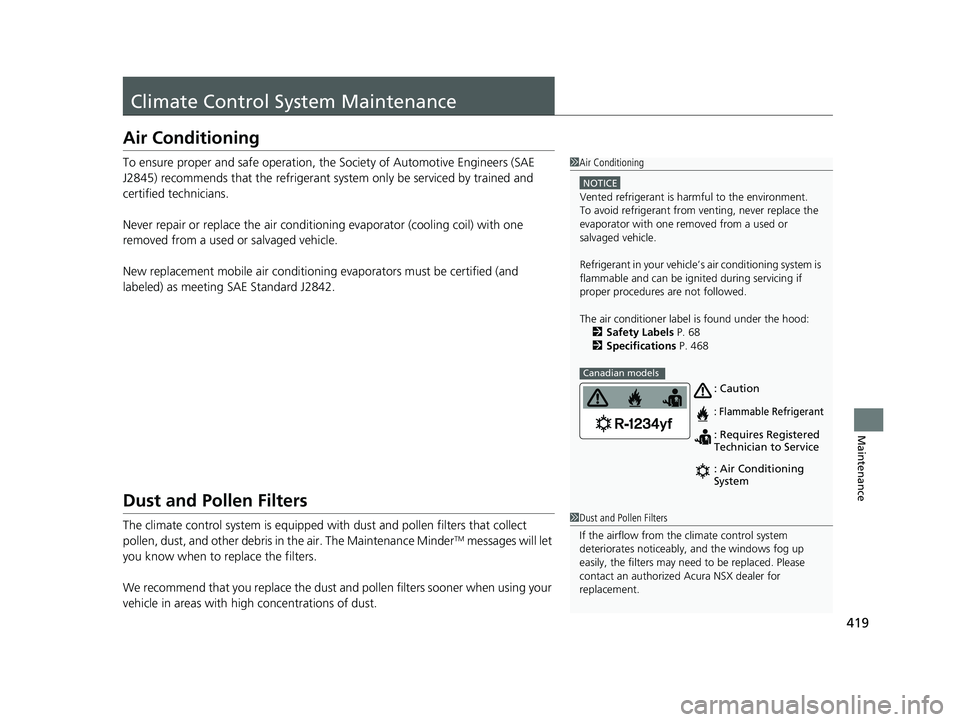
1Air Conditioning
NOTICE
Vented refrigerant is harmful to the environment.
To avoid refrigerant from venting, never replace the
evaporator with one removed from a used or
salvaged vehicle.
Refrigerant in your vehicle’ s air conditioning system is
flammable and can be igni ted during servicing if
proper procedures are not followed.
The air conditioner labe l is found under the hood:
2 Safety Labels P. 68
2 Specifications P. 468
Canadian models
: Caution
: Flammable Refrigerant
: Requires Registered
Technician to Service
: Air Conditioning
System
1Dust and Pollen Filters
If the airflow from the climate control system deteriorates noticeably, and the windows fog up
easily, the filters may need to be replaced. Please
contact an authorized Acura NSX dealer for
replacement.
20 ACURA NSX PMC-31T6N6300.book 419 ページ 2019年9月11日 水曜日 午後4時51分
Page 424 of 491
422
uuCleaninguExterior Care
Maintenance
Exterior Care
Dust off the vehicle body after you drive. Regularly inspect your vehicle for scratches
on painted surfaces. A scratch on a painted surface can result in body rust. If you
find a scratch, promptly repair it.
Wash the vehicle regularly. Wash more frequently when driving in the following
conditions: • If driving on roads with road salt.
• If driving in coastal areas.
• If tar, soot, bird droppings, insects, or tree sap are stuck to painted surfaces.
Do not use an automated car wash. • Keep sufficient distance between the cleaning nozzl e and the vehicle body.
• Take particular care around the windows. St anding too close may cause water to
enter the vehicle interior.
• Do not spray high pressure water directly into the engine compartment. Instead,
use low pressure water and a mild detergent.
■Washing the Vehicle
■Using an Automated Car Wash
■Using High Pressure Cleaners
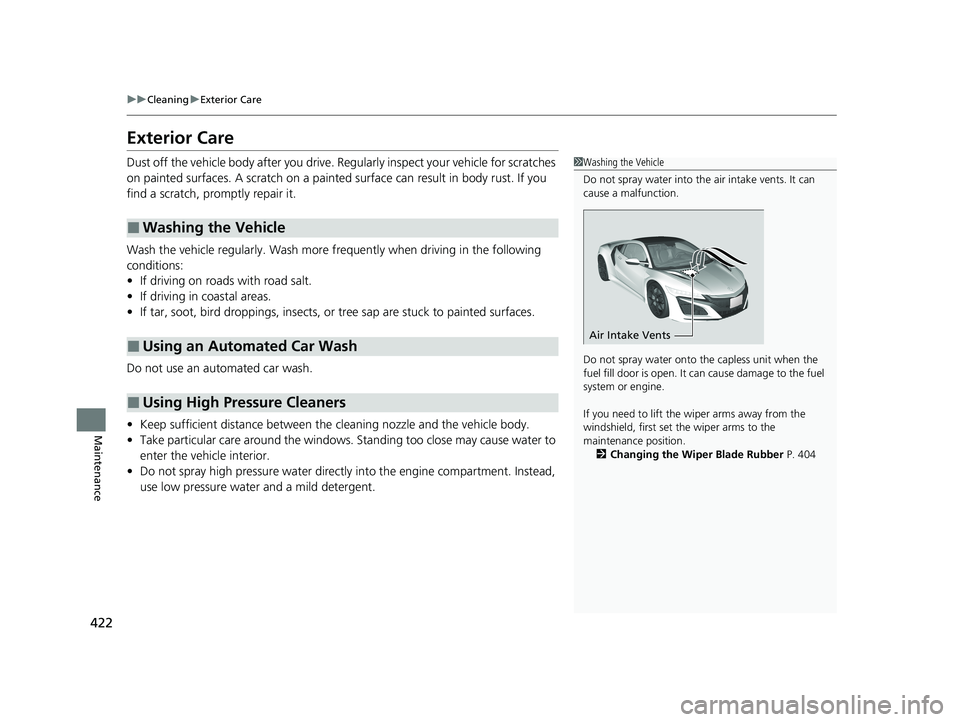
1Washing the Vehicle
Do not spray water into the air intake vents. It can cause a malfunction.
Do not spray water onto the capless unit when the
fuel fill door is open. It ca n cause damage to the fuel
system or engine. If you need to lift the wiper arms away from the
windshield, first set the wiper arms to the
maintenance position.
2 Changing the Wiper Blade Rubber P. 404
Air Intake Vents
20 ACURA NSX PMC-31T6N6300.book 422 ページ 2019年9月11日 水曜日 午後4時51分